
Did you know that as of 2026, approximately one in three Australian women will experience a significant change in hair volume at some point in their lives? If you’re currently searching for how to increase hair density for women, you’ve likely encountered the frustration of spending money on retail products that offer nothing more than temporary, surface-level volume. It’s a deeply personal concern to feel self-conscious about a visible scalp or to find yourself confused by the difference between seasonal shedding and genuine thinning. We understand that this uncertainty is exhausting, and you deserve a strategy rooted in clinical evidence rather than marketing hype.
The path to lasting restoration lies in reactivating the follicles themselves through a structured, professional approach. This guide moves beyond cosmetic camouflage to provide a scientifically-backed, non-surgical roadmap for recovery. We’ll explore the biological causes of follicular miniaturisation and outline the precise protocols used to achieve a visible reduction in scalp show-through. By the end of this article, you’ll have a clear understanding of your specific hair loss type and the systematic steps required to regain both your density and your confidence.
Key Takeaways
- Distinguish between individual hair thickness and follicular density to ensure your restoration strategy addresses the actual biological cause of thinning.
- Identify the signs of follicular miniaturisation, where healthy terminal hairs transition into fine vellus “peach fuzz” before the follicle becomes inactive.
- Learn the clinical protocols for how to increase hair density for women that move beyond ineffective retail serums to target the scalp at a cellular level.
- Utilise professional microscopic analysis rather than a mirror to establish an accurate baseline and monitor your scalp’s genuine recovery progress.
- Understand why a customised, non-surgical programme tailored to your unique diagnostic results is essential for achieving sustainable, long-term results.
Understanding Hair Density vs. Hair Thickness: Why Your Approach Matters
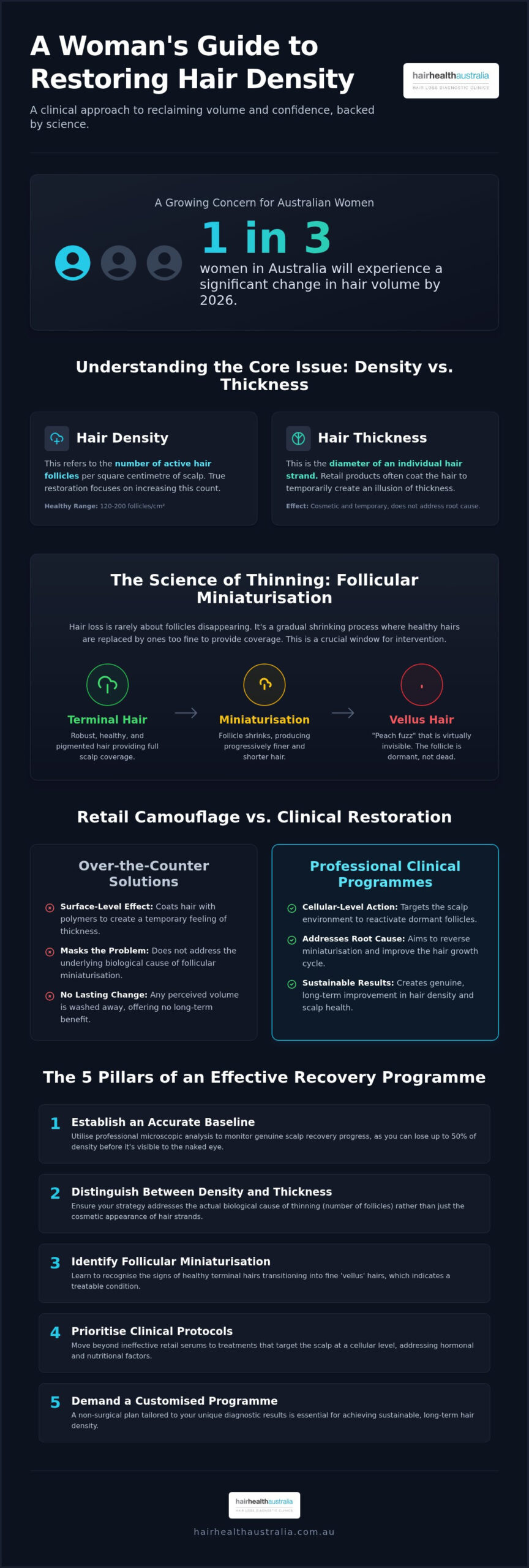
When you start noticing more of your scalp in the mirror, your first instinct might be to reach for a “thickening” shampoo. However, there’s a vital clinical distinction between the diameter of an individual hair strand and the actual number of hairs growing on your head. Hair thickness refers to the width of the hair shaft itself, whereas hair density is defined as the number of active follicles per square centimetre of scalp. If your goal is to learn how to increase hair density for women, you must shift your focus from the hair you can see to the follicles you can’t.
Retail thickening products work by coating the hair with polymers or proteins to temporarily increase the diameter of each strand. While this provides an immediate boost in volume, it does absolutely nothing to address the underlying cause of a sparse scalp. True density restoration requires reactivating dormant follicles and ensuring each one is producing a healthy hair. Clinically, a healthy follicular density for women is generally considered to range between 120 and 200 hairs per square centimetre, depending on age and individual genetic factors.
The Clinical Definition of Follicular Density
Maintaining a high follicular count is a complex biological process influenced by genetics and natural ageing cycles. It’s a common misconception that you can accurately judge your hair health by sight alone. In reality, a woman can lose nearly 50% of her natural density before the thinning becomes obvious to the naked eye. This is why professional diagnostics, such as a Hair Health Check, are essential. They allow us to see beyond the surface and identify follicles that are still active but producing hair so fine it’s practically invisible to the mirror.
Common Causes of Low Hair Density in Australian Women
Living in Australia presents unique challenges for scalp health. Prolonged exposure to high UV levels can cause oxidative stress on the scalp, potentially damaging the delicate follicular environment. Beyond environmental factors, many women experience density drops due to Pattern hair loss, which is often triggered or accelerated by hormonal shifts during menopause or the postpartum period. Additionally, modern Australian lifestyles can sometimes lead to subtle nutritional deficiencies in iron or Vitamin D, both of which are critical for maintaining a robust hair growth cycle. Addressing how to increase hair density for women effectively requires a holistic view that considers these regional and biological factors alongside targeted clinical treatments.
The Science of Follicular Miniaturisation: Why Hair Appears Sparse
To understand how to increase hair density for women, we must first look at the biological process occurring beneath the scalp surface. Sparse hair is rarely the result of follicles simply vanishing. Instead, it is usually caused by a process called follicular miniaturisation. This occurs when the hair follicle gradually shrinks over successive growth cycles. As the follicle diminishes in size, it produces a hair that is shorter, finer, and less pigmented than its predecessor.
The transition typically moves from ‘terminal hair’, which is the robust, healthy hair we are accustomed to, to ‘vellus hair’, often described as peach fuzz. When a follicle reaches the vellus stage, it provides very little visual coverage, leading to the appearance of a thinning scalp. However, it is vital to recognise that a follicle in this state is often ‘dormant’ rather than ‘dead’. While it may appear inactive, the biological machinery remains intact, offering a window of opportunity for clinical intervention.
A primary driver of this process is Dihydrotestosterone (DHT). While often associated with male hair loss, DHT also affects the female scalp, albeit in a different pattern. In women, the sensitivity to androgens typically leads to a diffuse thinning rather than a receding hairline. Research into current perspectives on therapeutic options highlights that addressing this hormonal sensitivity is a cornerstone of modern treatment.
Androgenetic Alopecia and the Female Thinning Pattern
In Australian clinics, we frequently see women concerned about a ‘widening part’ or a general loss of volume across the crown. This is the classic presentation of female androgenetic alopecia. Unlike men, women rarely experience total baldness; instead, they suffer from a significant drop in overall density. Recognising the Early Signs of Alopecia in Women is the first step toward reversing this trend before the follicles become permanently inactive.
The Role of Scalp Micro-circulation
Healthy hair growth depends on a consistent supply of oxygen and nutrients delivered via the blood to the hair bulb. When scalp micro-circulation is compromised, either through inflammation or chronic tension, the follicle begins to starve. This lack of nourishment accelerates the miniaturisation cycle. Clinical treatments focus on restoring this vital blood flow to ‘wake up’ dormant follicles. If you are unsure where your follicles sit in this cycle, a professional microscopic scalp analysis can reveal the true state of your hair health and provide a clear path on how to increase hair density for women through targeted stimulation.
Clinical Treatments vs. Over-the-Counter Solutions: What Delivers Results?
Many women start their search for how to increase hair density for women in the beauty aisle of a local chemist. It’s an understandable starting point, but retail “growth” shampoos and serums rarely deliver on their promises. The fundamental issue is one of contact time and penetration. A shampoo is on the scalp for mere minutes before being rinsed away, which is insufficient for active ingredients to reach the hair bulb and reverse miniaturisation. To achieve genuine results, we must look at a hierarchy of hair restoration that moves from basic cosmetic camouflage to clinical intervention.
While surgical transplants are an option for some, they are often unnecessary and prohibitively expensive for diffuse thinning. Non-surgical clinical programmes represent the “goldilocks” zone for most women. These protocols combine medical-grade topicals with advanced stimulation technologies to revive dormant follicles without the downtime of surgery. A common objection we hear is the desire for “natural” remedies like rosemary oil or basic vitamins. While scalp health is influenced by nutrition, these DIY approaches often fail to address the hormonal and genetic drivers of thinning, leaving the underlying cause of Female pattern baldness completely untreated.
Why Volumising Products Are a Temporary Illusion
Volumising products rely on chemistry rather than biology. They typically use synthetic polymers that wrap around the hair shaft to create a “faux-density” by increasing the diameter of existing hairs. While this helps with styling, it doesn’t help you grow more hair. In fact, if these products aren’t properly clarified, they can leave heavy residues on the scalp. This buildup can lead to inflammation or clogged follicles, which actually stifles the environment needed for healthy growth. There’s a profound difference between looking thick for a day and growing dense for a lifetime.
Evidence-Based Non-Surgical Clinical Therapies
Clinical therapies focus on cellular reactivation. Low-level laser therapy (LLLT), for instance, uses specific wavelengths of light to stimulate ATP production within the hair follicles. This boost in cellular energy can extend the growth phase and encourage miniaturised follicles to produce thicker, more robust terminal hairs. When combined with customised topical formulations that move beyond standard, one-size-fits-all Minoxidil, these treatments offer a systematic path to recovery. For a deeper look at the most effective options available today, refer to our guide on the Best Hair Regrowth Treatment Australia 2026. Achieving medical-grade results requires a shift from surface-level care to follicular-level science.
How to Measure and Monitor Your Hair Density Progress
Relying on your bathroom mirror to track hair regrowth is often a recipe for unnecessary stress. Because hair only grows about one centimetre per month, visual changes occur far too slowly for the naked eye to register on a daily basis. When investigating how to increase hair density for women, the ability to track micro-changes is just as important as the treatment itself. Establishing a baseline through a professional Hair Health Check allows you to move away from guesswork and toward data-driven results.
In the first 90 days of a clinical programme, you shouldn’t expect a full mane of new hair. Instead, look for secondary indicators of success, such as a noticeable reduction in daily shedding or an improvement in scalp comfort and oil balance. Microscopic scans reveal vellus hair growth before it’s visible to the eye. This early detection is vital for maintaining motivation during the initial months of treatment, as it confirms that the follicles are responding to the stimulation protocols long before the results become obvious in photos.
The Professional Microscopic Hair Analysis
High-magnification digital scans are the gold standard for monitoring density. These scans allow us to identify sebum blockages that may be stifling growth and, more importantly, measure the ratio of terminal to vellus hairs in specific areas of the scalp. By tracking this ratio over time, we can verify that miniaturised hairs are successfully transitioning back into thick, healthy terminal hairs. Online scanning tools or apps simply cannot provide the resolution required for this level of diagnostic accuracy. To get an accurate picture of your current follicular state, you can Book a Microscopic Hair Analysis with our Sydney team.
At-Home Indicators and When to Seek Specialist Help
While professional scans are essential for precision, there are reliable ways to monitor your progress at home. The “pony-tail test” is a practical method for women with longer hair; a shrinking circumference when you gather your hair often indicates a drop in density long before you see a widening part. Similarly, monitoring the “see-through” effect under harsh, overhead bathroom lighting can help you identify diffuse thinning. However, the most important indicator is your own psychological threshold. When hair worry starts impacting your daily life or dictates how you style your hair to hide your scalp, it’s time to seek a specialist’s opinion. Understanding how to increase hair density for women starts with acknowledging that early intervention is the most effective way to protect your remaining follicles. Schedule your Hair Health Check today to establish your clinical baseline and begin your recovery journey.
Restoring Density with Hair Health Australia’s Sydney Protocols
At Hair Health Australia, our non-surgical philosophy is built on the premise that every scalp requires a unique biological roadmap. While many women search for how to increase hair density for women through generic online subscriptions or local chemists, these solutions lack the diagnostic precision required to address the root cause of thinning. Our Sydney-based clinic provides a specialised alternative to the general GP experience. Rather than a standard “wait and see” approach, we use microscopic scanning to provide immediate clarity on your follicular health. Within your first 30 minutes at our centre, you’ll move from uncertainty to a clear, data-driven understanding of your hair’s recovery potential.
We’ve been providing clinical expertise in Sydney since 2009, focusing on medical-grade results without the need for invasive surgery. Our team acts as a dedicated guide, replacing hyperbolic marketing with transparency and evidence-based care. We understand that your hair is a significant part of your identity. Because of this, we treat every consultation as a partnership, ensuring you feel fully informed at every stage of the diagnostic process.
Personalised Non-Surgical Regrowth Programmes
We believe in a hybrid approach that combines intensive clinical therapy with structured at-home maintenance. This ensures your follicles receive 24/7 support, which is essential for reversing the miniaturisation cycle effectively. Our programmes focus on sustainability rather than temporary fixes. We aim to create a scalp environment where hair can thrive for years, not just weeks. For a comprehensive breakdown of the latest clinical options, you can explore our Female Hair Loss Treatment Guide. It is about moving beyond surface-level volume to achieve genuine, lasting density.
Starting Your Journey: The Hair Health Check
Your recovery begins with our signature 3-step process. First, we perform a high-magnification scan to assess your current terminal-to-vellus hair ratio. Second, our specialists provide a definitive diagnosis of your specific hair loss type. Finally, we design a customised treatment plan tailored to your unique microscopic results. This methodical approach removes the guesswork and provides a clear roadmap for how to increase hair density for women. It is never too late to intervene. Even if you have struggled with thinning for years, many follicles remain in a dormant state, waiting for the right clinical stimulation to return to a healthy growth cycle. Schedule your Hair Health Check at our Sydney centre and take the first step toward reclaiming your confidence.
Reclaiming Your Confidence Through Clinical Precision
Reversing the visible effects of thinning requires a transition from trial-and-error retail products to a structured clinical protocol. We’ve explored how understanding the difference between strand thickness and follicular density is the first step toward genuine restoration. By identifying the early stages of miniaturisation through professional diagnostics, you can intervene before follicles become permanently inactive. This scientific approach is the most reliable way to understand how to increase hair density for women while avoiding the high costs and risks of surgery.
Since 2009, our Australian owned and operated clinic has provided specialised non-surgical regrowth programmes rooted in precision. We replace uncertainty with clarity through a personalised microscopic diagnosis that reveals exactly what’s happening beneath the scalp surface. You don’t have to navigate this journey alone or settle for temporary illusions of volume. Take the first step toward a fuller future by choosing a partner dedicated to evidence-based recovery. Book your Clinical Hair Health Check in Sydney today to establish your baseline and begin your restoration journey. We’re here to help you move forward with confidence.
Frequently Asked Questions
Is it possible to increase hair density naturally without medication?
Natural methods can improve the quality of your existing hair, but they rarely reactivate dormant follicles on their own. Optimising your scalp hygiene and using gentle massage can increase local blood flow. However, for those looking for how to increase hair density for women after significant thinning, natural efforts are best used as a secondary support to clinical stimulation protocols that address the biological causes of miniaturisation.
How long does it take to see a visible increase in hair density?
You should expect to see the first visible signs of improvement within four to six months of consistent treatment. This timeline is dictated by the natural hair growth cycle. While microscopic changes are detectable within the first 90 days, the new terminal hairs must grow long enough to provide visual coverage. Patience is essential; the biological transition from vellus to terminal hair is a gradual process.
Can menopause cause a permanent drop in hair density for women?
Menopause triggers hormonal shifts that can lead to permanent density loss if the follicles are allowed to miniaturise completely. The drop in oestrogen often allows androgens to have a greater impact on the scalp. While the change is significant, it is not necessarily irreversible in the early stages. Early clinical intervention can often protect these follicles and maintain density before they become permanently inactive.
What is the difference between hair thinning and hair shedding?
Hair shedding, known as telogen effluvium, is the temporary loss of hair from the follicle, often triggered by stress or illness. Hair thinning refers to a reduction in density where the follicles themselves shrink and produce finer hairs. While shedding looks dramatic in the hairbrush, thinning is often more concerning. It indicates a change in the scalp’s long-term ability to produce robust hair.
Are there specific foods that help increase follicular density?
Nutrition provides the building blocks for hair, but it cannot override genetic or hormonal thinning. Ensuring adequate intake of iron, zinc, and high-quality proteins supports the hair bulb’s metabolic needs. In the Australian context, Vitamin D levels are also vital for follicle cycling. While a balanced diet is a necessary foundation, it is rarely a standalone solution for restoring lost density once miniaturisation has begun. Beyond nutrition, maintaining general health through holistic practices can further support the body’s natural systems; for those seeking professional guidance in this area, Dr.Vaishali Nore’s Homeopathy & Wellness Clinic provides natural treatment plans that focus on long-term wellness and internal balance.
Is hair density loss reversible if it’s genetic?
Genetic hair loss is a chronic condition that requires ongoing management rather than a one-time cure. However, the loss of density is often reversible if the follicles are still in the miniaturisation phase. By using targeted clinical therapies, we can often “reboot” these follicles to produce thicker hair again. The goal is to maintain and restore density for as long as the treatment is consistently applied.
What does a clinical hair regrowth programme in Sydney typically involve?
A specialised programme in Sydney involves a structured combination of in-clinic stimulation and prescribed at-home care. It begins with a microscopic analysis to map your scalp’s specific needs. From there, you’ll typically follow a routine of low-level laser therapy and customised topical formulations. Regular clinical reviews ensure the programme is adjusted based on your scalp’s response, providing a systematic path for how to increase hair density for women.
Does stress immediately impact my hair density?
Stress does not impact your hair density immediately. There is typically a three-month delay between a stressful event and the onset of increased shedding or density changes. This is because stress can push a large percentage of follicles into the resting phase prematurely. Once the event passes, the hair usually returns; however, chronic stress can exacerbate underlying thinning patterns if not managed alongside clinical treatments.