
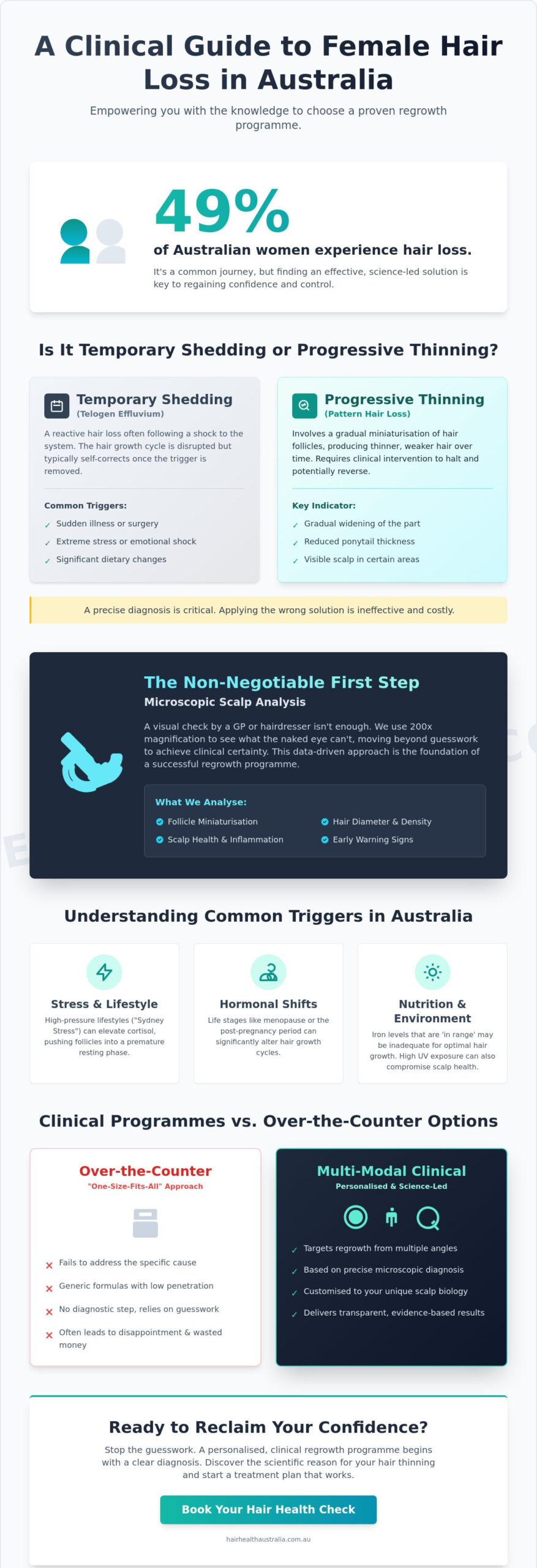
Did you know that approximately 49% of Australian women will experience some form of hair loss in their lifetime? It’s a staggering figure that highlights just how common this journey is, yet the emotional distress and loss of confidence often feel deeply personal and isolating. You’ve likely spent hours filtering through conflicting online “miracle” cures, fearing that you’ll waste more money on products that simply don’t work. Finding a legitimate, evidence-based hair loss treatment for women shouldn’t feel like a gamble or a source of further stress.
We understand that you want more than just a quick fix; you’re looking for restored hair density and a clear, scientific explanation for why your thinning is occurring. This 2026 clinical guide promises to empower you with the knowledge to evaluate professional regrowth programmes effectively. We’ll preview the essential steps for choosing a non-surgical path, including the importance of microscopic scalp analysis and how to establish a manageable daily routine that fits your lifestyle. By the end of this article, you’ll have the clarity needed to move forward with a treatment plan that is both transparent and grounded in proven clinical standards.
Key Takeaways
- Distinguish between temporary shedding and progressive thinning to ensure you aren’t applying the wrong solution to your specific type of hair loss.
- Understand why a diagnostic microscopic scalp analysis is a non-negotiable first step in identifying a successful hair loss treatment for women.
- Learn about the “multi-modal” clinical approach and why it outperforms standard over-the-counter options by targeting regrowth from multiple angles.
- Use our quality checklist to evaluate specialist credentials and ensure your chosen clinic prioritises non-surgical, science-led restoration.
- Discover how to integrate a manageable, professional-grade regrowth programme into your lifestyle without the need for invasive procedures.
Understanding Female Hair Thinning: Why a Personalised Approach Matters
For many Australian women, the mirror tells a story that general medical advice often ignores. Hair thinning isn’t merely a cosmetic concern. It’s a complex physiological shift that impacts over 2.2 million women across the country. While a chemist shelf might offer a generic bottle, these one-size-fits-all solutions frequently fail because they don’t address the specific biology of your scalp. Effective hair loss treatment for women begins by acknowledging that your hair thinning has its own unique fingerprint.
Distinguishing between temporary shedding, known as Telogen Effluvium, and progressive Pattern hair loss is critical. The former often follows a sudden shock to the system, such as illness or extreme stress, while the latter involves a gradual miniaturisation of the hair follicle. Without a precise diagnosis, you risk using products that are either unnecessary or insufficient for the task at hand. You need to know exactly what is happening beneath the surface before you can fix it.
The Australian climate adds another layer of complexity. High UV exposure and our outdoor lifestyle can compromise scalp health, leading to inflammation that hinders regrowth. When you combine these environmental factors with the specific nutritional or hormonal shifts unique to your life, it becomes clear why a personalised clinical approach is the only way to achieve sustainable results. Generic pharmacy foams often fail to penetrate the scalp effectively, leaving you with little more than a sticky residue and a sense of disappointment.
The Psychology of Hair Loss in Women
The link between hair density and self-esteem is profound. In a clinical setting, we see how thinning can trigger a cycle of anxiety that, ironically, may further impact hair health. Shifting your focus from “hiding the problem” with powders or styling tricks to “treating the cause” provides a sense of agency. Seeking professional help early isn’t just about aesthetics. It’s about reclaiming your confidence through scientific clarity and a structured path forward.
Common Triggers: Hormones, Stress, and Nutrition
Life stages like menopause or the post-pregnancy period significantly alter the hair growth cycle. In cities like Sydney, high-pressure lifestyles can lead to “Sydney Stress,” where elevated cortisol levels prematurely push follicles into the resting phase. While a GP might check your iron levels and find them within a “normal” range, those levels may still be inadequate for optimal hair regrowth. This is where a specialised clinical perspective identifies the subtle signs of female pattern thinning that general practice often overlooks. Understanding these triggers is the first step in finding a successful hair fall treatment for ladies that actually delivers on its promise.
The Diagnostic Foundation: Why Microscopic Scanning is Non-Negotiable
A visual inspection at the hair salon or a quick look from your GP often misses the early warning signs of thinning. While well-meaning, the naked eye simply cannot detect the subtle changes occurring at the follicle level. This is why microscopic scanning is the cornerstone of any effective hair loss treatment for women. By using 200x magnification, we can see exactly what is happening to your scalp health and follicle vitality in real-time. It’s the difference between a general guess and a clinical certainty.
The primary indicator we look for is “miniaturisation.” This is the process where a hair follicle shrinks over time, producing thinner, shorter, and more brittle strands until it eventually stops producing hair altogether. Detecting this early is vital. It allows us to intervene before the hair loss becomes visible to those around you. If you’re uncertain whether what you’re experiencing represents the early signs of alopecia in women, a microscopic scan provides the clinical certainty needed to distinguish normal shedding from progressive follicle miniaturisation. Relying on data-driven diagnostics rather than guesswork significantly increases the success rates of clinical regrowth programmes.
What Happens During a Professional Hair Health Check?
During a hair health check, we systematically examine different zones of the scalp to compare density and quality. We measure hair diameter and follicle density to identify patterns that align with modern clinical treatment concepts for FPHL. We also assess for scalp oiliness, inflammation, or debris. These factors often act as silent barriers to growth. By cleaning the “soil” of the scalp, we create a better environment for the “seeds” of the hair follicles to thrive. This methodical approach ensures no stone is left unturned.
Visualising Your Results: The Power of Before and After Data
Digital tracking provides an objective way to measure your progress over months, not just days. It’s one thing to feel like your hair is thicker; it’s quite another to see the hard data on a screen. Seeing your own follicles magnified builds a unique level of trust in the clinical process. It replaces uncertainty with evidence. Microscopic analysis is the gold standard for non-surgical hair loss diagnosis in 2026. If you’re ready to stop guessing about your hair loss treatment for women, you can book a comprehensive scan to see your scalp’s true condition and start a targeted plan.
Comparing Clinical Treatment vs. Over-the-Counter Options
Many women begin their journey at the local chemist, attracted by the convenience of off-the-shelf foams and lotions. While these products are easily accessible, they often lack the sophisticated delivery systems required to penetrate the skin’s natural barrier. Without professional guidance, a generic hair loss treatment for women frequently results in frustration rather than regrowth. A clinical approach prioritises the “multi-modal” advantage, where different therapies are combined to create a synergistic effect that no single bottle can achieve on its own.
The difference between self-medicating and supervised care is significant. When you choose a clinical path, you’re not just buying a product; you’re investing in a monitored process. This ensures that the active ingredients are actually reaching the follicle rather than just sitting on the hair shaft. Professional oversight also provides a safety net, reducing the risk of irritation and ensuring that the treatment remains appropriate for your specific type of thinning as it evolves over time.
The Limitations of Chemist-Bought Solutions
Generic pharmacy products are designed for the average user, meaning their concentrations are often too low to address progressive thinning. There’s also a significant risk of the “dread shed.” This occurs when old, resting hairs fall out to make way for new growth. Without a specialist to explain this biological process, many women panic and stop the treatment prematurely, losing any potential progress. When you factor in the months of wasted time and the cumulative cost of ineffective bottles, “cheap” solutions often prove to be the most expensive path in the long run.
The Clinical Regrowth Framework
Clinical-grade topicals differ from over-the-counter versions in both their purity and their ability to reach the follicle. Success depends heavily on scalp preparation. Just as you wouldn’t plant seeds in compacted, dry earth, you shouldn’t apply treatment to a scalp blocked by debris or oil. A professional hair loss diagnosis and treatment plan includes specific steps to clear the scalp, ensuring maximum absorption of active ingredients. Consistent monitoring by a specialist allows for real-time adjustments, ensuring your programme stays on track as your hair density improves.
Longevity of results is the ultimate goal. Instead of a temporary boost that fades the moment you miss a dose, clinical programmes focus on long-term follicle health. This methodical transition from a “quick fix” to systematic clinical care is what ultimately restores both your hair and your confidence. By choosing a supervised regrowth framework, you’re opting for a sustainable solution grounded in science rather than a gamble on a supermarket shelf. To understand the full spectrum of female hair loss treatment options backed by TGA-regulated medical protocols, exploring what Sydney clinics offer beyond generic products is an essential next step.
How to Choose a Hair Loss Clinic in Sydney: A Quality Checklist
Finding the right provider for a hair loss treatment for women in a city like Sydney requires a discerning eye. The industry is saturated with options, yet not all clinics offer the same level of clinical rigour. Your first step should be evaluating the credentials and specific experience of the hair specialists. Look for a team that prioritises non-surgical restoration. This focus ensures they are deeply invested in the latest therapeutic advancements rather than simply viewing your thinning as a precursor to surgery.
Transparency is another non-negotiable factor. A reputable clinic will provide clear pricing and, perhaps more importantly, realistic expectations for your regrowth. They should be honest about the timeframe involved and the likely outcomes based on your specific type of thinning. Accessibility also plays a practical role. A Sydney-based centre is vital because successful regrowth depends on regular, objective monitoring of your scalp’s response to the programme. It’s much easier to stay committed when your clinical partner is within reach for these essential check-ins.
Red Flags to Avoid in the Hair Industry
Be cautious of any business that makes “miracle” claims or promises 100% regrowth overnight. Biological processes take time, and any claim to the contrary is a significant red flag. You should also be wary of clinics that push surgery as the only viable path without first exploring non-invasive clinical options. Finally, avoid any environment that uses high-pressure sales tactics during an initial consult. A professional clinical setting should feel like a consultation, not a sales pitch. You deserve the space to make an informed decision about your health.
Essential Questions for Your First Consultation
When you sit down for your first appointment, come prepared with questions that test the clinic’s clinical standards. Ask if they use microscopic analysis to track your specific progress, as we’ve established this is the only way to see real change at the follicle level. Enquire whether the programme is tailored to your hormonal profile and what the specific clinical basis is for each therapy they recommend. For a deeper look at your choices, read about Managing Female Hair Thinning: Effective Treatment Options. These answers will tell you if you’re dealing with a dedicated specialist or a generic service provider. If you’re ready to take the first step with a team that values precision, you can consult with a Sydney specialist to discuss your unique needs.
Customised Female Regrowth at Hair Health Australia
At Hair Health Australia, we recognise that the journey toward restored hair density is as emotional as it is clinical. Our commitment to providing a science-led hair loss treatment for women in Sydney is built on a foundation of transparency and systematic care. We don’t just offer services; we act as your dedicated guide, replacing the uncertainty of thinning with the clarity of medical-grade diagnostics. By combining an empathetic understanding of your concerns with modern technology, we ensure your path forward is both manageable and effective.
The “Hair Health Australia difference” lies in our personalised care from day one. We understand that your hair thinning is unique to your biology and lifestyle. Instead of rushing you through a generic process, we take the time to conduct a thorough analysis, ensuring you feel fully informed at every stage. This methodical approach builds a narrative of trust, allowing you to move forward with confidence in the clinical standards we uphold.
Our Non-Surgical Philosophy
We believe the most sustainable results come from stimulating your natural follicles rather than relying on invasive surgical procedures. Our protocols are specifically designed for the unique challenges faced by Australian women, from environmental stressors to hormonal fluctuations. By focusing on the biological health of the scalp, we create the ideal conditions for long-term hair beauty. This science-backed approach ensures that every step we take is verified and individual-centric, moving away from generic fixes toward a programme that respects your biology.
Start Your Regrowth Journey Today
Taking the first step often feels like the most difficult part, but our process is designed to be thorough and reassuring. You can experience this first-hand by exploring a professional Female Scalp Treatment, which serves as a vital component of our regrowth strategy. Our Sydney clinic supports women through every stage of thinning, providing a steady presence from your initial diagnosis through to the implementation of your routine.
If you’re ready to move beyond “miracle” cures and embrace a proven clinical standard, we invite you to book your clinical hair health check at our Sydney centre. This is where your journey toward restored confidence and scientific clarity begins. We’ll provide the tools and understanding you need to take control of your hair loss treatment for women and achieve the density you deserve.
Reclaiming Your Confidence with Clinical Certainty
Choosing the right path for your hair regrowth journey doesn’t have to be a matter of guesswork. As we’ve explored, the foundation of a successful hair loss treatment for women lies in precise diagnostics and a multi-modal clinical approach. By moving away from generic chemist foams and embracing microscopic scalp analysis, you can target the root cause of your thinning with absolute clarity. It’s about replacing confusion with a structured, manageable routine that respects your biology and fits your lifestyle.
At Hair Health Australia, we bring over 15 years of clinical experience to every consultation. Our specialised non-surgical regrowth protocols are designed to deliver realistic results without the need for invasive procedures. Located conveniently in the Sydney CBD, our specialists are ready to act as your dedicated guide in this journey. If you’re ready to stop hiding the problem and start treating the cause, we invite you to Book Your Comprehensive Hair Health Check in Sydney today. You deserve to feel confident in your hair again, and we’re here to help you achieve that density with science-led care.
Frequently Asked Questions
Is hair loss treatment for women different from men?
Yes, hair loss treatment for women is specifically designed to address diffuse thinning, which differs from the localised balding patterns often seen in men. Women’s follicles generally react differently to hormonal shifts and environmental factors. Consequently, a clinical approach for women uses different concentrations of active ingredients and delivery methods to ensure the treatment is both safe and effective for the female scalp.
How long does it take to see results from a clinical programme?
You should expect to see the first signs of progress within three to six months of starting a clinical programme. The biological hair growth cycle is a slow process that cannot be rushed. Initial results often manifest as a reduction in daily shedding, followed by a gradual increase in hair diameter and density as the follicles transition back into the active growth phase.
Can I regrow hair if my scalp is already visible?
Regrowth is often possible even if the scalp has become visible, provided the hair follicles haven’t completely closed. We look for signs of miniaturisation, where follicles are still producing fine, downy hairs. By intervening with a targeted hair loss treatment for women, we can often revitalise these follicles to produce thicker, more robust strands that improve overall scalp coverage and density.
Are there any side effects to non-surgical hair treatments?
Side effects from non-surgical treatments are generally mild and infrequent when managed under professional clinical supervision. Some individuals might experience temporary scalp dryness or minor irritation as their skin adjusts to the active ingredients. Because we monitor your progress closely, we can adjust your protocol in real-time to ensure the treatment remains comfortable and effective for your specific scalp type.
How much does a professional hair loss consultation in Sydney cost?
The fee for a professional hair loss consultation in Sydney varies based on the diagnostic services included, such as microscopic scanning or a detailed health history review. Each clinic sets its own pricing based on the expertise of the specialists and the technology used. We recommend contacting your chosen centre directly to discuss their consultation process and any associated costs before booking your appointment.
Can stress really cause permanent hair loss in women?
Stress typically causes a temporary condition known as Telogen Effluvium, which isn’t permanent. This occurs when a shock to the system pushes a large number of follicles into the resting phase simultaneously. However, if you have an underlying genetic predisposition to thinning, chronic stress can accelerate that process. Identifying the specific trigger through a professional check is the best way to ensure recovery.
Will I need to continue treatment forever to keep my results?
Maintenance is usually necessary to preserve the results achieved during the intensive phase of a programme. For progressive conditions, stopping treatment entirely may allow the follicles to return to their previous state of thinning over time. Most women find that once they reach their desired density, they can move to a simplified, less frequent routine that fits easily into their long-term self-care habits.
Is female pattern baldness hereditary?
Yes, female pattern thinning is frequently a hereditary condition. It’s a common misconception that this trait only comes from the maternal side; it can actually be inherited from either parent. This genetic predisposition makes your hair follicles more sensitive to certain hormones, leading to the gradual miniaturisation process that results in visible thinning over several years or decades. For a comprehensive overview of the most effective clinical options available in Sydney, our hair fall treatment for ladies 2026 resource guide provides the data-driven guidance you need to make an informed decision.