Could the “miracle” shampoo currently sitting in your shower actually be preventing you from seeing real results? Many Australians facing visible scalp patches or finding clumps of hair in the drain spend hundreds of dollars on retail products that only treat the surface. It’s exhausting to deal with the uncertainty of why your hair feels fragile, especially when you’re searching for how to stop hair breakage and thinning but finding only temporary fixes. You want a solution that addresses the root cause rather than just masking the symptoms.
Understanding the path to restoration requires moving beyond generic marketing and into the realm of clinical science. You deserve a clear diagnosis that distinguishes between simple mechanical snapping and complex biological thinning. This guide provides a professional roadmap to help you restore your hair density without the need for invasive surgery. We will examine the diagnostic steps used in clinical settings, including the role of microscopic hair analysis, and outline a systematic, non-surgical approach to stop further loss. By the end of this article, you’ll have the clarity needed to move forward with confidence and a plan tailored to your specific hair health needs.
Key Takeaways
- Learn how to distinguish between physical shaft damage and follicle decline to ensure your treatment targets the correct biological issue.
- Discover why most retail shampoos fail to provide lasting results and the clinical steps for how to stop hair breakage and thinning.
- Identify how internal triggers and the harsh Australian climate impact your hair health and what you can do to reverse the damage.
- Understand the role of non-invasive microscopic hair analysis in providing a precise diagnosis of your scalp and follicle health.
- Explore proven non-surgical regrowth programmes designed to stimulate dormant follicles and restore hair density without the need for surgery.
Hair Breakage vs. Thinning: Recognising the Difference
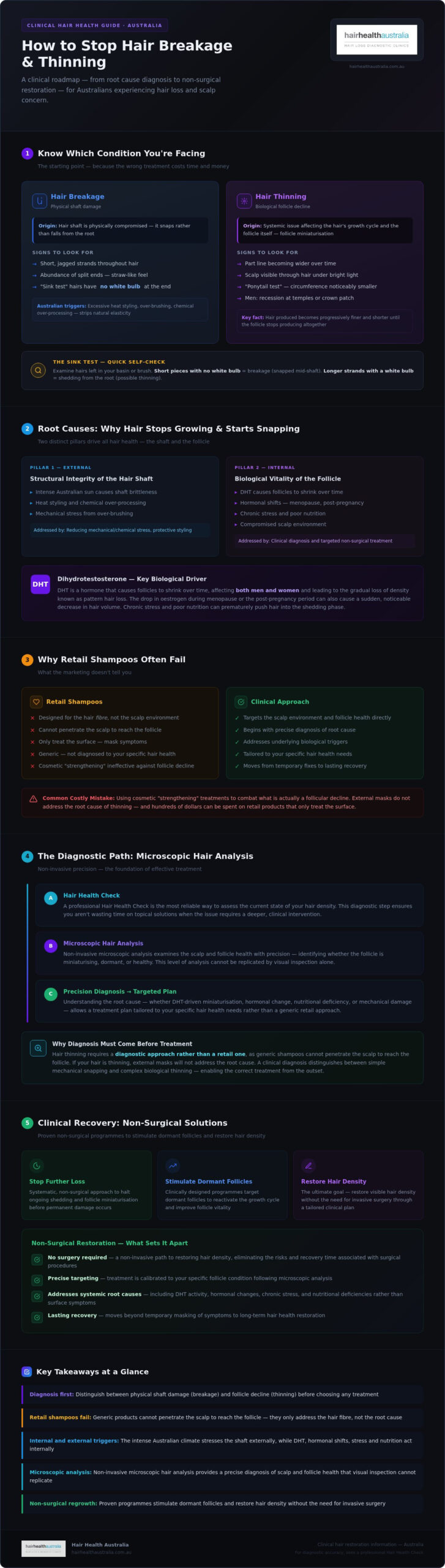
To effectively address concerns about how to stop hair breakage and thinning, you must first identify which issue you’re actually facing. While both conditions result in a loss of hair volume, their biological origins are fundamentally different. Breakage occurs when the hair shaft is physically compromised, leading to snapping. Thinning, however, is a systemic issue affecting the hair’s growth cycle and the follicle itself. Understanding this distinction is the essential first step in choosing a clinical path that actually works for your specific situation.
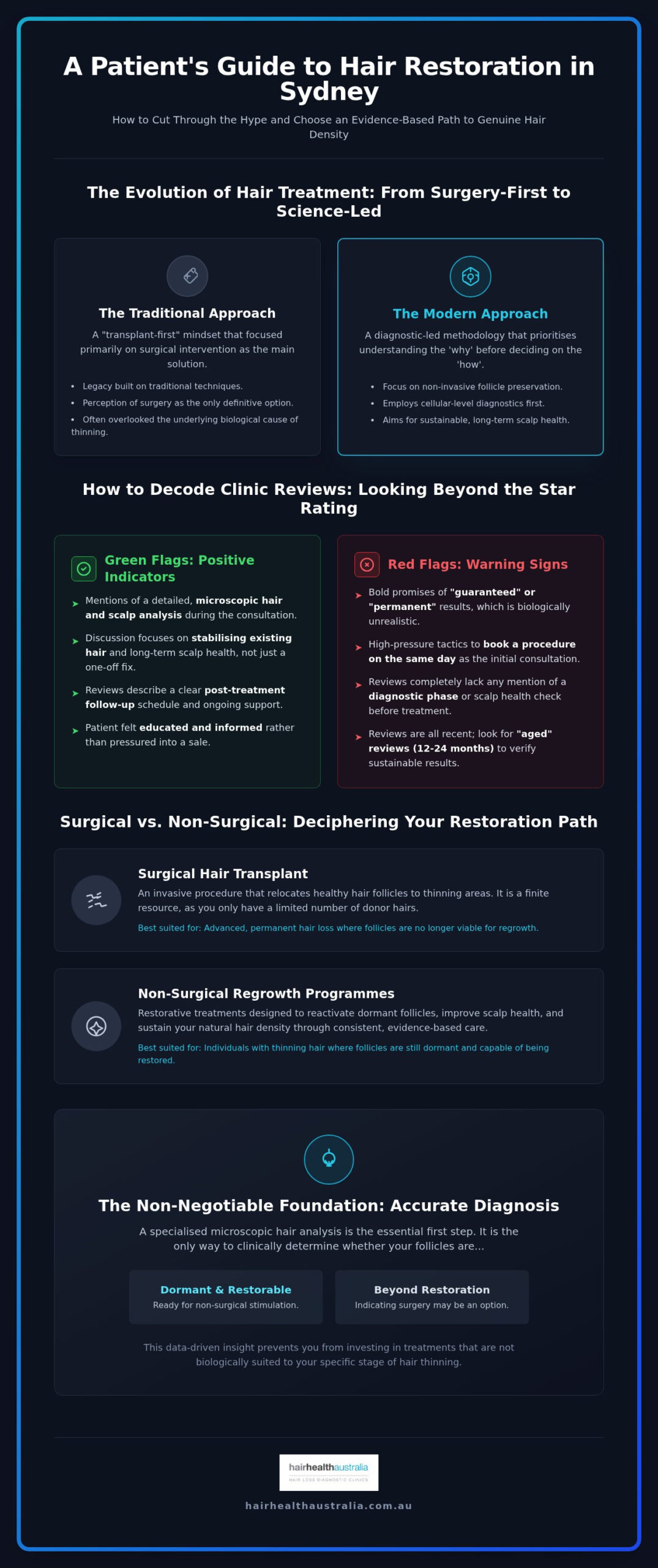
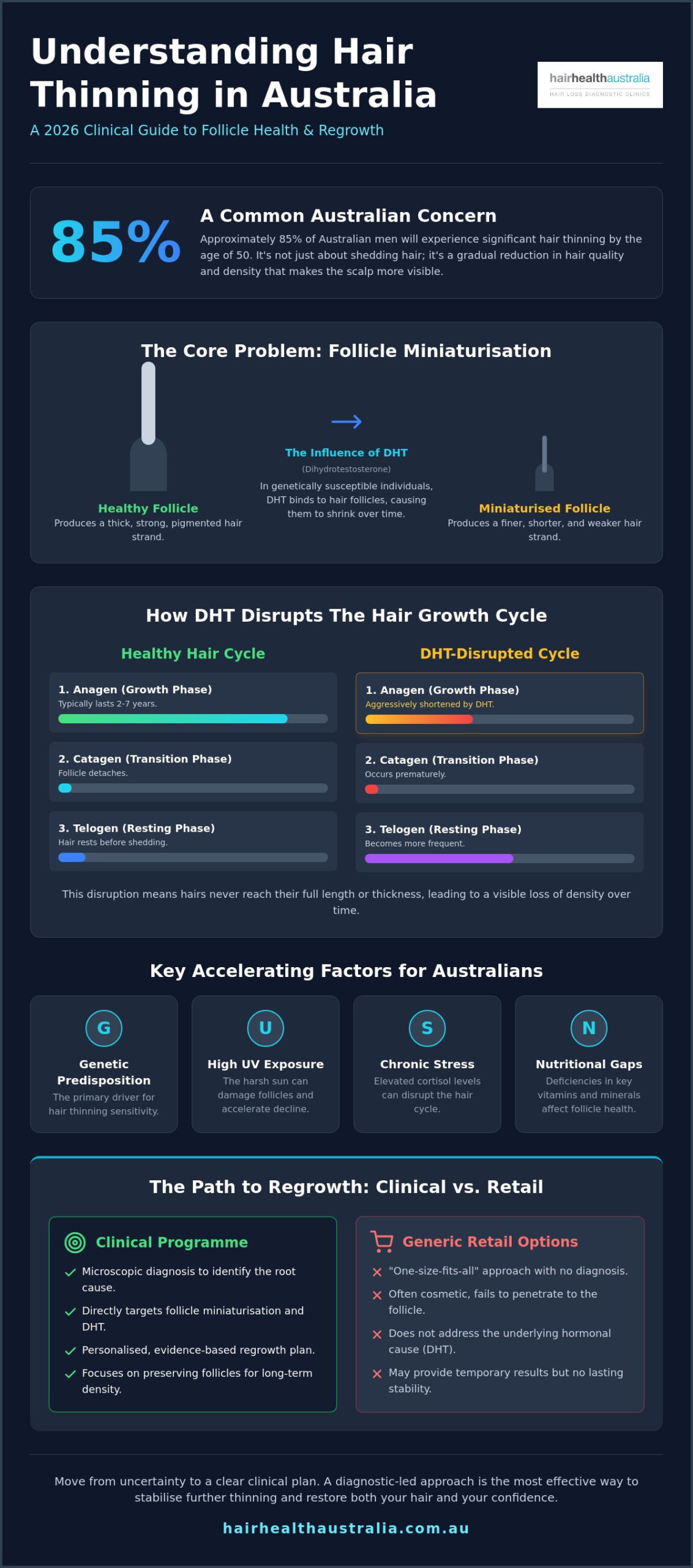
A frequent and expensive error involves using cosmetic “strengthening” treatments to combat what is actually a follicular decline. These products are designed for the hair fibre, not the scalp environment. If your hair is thinning, external masks will not address the root cause. Hair thinning is a biological process of follicle miniaturisation. During this process, the hair produced becomes progressively finer and shorter until the follicle eventually stops producing hair altogether. This complex nature of hair loss and thinning requires a diagnostic approach rather than a retail one, as generic shampoos cannot penetrate the scalp to reach the follicle.
Signs Your Hair is Breaking
Breakage is often the result of mechanical or chemical stress. You might notice short, jagged strands throughout your hair or an abundance of split ends that make the hair feel straw-like. A reliable way to check is the “sink test.” Examine the hairs left in your basin or brush; if they’re short pieces without a small white bulb at the end, they’ve snapped mid-shaft. Common triggers in the Australian lifestyle include excessive heat styling, over-brushing, and chemical over-processing, which strip the hair of its natural elasticity. To combat this, you can discover Hair Bar NYC and their range of advanced keratin treatments designed to restore strength and shine to damaged strands. Learning how to stop hair breakage and thinning begins with identifying these structural weaknesses before they lead to permanent damage.
Signs Your Hair is Thinning
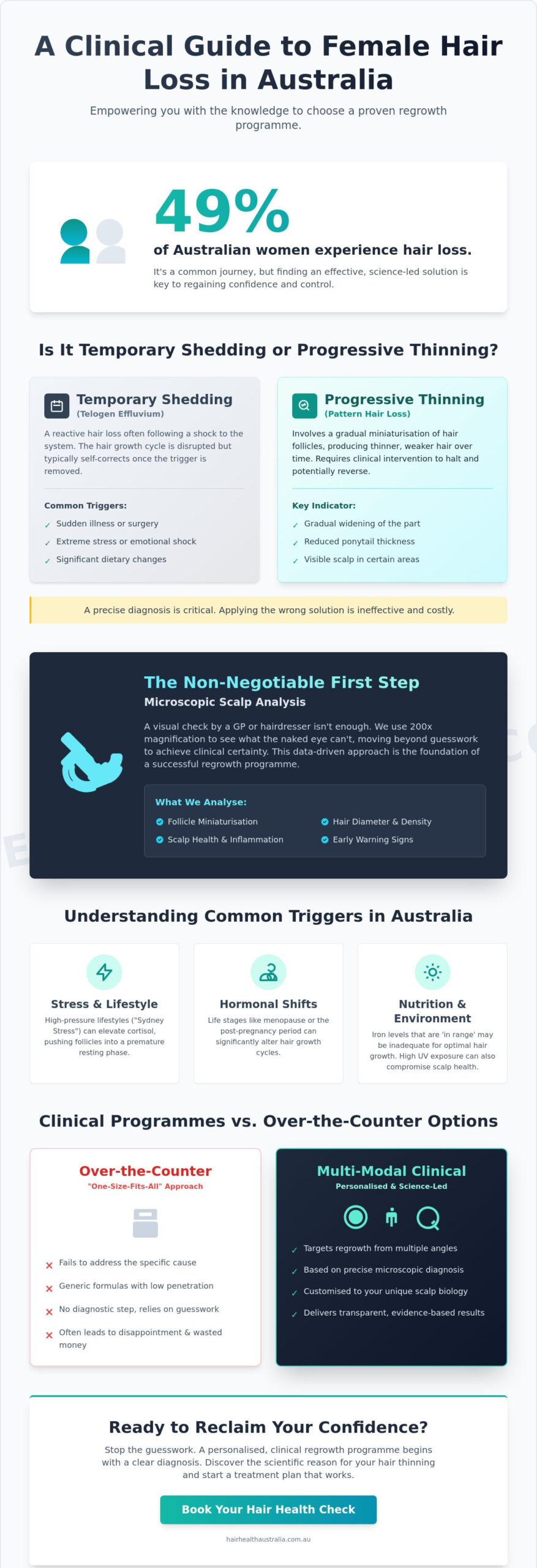
Thinning is typically a more subtle, progressive condition. Instead of seeing broken shards of hair, you’ll likely notice your part line becoming wider or your scalp becoming more visible through the hair under bright bathroom lights. Many women first notice this through the “ponytail test,” where the overall circumference of their hair feels significantly smaller than it did previously. For men, thinning usually presents as a gradual recession at the temples or a thinning patch at the crown. Because these changes happen deep within the scalp, a professional Hair Health Check is the most reliable way to assess the current state of your hair density. This diagnostic step ensures you aren’t wasting time on topical solutions when the issue requires a deeper, clinical intervention.
The Root Causes: Why Hair Stops Growing and Starts Snapping
The search for how to stop hair breakage and thinning often leads people to invest in topical oils and conditioners, yet these products only address one side of the equation. True hair health is built on two distinct pillars: the structural integrity of the hair shaft and the biological vitality of the follicle. While environmental stressors like the intense Australian sun cause the shaft to become brittle and snap, internal biological triggers can shut down the growth cycle entirely. Identifying which of these forces is at play is the only way to move from temporary fixes to lasting recovery.
Follicular health serves as the foundation for all growth. If the scalp environment is compromised or the follicle is miniaturising, no amount of external conditioning can restore lost density. Understanding the primary hair loss causes according to dermatologists is vital to creating a plan that actually yields results. Factors such as chronic stress and poor nutrition can prematurely push hair into the shedding phase, making it impossible to maintain a full head of hair without addressing these underlying systemic issues.
Biological Triggers for Thinning
For many Australians, thinning is driven by Dihydrotestosterone (DHT), a hormone that causes follicles to shrink over time. This process affects both men and women, leading to the gradual loss of density known as pattern hair loss. Hormonal shifts also play a significant role; for example, the drop in oestrogen during menopause or the post-pregnancy period can lead to a sudden, noticeable decrease in hair volume. To gain a deeper understanding of these specific indicators, you can read about the Early Signs of Alopecia in Women and how they differ from standard breakage.
Environmental and Lifestyle Factors
External factors are the primary drivers of hair snapping. In Australia, high UV exposure strips the hair of its natural protective lipids, while the minerals found in hard water can build up on the shaft, making it stiff and porous. Chemical damage from over-processing or poor-quality dyes further weakens the hair’s protein structure. Nutrition is equally non-negotiable; deficiencies in iron or biotin mean the body lacks the essential building blocks for resilient hair. When you understand how to stop hair breakage and thinning through both internal support and external protection, you can finally break the cycle of damage. If you’re struggling to identify your specific triggers, a professional Hair Health Check can provide the diagnostic clarity required to start your recovery.
The Limits of Retail Solutions: Why Shampoos Often Fail
When searching for how to stop hair breakage and thinning, it’s easy to be swayed by marketing that promises instant results through a simple wash. Most retail shampoos are formulated to clean the hair shaft and provide a temporary cosmetic improvement. They don’t reach the follicle, which is where the biological process of thinning actually occurs. While these products might help reduce surface breakage by adding a layer of artificial moisture, they’re incapable of reversing the miniaturisation of hair follicles.
Volumising products often rely on polymers that coat each strand to create an “illusion of thickness.” This makes the hair feel fuller for a few hours, but it doesn’t address the underlying loss of density. True scalp health is about more than just cleansing; it requires a environment where follicles can thrive without being suffocated by product build-up or inflammation. For those seeking a formal clinical hair loss diagnosis and treatment, it’s important to recognise that topical cleansing is only one small part of a broader health strategy.
Cosmetic Fixes vs. Clinical Recovery
Thickening fibres and volumising sprays are useful for immediate aesthetic needs, but they can be a double-edged sword. Relying on these “miracle” oils and sprays often delays professional treatment, allowing the biological thinning process to advance further. Most over-the-counter oils don’t penetrate the scalp deeply enough to affect the growth phase of the hair. This leads to a cycle of experimentation with retail brands that costs both time and money without providing a permanent solution to how to stop hair breakage and thinning. For those seeking a deeper medical perspective on scalp health, Couture Dermatology & Laser Beverly Hills provides an example of the clinical excellence required to diagnose and treat these conditions effectively.
When to Consult a Hair Specialist
Timing is critical in hair recovery. We recommend the “3-month rule”: if you notice increased shedding or a loss of density that persists for more than 90 days, it’s time for a professional check. Waiting longer often means the follicles have spent more time in a dormant state, making recovery more complex. Recognising the psychological impact of hair loss early on is also essential for maintaining your confidence throughout the process. For more guidance on finding the right support, consult our checklist for Choosing a Non-Surgical Hair Loss Clinic in Sydney to ensure you’re receiving evidence-based care.
The Diagnostic Path: Microscopic Hair Analysis
Relying on visual inspection alone is often why people struggle to understand how to stop hair breakage and thinning effectively. By the time you notice a wider part line in the mirror, you may have already lost up to 50% of your hair density in that specific area. Microscopic hair analysis serves as a non-invasive diagnostic tool that eliminates guesswork by providing a high-definition view of the scalp environment. This clinical approach allows us to see exactly what’s happening beneath the surface, identifying issues that are invisible during a standard haircut or a general health check-up.
While a standard GP visit is essential for ruling out systemic illnesses through blood tests, it often lacks the specialised technology required to assess follicular vitality. A clinical Hair Health Check focuses specifically on the biology of the hair and scalp, using high-magnification scans to reveal the presence of miniaturised follicles or sebum blockages. Microscopic scanning can detect thinning years before it is visible to the naked eye, providing a critical window for intervention before the hair loss becomes permanent.
What Happens During a Professional Scan?
During the analysis, we use specialised sensors to measure hair diameter across different zones of the scalp. This helps us identify miniaturised follicles, which are hairs that have become progressively finer due to hormonal or genetic factors. The scan also checks for scalp inflammation and sebum build-up, both of which can stifle healthy growth. By documenting these findings, we create a precise digital baseline. This allows us to track the progress of your treatment with objective data rather than subjective observations.
Personalised Treatment Planning
Data-driven results lead to more effective regrowth programmes because they address your specific biological needs. There’s no one-size-fits-all solution for hair recovery; a plan that works for chemical breakage won’t be effective for DHT-driven thinning. Customising treatments to your individual hair loss stage ensures that every step of your programme is optimised for results, providing a clear path on how to stop hair breakage and thinning based on science. To get your own data and start a targeted plan, we encourage you to book a Hair Health Check as your first step toward restoration.
Clinical Recovery: Non-Surgical Solutions in Sydney
Once the diagnostic phase is complete, the focus shifts to implementing a systematic recovery plan. For many Australians, the prospect of invasive surgery is a significant deterrent, which is why non-surgical regrowth programmes have become the gold standard for managing density loss. These clinical therapies work by stimulating dormant follicles back into the active growth phase, effectively “restarting” the biological machinery that has slowed down due to DHT or environmental damage. Understanding how to stop hair breakage and thinning requires this shift from reactive conditioning to proactive follicular stimulation.
Choosing a structured, monitored programme offers distinct advantages over over-the-counter (OTC) options found in local pharmacies. While OTC products often provide a generic concentration of active ingredients, a clinical programme is adjusted based on your real-time response. This clinical supervision ensures that your progress is measured objectively, providing the reassurance that your treatment is actually working. Having a specialist guide you through the regrowth journey replaces the frustration of “miracle” shampoos with a predictable, evidence-based process.
The Hair Health Australia Approach
Our clinical protocols are specifically designed for the Australian lifestyle, taking into account the unique challenges of our climate and water quality. We prioritise restoring density and scalp health through non-invasive methods that fit into your daily routine. By centring our approach on microscopic data, we ensure that every treatment is medically sound and tailored to your specific stage of thinning. For a deeper look at what makes a programme effective, you can explore our guide to the Best Hair Regrowth Treatment Australia 2026.
Taking the First Step to Recovery
The path from identifying clumps in the drain to seeing visible regrowth is a journey of precision and patience. It begins with a clear diagnosis, moves into a targeted treatment phase, and is maintained through regular clinical monitoring. Most importantly, hair loss is often manageable when caught early, and you don’t have to navigate the uncertainty alone. By addressing the root causes now, you can stop the cycle of damage and begin rebuilding your hair’s resilience. If you’re ready to move beyond temporary fixes, we invite you to start your journey with a professional Hair Health Check today.
Restoring Your Hair Health with Clinical Precision
Reclaiming the density and strength of your hair requires a shift from superficial cosmetic fixes to evidence-based diagnostics. You now understand that while breakage is a structural issue of the hair shaft, thinning is a biological process that happens deep within the follicle. By identifying these critical differences early, you can move past the cycle of using ineffective retail products. Learning how to stop hair breakage and thinning is most effective when your strategy is guided by objective data rather than guesswork.
At Hair Health Australia, we use expert microscopic hair analysis to create a clear baseline for your recovery. Our clinically-backed non-surgical methods provide personalised treatment plans for men and women, ensuring your path forward is tailored to your specific hair health needs. You don’t have to accept hair loss as an inevitable part of life. Take the first step toward thicker, more resilient hair by choosing a path rooted in clinical science and modern innovation.
Book Your Comprehensive Hair Health Check in Sydney to begin your restoration journey today. With the right clinical support, your hair’s best years are still ahead of you.
Frequently Asked Questions
How can I tell the difference between hair breakage and thinning?
You can identify the difference by examining the fallen strands. Breakage typically appears as short, jagged pieces of hair that have snapped mid-shaft, often due to physical or chemical stress. Thinning involves the entire hair falling from the root, often identified by a small white bulb at the end. A professional scan helps you understand how to stop hair breakage and thinning by pinpointing whether the issue is structural or follicular.
Is it possible to regrow hair that has already thinned?
Regrowth is often possible if the hair follicles are still active and have not yet reached a permanent dormant state. Clinical treatments focus on reversing the process of follicle miniaturisation by improving nutrient delivery and scalp health. By stimulating these follicles back into the anagen growth phase, we can often restore visible density. Early intervention remains the most significant factor in achieving a successful, non-surgical restoration of your hair.
How long does it take to see results from clinical hair loss treatments?
Most clients observe a reduction in shedding and an improvement in hair texture within the first three months of a structured programme. Visible regrowth and increased density typically become apparent between six and twelve months, as this timeline aligns with the natural biological hair growth cycle. Consistency is vital during this period. We use regular microscopic scanning to track your progress and ensure the follicles are responding effectively to the treatment.
Can stress really cause my hair to break and fall out?
High levels of physiological or emotional stress can trigger telogen effluvium, a condition that prematurely pushes hair follicles into a resting phase. This leads to significant shedding a few months after the stressful period. While stress doesn’t directly cause the hair shaft to snap, the resulting disruption to the growth cycle can produce weaker strands that are more prone to damage. Addressing these internal triggers is essential for long-term recovery.
Are non-surgical hair treatments as effective as a hair transplant?
Non-surgical treatments are a highly effective alternative for those in the early to moderate stages of hair loss who wish to avoid invasive surgery. While a transplant involves moving follicles from one area to another, clinical programmes focus on preserving and revitalising your existing hair across the entire scalp. This approach addresses the underlying biological causes of thinning, providing a natural restoration of density without the risks or downtime associated with surgical procedures.
Does wearing a hat or using dry shampoo cause thinning?
Wearing a hat does not cause thinning, though constant friction may lead to mechanical breakage. Dry shampoo is safe when used occasionally, but frequent use without thorough cleansing can lead to product build-up on the scalp. This accumulation can cause inflammation or blocked follicles, which may negatively impact healthy growth. Maintaining a clean scalp environment is a fundamental step for anyone learning how to stop hair breakage and thinning effectively.
What should I expect during my first hair clinic consultation in Sydney?
Your initial consultation at our Sydney clinic involves a comprehensive Hair Health Check to establish a precise diagnosis. We perform a detailed microscopic scan of your scalp to assess follicle density, diameter, and any signs of inflammation or blockage. Our specialists will also review your health history and lifestyle factors. This data-driven approach allows us to create a personalised, non-surgical treatment plan that sets realistic expectations for your specific hair restoration journey.
Can my diet help stop hair breakage and thinning?
Nutrition provides the essential building blocks for healthy hair production. Deficiencies in iron, zinc, and protein can lead to brittle strands and a slowed growth cycle, making the hair feel fragile. While a nutrient-dense diet supports the structural integrity of the hair, it may not be enough to reverse genetic or hormonal thinning. A combination of proper nutrition and targeted clinical treatments is usually the most effective path toward restoring lost density and strength.