
Did you know that approximately 12% of women are already affected by female pattern hair loss by the age of 29? It’s a confronting figure, particularly when you’re the one noticing more hair in the shower drain or feeling frustrated by generic vitamins that don’t deliver results. You’re likely looking for clinical clarity on whether your experience is just a temporary phase or the early signs of alopecia in women.
We understand that this uncertainty often leads to significant anxiety, but identifying these changes early is the most effective way to protect your follicles. In this guide, we’ll help you distinguish between normal shedding and medical hair loss through a scientific lens. We’ll explore the specific physical markers to look for and the professional diagnostic steps required to secure a clear path toward recovery and regrowth.
Key Takeaways
- Understand that alopecia is a broad clinical term for hair loss rather than a single condition, requiring a nuanced approach to diagnosis and care.
- Learn to identify the early signs of alopecia in women, such as increased scalp visibility along the part or a reduction in hair volume when using a hair tie.
- Distinguish between genetic thinning and autoimmune-related conditions to help you and your specialist determine the most effective recovery strategy.
- Discover why professional clinical assessments provide the precision needed to detect follicular changes that are often missed during routine appointments.
- Explore evidence-based, non-surgical treatments that focus on re-engaging the hair’s natural growth phase to encourage sustainable regrowth.
What is Alopecia? Defining Female Hair Loss in a Clinical Context
Alopecia is often misunderstood as a singular, frightening diagnosis. In reality, hair loss (alopecia) is simply the umbrella medical term used to describe any form of hair shedding or thinning. It isn’t a single disease but a clinical category that includes everything from temporary shedding due to iron deficiencies to permanent genetic patterns. While men typically experience receding hairlines or distinct bald patches, women often face a more diffuse thinning across the entire scalp. This subtle progression makes identifying the early signs of alopecia in women more challenging, as it doesn’t always result in immediate, obvious bare spots.
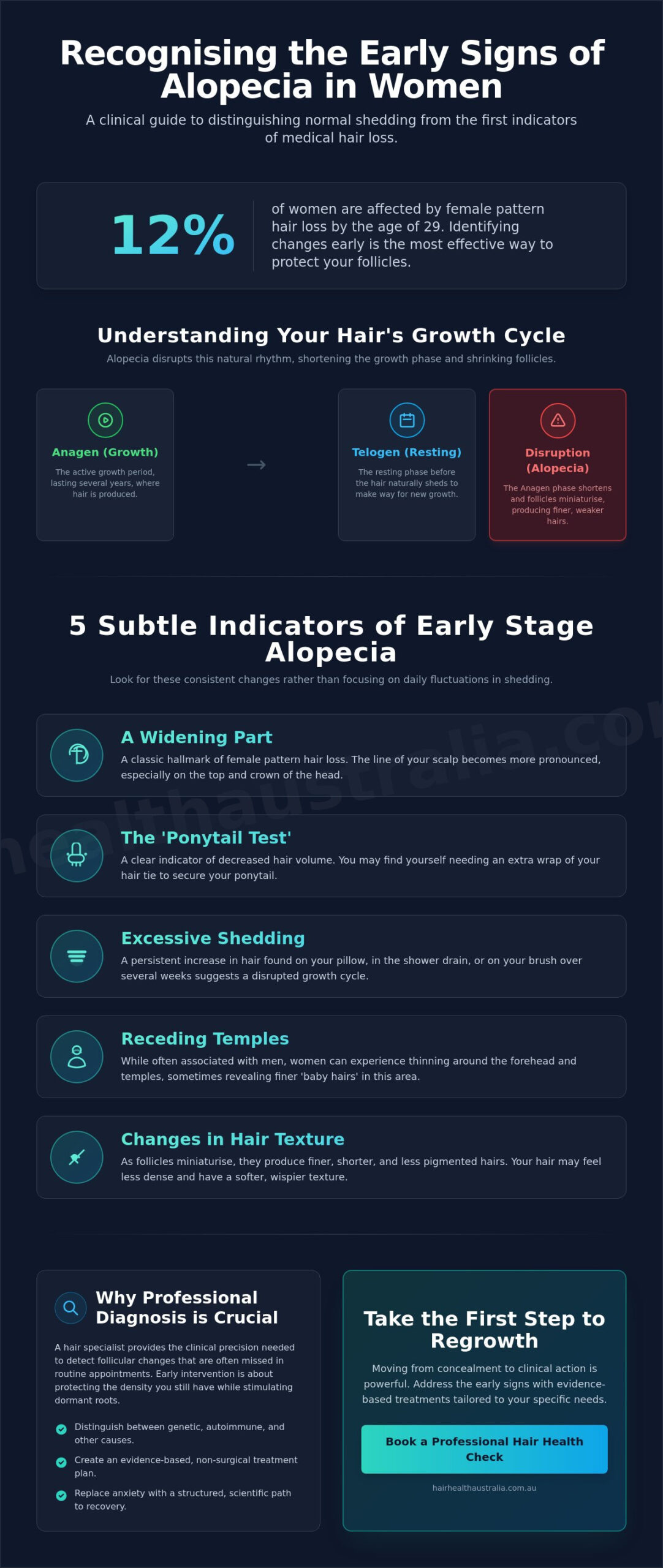
Our hair operates on a precise biological rhythm. The Anagen phase is the active growth period, which can last several years. This is followed by the brief Catagen transition and the Telogen resting phase, where the hair eventually sheds to make room for new growth. When alopecia begins, this cycle is disrupted. The Anagen phase shortens, and follicles undergo a process called miniaturisation. They produce finer, shorter hairs until they eventually stop producing altogether. Catching these changes while the follicles are still active is the most important factor in achieving successful regrowth through non-surgical protocols.
Normal Shedding vs. Clinical Thinning
Most people lose between 50 and 100 hairs a day as part of a healthy cycle. However, in Australia, factors like harsh UV exposure and varying water mineral content in our major cities can sometimes make it difficult to tell if you’re experiencing seasonal shedding or something more permanent. It’s vital to distinguish between hair breakage, which is caused by external damage like heat styling, and true follicle miniaturisation. If you notice your ponytail feels thinner or your scalp is becoming more visible in bright light, it’s time for a professional hair health check to assess the state of your follicles. Early intervention is about protecting the density you still have while stimulating dormant roots.
The Emotional Impact of Early Hair Loss
The psychological burden of thinning hair is significant and deserves clinical validation. Many women attempt to hide the problem with styling changes or expensive over-the-counter supplements, but this often delays necessary intervention. Stress itself can become a physiological trigger, potentially leading to conditions like Telogen Effluvium, which accelerates the shedding process. Moving from a mindset of concealment to one of clinical action is a powerful step. By addressing the early signs of alopecia in women with evidence-based treatments, you can replace the anxiety of the unknown with a structured, scientific plan for recovery. Seeking a specialist’s advice early ensures that your treatment is tailored to your specific type of hair loss rather than a one-size-fits-all approach.
5 Subtle Indicators: Identifying the Early Signs of Alopecia in Women
Identifying the early signs of alopecia in women requires a shift from casual observation to a more methodical assessment of your hair’s daily behaviour. Unlike the rapid loss seen in some medical treatments, clinical alopecia usually progresses through a series of subtle, almost imperceptible changes. By the time many women seek professional help, they have already lost a noticeable percentage of their hair density. Recognising these indicators early is the most effective way to preserve your existing follicles and maintain your natural volume.
- The Widening Part: When you style your hair, you might notice that the line of scalp visible at your part is becoming more pronounced. This is a classic hallmark of female pattern baldness, where thinning occurs primarily on the top and crown of the scalp.
- The ‘Ponytail Test’: For many women, the first real warning sign isn’t what they see, but what they feel. If you find yourself needing to wrap your hair tie around an extra time to secure your ponytail, it’s a clear indicator of decreased hair volume.
- Excessive Shedding: Finding more hair than usual on your pillow or a significant increase in the amount of hair clogging the shower drain can be distressing. While some shedding is normal, a persistent increase over several weeks suggests a disruption in your growth cycle.
- Receding Temples: While often associated with men, women can also experience thinning around the forehead and temples. You may notice “baby hairs” that never seem to grow longer, which often indicates follicle miniaturisation.
- Texture Changes: Pay attention to how your hair responds to styling. If your hair feels limp, wispy, or lacks its usual “bounce” even after using your regular products, the underlying structure of the hair shafts may be weakening.
Scalp Health and Sensitivity
Your scalp’s physical condition often provides vital clues. Some women report a “tingling” or tender sensation, known as trichodynia, which can precede periods of active shedding. Persistent redness, inflammation, or an unusually oily scalp can also signal that the follicular environment is compromised. Monitoring these sensations can help you decide when to book a professional hair health check to rule out more complex conditions before they progress.
The ‘Christmas Tree’ Pattern
In the clinical world, we often refer to the “Christmas Tree” pattern of thinning. This describes a widening of the part that is most narrow at the back of the head and widest toward the front hairline. You can monitor this at home using a two-mirror check to view your vertex density from different angles. It’s particularly helpful to do this under bright, natural light. The harsh Australian sun often reveals thinning that might be masked by the softer, artificial lighting in your bathroom. Recognising these early signs of alopecia in women allows for targeted, non-surgical intervention while your follicles are still capable of producing healthy hair.
Differentiating the Spectrum: Common Types of Alopecia Affecting Women
Determining the specific cause of your hair loss is the first step toward effective clinical recovery. While the early signs of alopecia in women often appear similar on the surface, the underlying biological triggers vary significantly. A professional diagnosis ensures that your treatment plan addresses the root cause rather than just the symptoms, which is why we focus on a scientific differentiation of these conditions.
- Androgenetic Alopecia (Female Pattern Hair Loss): This is the most common genetic cause of thinning. It typically manifests as a diffuse loss of density across the top of the scalp and a widening part line. Research indicates that the prevalence of this condition increases to over 25% by the age of 49.
- Alopecia Areata: This autoimmune condition causes the body to attack its own hair follicles. It’s identified by sudden, “coin-sized” smooth bald patches that can appear anywhere on the scalp. Unlike pattern thinning, this type often has a very rapid onset and affects approximately 2% of the population.
- Telogen Effluvium: This is a temporary form of thinning where a large number of hairs are pushed into the shedding phase simultaneously. It’s often triggered by significant physiological shocks, such as major surgery, childbirth, or extreme emotional stress.
- Traction Alopecia: Common in active Australian lifestyles, this type is caused by persistent tension on the hair follicles. Tight ponytails, buns, or braids worn during sports or gym sessions can lead to thinning, particularly around the hairline and temples.
Hormonal Triggers in the Australian Context
Hormonal health is inextricably linked to hair density. Conditions such as Polycystic Ovary Syndrome (PCOS), thyroid imbalances, and the transition through menopause are frequent contributors to clinical thinning. Even in our sun-drenched environment, many Australian women present with Vitamin D or iron deficiencies, both of which are critical for healthy follicular function. Hormonal shifts, particularly the presence of dihydrotestosterone (DHT), cause the hair follicle to shrink over time, resulting in shorter and finer strands with every growth cycle.
Frontal Fibrosing Alopecia (FFA)
Frontal Fibrosing Alopecia is a specific condition that requires immediate attention, particularly in post-menopausal women. It presents as a “receding headband” pattern, where the hairline slowly moves backward. Because FFA can cause permanent scarring of the follicle, early clinical intervention is vital to stop the progression. Distinguishing between this and standard thinning is essential for long-term hair preservation. For a deeper look at these differences, you can book a hair health check to identify your specific pattern. Recognising the early signs of alopecia in women within this spectrum allows us to implement a targeted strategy before the loss becomes irreversible.
The Importance of a Professional Hair Specialist for Early Diagnosis
A standard visual inspection by a general practitioner or your local hairdresser often fails to detect the early signs of alopecia in women. While these professionals are excellent for general health or aesthetic styling, they lack the specialised high-magnification tools required to see what is happening beneath the scalp surface. By the time hair loss is visible to the naked eye, a significant percentage of follicular density may already be compromised. A clinical specialist in Sydney serves as a vital bridge. We offer diagnostic precision that goes beyond cosmetic camouflage but remains focused on non-surgical preservation.
Moving from a state of hopeful guessing to a structured, evidence-based recovery plan is essential. Instead of trial-and-error with over-the-counter products, a clinical assessment provides a baseline of your current hair health. This methodical approach allows for the identification of specific patterns that distinguish temporary shedding from permanent thinning. It’s about taking control of the narrative through data and professional expertise. We focus on providing clarity so you can make informed decisions about your treatment path. When evaluating your options, understanding what to look for in a non-surgical hair loss clinic in Sydney can help you distinguish between genuine medical science and cosmetic cover-ups.
Microscopic Hair and Scalp Analysis
Digital trichoscopy is the cornerstone of a modern clinical assessment. High-magnification scans allow us to identify follicle miniaturisation long before the hair is actually gone. We measure the hair diameter and evaluate the ratio of hairs in the growth phase versus the shedding phase at the root level. This level of detail is impossible to achieve with a mirror or a simple physical exam. If you’re noticing changes in your density, you can book a hair health check to receive a definitive look at your follicular health.
Diagnostic Clues: Trichologist vs. General Practitioner
While a GP can order general blood tests, a hair specialist knows exactly which markers to look for in relation to hair density. We often recommend checking Ferritin, Zinc, and specific hormonal panels to identify underlying physiological triggers that contribute to the early signs of alopecia in women. These results are then used to tailor a customised regrowth programme that addresses your unique biological needs. Understanding the role of a hair specialist is key to finding the right clinical support for sustainable results. If you are ready to stop the cycle of uncertainty, reach out to our team to schedule your clinical consultation today.
Clinically-Backed Non-Surgical Treatments for Hair Regrowth in Sydney
The landscape of hair restoration has evolved significantly, moving away from invasive procedures toward sophisticated, non-surgical protocols. For many women, the goal is to avoid surgery while achieving visible, sustainable improvements in density. If you’ve identified the early signs of alopecia in women, the primary clinical objective is to re-engage the Anagen growth phase of your hair cycle. This isn’t about temporary cosmetic fixes. It’s about using evidence-based therapies to stimulate dormant follicles and reverse the miniaturisation process before it becomes permanent.
A personalised approach is vital because “off-the-shelf” solutions, such as generic hair vitamins or supermarket serums, often fail to address the specific biological cause of your thinning. Whether your hair loss is driven by hormonal shifts, nutritional deficiencies, or autoimmune responses, your treatment must be tailored to that underlying trigger. We focus on a systematic care plan that views hair health as a long-term commitment. Results aren’t achieved overnight, but through a methodical progression that supports the follicle at every stage of its cycle. Before committing to any programme, reviewing our essential checklist for choosing a non-surgical hair loss clinic in Sydney will help you ask the right questions and ensure your care is grounded in clinical evidence rather than marketing promises.
Sydney Clinical Standards for Women’s Regrowth
Adhering to established Australian standards is a fundamental part of providing professional services in Sydney. Whether it is the clinical precision required for hair regrowth or the technical specifications used by ML Traffic Engineers Australia for accessible infrastructure, compliance ensures the best outcomes; read more about the regulations for driveway grades and disabled access.
At Hair Health Australia, our approach to female thinning is built on clinical precision and multi-angled stimulation. We combine high-potency topical applications with targeted nutritional support and professional-grade stimulation techniques to maximise hair density. This multi-faceted strategy ensures that the follicular environment is optimised for growth. By integrating these different modalities, we can often achieve results that single-method treatments cannot match. You can explore our specific Alopecia Management Strategies to understand how a structured, professional plan provides the necessary support for follicular recovery.
Taking the First Step Toward Recovery
We recognise that booking your first consultation can be a source of anxiety. Our team is dedicated to replacing that uncertainty with a clear, science-based roadmap for your recovery. It’s important to set realistic expectations. Clinical regrowth is a biological process, and most women begin to see measurable improvements within a three to six month window. This timeframe allows the follicles to transition through the resting phase and back into active production. By addressing the early signs of alopecia in women now, you are taking the most proactive step possible to protect your future hair density. Start your journey with a professional Hair Health Check today to gain the clarity and confidence you deserve.
Secure Your Hair’s Future Through Early Clinical Action
Taking control of your hair health begins with moving beyond the anxiety of the unknown and into a space of clinical clarity. We have explored how identifying the early signs of alopecia in women is not merely about aesthetic preservation, but about intervening while your follicles are still biologically active. By distinguishing between temporary shedding and clinical thinning through specialised microscopic hair analysis, you can bypass the frustration of ineffective treatments and start a path grounded in science.
With over 15 years of experience in Sydney, our team is dedicated to providing personalised, non-surgical regrowth protocols that respect your unique physiology. You don’t have to navigate this journey alone or rely on guesswork. Our goal is to replace uncertainty with a methodical, evidence-based plan that prioritises long-term results and follicular health. If you’re ready to gain a definitive understanding of your hair density, we invite you to book your comprehensive Hair Health Check at our Sydney clinic. Your path toward recovery is a shared journey, and we’re here to guide you with professional expertise and empathetic care every step of the way.
Frequently Asked Questions
Can stress really cause alopecia in women?
Yes, significant emotional or physiological stress can trigger specific types of hair loss, most notably Telogen Effluvium. This condition forces a high percentage of follicles into the resting phase prematurely. While the shedding often happens three months after the stressful event, it’s usually temporary. However, chronic stress can exacerbate the early signs of alopecia in women by disrupting the natural growth cycle. Managing stress is a vital part of any clinical recovery plan.
Is hair loss from alopecia permanent for ladies?
Whether hair loss is permanent depends entirely on the specific diagnosis and how quickly you seek treatment. Non-scarring types, like female pattern thinning or Telogen Effluvium, are often treatable with clinical intervention. However, scarring alopecias can lead to permanent loss if the follicle is destroyed. This is why early detection is so critical. Identifying changes before the follicle becomes dormant ensures the best possible chance for successful, long-term regrowth and maintenance.
How do I tell the difference between normal ageing and alopecia?
While hair naturally thins slightly as we age, clinical alopecia involves more distinct and rapid changes. You might notice a widening part line, increased scalp visibility at the crown, or sudden patches of loss. Normal ageing shouldn’t result in significant density drops over a short period. If your ponytail feels noticeably thinner or your scalp is visible in natural light, these are likely the early signs of alopecia in women rather than standard ageing.
Are there non-surgical treatments available in Sydney for female hair loss?
Yes, there are several clinically-backed non-surgical treatments available in Sydney that offer effective results. These protocols focus on stimulating active follicles and re-engaging the growth phase without the need for invasive surgery. Treatments typically involve a combination of high-potency topical applications, nutritional optimisation, and clinical stimulation. Every programme is customised to the individual’s diagnostic results. This ensures that the therapy addresses the specific biological cause of the thinning for a successful outcome.
Does wearing my hair in a tight bun cause alopecia?
Yes, wearing your hair in tight buns, ponytails, or braids frequently can lead to Traction Alopecia. This occurs because the constant tension damages the hair follicles, particularly around the hairline and temples. If you notice thinning in these areas, it’s important to adopt looser styles immediately. While the hair can grow back, prolonged tension over several years can eventually lead to permanent follicle scarring and irreversible loss in those specific areas.
What vitamins should I take for early signs of thinning?
Effective supplementation must be based on your specific clinical needs rather than generic products. Iron, Zinc, and Vitamin D are the most common deficiencies linked to thinning in Australian women. Taking “hair growth” vitamins without a blood test often fails because you may not be addressing your actual deficiency. A professional assessment identifies exactly what your body requires. This targeted approach ensures your follicles have the necessary nutrients to support a healthy growth phase.
How long does it take to see results from a clinical regrowth programme?
You should expect to see measurable changes within a three to six month window. Hair grows in cycles, so it takes time for the follicles to transition from the resting phase back into active growth. Initial signs of success often include reduced shedding and the appearance of fine new hairs along the part or hairline. Consistency is key during this period. Following a structured clinical programme ensures that these early gains develop into sustainable density.
Will my hair grow back if I catch alopecia early?
Yes, catching alopecia in its early stages provides the highest probability of full recovery. When follicles are still active, they respond much more effectively to clinical stimulation and nutritional support. Early treatment stops the miniaturisation process before the follicle stops producing hair entirely. By acting when you first notice changes, you protect your existing density and create the best environment for new, healthy strands to emerge and thrive over the coming months.