One in two Australians experience noticeable hair thinning by the age of 50. It’s a confronting reality that often leads to a cycle of trial and error with supermarket shampoos that promise much but deliver little. You’ve likely felt the frustration of watching your hairline recede while wondering if you’re simply wasting money on cosmetic fixes that don’t address the biological root cause. Finding an effective hair regrowth treatment Australia wide has become increasingly complex as the market is flooded with products that lack clinical rigour and scientific backing.
We understand the anxiety that comes with the fear of permanent follicle death, and we’re here to replace that uncertainty with scientific clarity. This guide provides an evidence-based look at Australian clinical standards and the bio-active ingredients that actually work. You’ll learn how to distinguish between basic cosmetic products and TGA-listed therapeutic goods, especially following the 2026 TGA regulatory updates. We’ll also outline a clear framework for identifying when it’s time to seek professional clinical help in Sydney to ensure your hair health is managed with precision, care, and realistic expectations.
Key Takeaways
- Understand how unique local factors, such as extreme UV exposure and water mineral content, influence scalp health and treatment efficacy in the Australian climate.
- Identify the clinical gold standards, including Minoxidil and DHT blockers, that form the foundation of a scientifically backed hair regrowth treatment Australia.
- Learn why a professional diagnostic framework is essential to prevent follicle miniaturisation and avoid the common pitfall of wasting money on ineffective cosmetic products.
- Discover the two-step clinical routine for optimal follicle stimulation, starting with deep scalp cleansing followed by targeted nutrient delivery.
- Recognise the “point of no return” when follicles become permanently dormant, signalling the transition from home-use products to professional clinical programmes.
Understanding the Hair Regrowth Landscape in Australia for 2026
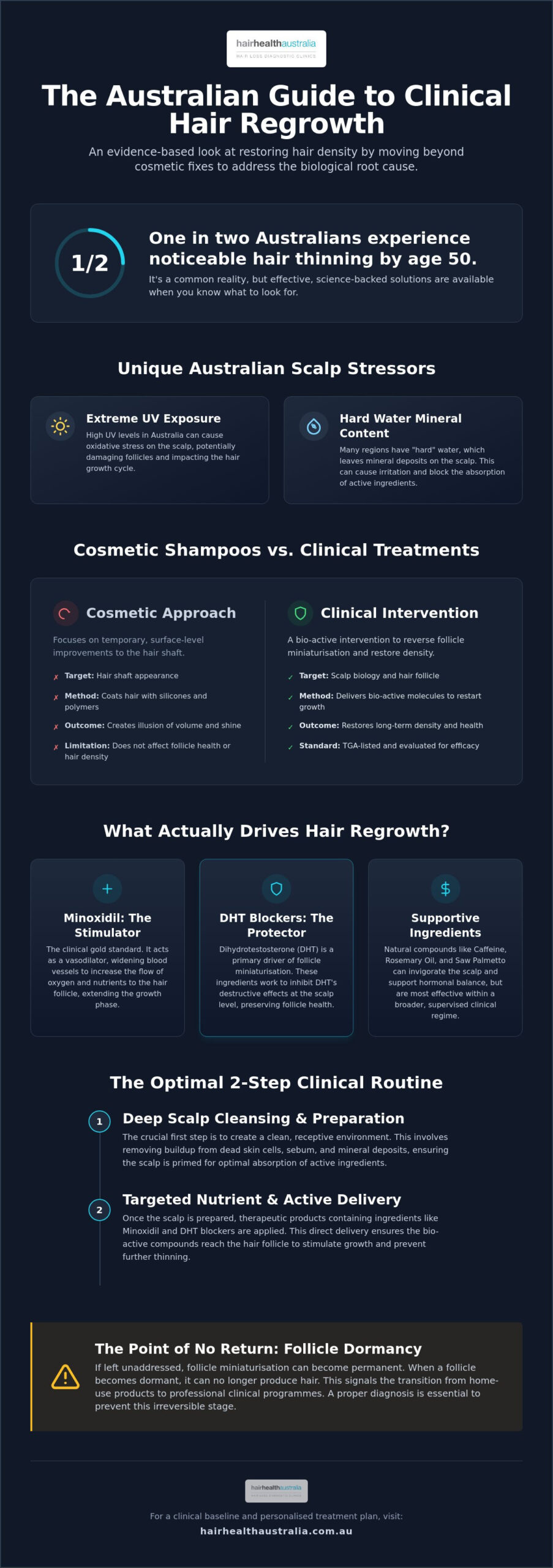
A hair regrowth treatment Australia doesn’t just mean a better shampoo; it represents a targeted bio-active intervention designed to reverse follicle miniaturisation. At its core, clinical regrowth focuses on the biological health of the scalp and the hair growth cycle rather than just the appearance of the strands. In the Australian environment, this distinction is vital. Our unique climate presents specific challenges, from extreme UV exposure that can cause oxidative stress on the scalp to “hard” water in various regions that leaves mineral deposits, potentially irritating the skin and hindering product absorption.
Success depends on identifying the underlying cause of thinning. For many, this involves Pattern hair loss (androgenetic alopecia), a genetic condition where follicles gradually shrink until they stop producing hair. A generic “hair fall control” product often only coats the hair shaft to prevent breakage. In contrast, a therapeutic stimulant works to revitalise the follicle itself. If you aren’t addressing the specific reason your hair is thinning, you’re likely investing in a solution that can’t provide the density results you’re looking for.
Cosmetic vs. Clinical: Knowing the Difference
The retail market is saturated with cosmetic serums that focus on the hair shaft, providing temporary volume and shine through silicones or film-forming polymers. These don’t change the rate of growth or the density of the hair. Clinical treatments target the follicle and scalp biology for long-term density restoration. Clinical hair growth products are bio-identical signalling molecules that restart the growth cycle. They move beyond surface-level aesthetics to influence the cellular environment where hair production begins.
The Role of the Australian TGA in Regrowth Standards
In Australia, the Therapeutic Goods Administration (TGA) maintains strict oversight of products that claim to treat medical conditions. While you’ll often see the term “clinically proven” in retail environments, it’s frequently misused to describe small-scale consumer perception studies rather than rigorous medical trials. Choosing a professional treatment means looking for evidence that goes beyond marketing buzzwords.
To ensure you’re using an authentic hair regrowth treatment Australia, you should verify if the product is registered on the Australian Register of Therapeutic Goods (ARTG). This registration confirms the product has been evaluated for safety and that its therapeutic claims are supported by evidence. Choosing a TGA-listed treatment ensures you’re using a formula held to clinical standards, providing a level of transparency that cosmetic alternatives simply cannot match. Before starting any regime, it’s wise to undergo a hair health check to establish a clinical baseline for your specific needs.
Active Ingredients: What Actually Drives Regrowth?
Selecting an effective hair regrowth treatment Australia requires a clear understanding of the bio-active ingredients that drive follicle recovery. While marketing often focuses on exotic extracts, clinical success is rooted in compounds that either stimulate blood flow, block destructive hormones, or signal cellular repair. Minoxidil remains the clinical gold standard for stimulation. By acting as a vasodilator, it widens the blood vessels around the follicle, which ensures a consistent supply of oxygen and nutrients to the hair bulb. This process helps to extend the growth phase and can effectively “wake up” follicles that have begun to thin.
Beyond simple stimulation, modern protocols often incorporate natural supportive ingredients. Compounds such as caffeine and rosemary oil have shown promise in clinical studies for their ability to invigorate the scalp environment. Saw palmetto is also frequently utilised for its potential to support hormonal balance at the scalp level. However, these natural stimulants are generally most effective when used as part of a broader, clinically supervised regime rather than as standalone solutions. Following Australian government health advice on alopecia, it’s essential to identify your specific type of hair loss to ensure these ingredients are targeted correctly.
The Science of DHT Inhibition
For both men and women, Dihydrotestosterone (DHT) is often the primary driver of follicle miniaturisation. DHT binds to androgen receptors in the scalp, causing the anagen (growth) phase of the hair cycle to shorten over time. This results in hair that grows back thinner and shorter until the follicle eventually stops producing hair altogether. Blocking this process is the non-negotiable foundation of managing pattern baldness. Australian patients can choose between systemic options or topical DHT blockers, which offer the advantage of delivering the active ingredients directly to the affected area while minimising broader absorption.
Biotech Advancements: Peptides and Stem Cell Signalling
The 2026 landscape has seen a significant shift toward bio-identical signalling. Modern peptides work by mimicking the natural growth factors that tell your body to produce new hair cells. Unlike older, harsher chemical treatments, these biotech advancements focus on “cell talk,” encouraging dormant follicles to return to an active state. Peptide-based therapies represent the most significant advancement in non-surgical hair science this decade. They offer a refined approach for those seeking restoration without the side effects sometimes associated with traditional pharmaceuticals. Establishing whether your thinning is caused by DHT or environmental factors is the first step toward recovery, which is why understanding the science of hair growth and clinical support is often recommended before starting a new regime.
The Diagnostic Framework: Why You Shouldn’t Buy Yet
Before investing in any hair regrowth treatment Australia offers, you must understand what you’re actually treating. Self-diagnosing based on a quick glance in the mirror or a social media ad often leads to wasted expenditure and, more critically, delayed results. Hair loss isn’t a singular condition. It’s a symptom of various biological processes. If you treat stress-induced shedding (Telogen Effluvium) with ingredients meant for genetic thinning (Androgenetic Alopecia), you’re simply not addressing the root cause. This mismatch allows the actual problem to progress, potentially leading to irreversible follicle death.
Clinical precision is the only way to avoid this cycle. Modern advancements, such as the TGA approval of Litfulo (ritlecitinib) for specific severe cases, demonstrate how specialised treatments must be for different types of hair loss. Without a clear starting point, you’re essentially guessing with your health. A professional hair health check provides the data needed to build a targeted, effective regime from day one. It’s about moving away from “hope in a bottle” and toward a methodical, evidence-based plan.
Microscopic Analysis: The Professional Standard
High-magnification scans are the cornerstone of a clinical approach. These scans reveal follicle health that the naked eye cannot detect. We can see signs of miniaturisation, where the hair bulb begins to shrink, long before visible thinning appears on the crown or hairline. By the time you notice a gap, you may have already lost up to 50% of the hair density in that area. Seeking a diagnosis at a Sydney hair clinic allows for early intervention. This proactive step is significantly more effective than trying to “resurrect” dormant follicles once they’ve already scarred over.
Scalp Health as the Foundation for Growth
Even the most advanced bio-active serum will fail if the scalp environment is compromised. Think of your scalp as the soil and your hair as the plant. If the soil is inflamed, overly oily, or clogged with environmental pollutants, the “plant” cannot thrive. Clogged pores and excess sebum can trap DHT near the follicle, accelerating the thinning process. We often see patients who’ve spent hundreds on premium serums but haven’t addressed basic scalp hygiene. You can learn more about these essential maintenance protocols by reviewing our guide on Scalp Health and Hair Loss. Preparing the scalp environment is a non-negotiable step in any successful regrowth journey.
How to Organise a Clinical-Grade Hair Routine
Success with a hair regrowth treatment Australia doesn’t happen by accident. It requires a methodical approach that respects the biological timeline of the hair follicle. Once a diagnosis has identified your specific needs, you must transition into a structured daily protocol. This isn’t a simple “wash and go” retail experience. It’s a systematic intervention designed to keep follicles active and healthy. By following a structured routine, you ensure that each product has the best possible chance to penetrate the scalp and deliver results.
- Step 1: Deep Cleansing. You must remove DHT-laden sebum and environmental pollutants from the scalp surface. A clean foundation ensures that subsequent treatments aren’t blocked by oily buildup or dead skin cells.
- Step 2: Nutrient Delivery. Use clinical-grade shampoos specifically formulated for follicle stimulation. These differ from cosmetic versions by delivering active compounds directly to the scalp skin rather than just coating the hair shaft.
- Step 3: Targeted Stimulant Application. Apply your prescribed serums or tonics to a clean, receptive scalp. Focus on the areas of greatest thinning to ensure the highest concentration of bio-active ingredients reaches the follicles.
- Step 4: Internal Support. Topical treatments work best when supported from within. Hair-specific micronutrients fuel the growth phase, providing the raw materials needed for robust keratin production. Understanding the difference between retail supplements and genuine hair growth support backed by clinical evidence is essential at this stage.
- Step 5: The 90-Day Rule. Consistency is the only path to visible results. You must commit to the routine for at least 90 days before expecting to see structural changes in hair texture or density.
Morning vs Evening Protocols for Maximum Absorption
Timing your applications can influence how well your scalp absorbs active ingredients. Many clinical stimulants are best applied in the evening. This allows the product to work undisturbed by daily styling products or environmental UV exposure. It also aligns with the body’s natural circadian rhythms, where cellular repair processes are often more active. A three-minute scalp massage during application can further increase local blood circulation. This simple action helps move the bio-active molecules deeper into the follicle. If you find product buildup is an issue, adjust your morning cleansing routine to maintain a fresh scalp environment without stripping away essential moisture.
Measuring Success: What to Expect in the First 6 Months
Managing your expectations is a vital part of the clinical process. During the first few weeks of a new regime, you may experience a temporary increase in shedding. Don’t panic. This is often a sign that dormant follicles are “resetting” and pushing out old, thin hairs to make room for new, stronger growth. You can use hair density checks and monthly high-resolution photos to track your progress objectively. True density changes usually become visible between the three and six-month marks. If you’re ready to move beyond guesswork, it’s time to book a hair health check and establish your clinical baseline.
When Products Aren’t Enough: Professional Sydney Solutions
Even the most diligent home routine has its limits when faced with aggressive or long-term thinning. There comes a stage in the hair loss journey often referred to as the “Point of No Return.” This occurs when follicles have undergone such extreme miniaturisation that they become permanently dormant. Over time, the follicle opening can scar over, a process called fibrosis. Once this happens, no topical hair regrowth treatment Australia can reach the hair bulb to stimulate new growth. Identifying this threshold early is the difference between successful restoration and continued, irreversible loss.
Moving beyond over-the-counter shelf products requires a shift from a “product” mindset to a “managed programme.” While retail serums serve a purpose for early-stage thinning, advanced loss demands clinical management. The Hair Health Australia approach focuses on personalised clinical regrowth that bridges the gap between basic home care and invasive surgery. We provide a structured, non-surgical framework that targets the biological drivers of your specific hair loss type, ensuring that every intervention is data-driven and results-oriented.
In-Clinic Therapies vs Home Kits
Clinical equipment, such as medical-grade low-level laser therapy, provides a level of follicle stimulation that home kits simply cannot match. These in-clinic therapies enhance product penetration by increasing local blood flow and cellular energy within the scalp. The primary benefit of a professional programme is the continuous supervision. A specialist can monitor your scalp’s response and adjust dosages or formulas as your hair health evolves. This level of precision is why many Sydney residents are increasingly choosing non-surgical restoration over the high costs and recovery times associated with invasive transplants.
Your Next Step: The Professional Consultation
It’s natural to feel a sense of anxiety before your first clinical visit. Many people worry they will be met with a sales pitch or told it’s too late. Our approach is built on a “straight-talking” assessment designed to provide clarity rather than false hope. During a clinical hair health assessment at our Sydney centre, we use high-magnification imaging to establish exactly where your follicles sit on the growth spectrum. We tell you honestly what can be revitalised and what has passed the point of clinical intervention. This transparency allows you to make an informed decision about your future. If you are ready for a definitive answer, book your clinical hair analysis at our Sydney centre today to begin your managed journey toward restoration.
Securing Your Future Hair Health
Achieving sustainable density requires moving beyond the “hope in a bottle” mindset. As this guide has detailed, an effective hair regrowth treatment Australia depends on a precise clinical diagnosis combined with the consistent application of bio-active stimulants. By prioritising scalp health and understanding the biological timeline of the hair follicle, you can effectively intervene before miniaturisation becomes permanent. Success isn’t found in a single supermarket product, but in a managed, evidence-based strategy that respects your unique biology.
Since 2009, we’ve operated as dedicated non-surgical regrowth experts, providing every client with detailed clinical microscopic analysis to establish a clear baseline. We develop tailored programmes for both men and women, focusing on transparency and realistic expectations. Our goal is to ensure you have the knowledge to make the right choice for your hair’s future. It’s never too early to take control of your density and replace uncertainty with a professional, data-driven plan.
Book Your Comprehensive Hair Health Check in Sydney today to begin your journey toward a healthier, fuller head of hair with confidence.
Frequently Asked Questions
Do hair growth products actually work for genetic balding?
Clinical hair growth products can be highly effective for genetic balding if the follicles are still active. These treatments work by inhibiting Dihydrotestosterone (DHT), the hormone responsible for shrinking follicles in androgenetic alopecia. While they cannot change your underlying genetics, they can halt miniaturisation and revitalise thinning hair to restore density. Success depends on starting the programme before the follicles have permanently scarred over.
How long does it take to see results from hair regrowth treatments in Australia?
You should expect to see visible changes between three and six months of consistent use. This timeline aligns with the natural hair growth cycle, which requires time to transition from the resting phase back into the active growth phase. Initial results often appear as fine, downy hairs that gradually thicken into stronger terminal hairs over several months of a dedicated hair regrowth treatment Australia.
Can I use hair growth products if I have a sensitive scalp?
Yes, but you must select clinical formulas specifically designed for scalp health. Many over-the-counter retail products contain high concentrations of alcohol or harsh preservatives that can trigger irritation. We recommend peptide-based signalling molecules or alcohol-free topicals that provide the necessary stimulation without compromising the delicate skin barrier. It’s always best to have a professional assessment to identify specific triggers before starting.
What is the best ingredient for female hair thinning in 2026?
Minoxidil remains the clinical gold standard for female thinning, though 2026 has seen a significant shift toward combining it with bio-identical peptides. These growth factors help signal cellular repair without the hormonal side effects sometimes associated with other pharmaceuticals. A multi-faceted approach that addresses both scalp circulation and nutrient delivery typically yields the most reliable results for women experiencing diffuse thinning or hormonal changes.
Is it better to use a hair growth shampoo or a leave-in serum?
Leave-in serums are generally more effective for active regrowth because they remain on the scalp for several hours. This extended contact time allows for deeper penetration of bio-active ingredients into the follicle. While growth shampoos are excellent for preparing the scalp and removing DHT-laden sebum, they are a supporting step rather than the primary driver of density restoration. For the best results, use both in a structured routine.
Should I wash my hair every day when using growth treatments?
Daily washing is often recommended when using a clinical hair regrowth treatment Australia to prevent product buildup. A clean scalp ensures that each application of your stimulant can reach the follicles without being blocked by old residue, oils, or environmental pollutants. If your scalp is particularly dry, we can adjust your routine to ensure you maintain hygiene without causing dehydration or stripping away essential natural oils.
Are there any side effects to clinical hair regrowth treatments?
Potential side effects are generally mild and may include temporary scalp irritation or an initial increase in shedding. This initial shedding is a normal biological response where the follicle pushes out a thin, weak hair to make room for a new, stronger one. If you experience persistent redness or itching, it’s essential to consult with a specialist. We can often adjust your formula or dosage to ensure the treatment remains comfortable.
Can I combine different brands of hair growth products safely?
We don’t recommend mixing different brands without professional guidance. Some active ingredients can cancel each other out or cause unexpected scalp reactions when combined. A managed clinical programme ensures that all components of your routine are chemically compatible and designed to work together. This systematic approach maximises your results while minimising the risk of irritation or ingredient interference that can occur with a “DIY” product mix.