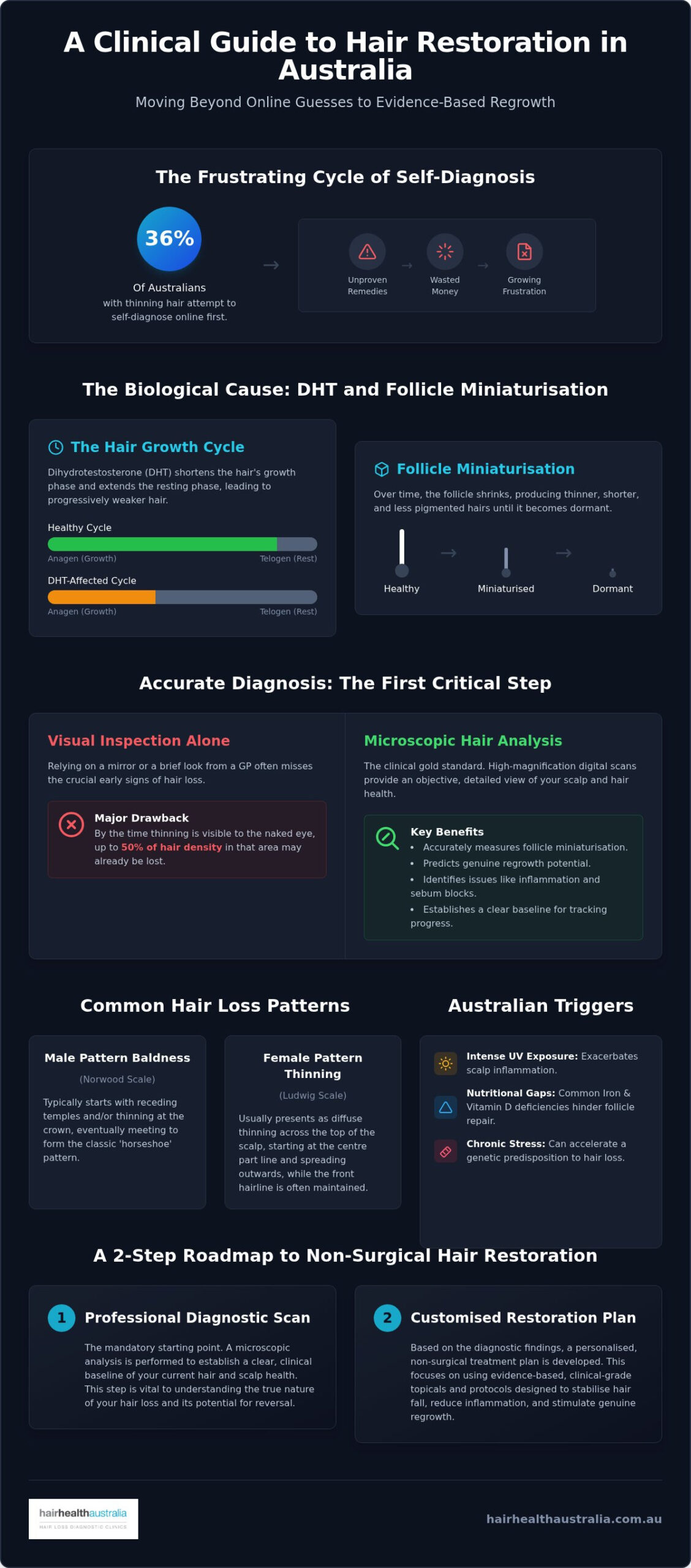
Did you know that roughly 36% of Australians struggling with thinning hair attempt to self-diagnose using online reviews before ever speaking to a professional? It’s a frustrating cycle that often leads to wasted money on unproven remedies and a growing fear that your hair loss might be permanent. If you’ve felt overwhelmed by the sheer volume of conflicting advice, you aren’t alone. Finding an effective hair loss treatment Australia requires moving past the marketing hype and focusing on the biological health of your individual follicles.
This 2026 clinical guide provides the clarity you need to stop thinning and begin a genuine journey toward regrowth. We’ll outline the latest evidence-based treatments and diagnostic techniques that offer a medical-grade alternative to invasive surgery. You’ll discover how a structured restoration plan, supported by a Sydney specialist, can transform your hair density and restore your self-confidence. We’ll examine the most effective non-surgical protocols currently available, ensuring you have the knowledge to make an informed, clinical decision for your long-term hair health.
Key Takeaways
- Learn why microscopic analysis is the only way to accurately assess follicle health and predict your hair’s genuine regrowth potential.
- Understand how DHT affects your growth cycle and why a customised hair loss treatment Australia plan is more effective than generic pharmacy options.
- Discover the critical differences between over-the-counter solutions and clinical-grade topicals designed to stabilise hair fall and reduce inflammation.
- Identify the two essential steps of a non-surgical restoration roadmap, beginning with a professional diagnostic scan to establish a clear baseline.
- Recognise the red flags when selecting a Sydney specialist and why transparent, evidence-based care is vital for achieving realistic, long-term results.
Understanding the Biological Mechanisms of Hair Loss and Baldness
The primary driver of thinning for the majority of Australians is Pattern hair loss (androgenetic alopecia). This condition isn’t an overnight occurrence but a progressive biological shift. It’s driven largely by Dihydrotestosterone (DHT), a byproduct of testosterone that binds to receptors in the scalp. When DHT interacts with susceptible follicles, it shortens the growth (anagen) phase and lengthens the resting (telogen) phase. Over time, the follicle undergoes miniaturisation. It produces thinner, shorter, and less pigmented hair until the follicle eventually stops producing visible hair altogether. This process is the core reason why most people eventually seek a professional hair loss treatment Australia.
It’s vital to distinguish this genetic process from temporary shedding, known as Telogen Effluvium. While temporary shedding can look alarming, it’s often a reaction to a specific trigger like illness, extreme weight loss, or surgery. Conversely, permanent thinning requires a structured clinical approach. Many people assume baldness means the follicle is dead. In reality, most cases involve follicles that are dormant or severely miniaturised. This means there is still a window for intervention before the scalp becomes completely smooth and the follicle reaches a point of no return.
Male Pattern Baldness vs. Female Thinning
Men and women experience thinning in distinct ways, often classified by specific medical scales. For men, we use the Norwood Scale to track receding temples and thinning at the crown. Women typically follow the Ludwig Scale, which describes diffuse thinning that begins at the centre part line and spreads outwards while maintaining the front hairline. Regardless of the pattern, early intervention is the most effective way to preserve existing density. To determine where you sit on these scales, a Hair Health Check is the definitive starting point for establishing a clinical baseline. Once a follicle has been inactive for several years, the chance of significant regrowth diminishes.
Environmental and Lifestyle Triggers in Australia
The Australian climate introduces unique challenges for scalp health. Intense UV exposure can damage the scalp’s protective barrier and exacerbate inflammation, which accelerates the thinning process. During clinical consultations in Sydney, we also frequently identify nutritional gaps that hinder hair health. Deficiencies in iron and Vitamin D are common and can prevent the follicle from repairing itself efficiently. Additionally, chronic stress acts as a catalyst. It doesn’t cause genetic hair loss on its own, but it can certainly speed up your genetic predisposition. Addressing these external factors is a cornerstone of any comprehensive hair loss treatment Australia program.
Microscopic Hair Analysis: Why Clinical Diagnosis is Essential
Many Australians begin their journey with a simple visual check in the bathroom mirror. However, by the time thinning is visible to the naked eye, you may have already lost up to 50% of your hair density in that area. Microscopic hair analysis is the gold standard for non-invasive hair loss diagnosis. This diagnostic approach uses high-magnification digital scans to examine the scalp at a level of detail that is impossible to achieve during a standard physical exam. By measuring follicle diameter and hair shaft health, we can accurately predict your genuine regrowth potential before you invest in any specific program.
This level of precision is also critical for identifying secondary issues like sebum crystallisation and scalp inflammation. While there are many common causes of hair loss, these local scalp conditions often act as physical barriers, hindering the absorption of topical clinical solutions. If these barriers aren’t addressed first, even the most advanced hair loss treatment Australia may fail to deliver the expected results. A clinical diagnosis ensures we’re treating the root cause rather than just the symptoms.
Visual Inspection vs. Digital Scanning
A standard GP visit often relies on a brief visual inspection, which can easily miss the early signs of miniaturisation. Digital scanning allows us to compare the thinning areas with your “donor area” at the back of the head, where follicles are typically more resilient. This comparison provides a clear baseline of what your healthy hair density should look like. Because these scans are saved digitally, they allow for objective tracking of your progress over months and years, replacing guesswork with hard data.
The Hair Health Check Process
During a professional Hair Health Check in our Sydney clinic, we perform a comprehensive analysis of your scalp’s current state. We calculate the exact percentage of hairs in the growth (anagen) phase versus the resting (telogen) phase. A healthy scalp usually has about 85% to 90% of hairs in the growth phase. If your data shows a significant shift toward the resting phase, it indicates that your follicles are under stress or DHT influence. This data is then used to create a customised hair loss treatment Australia roadmap for every client. If you’re ready to move past the confusion of online reviews, a professional Hair Health Check is the most reliable way to begin your restoration journey.
Comparing Clinical Hair Loss Treatments vs. Pharmacy Solutions
Many Australians begin their restoration journey at the local chemist, reaching for over-the-counter (OTC) minoxidil. While this is a recognised starting point, using it without professional clinical supervision often leads to disappointing results. Generic pharmacy solutions are frequently mass-produced to a standard concentration. They don’t account for individual scalp sensitivity or the specific stage of your condition. Clinical-grade topicals and DHT blockers, however, are often formulated with advanced penetration enhancers and higher concentrations of active ingredients, allowing them to significantly outperform generic brands.
A comprehensive hair loss treatment Australia relies on more than just a single medication. Clinical programs typically integrate Low-Level Laser Therapy (LLLT) to stimulate cellular repair at the mitochondrial level. LLLT increases the production of adenosine triphosphate (ATP), which provides the energy needed for follicles to transition from the resting phase back into the active growth phase. By combining multiple growth signals, such as LLLT, medical-grade topicals, and nutritional support, clinical programs create a synergistic effect that generic DIY solutions cannot replicate. This is the difference in a professional hair loss treatment Australia.
The Problem with DIY Hair Restoration
The most common reason DIY attempts fail is a lack of scalp preparation. If the scalp is covered in sebum buildup or inflammation, topical treatments cannot reach the follicle effectively. Many Australians also fall into the “shedding phase trap.” This occurs when the treatment begins to work, pushing out old, weak hairs to make room for new, stronger ones. Without clinical guidance, many people interpret this temporary shedding as a sign of failure and quit their program too early. As noted in the MedlinePlus guide to alopecia, understanding the specific type of thinning you are experiencing is vital before starting any regimen. A one-size-fits-all approach inevitably fails to address the unique hormonal profiles and lifestyle triggers that drive individual hair loss.
Non-Surgical Clinical Programs: The Evidence-Based Alternative
Personalised regrowth programs differ significantly from standard medication-only approaches by focusing on the entire follicle environment. This includes professional scalp hygiene treatments designed to remove crystallised sebum and improve the absorption of clinical topicals. These programs are not just about applying a product; they are about a systematic, data-driven restoration journey. For a deeper dive into the latest clinical standards, you may find the Best Hair Regrowth Treatment Australia 2026: A Clinical Reference Guide helpful. By choosing a structured clinical path, you replace the uncertainty of pharmacy trials with a clear, medical-grade plan tailored to your specific needs.
A Roadmap to Non-Surgical Hair Restoration
Success in hair restoration isn’t accidental. It’s the result of a deliberate, phased approach that addresses the biological environment of the scalp before attempting to force new growth. A professional hair loss treatment Australia follows a logical progression to ensure that every clinical intervention has the highest chance of success. By moving through these stages, we replace the uncertainty of unproven cures with a predictable, medical-grade framework.
- Step 1: Diagnostic Baseline. We use a high-magnification scan to establish a baseline of follicle health, identifying exactly how many follicles are active, miniaturised, or dormant.
- Step 2: Stabilisation Phase. The primary goal here is to stop further hair fall. We focus on reducing scalp inflammation and neutralising the impact of DHT on the follicle.
- Step 3: Stimulation Phase. Once the scalp environment is stable, we re-activate dormant follicles. This involves clinical protocols like LLLT and medical-grade topicals to restart the growth cycle.
- Step 4: Maintenance and Monitoring. Hair health is dynamic. We adjust your programme based on microscopic progress, ensuring your results are maintained for the long term.
Managing Expectations: The Regrowth Timeline
Understanding the biological timeline of hair growth is essential for staying committed to your programme. During months 1 to 3, the focus is entirely on stabilisation. You might notice a decrease in daily hair fall and a reduction in scalp oiliness or irritation. Between months 4 and 6, the first signs of visible density improvement typically appear as miniaturised hairs begin to thicken. Long-term results depend on consistency. Because hair grows in cycles, maintaining your new density requires ongoing care and periodic clinical reviews to ensure the follicles remain in the active growth phase.
Scalp Health: The Foundation of Growth
An unhealthy scalp environment is one of the most common barriers to effective treatment. Issues like dandruff, excessive oiliness, or seborrheic dermatitis create a physical layer that blocks clinical topicals from reaching the follicle. This is why we emphasise the use of clinical-grade cleansers and exfoliants as part of your daily routine. For a deeper understanding of these protocols, refer to our guide on Clinical Hair Treatment: A Professional Guide to Non-Surgical Restoration. If you’re ready to stop the guesswork and start a structured journey, the best first step is to book your initial Hair Health Check to establish your clinical baseline.
Choosing the Right Hair Loss Clinic in Sydney
Selecting a provider is the most significant decision you’ll make on your restoration journey. In a market often saturated with bold marketing claims, you should prioritise clinics that offer clinical experience and transparent pricing. A reliable hair loss treatment Australia should be grounded in science, not high-pressure sales. Hair Health Australia has been operating in Sydney since 2009, providing over 15 years of specialised non-surgical expertise. This longevity is a testament to our commitment to evidence-based care and realistic outcomes for our clients.
Be wary of clinics that offer “guaranteed” results. Biological responses vary, and an ethical specialist will always manage your expectations based on your specific clinical data. Another red flag is a provider that pushes invasive surgery as the only viable path. For many Australians, a non-surgical approach is more than sufficient to restore density if the follicles are still active. Having a local Sydney clinic allows for regular, face-to-face progress checks. These visits are vital for maintaining treatment compliance and adjusting your plan as your scalp health evolves over time.
The Importance of Personalised Care
Your restoration programme must be as unique as your DNA. It should be tailored specifically to your microscopic scan results, addressing the exact levels of DHT sensitivity and inflammation identified during your diagnosis. Ongoing support plays a critical role in your success. Our specialists act as partners in your journey, helping you navigate the initial stabilisation phase and the transition to visible regrowth. For a comprehensive list of what to evaluate when picking a provider, see our guide on Choosing a Non-Surgical Hair Loss Clinic in Sydney: The 2026 Essential Checklist.
Your Next Steps to Thicker Hair
Taking the first step can feel daunting, but it’s the only way to replace uncertainty with a clear medical-grade plan. When you book your initial consultation at our Sydney centre, you don’t need to bring anything other than a history of any previous treatments you’ve tried. We’ll perform your first digital scalp scan to establish your baseline and identify your regrowth potential. This data-driven approach ensures your hair loss treatment Australia starts on a foundation of accuracy. If you’re ready to regain control of your hair density and identity, book your Hair Health Check at our Sydney clinic today.
Secure Your Hair Restoration Future Today
Regaining your hair density isn’t a matter of luck or miracle cures. It’s the result of a systematic, clinical approach that prioritises the biological health of your follicles. By moving away from over-the-counter guesswork and embracing advanced digital microscopic analysis, you can finally establish a clear path toward regrowth. We’ve explored how identifying the root cause of thinning and following a structured, non-surgical roadmap can deliver visible results without the need for invasive procedures.
A successful hair loss treatment Australia journey requires both precision and patience. With over 15 years of clinical experience in Sydney, our team is dedicated to providing the specialised non-surgical regrowth protocols you need to restore your confidence. Don’t let another day pass in uncertainty while your follicles remain in a dormant state. Your restoration begins with data, not promises. It’s time to take control of your hair health and identity with a plan built specifically for you.
Book Your Comprehensive Hair Health Check in Sydney to start your clinical restoration journey today.
Frequently Asked Questions
Is hair loss treatment permanent, or do I have to continue it forever?
Genetic hair loss requires ongoing maintenance to preserve your results. Because conditions like androgenetic alopecia are driven by your biology, stopping a hair loss treatment Australia program usually means the follicles will return to their previous state of miniaturisation. Think of it like dental hygiene; you must continue the routine to maintain the health of your hair. Once you reach your density goals, we often transition you to a simplified maintenance phase to keep your results stable.
Can I regrow hair on a completely bald patch without surgery?
Regrowth depends entirely on the viability of the underlying follicles. If a patch is completely smooth with no visible downy hair, the follicles may have reached a stage of total inactivity where surgery is the only restorative option. However, many areas that appear bald to the naked eye actually contain miniaturised follicles. Clinical microscopic analysis can determine if these follicles are still alive and capable of responding to non-surgical stimulation protocols before you commit to a plan.
How much does a typical clinical hair loss treatment programme cost in Sydney?
The investment for a clinical program varies based on the complexity of your condition and the specific technologies required for restoration. While pharmacy-based medications can range from $10 to $100 per month, comprehensive clinical programs involving professional diagnostics and advanced therapies are structured differently. At our Sydney clinic, we focus on providing a transparent breakdown of your roadmap during the initial consultation, ensuring you understand the clinical steps and value involved before commencing any program.
Are there any side effects to non-surgical hair restoration methods?
Most non-surgical methods carry a very low risk of side effects compared to invasive procedures. Topical clinical solutions may occasionally cause mild scalp irritation or dryness in individuals with sensitive skin. During your program, we monitor your scalp health closely to adjust concentrations if necessary. Low-Level Laser Therapy is non-invasive and has no reported side effects, making it a safe option for the majority of Australians seeking to improve their hair density without systemic medication concerns.
How is male pattern baldness different from alopecia areata?
Male pattern baldness is a genetic, progressive thinning caused by DHT sensitivity, typically following a predictable pattern on the Norwood Scale. Alopecia areata is an autoimmune condition where the body’s immune system attacks healthy follicles, usually causing sudden, circular patches of total hair loss. While pattern thinning is predictable and permanent without intervention, alopecia areata can be unpredictable. Each condition requires a distinct clinical approach, which is why a professional microscopic diagnosis is the essential first step.
Does wearing a hat or using hair gel cause baldness?
No, wearing a hat or using hair gel does not cause genetic baldness. This is a common myth that often causes unnecessary concern. However, extremely tight headwear or hairstyles can lead to traction alopecia, which is hair loss caused by physical tension. Similarly, while gel doesn’t cause thinning, poor scalp hygiene and product buildup can lead to inflammation. Maintaining a clean scalp environment is vital for ensuring your hair loss treatment Australia remains effective and your follicles stay healthy.
Can stress-related hair loss be reversed with clinical treatment?
Stress-related hair loss, or Telogen Effluvium, is often reversible once the underlying trigger is addressed. Unlike genetic thinning, this type of shedding is usually temporary. Clinical treatments can help accelerate the recovery process by providing the follicles with the necessary growth signals and nutrients to return to the anagen phase sooner. If stress is accelerating a genetic predisposition, a combined approach is often required to stabilise the hair fall and restore lost density through a structured clinical roadmap.
How do I know if my hair follicles are still active or if they are dead?
You cannot determine follicle viability with the naked eye. Follicles that appear dead may simply be in a state of advanced miniaturisation, producing hairs too fine to see without high magnification. We use digital microscopic analysis to examine the scalp at a cellular level. This allows us to identify active follicles, measure their diameter, and establish whether they have the potential to respond to stimulation or if they have reached a point of permanent inactivity.