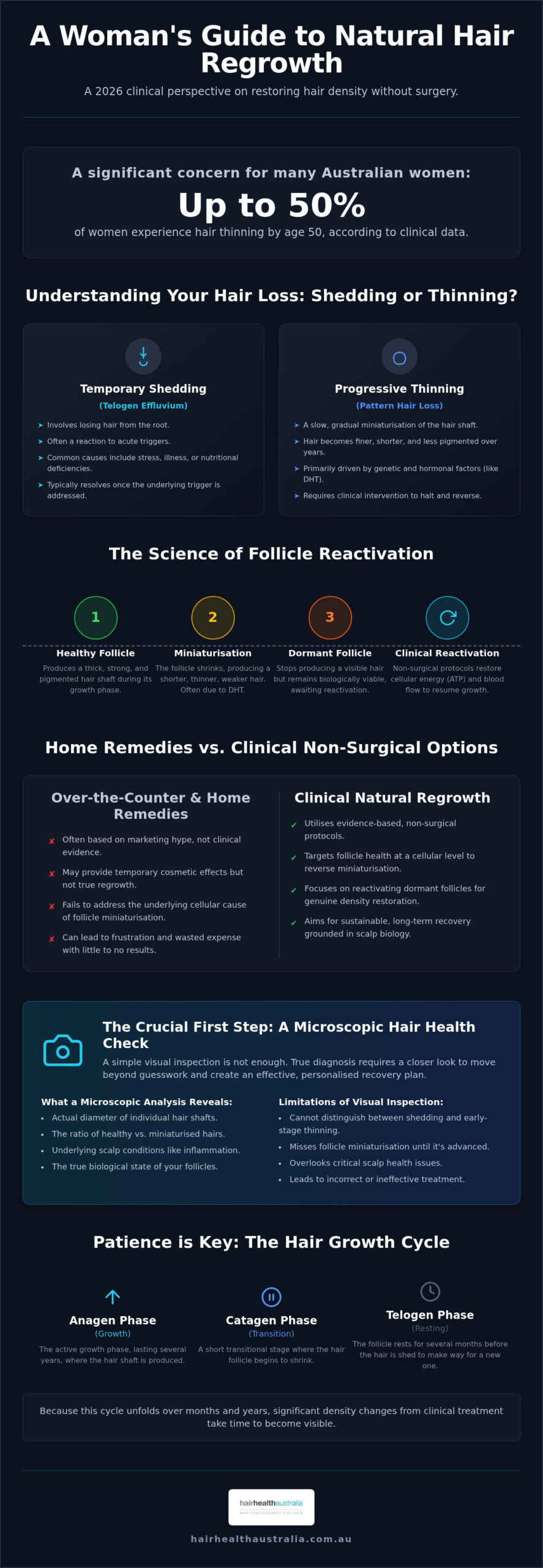
Have you ever found yourself tilting your head away from the harsh glow of overhead lights or feeling a pang of anxiety when the wind catches your hair? It’s a deeply personal vulnerability that many Australian women share, especially since clinical data suggests that up to 50 percent of women experience thinning by age 50. The search for effective natural hair regrowth options for women often leads to a frustrating maze of contradictory social media advice and expensive “miracle” oils. You deserve a solution that’s grounded in clinical reality rather than marketing hype.
We understand that the fear of invasive surgery can be just as daunting as the thinning itself. This 2026 guide promises to replace your uncertainty with a clear, scientific understanding of your scalp health. You’ll learn how non-surgical protocols and microscopic analysis can restore your hair density by addressing the underlying biology of your follicles. We’ll explore the evidence-based reality of regenerative care and outline a structured, non-invasive path to recovery that focuses on results without the need for a theatre or a scalpel.
Key Takeaways
- Understand the biological distinction between temporary shedding and genetic thinning to ensure you are treating the correct underlying cause.
- Discover why clinical natural hair regrowth options for women outperform over-the-counter remedies by targeting follicle miniaturisation at a cellular level.
- Learn how to optimise your scalp environment through professional hygiene standards and by managing the impact of cortisol on your hair growth cycle.
- Identify why a microscopic Hair Health Check is the only way to gain a true diagnosis and move beyond the limitations of a simple visual inspection.
What Does ‘Natural’ Hair Regrowth Actually Mean for Women?
In the context of 2026 clinical standards, “natural” refers to non-surgical protocols that stimulate your body’s own biological pathways to restore hair density. It’s a move away from invasive hair transplant surgery and toward systematic, evidence-based care. When exploring natural hair regrowth options for women, it’s vital to recognise that “natural” doesn’t mean “unregulated” or “unproven.” True clinical results rely on verified methodologies that reactivate dormant follicles rather than attempting to revive dead ones. A dormant follicle is one that has stopped producing a visible hair but remains biologically viable, whereas a dead follicle has undergone permanent cicatricial changes. Many women mistakenly believe their hair loss is permanent, when in reality, their follicles are simply stuck in a resting phase, waiting for the correct physiological signals to resume growth.
The Difference Between Shedding and Thinning
Identifying whether you are experiencing temporary shedding or progressive thinning is the first step toward recovery. Telogen Effluvium, or excessive shedding, often involves losing hair from the root due to acute triggers like stress or nutritional deficiencies, whereas Pattern hair loss involves a slow miniaturisation of the hair shaft over years. Breakage is a separate issue entirely, often exacerbated by the intense Australian sun and frequent exposure to salt water, which can leave the hair shaft brittle and prone to snapping. Because these conditions often overlap and look identical to the naked eye, a Hair Health Check is required. This microscopic analysis allows a specialist to see the actual diameter of your hair shafts and the health of your scalp environment, providing a level of detail that a bathroom mirror simply can’t offer.
Managing Realistic Expectations in 2026
Patience is a prerequisite for success because hair biology operates on its own internal schedule. The hair growth cycle consists of the Anagen (growth) phase, the Catagen (transition) phase, and the Telogen (resting) phase. Because these stages occur over months and years, significant changes in density take time to manifest as new, stronger shafts emerge from the scalp. Choosing natural hair regrowth options for women means committing to a clinical path backed by data rather than the immediate, but often temporary, results of cosmetic concealers. This methodical approach ensures you’re building genuine biological resilience. By focusing on cellular health and scalp optimisation, we aim for a recovery that is sustainable and grounded in your body’s natural ability to regenerate.
The Science of Follicle Reactivation
Understanding how follicles function is essential for anyone evaluating natural hair regrowth options for women. Follicle miniaturisation is a progressive biological process where the hair follicle gradually shrinks, resulting in a shorter, thinner, and less pigmented hair shaft. This process doesn’t happen overnight. It’s a slow decline that, if left unaddressed, can lead to the follicle becoming dormant. To reverse this, we must focus on cellular energy, specifically Adenosine Triphosphate (ATP). ATP is the primary energy carrier in all living cells. In the scalp, it provides the fuel necessary for the keratinisation process, which directly influences the diameter and strength of the hair shaft. Without sufficient ATP, the follicle simply lacks the power to produce a healthy, robust hair.
Blood flow is the delivery system for this energy. A healthy scalp requires a rich supply of oxygen and nutrients to sustain the high metabolic demands of the hair growth cycle. In many cases of Female pattern baldness, DHT (dihydrotestosterone) acts as a biological inhibitor. It binds to receptors in the follicle, shortening the growth phase and triggering miniaturisation. Successfully blocking these signals through non-surgical, clinical protocols is a biological necessity for restoring density and preventing further loss.
Nutrient Delivery and Scalp Health
Think of your scalp as the soil and your hair as the seed. Even the best seeds won’t flourish in depleted, inflamed soil. Keratinisation, the process by which cells are converted into hair protein, depends on a precise balance of vitamins and minerals. Chronic inflammation can effectively “strangle” a follicle, restricting blood flow and causing premature shedding. When assessing natural hair regrowth options for women, we must prioritise a calm, nutrient-rich scalp environment to support long-term recovery.
The Role of Hormones in Female Thinning
A common misconception is that hair loss only occurs when hormone levels are out of balance. In reality, thinning is often caused by the follicle’s increased sensitivity to normal androgen levels. This sensitivity is frequently triggered by significant life events such as post-pregnancy recovery or menopause, where shifting oestrogen levels leave follicles more vulnerable to DHT. Recognising the Early Signs of Alopecia in Women allows for intervention before miniaturisation becomes advanced. If you’ve noticed changes in your parting or hair volume, a professional Hair Health Check can provide the scientific clarity needed to start a targeted recovery programme.
Home Remedies vs. Clinical Non-Surgical Options
The distinction between “kitchen cupboard” solutions and medical-grade non-surgical care is often the difference between managing symptoms and achieving genuine recovery. While essential oils like rosemary have gained significant social media attention, they often lack the standardised potency and molecular structure required to penetrate the scalp effectively. Clinical topicals are formulated with specific delivery systems that ensure active ingredients reach the follicle bulb. Over-the-counter supplements also face limitations; while they support general health, they rarely provide the targeted biological signals needed to reverse genetic thinning. Evaluating natural hair regrowth options for women involves looking beyond the marketing of “miracle” gummies and toward protocols that have been verified through clinical observation.
Low-Level Laser Therapy (LLLT) has emerged as a leading light-based stimulant that fits within a natural, non-invasive framework. This technology uses specific wavelengths of light to invigorate cellular activity without heat or discomfort. It works by stimulating the mitochondria within the hair cells, essentially “recharging” the follicle to encourage thicker growth. Unlike home kits that often provide inconsistent energy output, professional-grade protocols offer superior bio-availability and precision, ensuring the light energy is delivered exactly where it’s needed most.
Why Home Treatments Often Fail
The primary hurdle for home remedies is a lack of penetration. Most oils and supermarket regrowth products sit on the surface of the scalp, unable to bypass the skin’s natural barrier to reach the follicle. This “one-size-fits-all” approach ignores the unique physiological needs of your scalp. Perhaps most concerning is the danger of delay. Many women spend months or years trialling unproven remedies while their follicles continue to miniaturise. By the time they seek professional help, the window for reactivation may have narrowed, making the recovery process more complex than it would have been with early intervention.
The Clinical Non-Surgical Advantage
Clinical programmes succeed because they combine multiple natural triggers for a synergistic effect. Rather than relying on a single ingredient, a structured protocol addresses blood flow, nutrient delivery, and hormonal sensitivity simultaneously. This multi-faceted approach is outlined in our Best Hair Regrowth Treatment Australia guide, which details how integrated care outperforms isolated home attempts. Regular monitoring and protocol adjustments ensure that as your scalp health improves, your treatment evolves to meet your changing needs. If you’re ready to move beyond trial and error, a professional Hair Health Check is the essential first step toward a personalised, evidence-based solution.
Optimising Your Scalp Environment at Home
Optimising your scalp environment at home is the foundation for any clinical intervention. While we often focus on external treatments, the daily habits you maintain can either support or sabotage your progress. Hygiene is paramount. Contrary to some social media trends suggesting “no-poo” methods, clinical evidence shows that regular cleansing is essential to remove sebum, sweat, and environmental pollutants. When sebum accumulates, it can create an inflammatory environment that hinders natural hair regrowth options for women. For most, washing every second or third day with a pH-balanced cleanser is the ideal frequency to maintain an optimal growth environment.
Stress management is equally critical. Elevated cortisol levels can prematurely push follicles from the growth phase into the resting phase, leading to a condition known as Telogen Effluvium. While you cannot always control external stressors, managing your physiological response is a key component of a holistic recovery plan. Similarly, avoiding mechanical damage from tight ponytails or excessive heat tools prevents unnecessary traction and breakage. Protecting the hair you have is just as important as encouraging new growth.
Scalp Massage and Blood Flow
Scalp massage is often dismissed as a mere relaxation technique, but it has a measurable impact on micro-circulation. Gentle, circular motions can help dilate the small blood vessels surrounding the follicle, improving the delivery of oxygen and nutrients. It’s vital to avoid aggressive rubbing or traction which can pull on weakened hairs. Using a clinical-grade stimulant as a vehicle for this massage ensures that the active ingredients are distributed evenly across the scalp surface, providing the follicles with the direct support they require.
Nutrition and Hair Density
The Australian “hair-healthy” plate should prioritise iron and protein. Low ferritin, or iron storage, is one of the most common clinical findings in women experiencing thinning. Without adequate iron, the follicle lacks the oxygen needed for cellular repair and growth. Protein is the literal building block of the hair shaft; a deficiency often results in brittle, thin hair that lacks structural integrity. Avoid “detox” diets or extreme calorie restriction, as these frequently trigger nutritional shock, leading to increased hair fall. Focus instead on consistent, nutrient-dense meals that provide a steady supply of energy to your scalp. If you’re unsure whether your current routine is supporting your goals, a Hair Health Check can identify specific scalp issues that need professional attention.
The First Step: A Professional Hair Health Check
A visual inspection in a bathroom mirror or a quick glance from a general practitioner is rarely sufficient for a true diagnosis. While you might see a wider parting or a receding hairline, these are merely symptoms of an underlying biological shift. To effectively evaluate natural hair regrowth options for women, we must look beneath the surface. Microscopic hair and scalp analysis allows us to identify the specific stage of follicle miniaturisation and assess the health of the scalp environment with clinical precision. Without this data, any attempt at regrowth is based on guesswork rather than science. Data-driven insights ensure that your protocol is tailored to your unique follicle density and hair shaft diameter, leading to significantly better outcomes than generic, over-the-counter solutions.
Transitioning from a cycle of “guessing” with various retail products to a structured clinical programme is a pivotal moment in your recovery. During a microscopic analysis, high-magnification sensors provide a clear view of your follicles, identifying which are dormant and which are still actively producing healthy hair. This level of detail allows us to create a baseline for your progress, making it possible to track improvements that are invisible to the naked eye. It moves the conversation from vague hope to measurable, evidence-based results.
What to Expect at our Sydney Clinic
Our Sydney clinic provides a professional, clinical environment where your concerns are addressed with both empathy and medical authority. You won’t find hyperbolic marketing here; instead, you’ll receive a personalised report detailing your current follicle health and hair density. We provide no-nonsense advice on your best path forward, ensuring you understand exactly what is achievable. This transparency builds a foundation of trust, allowing you to move forward with a clear understanding of the biological reality of your hair health.
Take Control of Your Hair Journey
Early intervention remains the most critical factor in successful natural regrowth. The sooner you address follicle miniaturisation, the greater the likelihood of restoring significant density before the follicles become permanently inactive. There is a profound sense of confidence that comes from having a clear, clinical plan in place. You no longer have to wonder if a treatment is working; you’ll have the data to prove it. If you’re ready to stop the uncertainty and start a verified path to recovery, the first step is simple. Book your comprehensive Hair Health Check today and discover the clinical reality of your natural hair regrowth options for women.
Your Path to Restored Hair Density
Understanding the biological reality of your scalp is the most powerful tool you have in the journey toward recovery. We’ve explored how natural hair regrowth options for women rely on scientific precision rather than guesswork, specifically by targeting follicle miniaturisation through evidence-based, non-surgical protocols. Since 2009, our Sydney specialists have focused on replacing uncertainty with clarity, using clinical microscopic analysis to identify exactly where your hair health stands. You don’t have to settle for thinning or the confusion of unproven home remedies that fail to reach the follicle bulb.
A structured clinical plan ensures that your scalp environment is optimised and your follicles receive the cellular energy they need to thrive. The transition from noticing loss to taking action is often the most significant step. By choosing a path grounded in clinical standards, you’re investing in the long-term resilience and density of your hair. We invite you to move forward with confidence and a clear diagnostic foundation. Book Your Clinical Hair Health Check today to begin your personalised recovery journey. Your hair has the potential to regrow; it simply needs the right clinical environment to do so.
Frequently Asked Questions
Can thinning hair truly grow back naturally for women?
Yes, thinning hair can grow back provided the follicles are still biologically active and haven’t undergone permanent scarring. Success depends on identifying dormant follicles through microscopic analysis and using targeted natural hair regrowth options for women to stimulate the root. If the follicle has permanently closed, regrowth is not possible. Early intervention is essential to catch thinning before it progresses to permanent loss, ensuring the best chance for restored density.
How long does it take to see results from natural regrowth options?
Most women begin to notice visible improvements in hair density within three to six months of starting a clinical programme. This timeline aligns with the natural hair growth cycle, as it takes time for new, stronger shafts to emerge from the scalp during the growth phase. While some initial changes in scalp health occur sooner, patience is required to see the full biological impact of non-surgical stimulation and consistent care.
Is female pattern hair loss the same as male pattern baldness?
While both conditions are often linked to genetics and hormones, they manifest quite differently across the scalp. Men typically experience a receding hairline or a bald spot at the crown, whereas women usually see diffuse thinning across the top of the head or a widening part. Understanding these patterns is vital for an accurate diagnosis, as the clinical approach for female thinning must account for these specific presentation styles.
Are there any side effects to non-surgical clinical treatments?
Non-surgical clinical treatments are designed to be non-invasive and generally carry a much lower risk profile than surgical alternatives. Most women experience no significant side effects when using light-based therapies or professional topical stimulants. Because these protocols avoid the risks associated with theatre and anaesthesia, they offer a safer path for those seeking to improve their hair density without the complications of invasive procedures or long recovery times.
Can stress cause permanent hair loss in women?
Stress typically triggers a temporary condition called Telogen Effluvium, which causes excessive shedding rather than permanent follicle death. However, chronic stress can exacerbate existing genetic thinning if it’s left unmanaged over a long period. While the hair lost during a stressful period usually grows back, it’s important to monitor the recovery process to ensure the follicles return to their normal growth cycle without a long-term reduction in shaft diameter.
How much does a professional hair health analysis cost in Sydney?
The cost of a professional analysis in Sydney depends on the depth of the diagnostic tools required for your specific concerns. At our clinic, we prioritise the Hair Health Check as the essential starting point for any treatment journey. This session provides a comprehensive microscopic view of your scalp and follicles, allowing us to build a structured, data-driven plan without the guesswork often associated with expensive, over-the-counter retail products.
Will my hair fall out again if I stop the treatment?
If your hair loss is driven by genetic factors, some level of maintenance is usually necessary to sustain your results. Stopping treatment means the follicles are no longer receiving the stimulation required to counter the miniaturising effects of DHT. We focus on creating sustainable protocols that help you maintain your restored density over the long term, ensuring your hair remains healthy and robust even after the initial intensive phase.
Can I use natural regrowth options while pregnant or breastfeeding?
Safety is the primary concern during pregnancy and breastfeeding, so certain clinical stimulants and medications must be paused during this time. While many natural hair regrowth options for women are non-invasive, we always recommend a consultation with our Sydney specialists to review your specific protocol. We can help you adjust your hair health routine to ensure it remains safe for both you and your baby while managing hormonal shedding.