
What if finding loose hair in your shower drain isn’t an early sign of going bald, but proof that your scalp biology is functioning as intended? It’s completely understandable to feel a jolt of anxiety when you notice stray strands across your pillow or clothing. Many Australians immediately wonder how much shedding is normal, caught between the fear of permanent genetic loss and the confusion of everyday follicle turnover.
Watching loose hair accumulate can feel deeply unsettling, particularly when harsh commercial products promise rapid fixes without clinical backing. You don’t have to guess whether your daily strand count falls within healthy physiological limits. In this guide, you’ll discover the biological benchmarks of daily hair fall, clear criteria to separate temporary shedding from progressive follicle miniaturisation, and the diagnostic pathways used to evaluate scalp health accurately. Let’s examine how the natural hair cycle operates and what your daily loss truly indicates.
Key Takeaways
- Understand the clinical baseline of follicular turnover to determine how much shedding is normal versus a potential biological disruption.
- Learn how the natural growth cycle keeps up to 90 per cent of follicles active, making daily strand release an expected physiological process.
- Differentiate between temporary telogen shedding and progressive follicle miniaturisation before pursuing targeted interventions.
- Recognise key systemic triggers, from acute physiological stress to postpartum hormonal shifts, that disrupt follicular timing.
- Pinpoint the specific signs that warrant objective microscopic scalp diagnostics to evaluate follicle density and bulb health accurately.
What Is Normal Hair Shedding? Understanding the Daily Benchmark
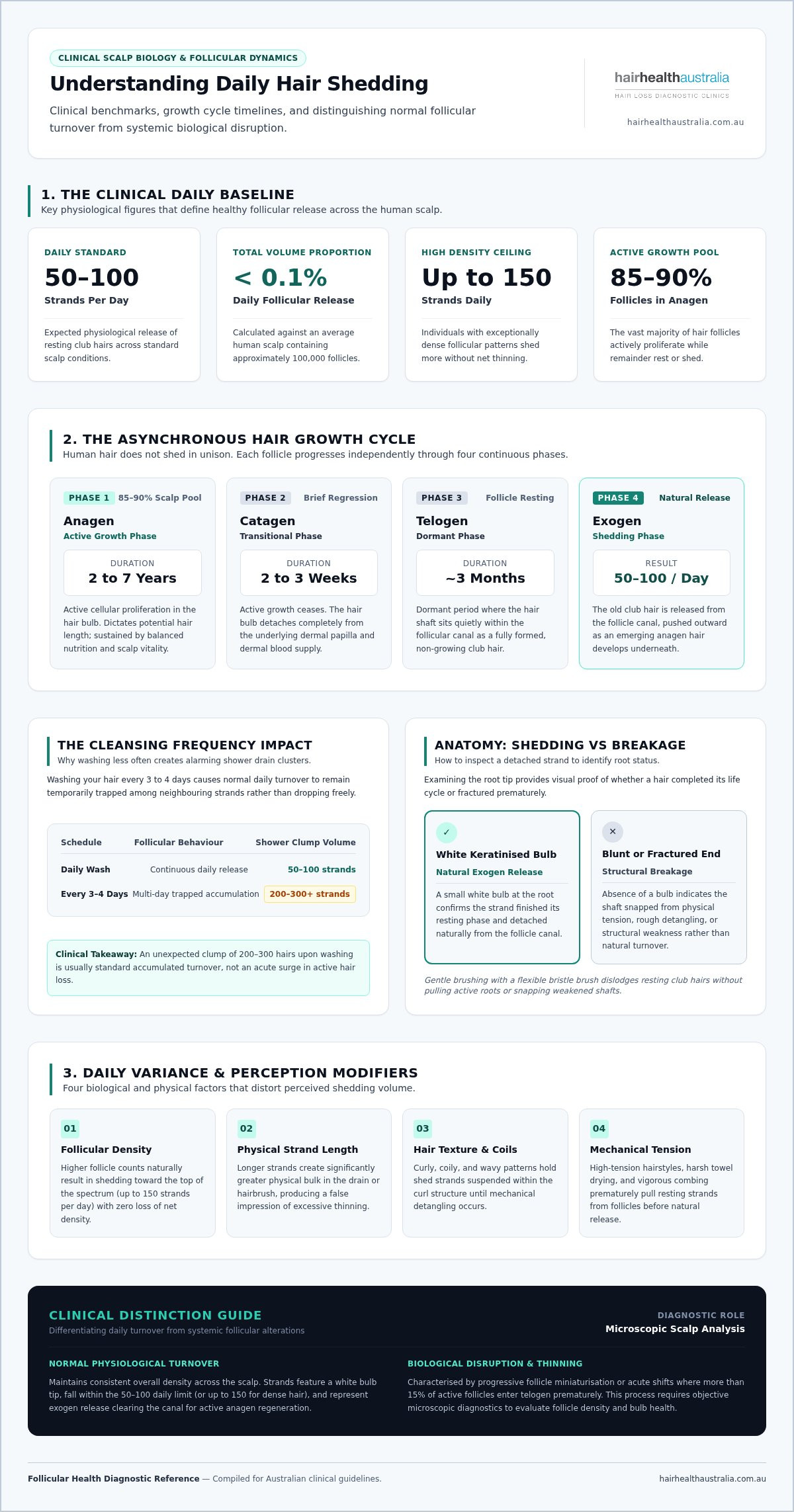
Clinical dermatologists widely agree that shedding between 50 and 100 hairs per day represents standard follicular turnover. On an average scalp containing approximately 100,000 follicles, this release accounts for less than 0.1 per cent of your total hair volume. However, establishing exactly how much shedding is normal requires looking beyond static figures, as natural variance in scalp density and daily grooming habits significantly alter what you see in the basin.
Every strand naturally progresses through the biological hair growth cycle, culminating in release. Yet daily visibility depends heavily on your individual baseline and styling routine:
- Baseline Follicle Density: People with exceptionally dense hair naturally shed toward the higher end of the spectrum, up to 150 strands daily, without experiencing any net thinning.
- Mechanical Tension: High-tension hairstyles, rough towel drying, and aggressive detangling forcibly dislodge resting strands before they release naturally.
- Physical Length: Longer strands create substantial physical bulk when collected, giving the false impression of severe shedding despite normal strand counts.
The 50 to 100 Strands Benchmark Explained
Daily hair fall primarily consists of club hairs, which are fully formed strands that have completed their resting phase. If you examine a naturally shed hair, you should spot a tiny, white keratinised bulb at the root tip. This bulb confirms the hair detached naturally from a resting follicle rather than breaking along the shaft from structural weakness.
How Wash Frequency and Hair Type Impact Shedding
Your cleansing frequency dramatically shapes your daily count. If you wash your hair every three to four days, the 50 to 100 hairs shed naturally each day remain trapped among your remaining strands. When you finally shampoo, several days of accumulated hair dislodge all at once, creating an alarming clump that easily exceeds 200 to 300 loose strands.
Hair texture plays an identical role. Curly, coily, and wavy hair types prevent detached strands from falling freely onto clothing or pillows. These loose hairs stay suspended in the curl pattern until detangling occurs. Gentle, consistent brushing with a flexible bristle brush helps remove these shed strands gradually, preventing them from tangling, pulling at active roots, or matting against the scalp.
The Biological Hair Growth Cycle: Why Strands Fall Out
Human scalp hair does not grow in unison. Instead, each follicle functions independently through an asynchronous four-phase cycle. Because individual follicles operate on separate timelines, you never experience mass molting like other mammals. Under healthy conditions, roughly 85 to 90 per cent of your 100,000 scalp follicles remain actively growing at any given moment, while the remainder rest or prepare to detach.
Understanding this continuous biological turnover clarifies how much shedding is normal across typical daily routines. When biological triggers disrupt this timing, a higher percentage of active hairs can get pushed prematurely into shedding phases, altering your regular baseline.
Phase 1 and 2: Anagen (Growth) and Catagen (Transition)
The anagen phase represents active cellular proliferation within the hair bulb. This stage spans anywhere from two to seven years, largely determining your maximum potential hair length. Balanced nutrition and scalp vitality support this prolonged growth window. Once anagen concludes, the strand enters catagen. Lasting roughly two to three weeks, this brief transitional phase signals the hair bulb to detach completely from the underlying dermal papilla and dermal blood supply.
Phase 3 and 4: Telogen (Resting) and Exogen (Shedding)
Following catagen, the follicle enters telogen, a dormant resting period lasting approximately three months. The hair shaft sits quietly in the follicle as a club hair. Finally, the exogen phase begins. During exogen, the old club hair releases from the follicle opening, pushed outward as an emerging anagen hair develops beneath it.
Daily shedding is simply this exogen release in action. It is an essential mechanism that clears the follicle canal for new growth. If you feel uncertain about your strand loss, a thorough hair health check can evaluate whether your follicles are maintaining their natural growth intervals or entering resting phases prematurely.
Hair Shedding vs. Hair Thinning: Critical Differences
Losing strands daily causes understandable alarm, but hair shedding and true hair thinning represent entirely distinct physiological events. People frequently question how much shedding is normal when they see sudden clumps on their clothes. While shedding involves an increase in the number of hairs falling out, thinning is an architectural change where the hair follicle itself shrinks over time.
Understanding these distinct biological pathways helps you take appropriate, measured action rather than reaching for unproven commercial remedies:
- Follicle Architecture: Acute shedding leaves the root structure intact, whereas thinning progressively reduces the physical diameter of individual hair shafts.
- Distribution: Shedding causes generalised, diffuse density loss across the entire scalp. Thinning typically concentrates in specific zones such as the crown, temples, or mid-parting line.
- Resolution: Shedding generally self-corrects once underlying physiological stressors resolve. Thinning requires active, targeted intervention to halt progressive follicular decline.
Characteristics of Excessive Hair Shedding (Telogen Effluvium)
Excessive shedding, clinically termed telogen effluvium, occurs when a physiological shock pushes up to 30 to 50 per cent of growing hairs into the resting phase simultaneously. Because the resting phase lasts roughly three months, diffuse hair fall typically begins eight to twelve weeks after the initial trigger. You might notice your ponytail circumference shrinking noticeably, but your hairline remains completely intact. Crucially, telogen effluvium does not cause permanent follicle death.
Characteristics of Progressive Follicle Miniaturisation
True thinning, or androgenetic alopecia, stems from genetic sensitivity to dihydrotestosterone (DHT). This androgen causes terminal hair follicles to undergo progressive miniaturisation, producing progressively finer, shorter vellus hairs with each subsequent cycle. Rather than a sudden drop in strand count, you see gradual scalp exposure along the vertex or a widening parting. Consulting clinical resources on early signs of alopecia in women helps clarify whether visible scalp changes stem from systemic shedding or localised miniaturisation that requires specialised clinical care.
Common Triggers That Turn Normal Shedding into Telogen Effluvium
While establishing how much shedding is normal gives you a reliable baseline, acute physiological disruptions can suddenly destabilise this biological rhythm. When a systemic shock occurs, follicles prematurely terminate their growth phase. The result is telogen effluvium, an acute condition where daily strand counts surge well beyond typical thresholds.
Identifying the root cause requires tracing your health history back several months, as follicles respond to internal changes on a delayed timeline:
- Systemic Illness: High fevers, viral infections, and surgical procedures divert metabolic resources away from hair production.
- Crash Dieting: Rapid weight reduction and severe caloric restriction deprive follicles of vital amino acids.
- Medication Changes: Starting or stopping oral contraceptives, blood pressure drugs, or hormone therapies can destabilise follicular cycling.
Physiological and Emotional Shock to the System
Severe psychological trauma, bereavement, or sudden illness trigger an acute surge of stress neurochemicals. These compounds signal dividing cells in the hair bulb to halt prematurely. Because telogen lasts between 60 and 90 days, the physical shedding wave only becomes apparent two to three months after the initial event. Postpartum shedding follows a similar pattern. Elevated pregnancy oestrogen artificially prolongs anagen, but once hormone levels crash after birth, thousands of extended hairs release in unison.
Nutritional Deficiencies and Thyroid Imbalances
Follicles possess exceptionally high metabolic demands. When nutrient availability drops, non-essential tissues suffer first. Depleted serum ferritin levels severely compromise cellular repair within the hair matrix, while vitamin D deficiency and inadequate protein intake stall cellular turnover. Similarly, thyroid irregularities disrupt resting metabolic rates throughout the scalp. Rather than guessing with over-the-counter supplements, arrange comprehensive blood pathology to identify your precise biochemical markers.
When telogen shedding persists beyond six months, it may unmask early pattern thinning or develop into a chronic condition. In these cases, exploring targeted hair loss treatment for women provides structured clinical support to reactivate sluggish follicles. If you want objective answers about your daily shedding, book a comprehensive hair health check to examine your scalp under magnification and establish an evidence-based recovery plan.
When to Seek Professional Evaluation: The Role of Microscopic Analysis
Pinpointing how much shedding is normal helps you manage minor daily fluctuations, but protracted strand loss requires structured clinical attention. A standard telogen shedding phase naturally tapers off within three to four months. When active hair fall pushes past this window, continuing to monitor it at home risks allowing early follicular changes to advance undetected.
Objective diagnostics remove the guesswork from your recovery plan. Rather than trialling harsh over-the-counter products, consider these clinical warning signs that demand expert verification:
- Loss Duration: Diffuse shedding that continues unabated beyond four consecutive months.
- Architectural Shifts: Progressive widening of your central parting line or thinning across the vertex.
- Scalp Sensations: Persistent burning, tingling, tenderness, or excess sebum accompanying daily hair fall.
- Pull Test Irregularities: Lightly sliding fingers through a section of 50 strands yields more than six loose hairs repeatedly.
Warning Signs That Shedding Is Becoming Chronic
Chronic telogen effluvium can drag on for months, often overlapping with underlying genetic vulnerabilities. Watch for visible scalp exposure under direct indoor lighting. If shedding coincides with localised density loss around your temples or the crown of your head, the root cause extends beyond a simple reaction to temporary stress. Addressing the condition early prevents resting follicles from sliding into prolonged latency.
What to Expect During a Clinical Microscopic Hair Check
An accurate assessment begins with digital epiluminescence microscopy, commonly called trichoscopy. Operating at high magnification, this non-invasive tool scans the scalp surface to quantify follicular unit density, measure follicular exit points, and evaluate perifollicular inflammation.
Microscopic scanning inspects individual hair shaft calibres directly. When a trichoscopy scan shows uniform strand diameters across your scalp, the loss is confirmed as pure telogen shedding. Conversely, if the scan reveals shaft diameter diversity exceeding 20 per cent, it demonstrates active follicle miniaturisation. These objective measurements enable specialists to design targeted, non-surgical male hair loss treatments or female hair loss treatments tailored to your precise biology. For residents in Sydney, booking an in-depth hair health check delivers the microscopic clarity needed to safeguard your hair density.
Protecting Your Hair Density with Objective Clinical Insights
Distinguishing ordinary daily turnover from progressive thinning gives you the control to act before density suffers. While understanding how much shedding is normal provides immediate reassurance, hair fall that persists beyond three to four months or causes visible scalp exposure requires objective investigation. Healthy follicles are remarkably resilient, but timely evaluation remains the decisive factor in safeguarding long-term follicular health.
You don’t have to navigate scalp changes alone. Operating in Sydney since circa 2009, Hair Health Australia provides specialised, non-surgical male and female hair regrowth treatments grounded in science. High-precision digital microscopic scalp scans accurately measure active follicle ratios and shaft calibres, pinpointing the root cause of excessive hair fall without invasive procedures or guesswork. Take a proactive step toward clear answers and book a comprehensive hair health check today to preserve your natural hair with confidence.
Frequently Asked Questions
Is it normal to lose hair every time I wash my hair?
Yes, losing hair during washing is completely normal. The physical action of lathering and rinsing dislodges strands that detached days earlier during the natural resting phase. If you wash your hair every few days, these loose strands collect together, making the fall appear dramatic. As long as your total hair fall averages within expected physiological limits across the week, shower shedding doesn’t indicate abnormal loss.
How can I tell if my hair is shedding or breaking off?
You can differentiate shedding from breakage by inspecting the fallen strand under light. A shed hair features a small, white keratinised bulb at its root end, showing it completed its full biological growth cycle. Breakage occurs when weakened strands snap along the shaft, leaving blunt, jagged ends without a bulb. If you frequently find short, uneven fragments on your shoulders, physical damage or chemical stress is the probable culprit.
Can high stress levels cause sudden excessive hair shedding?
Yes, acute physiological or psychological stress frequently triggers excessive strand loss. Major stressors prompt cortisol surges that force growing follicles into an early resting state. Because resting hair remains anchored for approximately two to three months before releasing, this diffuse shedding appears weeks after the initial stressor has passed. Understanding how much shedding is normal helps distinguish this temporary, stress-induced telogen effluvium from genetic thinning patterns.
What does a normal shed hair bulb look like at the root?
A healthy shed strand features a tiny, firm, off-white or translucent nodule at the proximal tip, often called a club hair. This microscopic keratinised capsule confirms the follicle smoothly finished its resting phase and detached without trauma. It shouldn’t look moist, dark, or ragged. Seeing this white bulb reassures you that the follicle remains securely anchored beneath the scalp, ready to initiate a new anagen growth phase.
Does seasonal weather in Australia affect daily hair shedding amounts?
Seasonal shifts do influence human shedding patterns across Australia. Many individuals experience an evolutionary shedding peak during late summer and early autumn, particularly in coastal climates like Sydney. Increased ultraviolet exposure during peak summer months often triggers an earlier transition into the resting phase. While this seasonal peak can temporarily push counts higher, establishing how much shedding is normal for your personal baseline ensures you can spot genuine follicular decline.
How long does telogen effluvium shedding usually last before resolving?
Acute telogen effluvium generally runs its course within three to six months once the primary trigger is identified and corrected. After the shedding slows, new strands emerge at a steady rate of about one centimetre per month. If active shedding continues beyond six months without slowing down, the condition is classified as chronic telogen effluvium. At this stage, professional microscopic diagnostics become necessary to investigate deeper metabolic or genetic factors.
Will hair that sheds from daily brushing grow back naturally?
Hair shed through gentle daily brushing will grow back naturally under normal physiological conditions. Brushing merely dislodges strands that have already detached within the exogen phase, clearing room for active anagen fibres developing below. However, if hair is subjected to aggressive detangling or the follicle is undergoing genetic miniaturisation, regrowth will gradually become finer. Non-surgical clinical treatments in Sydney focus on revitalising dormant follicles to ensure sustained, healthy density over time.