
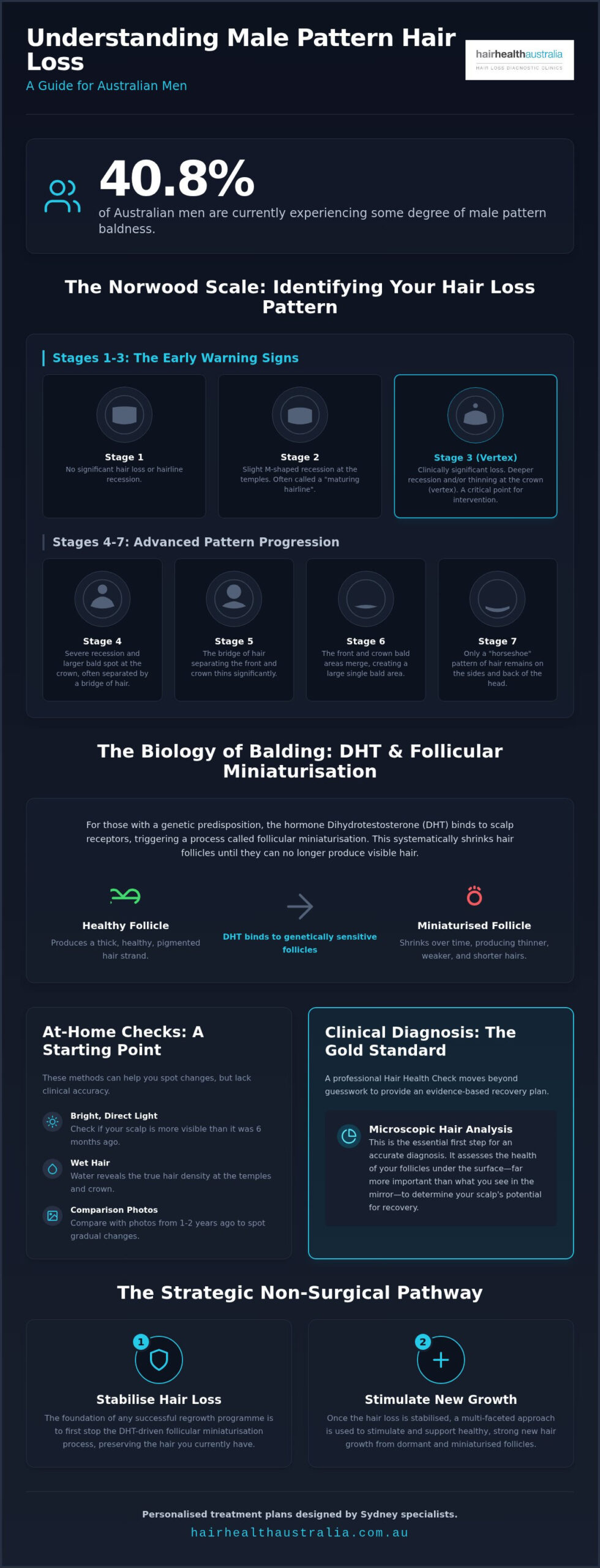
Did you know that approximately 40.8% of Australian men are currently experiencing some degree of male pattern baldness? It usually begins with a subtle shift in the mirror, perhaps a slightly higher forehead or a crown that feels less dense than it did a year ago. Identifying your specific men hair loss pattern is the first step toward regaining control over your appearance. It’s completely natural to feel a sense of anxiety about these changes, especially when conflicting online advice makes the path forward feel more like a maze than a medical process.
We understand that you want clarity without the fear of side effects or the necessity of invasive surgery. This article will help you recognise the early signs of genetic thinning and explain the clinical, non-surgical pathways available to restore your hair density. We’ll explore the biological drivers of thinning, the diagnostic importance of the Norwood Scale, and how a professional assessment at a Sydney clinic can replace uncertainty with a structured, evidence-based recovery plan.
Key Takeaways
- Identify your specific men hair loss pattern using the Norwood Scale to understand which clinical interventions are most suitable for your current stage.
- Understand the role of DHT in follicular miniaturisation and why stopping this process is the foundation of any successful regrowth programme.
- Learn why microscopic hair analysis is the essential first step for an accurate diagnosis, moving beyond the limitations of a simple bathroom mirror check.
- Discover the benefits of a multi-faceted, non-surgical approach that prioritises stabilising hair loss before stimulating healthy new growth.
- Recognise the value of a personalised treatment plan designed by Sydney specialists to address your individual hair health goals.
Understanding the Norwood Scale: Identifying Your Men’s Hair Loss Pattern
The Norwood Scale is the universal clinical standard used by specialists to categorise the progression of Androgenetic Alopecia. By providing a clear visual framework, it allows us to identify your specific men hair loss pattern with clinical accuracy. Recognising where you sit on this scale isn’t just about naming the problem; it’s about determining the window of opportunity for non-surgical intervention. While every man’s rate of progression is unique, the patterns themselves are remarkably predictable. Early detection is often the difference between simple hair maintenance and more complex restoration efforts later on.
Psychologically, seeing a defined pattern develop can be confronting and often leads to a sense of inevitability. However, moving from vague anxiety to a clinical diagnosis is incredibly empowering. It replaces uncertainty with a clear, actionable roadmap. Clinical reassurance helps you understand that while your genetics might set the stage, modern treatments can significantly alter the script. The focus here is on replacing fear with evidence-based clarity.
Stages 1 to 3: The Early Warning Signs
Many men struggle to distinguish between a “maturing hairline” and the start of Stage 2 recession. A maturing hairline is a natural shift that occurs in most men as they leave their teens, usually resulting in a slightly higher but still even line. In contrast, Stage 2 involves a deeper, M-shaped recession at the temples. Stage 3 is the critical tipping point where thinning becomes clinically significant. This stage also introduces the “Vertex” variant, where you might notice a small bald patch at the crown even if your hairline looks relatively stable. This is often the best time to start a non-surgical programme.
To check your status at home, observe your hair under these specific conditions:
- Bright, direct light: Check if the scalp is more visible through the hair than it was six months ago.
- Wet hair: Water clumps hair together, making it easier to see the true density at the temples and crown.
- Comparison photos: Look at photos from two years ago to spot subtle shifts in your forehead height or temple depth.
Stages 4 to 7: Advanced Pattern Progression
As the men hair loss pattern moves into Stage 4 and beyond, the recession at the front and the thinning at the crown begin to converge. A distinct bridge of hair often remains between these two areas in Stage 4, but this bridge eventually thins out as you move toward Stage 5. By the time a man reaches Stage 6 or 7, the classic “horseshoe” pattern appears. This leaves only the hair on the sides and back of the head, which is genetically programmed to be more resistant to thinning.
Even at these advanced stages, clinical intervention remains valuable for many. The goal often shifts toward preserving the remaining active follicles and improving the health of the existing hair to maintain as much coverage as possible. Regardless of your current stage, booking a Hair Health Check is the most reliable way to get a professional microscopic assessment of your scalp’s potential for recovery. Identifying the health of your follicles under the surface is far more important than what you see in the mirror alone.
The Biology of Balding: DHT and the Miniaturisation Process
While many factors can influence hair density, the primary driver behind the vast majority of genetic hair loss cases is Dihydrotestosterone (DHT). This hormone is a derivative of testosterone and plays a critical role of genetics and DHT in hair loss by binding to receptors in your scalp. For those with a genetic predisposition, this interaction triggers a systematic decline in hair quality known as follicular miniaturisation. It is important to distinguish this from Telogen Effluvium, which is a temporary shedding phase often caused by sudden stress or illness. In contrast, a permanent men hair loss pattern involves a progressive change in the follicle’s physical structure. Miniaturisation is the slow shrinking of hair follicles until they can no longer produce visible hair.
How Genetics Dictate Your Scalp’s Sensitivity
There is a persistent myth that hair loss is only inherited from the mother’s side of the family. Scientific evidence shows that the genetic blueprint for balding is polygenic, meaning it can be passed down from either or both parents. Your DNA determines how sensitive the androgen receptors in your scalp are to circulating DHT. This sensitivity isn’t uniform across the entire head. Follicles at the temples and crown typically have the highest concentration of these receptors, while the hair at the back and sides is naturally more resistant. This biological variance is why even advanced thinning usually leaves a “horseshoe” of hair intact.
The Hair Growth Cycle: Why Patterns Take Years to Form
Every hair on your head follows a three-stage cycle: Anagen (growth), Catagen (transition), and Telogen (resting). In a healthy scalp, the Anagen phase lasts between two and six years. DHT disrupts this rhythm by progressively shortening the growth phase. With each subsequent cycle, the hair produced is finer, shorter, and loses its pigment. This explains why your hair might feel “wispy” or less manageable long before you see a distinct bald patch.
One of the most encouraging aspects of modern clinical recovery is the understanding of dormancy. A follicle is not necessarily “dead” the moment it stops producing a visible hair. In many cases, the follicle is simply dormant and miniaturised. If you intervene while the follicles are still active, there is a much higher chance of success. Understanding the current state of your scalp is the only way to move forward with confidence. A professional Hair Health Check provides the microscopic detail needed to see exactly which follicles are capable of being revitalised through a targeted regrowth programme.
Clinical Diagnosis vs. Visual Guesswork: The Value of a Hair Health Check
Relying on a bathroom mirror to track your hair’s health is a bit like checking a car’s engine by looking at the paintwork. While you might notice a receding hairline or a thinning crown eventually, the mirror only shows the results of a biological process that has been underway for years. A professional clinical diagnosis and treatment for hair loss is the only way to move beyond guesswork and understand the specific state of your follicles. At our Sydney clinic, we use advanced technology to look beneath the surface. The naked eye cannot see these subtle changes.
Establishing a baseline through digital tracking is essential. It allows for an objective measurement of your treatment’s progress over several months. Without these metrics, it’s easy to become discouraged or confused by normal daily fluctuations in how your hair looks. We encourage every man noticing a change to book a professional Hair Health Check to get a definitive answer about their scalp health. Precision is the foundation of any successful recovery.
What Microscopic Scanning Reveals
High-magnification scans are a cornerstone of our diagnostic process. These scans allow us to identify the exact percentage of miniaturised hairs in a specific area, which is a key indicator of a developing men hair loss pattern. By measuring hair density, specifically the number of hairs per square centimetre, we can create a precise map of your scalp’s current condition. This process also reveals underlying scalp health factors such as sebum build-up or localised inflammation. These issues often exacerbate genetic thinning and must be addressed to create the best possible environment for regrowth.
The Limitations of Self-Diagnosis
Many men fall into the trap of counting hairs in the shower drain as a way to measure their loss. This is an unreliable metric because it’s normal to lose between 50 and 100 hairs a day. Pattern baldness is not about how many hairs fall out, but about the quality of the hairs that grow back in their place. Additionally, different hairstyles or longer lengths can easily mask the true extent of thinning for a long time. The greatest danger of self-diagnosis is the temptation to use generic over-the-counter products. Without understanding your specific men hair loss pattern, you risk wasting time and money on treatments that may not be appropriate for your level of follicular miniaturisation.
Strategic Non-Surgical Management for Pattern Thinning
Managing a men hair loss pattern effectively requires more than a reactive purchase of a generic shampoo. Our clinical philosophy centres on a two-stage process: first, we must stabilise the existing loss, and second, we work to stimulate regrowth in dormant follicles. This multi-faceted approach is far more effective than relying on a single “magic” ingredient because it addresses the problem from multiple biological angles simultaneously. These programmes are meticulously designed to align with the body’s natural hair growth cycles. This ensures that treatments are introduced at the optimal time for maximum absorption and efficacy. For a deeper understanding of these protocols, you can read our Clinical Hair Treatment guide.
Follicle Stimulation and Scalp Nutrition
Clinical-grade topicals are significantly more potent than standard supermarket shampoos. The latter often lack the necessary concentration of active ingredients to penetrate the scalp effectively. A primary goal of these treatments is to increase localised blood flow. By enhancing circulation, we “feed” the follicles with essential nutrients and oxygen required for healthy hair production. We often supplement this with non-invasive stimulation techniques, such as low-level light therapies. These methods energise the cells within the follicle to extend the growth phase without the need for surgery. This synergistic approach ensures the scalp environment is optimised for hair density.
DHT Blockers and Hormonal Balance
To halt the progression of a men hair loss pattern, we must address the hormonal root cause. This involves inhibiting the enzyme known as 5-alpha-reductase, which converts testosterone into DHT. By lowering DHT levels in the scalp, we reduce the pressure on sensitive follicles and stop the miniaturisation process. We understand that many men have concerns about side effects. From a clinical perspective, these risks are often manageable through personalised dosing and professional oversight. Stabilising your current hair is just as vital as growing new hair. Without a stable foundation, any new growth will eventually be subject to the same genetic thinning. This is why a consistent, long-term strategy is essential for lasting results.
If you’re ready to move beyond generic solutions and want a plan tailored to your specific needs, the best way to start is by booking your Hair Health Check today.
Why Sydney Men Choose Hair Health Australia for Regrowth
Sydney men are increasingly seeking specialists who understand the nuances of a men hair loss pattern rather than relying on generic, over-the-counter solutions. Since 2009, Hair Health Australia has provided a dedicated professional environment for those looking to address thinning without resorting to invasive procedures. Every Male Hair Loss Treatment we provide is personalised to the individual. We don’t believe in “one-size-fits-all” kits because your scalp’s biology is as unique as your thumbprint. Being treated in a professional clinical centre offers a level of reassurance and accountability that simply cannot be matched by buying unregulated products online.
Our commitment to non-surgical methods is central to our philosophy. Many of our clients wish to avoid the significant costs and potential recovery risks associated with hair transplant surgery. By focusing on clinically-backed regrowth programmes, we provide a pathway that works with your body’s natural systems. This approach prioritises the long-term health of your existing hair while systematically revitalising dormant follicles. It’s about achieving a natural-looking restoration through precise, evidence-based care and professional oversight.
The Journey: What to Expect in Your First Six Months
Patience is a fundamental component of any successful restoration journey. Real regrowth takes time. You should expect a minimum of three to six months before visible changes become apparent in the mirror. During the early stages, some men experience what’s known as a “shedding phase”. This is actually a positive clinical sign. It indicates that healthier, stronger hairs are beginning to grow and are pushing out the old, miniaturised hairs that were stuck in a weakened state. We don’t ask you to take our word for it. We use regular digital microscopic scans to provide objective proof of your progress, allowing you to see the increase in density at a cellular level long before it’s obvious to the naked eye.
Taking the First Step Toward Restoration
The link between early detection and successful outcomes is undeniable. Identifying a men hair loss pattern in its initial stages allows for much more effective stabilisation and a higher chance of significant regrowth. We invite you to a confidential consultation where we can discuss your specific concerns with “straight-talking” clinical honesty. We won’t over-promise or use hyperbolic marketing language. Instead, we’ll provide a realistic assessment of what can be achieved based on your current follicular health. Taking that first step is often the hardest part, but it’s the only way to replace anxiety with a structured, professional plan. You can begin this process by booking a Hair Health Check at our Sydney clinic today.
Take Control of Your Hair Restoration Journey
Recognising a developing men hair loss pattern is the most significant step toward preserving your hair density. We’ve explored how the Norwood Scale provides a clinical roadmap and why understanding the biological role of DHT is essential for effective treatment. Moving beyond the limitations of the bathroom mirror allows you to replace anxiety with a structured, evidence-based plan. Since 2009, our team of non-surgical specialists has helped men navigate this process using advanced microscopic diagnostic technology and personalised clinical programmes.
The key to successful restoration is early intervention. By identifying follicular miniaturisation while it’s still manageable, you can stabilise existing growth and stimulate dormant follicles before they become inactive. Our Sydney clinic is dedicated to providing the clarity and professional guidance you need to make informed decisions about your hair health. Don’t leave your appearance to chance when clinical, non-surgical solutions are within reach.
Book Your Comprehensive Hair Health Check in Sydney Today and start your journey toward clinical recovery with confidence. You don’t have to face hair loss alone; expert support is ready to help you restore your hair density and your confidence.
Frequently Asked Questions
How can I tell if my hairline is receding or just maturing?
A maturing hairline is a natural shift that occurs in most men, usually resulting in an even hairline about one centimetre above the juvenile line. In contrast, a receding hairline, which signals a developing men hair loss pattern, involves uneven “M-shaped” thinning at the temples. To be certain, a microscopic scan is required to check for follicular miniaturisation. This clinical diagnostic step is the only way to distinguish normal ageing from active genetic thinning accurately.
Is male pattern hair loss reversible without surgery?
While “reversing” loss suggests returning to a juvenile state, modern clinical treatments can significantly restore density and stabilise thinning without surgery. Non-surgical programmes focus on revitalising dormant follicles and halting the miniaturisation process. Your success depends on the current stage of your men hair loss pattern; if your follicles are still active but weakened, significant regrowth is achievable through targeted clinical protocols that work with your natural growth cycles.
What is the most common hair loss pattern in men?
The most common pattern is Androgenetic Alopecia, which follows the predictable stages of the Norwood Scale. It typically begins with recession at the temples or thinning at the vertex, which is the crown area. Over time, these two thinning zones often meet, leaving a “horseshoe” of hair around the back and sides. This specific pattern is responsible for approximately 95% of hair loss cases in Australian men and requires a clinical approach.
Can stress cause a permanent hair loss pattern?
Stress typically causes Telogen Effluvium, which is a temporary shedding phase rather than a permanent pattern. However, significant physiological stress can sometimes accelerate the onset of genetic thinning in those already predisposed. While the stress-induced shed itself may eventually recover, any underlying genetic loss revealed during that time will require clinical management to maintain your density. We recommend a professional assessment to determine if your shedding is temporary or part of a broader pattern.
How long does it take to see results from a clinical regrowth programme?
You should expect to see measurable clinical results within three to six months of starting a regrowth programme. The initial months focus on stabilising the loss and improving scalp health to create a better growth environment. Visible density improvements follow as the hair growth cycle resets. We use digital microscopic scanning at regular intervals to track these changes at a cellular level, providing objective proof of progress before the changes are obvious in the mirror.
Do I need a referral from a GP to visit a hair loss clinic in Sydney?
No, you don’t need a referral from a GP to visit our Sydney clinic for a Hair Health Check. You can book a consultation directly with our specialists to begin your diagnostic process. While we always encourage you to discuss your general health with your doctor, our services are specialised for hair and scalp analysis. We focus on non-surgical restoration pathways that are easily accessible to any man noticing the early signs of thinning.
Are the results of non-surgical hair treatment permanent?
Results from non-surgical treatments require ongoing maintenance because the underlying genetic driver, DHT, remains present in your system. If you stop the treatment, the miniaturisation process will eventually resume its natural course. Think of it like dental hygiene or physical fitness; consistent care is necessary to maintain the density achieved during your programme. We provide structured long-term plans to ensure your results stay stable and your hair health is prioritised over time.
What is the difference between a trichologist and a hair loss consultant?
A trichologist is a specialist in the science of the hair and scalp, focusing on the biological causes of various disorders. A hair loss consultant often works within a clinical setting to guide you through specific treatment pathways and programme options. At Hair Health Australia, our team combines clinical expertise with advanced diagnostic technology. This ensures you receive a comprehensive assessment and a personalised programme tailored to your specific needs and hair restoration goals.