
Men Hair Loss Pattern: Identifying Genetic Thinning and Clinical Recovery

Did you know that approximately 40.8% of Australian men are currently experiencing some degree of male pattern baldness? It usually begins with a subtle shift in the mirror, perhaps a slightly higher forehead or a crown that feels less dense than it did a year ago. Identifying your specific men hair loss pattern is the first step toward regaining control over your appearance. It’s completely natural to feel a sense of anxiety about these changes, especially when conflicting online advice makes the path forward feel more like a maze than a medical process.

We understand that you want clarity without the fear of side effects or the necessity of invasive surgery. This article will help you recognise the early signs of genetic thinning and explain the clinical, non-surgical pathways available to restore your hair density. We’ll explore the biological drivers of thinning, the diagnostic importance of the Norwood Scale, and how a professional assessment at a Sydney clinic can replace uncertainty with a structured, evidence-based recovery plan.

Key Takeaways

  • Identify your specific men hair loss pattern using the Norwood Scale to understand which clinical interventions are most suitable for your current stage.
  • Understand the role of DHT in follicular miniaturisation and why stopping this process is the foundation of any successful regrowth programme.
  • Learn why microscopic hair analysis is the essential first step for an accurate diagnosis, moving beyond the limitations of a simple bathroom mirror check.
  • Discover the benefits of a multi-faceted, non-surgical approach that prioritises stabilising hair loss before stimulating healthy new growth.
  • Recognise the value of a personalised treatment plan designed by Sydney specialists to address your individual hair health goals.

Understanding the Norwood Scale: Identifying Your Men’s Hair Loss Pattern

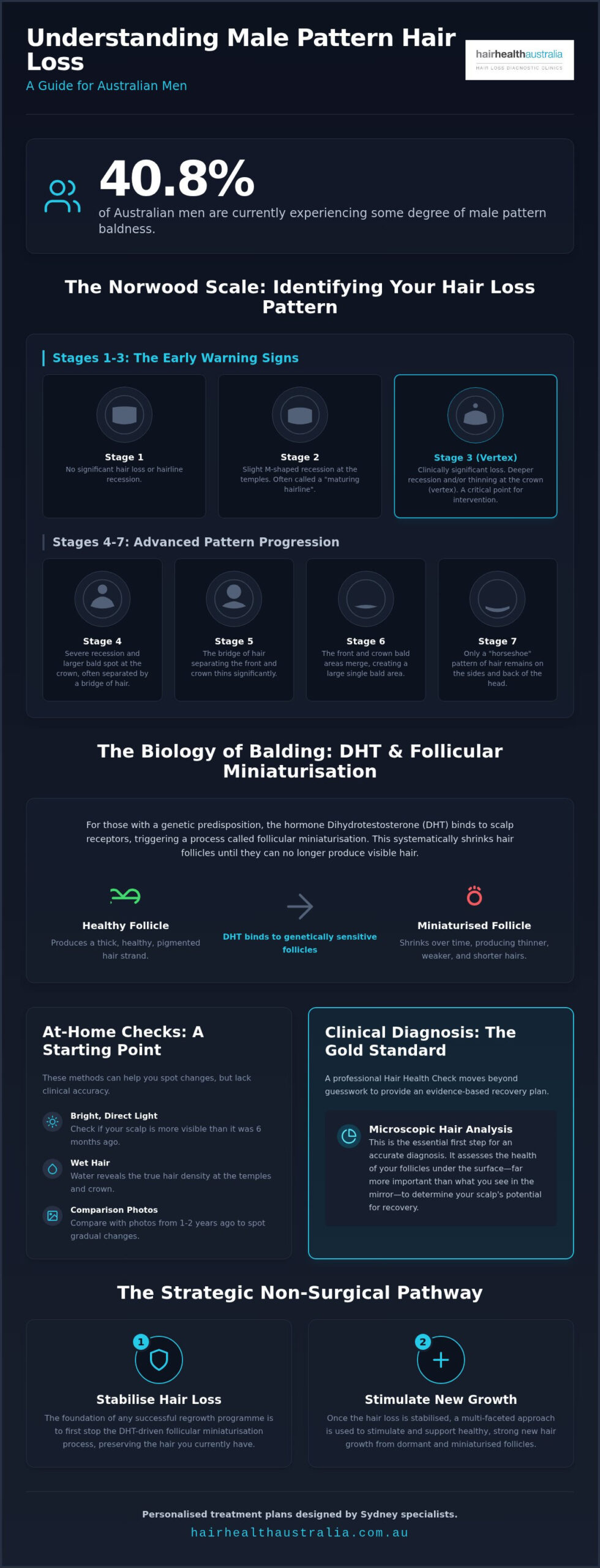
The Norwood Scale is the universal clinical standard used by specialists to categorise the progression of Androgenetic Alopecia. By providing a clear visual framework, it allows us to identify your specific men hair loss pattern with clinical accuracy. Recognising where you sit on this scale isn’t just about naming the problem; it’s about determining the window of opportunity for non-surgical intervention. While every man’s rate of progression is unique, the patterns themselves are remarkably predictable. Early detection is often the difference between simple hair maintenance and more complex restoration efforts later on.

Psychologically, seeing a defined pattern develop can be confronting and often leads to a sense of inevitability. However, moving from vague anxiety to a clinical diagnosis is incredibly empowering. It replaces uncertainty with a clear, actionable roadmap. Clinical reassurance helps you understand that while your genetics might set the stage, modern treatments can significantly alter the script. The focus here is on replacing fear with evidence-based clarity.

Stages 1 to 3: The Early Warning Signs

Many men struggle to distinguish between a “maturing hairline” and the start of Stage 2 recession. A maturing hairline is a natural shift that occurs in most men as they leave their teens, usually resulting in a slightly higher but still even line. In contrast, Stage 2 involves a deeper, M-shaped recession at the temples. Stage 3 is the critical tipping point where thinning becomes clinically significant. This stage also introduces the “Vertex” variant, where you might notice a small bald patch at the crown even if your hairline looks relatively stable. This is often the best time to start a non-surgical programme.

To check your status at home, observe your hair under these specific conditions:

  • Bright, direct light: Check if the scalp is more visible through the hair than it was six months ago.
  • Wet hair: Water clumps hair together, making it easier to see the true density at the temples and crown.
  • Comparison photos: Look at photos from two years ago to spot subtle shifts in your forehead height or temple depth.

Stages 4 to 7: Advanced Pattern Progression

As the men hair loss pattern moves into Stage 4 and beyond, the recession at the front and the thinning at the crown begin to converge. A distinct bridge of hair often remains between these two areas in Stage 4, but this bridge eventually thins out as you move toward Stage 5. By the time a man reaches Stage 6 or 7, the classic “horseshoe” pattern appears. This leaves only the hair on the sides and back of the head, which is genetically programmed to be more resistant to thinning.

Even at these advanced stages, clinical intervention remains valuable for many. The goal often shifts toward preserving the remaining active follicles and improving the health of the existing hair to maintain as much coverage as possible. Regardless of your current stage, booking a Hair Health Check is the most reliable way to get a professional microscopic assessment of your scalp’s potential for recovery. Identifying the health of your follicles under the surface is far more important than what you see in the mirror alone.

The Biology of Balding: DHT and the Miniaturisation Process

While many factors can influence hair density, the primary driver behind the vast majority of genetic hair loss cases is Dihydrotestosterone (DHT). This hormone is a derivative of testosterone and plays a critical role of genetics and DHT in hair loss by binding to receptors in your scalp. For those with a genetic predisposition, this interaction triggers a systematic decline in hair quality known as follicular miniaturisation. It is important to distinguish this from Telogen Effluvium, which is a temporary shedding phase often caused by sudden stress or illness. In contrast, a permanent men hair loss pattern involves a progressive change in the follicle’s physical structure. Miniaturisation is the slow shrinking of hair follicles until they can no longer produce visible hair.

How Genetics Dictate Your Scalp’s Sensitivity

There is a persistent myth that hair loss is only inherited from the mother’s side of the family. Scientific evidence shows that the genetic blueprint for balding is polygenic, meaning it can be passed down from either or both parents. Your DNA determines how sensitive the androgen receptors in your scalp are to circulating DHT. This sensitivity isn’t uniform across the entire head. Follicles at the temples and crown typically have the highest concentration of these receptors, while the hair at the back and sides is naturally more resistant. This biological variance is why even advanced thinning usually leaves a “horseshoe” of hair intact.

The Hair Growth Cycle: Why Patterns Take Years to Form

Every hair on your head follows a three-stage cycle: Anagen (growth), Catagen (transition), and Telogen (resting). In a healthy scalp, the Anagen phase lasts between two and six years. DHT disrupts this rhythm by progressively shortening the growth phase. With each subsequent cycle, the hair produced is finer, shorter, and loses its pigment. This explains why your hair might feel “wispy” or less manageable long before you see a distinct bald patch.

One of the most encouraging aspects of modern clinical recovery is the understanding of dormancy. A follicle is not necessarily “dead” the moment it stops producing a visible hair. In many cases, the follicle is simply dormant and miniaturised. If you intervene while the follicles are still active, there is a much higher chance of success. Understanding the current state of your scalp is the only way to move forward with confidence. A professional Hair Health Check provides the microscopic detail needed to see exactly which follicles are capable of being revitalised through a targeted regrowth programme.

Clinical Diagnosis vs. Visual Guesswork: The Value of a Hair Health Check

Relying on a bathroom mirror to track your hair’s health is a bit like checking a car’s engine by looking at the paintwork. While you might notice a receding hairline or a thinning crown eventually, the mirror only shows the results of a biological process that has been underway for years. A professional clinical diagnosis and treatment for hair loss is the only way to move beyond guesswork and understand the specific state of your follicles. At our Sydney clinic, we use advanced technology to look beneath the surface. The naked eye cannot see these subtle changes.

Establishing a baseline through digital tracking is essential. It allows for an objective measurement of your treatment’s progress over several months. Without these metrics, it’s easy to become discouraged or confused by normal daily fluctuations in how your hair looks. We encourage every man noticing a change to book a professional Hair Health Check to get a definitive answer about their scalp health. Precision is the foundation of any successful recovery.

What Microscopic Scanning Reveals

High-magnification scans are a cornerstone of our diagnostic process. These scans allow us to identify the exact percentage of miniaturised hairs in a specific area, which is a key indicator of a developing men hair loss pattern. By measuring hair density, specifically the number of hairs per square centimetre, we can create a precise map of your scalp’s current condition. This process also reveals underlying scalp health factors such as sebum build-up or localised inflammation. These issues often exacerbate genetic thinning and must be addressed to create the best possible environment for regrowth.

The Limitations of Self-Diagnosis

Many men fall into the trap of counting hairs in the shower drain as a way to measure their loss. This is an unreliable metric because it’s normal to lose between 50 and 100 hairs a day. Pattern baldness is not about how many hairs fall out, but about the quality of the hairs that grow back in their place. Additionally, different hairstyles or longer lengths can easily mask the true extent of thinning for a long time. The greatest danger of self-diagnosis is the temptation to use generic over-the-counter products. Without understanding your specific men hair loss pattern, you risk wasting time and money on treatments that may not be appropriate for your level of follicular miniaturisation.
Men Hair Loss Pattern: Identifying Genetic Thinning and Clinical Recovery

Strategic Non-Surgical Management for Pattern Thinning

Managing a men hair loss pattern effectively requires more than a reactive purchase of a generic shampoo. Our clinical philosophy centres on a two-stage process: first, we must stabilise the existing loss, and second, we work to stimulate regrowth in dormant follicles. This multi-faceted approach is far more effective than relying on a single “magic” ingredient because it addresses the problem from multiple biological angles simultaneously. These programmes are meticulously designed to align with the body’s natural hair growth cycles. This ensures that treatments are introduced at the optimal time for maximum absorption and efficacy. For a deeper understanding of these protocols, you can read our Clinical Hair Treatment guide.

Follicle Stimulation and Scalp Nutrition

Clinical-grade topicals are significantly more potent than standard supermarket shampoos. The latter often lack the necessary concentration of active ingredients to penetrate the scalp effectively. A primary goal of these treatments is to increase localised blood flow. By enhancing circulation, we “feed” the follicles with essential nutrients and oxygen required for healthy hair production. We often supplement this with non-invasive stimulation techniques, such as low-level light therapies. These methods energise the cells within the follicle to extend the growth phase without the need for surgery. This synergistic approach ensures the scalp environment is optimised for hair density.

DHT Blockers and Hormonal Balance

To halt the progression of a men hair loss pattern, we must address the hormonal root cause. This involves inhibiting the enzyme known as 5-alpha-reductase, which converts testosterone into DHT. By lowering DHT levels in the scalp, we reduce the pressure on sensitive follicles and stop the miniaturisation process. We understand that many men have concerns about side effects. From a clinical perspective, these risks are often manageable through personalised dosing and professional oversight. Stabilising your current hair is just as vital as growing new hair. Without a stable foundation, any new growth will eventually be subject to the same genetic thinning. This is why a consistent, long-term strategy is essential for lasting results.

If you’re ready to move beyond generic solutions and want a plan tailored to your specific needs, the best way to start is by booking your Hair Health Check today.

Why Sydney Men Choose Hair Health Australia for Regrowth

Sydney men are increasingly seeking specialists who understand the nuances of a men hair loss pattern rather than relying on generic, over-the-counter solutions. Since 2009, Hair Health Australia has provided a dedicated professional environment for those looking to address thinning without resorting to invasive procedures. Every Male Hair Loss Treatment we provide is personalised to the individual. We don’t believe in “one-size-fits-all” kits because your scalp’s biology is as unique as your thumbprint. Being treated in a professional clinical centre offers a level of reassurance and accountability that simply cannot be matched by buying unregulated products online.

Our commitment to non-surgical methods is central to our philosophy. Many of our clients wish to avoid the significant costs and potential recovery risks associated with hair transplant surgery. By focusing on clinically-backed regrowth programmes, we provide a pathway that works with your body’s natural systems. This approach prioritises the long-term health of your existing hair while systematically revitalising dormant follicles. It’s about achieving a natural-looking restoration through precise, evidence-based care and professional oversight.

The Journey: What to Expect in Your First Six Months

Patience is a fundamental component of any successful restoration journey. Real regrowth takes time. You should expect a minimum of three to six months before visible changes become apparent in the mirror. During the early stages, some men experience what’s known as a “shedding phase”. This is actually a positive clinical sign. It indicates that healthier, stronger hairs are beginning to grow and are pushing out the old, miniaturised hairs that were stuck in a weakened state. We don’t ask you to take our word for it. We use regular digital microscopic scans to provide objective proof of your progress, allowing you to see the increase in density at a cellular level long before it’s obvious to the naked eye.

Taking the First Step Toward Restoration

The link between early detection and successful outcomes is undeniable. Identifying a men hair loss pattern in its initial stages allows for much more effective stabilisation and a higher chance of significant regrowth. We invite you to a confidential consultation where we can discuss your specific concerns with “straight-talking” clinical honesty. We won’t over-promise or use hyperbolic marketing language. Instead, we’ll provide a realistic assessment of what can be achieved based on your current follicular health. Taking that first step is often the hardest part, but it’s the only way to replace anxiety with a structured, professional plan. You can begin this process by booking a Hair Health Check at our Sydney clinic today.

Take Control of Your Hair Restoration Journey

Recognising a developing men hair loss pattern is the most significant step toward preserving your hair density. We’ve explored how the Norwood Scale provides a clinical roadmap and why understanding the biological role of DHT is essential for effective treatment. Moving beyond the limitations of the bathroom mirror allows you to replace anxiety with a structured, evidence-based plan. Since 2009, our team of non-surgical specialists has helped men navigate this process using advanced microscopic diagnostic technology and personalised clinical programmes.

The key to successful restoration is early intervention. By identifying follicular miniaturisation while it’s still manageable, you can stabilise existing growth and stimulate dormant follicles before they become inactive. Our Sydney clinic is dedicated to providing the clarity and professional guidance you need to make informed decisions about your hair health. Don’t leave your appearance to chance when clinical, non-surgical solutions are within reach.

Book Your Comprehensive Hair Health Check in Sydney Today and start your journey toward clinical recovery with confidence. You don’t have to face hair loss alone; expert support is ready to help you restore your hair density and your confidence.

Frequently Asked Questions

How can I tell if my hairline is receding or just maturing?

A maturing hairline is a natural shift that occurs in most men, usually resulting in an even hairline about one centimetre above the juvenile line. In contrast, a receding hairline, which signals a developing men hair loss pattern, involves uneven “M-shaped” thinning at the temples. To be certain, a microscopic scan is required to check for follicular miniaturisation. This clinical diagnostic step is the only way to distinguish normal ageing from active genetic thinning accurately.

Is male pattern hair loss reversible without surgery?

While “reversing” loss suggests returning to a juvenile state, modern clinical treatments can significantly restore density and stabilise thinning without surgery. Non-surgical programmes focus on revitalising dormant follicles and halting the miniaturisation process. Your success depends on the current stage of your men hair loss pattern; if your follicles are still active but weakened, significant regrowth is achievable through targeted clinical protocols that work with your natural growth cycles.

What is the most common hair loss pattern in men?

The most common pattern is Androgenetic Alopecia, which follows the predictable stages of the Norwood Scale. It typically begins with recession at the temples or thinning at the vertex, which is the crown area. Over time, these two thinning zones often meet, leaving a “horseshoe” of hair around the back and sides. This specific pattern is responsible for approximately 95% of hair loss cases in Australian men and requires a clinical approach.

Can stress cause a permanent hair loss pattern?

Stress typically causes Telogen Effluvium, which is a temporary shedding phase rather than a permanent pattern. However, significant physiological stress can sometimes accelerate the onset of genetic thinning in those already predisposed. While the stress-induced shed itself may eventually recover, any underlying genetic loss revealed during that time will require clinical management to maintain your density. We recommend a professional assessment to determine if your shedding is temporary or part of a broader pattern.

How long does it take to see results from a clinical regrowth programme?

You should expect to see measurable clinical results within three to six months of starting a regrowth programme. The initial months focus on stabilising the loss and improving scalp health to create a better growth environment. Visible density improvements follow as the hair growth cycle resets. We use digital microscopic scanning at regular intervals to track these changes at a cellular level, providing objective proof of progress before the changes are obvious in the mirror.

Do I need a referral from a GP to visit a hair loss clinic in Sydney?

No, you don’t need a referral from a GP to visit our Sydney clinic for a Hair Health Check. You can book a consultation directly with our specialists to begin your diagnostic process. While we always encourage you to discuss your general health with your doctor, our services are specialised for hair and scalp analysis. We focus on non-surgical restoration pathways that are easily accessible to any man noticing the early signs of thinning.

Are the results of non-surgical hair treatment permanent?

Results from non-surgical treatments require ongoing maintenance because the underlying genetic driver, DHT, remains present in your system. If you stop the treatment, the miniaturisation process will eventually resume its natural course. Think of it like dental hygiene or physical fitness; consistent care is necessary to maintain the density achieved during your programme. We provide structured long-term plans to ensure your results stay stable and your hair health is prioritised over time.

What is the difference between a trichologist and a hair loss consultant?

A trichologist is a specialist in the science of the hair and scalp, focusing on the biological causes of various disorders. A hair loss consultant often works within a clinical setting to guide you through specific treatment pathways and programme options. At Hair Health Australia, our team combines clinical expertise with advanced diagnostic technology. This ensures you receive a comprehensive assessment and a personalised programme tailored to your specific needs and hair restoration goals.

The 7 Stages of Male Pattern Baldness: A Clinical Guide to the Norwood Scale

Approximately 40.8% of Australian men experience some degree of hair loss, and for one in five, visible thinning begins as early as their 20s. If you have spent your mornings scrutinising the bathroom mirror, you aren’t alone in feeling a sense of premature aging or frustration over the conflicting “miracle” cures promoted online. It is natural to feel overwhelmed by the different stages of male pattern baldness, especially when you aren’t sure if your receding hairline is a minor shift or the start of a more significant progression.

We understand that the fear of invasive surgery often leads many men to delay seeking help, yet the key to effective restoration lies in early, clinical intervention. This guide provides a clear roadmap to help you identify your current position on the Norwood Scale and understand the biological role of DHT in follicle miniaturisation. You will discover that a transplant is not your only option. By using microscopic scalp analysis, we can move beyond guesswork to create a targeted, non-surgical regrowth programme. We will explore the seven stages of hair loss and the evidence-based paths available right here in Sydney to help you regain control over your appearance.

Key Takeaways

  • Understand how specialists use the Norwood Scale to categorise the progression of hair loss from a subtle receding hairline to significant thinning.
  • Learn how identifying the specific stages of male pattern baldness allows for a more targeted approach to blocking DHT and protecting your existing follicles.
  • Discover why a visual check in the bathroom mirror often misses early signs of miniaturisation and why microscopic scalp analysis is essential for an accurate diagnosis.
  • Explore clinically-proven, non-surgical alternatives to hair transplants that focus on stabilisation and regrowth without the need for invasive surgery.
  • Find out how a professional Hair Health Check in Sydney provides the clinical data needed to customise a treatment programme for your unique hair profile.

What is Male Pattern Baldness? Understanding Androgenetic Alopecia

Male pattern baldness, or androgenetic alopecia, is often misunderstood as a simple byproduct of ageing. In reality, it’s a specific genetic condition where hair follicles are predisposed to a sensitivity to dihydrotestosterone (DHT). This hormone is a derivative of testosterone. While it’s essential for various biological functions, it can be destructive to the scalp of a genetically susceptible man. Recent data indicates that approximately 40.8% of Australian men experience some degree of hair loss, making it one of the most common clinical concerns across the country. Understanding the different Norwood Scale stages of male pattern baldness is the first step toward effective stabilisation.

While the condition is rooted in your DNA, the rate at which you lose hair is not set in stone. Many men assume that because their father or grandfather lost their hair, they are destined for the same outcome. This is a misconception. Modern clinical treatments allow us to manage the progression of thinning and, in many cases, reverse the early signs of miniaturisation. The goal is to move away from guesswork and toward a methodical, evidence-based approach to hair health.

The Role of DHT: The ‘Why’ Behind the Thinning

DHT acts by binding to receptors in the hair follicles, particularly those on the crown and hairline. Once bound, it begins a process called miniaturisation. This isn’t an overnight disappearance. Instead, the follicle’s growth phase (anagen) shortens, and the resting phase (telogen) lengthens. With each cycle, the hair produced is finer, shorter, and less pigmented. Eventually, the follicle may become dormant. It’s vital to distinguish between a dormant follicle and one that has completely atrophied. Dormant follicles can often be revitalised with the right clinical intervention, whereas dead follicles usually require more invasive measures. Interestingly, the follicles at the back and sides of the head often lack these DHT receptors, which explains why these areas typically remain thick even as the top thins.

Why Early Detection in Sydney is Critical

Living in Sydney presents unique challenges for scalp health. Our high UV index and harsh coastal environment can cause oxidative stress, which may exacerbate existing thinning. When you wait to see visible patches in the mirror, you might have already lost up to 50% of your hair density in those areas. Proactive monitoring is the most effective way to protect your hair. We recommend a professional Hair Health Check as a baseline diagnostic tool. This allows us to see exactly what is happening beneath the surface before the follicles reach a point of no return. Early intervention isn’t just about appearance; it’s about clinical preservation. The sooner you identify your stage, the more options you have for non-surgical recovery.

The 7 Stages of the Norwood Scale: Where Do You Sit?

The Norwood Scale serves as the global benchmark for diagnosing this common form of hair loss. It allows specialists and patients to speak the same clinical language, transforming a subjective worry into a measurable data point. By categorising the stages of male pattern baldness, we can determine the most effective treatment protocol based on your current follicular health rather than relying on generic, one-size-fits-all solutions. Understanding your position on this scale is the first step toward moving from uncertainty to a clear, actionable plan.

Stages 1 to 3: The ‘Prevention’ Phase

In the earliest phases, changes are often so subtle they go unnoticed by friends and family. Stage 1 represents a “control” state with no visible recession. While it may seem unnecessary to seek advice here, establishing a baseline is invaluable for future comparison. Stage 2 involves a slight shift at the temples. Many men dismiss this as a “maturing” hairline, but it is often the first indicator of DHT sensitivity. By Stage 3, the recession becomes clinically significant, often forming a distinct ‘M’ or ‘V’ shape. This is the optimal window for non-surgical intervention. Follicles at this stage are typically still active and highly responsive to stabilisation therapies, making it easier to maintain your current density.

Stages 4 to 7: The ‘Restoration’ Phase

As the condition progresses, the focus shifts from pure prevention to active restoration. Stage 4 is characterised by a deepening of the temple recession alongside noticeable thinning at the vertex, or the crown of the head. A band of hair still separates these two areas, but it begins to narrow in Stage 5. By the time a man reaches Stage 6, this bridge of hair has largely disappeared, leaving a large area of exposed scalp. Stage 7 is the most advanced of the stages of male pattern baldness, where only a thin horseshoe-shaped band of hair remains around the sides and back. Even at these later stages, clinical management can help maintain existing hair and improve the overall scalp environment.

Identifying your specific stage is a critical step, but visual self-mapping only tells part of the story. Because density loss occurs beneath the surface long before it becomes visible to the naked eye, a professional Hair Health Check is recommended to assess the health of your remaining follicles. This diagnostic approach ensures you aren’t just guessing your stage but are instead making decisions based on microscopic evidence. It is about knowing exactly where you stand so you can choose the most effective path forward.

Beyond the Mirror: Why Visual Stages Can Be Deceiving

The bathroom mirror is often the first place men notice changes, but it’s a remarkably poor tool for early diagnosis. By the time you can physically see scalp through your hair, you may have already lost up to 50% of your hair density in that specific area. This lag occurs because this genetically predetermined disorder progresses follicle by follicle, with individual hairs thinning at different rates. Two men might both appear to be at Stage 3 on the Norwood Scale, yet their underlying follicular health could be vastly different. One may have a high percentage of hairs currently in the miniaturisation phase, while the other might have stable coverage. This is why self-mapping the stages of male pattern baldness is often inaccurate and can lead to delayed or ineffective treatment.

The Power of Microscopic Hair Analysis

Clinical diagnostics move beyond what the naked eye can perceive. Using high-magnification scanning, we can identify hairs that are in the process of miniaturising before they disappear entirely. We measure the specific ratio of terminal hairs, which are thick and healthy, to vellus hairs, which are the fine, translucent strands that indicate a shortening growth cycle. By identifying these vellus hairs early, we can intervene before they reach the point of total loss. Microscopic hair analysis is the gold standard for non-surgical planning. This data allows us to predict the future progression of your hair loss with far greater accuracy than a simple visual inspection.

Identifying ‘Dormant’ vs. ‘Dead’ Follicles

A common fear is that once a patch of scalp is visible, the hair is gone forever. However, a “bald” patch often contains hundreds of dormant follicles that are still technically alive but are producing hairs too fine to see. Clinical regrowth programmes are specifically designed to target these dormant bulbs, providing the necessary stimulus to encourage them back into an active growth phase. The distinction between a dormant follicle and one that has completely atrophied (dead) determines if you are a candidate for non-surgical therapy. If the follicle has atrophied, regrowth is no longer possible through topical or systemic treatments. This makes early clinical identification vital for anyone hoping to avoid invasive procedures.

To get a true understanding of your scalp health, you need more than a reflection. A professional Hair Health Check provides a high-definition scan of your follicles, offering the clinical clarity needed to choose the right treatment path. Making an informed decision today can prevent the irreversible atrophy of your follicles tomorrow.

Non-Surgical Treatments for Every Norwood Stage

Many men mistakenly believe that once they reach the mid-to-late stages of male pattern baldness, surgery is their only remaining path. This perspective overlooks the efficacy of modern, multi-therapy clinical programmes. A single-product approach, such as using only a DHT-blocking shampoo or a generic supplement, rarely addresses the complex biological factors at play. Instead, a combined protocol that targets DHT stabilisation, scalp health, and follicle stimulation simultaneously offers the best chance for significant regrowth. By using clinical-grade topicals and professional supervision, we can customise a plan that evolves as your hair health improves.

For those in the early phases (Norwood 1 to 3), the primary objective is stabilisation. At this point, the follicles are often still robust, but the growth cycle is beginning to shorten. Treatment focuses on blocking DHT locally to prevent further miniaturisation and maintaining existing density. In the mid-to-late phases (Norwood 4 to 6), the strategy shifts toward intensive stimulation. We aim to “wake up” dormant follicles that have stopped producing visible hair but have not yet completely atrophied. This requires a more disciplined, high-potency approach to ensure the scalp environment is perfectly primed for recovery.

DHT Blockers and Growth Stimulants

The core of any successful non-surgical programme involves a two-pronged attack. First, local DHT blockers work to protect the follicle from the hormone sensitivity that causes thinning. By applying these treatments directly to the affected areas, we can manage the condition with a focus on safety and precision. Second, growth stimulants are utilised to increase blood flow to the scalp. This enhanced circulation delivers vital nutrients and oxygen to the hair bulb, essentially “feeding” the hair to encourage a longer, thicker growth phase. Professional oversight is essential here to ensure the concentrations are optimised for your specific stage while minimising the risk of side effects.

Scalp Health and Maintenance

Think of your scalp as the “soil” in which your hair grows. If the environment is hindered by inflammation, excessive sebum buildup, or poor hygiene, even the most advanced growth stimulants will struggle to be effective. Clinical-grade cleansers and specialised treatments are used to clear the follicles and reduce scalp tension. This creates an ideal foundation for regrowth and ensures that topical applications can penetrate deeply enough to reach the hair root. For a more comprehensive look at these professional protocols, you can read our guide to clinical hair treatment.

Consistency is the final, most important component of any non-surgical journey. Results do not happen overnight; they are the product of a methodical, daily commitment to your hair’s health. To determine which specific combination of therapies is right for your current stage, a professional Hair Health Check is the most reliable starting point. This diagnostic step ensures your programme is built on data rather than guesswork, giving you the clearest path to restoration.

Taking Control: Your Path to Hair Restoration in Sydney

Your current position within the stages of male pattern baldness serves as a clinical starting point, not a final verdict on your future hair density. At Hair Health Australia, we specialise in non-surgical recovery because we believe that science-backed stabilisation is often more effective and less invasive than surgery. Our Sydney-based specialists are dedicated to replacing the anxiety of hair loss with the clarity of a professional diagnosis. We don’t rely on generic products or “miracle” cures found online. Instead, we offer a straight-talking approach rooted in clinical standards and realistic expectations. Our goal is to empower you with the knowledge needed to make informed decisions about your hair health.

The transition from noticing thinning to taking action can be daunting, but it is the most critical step you can take. We move beyond the one-size-fits-all model by focusing on the unique biological profile of your scalp. By addressing the root causes of follicle miniaturisation, we can often achieve significant results without the need for surgical grafts. This methodical, evidence-based progression ensures that you are not just masking a problem, but actively managing a clinical condition with precision and care.

What to Expect at Your Sydney Consultation

The diagnostic process at our clinic is designed to be thorough and transparent. We utilise advanced microscopic scanning technology to look beneath the surface of the scalp. This allows us to assess follicle health in real-time, identifying areas where hair is dormant rather than lost. During your consultation, we walk you through several key steps:

  • A detailed analysis of your specific Norwood stage to establish a clinical baseline.
  • High-magnification scans to measure terminal versus vellus hair ratios.
  • An evaluation of scalp health, looking for inflammation or sebum issues that hinder growth.
  • A discussion about your lifestyle and goals to ensure your programme is sustainable.

Our Sydney clinic provides a reassuring and empathetic environment where your concerns are heard and addressed by experts. We act as your dedicated guide, ensuring you feel fully informed at every stage of the restoration journey. This personalised focus ensures that your treatment plan is as unique as your hair profile.

The First Step: Booking Your Hair Health Check

It is time to stop guessing about your hair loss and start measuring it with clinical accuracy. Relying on visual self-mapping in the mirror often leads to delayed treatment and missed opportunities for stabilisation. By booking a professional assessment, you gain access to the data needed to stop the progression of thinning in its tracks. Our Sydney team is ready to help you navigate the stages of male pattern baldness with confidence and clinical expertise.

Book your Hair Health Check at our Sydney clinic today to begin your personalised journey toward regrowth.

Successful hair restoration begins with a professional diagnosis, not a generic product.

Moving Beyond Guesswork to Secure Your Hair Health

Understanding where you sit on the Norwood Scale is a vital diagnostic step, but it is only the beginning of your restoration journey. We have explored how the biological process of thinning often precedes visible loss and why relying on the mirror alone can lead to missed opportunities for stabilisation. By identifying the specific stages of male pattern baldness through clinical data rather than visual estimation, you can move away from the uncertainty of unverified cures and toward a scientifically validated path.

Our trusted Sydney specialists utilise personalised microscopic analysis to assess the health of your follicles at a level the naked eye cannot reach. This non-surgical clinical expertise allows us to create a roadmap for regrowth that is tailored specifically to your scalp’s requirements. You don’t have to navigate this alone or resort to invasive surgery as your first option. Taking a proactive stance today ensures that you are protecting your hair for the years to come. Clarity is the most powerful tool you have against thinning.

Book Your Comprehensive Hair Health Check in Sydney to gain the clinical clarity you deserve and start your personalised regrowth programme. Your hair health is a long-term investment, and we are here to guide you through every step with honesty and precision.

Frequently Asked Questions

Is male pattern baldness reversible at Stage 4?

Stabilisation and partial regrowth are achievable at Stage 4 through clinical intervention targeting dormant follicles. While a total return to a teenage hairline is unlikely without surgery, many men see significant density improvements with non-surgical programmes. The success of your treatment depends heavily on how many follicles have reached total atrophy versus those that are merely dormant. Early clinical intervention remains the most effective way to protect your remaining coverage and improve hair thickness.

How fast does male pattern baldness progress through the stages?

The progression through the stages of male pattern baldness is highly individual and depends largely on your genetic sensitivity to DHT. Some men experience a slow shift over several decades, while others may see noticeable changes within just a few years. Environmental factors and scalp health can also influence this timeline. Regular monitoring through microscopic analysis is the only reliable way to accurately track your specific rate of loss and adjust your treatment plan accordingly.

Can I jump from Stage 2 to Stage 4 quickly?

You won’t technically skip a stage, but hair loss can appear to accelerate once density drops below a critical threshold. Because you can lose up to 50% of your hair before thinning becomes visible to the naked eye, the transition can seem sudden. This gives the illusion of a “jump” from a maturing hairline to a visible bald patch at the crown. Clinical scans are essential because they detect this underlying thinning long before it manifests as a visible gap.

What is the difference between a maturing hairline and Stage 2 balding?

A maturing hairline is a natural, slight shift that affects most men as they transition out of their teens, usually involving a small, even lift across the entire hairline. Stage 2 balding is characterised by deeper, often asymmetrical recession specifically at the temples. If your hairline begins to form a distinct “M” shape or continues to move backward past the forehead creases, it is likely the beginning of androgenetic alopecia rather than a simple maturing process.

Does a receding hairline always mean I will go fully bald?

A receding hairline does not guarantee you will reach the advanced stages of male pattern baldness, as every man’s genetic destination is unique. Some individuals may stabilise at Stage 3 for the rest of their lives, while others might progress toward the “horseshoe” pattern of Stage 7. Without a professional diagnosis, it’s impossible to predict where your hair loss will naturally stop. Stabilisation treatments are designed to halt this recession regardless of your genetic predisposition.

Are non-surgical treatments effective for Stage 5 or 6?

Non-surgical treatments remain effective at Stages 5 and 6 for stabilising remaining hair and revitalising follicles that haven’t yet atrophied. While these advanced stages require more intensive therapy, a multi-modal clinical programme can still improve scalp health and overall hair diameter. The goal at this level is to maximise your existing density and prevent the total loss of the remaining bridge of hair. Many men find this a viable alternative to the invasive nature of surgery.

How do I know if my hair follicles are dead or just dormant?

You cannot determine if a follicle is dead or dormant simply by looking at your reflection. A patch of scalp that appears bald often contains hundreds of miniaturised, “vellus” hairs that are too fine to be seen without magnification. Microscopic scalp analysis is the clinical standard for identifying these dormant bulbs. If the scalp surface is completely smooth and lacks follicular openings under high magnification, the follicle has likely atrophied and will no longer respond to non-surgical regrowth therapies.