
Did you know that by the age of 50, nearly half of all Australian women will experience a noticeable decline in hair volume? It’s a deeply personal challenge that often leaves you feeling less like yourself, especially when you’re faced with a sea of conflicting advice ranging from basic vitamins to complex hormonal therapies. If you’ve felt the frustration of thinning patches or a widening part, you aren’t alone in wanting a clear, scientific path forward that doesn’t involve the risks of invasive surgery. Finding an effective female pattern baldness treatment in Australia starts with moving past the myths and focusing on clinical data.
In this 2026 clinical guide, we’ll clarify the reality behind hair restoration and show you how to regain density without the need for a transplant. You’ll discover why a precise microscopic diagnosis is the only way to uncover the root cause of your thinning. We will also outline the non-surgical protocols that are currently helping women across the country achieve visible regrowth. By the end of this article, you’ll have a transparent, evidence-based plan tailored for a modern Sydney lifestyle, allowing you to reclaim your confidence with certainty and ease.
Key Takeaways
- Understand why clinical management and targeted regrowth are more realistic and effective goals than searching for a mythical permanent “cure”.
- Identify the specific roles that DHT, menopause, and PCOS play in follicular miniaturisation and hair thinning for Australian women.
- Learn why microscopic hair analysis at 200x magnification is the essential first step for a successful female pattern baldness treatment Australia.
- Discover how multi-modal, non-surgical protocols outperform generic vitamins by addressing the unique biological root causes of hair loss.
- Explore the benefits of a Sydney-based clinical approach that restores hair density and confidence with no downtime or invasive surgery.
Understanding the Search for a Cure for Thinning Hair in Females
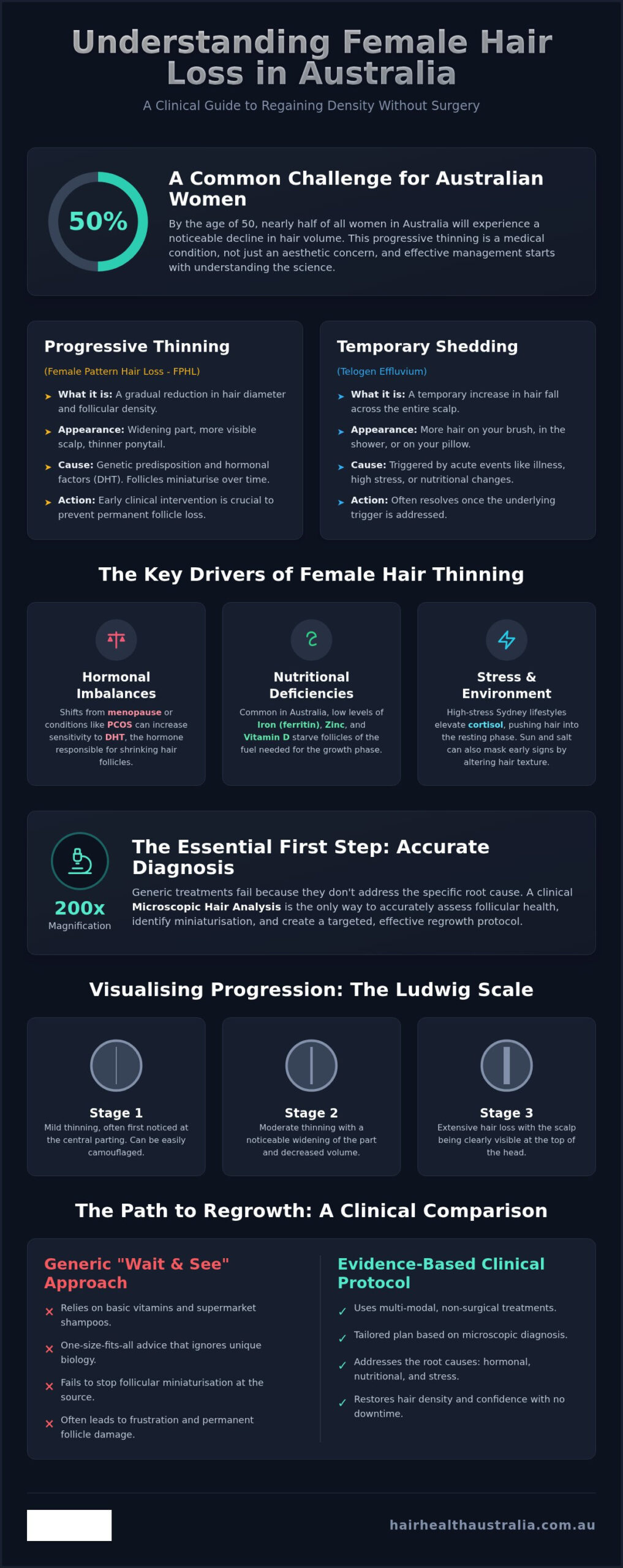
Female hair thinning is clinically defined as a progressive reduction in both the diameter of individual hair shafts and the overall follicular density across the scalp. While many women search for a permanent “cure”, it’s more accurate to discuss clinical management and regrowth protocols. Unlike a common cold that disappears entirely; hair thinning is often a chronic condition that requires ongoing care to maintain results. Female Pattern Hair Loss (FPHL) is the most common genetic cause of hair density loss among women in Australia.
The psychological impact of this condition shouldn’t be underestimated. For many Australian women, hair is naturally linked to femininity and self-esteem. Research suggests that women often experience more profound distress and a greater sense of loss than men when noticing visible scalp. This makes finding a reliable female pattern baldness treatment Australia a priority for both emotional and physical health. Seeking a solution isn’t just about aesthetics; it’s about restoring a sense of self.
Thinning vs. Shedding: Recognising the Difference
It’s vital to distinguish between Telogen Effluvium, which is temporary shedding often caused by acute stress or illness, and Pattern hair loss, which is progressive. You might notice a widening part, a ponytail that feels significantly thinner, or more visible scalp at the crown. These signs indicate that follicles are miniaturising. If you choose a “wait and see” approach, you risk permanent damage. Once a follicle has completely ceased production, the potential for regrowth diminishes significantly, making early intervention essential for long-term density.
The Social Reality for Australian Women
Sydney’s fast-paced lifestyle, combined with the harsh coastal climate, creates a unique set of challenges for hair health. High stress levels often exacerbate underlying genetic predispositions, while salt and sun exposure can mask the early signs of thinning by affecting hair texture. Rather than relying on generic supermarket shampoos or advice from a stylist, seeking a professional clinical diagnosis is the first step toward restoration. A comprehensive Hair Health Check allows for a scientific assessment of your scalp health before you invest in any long-term programme. You can find more detailed information on choosing the right path in our Hair Loss Treatment for Women: The 2026 Australian Clinical Buying Guide.
Why Women Lose Hair: Hormones, Stress, and Genetics
The biological drivers of hair loss in women are often multi-faceted. Dihydrotestosterone (DHT), a derivative of testosterone, plays a central role in follicular miniaturisation. When DHT binds to receptors in the hair follicles, it causes them to shrink, shortening the growth phase and resulting in finer, shorter hairs. This process is a hallmark of Female pattern hair loss. Significant hormonal shifts, such as those experienced during menopause, pregnancy, or with conditions like PCOS, can trigger or accelerate this thinning by altering the delicate balance of androgens in the body.
Nutritional health is another critical pillar often overlooked in generic advice. In Australia, deficiencies in Iron (specifically ferritin levels), Zinc, and Vitamin D are frequently observed in clinical settings. These nutrients are essential for robust hair production; without them, the hair cycle lacks the fuel required for the anagen (growth) phase. Additionally, the “Stress-Thinning Cycle” is a reality for many in a professional Sydney environment. Elevated cortisol levels can prematurely push hair follicles into the resting phase, leading to noticeable volume loss. Understanding these unique triggers is vital when seeking an effective female pattern baldness treatment Australia.
Genetics and the Ludwig Scale
Hereditary thinning in women typically presents as diffuse thinning across the top of the scalp, rather than the receding hairline common in men. Clinicians use the Ludwig Scale to categorise this progression. Stage 1 involves mild thinning that might be easily camouflaged, while Stage 3 represents extensive loss where the scalp is clearly visible. Your maternal and paternal hair history provides essential clues, as the genetic predisposition can be inherited from either side of the family. Identifying where you sit on this scale helps in tailoring a specific clinical response.
Environmental and Lifestyle Factors in Sydney
Sydney’s environment introduces specific stressors that can impact hair health. Harsh UV exposure can degrade hair shaft integrity, while hard water in certain urban areas may contribute to scalp irritation and mineral build-up. Many women also find that frequent chemical treatments or heat styling in local salons can mask early miniaturisation until the loss becomes significant. Modern lifestyle stress in Australia is also contributing to “premature” thinning in younger demographics who might not otherwise expect it. Because the causes are so varied, a professional assessment of your scalp health is the most reliable way to identify your specific triggers and start a targeted recovery plan.
Diagnostic Accuracy: Why Your Current Routine Might Fail
Most Australian women start their journey at a local chemist or supermarket, purchasing generic “hair growth” vitamins or thickening shampoos. While these products might improve hair texture, they often fail because they don’t address the complex biological root cause within the follicle. Without a scientific diagnosis, you’re essentially guessing at a solution. To secure a successful female pattern baldness treatment Australia, you must move beyond surface-level treatments. The “naked eye” diagnosis used by many GPs or hairdressers is simply too limited. It cannot detect the early stages of miniaturisation or accurately distinguish between follicles that are currently active, those that are struggling, and those that have become dormant.
Microscopic Hair Analysis: The Clinical Standard
During a microscopic scan, we examine the scalp at 200x magnification to reveal what the mirror cannot show. We analyse the hair bulb’s health, measure sebum levels that can block follicles, and assess the overall scalp environment. This allows us to identify miniaturisation, the process where hair shafts become thinner and shorter, long before it becomes visible to you or your hairdresser. This clinical precision is what allows for a personalised regrowth programme. Every woman’s scalp is different, and data-driven diagnostics ensure your protocol is tailored to your specific needs. Gaining this level of insight is fundamental to managing Hair loss in women effectively.
Blood Tests and Medical Co-factors
Diagnostic accuracy also requires looking at internal medical co-factors. Checking ferritin (iron stores) and thyroid function is a non-negotiable part of a holistic check. A common frustration for women in Sydney is being told a blood test is “normal” by a GP, while their hair continues to thin. In the world of hair science, a “normal” range is frequently sub-optimal for regrowth. For instance, a ferritin level that is technically within the lab’s healthy range might still be too low to support a vigorous anagen growth phase. A specialist clinician will work with you to rule out underlying medical conditions that mimic pattern baldness, ensuring your female pattern baldness treatment Australia is built on a foundation of medical fact.
If you’re tired of conflicting advice and want a definitive scientific answer, the next step is clear. Booking a Hair Health Check provides the microscopic evidence needed to stop the guesswork and start a treatment plan that actually works.
Evidence-Based Clinical Treatments for Hair Regrowth
Transitioning from a precise diagnosis to an active recovery phase requires a shift in perspective. Successful hair restoration is rarely the result of a single “magic pill”; it’s a multi-modal process that addresses hair health from several angles simultaneously. Non-surgical regrowth programmes outperform single-drug treatments because they create a synergistic environment where follicles can thrive over the long term. While the desire for immediate results is natural, clinical patience is essential. Because of the natural hair growth cycle, most women begin to see measurable improvements in density and hair shaft diameter after 4 to 6 months of consistent adherence to their protocol.
Finding the right balance between topical and oral protocols is a key part of modern clinical management. Every woman’s physiology and lifestyle are different, and a female pattern baldness treatment Australia must be tailored to fit into a busy daily routine. Oral options can provide systemic support, while topical stimulants offer direct follicular action. The goal of any clinical intervention is to awaken dormant hairs and prolong the anagen (growth) phase, effectively reversing the miniaturisation process that leads to visible thinning.
Growth Stimulants and DHT Management
Clinical-grade topicals are often a cornerstone of non-surgical restoration. These formulations differ significantly from over-the-counter options found in local chemists, primarily in their concentration and the inclusion of advanced delivery systems that ensure superior scalp absorption. Effective DHT management is about more than just blocking a hormone; it’s about ensuring the scalp environment is receptive to stimulation. For women seeking natural-looking results without the risks or downtime associated with invasive procedures, these non-invasive stimulants offer a safe and scientifically proven alternative.
Low-Level Laser Therapy (LLLT) and Scalp Hygiene
Modern clinical protocols frequently incorporate Low-Level Laser Therapy (LLLT). This technology uses specific wavelengths of light to increase cellular energy, known as ATP, within the hair follicle. By boosting this energy, LLLT helps prolong the growth phase and can improve the quality of the hair being produced. However, light therapy is most effective when the scalp is properly prepared. A clinical-grade scalp cleansing routine is vital to remove excess sebum and DHT build-up that can physically block follicles. When these therapies are combined, they create a powerful regrowth effect. You can find a deeper breakdown of these combined methods in our guide on the Best Hair Regrowth Treatment Australia 2026.
Every successful restoration journey begins with a clear understanding of your unique scalp needs. To determine which of these evidence-based treatments is right for your specific condition, book your professional Hair Health Check today.
Restoring Confidence with Sydney’s Leading Non-Surgical Experts
Hair Health Australia has been a dedicated specialist in the Sydney community since 2009, providing a sanctuary for women navigating the emotional weight of thinning hair. Finding a reliable partner in this journey is essential for long-term success. We move away from the generic chemist approach, offering a tailored clinical journey that respects your individual biology and lifestyle. Choosing a professional female pattern baldness treatment Australia means opting for a path that prioritises sustained scalp health and natural density over temporary, surface-level fixes.
Our non-surgical approach is designed specifically for the modern woman who requires results without disruption. There is no downtime and no scarring. The results look entirely natural because we focus on stimulating your own biological growth. This allows you to maintain your professional and social commitments in Sydney without the recovery period or clinical risks associated with more invasive methods. By focusing on follicular health, we help you reclaim your hair density with a protocol that fits seamlessly into your life.
The Hair Health Australia Difference
We focus on clinically-backed methods that provide realistic, honest expectations for every client. We don’t use hyperbolic marketing language; instead, we provide a supportive, empathetic environment where your concerns are heard and scientifically addressed. Our clinicians have proven success in treating various stages of female thinning, from early-stage miniaturisation to more advanced alopecia. We understand that every woman’s experience is unique, and we are committed to providing the education and care needed to navigate this transition with confidence.
Book Your Hair Health Check in Sydney
The first step toward restoration is to stop the guesswork and start a scientific recovery path. During your initial consultation, we conduct a comprehensive microscopic scan to establish a clear baseline for your recovery. It’s helpful to come prepared to discuss your medical history, current hair care routine, and your specific goals. This is your opportunity to ask your clinician detailed questions about the underlying causes of your thinning and the realistic timeline for your regrowth results. By choosing a data-driven approach, you take the first definitive step toward restoring both your hair and your self-esteem.
If you’re ready to move past the confusion of conflicting advice, our team is here to guide you through a proven, clinical process. Book your non-surgical hair loss consultation today and discover the clinical reality behind your hair health.
Your Path to Restored Hair Density
Establishing a clear, clinical path for hair restoration is about moving from uncertainty to evidence-based action. While a singular “cure” remains a medical myth, managing thinning through targeted, non-surgical protocols is a proven reality for women across the country. Success relies on identifying the specific biological triggers unique to your scalp through advanced microscopic analysis at 200x magnification. This scientific foundation ensures your chosen female pattern baldness treatment Australia is tailored to your needs rather than a generic guess.
With over 15 years of specialised clinical experience in Sydney, Hair Health Australia provides the expertise needed to awaken dormant follicles and restore visible density. Patience and consistency are your greatest allies during this transition. By focusing on non-invasive restoration today, you can reclaim your confidence and achieve natural-looking results that last. Book Your Comprehensive Hair Health Check in Sydney to receive a definitive diagnosis and start your personalised journey toward thicker, healthier hair. Expert guidance is ready when you are.
Frequently Asked Questions
Is there a permanent cure for female pattern hair loss?
There is currently no permanent, one-time cure for female pattern hair loss, as the condition is often linked to ongoing genetic and hormonal factors. Instead, clinical focus remains on effective management and sustainable regrowth through non-surgical protocols. By identifying the root cause early, you can stabilise thinning and stimulate follicles to produce denser hair. While the underlying predisposition remains, consistent clinical care allows you to maintain a healthy, full head of hair indefinitely.
Can thinning hair ever grow back thick again?
Thinning hair can often return to its former density if the underlying follicles are still active and have not yet become dormant. When you start a professional female pattern baldness treatment Australia, the goal is to reverse the miniaturisation process that causes hair shafts to become finer over time. Using targeted stimulants and scalp hygiene, we can help follicles produce thicker, more robust hair strands, significantly improving your overall volume and scalp coverage.
How long does it take to see results from clinical hair treatments?
Most women begin to notice a visible change in hair density and quality within four to six months of starting a clinical programme. This timeline aligns with the natural biological rhythm of the hair growth cycle, which requires time to move from the resting phase back into the active growth phase. While early signs of improved scalp health may appear sooner, measurable regrowth requires consistent adherence to your personalised protocol over several months to achieve stability.
Will I need to use treatments forever to maintain my hair?
Maintenance is typically required for genetic or hormonal thinning because the biological triggers for loss remain present in your system. If you don’t continue with your protocol, the follicles may eventually return to their previous state of miniaturisation, leading to a recurrence of thinning. However, many women find they can move to a less intensive maintenance phase once they achieve their desired density. This ensures your results remain stable without the need for the initial high-intensity schedule.
What is the most effective non-surgical treatment for women?
The most effective approach is a multi-modal programme that combines several clinically proven therapies tailored to your specific diagnostic data. This often forms the core of a successful female pattern baldness treatment Australia. It typically includes a combination of clinical-grade topicals, Low-Level Laser Therapy (LLLT), and a professional scalp cleansing routine. Rather than relying on a single product, this synergistic method addresses follicular health, hormonal triggers, and cellular energy simultaneously to produce the most sustainable results.
Can stress-related thinning be reversed with clinical help?
Stress-related thinning, known as Telogen Effluvium, is generally reversible because it involves a temporary disruption of the hair cycle rather than permanent follicular damage. Clinical intervention helps by soothing the scalp environment and providing the nutrients required to push follicles back into the growth phase more quickly. By addressing the physiological impact of cortisol and ensuring optimal scalp health, we can help you recover your original hair density and stop the cycle of excessive shedding.
Does menopause always cause permanent hair loss?
Menopause doesn’t always lead to permanent hair loss, though the drop in oestrogen can trigger significant thinning by allowing androgens to impact the follicles more heavily. While this shift can accelerate genetic predispositions, it is a condition that responds well to non-surgical clinical management. By stabilising the scalp environment and using targeted stimulants, many women successfully maintain their hair volume throughout and after the menopausal transition, preventing the loss from becoming permanent or extensive.
How much does a professional hair loss consultation in Sydney cost?
Consultation fees in Sydney vary depending on the depth of the diagnostic technology used and the expertise of the clinician. A professional assessment at a specialist clinic typically includes a detailed medical history review and a microscopic scan at 200x magnification to establish a baseline for your hair health. While costs for these sessions are standard within the industry, the primary value lies in receiving a scientific diagnosis that prevents you from wasting money on ineffective, generic products.