
What if the thinning you see in the mirror today isn’t a permanent loss, but a biological delay that your body is capable of reversing? It’s a common concern for many Australians who find themselves asking exactly how long for hair to grow back after thinning when the usual over-the-counter “miracle” lotions fail to deliver. The anxiety of seeing more scalp than usual often leads to a frantic search for quick fixes, yet the reality of hair biology is far more methodical and requires a structured, clinical approach.
We understand that waiting for results can feel like an endless cycle of uncertainty, especially when you’re trying to distinguish between natural shedding and genuine follicle miniaturisation. This 2026 clinical guide provides a modern perspective on the recovery process, moving past the marketing hype to offer evidence-based timelines for regrowth. You’ll learn how to identify the specific phase of your hair’s growth cycle and how professional intervention can effectively shorten the path to a fuller, healthier head of hair.
Key Takeaways
- Understand how the biological growth cycle dictates a minimum three-month wait for visible changes in hair density and volume.
- Learn the clinical differences between temporary shedding caused by lifestyle stress and the progressive thinning associated with genetic factors.
- Gain clarity on the 2026 clinical timeline to see exactly how long for hair to grow back after thinning and when new vellus hairs emerge.
- Identify the specific nutritional markers and scalp conditions that can either accelerate or hinder your hair’s natural recovery speed.
- Discover why microscopic hair analysis is the essential first step in creating a personalised, non-surgical regrowth program tailored to your scalp.
Understanding the Hair Growth Cycle: Why Regrowth Takes Time
Hair growth is not a continuous stream of production but a series of highly regulated biological phases. When Australians ask how long for hair to grow back after thinning, they are often surprised to learn that the timeline is strictly dictated by a biological clock that cannot be artificially rushed. Your hair follicles function much like a factory. Even if the visible “product” is missing from the scalp, the underlying machinery is often still alive and capable of recovery if given the correct clinical environment and nutritional support.
The Four Stages of Hair Life
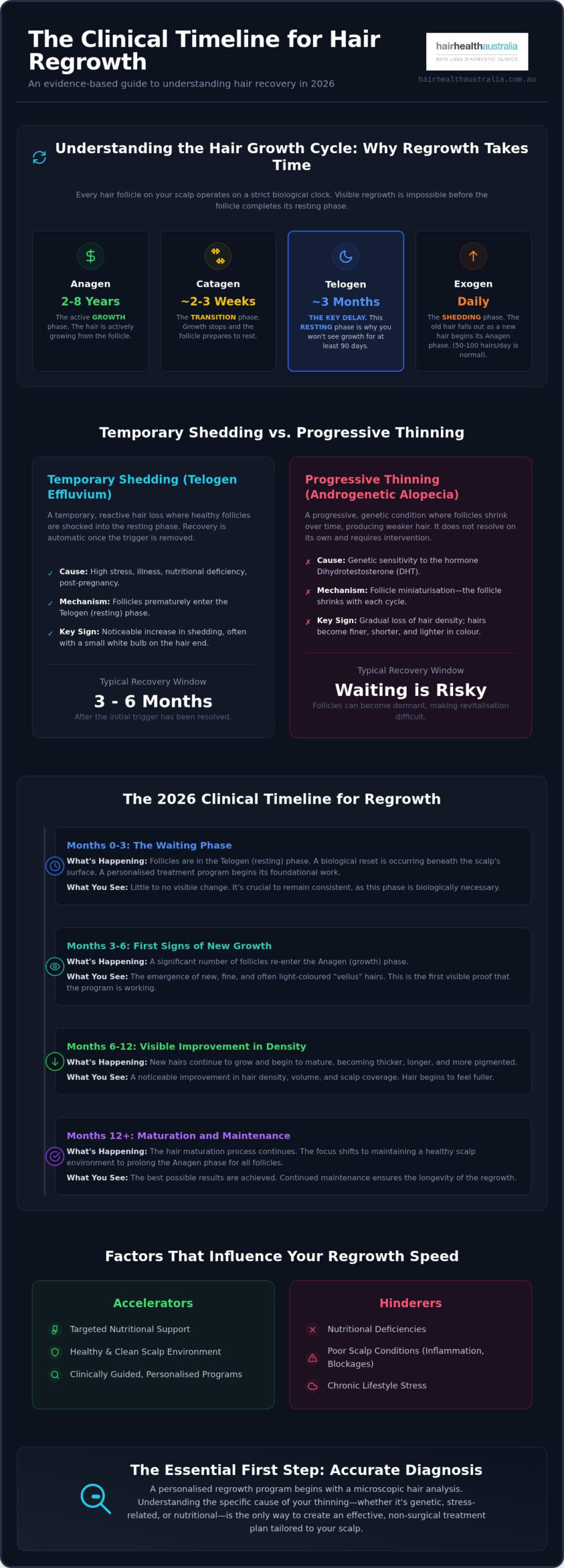
Every individual hair on your head is at a different stage of its life cycle. The Anagen phase is the active growth stage, which typically lasts between two and eight years. This is followed by the Catagen transition and then the Telogen phase. Understanding the Hair Growth Cycle is essential because it highlights that the Telogen, or resting stage, lasts for approximately three months. The Telogen phase serves as the primary reason for delayed regrowth because the follicle must remain dormant before a new strand can emerge. Consequently, you cannot expect to see a visible change in hair density in less than 90 days, as the follicle requires this time to reset and enter a new Anagen phase.
Why Thinning Differs from Normal Shedding
It is vital to distinguish between daily shedding and the progressive loss of density. Most people lose between 50 and 100 hairs a day as part of the Exogen phase, which is perfectly healthy. Thinning, however, often involves a process called miniaturisation. This occurs when the hair follicle physically shrinks, producing strands that are progressively finer, shorter, and lighter in colour. Determining exactly how long for hair to grow back after thinning depends heavily on whether your follicles are merely resting or if they are undergoing this miniaturisation process. A professional Hair Health Check using microscopic analysis can identify these subtle changes early. Maintaining a healthy scalp environment is the best way to ensure your follicles stay in the growth phase for as long as possible, preventing the premature transition into shedding.
Medical Thinning vs. Temporary Shedding: Timelines for Recovery
Distinguishing between a temporary shed and permanent thinning is the first step in managing expectations. If you notice hairs on your pillow or in the shower drain, look closely at the ends. A small, hard white bulb indicates the hair was in the Telogen phase and fell out naturally. This is often a sign of shedding rather than the follicle dying. However, when people ask how long for hair to grow back after thinning, they are usually dealing with a shift in density that requires a deeper look at the underlying cause. Understanding whether your loss is a temporary reaction or a genetic progression changes the recovery timeline entirely.
Telogen Effluvium: The 3-6 Month Recovery Window
Telogen Effluvium (TE) is a form of temporary hair loss often triggered by high-stress events, nutritional deficiencies, or significant physiological changes like post-pregnancy. Because of the four phases of hair growth, there is a distinct lag between the trigger and the visible loss. Shedding typically peaks around three months after the initial stressor. In these cases, the follicle remains healthy but has been prematurely pushed into its resting phase. Natural recovery is generally automatic once the trigger is resolved, with new growth becoming visible within a three to six month window as the follicles reset and re-enter the Anagen phase.
Pattern Thinning: Why Waiting Can Be Risky
Unlike temporary shedding, Androgenetic Alopecia (pattern thinning) is a progressive condition. It involves follicle miniaturisation, where the hormone Dihydrotestosterone (DHT) causes the hair to grow back thinner and weaker with each cycle. This type of thinning does not “grow back” on its own because the biological factory is shrinking. Waiting for natural recovery in this scenario can be risky, as once a follicle becomes completely dormant, it is much harder to revitalise. For those seeking clinical solutions, exploring the Best Hair Regrowth Treatment Australia 2026 can provide a roadmap for active management. Clinical intervention focuses on blocking the miniaturisation process to prevent further loss and stimulate existing follicles while they are still viable.
Determining which category your hair loss falls into is the only way to establish an accurate timeline. While TE might resolve with time and better nutrition, genetic thinning requires a targeted intervention to block DHT and stimulate the growth phase. If you’re unsure whether you’re experiencing a temporary shed or the start of permanent loss, a professional Hair Health Check can provide the clinical clarity you need to act before miniaturisation progresses.
How Long for Hair to Grow Back? The 2026 Clinical Timeline
Understanding the chronological progression of regrowth helps replace anxiety with an informed plan. When considering how long for hair to grow back after thinning, it’s helpful to view the process as a series of biological milestones rather than a sudden transformation. Clinical intervention works by systematically re-engaging follicles that have shifted into a premature resting state. Patience is your most valuable asset during this phase.
- Month 1-2: The primary goal is stabilisation. You’ll likely notice a significant reduction in active shedding as treatments begin to stimulate the follicles and strengthen the hair anchor.
- Month 3-4: This is when new “vellus” hairs begin to emerge. These are fine, light hairs that indicate the follicle is functioning again. They are the first signs of success.
- Month 6: Visible improvement in scalp coverage typically occurs here. Individual hair diameter often increases, which contributes to a noticeable sense of fullness and improved texture.
- Month 12+: Maximum density is usually achieved at this stage. Consistent adherence to a clinical protocol ensures that the new growth is maintained and the follicles remain in the active Anagen phase.
The “Dormancy” Trap: Why Early Action Matters
Follicles don’t die instantly. They enter a state of dormancy that can last for several years. During this period, the follicle is still viable but lacks the required signals to produce a terminal hair. The danger lies in waiting too long. Prolonged dormancy can eventually lead to permanent scarring of the follicle, at which point non-surgical regrowth becomes impossible. Microscopic analysis is the only way to accurately identify which follicles are merely resting and which have reached a point of no return. A professional Hair Health Check is the most effective way to determine if your specific thinning is still reversible.
Managing Expectations: The “First Three Months” Rule
The first 90 days are often the most challenging for any patient. Some individuals experience what is known as a “dread shed” during the first few weeks of treatment. This occurs because the clinical stimulation pushes old, resting hairs out to make room for new, stronger growth. It’s a sign that the treatment is working. Because hair grows at an average rate of only one centimetre per month, you won’t see a dramatic shift in the mirror by week four. We recommend tracking your progress with high-resolution photos under consistent lighting every eight weeks. This provides a much more accurate record of how long for hair to grow back after thinning than a daily check in the bathroom mirror.
Factors That Accelerate or Hinder Your Regrowth Speed
While the biological clock of the hair cycle is set, several variables can either streamline or stall the recovery process. When assessing how long for hair to grow back after thinning, we must look beyond the follicle itself to the systemic and environmental factors that support it. In Australia, nutritional deficiencies are surprisingly common despite our outdoor lifestyle. Low levels of Iron, Vitamin D, and Zinc can significantly extend the time it takes for a follicle to transition from the resting phase back into active growth. Without these essential building blocks, even the most advanced treatments will struggle to produce a robust hair shaft.
Hormonal balance, specifically the management of Dihydrotestosterone (DHT), is another critical factor for both men and women. DHT binds to receptors in the scalp follicles, causing them to miniaturise and eventually stop producing hair altogether. Addressing this hormonal trigger is essential for anyone seeking long-term results. Additionally, blood circulation plays a vital role in the recovery timeline. Clinical therapies are often designed to increase microcirculation, ensuring that oxygen and nutrients actually reach the root of the hair. If the blood supply is poor, the “factory” simply doesn’t have the fuel it needs to operate efficiently.
Optimising the Scalp for Growth
The scalp is the biological soil in which your hair grows. A clean, non-inflamed environment is non-negotiable for successful regrowth. Chronic inflammation, often invisible to the naked eye, can constrict the follicle and disrupt the growth cycle. Professional-grade clinical cleansers are formulated to remove DHT buildup and environmental pollutants without stripping the scalp’s natural protective barrier, a feat most supermarket shampoos fail to achieve. A blocked follicle cannot produce a healthy hair shaft, making scalp hygiene a cornerstone of any recovery plan.
Lifestyle and Stress Management
Stress is more than just a feeling; it’s a physiological state that releases cortisol into your system. High cortisol levels can prematurely push hair follicles into the Telogen (resting) phase, effectively halting your progress. Supporting your body through dietary changes that boost keratin production, such as increasing high-quality proteins and biotin-rich foods, provides the structural materials your hair requires. For those ready to move beyond lifestyle adjustments, a structured Clinical Hair Treatment can provide the intensive support needed to overcome these biological hurdles.
Identifying which factors are personally hindering your progress is the most direct way to shorten your recovery timeline. To get a precise understanding of your scalp health and nutrient requirements, we recommend booking a Hair Health Check to ensure your regrowth strategy is built on a foundation of clinical data.
The Hair Health Australia Approach: Accelerating Your Results
While understanding the biological constraints of the hair cycle is vital, the most significant variable in your recovery is the precision of your treatment plan. At Hair Health Australia, we specialise in non-surgical regrowth programmes designed specifically for the unique lifestyle and environmental factors facing Sydney residents. Our approach focuses on moving beyond the guesswork of over-the-counter solutions to provide a structured, evidence-based path forward. When patients ask us how long for hair to grow back after thinning, we explain that while we cannot bypass the mandatory 90-day Telogen reset, we can ensure that every day of the subsequent growth cycle is optimised for maximum density.
With over 15 years of clinical experience in Sydney, we have found that the most effective results stem from precision diagnosis rather than a one-size-fits-all product. We utilise microscopic hair analysis to examine the scalp at a cellular level, which is a far more reliable method than a standard visual inspection. This allows our specialists to determine the exact ratio of hairs in the Anagen versus Telogen phases and identify the presence of DHT-related miniaturisation before it becomes visible to the naked eye. By identifying the root cause early, we can implement clinically-backed therapies that target your specific biological needs. This provides a level of systematic care and ongoing monitoring that ensures your recovery remains on the right trajectory throughout the year.
Why a Professional Diagnosis is Essential
Self-diagnosing hair loss is a common pitfall that often leads to wasted time and increased anxiety. Many Australians mistake progressive pattern thinning for temporary shedding, resulting in the use of ineffective “miracle” cures that do nothing to address follicle health. Our Sydney specialists create a custom recovery roadmap that distinguishes between purely cosmetic improvements and genuine clinical regrowth. Clinical regrowth focuses on the long-term health of the follicle, ensuring that the new hair is not just a temporary fix but a sustainable return to density. This professional oversight means your programme is adjusted as your scalp responds, providing a level of agility that over-the-counter products simply cannot offer.
Take the First Step Toward Regrowth
The journey to recovery begins with a comprehensive assessment of your current scalp health. During a Hair Health Check at our Sydney clinic, we perform a detailed evaluation of hair density, follicle viability, and scalp inflammation. This data-driven approach allows us to set realistic expectations and monitor your progress with clinical accuracy. It is the essential first step to determine exactly how long for hair to grow back after thinning in your specific case. By measuring these markers, we ensure your growth cycle stays on track and your results are backed by verifiable data rather than hope alone.
Ready to replace uncertainty with a clinical plan? Book your Hair Health Check in Sydney today and discover what is truly possible for your hair’s future.
Take Control of Your Hair’s Future
Regaining hair density is a process rooted in biological reality rather than overnight miracles. The mandatory resting phase of the follicle means that patience and consistency are essential during the first 90 days. By distinguishing between temporary shedding and progressive miniaturisation, you can move past the confusion of self-diagnosis and adopt a strategy that actually works. Determining how long for hair to grow back after thinning requires a shift from guesswork to clinical precision, ensuring your follicles have the specific nutrients and stimulation they need to thrive.
Our non-surgical regrowth specialists utilise over 15 years of experience to guide you through this journey. We replace uncertainty with clarity through personalised microscopic analysis and clinically-backed Australian protocols. If you’re ready to stop the cycle of thinning and start a targeted recovery plan, the first step is a professional assessment of your scalp’s current state. Book your Microscopic Hair Health Check in Sydney today. Your path to a healthier head of hair is a steady progression, but with the right clinical partner, every step brings you closer to visible, lasting results.
Frequently Asked Questions
Can thinning hair ever grow back to its original thickness?
Yes, restoring original thickness is possible if the follicle hasn’t reached the stage of permanent scarring. The success of this process depends on how far miniaturisation has progressed. Clinical treatments focus on reversing this shrinkage by extending the growth phase. Using microscopic analysis, we can determine the current diameter of your strands compared to your baseline, allowing us to create a roadmap for returning to your natural density.
How can I tell if my hair is growing back or just breaking?
You can distinguish between growth and breakage by examining the ends of the short hairs near your scalp. New growth will have a naturally tapered, soft point, whereas hair that has broken off will have a blunt, jagged, or frayed edge. Additionally, new growth usually appears as a uniform “fuzz” across a specific area rather than isolated short strands of varying lengths, which is more typical of mechanical damage or brittle hair.
Does stress-related thinning grow back on its own?
Temporary thinning caused by acute stress generally resolves without intervention once your cortisol levels stabilise and the physiological trigger is removed. This recovery follows the standard three-to-six-month Telogen reset mentioned earlier in this guide. However, if the stress is chronic or if it has triggered a latent genetic predisposition for thinning, you may require a clinical program to jumpstart the follicles and prevent the loss from becoming a permanent pattern.
What are the first signs of hair regrowth after thinning?
A reduction in daily shedding is the first clinical sign that your follicles are stabilising. Following this, you will notice fine, light-coloured vellus hairs emerging along the hairline or part. When tracking how long for hair to grow back after thinning, these “peach fuzz” hairs are the primary indicator that the follicle has successfully re-entered the Anagen phase. Over several months, these strands will gain pigment and diameter, eventually becoming terminal hairs.
Is it too late to regrow hair if I can see my scalp?
It is rarely too late to see improvement, even if you can clearly see your scalp through your hair. Scalp visibility usually occurs once hair density has decreased by at least 50%, but this doesn’t mean the follicles are dead. Many of these follicles are simply dormant or producing hairs too fine to provide coverage. As long as the “factory” hasn’t scarred over, clinical stimulation can often revitalise these follicles to improve overall density.
How does DHT affect the timeline of hair regrowth in men?
DHT significantly extends the timeline of regrowth by keeping follicles in a resting state for longer periods. In men sensitive to this hormone, the Anagen phase becomes shorter with every cycle, meaning the hair never reaches its full potential length or thickness. By blocking DHT’s impact at the scalp level, we can remove this biological barrier, allowing the follicles to remain in the active growth stage for years rather than months.
Do hair growth vitamins actually speed up the process?
Vitamins act as the structural building blocks for hair, but they only speed up the process if you are currently deficient in specific nutrients like Iron or Vitamin D. For most Australians, a supplement won’t “cure” genetic thinning, but it will ensure that the hair being produced is of the highest possible quality. Think of vitamins as the raw materials; without a functioning factory, the materials cannot be utilised effectively.
Why does my hair seem to grow slower as I get older?
Hair growth slows with age because the metabolic processes that fuel follicle cells become less efficient over time. Additionally, the Anagen phase naturally shortens as we get older, while the Telogen phase can become more prolonged. This shift results in a slower overall replacement rate and a gradual reduction in the maximum length each hair can reach. Clinical intervention focuses on supporting these metabolic processes to maintain a more youthful growth rhythm.