Did you know that 95% of male hair loss in Australia is attributed to androgenetic alopecia, yet a significant number of men still rely on generic over-the-counter serums that offer little more than hope? If you’ve spent months trial-testing chemist lotions only to see your hairline continue its retreat, you aren’t alone. It’s frustrating to feel like you’re gambling with your appearance while navigating the confusing world of prescription hair loss medication in Australia. You deserve a strategy grounded in clinical evidence rather than marketing hype.
We understand that the fear of potential side effects from oral medications and the sheer volume of conflicting online reviews can lead to a state of “analysis paralysis”. This 2026 clinical guide is designed to replace that uncertainty with professional clarity and scientific confidence. You’ll discover the latest TGA-approved treatments, including established options and emerging JAK inhibitors, while learning why a diagnostic-led approach is essential for achieving non-surgical regrowth. We’ll preview the specific medications available today and explain how specialised microscopic hair analysis provides the professional confirmation you need to stop guessing and start growing.
Key Takeaways
- Understand why a diagnostic-led approach, starting with microscopic hair analysis, is the only way to confirm if your follicles are dormant or permanently lost.
- Learn the critical differences between pharmacy-shelf options and a tailored clinical protocol involving prescription hair loss medication australia.
- Discover how TGA-approved medications work at a biological level to disrupt the miniaturisation process and stabilise thinning hair.
- Explore why combining clinical medication with supportive therapies like low-level laser treatment often yields superior results compared to single-drug use.
- Identify the realistic timelines and expectations for non-surgical regrowth to avoid the frustration of premature treatment discontinuation.
Understanding Prescription Meds for Hair Loss: How Clinical Treatments Work
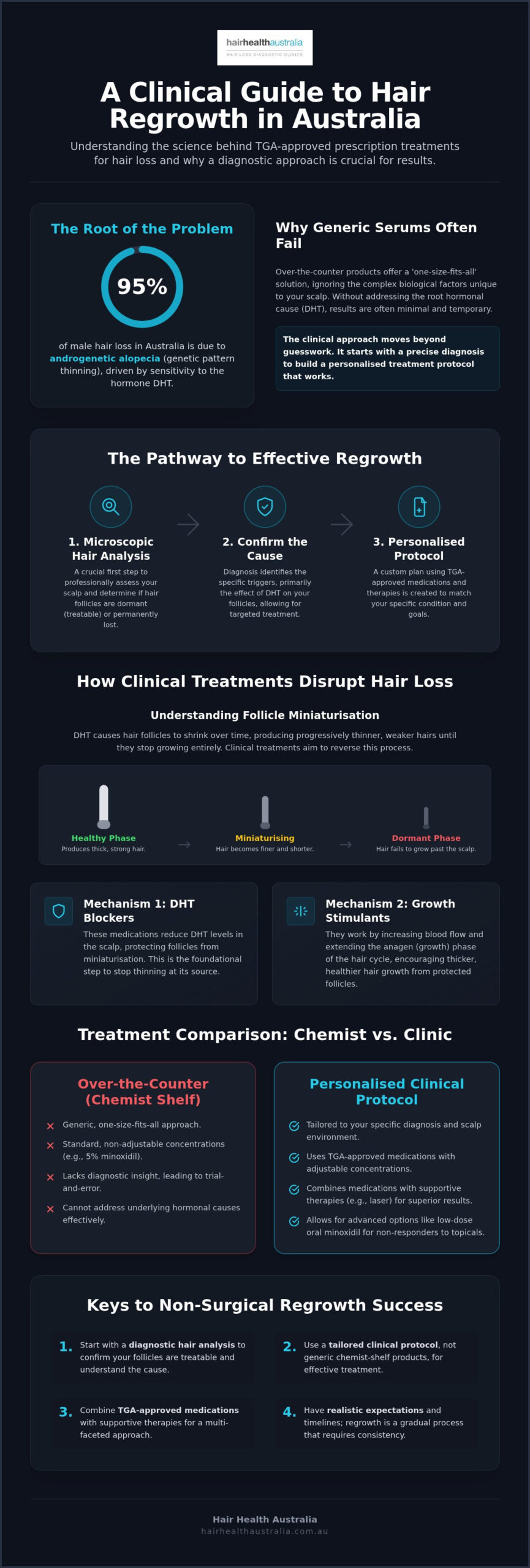
Modern prescription hair loss medication australia functions as a targeted clinical intervention rather than a superficial cosmetic fix. Its primary purpose is to disrupt the biological pathways that lead to hair thinning. For many, Pattern hair loss is not a sudden event but a progressive decline known as follicle miniaturisation. During this process, the hair follicle physically shrinks, producing shorter, finer, and less pigmented strands until the hair eventually fails to break the surface of the scalp. Clinical treatments aim to halt this decline by protecting the follicle from internal stressors, effectively allowing the hair to recover its original diameter and strength.
Success hinges on the timing of the intervention. It is far easier to save a struggling follicle than it is to revive one that has been dormant for years. Starting a clinical programme early in the thinning cycle significantly improves the likelihood of a robust response. By identifying the specific cause through a Hair Health Check, we can determine whether the focus should be on blocking hormonal triggers, stimulating growth, or a combination of both to achieve the best results.
The Role of DHT in Pattern Thinning
Genetic hair loss is largely driven by a sensitivity to Dihydrotestosterone (DHT). This hormone binds to receptors in the scalp, triggering the gradual shutdown of the hair production cycle. Specific medications are designed to lower DHT levels within the scalp environment, reducing the biological pressure on the follicles. Dihydrotestosterone (DHT) is a potent androgen that causes susceptible hair follicles to miniaturise, leading to the progressive thinning and eventual loss of hair. Without addressing this hormonal component, any regrowth achieved through other means will likely be temporary, as the underlying cause remains active.
Stimulating the Anagen (Growth) Phase
While blockers protect the follicle, stimulants act as the engine for the growth cycle. These treatments extend the duration of the anagen phase, which is the period when the hair is actively growing. By increasing blood flow and nutrient delivery to the hair bulb, these medications ensure the follicle has the resources needed to produce a thicker, healthier shaft. However, stimulation alone is rarely a complete solution. If the underlying hormonal cause remains unaddressed, the follicle continues to face the same biological pressure that caused it to thin in the first place. A comprehensive clinical approach ensures both the cause and the symptoms are managed simultaneously, providing a more sustainable path to hair recovery.
Comparing TGA-Approved and Clinical Hair Growth Medications in Australia
In 2026, the Australian clinical landscape has shifted toward highly specific protocols. The Therapeutic Goods Administration (TGA) remains the gold standard for safety, ensuring that any prescription hair loss medication australia meets rigorous clinical benchmarks. While over-the-counter (OTC) options like standard 5% minoxidil solutions are readily available at any local chemist, they often lack the potency or customisation required for significant regrowth. Clinical protocols, by contrast, allow for adjusted concentrations and delivery methods tailored to your specific scalp environment.
Personalisation is the hallmark of modern care. Generic products assume every scalp responds identically, but we know that biological factors vary wildly between individuals. A specialised clinical assessment is the most reliable way to determine which concentration will actually produce results for you. This diagnostic step ensures you aren’t wasting time on a dose that is either too weak to be effective or unnecessarily high.
Topical vs. Oral Minoxidil
Historically, topical foam was the only choice; today, low-dose oral minoxidil has become a cornerstone of Australian hair loss treatments due to its convenience and efficacy for those who don’t respond well to topicals. Topical minoxidil requires an enzyme called sulfotransferase to be present in the scalp to work. If you lack this enzyme, topical solutions will likely fail. Oral versions bypass this issue. However, higher-strength formulations or oral tablets require strict clinical supervision to monitor for systemic effects and ensure the dosage remains appropriate for your needs.
Finasteride and Modern Hormone Modulators
Finasteride works by inhibiting the 5-alpha reductase enzyme, which prevents the conversion of testosterone into DHT. For men, this is a primary clinical standard. For women, these medications are often used off-label and require careful medical oversight. Recent approvals in 2026, such as JAK inhibitors for alopecia areata, have further expanded the toolkit available to clinicians. Common misconceptions often exaggerate the risks to overall hormonal health. When prescribed at personalised, clinical doses, these modulators are designed to stabilise the follicle environment without disrupting your broader wellbeing. Long-term use is generally well-tolerated when managed by an expert who understands your unique health profile.
Why ‘Off-the-Shelf’ Meds Often Fail Without a Clinical Diagnosis
“I tried that medication and it just didn’t work for me.” This is perhaps the most common sentiment we hear from patients who have attempted to manage their thinning independently. While it’s easy to blame the drug, the reality is that medication is a tool that requires a precise target. If you’re using prescription hair loss medication australia without a prior clinical diagnosis, you’re essentially flying blind. Success depends entirely on whether your follicles are still capable of producing hair or if they’ve reached a stage beyond repair.
Medication cannot revive a dead follicle. Once a follicle has completely fibrosed, it’s gone. However, many people mistake dormant or severely miniaturised follicles for dead ones. Without a professional assessment, you might be applying treatment to areas where it’s biologically impossible to see results, or conversely, giving up on areas that could still be saved with the right intervention. Generic, off-the-shelf doses often fail because they don’t account for individual absorption rates or the specific severity of your condition. We also see “non-responders” who lack the necessary enzymes to activate certain drugs, a factor that only a clinical approach can identify early.
The Necessity of Microscopic Hair Analysis
A Hair Health Check is the gold standard for moving beyond guesswork. By using high-magnification scans, we can determine the exact ratio of active to dormant follicles on your scalp. This data-driven approach ensures you don’t waste months of time and hundreds of dollars on a treatment protocol that was never suited to your specific stage of thinning. If the analysis shows that follicles are merely miniaturised, we can proceed with confidence. If they’re absent, we provide the straight-talking honesty you need to adjust your expectations. This precision prevents the cycle of hope and disappointment that often follows unguided treatment.
Identifying Underlying Scalp Conditions
Even the most potent medication will fail if it cannot reach the hair bulb. Issues like chronic inflammation, dermatitis, or excessive sebum build-up can create a physical barrier or an inhospitable environment that blocks absorption. This is where microscopic hair analysis Australia becomes invaluable. We look beyond the hair shaft to the health of the scalp itself. Ensuring a clean, healthy scalp environment is a non-negotiable prerequisite for medical success. By identifying these blockers early, we can clear the path for your medication to actually do its job, turning a perceived treatment failure into a successful regrowth journey.
Creating a Personalised Medication and Therapy Protocol in 2026
Relying on a single drug to resolve thinning is often like trying to maintain a complex engine with just one tool. While prescription hair loss medication australia provides the biological foundation for recovery, the most successful clinical outcomes in 2026 come from multi-modal protocols. In our Sydney clinic, we’ve observed that combining medical interventions with supportive therapies, such as low-level laser therapy or targeted topical nutrients, produces a synergistic effect. This approach addresses the problem from multiple angles: it stabilises the hormonal environment while simultaneously increasing cellular energy and blood flow to the hair bulb.
Managing the initial phases of treatment is a critical part of the clinical journey. Many patients experience a temporary period of increased shedding, often called the “dread shed,” shortly after starting their programme. This is actually a positive sign that the medication is working. It indicates that the follicles are shifting from a resting phase into an active growth phase, pushing out old, weak strands to make way for new, robust hair. Clear communication during these early months helps replace anxiety with the confidence needed to stay the course.
To see how a personalised protocol can be tailored to your specific needs, the first step is always a Hair Health Check to establish your baseline.
Customised Compounding and Synergistic Therapies
Generic, mass-produced medications are designed for the average responder, but clinical reality is rarely that simple. Customised compounding allows us to refine the concentration of active ingredients to suit your specific scalp sensitivity and hair loss stage. This precision helps maximise your regrowth potential while significantly reducing the likelihood of unwanted side effects. Our specialists work to refine your prescription based on real-time microscopic data, ensuring the protocol evolves as your hair recovers. We maintain a “straight-talking” policy regarding timelines: sustainable clinical results require patience and consistency over several months.
Long-term Maintenance and Scalp Health
Successful hair restoration is a marathon, not a sprint. Once you’ve achieved your regrowth goals, the protocol naturally transitions into a maintenance phase. This stage is vital for protecting your investment and ensuring that the biological causes of thinning remain suppressed. You can find more details on sustaining these results in our guide on the Best Hair Regrowth Treatment Australia 2026. Beyond medication, ongoing scalp hygiene and health are non-negotiable. A clean, balanced scalp environment ensures that your maintenance treatments can continue to penetrate effectively, keeping your follicles in peak condition for the years ahead.
The Non-Surgical Approach: Why a Sydney Clinic Beats a Pharmacy Shelf
Choosing to address thinning hair is a significant decision, but where you seek help determines the quality of your results. While you can easily obtain prescription hair loss medication australia through a local pharmacy or a generic online subscription, these transactions lack the clinical oversight necessary for long-term success. At our Sydney centre, we view medication not as a standalone product, but as a high-performance tool within a broader, supervised non-surgical regrowth programme. This distinction is vital for those who want to avoid the risks and recovery times associated with invasive hair transplant surgery.
A clinical environment provides a level of accountability that a pharmacy shelf cannot match. We focus exclusively on non-surgical pathways, using evidence-based protocols to stabilise loss and encourage new growth without the need for a scalpel. By integrating medical treatments with professional monitoring, we ensure that your progress is tracked with scientific precision. If a specific medication isn’t yielding the expected data on your microscopic scans, we can pivot your strategy immediately rather than waiting months for a visible change that may never come.
The Advantage of Specialised Clinical Monitoring
Seeing a specialist who focuses solely on hair and scalp health offers a level of reassurance that general practitioners or pharmacists often can’t provide. Our Sydney centre is designed to be a professional, supportive space where your journey is managed by experts who understand the nuances of follicle biology. Regular in-person reviews allow us to verify that your scalp remains healthy and that the medication is being absorbed effectively. For a detailed guide on what to look for in a provider, refer to our checklist on Choosing a Non-Surgical Hair Loss Clinic in Sydney.
Your First Step: The Hair Health Check
The most effective way to stop the frustration of trial-and-error is to replace guesswork with clinical facts. Every successful regrowth journey begins with a clear understanding of your current follicle status. We encourage you to move past conflicting online reviews and start measuring your hair health with microscopic accuracy. Establishing a factual baseline is the only way to know which prescription protocol is right for your specific condition. It’s a straightforward, diagnostic process that provides the clarity you need to move forward with confidence. Don’t leave your results to chance; Book your Hair Health Check in Sydney today and take the first definitive step toward real, non-surgical restoration.
Take the First Step Toward Scientific Hair Recovery
Achieving real regrowth is a methodical process that begins with understanding your unique follicle health. We’ve established that medication is most effective when it’s part of a broader, non-surgical clinical protocol rather than a standalone purchase. By choosing a diagnostic-led path, you ensure that any prescription hair loss medication australia you use is tailored to your specific stage of thinning, avoiding the common pitfalls of generic pharmacy options.
Since 2009, our Sydney centre has combined medical authority with empathetic care to help patients navigate their restoration journey with confidence. Our approach relies on specialised microscopic hair analysis to provide the professional confirmation you need before starting any treatment. This factual baseline allows us to create a personalised programme that targets the biological causes of loss while protecting your existing hair.
Stop guessing about your scalp health and start measuring it with clinical precision. We invite you to Book Your Comprehensive Hair Health Check in Sydney today. Your path to a fuller head of hair is grounded in science, and we’re here to guide you through every step of the recovery process.
Frequently Asked Questions
Do I need a prescription for hair loss medication in Australia?
You need a prescription for specific clinical treatments, while others are available over-the-counter. In Australia, oral medications like Finasteride and low-dose oral Minoxidil are classified as Schedule 4 medicines, meaning they require a script from a registered medical practitioner. Topical Minoxidil is a Schedule 5 medicine that you can buy at a pharmacy without a script. Accessing prescription hair loss medication australia through a clinical consultation ensures you receive the correct dosage for your specific thinning stage.
Can women take the same hair loss medications as men?
Women and men often use different protocols due to the biological causes of their thinning. While topical Minoxidil is used by both, certain oral medications like Finasteride are primarily TGA-approved for men and are only prescribed off-label to women under strict medical supervision. Women may instead be prescribed modulators like Spironolactone. A diagnostic scan is essential to determine which hormonal or nutritional factors are driving the loss before starting any medical programme.
How long does it take for hair loss medication to show visible results?
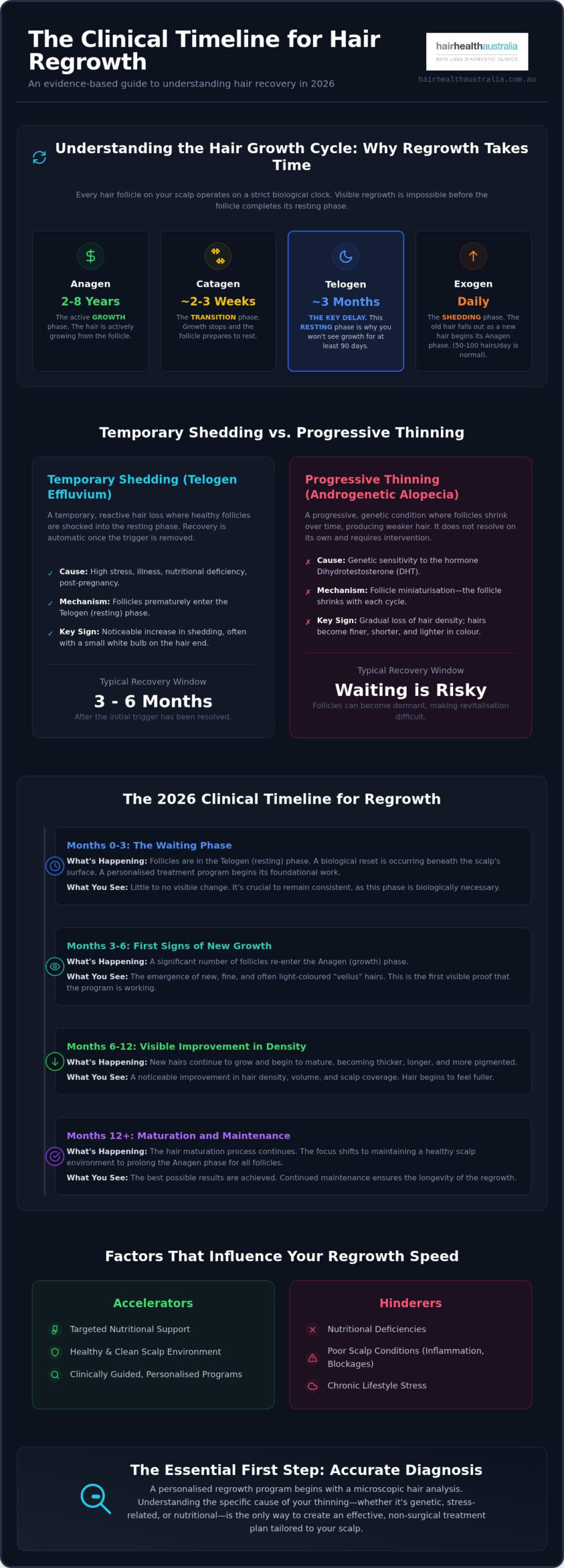
Visible results typically require at least three to six months of consistent use. Hair follicles operate on a slow biological cycle, so you won’t see an immediate change overnight. The first few months are usually focused on stabilising the loss and halting further thinning. Significant regrowth or improvements in hair density generally become apparent between the six and twelve-month marks. We use microscopic scans during reviews to track these internal changes before they’re visible to the naked eye.
What happens if I stop taking my hair growth medication?
If you discontinue your treatment, the biological process of miniaturisation will eventually resume. Medication works by suppressing the hormones that cause thinning or by artificially extending the growth phase. Once that support is removed, your follicles will return to their genetically programmed state. This doesn’t happen instantly, but you’ll likely notice a gradual return to your previous thinning pattern over three to six months. Maintenance is a long-term commitment to protecting your results.
Are there any natural alternatives to medication for hair loss?
Natural alternatives like saw palmetto or pumpkin seed oil exist, but they lack the clinical potency of TGA-approved medications. While some patients use these supplements to support general hair health, they rarely provide enough hormonal suppression to stop aggressive genetic thinning. In a clinical setting, we often combine medical protocols with non-drug therapies like low-level laser therapy (LLLT). This multi-modal approach provides a more robust solution than relying on natural extracts alone.
Does Minoxidil work for a receding hairline or just the crown?
Minoxidil can work on a receding hairline provided there are still viable, miniaturised follicles present in the area. Many product labels specify the crown simply because that is where the original clinical trials were conducted. However, the biological mechanism of increasing blood flow and extending the growth phase applies to the entire scalp. If the hairline has completely fibrosed and no follicles remain, medication will not be effective, making an early diagnosis vital.
Will my local GP be able to prescribe the same meds as a hair clinic?
A local GP can write a script for standard medications, but they often lack the specialised diagnostic equipment found in a dedicated hair clinic. GPs typically provide a general assessment rather than the microscopic hair analysis required to measure follicle miniaturisation accurately. At a specialised centre, we use high-magnification scans to tailor your prescription hair loss medication australia and adjust your protocol based on real-time data, ensuring you aren’t using a generic, ineffective dose.
Is hair loss medication safe for long-term use in Australia?
TGA-approved hair loss medications are generally considered safe for long-term use when administered under professional supervision. These drugs have undergone extensive clinical trials to verify their safety profiles for prolonged treatment. While side effects are possible, they are relatively rare and often dose-dependent. Regular clinical reviews allow us to monitor your response and adjust your protocol if needed. Maintaining open communication with your specialist ensures your treatment remains both safe and effective over the coming years.