A high hair loss treatment success rate doesn’t guarantee a single new strand of hair on your head unless your follicles are still clinically viable. It’s a frustrating reality for many Australians who spend thousands on generic serums, only to see no change in the mirror. You’ve likely felt that familiar anxiety when looking at conflicting statistics. You might wonder if you’re simply destined for total baldness or if there’s a genuine path to restoration. We understand that the fear of wasting money on ineffective treatments is just as taxing as the hair loss itself.
This guide clarifies the clinical reality of 2026. We move past marketing hype to examine what the data actually says about stopping loss versus achieving visible regrowth. You’ll discover how to accurately predict your own potential for success by understanding the biological markers that specialists look for during a professional assessment. We’ll explore the latest non-surgical advancements and explain how a targeted Hair Health Check at our Sydney clinic can provide the clarity you need to move forward with confidence.
Key Takeaways
- Understand the distinction between clinical maintenance and cosmetic regrowth to set realistic milestones for your restoration journey.
- Learn how microscopic scalp analysis identifies viable follicles and helps you avoid spending money on areas with permanent fibrosis.
- Discover why the hair loss treatment success rate of clinical-grade protocols often exceeds that of standard over-the-counter chemist products.
- Identify the essential nutritional foundations and consistency habits required to maximise the efficacy of non-surgical restoration programs.
- Find out how a professional Hair Health Check in Sydney provides a data-driven roadmap tailored to your specific biological needs.
Defining Hair Loss Treatment Success Rates: Beyond the Marketing Hype
When you search for a hair loss treatment success rate, you’re often met with glossy photos and broad percentages that seem too good to be true. In a clinical setting, success isn’t just a subjective feeling about how you look in the mirror; it’s a measurable biological shift. Clinical success is often achieved long before you see a visible change in your hairline. For many, the first victory is simply “stopping the shed.” If a program successfully halts the progression of androgenic alopecia, it has already achieved its primary clinical objective. Without first stabilising the loss, any attempt at regrowth is built on a failing foundation.
Clinicians define a “responder” as an individual who shows either a stabilisation of hair loss or a statistically significant increase in hair density over a set period. To track this, we use microscopic scans to measure the number of terminal hairs per square centimetre. This objective data is far more reliable than a standard selfie. When exploring various hair loss treatment options, it’s vital to distinguish between maintaining the hair you currently have and the more intensive process of stimulating new growth from dormant follicles.
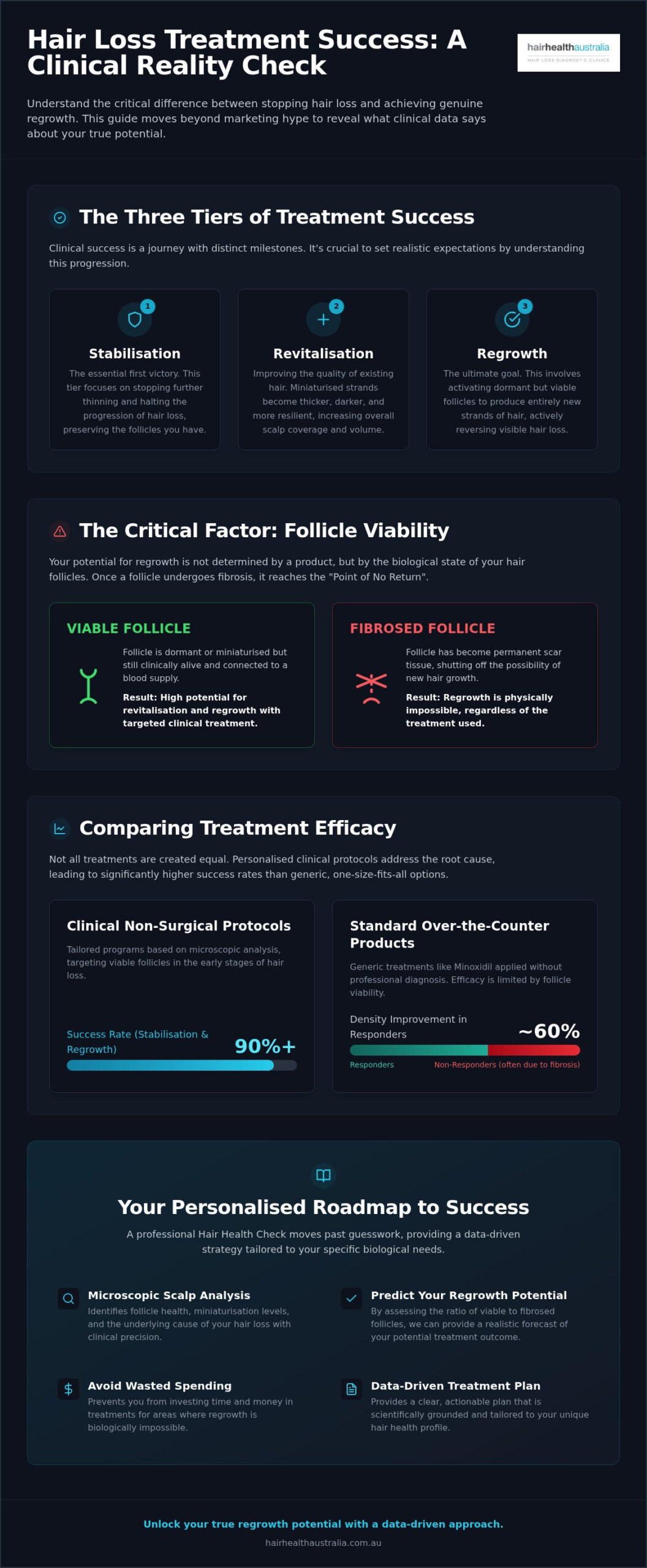
The Three Tiers of Treatment Success
We categorise success into three distinct levels to help patients manage their expectations and track their progress accurately.
- Tier 1: Stabilisation. This is the essential first milestone. We focus on stopping further thinning and ensuring the follicles you currently have remain healthy and active.
- Tier 2: Revitalisation. At this stage, we improve the quality of existing hair. Thin, “miniaturised” strands become thicker, darker, and more resilient, which increases overall scalp coverage and volume.
- Tier 3: Regrowth. The most sought-after outcome. This involves activating dormant follicles that haven’t yet reached the point of permanent scarring or fibrosis, allowing new hairs to emerge.
Why Generic Statistics Can Be Misleading
Broad statistics often fail to account for individual variables. For instance, a 20-year-old with early-stage thinning will naturally have a higher hair loss treatment success rate than a 60-year-old who has experienced significant loss for decades. The duration of your hair loss is perhaps the most critical predictor of your outcome. Once a follicle has been inactive for several years, it may undergo fibrosis, making regrowth physically impossible regardless of the treatment used.
Underlying health conditions, such as iron deficiencies or thyroid imbalances, can also dampen your results. This is why a personalised Hair Health Check is essential. It moves beyond the generic “before and after” photos, which are easily manipulated by lighting or hair styling, and focuses on the clinical reality of your scalp’s health. By identifying these factors early, we can provide a realistic forecast of your potential regrowth rather than relying on industry averages.
The Biological Predictors of Success: Follicles, Phases, and Scans
Generic statistics often claim a high hair loss treatment success rate, but these numbers mean very little without biological context. The reality is that your physical “starting point” dictates your ultimate result. While medications like Minoxidil show density improvements in roughly 60% of users, the remaining 40% often fail to respond because their follicles have passed what we call the “Point of No Return.” This occurs when a follicle undergoes permanent fibrosis, essentially becoming scar tissue. Once this stage is reached, no amount of stimulation can force a hair to grow. This is why early intervention is the single most important factor. Treating thinning hair while follicles are still active leads to a success rate of 90% or higher in many clinical settings.
Your regrowth ceiling is also limited by the duration of your Anagen, or growth, phase. As hair loss progresses, this phase shortens, leading to thinner, shorter strands. To get a clear picture of your potential, a professional dermatologist’s guide to hair loss can provide foundational context, but nothing replaces a physical examination of the scalp. We use microscopic hair analysis to look beneath the surface. This diagnostic tool allows us to see exactly how many follicles are still viable and which ones have permanently closed, providing an honest forecast of your recovery potential.
Follicular Viability: Can the Hair Actually Return?
Distinguishing between a dormant follicle and a dead one is the core of our diagnostic process. Through microscopic scans, we identify the process of follicular miniaturisation. This is where the hair shaft becomes progressively thinner and shallower until it eventually disappears. If we catch this process in the middle stages, we can often reverse the trend. Scans reveal thinning patterns that are invisible to the naked eye, allowing us to intervene before the follicle reaches that irreversible fibrotic state. Understanding this biological reality is the first step toward a successful outcome. If you’re concerned about your current rate of thinning, booking a Hair Health Check is the most effective way to determine your own hair loss treatment success rate before committing to a long-term plan.
Diagnostic Clues That Signal High Success Potential
When we examine a scalp, we look for specific indicators of regrowth potential. The presence of “vellus” hairs, those fine, light-coloured peach fuzz strands, is often a positive sign. It suggests that follicles are still active, even if they aren’t currently producing thick terminal hairs. We also assess scalp health, looking for inflammation or poor circulation that might hinder treatment absorption. While genetic markers play a significant role, lifestyle-induced thinning, such as stress or nutritional deficiencies, often responds more rapidly to clinical intervention. By identifying these clues early, we can customise a program that targets your specific biological hurdles.
Comparing Efficacy: Clinical Non-Surgical Protocols vs. Over-the-Counter Options
Many Australians start their journey at the local chemist, picking up standard topical solutions. While these products have their place, they often lack the concentration and delivery mechanisms required for significant change. A generic hair loss treatment success rate is often based on standalone medication use, which ignores the power of a combined approach. Clinical-grade protocols utilise higher concentrations and specialised delivery systems that penetrate the scalp more effectively than off-the-shelf alternatives. By moving beyond a single-product mindset, we can address the multiple biological pathways responsible for thinning.
Multi-modal therapy is the gold standard for non-surgical restoration. This involves combining follicular stimulation with DHT suppression and nutritional support. When these elements work together, the results are often far superior to using any single product in isolation. Clinical data from 2026 suggests that Finasteride can halt hair loss in 80-90% of men, but when integrated into a supervised program, the quality of that retained hair often improves significantly. We focus on creating a synergistic environment where each component of the treatment enhances the others.
Managing expectations is a vital part of our consultation process. While we aim for the highest possible outcomes, “100% success” is a rare clinical claim. In reality, success is about reaching your individual biological ceiling. For some, this means total regrowth; for others, it means successfully stopping the shed and thickening existing strands to provide better coverage. Transparency about these outcomes is what builds trust between a specialist and a patient.
Standalone Medications vs. Integrated Clinical Programs
The primary limitation of “one-size-fits-all” solutions is their lack of adaptability. Your scalp is a living ecosystem with unique requirements. Clinical supervision ensures that your program is adjusted based on real-time progress. This oversight also dramatically increases compliance. Many people abandon chemist products because they don’t see immediate results or experience minor irritation. In a clinical setting, we manage these hurdles, ensuring you stay on track to reach your regrowth milestones. Incorporating DHT blockers is often essential for long-term maintenance, as they protect follicles from the hormonal triggers of miniaturisation.
Non-Surgical Success vs. Surgical Outcomes
Surgery is frequently viewed as a “quick fix,” yet it carries risks that non-invasive paths do not. While a hair transplant can move follicles from one area to another, it does nothing to stop the underlying progression of hair loss. Without ongoing clinical therapy, patients often continue to lose their original hair around the transplanted grafts, leading to an unnatural appearance over time. A cost-benefit analysis of non-surgical restoration in Sydney often reveals it to be a more sustainable first step. It allows you to maximise your natural density and stabilise loss before ever considering more invasive surgical options. Achieving a high hair loss treatment success rate is about choosing the most effective, least risky path for your specific stage of thinning.
How to Optimise Your Regrowth: A Patient’s Practical Roadmap
Achieving a high hair loss treatment success rate is a partnership between clinical expertise and patient discipline. While the biological foundations discussed in previous sections are vital, your daily habits determine whether your follicles reach their full potential. The “Consistency Rule” is the most critical factor here. Hair follicles operate on a strict biological clock. When you skip a day of treatment, you disrupt the steady signal required to keep the follicle in the Anagen (growth) phase. Consistency isn’t just about memory; it’s about maintaining the therapeutic threshold necessary to counteract the effects of DHT.
Your results also rely on nutritional foundations. Hair is a non-essential tissue in the eyes of your body, meaning it’s the first to lose out when nutrients are scarce. Ensuring adequate levels of ferritin (iron), vitamin D, and protein provides the raw materials needed for keratin production. Beyond nutrition, you must eliminate “regrowth disruptors” such as high-stress levels or smoking, which restrict blood flow to the scalp and can dampen your overall hair loss treatment success rate.
Progress follows a predictable clinical timeline. At month 3, the primary goal is stabilisation; you should notice a significant decrease in daily shedding. By month 6, early revitalisation begins as miniaturised hairs start to thicken. By month 12, clinical data, such as the 48-week benchmarks for topical minoxidil which show density improvements in 60% of users, suggests you will see your peak cosmetic results. Understanding this timeline prevents the premature abandonment of a program that is actually working beneath the surface.
Maximising Absorption and Follicle Stimulation
Proper application technique is just as important as the medication itself. Clinical topicals must reach the scalp, not just the hair shafts. We recommend a clean, dry scalp to ensure maximum penetration. Excessive sebum or product buildup acts as a physical barrier, reducing the efficacy of your protocol. Regular scalp hygiene and professional monitoring allow us to adjust your concentrations based on how your skin responds, ensuring you never plateau. To ensure your scalp is primed for these clinical protocols, we recommend starting with a Hair Health Check to assess your current follicular environment.
The Mental Game: Staying Patient During the “Shedding Phase”
One of the most challenging hurdles is the temporary “shedding phase” that often occurs in the first 4 to 8 weeks. This is actually a sign of success. It indicates that the treatment is pushing out old, weak hairs to make room for new, stronger terminal hairs. Tracking your progress through objective microscopic scans rather than obsessing over the bathroom mirror helps maintain perspective. If you feel your progress has stalled, consult your specialist rather than self-adjusting your dose. A structured, data-driven approach is the only way to replace anxiety with confidence.
Personalised Success at Hair Health Australia: Sydney’s Non-Surgical Experts
We pride ourselves on a straight-talking, clinical approach that replaces marketing hype with hard data. At our Sydney clinic, we recognise that every patient’s journey is unique. A generic hair loss treatment success rate doesn’t account for your specific follicular health, hormonal profile, or genetic history. Our commitment is to provide a realistic, evidence-based path to restoration. We focus on high-efficacy follicular stimulation rather than invasive surgery, ensuring that our patients achieve sustainable density that looks and feels natural. By prioritising the biological health of your scalp, we move past temporary fixes to provide long-term solutions.
The foundation of our success is the Hair Health Check. This isn’t a standard consultation; it’s a precision diagnostic tool used to calculate your individual potential for regrowth. By using microscopic analysis, we see exactly what is happening beneath the scalp surface. This allows us to move away from guesswork and provide you with a clear, data-driven forecast of your expected results. We believe that an informed patient is a confident patient. Our role is to act as your dedicated guide, providing the clarity you need to make decisions about your hair health without the fear of wasting money on ineffective options.
The Hair Health Australia Diagnostic Process
During your microscopic scan in Sydney, we examine the scalp for specific markers of hair health. We look at hair diameter, scalp hydration, and the ratio of terminal to vellus hairs across different zones of the head. This information allows us to build a customised protocol specifically designed for your hair loss pattern, whether you require Male Hair Loss Treatment or Female Hair Loss Treatment. We maintain a strict policy of clinical transparency. If our analysis shows that your follicles have reached a state of permanent fibrosis, we’ll tell you honestly. We only initiate treatment programs for candidates who have a genuine biological potential for improvement.
Start Your Journey with Confidence
We align our protocols with the best hair regrowth treatment Australia 2026 standards, ensuring you receive the most advanced non-surgical care available. Booking your initial consultation is the first step toward reclaiming your hair density. When you visit our Sydney centre, feel free to bring any previous blood test results or details of past treatments you’ve tried. This helps us refine your roadmap from day one. You’ll be joining thousands of Australians who have successfully restored their hair density through our systematic, clinical care. It’s time to stop the cycle of uncertainty and start a journey backed by proven science and professional oversight.
Take Control of Your Hair Restoration Journey
Achieving a high hair loss treatment success rate is about moving past generic promises and focusing on your unique biological profile. We’ve established that the most effective results come from early intervention and precision diagnostics that identify viable follicles before they reach the point of no return. By choosing clinically-backed non-surgical methods over generic chemist products, you ensure your scalp receives the exact stimulation it needs to thrive.
Since 2009, our team of trusted Sydney hair loss specialists has helped thousands of Australians navigate this process with honesty and clarity. Our expert microscopic diagnosis removes the guesswork, providing a transparent look at your regrowth potential. You don’t have to settle for uncertainty or worry about wasting resources on ineffective solutions; just as True North Lifestyle offers clear guidance for your financial future, a professional assessment provides the roadmap you need to stop the shed and revitalise your hair density for the long term.
Book Your Microscopic Hair Health Check in Sydney Today. We’re here to help you move forward with confidence and clinical certainty. Your path to restoration starts with a single, data-driven step.
Frequently Asked Questions
What is the average success rate for non-surgical hair loss treatments?
Success rates depend heavily on the specific medication and the patient’s stage of thinning. Clinical data from 2026 indicates that Finasteride can halt hair loss in 80% to 90% of men, while topical minoxidil shows visible density improvements in approximately 60% of users. A high hair loss treatment success rate is most achievable when multiple clinical-grade therapies are combined and tailored to an individual’s biological needs.
How long does it take to see measurable results from a clinical program?
Most patients observe the first clinical milestone, which is the stabilisation of shedding, within 3 to 4 months of consistent treatment. Visible revitalisation and thickening of existing strands typically occur between months 6 and 9. It’s important to remember that hair grows in cycles, so reaching peak cosmetic density generally requires a full 12 months of adherence to your prescribed protocol.
Can I regrow hair on a completely bald spot without surgery?
Regrowth is only possible if the hair follicles are still alive and active beneath the surface. If a bald spot has become smooth and shiny, it often indicates permanent follicular fibrosis or scarring. In these cases, non-surgical stimulation cannot revive the follicle. However, if the area still contains fine vellus hairs, there is a biological chance for revitalisation through intensive clinical protocols.
Does the success rate of hair loss treatment decrease as I get older?
Age is less of a factor than the duration of the hair loss itself. While older patients may have a slightly slower cellular response, someone in their 50s who has only recently started thinning often has a better prognosis than a 25-year-old who has ignored aggressive loss for five years. The key is intervention before the follicles undergo permanent miniaturisation, regardless of your age.
What happens if I stop the treatment after achieving success?
Your hair will gradually return to its original genetic thinning pattern if treatment is discontinued. Because androgenic alopecia is a progressive hormonal condition, clinical treatments work by managing the symptoms rather than providing a permanent cure. Most patients transition to a simplified maintenance phase once they reach their desired density to ensure they keep their results long-term.
Are there any side effects that could impact the success of my treatment?
Minor side effects like scalp dryness or temporary shedding are common but don’t usually hinder the overall success of the program. In fact, an initial shed often indicates that the follicles are responding to the treatment by pushing out weak hairs to make room for stronger ones. Clinical supervision allows us to adjust your concentrations to minimise irritation while maintaining high efficacy.
How does a microscopic hair health check improve my chances of success?
A microscopic scan removes the guesswork by identifying exactly which follicles are viable and which are beyond repair. By focusing resources only on treatable areas, we can ensure a much higher hair loss treatment success rate for our patients. This diagnostic precision allows us to build a customised roadmap that targets your specific thinning pattern with clinical accuracy.
Is hair loss treatment covered by Medicare or private health insurance in Australia?
Hair restoration is generally classified as a cosmetic service in Australia, meaning it isn’t covered by Medicare. Most private health insurance providers also do not offer rebates for these programs. While this means the cost is typically an out-of-pocket expense, many patients find the long-term value of non-surgical restoration to be a more sustainable investment than the high cost of surgical alternatives.