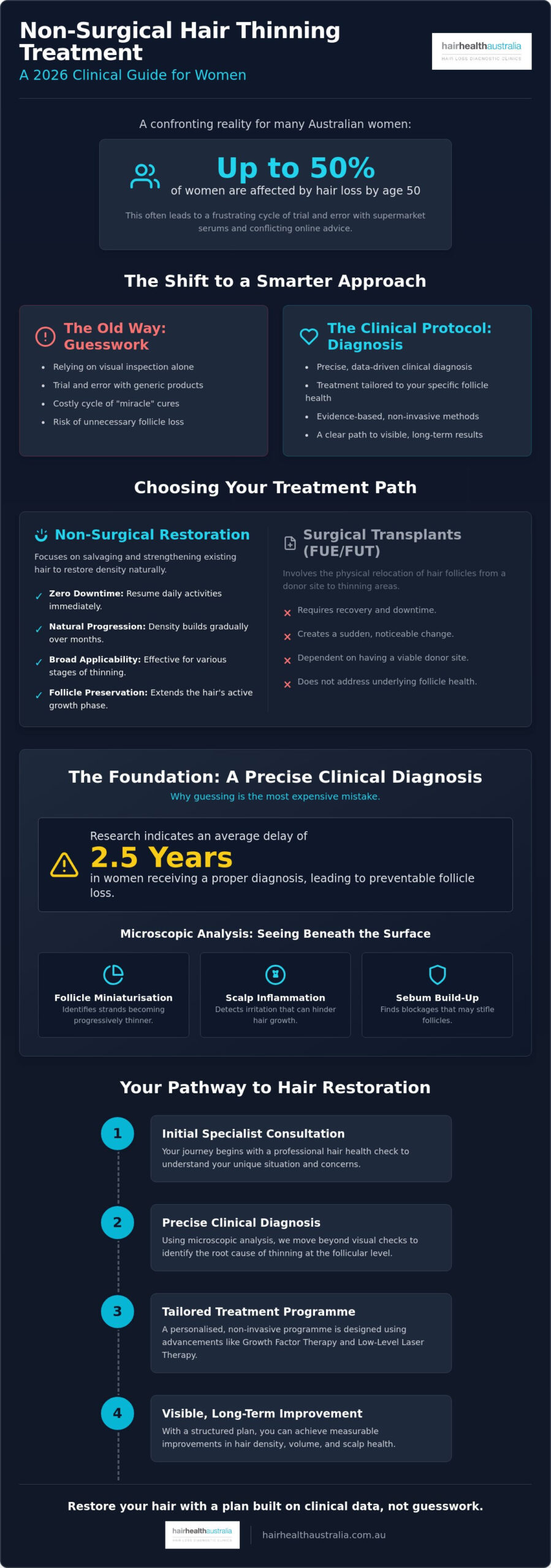
Did you know that up to 50% of women are affected by hair loss by the time they reach age 50? It’s a confronting reality that often leads to a frustrating cycle of trial and error with supermarket serums and conflicting online advice. If you’re searching for an effective non surgical hair thinning treatment for women, you’ve likely encountered significant confusion regarding which options actually work. It’s completely understandable to feel overwhelmed or fear that your loss of volume is an inevitable, permanent part of the ageing process.
The good news is that clinical hair restoration has evolved. Restoring your hair is no longer about guesswork; it’s about following a diagnostic-led protocol tailored to your specific follicle health. In this 2026 clinical guide, we’ll explore evidence-based, non-invasive methods to restore your hair density and scalp health. We’ll examine the latest combination therapies and medical advancements that provide a clear, manageable path toward visible volume and renewed confidence.
Key Takeaways
- Distinguish between invasive surgical procedures and modern, clinical-grade non-surgical protocols designed to preserve and restore hair density.
- Understand why a precise clinical diagnosis is essential for identifying the specific cause of your thinning rather than relying on visual inspection alone.
- Explore the latest 2026 advancements in Growth Factor Therapy and Low-Level Laser Therapy for active follicle stimulation and improved scalp health.
- Learn why professional non surgical hair thinning treatment for women offers superior potency and results compared to generic over-the-counter chemist products.
- Discover the structured pathway to recovery, moving from your initial specialist consultation to achieving visible, long-term improvements in hair volume.
What is Non-Surgical Hair Thinning Treatment for Women?
Choosing a non surgical hair thinning treatment for women is often the first step toward reclaiming both hair volume and personal confidence. These treatments are not merely cosmetic cover-ups; they are clinical-grade, non-invasive procedures that target the underlying biological mechanisms of hair loss. While surgical options such as FUE or FUT transplants involve the physical relocation of follicles, non-surgical restoration focuses on salvaging and strengthening the hair you already have. The goal is to extend the anagen phase, which is the active growth period of the hair follicle, while re-energising those that have become dormant. In 2026, these protocols are firmly established as the gold standard for women experiencing early-to-mid stage thinning.
The Shift from Surgery to Clinical Restoration
There’s a noticeable shift among Australian women away from invasive surgery in favour of medical-grade clinical paths. This preference stems from several practical benefits that better suit a modern lifestyle. Firstly, non-surgical methods require zero downtime, allowing patients to return to their daily routines immediately. Secondly, the results develop gradually, providing a natural-looking improvement in density that avoids the “sudden change” often associated with transplants. We often encounter the myth that surgery is the only “real” solution for hair loss. However, for many women, preserving the health of existing follicles through a structured clinical programme is a more effective and sustainable strategy. Key advantages include:
- Zero downtime: Patients can return to work or social activities immediately after a session.
- Natural progression: Density builds over several months, mirroring the natural hair growth cycle.
- Broad applicability: Effective for various stages of thinning without the need for a donor site.
Who is a Candidate for Non-Surgical Therapy?
The success of any non surgical hair thinning treatment for women depends heavily on timing. The ideal window for intervention is when follicles are thinning but still biologically active. If a follicle has completely miniaturised and the scalp has become smooth, non-surgical methods may be less effective. This is why early intervention is critical for long-term density maintenance. Common candidates include those experiencing Pattern hair loss, as well as thinning triggered by hormonal shifts, chronic stress, or genetic predisposition. To determine your specific candidacy and the current state of your follicle health, we recommend a professional hair health check. This diagnostic approach ensures that your treatment plan is built on clinical data rather than guesswork.
The Importance of a Precise Clinical Diagnosis
Visual assessment alone is rarely enough to build a successful recovery plan. While you might notice more hair in the brush or a widening part, these symptoms don’t tell the full story of why the loss is occurring. Without clinical data, choosing a non surgical hair thinning treatment for women becomes a game of chance. Accurate identification is the only way to distinguish between temporary shedding, such as Telogen Effluvium, and permanent thinning caused by Androgenetic Alopecia. By pinpointing the exact cause, we eliminate the costly cycle of trial and error often associated with over-the-counter “miracle” cures. Research indicates that women face an average delay of 2.5 years in receiving a proper diagnosis, a timeframe that can lead to unnecessary follicle loss.
At our Sydney clinic, we treat the diagnostic phase as the foundation of your journey. This isn’t a quick glance; it’s a systematic review of your scalp health and hair growth patterns. Understanding the nuances of female pattern hair loss diagnosis and treatment allows us to align your protocol with proven medical standards. We move logically from identifying the issue to implementing a solution, ensuring you feel informed at every stage.
Microscopic Hair Analysis: Seeing Beneath the Surface
Microscopic scanning allows us to observe what is happening at the follicular level. We look for follicle miniaturisation, where hair strands become progressively thinner and shorter until they stop growing entirely. This technology also identifies scalp health issues like inflammation or sebum build-up that could hinder growth. By establishing baseline data, we can track your progress with precision during follow-up scans. This objective evidence ensures your non surgical hair thinning treatment for women is working as intended. Local Sydney residents can begin this process by booking a comprehensive Hair Health Check to gain immediate clarity on their condition.
Trichologist vs. General Practitioner
A GP is an essential partner for your general health, but a dedicated hair specialist offers a more targeted focus. We look specifically at the hair growth cycle and the complex scalp environment. A specialist understands how subtle hormonal shifts or nutritional deficiencies manifest in the hair. We ensure your personalised plan aligns with your medical history while focusing purely on restoration. This level of specialisation provides the targeted insights needed to manage complex cases effectively. If you’re tired of conflicting advice, it’s often best to consult with a specialist who focuses solely on hair restoration.
Evidence-Based Clinical Protocols for 2026
By 2026, the landscape of non surgical hair thinning treatment for women has moved beyond single-ingredient solutions. We now rely on multi-modal protocols that address follicle health from several biological angles simultaneously. This “combination therapy” approach is why modern clinical results often surpass what was possible just a few years ago. It’s about creating a synergistic effect where each treatment phase enhances the next. Because these methods are non-invasive, they maintain an exceptional safety profile. You won’t have to worry about the systemic side effects sometimes associated with aggressive pharmaceutical interventions or the surgical risks of a transplant.
Moving from a single product to a clinical programme is a deliberate shift toward precision. We focus on the environment of the scalp as much as the hair itself. By improving the health of the “soil,” we ensure the “seed”, your hair follicle, has the best possible chance to thrive. This methodical progression ensures that every action taken is supported by clinical evidence and tailored to your unique biology. It replaces the uncertainty of home-based experiments with a structured, professional path forward.
Stimulating Growth with Advanced Clinical Methods
Growth Factor Therapy represents a significant evolution in follicle stimulation. These treatments work by delivering concentrated biological signals directly to the scalp. During a typical clinical session, which usually lasts around 30 to 45 minutes, you’ll receive a series of targeted applications designed to nourish the hair at its source. Most patients describe the sensation as a mild, cooling pressure with no discomfort. Unlike the “miracle” cures often sold through late-night television or unverified online stores, these methods are grounded in rigorous clinical standards. They focus on the actual biology of the growth cycle rather than just the temporary appearance of the hair shaft.
The Role of Low-Level Laser Therapy (LLLT)
Light-based therapy, specifically LLLT, is a cornerstone of modern restoration. It uses specific light wavelengths to trigger the production of Adenosine Triphosphate (ATP) within the follicle cells. Think of ATP as the fuel that powers cellular repair and growth. This increase in energy improves blood circulation and oxygen delivery, effectively “waking up” sluggish or miniaturised follicles. Clinical evidence consistently shows an increase in both hair diameter and overall density when using professional-grade equipment. It’s vital to distinguish between high-output clinical lasers and low-power home devices. The professional equipment used in a clinical setting provides the therapeutic intensity required for a successful non surgical hair thinning treatment for women.
Comparing Clinical Treatment vs. Over-the-Counter Options
Choosing a non surgical hair thinning treatment for women often involves a choice between a trip to the local chemist and a professional clinical consultation. While supermarket shelves are lined with shampoos and serums promising rapid regrowth, these products rarely contain the therapeutic concentrations required to reverse follicle miniaturisation. Clinical-grade applications are formulated with higher potencies and advanced delivery systems that reach the follicle’s base. In contrast, over-the-counter (OTC) options are designed for the “average” user, often resulting in a one-size-fits-all approach that fails to address your specific hair loss triggers.
Oral supplements are another common point of confusion. We view vitamins and minerals as supportive elements rather than primary treatments. While a deficiency can certainly exacerbate thinning, a supplement alone is unlikely to restart a stalled growth cycle in the presence of genetic or hormonal factors. Professional care provides a more economical path long-term. Instead of spending years on ineffective “trial and error” purchases, a clinical intervention targets the root cause immediately, protecting your existing hair density before further loss occurs.
Why Pharmacy Solutions Often Fall Short
The primary issue with pharmacy-bought solutions is the lack of professional monitoring. Without a specialist to track your progress and adjust concentrations, it’s difficult to know if a product is actually working. Many OTC brands rely on surface-level ingredients that improve the hair’s texture without impacting the scalp’s internal biology. Because thinning is often an internal process, it requires more than just a superficial wash. Consistent application is also a hurdle; without a structured clinical programme, many women find it difficult to maintain the rigorous daily routine required for even modest OTC results.
The Synergy of Clinical Care and Home Maintenance
We don’t view home care and clinical treatment as mutually exclusive. Instead, professional sessions “prime” the scalp, increasing its receptivity to maintenance products. This synergy creates a sustainable, long-term routine that protects your investment in regrowth. By following a plan that combines in-clinic technology with high-quality home kits, you ensure your follicles remain in the anagen phase for as long as possible. For a deeper look at the specific protocols available this year, you can explore the Best Hair Regrowth Treatment Australia 2026. If you are ready to move beyond generic pharmacy brands, book a clinical assessment to determine the right intervention for your hair type.
Your Pathway to Recovery at Hair Health Australia
At Hair Health Australia, we understand that hair loss is a deeply personal experience that requires more than just a medical prescription. Our Sydney-based team is dedicated to providing a non surgical hair thinning treatment for women that is as empathetic as it is scientifically rigorous. We focus exclusively on evidence-based, non-invasive restoration protocols that prioritise the health of your existing follicles. By choosing a clinical path, you’re moving away from the uncertainty of “miracle” products and toward a structured, professional journey. The most critical factor in this journey is timing. Taking action while your follicles remain viable is the key to achieving the density and volume you desire.
Our commitment to transparency means we provide realistic expectations from the very first day. We don’t promise overnight transformations; instead, we offer a steady, methodical progression toward scalp health and hair regrowth. This process is built on trust and clinical verification, ensuring you feel supported at every stage of your recovery. We aim to replace your uncertainty with a clear, actionable path forward.
A Personalised Programme for Every Woman
We reject the “cookie-cutter” approach common in the hair restoration industry. Every woman’s hair loss journey is unique, which is why your protocol is tailored specifically to your microscopic hair scan results. During your time at our specialised Sydney clinic, we create a supportive environment where your concerns are heard and addressed with clinical precision. We establish clear, realistic milestones for your regrowth journey. Typically, we look for improvements in scalp health within the first few months, followed by visible changes in hair diameter and density. This individual-centric approach ensures that your treatment plan evolves as your hair health improves.
Taking the First Step: Booking Your Consultation
Your recovery begins with a comprehensive 1-on-1 session with our specialists. To prepare for your first microscopic hair analysis, we recommend arriving with clean hair, free from heavy styling products or concealers. During this initial session, we use high-definition scanning technology to examine your scalp and follicles in detail. This diagnostic data allows us to identify the specific nature of your thinning and determine your candidacy for our protocols. It’s a straight-talking, honest assessment designed to empower you with knowledge and understanding. If you’re ready to stop the cycle of uncertainty, we invite you to organise your clinical hair health check today and take control of your hair’s future.
Take Control of Your Hair Restoration Journey
The path to thicker, healthier hair doesn’t require invasive surgery or the uncertainty of generic pharmacy brands. By prioritising a precise clinical diagnosis through specialised microscopic hair analysis, you can identify the exact cause of your thinning and address it with a targeted protocol. We’ve seen that the most successful outcomes for a non surgical hair thinning treatment for women rely on multi-modal, evidence-based care that re-energises dormant follicles while they’re still viable.
With over 15 years of experience in Australian hair restoration, our team provides the medical authority and empathetic guidance needed to navigate this process with confidence. It’s time to replace trial and error with a systematic, professional plan tailored to your unique scalp environment. If you’re ready to see visible improvements in hair volume and density, the first step is gaining clinical clarity through a structured assessment.
Book Your Comprehensive Hair Health Check in Sydney today to begin your recovery. You don’t have to face hair thinning alone; professional support is available to help you restore both your hair and your confidence.
Frequently Asked Questions
Is non-surgical hair thinning treatment permanent?
Non-surgical restoration is a management strategy rather than a one-time permanent fix. Because conditions like androgenetic alopecia are progressive, ongoing maintenance is usually required to sustain your results. These treatments work to keep follicles in the active growth phase, but if therapy stops, the hair will eventually return to its natural thinning pattern. We focus on building a sustainable long-term plan to preserve your density and scalp health.
How long does it take to see results from clinical hair treatments?
Most patients begin to see a visible improvement in hair volume and quality within three to six months of starting their protocol. Hair grows in cycles, so it takes time for newly stimulated follicles to produce visible strands. We typically conduct a follow-up microscopic analysis at the four-month mark to objectively measure your progress against your baseline data and adjust your plan if necessary.
Are there any side effects to non-surgical hair restoration for women?
Clinical non surgical hair thinning treatment for women is favoured for its high safety profile and lack of systemic side effects. Unlike some aggressive medications, non-invasive therapies like LLLT or growth factor applications don’t cause hormonal disruptions. Some patients might experience very mild, temporary scalp sensitivity or redness immediately after a session, but these symptoms usually resolve within a few hours.
Can these treatments help with thinning caused by menopause?
Yes, these protocols are highly effective for addressing thinning triggered by the hormonal shifts of menopause. Research indicates that up to two-thirds of women experience thinning or loss post-menopause. By targeting the follicles with growth factors and improved circulation, we can help counteract the effects of declining oestrogen levels. Early intervention is particularly beneficial during this life stage to maintain existing hair density.
What is the difference between clinical growth factors and PRP?
Platelet-Rich Plasma (PRP) uses a concentration of your own blood platelets to trigger healing, while modern clinical growth factor therapy often uses lab-refined, bio-identical proteins. Both aim to stimulate the follicle, but growth factor treatments are sometimes preferred by those who wish to avoid blood draws. During your consultation, we’ll determine which biological stimulant is best suited to your specific scalp health and recovery goals.
How many sessions will I need to see a visible change in my hair density?
A standard clinical programme typically consists of an initial intensive phase of 10 to 12 sessions, followed by less frequent maintenance visits. The exact number depends on the severity of your thinning and how your follicles respond to the stimulation. We provide a personalised schedule after your microscopic analysis, ensuring your treatment frequency aligns with your specific hair growth cycle and desired outcome.
Is the treatment painful or does it require downtime?
These procedures are designed to be comfortable and require absolutely no downtime. You can return to your workplace or social commitments immediately after your appointment. Most patients describe the sessions as relaxing, involving a cooling sensation or a gentle tingling on the scalp. It’s a convenient alternative for busy women who want professional results without the recovery period associated with surgical transplants.
Can I continue to colour my hair while undergoing clinical treatment?
You can certainly continue to colour your hair, though we recommend waiting 48 hours after a clinical session before applying chemical dyes. Maintaining your aesthetic routine is important for your confidence, and our treatments won’t interfere with your regular hairdressing appointments. We simply ask that you coordinate your salon visits with your clinical schedule to ensure your scalp is calm and receptive to the restoration protocol.