What if the most effective path to a fuller head of hair in 2026 isn’t found in a surgical theatre, but under a microscope? It’s understandable to feel overwhelmed by the aggressive marketing and “miracle” cures that often flood digital feeds. Many Sydney professionals feel a quiet anxiety when they notice thinning in the mirror, yet they understandably hesitate at the thought of the “surgical look” or the weeks of recovery required for a transplant. You deserve a solution that’s grounded in clinical data rather than expensive guesswork.
This guide explores the latest advancements in non-invasive hair restoration Sydney has to offer, focusing on how precise diagnostics can restore your hair density without a single incision. We’ll examine why the signature Hair Health Check is the essential starting point for any successful regrowth journey. By the end of this article, you’ll understand the biological science behind follicular health and how to implement a sustainable maintenance programme that fits seamlessly into your busy lifestyle. It’s time to replace uncertainty with a clear, scientific roadmap to confidence.
Key Takeaways
- Understand why a microscopic Hair Health Check is the mandatory first step to identify active follicles and avoid wasting money on ineffective treatments.
- Discover how modern non-invasive hair restoration Sydney protocols provide clinical-grade results without the downtime or visible scarring of surgical alternatives.
- Learn to identify the “three pillars” of restoration, stimulation, inhibition, and nutrition, that must be balanced to address the biological causes of thinning.
- Recognise the essential quality markers for a Sydney clinic, such as the use of TGA-approved technology and a commitment to evidence-based diagnostic data.
- Gain clarity on how a customised clinical programme can be integrated into a professional lifestyle, providing a clear path to restored density and scalp health.
What is Non-Invasive Hair Restoration and Why is Sydney Choosing It?
Non-invasive hair restoration Sydney protocols represent a clinical shift away from the trauma of traditional surgery. Instead of relying on incisions or follicular unit extraction, these programmes focus on biological reactivation. The goal is to stimulate dormant follicles and stabilise thinning without the need for stitches, local anaesthesia, or significant downtime. For the modern Sydney professional, this means achieving a natural increase in density through a series of “lunchbreak” appointments rather than a single, invasive procedure that requires weeks of recovery.
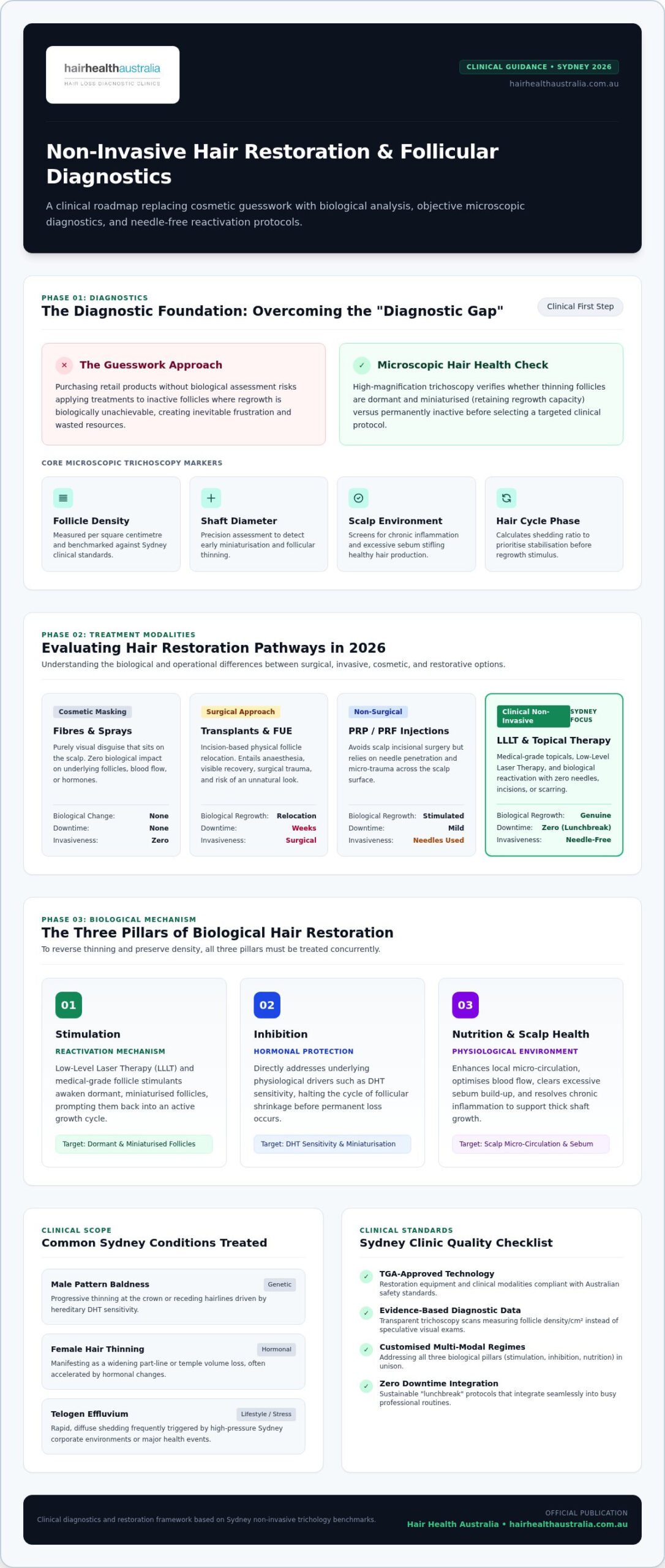
In 2026, the demand for these treatments has surged. Many clients are moving away from the “surgical look” often associated with transplants, seeking instead to preserve their existing hair and thicken areas affected by pattern hair loss. There’s also a critical distinction between cosmetic thickening, which uses fibres or sprays to mask loss, and clinical restoration. Clinical protocols aim to address the underlying physiology of the scalp, such as DHT sensitivity and blood flow, to produce genuine regrowth from your own follicles.
The Difference Between Non-Surgical and Non-Invasive
It’s easy to confuse these terms, but the distinction is vital for managing your expectations. Many “non-surgical” options in Sydney still involve invasive elements, such as needles for PRF or PRP injections. True non-invasive restoration focuses on medical-grade topical formulas, Low-Level Laser Therapy (LLLT), and systematic follicle stimulation. This approach is ideal for those who prefer to avoid needles entirely. Because it’s gentle on the scalp, it’s a sustainable choice for long term maintenance. Every successful journey begins with a thorough Hair Health Check to ensure your follicles are still capable of responding to these stimuli.
Common Conditions Treated in Sydney Clinics
Sydney’s high pressure corporate environments and coastal lifestyle present unique challenges for hair health. We frequently see three primary conditions:
- Male Pattern Baldness: Gradual thinning at the crown or receding hairlines driven by genetic factors.
- Female Hair Thinning: Often manifesting as a widening part-line or loss of volume at the temples, which can be exacerbated by hormonal shifts.
- Telogen Effluvium: Rapid shedding often triggered by the high stress levels common in Sydney’s competitive professional sectors or following significant health events.
By identifying these conditions early through microscopic analysis, we can implement a targeted clinical protocol that halts progression and encourages new growth before the follicles reach a state of permanent inactivity.
The Diagnostic Foundation: Why the Hair Health Check is Essential
Many individuals begin their hair journey by purchasing retail shampoos or supplements without understanding the biological reality of their scalp. This creates a “Diagnostic Gap” where treatments are applied to follicles that may no longer be viable, leading to inevitable frustration. If a hair follicle has been inactive for several years, it may have reached a point where regrowth is no longer possible. Conversely, many follicles that appear “dead” to the naked eye are actually just dormant or miniaturised, meaning they still retain the biological capacity for regrowth if treated with the correct clinical protocol. For successful non-invasive hair restoration Sydney specialists rely on data, not assumptions. Trichoscopy is a non-invasive scanning technique used to assess follicle health and hair shaft diameter.
What Happens During a Microscopic Scan?
A microscopic scan provides a high-magnification view of the scalp environment that is impossible to see in a standard mirror. We look for specific markers of poor scalp health, such as chronic inflammation or excessive sebum build-up, which can stifle hair growth. By measuring follicle density per square centimetre, we compare your results against Sydney clinical benchmarks to determine the precise stage of thinning. This process also allows us to analyse your current hair cycle stage. If an unusually high percentage of hairs are in the shedding phase, we can pivot the strategy to stabilise the scalp first. This methodical approach aligns with Healthdirect guidance on pattern baldness, which emphasises the importance of clinical assessment in managing genetic hair loss.
Personalised Data vs. One-Size-Fits-All Retail Products
Retail products are designed for a broad demographic, but hair loss is a highly individualised biological process. It’s often driven by specific hormonal triggers or genetic sensitivities that a generic shampoo simply cannot address. Using diagnostic data allows us to customise non-invasive hair restoration Sydney programmes to target your specific root causes. This eliminates the trial-and-error approach that often leads to wasted investment in “miracle” cures. When we take the second-guessing out of the process, we can focus on the formulas and technologies that will actually yield results for your unique hair profile. If you’re ready to establish a scientific baseline for your hair health, you can book your Hair Health Check here to see exactly what is happening beneath the surface.
Comparing Non-Invasive Pathways: Modalities for 2026
Effective non-invasive hair restoration Sydney protocols rely on a multi-faceted approach rather than a single “silver bullet” solution. In a clinical setting, we view successful regrowth through the lens of three distinct pillars: stimulation, inhibition, and nutrition. By addressing these factors simultaneously, we can create an environment where follicles thrive rather than struggle against genetic or environmental pressures. This comprehensive methodology aligns with global standards for clinical hair loss diagnosis and treatment modalities, ensuring every step of your programme is backed by biological evidence.
The Science of DHT Inhibition
Dihydrotestosterone, or DHT, is the primary hormone responsible for the miniaturisation of hair follicles in genetic thinning. It binds to receptors in the scalp, causing the hair growth cycle to shorten and the hair shafts to become progressively thinner over time. Clinical-grade topicals play a vital role here by acting as a localised barrier. Unlike some oral medications that can impact the entire body, these targeted non-invasive programmes focus on blocking DHT at the follicle level to avoid systemic side effects. You can explore the deeper mechanics of this process in our guide on Dht Blocker Science: How Men Regrow Hair Clinically.
Laser Therapy (LLLT) in a Clinical Setting
Low-Level Laser Therapy (LLLT) uses specific wavelengths of light to re-energise weakened follicles through a process called photobiomodulation. This light energy stimulates cellular activity within the mitochondria, increasing blood flow and nutrient delivery directly to the hair bulb. While handheld home devices are readily available, clinical-grade laser panels provide a significantly higher power density and more uniform scalp coverage. A typical Sydney treatment schedule usually involves two 20-minute sessions per week. This frequency is designed to maintain a consistent state of follicular stimulation without disrupting a demanding professional or social calendar.
Finally, we must consider the role of nutraceuticals in supporting the internal environment. Even the most advanced external treatments can struggle if the body lacks the essential building blocks for keratin production. By combining these three modalities, we ensure that the follicle is protected from DHT, energised by light, and nourished by high-quality clinical supplements. This holistic yet scientific approach is what distinguishes a professional clinic from basic retail solutions.
Choosing a Sydney Hair Clinic: The 2026 Quality Checklist
Selecting the right clinic is a critical decision that determines your long term success. In a market saturated with hyperbolic marketing claims, you must prioritise transparency and clinical evidence. A reputable provider of non-invasive hair restoration Sydney will always insist on a diagnostic-first approach. This means they refuse to sell a treatment programme until they’ve verified the health of your follicles through high-magnification imaging. It’s about ensuring the solution matches the biological reality of your scalp rather than just following a generic sales script. You deserve a partner who values data over a quick sale.
Red Flags to Avoid in the Hair Loss Industry
Guarantees of “100% regrowth” are a significant warning sign. Biology is variable; no ethical specialist can promise universal results without first assessing follicle viability. Avoid clinics that use high-pressure sales tactics, such as demanding immediate deposits for surgical procedures or long term contracts during your first visit. When evaluating non-invasive hair restoration Sydney options, be wary of any provider that lacks transparency regarding realistic timelines. You should also verify the use of TGA-approved equipment and clinically-backed formulas. Genuine results must be supported by microscopic evidence in case studies. Look for trichoscopy images showing increased hair shaft diameter and follicle density, as these provide a much more accurate representation of success than standard “before and after” photos taken in flattering lighting.
The Importance of Local Sydney Support
Consistency is the foundation of any successful regrowth journey. Choosing a Sydney-based centre, such as a facility in Redfern or the CBD, ensures you can attend regular follow-ups and progress monitoring sessions without disrupting your work day. A “straight-talking” Australian specialist provides an objective perspective that cuts through the noise of conflicting online advice. They understand local factors that affect hair health, ranging from Sydney’s coastal UV exposure to the chronic stress associated with high-stakes corporate careers. Having a local point of contact means your treatment can be adjusted in real-time based on your scalp’s response. For a more comprehensive framework on evaluating providers, see our guide on Choosing a Non-Surgical Hair Loss Clinic in Sydney.
If you’re ready for an honest, scientific assessment of your hair’s potential, book your microscopic Hair Health Check today to see if you’re a candidate for clinical regrowth.
Starting Your Journey: The Hair Health Australia Approach
Choosing the right path for non-invasive hair restoration Sydney professionals can trust involves a commitment to clinical precision. At Hair Health Australia, we don’t rely on guesswork or generic retail trends. Instead, we utilise microscopic data to take the second-guessing out of your hair restoration journey. By examining your scalp at high magnification, we can identify exactly which follicles are in a state of miniaturisation and which are still capable of robust regrowth. This data-driven approach ensures that every recommendation is based on your unique biological profile rather than a one-size-fits-all marketing promise.
Once we’ve established your baseline, we customise the “Retain” regrowth programme to match your specific stage of loss. This isn’t a static plan; it’s a dynamic clinical protocol designed to evolve as your scalp health improves. During your first 90 days of treatment, the primary focus is on stabilisation. You’ll likely notice a significant reduction in excessive shedding as the follicles begin to transition into a healthier growth phase. We believe in empowering Sydney-siders with the knowledge to maintain their results long-term, providing you with a clear understanding of the science behind your progress.
Your First Appointment: The Hair Health Check
Your journey begins with a dedicated clinical assessment. The Hair Health Check is a no-obligation microscopic scan designed to determine your true potential for success before you commit to a full programme. During this session, we’ll map out your scalp’s density and follicle health, providing you with a personalised diagnostic report and a clear treatment roadmap. This transparency allows you to make an informed decision based on clinical evidence. If you’re ready to see what’s happening beneath the surface, you can secure your free microscopic scan in Sydney today.
Integrated Care for Lasting Results
Successful regrowth requires a consistent, multi-angled strategy. Our approach combines intensive in-clinic therapy with professional home-use maintenance to ensure your follicles receive constant stimulation. We don’t just start a programme and leave you to it; we conduct regular progress scans to adjust your protocol as your hair recovers. Hair Health Australia provides a comprehensive diagnostic scan that serves as the blueprint for every successful non-invasive restoration programme. This systematic monitoring allows us to verify that your hair is responding correctly and make precise adjustments to your topical formulas or light therapy schedules as needed.
Securing the Future of Your Hair Health
Restoring hair density is no longer a matter of trial and error or invasive surgery. By prioritising a diagnostic-first approach, you can identify the precise biological state of your follicles and implement a clinical protocol that works. Successful non-invasive hair restoration Sydney relies on this foundation of microscopic data to ensure you’re investing in a programme that matches your specific needs. We’ve moved beyond the era of “miracle” cures into a time where evidence-based results are the standard.
Hair Health Australia has provided over 10 years of clinical results in Sydney, helping men and women navigate thinning with absolute clarity. Our signature microscopic scanning technology removes the uncertainty, allowing for personalised programmes that fit a busy professional lifestyle. It’s time to stop second-guessing and start a journey backed by proven science. You don’t have to accept thinning as inevitable when clinical tools exist to help you retain and regrow.
Book Your Free Hair Health Check in Sydney Today to discover your hair’s true potential and receive a scientific roadmap for your recovery. We’re here to guide you toward a more confident future with a steady, expert hand.
Frequently Asked Questions
Is non-invasive hair restoration as effective as a hair transplant?
Non-invasive hair restoration Sydney protocols offer a different clinical objective than transplants. While a transplant redistributes existing hair through surgery, non-invasive methods focus on revitalising dormant follicles and increasing the diameter of thinning shafts. For many clients, this is a more effective first step because it preserves the natural hair and avoids surgical risks. It’s particularly successful for those in the earlier stages of thinning where follicles are still viable.
How long does it take to see results from non-surgical hair treatment in Sydney?
Patience is essential when working with biological growth cycles. Most clients begin to notice a significant reduction in hair shedding within the first 90 days of a clinical programme. Visible improvements in hair density and scalp coverage typically emerge between four and six months of consistent treatment. This timeline allows the follicles to transition from a resting phase into an active growth phase; ensuring the new hair is strong and well-nourished.
Can women benefit from non-invasive hair restoration programmes?
Absolutely. Female hair loss treatment is a specialised area that addresses unique thinning patterns, such as a widening part-line or loss of volume at the temples. Our non-invasive hair restoration Sydney programmes are customised to account for the specific hormonal and environmental factors that affect women. By using microscopic data from a Hair Health Check, we can develop a targeted roadmap that restores density without the need for aggressive surgical intervention.
What is the difference between a hair clinic and a general hairdresser?
The primary difference lies in the focus on biology versus aesthetics. A general hairdresser focuses on the appearance of the hair shaft through cutting, colouring, and styling. A specialised hair clinic like Hair Health Australia focuses on the health of the hair follicle and the scalp environment. We use clinical diagnostic tools and medical-grade protocols to address the root causes of hair loss, providing a level of scientific analysis that a salon cannot offer.
Does the microscopic hair health check hurt or require any preparation?
The Hair Health Check is a completely painless and non-invasive procedure. It involves using a high-magnification microscopic camera to scan the scalp surface, so there’s no discomfort or recovery time required. You don’t need to perform any special preparation before your appointment. However, we recommend arriving with relatively clean hair, free from heavy styling products or fibres, to ensure the clearest possible imaging of your follicles and scalp health.
Are the results of non-invasive hair restoration permanent?
Results are sustainable but require a commitment to ongoing maintenance. Because conditions like androgenetic alopecia are progressive, the biological triggers for thinning must be managed continually. Once you achieve your desired density, we transition you to a maintenance programme designed to inhibit DHT and support follicle nutrition. This proactive approach ensures that your hair remains in the growth phase and prevents the return of the miniaturisation process over time.
Can I continue my normal hair styling routine during clinical treatment?
You can certainly maintain a professional styling routine, though some adjustments may be recommended. We advise being mindful of extreme heat from blow-dryers or harsh chemical treatments that can irritate the scalp environment. During your consultation, we’ll review your current products and suggest ways to integrate your clinical treatment into your daily life. The goal is to ensure your styling habits don’t counteract the progress made by your regrowth programme.
What is the cost of non-invasive hair restoration compared to surgery?
Non-invasive restoration is typically a more accessible financial option compared to the high upfront costs of surgery. While a hair transplant requires a significant one-off payment for a surgical procedure, clinical programmes involve a structured investment in ongoing care and maintenance. This allows you to manage the cost over time while focusing on the health of your existing hair. It also eliminates the hidden costs associated with surgical downtime and post-operative recovery.