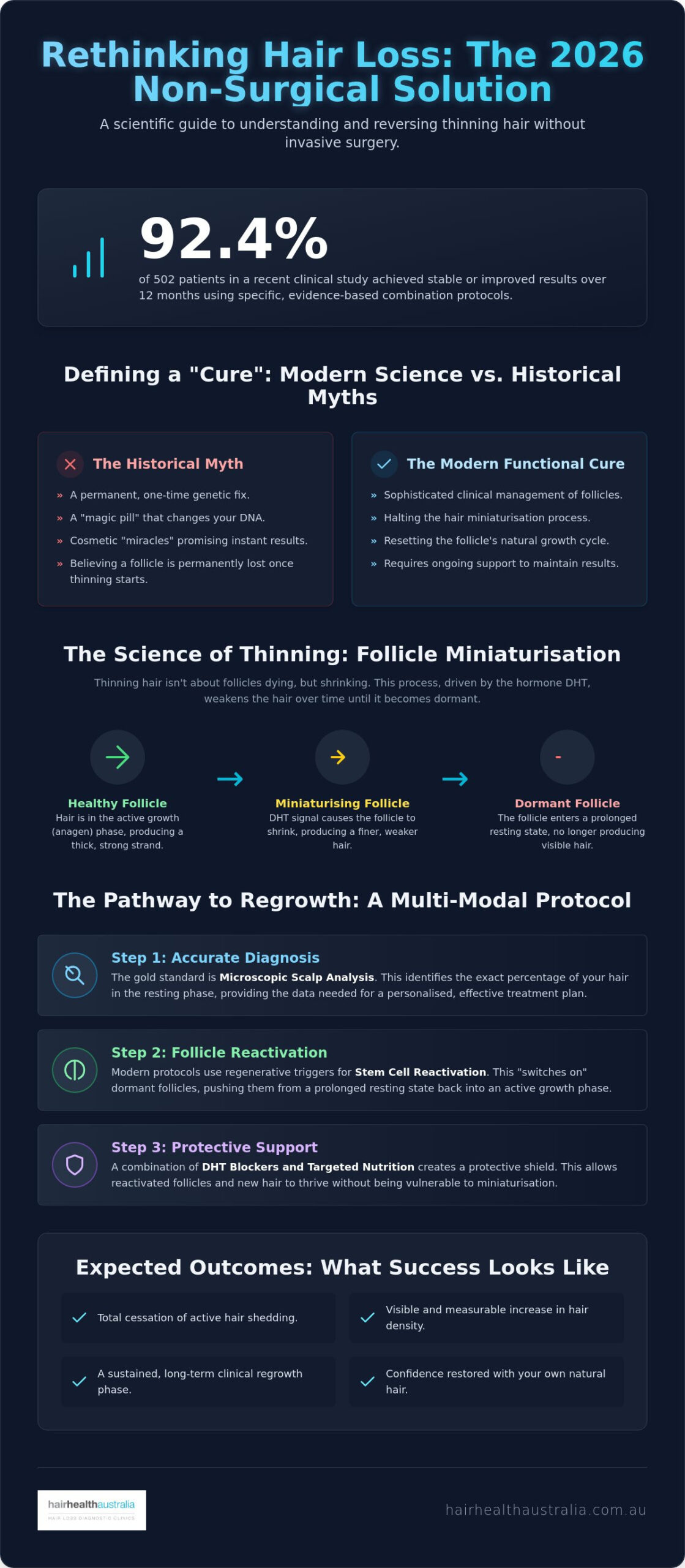
What if the “permanent cure” for hair loss isn’t a single surgical event, but a sophisticated biological reversal you can achieve without ever needing a scalpel? For many Australians, the emotional distress of thinning hair is compounded by a fear of invasive surgery and the sheer exhaustion of navigating conflicting medical advice online. You’ve likely wondered if real results are actually possible or if you’re simply chasing another marketing gimmick. Recent clinical data suggests that non surgical hair regrowth effectiveness has reached a critical turning point in 2026. A notable study of 502 patients demonstrated that 92.4% achieved stable or improved results over 12 months using specific, evidence-based combination protocols.
We understand that your hair is a core part of your identity, and we’re here to replace uncertainty with scientific clarity. This article will guide you through the latest breakthroughs in regenerative medicine and non-invasive treatments that offer a functional cure for thinning hair today. You’ll gain a clear understanding of what a “cure” looks like in the current medical landscape and how to begin a personalised path to regrowing your own natural hair with the confidence of professional, Sydney-based clinical expertise.
Key Takeaways
- Understand the clinical distinction between a permanent genetic fix and the functional management of follicles to set realistic expectations for your restoration journey.
- Explore how breakthroughs in stem cell reactivation are targeting dormant follicles, proving that thinning hair doesn’t always mean the follicle is permanently lost.
- Discover why microscopic scalp analysis is the gold standard for diagnostic accuracy, identifying the exact percentage of your hair currently in the resting phase.
- Learn why a multi-modal protocol is the key to non surgical hair regrowth effectiveness, combining follicle stimulation with targeted nutritional support for superior results in 2026.
- Gain insight into how a personalised, professional consultation at a specialised Sydney clinic can replace uncertainty with a clear, science-based path forward.
Defining a Cure: Modern Science vs. Historical Myths
For many Australians, the word “cure” suggests a permanent, one-time solution that resolves a condition forever. In the context of Pattern hair loss (androgenetic alopecia), this definition is often misleading. Science hasn’t yet found a way to rewrite the genetic code responsible for thinning. Instead, modern medicine focuses on clinical management. This involves intervening in the biological processes that cause follicles to shrink. The term “cure” is frequently misused by retailers selling cosmetic “miracles,” which creates a cycle of hope and disappointment. This psychological toll is significant. Many people find themselves searching for a miracle instead of committing to a structured medical programme. Success depends on setting realistic expectations. If a follicle has been dormant for a decade, it’s harder to revive than one that has only recently begun to thin.
The confusion often stems from a lack of transparency in the industry. A “cure” in 2026 isn’t a magic pill that changes your DNA; it’s a systematic approach to halting the miniaturisation process. When we discuss non surgical hair regrowth effectiveness, we’re measuring how well a clinical protocol can override genetic signals to keep hair in the growing phase. Understanding this distinction helps replace fear with a sense of control. You aren’t fighting a losing battle against your genes. You’re managing a biological condition with the same precision you’d use for any other health concern.
The Evolution of Hair Restoration in Australia
Australian clinical standards have undergone a massive transformation. We’ve moved away from the era of “mice in a jar” and unverified tonics toward rigorous trichological standards in Sydney. Local protocols now prioritise non-invasive methods over surgery whenever possible. This shift focuses on preserving and reawakening existing follicles rather than simply moving hair from one spot to another. By concentrating on the underlying health of the scalp, clinicians can improve the results for patients in the early to moderate stages of loss. It’s a move toward sophisticated, evidence-based care that respects the patient’s desire for a natural look without the downtime of a transplant; however, for those evaluating all options, you can find out more about Per-procedure medical fees for hair restoration and transplantation to understand how clinical costs vary across different treatment types.
What is a Functional Cure?
A functional cure differs from a traditional one because it requires ongoing support to maintain results. We define success as the total cessation of active shedding combined with a visible, measurable increase in hair density. Modern non-surgical interventions work by resetting the follicle growth cycle, pushing more hairs back into the active anagen phase. To see if your follicles are suitable for this approach, a professional hair health check is the essential first step. A functional cure is a sustained clinical regrowth phase.
Breakthroughs in Follicle Stem Cell Reactivation
One of the most significant shifts in 2026 clinical perspectives is the understanding that follicles rarely “die” during the initial years of thinning. Instead, they enter a state of prolonged dormancy. The discovery of the PP405 molecule has revolutionised how we approach this hibernating state. PP405 works by activating the natural lactate production within hair follicle stem cells, which effectively “switches” the follicle back into an active growth phase. While this molecule represents the future of pharmacology, current clinical methods already utilise similar pathways to achieve results. Evaluating non surgical hair regrowth effectiveness today requires a focus on these regenerative triggers rather than just surface-level stimulation.
For a treatment to be successful, it must address the biological environment of the scalp. This is where DHT blockers play a vital role. Dihydrotestosterone (DHT) is the primary hormone responsible for follicle miniaturisation; a process where the hair becomes thinner and shorter with each cycle. By utilising proven blockers, we create a protective shield that allows stem cell reactivation to take place. Without this protection, any new growth remains vulnerable. For those seeking a comprehensive overview of established clinical options, this dermatologist’s guide to hair loss treatments provides an excellent foundation for understanding how these medications function within a broader programme.
Reawakening Hibernating Follicles
The biological difference between a dead follicle and a dormant one is the presence of viable stem cells. Clinical-grade light therapy and targeted topical protocols work by triggering cellular energy, specifically increasing ATP production at the mitochondrial level. This provides the “fuel” required for the follicle to exit the telogen (resting) phase. Early intervention remains the most effective way to secure a functional cure. If you’re concerned about the current state of your hair, a professional hair health check can determine whether your follicles are simply dormant or if more advanced loss has occurred.
The Problem with Compounded Products
Many Australians are tempted by unverified miracle supplements and “custom” compounded foams found online. These products often lack standardised clinical formulations and medical-grade purity, which can lead to inconsistent results or scalp irritation. Standardised clinical treatments outperform over-the-counter options because they are held to rigorous stability and absorption standards. Choosing a professional clinical path ensures that the non surgical hair regrowth effectiveness you experience is based on verified science rather than marketing claims. Consistency in formulation is just as important as the active ingredients themselves.
The Role of Microscopic Hair Analysis in Diagnostic Accuracy
A standard visual inspection is often the first step many take when they notice thinning, yet it remains fundamentally insufficient for a professional diagnosis. Looking at the scalp with the naked eye doesn’t reveal the biological state of the follicles beneath the surface. Microscopic hair analysis changes this by providing a high-definition view of the scalp environment. This technology allows clinicians to measure the exact percentage of follicles currently in the telogen, or resting, phase. When we assess non surgical hair regrowth effectiveness, we rely on these metrics to determine if a treatment is successfully shifting follicles back into the anagen, or growth, phase.
Tracking follicle diameter over time is another critical component of a science-led approach. As hair thins, the shaft becomes progressively finer, a process known as miniaturisation. By measuring these microns, we can catch the early signs of loss before they become visible to the naked eye. This level of precision is supported by ongoing research into New Approaches to Combat Hair Loss, which emphasises the need to understand follicle health at a cellular level. Linking diagnostic data to clinical outcomes ensures that your programme is reactive to your specific needs rather than a generic solution. It replaces guesswork with objective, verifiable data.
What a Microscopic Scan Reveals
A scan provides a window into the health of your scalp that no mirror can offer. We look for sebum build-up and scalp inflammation, both of which can hinder healthy growth by constricting the follicle exit. The analysis also measures the ratio of terminal hair to vellus hair. Terminal hairs are the thick, pigmented strands we want to preserve, while vellus hairs are the fine “peach fuzz” that often indicates a follicle is in distress. Identifying these patterns helps us rule out temporary conditions and focus on long-term non surgical hair regrowth effectiveness.
The Diagnostic Process in a Sydney Clinic
Our approach in Sydney is methodical and thorough, designed to give you total confidence in your treatment plan. The process follows three distinct stages:
- Step 1: Digital imaging of the scalp at high magnification to establish a baseline of your current hair health.
- Step 2: Detailed analysis of follicle density and hair shaft thickness across different areas of the scalp.
- Step 3: Formulating a bespoke regrowth protocol based on the specific data gathered during your hair health check.
This structured progression ensures that every action we take is grounded in your unique biological profile. It’s about moving away from “one-size-fits-all” retail products and toward a professional, clinical standard of care.
Effective Non-Surgical Treatment Protocols for 2026
Many patients begin their restoration journey by experimenting with a single over-the-counter medication. While these products have their place, they often fail to address the complex biological environment required for sustained results. In 2026, the clinical gold standard for non surgical hair regrowth effectiveness is the multi-modal protocol. This approach doesn’t rely on a single “magic bullet.” Instead, it creates a synergy between follicle stimulation, hormonal management, and targeted nutritional support. By addressing the problem from multiple angles, we can override the genetic signals that lead to thinning and create a scalp environment where hair can actually thrive.
There is a significant difference between clinical regrowth programmes and traditional hair transplant surgery. Surgery is a distributive process; it relocates follicles from one area to another but does nothing to stop the underlying cause of loss. In contrast, a non-surgical clinical programme focuses on preservation and thickening. It aims to keep your natural hair on your head while reawakening dormant follicles. For those in the early to moderate stages of loss, this is often the more sustainable and less invasive path forward. It’s about managing a biological condition with precision rather than simply masking the symptoms.
For patients who may require a combination of approaches or are dealing with advanced hair loss, it is useful to find out more about Surgical Hair Restoration and Hair Loss Treatments to see how clinical expertise can address permanent restoration needs.
Male Hair Loss: Targetting DHT and Circulation
For men, the primary driver of thinning is a genetic sensitivity to Dihydrotestosterone (DHT). Our clinical programmes manage this by combining DHT-blocking agents with treatments that increase blood flow to the follicle. Scalp hygiene is a critical, yet often neglected, part of this process. Excess sebum and environmental pollutants can lead to micro-inflammation, which further chokes the follicle. A structured routine ensures the scalp remains clear and receptive to active treatments. If you want to understand the specific steps involved in professional restoration, our clinical hair treatment guide offers a detailed look at modern non-surgical standards.
Female Hair Thinning: Addressing Hormones and Stress
Women require a fundamentally different diagnostic approach than men. Thinning in women is rarely caused by a single factor; it is often a combination of hormonal shifts, nutritional deficiencies, and stress-induced conditions like telogen effluvium. Because the female scalp is often more sensitive, the treatments must be carefully balanced to avoid irritation while still providing enough stimulation to reset the growth cycle. We prioritise stabilising the scalp environment before introducing intensive regrowth triggers. You can read more about these specialised pathways in our comprehensive guide to hair loss treatment for women.
The first step toward a successful outcome is an accurate diagnosis. To move beyond guesswork and start a programme tailored to your unique needs, we invite you to book a professional hair health check at our Sydney clinic today.
Professional Hair Restoration at our Sydney Clinic
At Hair Health Australia, our philosophy is rooted in the intersection of clinical precision and empathetic care. We don’t view hair loss as a cosmetic inconvenience. Instead, we treat it as a manageable biological condition that requires a dedicated, science-led approach. By choosing a specialised clinic in Sydney, you ensure that your restoration journey is overseen by experts who understand the nuances of the local medical landscape and the specific environmental factors affecting Australian hair health. Our goal is to replace the uncertainty of retail products with a structured, professional programme that delivers measurable results.
The journey from your initial diagnosis to visible regrowth is a methodical process. During your first consultation, we conduct a deep-dive microscopic analysis to establish your baseline follicle health. This isn’t a simple visual check. We use high-definition imaging to map your scalp and identify the exact percentage of follicles that are currently dormant. This data allows us to project the potential non surgical hair regrowth effectiveness for your specific case. We believe in transparency, which means we provide realistic expectations from day one. You’ll leave your first visit with a clear understanding of the biological state of your hair and a defined path forward.
Personalised Care vs. One-Size-Fits-All
Every scalp is unique, and a treatment that works for one individual may not be suitable for another. We customise every programme to the individual’s specific follicle health, adjusting the concentration of active triggers and nutritional support as your scalp responds. The benefit of ongoing clinical monitoring cannot be overstated. By tracking your progress through regular microscopic reviews, we can fine-tune your protocol in real-time. This ensures that the non surgical hair regrowth effectiveness remains high throughout every stage of your recovery. Our commitment to non-surgical excellence means we focus on the long-term health of your hair, not just a temporary fix.
Take the First Step Toward Recovery
Timing is a critical factor in hair restoration. While modern science can reawaken dormant follicles, it cannot revive those that have been lost to advanced scarring or total atrophy. Acting while your follicles are still viable is the most effective way to secure a functional cure and maintain your natural appearance. Our comprehensive scalp and hair analysis is designed to give you the answers you need to stop the cycle of loss. It’s time to move away from conflicting online advice and step into a professional clinical environment. We invite you to Schedule your Hair Health Check at our Sydney clinic today and take control of your hair health journey.
Secure Your Hair Health Future
The landscape of hair restoration has shifted from historical myths toward precise, biological management. We’ve established that a functional cure is achievable by reawakening dormant follicles and protecting them from further miniaturisation. This process relies on moving beyond visual inspections and utilising evidence-based microscopic diagnostic technology to understand your unique scalp environment. Clinical data remains clear: non surgical hair regrowth effectiveness depends on a multi-modal approach that is tailored specifically to your hormonal and nutritional needs.
Choosing a professional path means replacing uncertainty with a structured, medical-grade programme. With over 15 years of clinical experience in Sydney, our specialists are dedicated to providing realistic outcomes through modern, non-invasive protocols. You don’t have to accept thinning as an inevitability. Taking action while your follicles are still viable is the most effective way to restore your natural density and confidence. To begin your journey with a science-led diagnosis, Book Your Comprehensive Microscopic Hair Analysis in Sydney today. Your path to recovery starts with professional clarity.
Frequently Asked Questions
Is there a permanent cure for male pattern baldness in 2026?
While there is no one-and-done permanent cure that changes your genetics, clinical non-surgical treatments act as a functional cure by effectively stopping hair loss. By managing the hormonal and environmental factors that cause thinning, patients can maintain a full head of hair indefinitely through consistent, professional care. This approach ensures that non surgical hair regrowth effectiveness is sustained over the long term through regular clinical monitoring and protocol adjustments.
How do I know if my hair follicles are dead or just dormant?
A microscopic hair analysis is the only reliable way to determine follicle viability. Dormant follicles often continue to produce fine, vellus hair that is invisible to the naked eye; however, these can still be revived with the correct intervention. If the follicle is still present, clinical treatments can often reawaken it. Once a follicle has completely scarred over, regrowth is no longer possible without surgery, which makes early detection vital.
Can women find a cure for thinning hair?
Yes, most cases of female hair thinning are treatable once the underlying cause, such as hormonal shifts, stress, or nutritional deficiencies, is identified. Clinical programmes for women focus on stabilising the scalp environment and providing the necessary biological triggers to return follicles to the growth phase. This process effectively cures the thinning appearance by restoring natural density and hair quality through a personalised, science-led approach tailored to the female hormonal profile.
What is the newest treatment for hair loss in 2026?
The most significant recent advancements involve follicle stem cell reactivation and bio-identical topical protocols. Research into molecules like PP405 has paved the way for more sophisticated clinical treatments that target the hibernating stem cells in the hair bulb. These innovations have vastly improved non surgical hair regrowth effectiveness for those who haven’t responded to traditional medications like minoxidil, offering a new pathway for reawakening follicles that were previously considered difficult to treat.
Are natural cures for hair loss effective?
While scalp massages and certain oils can improve blood flow and hair quality, they are rarely a cure for genetic or hormonal hair loss on their own. Clinical treatments utilise these natural principles, such as increasing circulation, but combine them with medical-grade technology and blockers to address the root cause of the loss more aggressively. This ensures the treatment is powerful enough to override the genetic signals that lead to follicle miniaturisation and sustained hair fall.
How long does it take to see results from a clinical regrowth programme?
Most patients begin to see a stabilisation of hair fall within the first 4 to 8 weeks of a professional programme. Visible regrowth and increased density typically take 3 to 6 months, as this timeline aligns with the natural biological cycle of the hair follicle. Patience and strict adherence to the clinical protocol are essential for achieving a successful outcome, as the follicles require several cycles to produce thicker, more pigmented terminal hair.