
Catching a glimpse of your scalp under the harsh, clinical downlights of a shopping centre can instantly trigger a wave of anxiety. You aren’t alone in this experience; research indicates that approximately 50 per cent of Australians are affected by hair loss by the age of 50. It’s exhausting to constantly check the mirror or avoid outdoor events on windy days because you’re worried about your appearance. If you’re wondering how to feel confident with thinning hair, the answer lies in moving away from the frustration of generic products and toward a scientifically backed clinical roadmap. We understand that regaining control over your hair density is a priority, and it starts with replacing uncertainty with evidence-based clarity.
This article provides a professional perspective on transitioning from anxiety to action through practical styling tips and non-surgical restoration strategies. You’ll discover how microscopic analysis helps identify the specific biological causes of hair thinning, allowing for a more customised approach than any off-the-shelf solution. We’ll guide you through the process of improving hair density discretely, ensuring you feel empowered by knowledge rather than overwhelmed by options. By focusing on proven clinical methodologies, you can move forward with a renewed sense of confidence and a clear, systematic plan for your hair health.
Key Takeaways
- Understand how to break the cycle of “mirror anxiety” by replacing uncertainty with a scientifically backed clinical roadmap.
- Master immediate grooming strategies, including the use of matt-finish products, to improve the appearance of hair density under harsh lighting.
- Discover how to feel confident with thinning hair through non-surgical clinical programs that provide a discrete and sustainable alternative to surgery.
- Learn why a professional Hair Health Check using microscopic analysis is the essential first step in creating a personalised treatment plan.
- Gain insight into the benefits of local clinical support in Sydney for monitoring progress and achieving visible improvements in hair density.
Understanding the Psychological Impact of Thinning Hair
“Mirror anxiety” describes the reflexive habit of scanning every shop window or bathroom mirror to check for scalp visibility under different angles. For many Australians, hair is intrinsically linked to identity, and its thinning can feel like a loss of professional authority or social vitality. This transition from a minor annoyance to a constant background hum of self-consciousness happens gradually as the cycle of checking becomes more frequent. Research highlights that Psychological distress and hair loss are deeply connected, as the perceived loss of control can affect your overall mental well-being. True hair-related confidence is not a feeling you wait for; it is a byproduct of taking proactive, clinical steps toward care.
The “Downlight” Dilemma: Why Social Situations Feel Stressful
The intense, vertical lighting found in Sydney shopping centres and corporate boardrooms is often the primary source of social stress. These “downlights” penetrate through thinning strands, highlighting the contrast between hair and scalp in a way that feels exposed. You might find yourself avoiding certain venues or relying on headwear to feel secure even when it isn’t appropriate for the setting. However, hiding the issue often creates a dependency that fuels more anxiety. Understanding that your hair loss has a specific biological cause, rather than being a personal failing, is the first step in reclaiming your social freedom. When you replace the mystery of thinning with clinical facts, the environment stops feeling like a series of traps.
Moving from “Why Me?” to a Proactive Mindset
Acknowledging the emotional toll of hair loss is vital for both men and women. It isn’t “just hair”; it’s a significant part of how you present yourself to the world. The shift toward a proactive mindset happens when you stop focusing on what has been lost and start protecting the follicles that are still active. Clinical data provides a form of mental armour against self-doubt. By undergoing a Hair Health Check, you gain access to microscopic evidence that clarifies your options. Knowing exactly how to feel confident with thinning hair involves trusting a systematic process that prioritises follicle health over temporary fixes. This transition from passive worry to active restoration offers immediate psychological relief and a clear path toward improved density.
Immediate Practical Strategies for Boosting Confidence
While clinical restoration takes time, there are immediate ways to manage your appearance and reduce daily stress. Learning how to feel confident with thinning hair often starts with changing your grooming habits to work with your current density rather than fighting against it. Many people mistakenly reach for wet-look gels or shiny waxes, but these products cause hair to clump together, which exposes more of the scalp under bright lights. Instead, you should choose “matt” finish clays or pastes. These products expand the hair fibre and create a flatter, denser appearance that diffuses light more effectively.
A professional cut from a stylist who understands thinning patterns is equally vital. They can create layers that provide “lift” or suggest a length that minimises the contrast between thin and thick areas. The impact on a person’s self-esteem when dealing with physical changes like hair loss is significant, making these small daily victories in styling essential for maintaining your mental resilience while you pursue a long-term solution.
Styling Tips for Men and Women
For men managing a receding hairline, a shorter, textured cut is often more effective than attempting to grow hair longer to cover the area. Long strands lack the structural integrity to stay in place, often leading to more mirror-checking throughout the day. For crown thinning, keeping the hair on the sides of your head shorter creates an optical illusion of more volume on top. This balance helps maintain a structured, intentional look.
Women can benefit from blow-drying techniques that use a round brush to lift hair at the root, creating immediate volume. It’s best to avoid heavy silicone-based conditioners that weigh fragile follicles down. In a humid Sydney climate, excess moisture can make thinning hair go limp within hours. Using a light, volumising dust or a pH-balanced dry shampoo can help maintain structure and absorb excess oils that would otherwise cause hair to flatten. These “less is more” approaches ensure you aren’t damaging the hair you have while trying to make it look its best.
Broadening your self-care routine to include other aesthetic treatments can further support your confidence; for example, you might discover House of Beauty Austin to see how professional facials can complement your hair restoration journey by improving your overall appearance.
The Role of Scalp Health in Hair Appearance
A congested scalp, often caused by a buildup of sebum, dead skin cells, and styling products, can make hair appear flatter and thinner than it actually is. Maintaining an optimal environment for hair growth is not just about cleanliness; it’s about ensuring follicles aren’t suffocated by debris. If you’re looking for comprehensive strategies, you might explore the Best Hair Regrowth Treatment Australia 2026 to see how modern clinical standards address these underlying issues.
Regularly using a clarifying shampoo can help reset the scalp environment. However, to move beyond temporary fixes, you need to understand the biological state of your follicles. A specialised microscopic analysis can identify whether your scalp health is hindering your hair’s natural density, providing the clarity needed to move forward with a personalised plan.
Why “Embracing It” Does Not Have to Mean Doing Nothing
There is a common misconception in Australia that hair loss allows for only two responses: shaving your head to “go bald gracefully” or committing to invasive surgery. This binary choice ignores a highly effective middle ground. For many, the path to understanding how to feel confident with thinning hair involves non-surgical clinical programs that are both discrete and sustainable. These programs focus on the biological reality that preserving existing hair is significantly easier and more cost-effective than attempting to regrow hair from follicles that have been dormant for years. Choosing to take action doesn’t mean you’re struggling against the inevitable; it means you’re making an informed decision to maintain your appearance using modern science.
It’s vital to distinguish between clinical-grade treatments and the “thickening” shampoos found on supermarket shelves. Most retail products rely on waxes or polymers that coat the hair shaft to create a temporary illusion of density. While these might offer a minor aesthetic boost, they do nothing to address the underlying causes of follicle miniaturisation. Clinical interventions use active ingredients designed to penetrate the scalp and support the hair at its source. This shift from cosmetic masking to biological support is what creates lasting results and genuine peace of mind.
The Science of Non-Surgical Hair Restoration
Non-surgical restoration works by revitalising follicles that are still active but producing weaker, thinner strands. Central to this process is the management of Dihydrotestosterone (DHT), a hormone often responsible for shrinking follicles until they can no longer produce visible hair. Clinical programs combine DHT blockers with follicle stimulants to extend the growth phase of the hair cycle. While over-the-counter DIY attempts often lack the necessary concentration of active ingredients, professional-led programs ensure that the application is precise and the dosage is optimised for your specific needs. This systematic approach ensures you aren’t wasting time on ineffective remedies.
The Confidence of a Customised Plan
Hair loss is a highly individual experience. What works for a receding hairline may not be suitable for diffuse thinning across the crown. A bespoke approach is necessary because your scalp biology is unique. Following a structured, professional programme provides a sense of daily achievement that counters the helplessness often associated with thinning hair. When you have a clear roadmap, you stop wondering if your efforts are working and start trusting the process. For a deeper look at these methodologies, you can refer to our Clinical Hair Treatment Guide, which outlines the journey from initial diagnosis to visible density improvements.
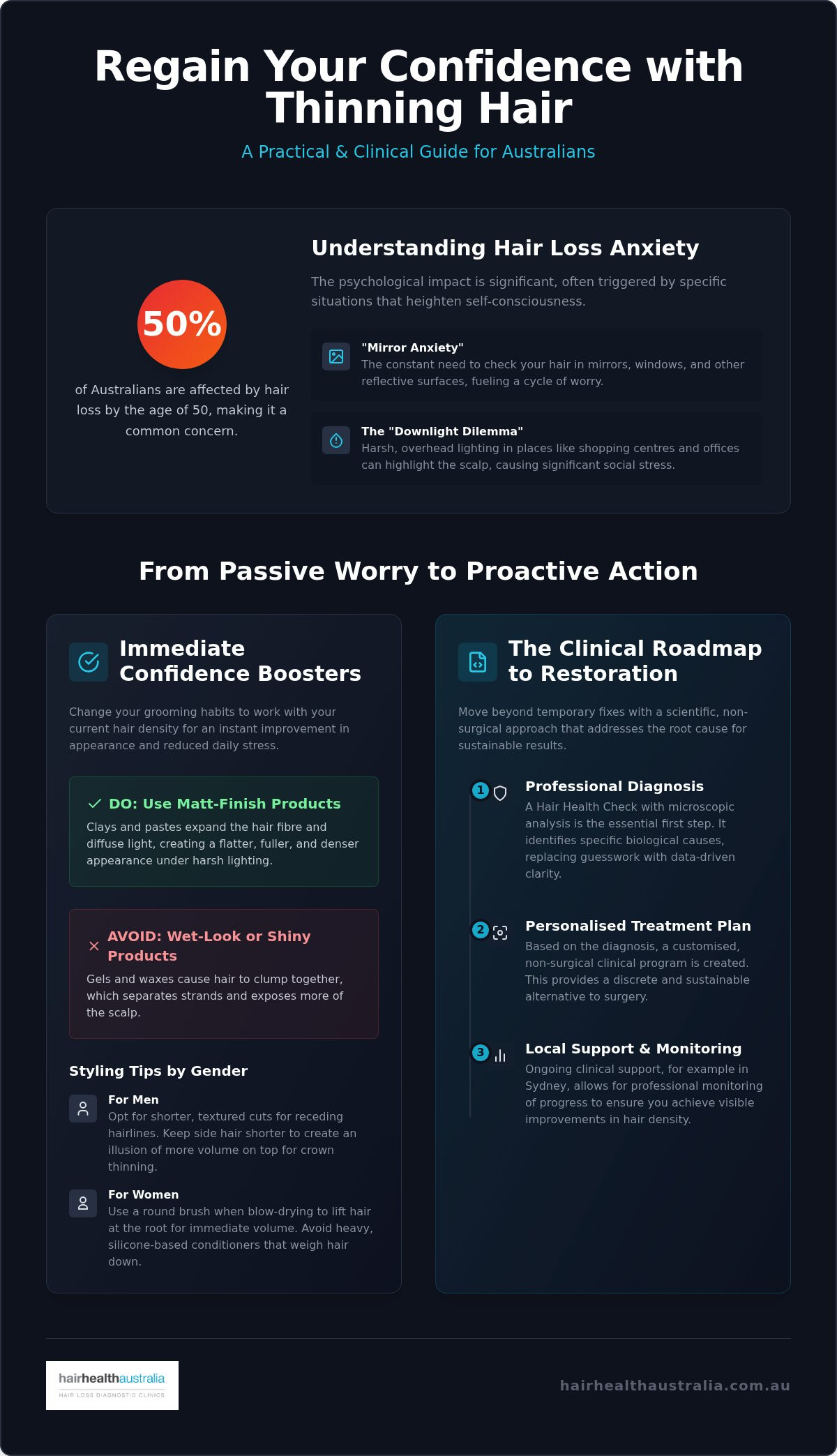
Clarity as a Cure: The Role of Professional Diagnosis
Attempting to self-diagnose hair loss is a high-stakes gamble. Many Australians spend years cycling through expensive supplements and “miracle” shampoos without ever identifying the actual biological triggers of their thinning. This trial-and-error approach doesn’t just waste money; it costs you valuable time during which active follicles may continue to miniaturise beyond the point of easy restoration. When you discover how to feel confident with thinning hair, you learn that clarity is the most effective cure for the anxiety of the unknown. A clinical consultation provides the straight-talking honesty needed to separate marketing hype from evidence-based reality, helping you understand how to feel confident with thinning hair by focusing on facts rather than promises.
What Happens During a Microscopic Hair Analysis?
The diagnostic process involves a non-invasive scan of the scalp using a high-definition microscopic camera. This allows you to see your follicles magnified on a screen, revealing the health of the scalp environment and the current stage of the hair growth cycle. We look specifically for miniaturisation, where the follicle produces progressively thinner, shorter, and more brittle strands. Detecting this process in its early stages is vital, as it allows for intervention while the follicle is still capable of being revitalised. This analysis establishes a precise baseline, providing a measurable starting point to track the success of your personalised regrowth programme over time.
Replacing Uncertainty with Actionable Data
A comprehensive diagnostic report removes the guesswork that often fuels hair-related stress. Once the cause of your thinning is identified, whether it is hormonal, nutritional, or environmental, we define a clear roadmap for the next 6 to 12 months. This systematic plan ensures you are using the correct clinical-grade treatments at the right time, rather than hoping for a result from a generic product. Having access to this data provides a sense of control that is often lost during the early stages of hair thinning. If you are ready to replace uncertainty with a professional strategy, Book your Hair Health Check today to gain total clarity.
Finding Your Path to Restoration in Sydney
Choosing a local Sydney clinic provides more than just accessibility; it offers a consistent partnership in your long-term hair health. When you’re learning how to feel confident with thinning hair, having a dedicated specialist to monitor your progress ensures that your treatment remains aligned with your biological response. Modern clinical environments in Sydney prioritise your privacy, offering a discrete setting where you can discuss your concerns with an expert who understands the local climate and lifestyle factors. This continuity of care is what transforms a temporary attempt at regrowth into a successful, systematic strategy for improved density.
The journey from your first consultation to visible density improvements is methodical and transparent. It begins with a diagnostic phase that removes the guesswork, followed by the implementation of a bespoke treatment plan. You don’t need to commit to invasive surgery to see a significant boost in your self-image. By focusing on non-surgical, clinically backed protocols, you can achieve results that feel natural and sustainable. This professional path replaces the anxiety of “waiting and seeing” with the confidence of knowing that every action you take is supported by microscopic data and clinical expertise.
Personalised Hair Restoration for Men and Women
Effective restoration requires a nuanced understanding of why thinning occurs, as the triggers for male pattern baldness often differ significantly from the causes of thinning in women. While genetic factors are common, hormonal fluctuations, nutritional deficiencies, and stress also play critical roles. For instance, women often require a different diagnostic focus to address diffuse thinning effectively. You can learn more about these specific requirements in our Hair Loss Treatment for Women guide. Regular check-ins at our Sydney clinic allow us to monitor your follicle progress and adjust your program as your hair health improves, ensuring you never plateau in your journey toward better density.
Your First Step to Reclaiming Confidence
The most important factor in any restoration plan is timing. Follicles that have miniaturised can often be revitalised, but once a follicle has remained dormant for too long, the options for non-surgical restoration diminish. Acting while your follicles are still active gives you the best statistical chance for success. Understanding how to feel confident with thinning hair starts with the realisation that a solution exists and it doesn’t involve a scalpel. You have the power to change the trajectory of your hair health by choosing a path rooted in science and professional care. If you’re ready to move past the frustration of thinning, start your journey with a professional Hair Health Check to reclaim control over your appearance today.
Reclaiming Control of Your Hair Health
Understanding how to feel confident with thinning hair requires a shift from managing symptoms to addressing biological causes. We’ve explored how immediate styling adjustments can alleviate daily stress, but lasting confidence is built on the foundation of clinical clarity. By moving away from supermarket products and embracing non-surgical, evidence-based regrowth protocols, you replace the anxiety of the mirror with a systematic roadmap for density.
With over 15 years of experience in Australian hair restoration, our clinic uses specialised microscopic scanning technology to identify exactly why your hair is thinning. This diagnostic precision ensures your treatment is tailored to your unique scalp biology. You don’t have to navigate this journey alone or resort to invasive surgery to see meaningful results. The first step toward a more secure future is understanding the current state of your follicles. Book Your Comprehensive Hair Health Check in Sydney today to begin your transition from uncertainty to clinical clarity. You deserve to feel empowered by facts and supported by experts.
Frequently Asked Questions
How can I hide my thinning hair without wearing a hat all the time?
You can effectively disguise thinning hair by using matt-finish styling products like clays or pastes, which add volume without clumping strands together. Strategic haircuts, such as a textured crop for men or soft layers for women, help minimise the contrast between the scalp and hair. Avoid heavy gels or waxes that expose more of the scalp under bright lights. These immediate adjustments provide a practical solution for how to feel confident with thinning hair while you pursue clinical restoration.
Can I actually regrow hair that has already started thinning?
Yes, regrowth is possible provided the hair follicles are still active and have not yet become completely dormant. Clinical treatments work by reversing the process of miniaturisation, where follicles produce progressively thinner strands. By using targeted stimulants and addressing hormonal or nutritional triggers, we can revitalise these follicles to produce thicker, denser hair. Early diagnosis via microscopic analysis is essential to determine the viability of your follicles before they reach a stage where restoration is no longer possible.
How long does it take to see results from a clinical hair programme?
Most patients begin to see visible improvements in hair density within three to six months of starting a structured clinical programme. This timeline aligns with the natural biological hair growth cycle, which requires time to transition from a resting phase to an active growth phase. While initial stabilisation of loss happens relatively quickly, significant regrowth usually becomes more apparent around the nine to twelve-month mark. Consistency with your personalised treatment plan is the most critical factor in achieving these milestones.
Is thinning hair always genetic, or can stress play a part?
While genetics are the most common cause of hair loss, stress, hormonal changes, and nutritional deficiencies play significant roles. Chronic stress can trigger a condition called Telogen Effluvium, which pushes a large number of follicles into a resting phase simultaneously. This leads to noticeable thinning across the entire scalp rather than a specific pattern. Identifying whether your loss is genetic or lifestyle-based requires a professional diagnosis to ensure you aren’t using the wrong treatment for your specific condition.
What is the difference between a hair clinic and a regular barber?
A regular barber focuses on the aesthetic arrangement of your existing hair, whereas a hair clinic specialises in the biological health of the follicle and scalp. While a skilled stylist can help you manage your appearance, a clinical specialist uses microscopic analysis to diagnose the root cause of thinning. Clinics provide evidence-based treatments designed to improve hair density and stop further loss, offering a long-term medical solution rather than a temporary cosmetic fix for your appearance.
Is a hair transplant the only way to get my confidence back?
Surgery is not the only option, and for many Australians, non-surgical clinical programmes are a more suitable and less invasive first step. These programmes focus on preserving and thickening your natural hair, which is often more effective than transplanting follicles into an unhealthy scalp environment. Regaining a sense of control over your appearance through a structured, evidence-based plan provides a significant boost in confidence without the high costs or recovery time associated with surgical procedures.
What should I expect during my first hair health consultation?
Your first consultation involves a thorough microscopic analysis of your scalp and hair follicles to identify signs of miniaturisation or congestion. We review your medical history, lifestyle factors, and specific concerns to understand the triggers behind your thinning. You will see high-definition images of your scalp on a screen, providing a clear baseline for your progress. By the end of the session, you will receive a straight-talking assessment and a customised roadmap for your restoration journey.