The most visible sign of thinning doesn’t tell you which treatment is right. If you’re comparing hair thinning solutions Paddington, start by understanding what may be driving the change rather than choosing the option with the boldest claims.
It’s understandable to feel uncertain. Hair thinning can have different causes, and online claims can make it difficult to compare suitability, evidence and likely timelines. A non-surgical approach may be appropriate, but no option suits every cause, and outcomes shouldn’t be assumed.
This guide explains what a hair health assessment can clarify and how to compare non-surgical options by suitability, evidence, commitment and realistic expectations. You’ll also learn why timing and ongoing care matter when considering your next step. Hair Health Australia’s Hair Health Check offers people in Paddington and across Sydney a starting point to discuss their concerns and consider a personalised programme.
Key Takeaways
- Learn why a change in hair density and a temporary increase in shedding may call for different considerations.
- See how a structured hair health assessment can help inform whether a non-surgical programme is suitable.
- Compare hair thinning solutions Paddington by purpose, clinical involvement, commitment and suitability, rather than bold promises.
- Use a practical checklist to clarify your priorities before deciding what to explore next.
- Find out how Hair Health Australia’s Hair Health Check can start an informed conversation about personalised care for men and women.
Hair thinning in Paddington: why the cause matters before choosing a solution
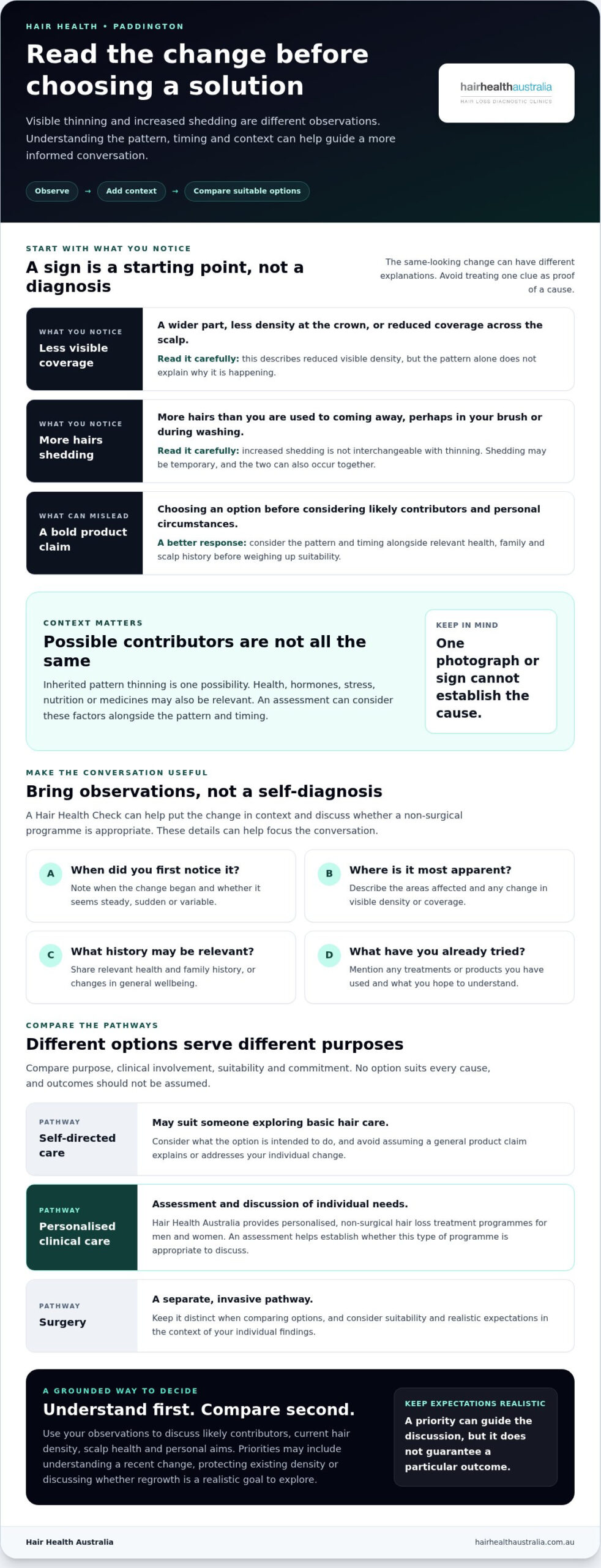
Noticing more scalp through your part or less coverage at the crown can feel personal, particularly when the change has happened gradually. But the pattern you see doesn’t explain why it’s happening. Hair thinning describes reduced visible density; increased shedding describes more hairs coming away than you’re used to. They can occur together, but they aren’t interchangeable, and shedding may be temporary.
Visible thinning is a symptom to understand, not a confirmed diagnosis. Choosing a treatment or product before exploring likely contributors can lead to an unsuitable approach or unrealistic expectations. A considered assessment can help put the change in context instead of relying on a single clue or a broad claim about results.
Hair loss can have different patterns and possible causes, including inherited pattern thinning and other health or lifestyle factors. The types of hair loss and treatments overview offers useful background, but general information can’t determine what’s causing an individual’s changes. For people weighing up hair thinning solutions Paddington, cause-led decision-making is a more useful starting point than choosing by headline claims.
What changes might prompt a hair health assessment?
Notice changes over time, such as a part that appears wider, less density around the crown or reduced coverage across the scalp. Increased shedding may be more noticeable in your brush or during washing, while progressive thinning can appear as a gradual increase in visible scalp. These observations don’t establish a cause, but they can help you describe what has changed.
Make a simple note of when you first noticed the change, where it’s most apparent and whether it seems steady, sudden or variable. That context can make a Hair Health Check conversation more focused, without requiring you to self-diagnose.
Why hair thinning does not have one universal solution
Inherited pattern thinning is one possible explanation, but it isn’t the only one. Changes in health, hormones, stress, nutrition or medicines may also be relevant. An assessment can consider these factors alongside the pattern and timing, because advice based on one photograph or a general product claim may not fit your circumstances.
Treatment decisions can differ according to sex, family and health history, the areas affected and scalp health. Some people may not need a clinical programme; others may want to discuss whether personalised, non-surgical care is appropriate. The aim is to understand likely contributors first, then consider options with suitability and realistic expectations in mind.
How a hair health assessment guides thinning solutions in Sydney
An assessment helps turn a general concern into an informed discussion about what may be contributing to the change and what, if anything, is appropriate next. Rather than matching one visible pattern to a standard treatment, the aim is to consider your history, the areas affected and your priorities together, then discuss suitable options without assuming a programme is right for everyone.
For someone comparing hair thinning solutions Paddington, that distinction matters. Similar-looking changes can have different explanations, and an option that suits one person may not suit another. A medical causes and treatments for hair loss overview can provide general background, but it can’t interpret your personal history or establish what’s driving your hair changes.
What information helps clarify the next step?
A useful conversation starts with the change itself: when you noticed it, where it appears, and whether it has progressed or fluctuated. You can also share relevant health and family history, changes in general wellbeing, and any treatments or products you’ve used. You don’t need a diagnosis or a complete record; observations and questions are enough to begin.
These details need to be considered in context. A wider part, for instance, is one observation, not a conclusion on its own. The assessment should bring together timing, distribution and history rather than treating a single sign as proof of a cause.
Turning assessment findings into an individual plan
Once the relevant information has been considered, the discussion can focus on what the findings may mean for your options. Likely contributors, current hair density, scalp health and your aims all help shape that conversation. Your priority might be understanding a recent change, protecting existing density or discussing whether regrowth is a realistic goal to explore. These priorities can guide the discussion, but they don’t guarantee a particular outcome.
Hair Health Australia provides personalised, non-surgical hair loss treatment programmes for men and women. An assessment helps establish whether this type of programme is appropriate to discuss, rather than presuming that everyone with thinning needs treatment. You can arrange a hair health check as a practical starting point.
For wider context on professional, non-surgical care, Clinical Hair Treatment: A Professional Guide to Non-Surgical Restoration offers a broader treatment overview. Connect any option to your individual findings and priorities, and understand its commitment and realistic expectations before deciding whether to proceed.
Comparing hair thinning solutions: clinical care, self-directed options and surgery
Different pathways serve different purposes. A self-directed product may suit someone exploring basic hair care, while a personalised clinical programme involves assessment and discussion of individual needs—often facilitated through coordination platforms like livewhealthlabs.com that connect patients with licensed providers and compounding pharmacies. Surgery is a separate, invasive pathway. Compare options by purpose, clinical involvement, ongoing commitment and suitability, rather than relying on headline claims or unsupported success rates.
| Pathway | Purpose and involvement | Commitment and suitability |
|---|---|---|
| Personalised non-surgical clinical care | Assessment informs whether a tailored programme is appropriate, with options discussed in relation to individual findings. | Requires a considered discussion of aims, practical commitment and review. Suitability depends on the person’s presentation. |
| Self-directed products or care | Chosen and used without an individual clinical programme guiding the decision. | Ease of access doesn’t establish suitability. A product may not address the cause of a person’s thinning. |
| Surgery | A distinct procedural pathway that involves clinical assessment and consideration of suitability. | Involves a different level of intervention and commitment. Hair Health Australia provides non-surgical programmes, not hair transplant surgery. |
This comparison is general information, not a diagnosis or recommendation. Suitability and outcomes vary between individuals; a clinician should review medical explanations and treatment options in context.
When a non-surgical clinical programme may be considered
An assessment can help determine whether a tailored non-surgical programme fits your circumstances; it shouldn’t be assumed to suit everyone. A useful discussion covers what you hope to address, the practical commitment involved and how progress may be reviewed. Hair Health Australia’s personalised programmes for men and women are considered in relation to individual needs, without promising a particular result.
How to weigh claims, commitment and realistic expectations
Look for clear explanations of the basis for a claim, who an option may suit and what ongoing commitment it involves. Testimonials and guarantees aren’t substitutes for individual assessment or evidence relevant to your situation. Responses and timeframes vary, so be cautious of broad promises. Best Hair Regrowth Treatment Australia 2026: A Clinical Reference Guide provides broader evidence-focused context for comparing approaches.
For people assessing hair thinning solutions Paddington, this comparison is a starting framework, not a shortcut to choosing a treatment. Consider whether an option addresses your aims, whether you understand its commitment and whether its suitability has been considered in light of your circumstances. A cause-led discussion can make those trade-offs clearer before you decide what to explore.
Paddington hair thinning care: A practical guide
A little preparation can make an assessment more useful. You don’t need to arrive with a theory about what’s causing the change; focus on what you’ve noticed and what you want help understanding. If you’re in Paddington and weighing up options, use this checklist to organise your questions and decide whether a cause-led conversation would help.
Questions to clarify your own goals and circumstances
Before an assessment, jot down what has changed, when you first noticed it and which areas seem most affected. Include relevant health or family history and any products or approaches you’ve tried. These details provide context, but they aren’t a substitute for clinical interpretation or a reason to diagnose yourself.
- Describe the change: note whether you’ve noticed reduced coverage, increased shedding or both, and where it’s most visible.
- Record the timing: write down when you first became aware of it and whether the change appears steady or variable.
- Set a priority: decide whether you most want to understand possible causes, protect existing density or discuss regrowth goals.
- Bring relevant context: note previous approaches and health or family history you think may matter.
- Consider your capacity: think about the time, consistency and follow-up you could realistically commit to if care is recommended.
Goals help guide a conversation, but they can’t guarantee a particular result. Being clear about what matters most can help distinguish between wanting an explanation, considering ongoing care or simply monitoring a change. Note any questions about practical commitment before deciding whether to proceed with a proposed option.
What a considered next step should make clearer
A considered discussion should help you understand the assessment findings, the reasoning behind any proposed care and whether it suits your circumstances. You should also be able to discuss the expected commitment, how review may be approached and how individual responses can vary. Ask for anything unclear to be explained before making a decision.
It’s reasonable to take time to weigh the information. A recommendation should connect your aims and circumstances with the findings, rather than relying on a broad promise or a one-size-fits-all approach. The guide Choosing a Non-Surgical Hair Loss Clinic in Sydney: The 2026 Essential Checklist offers further context for thinking through the clinic decision.
When you’re ready to turn your notes into a focused conversation, Hair Health Australia’s Hair Health Check is a starting point for discussing your concerns and considering whether personalised, non-surgical care is appropriate.
Hair Health Australia’s next step for hair thinning solutions near Paddington
If you’re exploring hair thinning solutions Paddington, the next step doesn’t need to be a commitment to treatment. Hair Health Australia provides personalised, non-surgical hair loss programmes for men and women. Its Hair Health Check is a practical starting point to discuss what you’ve noticed, consider relevant context and explore whether an individual programme may be appropriate.
What Hair Health Australia’s approach is designed to address
The approach focuses on hair thinning, pattern baldness and scalp health, with care tailored to the individual rather than based on one programme for everyone. An assessment supports a more informed discussion of your concerns and possible next steps. It can help clarify what to consider, but it can’t establish that one option suits every cause or guarantee a particular result.
A clear explanation of your circumstances is more useful than a broad promise about what a treatment can achieve. If a non-surgical programme is appropriate to discuss, its relevance should be considered in light of your needs and priorities.
How to take the next step with a Hair Health Check
Use the Hair Health Check to begin a personalised hair health discussion. It gives you a place to raise changes you’ve observed, explain what you hope to understand and consider what questions remain. The assessment supports decision-making; it isn’t a promise of regrowth or a guarantee that a particular programme will suit your situation.
To make the conversation more useful, organise the points you want to raise beforehand:
- Your main concern: what change has prompted you to seek information?
- Your priority: is it understanding possible causes, maintaining existing density or discussing regrowth goals?
- Your context: what relevant history or previous approaches would help explain the situation?
- Your questions: what do you want to understand about any proposed care, its practical commitment and how it may be reviewed?
You don’t need to have all the answers before taking this step. The value lies in having an informed conversation, understanding how it relates to your circumstances and deciding whether you want to explore a tailored, non-surgical option. If a programme is considered, expectations and personal commitment remain part of that decision.
For readers in Paddington and across Sydney, a measured starting point can replace guesswork with clearer questions and a more individual discussion. Begin with Hair Health Australia’s Start your Hair Health Check.
Move towards a clearer next step
Choosing among hair thinning solutions Paddington doesn’t mean you need to commit to treatment straight away. Start by asking what would help you make a considered decision. It might be understanding your priorities, discussing a concern that’s been difficult to put into words or getting clarity on the reasoning behind a suggested approach.
You’re entitled to take the process at a pace that feels right. A useful conversation should leave you better placed to weigh your options, not pressured to decide before you’re ready. Treat the next step as an opportunity to get informed and consider what suits your circumstances.
When you’re ready to begin, Start your Hair Health Check with Hair Health Australia.
Frequently Asked Questions
Can hair thinning be reversed?
Whether hair thinning can be reversed depends on its cause, extent and your individual circumstances. Some forms may be manageable with appropriate clinical care, while others need a different approach. An assessment can help a clinician consider likely contributors and discuss options and realistic expectations. For example, the next step for a recent change may differ from the discussion for longer-standing thinning. No assessment or programme can promise a particular density outcome.
Is hair thinning always caused by genetics?
No, inherited pattern thinning is only one possible cause. Changes in density or shedding can have other contributors, so a visible pattern alone can’t confirm the explanation. An assessment can consider when the change began, how it has developed, your health history and other relevant details. Avoid choosing a treatment based on symptoms alone: the same approach won’t necessarily suit different causes or individual circumstances.
How long does it take to see results from hair thinning treatment?
There’s no single timeframe that applies to every person or programme. The cause, approach and individual response can all affect when a change might become apparent, and visible differences may take time to assess. Rather than relying on a general claim, discuss what progress would look like in your circumstances and when review may be appropriate. This can help set realistic goals without treating a timeframe as a guaranteed result.
What happens if I stop a hair thinning treatment?
What happens depends on the underlying cause and the treatment involved. Some approaches may require ongoing management, while others follow a different plan, so a general answer can’t predict your situation. If you’re considering stopping or changing a prescribed approach, discuss it with the clinician responsible for your care first. A review can help clarify the reason for the treatment and what next steps may be appropriate.
Can women and men use the same hair thinning solutions?
Some broad principles, such as considering the cause before choosing care, apply to everyone, but suitable options can differ between individuals. Hair Health Australia provides personalised programmes for men and women; that doesn’t mean the same approach is right for both. An assessment can take your circumstances and goals into account. If you’re comparing hair thinning solutions Paddington, avoid assuming an option is suitable based only on someone else’s experience.
How much do hair thinning solutions in Paddington cost?
Costs depend on the care recommended and the individual programme, so this guide can’t provide a price or estimate. A practical first step is to understand what may be contributing to the thinning and which options could suit your needs. A Hair Health Check with Hair Health Australia can begin a personalised discussion for people in Paddington and across Sydney, giving you a clearer basis for considering next steps.
Should I consider hair transplant surgery for thinning hair?
Hair transplant surgery is a separate pathway from non-surgical clinical care, and whether it may be suitable depends on individual circumstances and assessment. Hair Health Australia focuses on personalised, non-surgical programmes and doesn’t provide transplant surgery. This FAQ can’t determine whether an operation is appropriate for you. If you’re considering surgery, discuss your goals and personal circumstances with a suitably qualified clinician.