
Hair Thinning Solutions in Paddington: A Clinical Buying Guide

The most visible sign of thinning doesn’t tell you which treatment is right. If you’re comparing hair thinning solutions Paddington, start by understanding what may be driving the change rather than choosing the option with the boldest claims.

It’s understandable to feel uncertain. Hair thinning can have different causes, and online claims can make it difficult to compare suitability, evidence and likely timelines. A non-surgical approach may be appropriate, but no option suits every cause, and outcomes shouldn’t be assumed.

This guide explains what a hair health assessment can clarify and how to compare non-surgical options by suitability, evidence, commitment and realistic expectations. You’ll also learn why timing and ongoing care matter when considering your next step. Hair Health Australia’s Hair Health Check offers people in Paddington and across Sydney a starting point to discuss their concerns and consider a personalised programme.

Key Takeaways

  • Learn why a change in hair density and a temporary increase in shedding may call for different considerations.
  • See how a structured hair health assessment can help inform whether a non-surgical programme is suitable.
  • Compare hair thinning solutions Paddington by purpose, clinical involvement, commitment and suitability, rather than bold promises.
  • Use a practical checklist to clarify your priorities before deciding what to explore next.
  • Find out how Hair Health Australia’s Hair Health Check can start an informed conversation about personalised care for men and women.

Hair thinning in Paddington: why the cause matters before choosing a solution

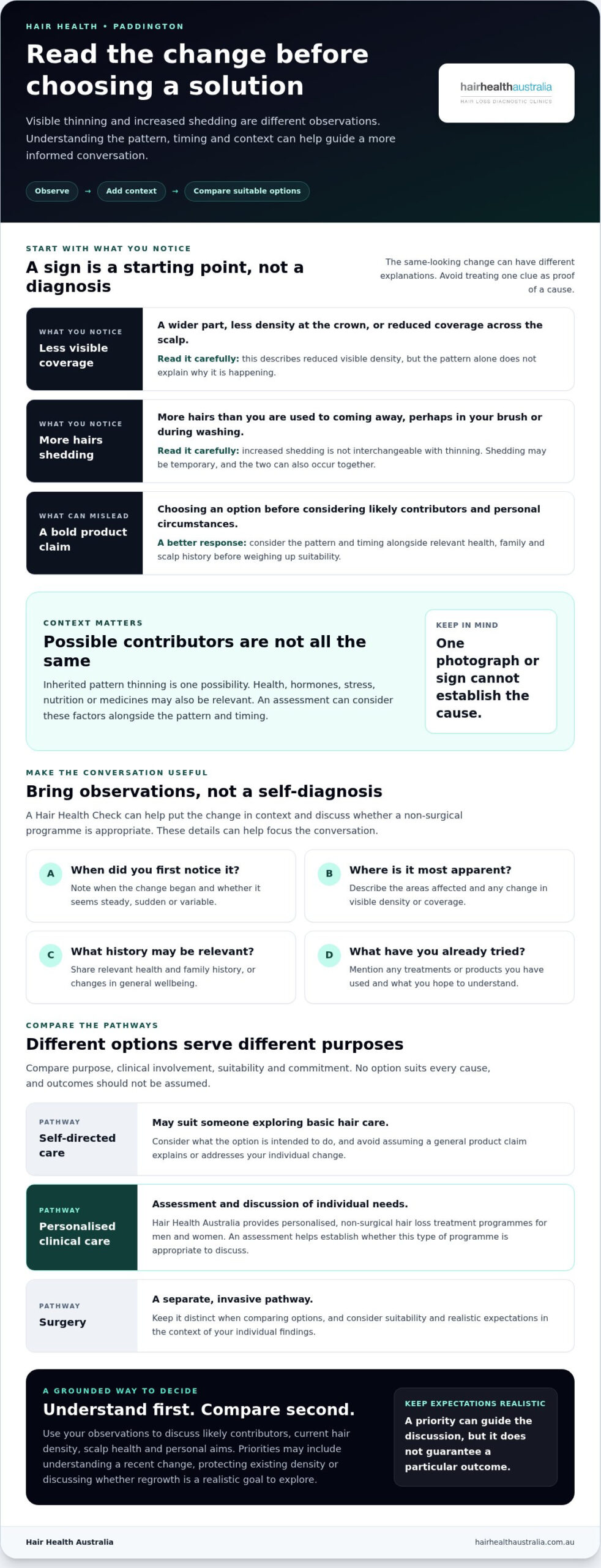
Noticing more scalp through your part or less coverage at the crown can feel personal, particularly when the change has happened gradually. But the pattern you see doesn’t explain why it’s happening. Hair thinning describes reduced visible density; increased shedding describes more hairs coming away than you’re used to. They can occur together, but they aren’t interchangeable, and shedding may be temporary.

Visible thinning is a symptom to understand, not a confirmed diagnosis. Choosing a treatment or product before exploring likely contributors can lead to an unsuitable approach or unrealistic expectations. A considered assessment can help put the change in context instead of relying on a single clue or a broad claim about results.

Hair loss can have different patterns and possible causes, including inherited pattern thinning and other health or lifestyle factors. The types of hair loss and treatments overview offers useful background, but general information can’t determine what’s causing an individual’s changes. For people weighing up hair thinning solutions Paddington, cause-led decision-making is a more useful starting point than choosing by headline claims.

What changes might prompt a hair health assessment?

Notice changes over time, such as a part that appears wider, less density around the crown or reduced coverage across the scalp. Increased shedding may be more noticeable in your brush or during washing, while progressive thinning can appear as a gradual increase in visible scalp. These observations don’t establish a cause, but they can help you describe what has changed.

Make a simple note of when you first noticed the change, where it’s most apparent and whether it seems steady, sudden or variable. That context can make a Hair Health Check conversation more focused, without requiring you to self-diagnose.

Why hair thinning does not have one universal solution

Inherited pattern thinning is one possible explanation, but it isn’t the only one. Changes in health, hormones, stress, nutrition or medicines may also be relevant. An assessment can consider these factors alongside the pattern and timing, because advice based on one photograph or a general product claim may not fit your circumstances.

Treatment decisions can differ according to sex, family and health history, the areas affected and scalp health. Some people may not need a clinical programme; others may want to discuss whether personalised, non-surgical care is appropriate. The aim is to understand likely contributors first, then consider options with suitability and realistic expectations in mind.

How a hair health assessment guides thinning solutions in Sydney

An assessment helps turn a general concern into an informed discussion about what may be contributing to the change and what, if anything, is appropriate next. Rather than matching one visible pattern to a standard treatment, the aim is to consider your history, the areas affected and your priorities together, then discuss suitable options without assuming a programme is right for everyone.

For someone comparing hair thinning solutions Paddington, that distinction matters. Similar-looking changes can have different explanations, and an option that suits one person may not suit another. A medical causes and treatments for hair loss overview can provide general background, but it can’t interpret your personal history or establish what’s driving your hair changes.

What information helps clarify the next step?

A useful conversation starts with the change itself: when you noticed it, where it appears, and whether it has progressed or fluctuated. You can also share relevant health and family history, changes in general wellbeing, and any treatments or products you’ve used. You don’t need a diagnosis or a complete record; observations and questions are enough to begin.

These details need to be considered in context. A wider part, for instance, is one observation, not a conclusion on its own. The assessment should bring together timing, distribution and history rather than treating a single sign as proof of a cause.

Turning assessment findings into an individual plan

Once the relevant information has been considered, the discussion can focus on what the findings may mean for your options. Likely contributors, current hair density, scalp health and your aims all help shape that conversation. Your priority might be understanding a recent change, protecting existing density or discussing whether regrowth is a realistic goal to explore. These priorities can guide the discussion, but they don’t guarantee a particular outcome.

Hair Health Australia provides personalised, non-surgical hair loss treatment programmes for men and women. An assessment helps establish whether this type of programme is appropriate to discuss, rather than presuming that everyone with thinning needs treatment. You can arrange a hair health check as a practical starting point.

For wider context on professional, non-surgical care, Clinical Hair Treatment: A Professional Guide to Non-Surgical Restoration offers a broader treatment overview. Connect any option to your individual findings and priorities, and understand its commitment and realistic expectations before deciding whether to proceed.

Comparing hair thinning solutions: clinical care, self-directed options and surgery

Different pathways serve different purposes. A self-directed product may suit someone exploring basic hair care, while a personalised clinical programme involves assessment and discussion of individual needs—often facilitated through coordination platforms like livewhealthlabs.com that connect patients with licensed providers and compounding pharmacies. Surgery is a separate, invasive pathway. Compare options by purpose, clinical involvement, ongoing commitment and suitability, rather than relying on headline claims or unsupported success rates.

Pathway Purpose and involvement Commitment and suitability
Personalised non-surgical clinical care Assessment informs whether a tailored programme is appropriate, with options discussed in relation to individual findings. Requires a considered discussion of aims, practical commitment and review. Suitability depends on the person’s presentation.
Self-directed products or care Chosen and used without an individual clinical programme guiding the decision. Ease of access doesn’t establish suitability. A product may not address the cause of a person’s thinning.
Surgery A distinct procedural pathway that involves clinical assessment and consideration of suitability. Involves a different level of intervention and commitment. Hair Health Australia provides non-surgical programmes, not hair transplant surgery.

This comparison is general information, not a diagnosis or recommendation. Suitability and outcomes vary between individuals; a clinician should review medical explanations and treatment options in context.

When a non-surgical clinical programme may be considered

An assessment can help determine whether a tailored non-surgical programme fits your circumstances; it shouldn’t be assumed to suit everyone. A useful discussion covers what you hope to address, the practical commitment involved and how progress may be reviewed. Hair Health Australia’s personalised programmes for men and women are considered in relation to individual needs, without promising a particular result.

How to weigh claims, commitment and realistic expectations

Look for clear explanations of the basis for a claim, who an option may suit and what ongoing commitment it involves. Testimonials and guarantees aren’t substitutes for individual assessment or evidence relevant to your situation. Responses and timeframes vary, so be cautious of broad promises. Best Hair Regrowth Treatment Australia 2026: A Clinical Reference Guide provides broader evidence-focused context for comparing approaches.

For people assessing hair thinning solutions Paddington, this comparison is a starting framework, not a shortcut to choosing a treatment. Consider whether an option addresses your aims, whether you understand its commitment and whether its suitability has been considered in light of your circumstances. A cause-led discussion can make those trade-offs clearer before you decide what to explore.
Hair Thinning Solutions in Paddington: A Clinical Buying Guide

Paddington hair thinning care: A practical guide

A little preparation can make an assessment more useful. You don’t need to arrive with a theory about what’s causing the change; focus on what you’ve noticed and what you want help understanding. If you’re in Paddington and weighing up options, use this checklist to organise your questions and decide whether a cause-led conversation would help.

Questions to clarify your own goals and circumstances

Before an assessment, jot down what has changed, when you first noticed it and which areas seem most affected. Include relevant health or family history and any products or approaches you’ve tried. These details provide context, but they aren’t a substitute for clinical interpretation or a reason to diagnose yourself.

  • Describe the change: note whether you’ve noticed reduced coverage, increased shedding or both, and where it’s most visible.
  • Record the timing: write down when you first became aware of it and whether the change appears steady or variable.
  • Set a priority: decide whether you most want to understand possible causes, protect existing density or discuss regrowth goals.
  • Bring relevant context: note previous approaches and health or family history you think may matter.
  • Consider your capacity: think about the time, consistency and follow-up you could realistically commit to if care is recommended.

Goals help guide a conversation, but they can’t guarantee a particular result. Being clear about what matters most can help distinguish between wanting an explanation, considering ongoing care or simply monitoring a change. Note any questions about practical commitment before deciding whether to proceed with a proposed option.

What a considered next step should make clearer

A considered discussion should help you understand the assessment findings, the reasoning behind any proposed care and whether it suits your circumstances. You should also be able to discuss the expected commitment, how review may be approached and how individual responses can vary. Ask for anything unclear to be explained before making a decision.

It’s reasonable to take time to weigh the information. A recommendation should connect your aims and circumstances with the findings, rather than relying on a broad promise or a one-size-fits-all approach. The guide Choosing a Non-Surgical Hair Loss Clinic in Sydney: The 2026 Essential Checklist offers further context for thinking through the clinic decision.

When you’re ready to turn your notes into a focused conversation, Hair Health Australia’s Hair Health Check is a starting point for discussing your concerns and considering whether personalised, non-surgical care is appropriate.

Hair Health Australia’s next step for hair thinning solutions near Paddington

If you’re exploring hair thinning solutions Paddington, the next step doesn’t need to be a commitment to treatment. Hair Health Australia provides personalised, non-surgical hair loss programmes for men and women. Its Hair Health Check is a practical starting point to discuss what you’ve noticed, consider relevant context and explore whether an individual programme may be appropriate.

What Hair Health Australia’s approach is designed to address

The approach focuses on hair thinning, pattern baldness and scalp health, with care tailored to the individual rather than based on one programme for everyone. An assessment supports a more informed discussion of your concerns and possible next steps. It can help clarify what to consider, but it can’t establish that one option suits every cause or guarantee a particular result.

A clear explanation of your circumstances is more useful than a broad promise about what a treatment can achieve. If a non-surgical programme is appropriate to discuss, its relevance should be considered in light of your needs and priorities.

How to take the next step with a Hair Health Check

Use the Hair Health Check to begin a personalised hair health discussion. It gives you a place to raise changes you’ve observed, explain what you hope to understand and consider what questions remain. The assessment supports decision-making; it isn’t a promise of regrowth or a guarantee that a particular programme will suit your situation.

To make the conversation more useful, organise the points you want to raise beforehand:

  • Your main concern: what change has prompted you to seek information?
  • Your priority: is it understanding possible causes, maintaining existing density or discussing regrowth goals?
  • Your context: what relevant history or previous approaches would help explain the situation?
  • Your questions: what do you want to understand about any proposed care, its practical commitment and how it may be reviewed?

You don’t need to have all the answers before taking this step. The value lies in having an informed conversation, understanding how it relates to your circumstances and deciding whether you want to explore a tailored, non-surgical option. If a programme is considered, expectations and personal commitment remain part of that decision.

For readers in Paddington and across Sydney, a measured starting point can replace guesswork with clearer questions and a more individual discussion. Begin with Hair Health Australia’s Start your Hair Health Check.

Move towards a clearer next step

Choosing among hair thinning solutions Paddington doesn’t mean you need to commit to treatment straight away. Start by asking what would help you make a considered decision. It might be understanding your priorities, discussing a concern that’s been difficult to put into words or getting clarity on the reasoning behind a suggested approach.

You’re entitled to take the process at a pace that feels right. A useful conversation should leave you better placed to weigh your options, not pressured to decide before you’re ready. Treat the next step as an opportunity to get informed and consider what suits your circumstances.

When you’re ready to begin, Start your Hair Health Check with Hair Health Australia.

Frequently Asked Questions

Can hair thinning be reversed?

Whether hair thinning can be reversed depends on its cause, extent and your individual circumstances. Some forms may be manageable with appropriate clinical care, while others need a different approach. An assessment can help a clinician consider likely contributors and discuss options and realistic expectations. For example, the next step for a recent change may differ from the discussion for longer-standing thinning. No assessment or programme can promise a particular density outcome.

Is hair thinning always caused by genetics?

No, inherited pattern thinning is only one possible cause. Changes in density or shedding can have other contributors, so a visible pattern alone can’t confirm the explanation. An assessment can consider when the change began, how it has developed, your health history and other relevant details. Avoid choosing a treatment based on symptoms alone: the same approach won’t necessarily suit different causes or individual circumstances.

How long does it take to see results from hair thinning treatment?

There’s no single timeframe that applies to every person or programme. The cause, approach and individual response can all affect when a change might become apparent, and visible differences may take time to assess. Rather than relying on a general claim, discuss what progress would look like in your circumstances and when review may be appropriate. This can help set realistic goals without treating a timeframe as a guaranteed result.

What happens if I stop a hair thinning treatment?

What happens depends on the underlying cause and the treatment involved. Some approaches may require ongoing management, while others follow a different plan, so a general answer can’t predict your situation. If you’re considering stopping or changing a prescribed approach, discuss it with the clinician responsible for your care first. A review can help clarify the reason for the treatment and what next steps may be appropriate.

Can women and men use the same hair thinning solutions?

Some broad principles, such as considering the cause before choosing care, apply to everyone, but suitable options can differ between individuals. Hair Health Australia provides personalised programmes for men and women; that doesn’t mean the same approach is right for both. An assessment can take your circumstances and goals into account. If you’re comparing hair thinning solutions Paddington, avoid assuming an option is suitable based only on someone else’s experience.

How much do hair thinning solutions in Paddington cost?

Costs depend on the care recommended and the individual programme, so this guide can’t provide a price or estimate. A practical first step is to understand what may be contributing to the thinning and which options could suit your needs. A Hair Health Check with Hair Health Australia can begin a personalised discussion for people in Paddington and across Sydney, giving you a clearer basis for considering next steps.

Should I consider hair transplant surgery for thinning hair?

Hair transplant surgery is a separate pathway from non-surgical clinical care, and whether it may be suitable depends on individual circumstances and assessment. Hair Health Australia focuses on personalised, non-surgical programmes and doesn’t provide transplant surgery. This FAQ can’t determine whether an operation is appropriate for you. If you’re considering surgery, discuss your goals and personal circumstances with a suitably qualified clinician.
Hair Thinning: A Calm, Practical Guide

If you’ve noticed more scalp showing, a wider part or extra hair in your brush, it’s understandable to wonder whether the change is temporary or progressive. Knowing what to do when you first notice hair thinning starts with keeping a clear record of what has changed, rather than rushing to buy a treatment. A simple, consistent record can help you make sense of the change without letting conflicting online advice push you into trying products.

A change in hair density doesn’t, on its own, reveal what’s causing it. The pattern, timing and any other symptoms can help build a clearer picture. This guide covers how to observe and document changes, what details may be useful in a professional conversation, and when an individual assessment could help. Understanding the likely cause and your circumstances should come before choosing treatment. You don’t need to diagnose yourself or make a decision today. Start with what you can see, record it consistently, and use that information to choose a sensible next step.

Key Takeaways

  • When you first notice hair thinning, record what has changed instead of assuming a cause.
  • Note the pattern, timing, changes in shedding and any scalp symptoms to build a clearer picture.
  • Keep your routine gentle. Don’t rely on shampoos or supplements to reverse thinning without understanding the cause.
  • Seek professional advice if changes persist, progress or cause distress. Sudden patchy loss or scalp pain and marked irritation warrant prompt medical advice.
  • An individual assessment can help guide next steps. Treatment options depend on the likely cause and your circumstances.

Hair Thinning: Start With What Has Changed

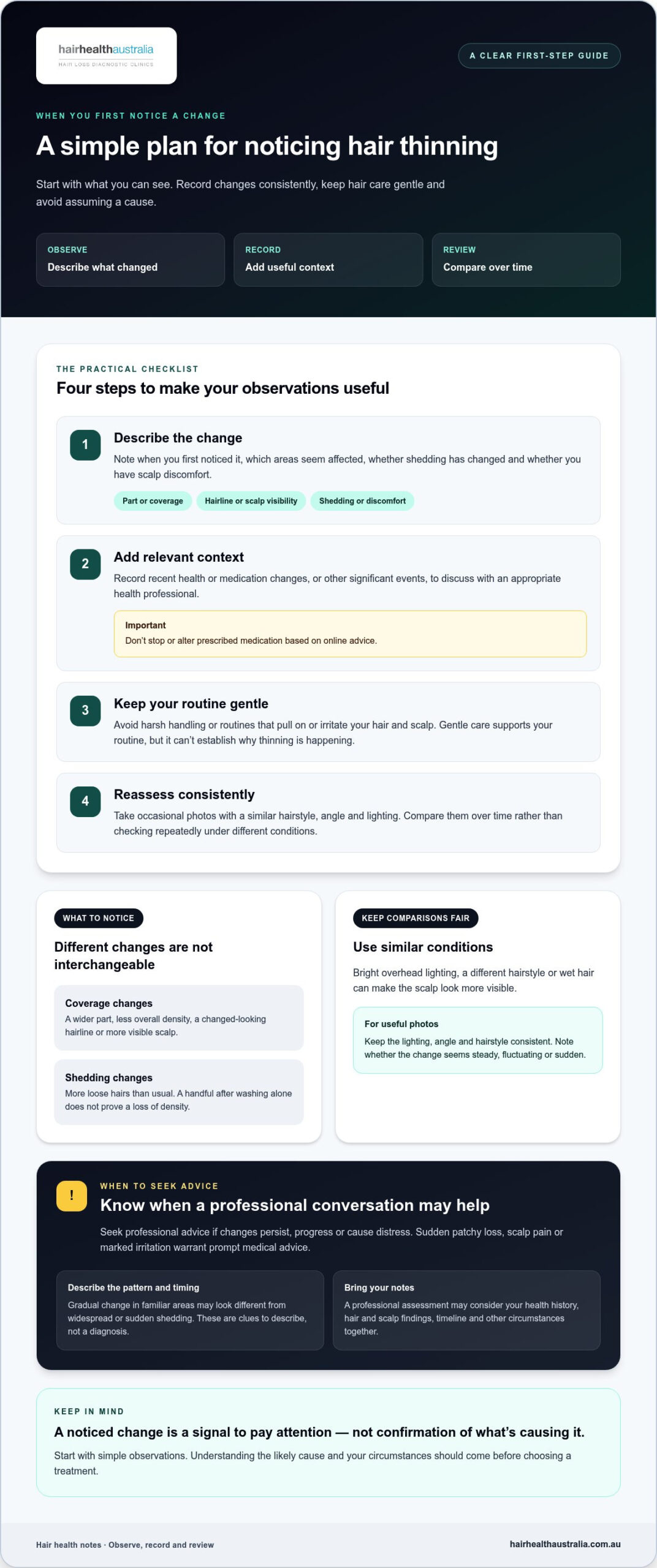
Noticing a change in your hair is a reason to observe it, not to assume a diagnosis. If you’re deciding what to do when you first notice hair thinning, follow a simple sequence: describe what looks different, record relevant context, avoid drastic self-treatment, then review the change consistently over time.

Hair naturally sheds, and the amount you see can vary from day to day. A handful of loose hairs after washing doesn’t, by itself, prove that you’re losing density. Gradual changes in coverage and a noticeable increase in shedding are different observations, and neither identifies the cause on its own. For an overview, read about common types of hair loss.

A noticed change is a signal to pay attention, not confirmation of what’s causing it.

Which early changes are worth noting?

Look for changes you can describe: a part that appears wider, less overall density, a hairline that seems to have changed shape, or more visible scalp. Note whether coverage appears to be changing gradually or whether you’re seeing more loose hairs than usual. These are different signs, not interchangeable descriptions.

Conditions can affect what you see. Bright overhead lighting, a different hairstyle or wet hair may make your scalp more visible. Compare your hair under similar conditions before deciding a change is sustained.

How to record changes without becoming preoccupied

Take occasional photos in similar lighting, from the same angle and with your hair styled consistently. Add a brief note about when you first noticed the change and whether it seems steady, fluctuating or sudden. You can also record relevant context, such as a change in your routine or general health, without trying to interpret it yourself.

Daily counting or repeated checking can increase worry without providing a more useful picture. Choose a reasonable interval for reviewing your notes and keep the record simple. If you’d like support understanding what you’ve observed, a hair health check at Hair Health Australia’s Sydney clinic can help you discuss next steps.

Possible reasons for hair thinning: why the pattern and timing matter

Hair thinning can have different explanations, and appearance alone can’t confirm which one applies. A gradual change in familiar areas, such as the temples or crown, may look different from more widespread shedding that becomes noticeable over a shorter period. These patterns are useful to describe, but they aren’t a way to diagnose yourself.

The same visible change can have different underlying causes, so its pattern is a clue, not a conclusion. Genetic pattern changes and temporary shedding are among the possibilities. Health changes, stress, diet and some medicines may also be relevant. MedlinePlus outlines a range of reasons for hair loss. Don’t stop or alter prescribed medication on your own. Instead, note any changes and discuss them with a health professional.

What the pattern and timeline may help describe

Think about where you first noticed a difference and how it has developed. Gradual changes in particular areas may differ from diffuse or sudden shedding across the scalp. Record when it began and whether it followed an illness, a stressful period, a medication change or another significant life change. These details provide context, but can’t establish the cause by themselves.

Women looking for more specific information about changes to watch for can read this guide to early signs of alopecia in women.

Why a symptom list can’t identify the cause

Different causes can produce overlapping changes. An online checklist may help you describe what you’ve noticed, but it can’t provide a personal diagnosis. A professional assessment may consider your health history, hair and scalp findings, timeline and other relevant circumstances together.

That’s why the answer to what to do when you first notice hair thinning isn’t to match one symptom to a treatment. Start with your observations, then seek an individual assessment if you want help making sense of them. A hair health check at Hair Health Australia can help you discuss your hair changes and consider options in light of your circumstances.

What to Do Now: A Practical Hair-Thinning Checklist

If you’re deciding what to do when you first notice hair thinning, keep your first steps simple. The aim is to create a useful record and care for your hair gently, not to diagnose the cause or start several remedies at once.

  1. Describe the change. Note when you first noticed it, which areas seem affected, whether shedding has changed and whether you have scalp discomfort.
  2. Add relevant context. Record recent health or medication changes, or other significant events, to discuss with an appropriate health professional. Don’t stop prescribed medication based on online advice.
  3. Keep your routine gentle. Avoid harsh handling or routines that pull on or irritate your hair and scalp. Gentle care supports your hair-care routine, but it can’t establish why thinning is happening.
  4. Reassess consistently. Take occasional photos with a similar hairstyle, angle and lighting. Compare them over time rather than checking repeatedly under different conditions.

Before a professional conversation, record what changed, when it began and what else was happening. Keep care gentle and review the change consistently.

Build a simple, useful record

Keep your notes brief and factual. For example: “Part looks wider than before; first noticed around this time; more shedding during washing; no scalp discomfort.” Add relevant health or medication changes without deciding whether they caused the thinning. A clear summary can help keep a future conversation focused. The American Academy of Dermatology explains how dermatologists diagnose hair loss, including the role of questions and examination.

Avoid rushed fixes and unsupported claims

Some cosmetic products can affect how your hair feels or looks, but that doesn’t identify the cause or show that thinning has been reversed. Be cautious about starting several products or supplements together. This can make changes harder to track, and a supplement or medicine may not be suitable for everyone. Discuss these decisions with a qualified health professional.

Avoid restrictive diets, harsh routines and repeated product changes based only on online advice. If you’d like help making sense of your observations, a hair health check at Hair Health Australia can be a considered next step.

Hair Thinning: A Calm, Practical Guide

When should you seek professional advice about thinning hair?

You don’t need to wait until hair thinning is pronounced before asking for help. Arrange an assessment if the change persists, appears to be progressing or is causing you distress. A GP or relevant clinician can consider whether health factors may be involved and guide appropriate next steps. A hair-focused assessment can also help you review the changes you’ve recorded and discuss options suited to your circumstances.

Sudden patchy hair loss, scalp pain, or marked irritation or inflammation are reasons to seek prompt medical advice rather than simply monitoring the change. These signs don’t confirm a particular cause, but they deserve timely attention. If symptoms are severe or you need emergency help in Australia, call 000.

What to prepare before an appointment

A short, organised record can make the conversation more useful. Bring your timeline, occasional photos taken in consistent conditions, relevant symptoms and a list of medicines and supplements. Note any health or medication changes you think may matter. You could also write down questions about possible causes, what an assessment involves, relevant options, risks and realistic expectations.

For Sydney readers, Hair Health Australia offers a hair health check to help you explore changes and discuss personalised next steps. To arrange one, book a Hair Health Check.

When a medical review should not be delayed

Routine observation may suit a mild, stable change, but don’t rely on monitoring alone if loss is sudden or accompanied by scalp pain, pronounced irritation or inflammation. Seek prompt advice from a GP or another appropriate medical professional. If you’re unsure how urgently to act, contact a health service for guidance. Severe symptoms or an emergency call for emergency care.

Knowing what to do when you first notice hair thinning includes recognising when a change needs individual attention. The right next step depends on the pattern, symptoms and your health context. Avoid choosing a treatment based only on a checklist or a guess about the cause.

Choosing your next step: understand the cause before considering treatment

A practical path is steady: notice what has changed, document the pattern and timing, seek an appropriate assessment, then consider options in light of the findings. This helps separate what you’ve observed from what may be causing it. It also takes the pressure off choosing a product or treatment before you have a clearer picture.

Recommendations depend on the individual and the likely cause. No plan can guarantee regrowth, and expectations should be discussed honestly before you decide how to proceed. For individuals seeking immediate coverage or cosmetic alternatives while navigating hair changes, services like Creative Wigs & Hair Replacement offer practical non-surgical options. If you’re asking what to do when you first notice hair thinning, remember that gathering information and asking questions are useful steps in their own right. Seeking advice doesn’t commit you to treatment.

Questions to ask before deciding on a treatment path

A helpful assessment should give you room to understand the findings and any uncertainty. Consider asking:

  • What might explain the pattern I’ve noticed, and what remains uncertain?
  • What are the available options for my circumstances, and what are their potential risks?
  • What timeframe should I use to assess progress, and how will it be reviewed?
  • What happens if I choose to monitor the change before deciding?

Understanding the reasoning, likely timeframes and follow-up plan can help you make an informed decision at your own pace.

How personalised, non-surgical care fits into the decision

Hair Health Australia provides personalised, non-surgical hair-loss programs for men and women. This care is best considered after your hair changes and individual circumstances have been assessed, rather than as a one-size-fits-all response. The focus is on discussing appropriate next steps without promising a particular result.

Before deciding, make sure you understand what a proposed plan involves and how it fits your needs. Assessment and clear information come first. Treatment is an option to consider once you have the relevant context.

If you’d like to explore your hair concerns in a personalised setting, you can arrange a Hair Health Check at Hair Health Australia’s Sydney clinic. It’s a considered next step for discussing what you’ve noticed and learning more before making a decision.

Take a considered next step

The first step isn’t to diagnose yourself or rush into a product. Notice what has changed, keep a simple record of the pattern and timing, and seek advice if thinning persists, progresses or concerns you. Sudden patchy loss or significant scalp symptoms warrant prompt medical advice.

Understanding what to do when you first notice hair thinning means giving the cause and your circumstances room to guide the next decision. Treatment recommendations are individual, and realistic expectations matter. Hair Health Australia’s Sydney clinic offers personalised, non-surgical hair-loss programs for men and women.

If you’d like support exploring your hair concerns before deciding what to do next, arrange a Hair Health Check. Take a considered first step towards understanding your options.

Frequently Asked Questions

Is hair thinning normal as you get older?

Hair may gradually become finer or less dense with age, but thinning isn’t inevitable, and age alone doesn’t explain every change. A gradual shift in coverage can have different causes, so consider the pattern and timeline rather than assuming it’s simply ageing. If the change is progressing, troubling you or accompanied by scalp symptoms, seek an individual assessment to discuss what may be contributing and whether any next steps are appropriate.

What should I do first when I notice my hair thinning?

Start by noting what has changed and when you first noticed it. Record which areas look different, whether shedding seems to have increased and whether you have scalp discomfort or other relevant changes. Occasional photos taken with a similar hairstyle, angle and lighting can help you compare fairly. Avoid rushing into several products or supplements at once. When you first notice hair thinning, focus on creating a calm, useful record.

Can stress cause hair thinning?

Stress may be associated with increased hair shedding for some people, but it isn’t the only possible explanation. Changes in health, medicines and other factors may also be relevant, and the timing of shedding can differ from when a trigger occurred. A stressful period alone can’t confirm the cause. Note the timing and any related changes, then discuss persistent or concerning shedding with a GP or other appropriate health professional.

How long should I wait before seeking advice about hair thinning?

There’s no set waiting period that suits everyone. You can seek advice if thinning persists, progresses or causes concern, rather than waiting for it to become pronounced. Sudden patchy loss, scalp pain or marked irritation and inflammation warrant prompt medical advice. If the change is mild and stable, you may choose to monitor it, but don’t delay seeking help if symptoms worsen or you’re unsure what to do.

Can shampoo or supplements stop hair thinning?

Shampoo may change how your hair feels or looks, but a cosmetic effect doesn’t establish the cause of thinning or show that it has been reversed. Supplements are not a universal solution, and taking them without considering your individual needs may be unhelpful. Before starting supplements or medication, discuss suitability with a qualified health professional. Avoid restrictive diets or stopping prescribed medicine based on online advice.

Should I see a GP or a hair loss clinic first?

A GP is a sensible first step if you have sudden or patchy loss, scalp symptoms, other health changes or questions about medicines. They can help assess general health factors and advise on appropriate next steps. For a focused discussion about thinning and personalised, non-surgical hair-loss programs for men and women, Hair Health Australia’s Sydney clinic offers a hair health check. The right starting point depends on your symptoms and concerns.

Male Hair Loss Treatment Sydney: The 2026 Clinical Buying Guide

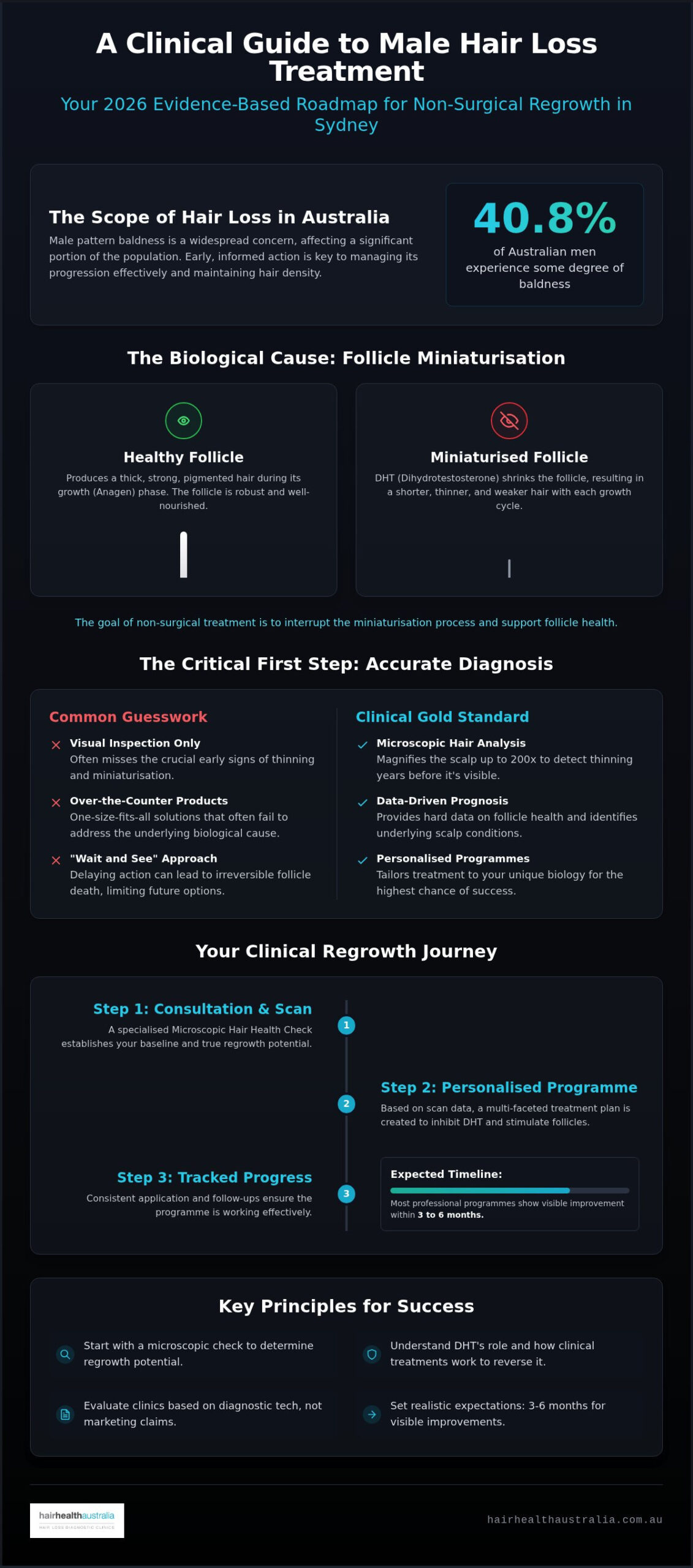
Statistics show that approximately 40.8% of Australian men experience some degree of baldness, making our nation one of the most affected in the world. If you’ve spent your mornings checking the mirror for a receding hairline, you’re likely searching for a male hair loss treatment Sydney that offers more than just empty promises. It’s completely normal to feel a sense of anxiety about your professional image or social confidence as your hair thins. You might even feel trapped between the high costs of surgery and the confusion of conflicting online advice.

We understand that you want a solution that’s both effective and grounded in reality. This 2026 clinical guide is designed to replace your uncertainty with a clear, scientifically-backed roadmap for non-surgical hair restoration. You’ll discover how personalised regrowth programmes, starting with precise microscopic diagnostics, can stabilise your current density and foster visible results. We’ll explore the latest evidence-based pathways available in Sydney today, giving you the tools to take control of your hair health with total clarity.

Key Takeaways

  • Learn why a specialised microscopic hair health check is the critical first step to determine your true regrowth potential before starting any programme.
  • Understand the biological role of DHT in follicle miniaturisation and how modern male hair loss treatment Sydney works to stabilise and reverse this process.
  • Discover how to evaluate local clinics based on their diagnostic technology and clinical expertise rather than one-size-fits-all marketing claims.
  • Set realistic expectations for your restoration journey, with most professional non-surgical programmes showing visible improvement within three to six months.
  • Identify the benefits of a personalised, evidence-based approach that prioritises clinical honesty and long-term hair density.

A clinical hair loss diagnosis is the systematic identification of follicle health through objective data. It isn’t just a guess about where your hair is going; it’s a precise assessment of what’s happening beneath the surface of your scalp. For anyone seeking a male hair loss treatment Sydney, starting with a clear picture of your scalp’s current state is vital. Microscopic Hair Analysis is the gold standard for non-surgical planning, providing the data needed to create a tailored programme based on your unique biology.

The success of any restoration journey depends on the presence of active follicles. These are follicles that, while producing thinner or shorter hairs, haven’t yet reached a state of total dormancy. Once a follicle dies and the scalp becomes smooth, non-surgical options can’t revive it. This is why we focus on identifying regrowth potential before recommending any specific therapy. Understanding your baseline allows for a straight-talking conversation about what’s achievable.

Visual Inspection vs. Microscopic Hair Analysis

A visual check by a GP or stylist can identify advanced androgenetic alopecia, but it often misses the early signs of miniaturisation. Microscopic scans reveal hairs that are invisible to the naked eye by magnifying the scalp up to 200 times. This technology allows us to:

  • Detect follicle thinning years before it becomes visible in the mirror.
  • Identify underlying scalp conditions, such as inflammation or oil blockages, that may be hindering follicle productivity.
  • Provide a realistic prognosis for hair density restoration based on hard data.

Without this level of detail, you’re essentially guessing which treatments might work. Clinical diagnostics replace that uncertainty with a clear, measurable baseline that tracks your progress over time.

Why Sydney Men Delay Seeking Professional Help

Many men fall into the “wait and see” trap. They hope the thinning will stop on its own or wait until the loss is undeniable before acting. This delay often leads to permanent follicle death, which significantly limits your future options. The psychological impact of thinning hair is significant, often causing a loss of self-confidence in professional and social settings across Sydney.

Early clinical intervention is the most effective way to stabilise your current density and protect your appearance. Transitioning from the frustration of over-the-counter products to clinical clarity gives you a sense of control over your image. If you’re unsure where your hair health stands, a specialised microscopic hair health check provides the answers you need without the guesswork. Taking this first step ensures your male hair loss treatment Sydney is built on a foundation of scientific fact rather than marketing promises.

The Science of Non-Surgical Regrowth: Beyond Over-the-Counter Solutions

Androgenetic Alopecia, or male pattern baldness, isn’t just a matter of “bad luck” or aging; it’s a specific biological process driven by genetics and hormones. The primary culprit is Dihydrotestosterone (DHT), a derivative of testosterone. For men with a genetic predisposition, DHT binds to receptors in the scalp follicles, causing them to shrink. This process, known as miniaturisation, results in hair that grows back thinner, shorter, and less pigmented with every cycle. Eventually, the follicle may stop producing visible hair altogether. A professional male hair loss treatment Sydney focuses on disrupting this hormonal cycle rather than just washing the scalp with generic ingredients.

Clinical-grade therapies differ significantly from supermarket shampoos or basic supplements. Most retail products only address the hair shaft’s surface, providing a temporary illusion of thickness. In contrast, clinical protocols are designed to penetrate the scalp and reach the follicle bulb. A multi-faceted approach is essential because no single “miracle” solution can address every aspect of hair loss. By combining DHT inhibition with growth stimulants and scalp health optimisation, we create an environment where hair can actually thrive again.

Follicle Dormancy vs. Follicle Death

There’s a critical window of opportunity for hair regrowth. During the natural hair growth cycle, follicles move through the Anagen (growth), Catagen (transition), and Telogen (resting) phases. In a balding scalp, the Anagen phase becomes progressively shorter. This leads to follicle dormancy, where the follicle is still alive but inactive. However, if the follicle is left untreated for years, it can undergo fibrosis, or scarring, which leads to permanent follicle death. Clinical treatments are designed to “wake up” dormant follicles and shift them back into a healthy Anagen phase before permanent scarring occurs.

Clinically-Backed Non-Surgical Protocols

Modern restoration relies on a combination of clinically proven hair loss treatments that have been rigorously tested for efficacy. These may include topical solutions that increase blood flow or systemic treatments that manage DHT levels. The most important word in any successful programme is “personalised.” Because your pattern of loss is unique, your treatment must be tailored to your specific follicle health and lifestyle. Medical supervision is vital during this process to monitor your progress and adjust dosages for maximum results.

Moving away from the frustration of trial-and-error with retail products is a major step toward clinical clarity. To understand exactly which stage your follicles are in, you can organise a specialised hair health check to receive a straight-talking assessment of your regrowth potential.

Comparing Sydney Hair Loss Clinics: A 2026 Evaluation Framework

Selecting the right provider for male hair loss treatment Sydney involves looking beyond marketing gloss to find a clinical partner who prioritises data over sales targets. A reliable evaluation framework should focus on three pillars: the precision of their diagnostic technology, the depth of their specialist expertise, and the breadth of their non-surgical treatment range. In 2026, the industry has split into two distinct models that every man should understand before booking a consultation.

High-volume clinics often operate on a “one-size-fits-all” approach, pushing standardised kits to as many people as possible. These environments can feel like factories where the focus is on turnover rather than individual outcomes. In contrast, a personalised clinical model treats every scalp as a unique biological case. This distinction is vital because hair loss isn’t a uniform condition. Having a local Sydney presence, such as a Redfern-based clinic, ensures you receive ongoing monitoring and support from specialists who understand your history and can adjust your programme as your hair responds.

Non-Surgical Therapy vs. Hair Transplant Surgery

It’s important to distinguish between the “maintenance and regrowth” path and the “invasive” surgical path. Surgery involves relocating follicles from the back of the head to the thinning areas, but it doesn’t stop the underlying process of hair loss. Non-surgical therapy is often a prerequisite even for those considering surgery. You can’t successfully transplant hair into a scalp where the surrounding native hair is still actively thinning. A clinical programme stabilises your current density first, providing a more cost-effective and sustainable result without the downtime of a surgical procedure.

Red Flags to Watch for in Sydney Hair Clinics

Be wary of any clinic offering “guaranteed” results before they’ve even looked at your scalp under a microscope. Without a specialised hair health check, any promise of regrowth is purely speculative and medically unsound. High-pressure sales tactics are another significant warning sign. A professional specialist acts as an educator, providing straight-talking advice and evidence-based options rather than pushing for an immediate contract. If a clinic lacks transparent case studies or refuses to explain the clinical science behind their protocols, it’s best to look elsewhere for your male hair loss treatment Sydney. Trust is built on clinical honesty and realistic expectations, not on hyperbolic marketing claims.

Male Hair Loss Treatment Sydney: The 2026 Clinical Buying Guide

Your Clinical Journey: From Microscopic Scan to Sustainable Regrowth

A professional restoration programme is a methodical process, not a quick fix. When you begin a male hair loss treatment Sydney, you’re entering a structured clinical journey designed to reset your hair growth cycle. This path requires patience, precision, and regular monitoring to ensure the biological changes occurring beneath your scalp are on the right track. The vital starting point for this entire process is a Hair Health Check, which provides the baseline data needed to build your customised plan. You should expect a timeline of three to six months before visible regrowth becomes apparent, as the follicles need time to transition back into the active growth phase.

Phase 1: The Diagnostic Consultation

The journey starts with a deep dive into your scalp’s current condition. During the microscopic scan and digital scalp analysis, we magnify your follicles to see exactly what the naked eye misses. We assess your medical history and lifestyle factors to identify potential triggers for thinning. This data allows us to define your individual potential for regrowth. We don’t guess. We use these findings to tell you exactly which follicles are dormant and which are still capable of producing thicker hair.

Phase 2: Implementation and Active Regrowth

Phase 2 is about action. It involves starting your customised treatment plan and establishing a daily routine that fits your lifestyle. Many men feel anxious during the initial weeks because of a “shedding” phase. It’s vital to understand this as a sign of progress. Your follicles are pushing out old, weak hairs to make room for new, stronger terminal hairs. You aren’t doing this alone. Regular check-ups with your specialist ensure the programme is effective and allow for real-time adjustments based on your progress.

Phase 3: Maintenance and Density Management

Once you’ve achieved visible regrowth, the focus shifts to long-term hair health maintenance. This phase ensures your results are sustainable. You’ll likely transition to a maintenance routine that includes clinical-grade shampoos and scalp health products designed to keep the scalp environment optimal. For a deeper look at these protocols, you can consult our Clinical Hair Treatment Guide. Consistency is the key to protecting your new hair density for years to come.

If you’re ready to stop the guesswork and start a scientifically-backed journey, the first step is clarity. You can book your specialised microscopic hair health check today to discover your true regrowth potential.

Personalised Hair Restoration at Hair Health Australia

Hair Health Australia stands as a dedicated specialist for non-surgical solutions in the heart of Sydney. Since our founding circa 2009, we’ve provided a clinical alternative to invasive procedures, focusing on what actually works for the modern man. Our Redfern clinic is specifically positioned to be accessible for Sydney professionals who require efficient, effective care without the noise of high-volume marketing. We prioritise clinical honesty, ensuring you receive a realistic assessment of your regrowth potential based on objective data rather than sales targets.

Choosing a male hair loss treatment Sydney shouldn’t feel like a gamble. We act as your partner in this journey, replacing uncertainty with a clear, scientifically-backed plan. Our team combines medical authority with an empathetic understanding of how hair loss affects your self-confidence in both professional and social settings. By focusing on evidence-based results, we ensure that every step of your programme is designed to stabilise your density and foster visible regrowth.

The Hair Health Australia Difference

With over 15 years of experience in the Sydney hair loss market, we’ve refined our approach to focus on what delivers the most sustainable outcomes. We remain committed to non-invasive, clinically-proven regrowth protocols that respect your body’s natural biology. Our “straight-talking” persona is a core part of our service; we prioritise patient education over sales. We believe that an informed patient is a successful one, which is why we take the time to explain the microscopic findings of your scalp in plain English. You won’t find hyperbolic promises here, only a commitment to precision and systematic care.

Booking Your Sydney Consultation

The first step toward regaining your confidence is a no-obligation consultation. To prepare for your specialised hair health check, it’s helpful to gather a few details beforehand. We recommend bringing a list of any current medications and a brief history of any previous treatments you’ve tried, whether they were over-the-counter or prescribed. This information helps us tailor your programme with greater accuracy.

During your visit, we’ll use digital microscopic imaging to provide a clear view of your follicle health, identifying exactly where the potential for regrowth remains. This diagnostic-first approach ensures that you only invest in a programme that is biologically viable for you. Book your free Hair Health Check in Sydney today and take the first step toward a clearer, more confident future with a plan that’s built for your unique needs.

Taking Control of Your Hair Health Journey

The path to restoration begins with moving away from the uncertainty of generic products and toward a structured, data-driven approach. By prioritising a specialised microscopic diagnostic check, you gain the clinical clarity needed to identify active follicles before they reach permanent dormancy. This evidence-based strategy ensures your male hair loss treatment Sydney is built on your specific biological needs rather than high-pressure marketing promises.

With over 15 years of clinical experience in Sydney, we’ve seen that the most sustainable results come from personalised, non-surgical programmes that address the root causes of thinning hair. You don’t have to navigate the confusion of hair loss alone or feel forced into invasive surgical options. Instead, you can choose a clinical partner who values transparency, systematic care, and realistic outcomes through proven technology.

Ready to discover your true regrowth potential? Book Your Free Sydney Hair Health Check Today and start your journey toward visible hair density with total confidence. Taking action now is the most effective way to protect your appearance and restore your self-assurance for years to come.

Frequently Asked Questions

Is male hair loss treatment in Sydney covered by Medicare?

Medicare and private health insurance in Australia generally don’t cover hair loss consultations or treatments because they’re classified as elective cosmetic procedures. This means you’re responsible for the full cost of your clinical programme. However, we focus on providing a transparent, non-surgical path that remains significantly more accessible than high-cost surgical interventions. This ensures you receive professional care without the hidden fees often associated with hospital-based surgical procedures.

How long does it take to see results from non-surgical hair loss treatment?

You should expect to see visible results within three to six months of starting a professional male hair loss treatment Sydney. This timeline is dictated by the natural hair growth cycle, as follicles require time to transition from a dormant state back into the active growth phase. While initial stabilisation of hair density often occurs sooner, the production of thicker terminal hairs is a gradual biological process that requires consistent adherence to your personalised programme.

Can a microscopic hair health check tell me if I will go bald?

A microscopic hair health check provides a clear indication of your current follicle health and identifies patterns of miniaturisation that suggest future loss. While it can’t predict the exact day you might lose your hair, it reveals how many follicles are currently active versus dormant. This data allows us to provide a straight-talking assessment of your risk level and helps us intervene early to protect your existing hair density before permanent follicle death occurs.

Are the results of clinical hair regrowth programmes permanent?

Results from clinical hair regrowth programmes aren’t permanent in the sense that they require ongoing maintenance to counteract the genetic influence of DHT. If you stop a successful treatment, the biological process of follicle miniaturisation will eventually resume. We focus on transitioning patients into a sustainable maintenance phase after the initial regrowth period, using clinical-grade scalp products to ensure your restored hair density remains stable and healthy for the long term.

What is the difference between a trichologist and a hair loss specialist in Sydney?

A trichologist is a specialist focusing specifically on the scalp and hair health, while a “hair loss specialist” in Sydney is a broader term often used by clinicians who manage restoration programmes. At our clinic, we combine clinical expertise with advanced diagnostic technology to provide a comprehensive approach. The main difference lies in the specific focus on non-surgical, evidence-based protocols that go beyond general hair care to address the hormonal and biological drivers of pattern baldness.

Can I treat a receding hairline without getting a hair transplant?

Yes, you can effectively treat a receding hairline without undergoing a hair transplant, provided the follicles in the affected area are still active. Clinical treatments focus on blocking DHT and stimulating blood flow to “wake up” dormant follicles along the hairline. By starting a non-surgical male hair loss treatment Sydney early, you can often restore density and stop the recession from advancing, making invasive and expensive surgical procedures unnecessary for many men.

Are there any side effects to clinical male hair loss treatments?

Most clinical-grade non-surgical treatments have a high safety profile, but like any medical-grade protocol, some individuals may experience minor side effects. These can include temporary scalp irritation or changes in hair texture during the initial phases. Because our programmes are professionally supervised, we monitor your progress closely and can adjust your customised routine to mitigate any discomfort. Our goal is to ensure your restoration journey is both effective and comfortable through every stage.

How often do I need to visit the Sydney clinic for treatment?

Following your initial diagnostic consultation in our Redfern clinic, follow-up visits are typically scheduled every three to four months. These regular check-ups are essential for tracking your progress through digital scans and ensuring your programme is delivering the desired results. Between these visits, you’ll follow a straightforward daily routine at home. This structured approach allows us to provide professional support and make necessary adjustments to your programme without requiring a significant time commitment from you.