
What if the most meaningful sign of progress isn’t a dramatic change, but a small difference you can see consistently over time? A good hair day can look fuller because of lighting, styling or how your hair sits. Meanwhile, day-to-day changes can make genuine progress hard to judge. Celebrating hair regrowth milestones works best when you look for patterns, not a single promising glimpse. It’s understandable to feel unsure about which changes count, especially when online timelines suggest everyone should see the same results at the same point. Hair changes and treatment responses vary from person to person, so those timelines aren’t a reliable yardstick for your own experience.
This article explains which changes can be useful to observe, how to record them consistently and how to compare them realistically. You’ll also learn when a clinical review can add context to what you’re noticing. A Hair Health Check at Hair Health Australia uses microscopic scanning and clinical assessment to examine hair and scalp concerns, making progress tracking more meaningful than appearance alone. The aim is to recognise evidence of change without turning every good or difficult hair day into a verdict.
Key Takeaways
- A useful milestone is an observable change to record, not proof of a guaranteed outcome.
- Understanding the hair growth cycle can explain why changes at the scalp may not be immediately visible.
- When celebrating hair regrowth milestones, use consistent photos and brief notes to spot patterns rather than judge a single day.
- Build a simple tracker around a baseline, regular records and personally meaningful milestones, not comparisons with others.
- A clinical Hair Health Check, including microscopic scanning, can help put your observations and concerns into context.
Why celebrating hair regrowth milestones can feel difficult
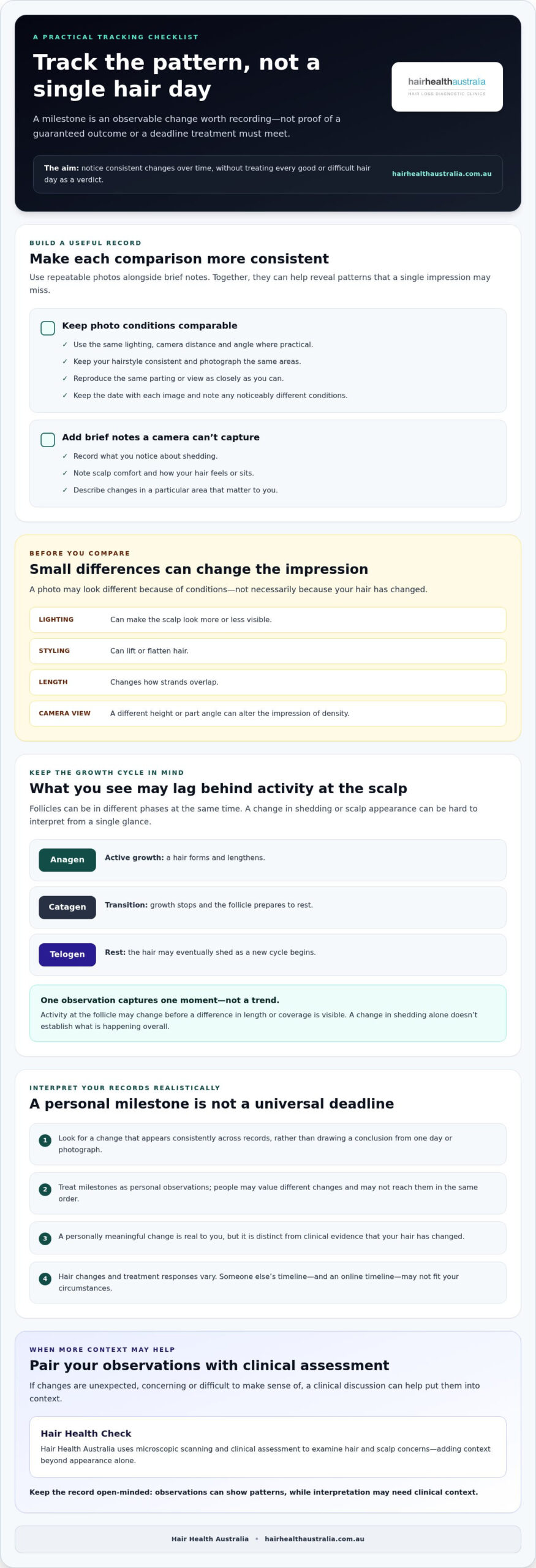
A hair regrowth milestone is an observable change worth recording, not proof of a guaranteed outcome or a deadline treatment must meet. It might be a difference in a particular area, or a change in how your hair feels or sits. The milestone gives you a point of reference; it doesn’t promise what will happen next.
Progress can be hard to judge because you see your hair every day. Gradual changes may blend into the familiar, while a particularly good or difficult hair day can suddenly seem decisive. It’s easy to overlook a slow shift or read too much into a temporary difference. Hair grows in cycles, as outlined in this overview of the human hair growth cycle, so what you see at the scalp and what’s visible in the mirror may not change in step.
Why progress can be hard to see in the mirror
Visual comparisons are affected by more than your hair itself. Lighting can make the scalp look more or less visible, styling can lift or flatten hair, and length changes how strands overlap. A slight shift in camera height or the angle of your part can also alter the impression of density. Don’t draw a conclusion from one photograph or one day. A consistent record helps you distinguish a pattern from ordinary variation.
What a milestone can mean for your individual journey
Milestones are personal observations, not a checklist everyone must meet in the same order. You may value a change in a particular area, or feel encouraged by a difference that appears consistently across records. That emotional significance is real, but it isn’t the same as clinical evidence that your hair has changed. Treat these as useful, distinct forms of information.
A slower-looking journey doesn’t, by itself, establish that treatment has failed. Appearance can be difficult to assess in isolation, and expectations based on someone else’s experience may not fit your circumstances. A more useful question is whether you can identify a consistent change over time, rather than whether you’ve reached a particular milestone by a fixed date. This is a more grounded way of celebrating hair regrowth milestones.
How the hair growth cycle shapes the milestones you may notice
Hair doesn’t grow continuously at the same pace from every follicle. Each follicle moves through a cycle of growth, transition and rest, and neighbouring follicles can be in different phases at the same time. This helps explain why a change in shedding or scalp appearance can be difficult to interpret from a single glance.
What the hair growth cycle means for visible change
Anagen is the active growth phase, when a hair forms and lengthens. Catagen is a short transition phase in which growth stops and the follicle prepares to rest. During telogen, the follicle rests; the hair may eventually shed as a new cycle begins. These phases don’t happen in synchrony across the scalp, so shedding and new growth can occur in different areas at the same time.
Activity at the follicle may change before you can see a difference in length or coverage. A newly growing hair needs time to extend above the scalp, and its visibility depends partly on its location and the surrounding hair. One observation cannot define a trend because it captures only one moment in a cycle that varies between follicles. A change in shedding, on its own, also doesn’t establish what’s happening overall. Record what you notice and consider it alongside other observations.
Why regrowth timelines differ between people
The reason for hair loss matters. Different underlying causes can affect which changes are relevant and how a clinician interprets them. A shift in shedding, for example, may need to be considered alongside when it began, other hair or scalp concerns, and any changes to your routine or health. There isn’t one visible-regrowth date that applies to everyone, so an online timeline shouldn’t be treated as your personal deadline.
If changes are unexpected, concerning or difficult to make sense of, a clinical discussion can help put your observations into context. Hair Health Australia’s Hair Health Check uses microscopic scanning and clinical assessment to examine hair and scalp concerns. This gives you a more informed reference point than judging appearance alone, without assuming that every observation signals treatment progress. Understanding the cycle can make celebrating hair regrowth milestones more measured: note what you see, but leave interpretation open until a pattern or clinical context emerges.
Which hair regrowth milestones are worth tracking objectively?
Useful tracking combines repeatable visual records with brief notes about what you’re experiencing. Photographs help you compare appearance; written observations preserve details a camera can’t show, such as scalp comfort or changes in shedding. Neither replaces clinical interpretation. Consistent records are more useful than isolated impressions because they help reveal patterns over time, rather than magnifying one unusually good or difficult day.
How to take comparable progress photographs
Where practical, use the same lighting, camera distance, angle and hairstyle each time. Photograph the same areas and reproduce the same parting or view as closely as you can. Keep the date with each image, and note any conditions that differ noticeably. Photos are supporting observations, not a diagnosis or a guaranteed measure of hair density.
What to record alongside photographs
Keep notes brief and factual. Record when shedding seems different, whether you’ve noticed scalp discomfort, and any changes to your hair-care or treatment routine. Relevant health or life changes may also be useful to discuss with a clinician. Avoid treating one image or symptom as an explanation on its own; context matters.
The distinction between what you notice and what it means is important when celebrating hair regrowth milestones:
| Record | What it can help with | What it can’t establish alone |
|---|---|---|
| Comparable photographs | Seeing visual differences in the same area across records | The cause of a change or a definitive measure of density |
| Written observations | Remembering shedding concerns, scalp comfort and routine changes | Whether a symptom or change has a particular clinical cause |
| Clinical assessment | Considering observations alongside hair and scalp findings and your concerns | A guaranteed future outcome |
A clinical assessment adds context that personal records can’t provide. Hair Health Australia’s Hair Health Check uses microscopic scanning and clinical assessment to examine hair and scalp concerns. Consider your observations alongside your history, rather than relying on appearance alone.
How to create a realistic hair regrowth milestone tracker
A tracker should make changes easier to review, not turn every day into a test. Keep it simple enough to maintain and focused on information you can compare. This four-step routine gives you a practical starting point for celebrating hair regrowth milestones without relying on someone else’s timeline.
- Establish a baseline. Take photographs under repeatable conditions and write a brief note about what you currently notice, including any shedding concerns or scalp symptoms. Record your current hair-care and treatment routine.
- Record consistently. Choose a review interval that feels manageable and stick with it. Avoid checking so frequently that everyday variation takes over. Date your photos and notes, and mention any changes in conditions that could affect comparison.
- Review patterns. Compare records across time instead of judging one image or observation. Note what appears consistent, what has changed and what remains uncertain.
- Write down questions. Keep a short list of concerns or changes you’d like to discuss during a clinical review. This can make the conversation more specific.
Set a useful baseline and review routine
Choose a repeatable view and hairstyle for your baseline, then keep notes concise. A few factual words are often enough: what you noticed, when, and whether your routine changed. If you’re following a treatment plan, record whether you’ve been able to follow it as discussed and note any interruptions or difficulties. Don’t change or stop a clinical plan based on your tracker alone; raise questions with your clinician.
For wider treatment context, the guide Best Hair Regrowth Treatment Australia 2026 can help frame questions about treatment options. Your personal tracking record has a different purpose: it captures your own observations and routine over time.
Celebrate progress without creating pressure
Milestones don’t have to be dramatic or purely visual. You might value feeling more confident, keeping a routine that suits you or having clearer questions for a review. These can be personally meaningful, even though they aren’t clinical measures of hair change. Testimonials, advertisements and another person’s experience shouldn’t set your deadline.
If tracking starts to increase distress or makes you check your appearance compulsively, pause the routine and raise that concern during a clinical discussion. A clinical assessment can help interpret your observations alongside your history and concerns. Book a Hair Health Check to discuss your hair and scalp concerns in context.
When a clinical Hair Health Check can put milestones in context
A tracking record shows what you’ve noticed; a clinical assessment helps consider those observations alongside your hair and scalp concerns, personal history and routine. This context matters because a photograph or change in shedding doesn’t explain its cause on its own. A review can help clarify what may be relevant and which questions are worth exploring next, without promising a particular result.
Hair Health Australia’s Hair Health Check includes microscopic scanning, also known as trichoscopy, and clinical assessment of hair and scalp concerns. For Sydney readers, bringing a few dated photographs and concise notes can make the discussion more focused. The aim is to put your observations into context, not to treat any single image as proof of progress or predict a fixed outcome.
What to bring to a hair health assessment
You don’t need a perfect log. Bring what you have, organised so it’s easy to refer to:
- Dated photographs, ideally taken under similar conditions.
- A brief timeline of changes you’ve noticed, including shedding or scalp symptoms.
- Notes about relevant hair-care or treatment routine changes and other health or life changes you’d like to discuss.
- Questions about what the observations might mean, possible contributing causes and suitable next steps.
An assessment adds clinical context to your record. It doesn’t guarantee regrowth or confirm that every perceived difference represents a lasting change.
Turn observations into a clear next step
Individual findings can guide a discussion about options that may suit your circumstances. That might mean clarifying what to keep monitoring or discussing personalised, non-surgical treatment. The focus is on making sense of your specific concerns, rather than matching your experience to a generic timeline. For broader treatment information, read Clinical Hair Treatment: A Professional Guide to Non-Surgical Restoration.
Celebrating hair regrowth milestones can feel more grounded when your records are considered alongside an individual assessment. Bring your dated photographs and notes to help make the conversation specific. Book a Hair Health Check.
Make your next milestone a clearer understanding
Hair changes are easier to assess as patterns than as single moments. Consistent photographs and concise notes can help you track what you notice, while remembering that personal milestones aren’t deadlines or guarantees. That’s a more grounded way of celebrating hair regrowth milestones, and it leaves room for your experience to differ from someone else’s.
If you’d value clinical context, Hair Health Australia’s Hair Health Check uses microscopic scanning and clinical assessment to examine hair and scalp concerns. These findings can inform a discussion about personalised, non-surgical hair-loss treatment for men and women, without promising a particular outcome.
Book a Hair Health Check with Hair Health Australia to discuss your observations and concerns. Every useful step towards understanding your hair health is worth recognising.
Frequently Asked Questions
How long does it take to notice hair regrowth?
There’s no single timeframe for noticing hair regrowth. The underlying cause of hair loss, the treatment being used and individual response can all affect what changes you may observe and when. Hair follicles also move through different growth phases, so a change at the scalp may not be immediately visible. Follow the review guidance for your treatment plan, and discuss expectations with a clinician rather than relying on an online deadline.
What are the first signs of hair regrowth?
Possible signs include short, fine hairs in an area you’ve been monitoring or a gradual change in how much scalp is visible in comparable photographs. These observations aren’t conclusive on their own: lighting, styling, hair length and breakage can affect appearance. Record what you notice, including the date and conditions, then look for a consistent pattern. A clinical assessment can help interpret changes alongside your hair and scalp concerns.
How can I track hair regrowth at home?
Start with dated photographs taken from the same angle, distance and lighting, with your hair arranged similarly. Add brief notes about shedding concerns, scalp comfort, hair-care or treatment routine changes, and relevant health or life changes. Review records at a manageable interval instead of checking repeatedly. This consistent approach to celebrating hair regrowth milestones can help you notice patterns, but it can’t diagnose the cause of a change or guarantee an outcome.
Can hair regrowth look different from one month to the next?
Yes. The appearance of your hair can vary with styling, length, lighting and how it sits, while different follicles move through growth phases at different times. A single month’s photograph may therefore look fuller or thinner without showing a lasting change. Keep comparison conditions as similar as practical and consider several records together. If a change concerns you, note when you noticed it and raise it in a clinical discussion.
Do progress photos show whether hair treatment is working?
Progress photos can show visual differences over time, but they can’t confirm by themselves whether a treatment is working or explain why your hair looks different. Use repeatable lighting, angle, distance and hairstyle, and keep the dates with each image. Consider the photos alongside your written notes and clinical review. Avoid changing a treatment plan based only on a photograph; discuss questions about your response with your clinician.
What should I do if I cannot see any hair regrowth?
Not seeing a clear change doesn’t, by itself, establish that treatment has failed. Check whether your photographs are comparable, make a note of your concerns and confirm that you’re following your treatment plan as discussed. Don’t alter the plan independently. A clinical review can consider your history, concerns and scalp findings. In Sydney, Hair Health Australia’s Hair Health Check uses microscopic scanning and clinical assessment to examine hair and scalp concerns.
Is a hair regrowth milestone the same for everyone?
No. A milestone is a personally meaningful, observable change, not a standard result or deadline everyone should reach. Your underlying cause of hair loss and individual circumstances affect which changes may be relevant. One person may notice a difference in a particular area, while another may value having a clearer record or better understanding of their concerns. Compare your progress with your own baseline, not another person’s photos or timeline.