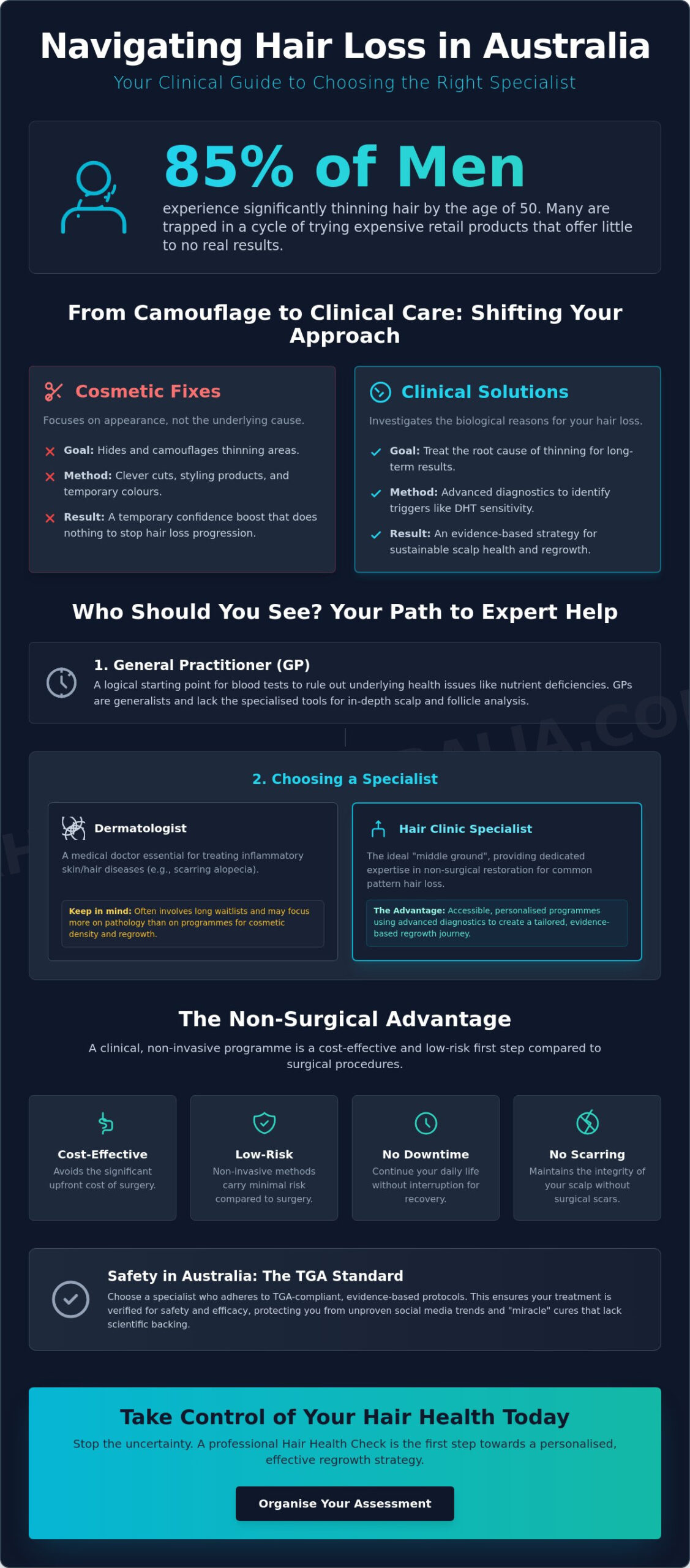
You don’t need to arrive with all the answers, just useful observations. Preparing for your first trichologist appointment can feel daunting when you’re unsure which changes matter or what the assessment involves. You don’t need to diagnose the cause yourself. Notes about when thinning or shedding began, where you’ve noticed it and any changes in your hair or scalp can make the conversation more useful.
A clinical assessment can add detail that memory and a quick glance in the mirror may miss. At Hair Health Australia’s Hair Health Check in Redfern, Sydney, a microscopic Trichoscopy scan assesses active hair follicles and helps diagnose the type of hair loss. The check is free, with no obligation, and takes ONLY 30 MINS. Specialists explain the findings and tailor treatment plans to your individual diagnostic results.
This guide covers what to note before your appointment, what to expect during an assessment and questions that can help you understand your next steps. You’ll be better prepared to discuss your concerns and leave with clearer information about your options.
Key Takeaways
- When preparing for your first trichologist appointment, note when changes began and what you’ve observed, without trying to diagnose the cause yourself.
- Microscopic Trichoscopy assesses active hair follicles and helps identify the type of hair loss.
- Use the assessment to understand the diagnosis, the reasoning behind recommendations and how proposed next steps relate to your results.
- A simple checklist of your hair-change timeline, relevant history and questions can help you feel organised. Records and product details are useful context, not requirements.
- Hair Health Australia’s Sydney Hair Health Check is free, with no obligation, and takes ONLY 30 MINS.
Preparing for your first trichologist appointment: start with what you have noticed
Noticing more hair in your brush, a wider-looking part or a change in your hairline can feel unsettling. You don’t need to arrive with a theory about why it’s happening. Start by describing what you’ve observed, when it began and whether it has changed. These details help frame the conversation without turning your notes into a self-diagnosis.
Hair changes can involve shedding, density, the hairline or the condition of your scalp. One observation alone doesn’t identify a cause, and patterns vary between people. If you’re curious about the field, What is Trichology? offers background on its focus on hair and scalp health. For your appointment, everyday descriptions are enough: “my part looks wider in photos” or “I’ve noticed more hair coming away when I wash it”.
What changes should you write down before the appointment?
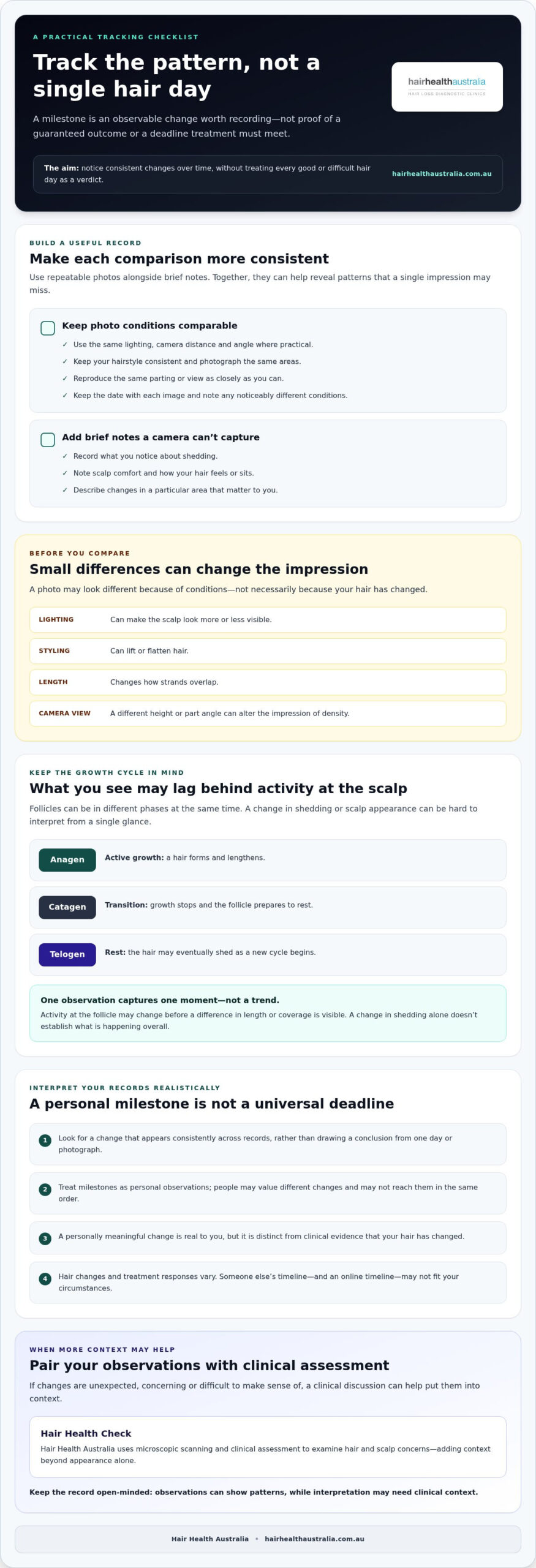
Jot down a few observations while they’re fresh. You’re building a useful record, not preparing a clinical report. Include what you’ve noticed, even if you’re unsure whether it’s relevant. The assessment can help put those details into context.
- Timing: Note when you first became aware of the change. Describe it as gradual or sudden if that’s clear to you.
- Location: Record where thinning or shedding stands out, such as around the temples, crown, part or across the scalp.
- Scalp observations: Mention visible changes or discomfort, such as itchiness, tenderness, redness or flaking. Describe what you experience rather than trying to label a condition.
- Progress: Note whether the change seems stable, more noticeable or different in certain areas over time.
A dated record can make a first assessment more focused by showing when changes began and how they developed, rather than relying on memory alone. A short timeline in your phone or notebook is enough. You don’t need to track every strand or measure your hair.
How can you describe your hair-loss history clearly?
When preparing for your first trichologist appointment, keep your history simple and factual. A few dates or brief notes can help organise what you remember, especially if changes have happened over an extended period.
- List any previous assessments and what you were told, if you remember.
- Note products or treatments you’ve tried, roughly when you used them and whether you noticed a change.
- Include relevant health changes, medicines or family history that you already know about.
- Bring dated photos if they help show changes over time. They’re optional context, not a requirement.
If you can’t recall exact dates, use approximate markers such as “before winter” or “after changing jobs”. The aim is to share what you know, not account for every detail. Your notes give the specialist a clearer starting picture, while the assessment helps interpret the pattern and guide a discussion about next steps.
What happens at a first trichologist appointment and what can it clarify?
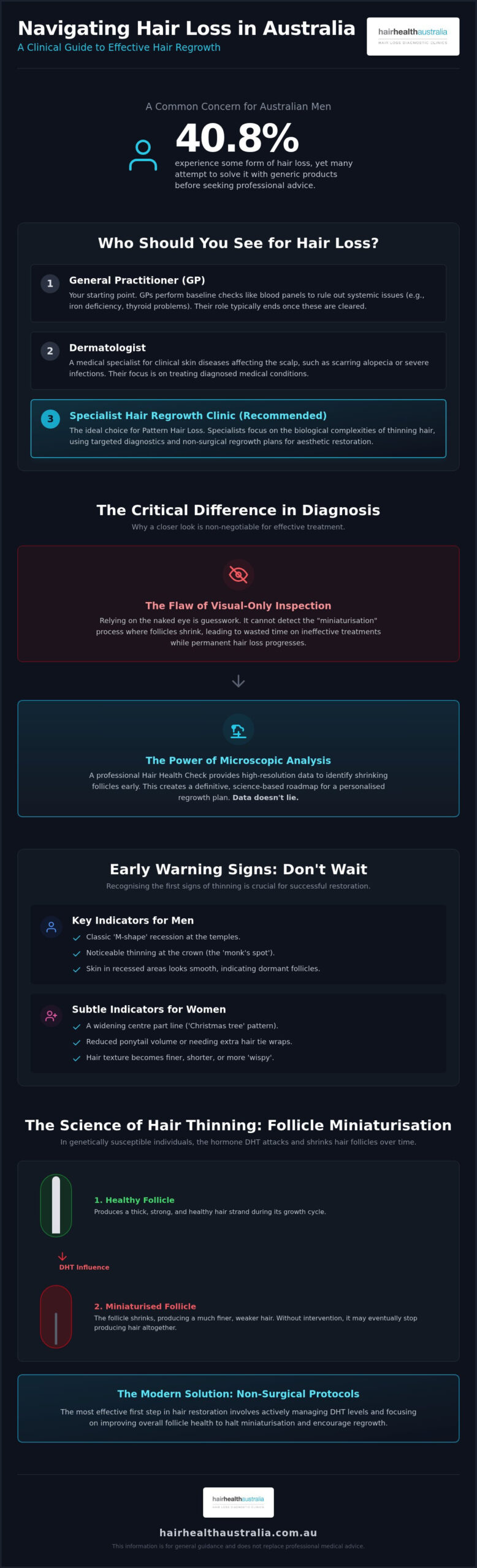
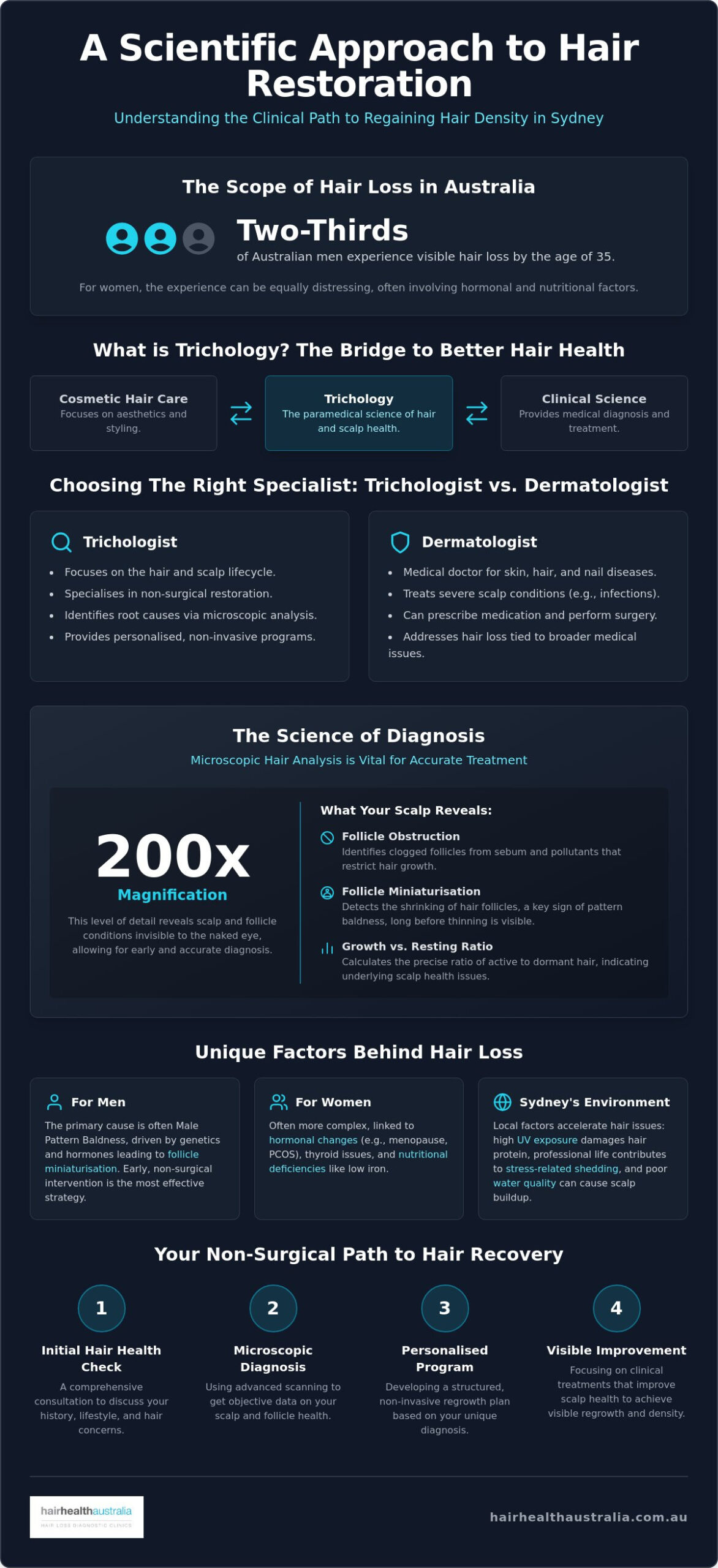
A first appointment is an opportunity to move from noticing a change to understanding what type of hair loss may be involved. At Hair Health Australia’s Hair Health Check, microscopic Trichoscopy is used as part of the assessment. This scan assesses active hair follicles and helps diagnose hair-loss type. Your observations and history add context, and the findings inform a discussion about suitable next steps.
What can a microscopic Trichoscopy scan show?
The Trichoscopy scan assesses active hair follicles. It forms part of the Hair Health Check’s full clinical diagnosis of hair-loss type. The scan gives the specialist follicle information to consider alongside what you’ve noticed about density or shedding.
During Hair Health Australia’s Hair Health Check, microscopic Trichoscopy assesses active hair follicles and helps diagnose the type of hair loss.
Thinning or shedding can look similar to you while having different explanations. A scan adds a closer view to the clinical assessment, within its scope of assessing active follicles and helping identify hair-loss type. The findings are used to tailor treatment plans, rather than assuming the same approach suits everyone.
Why does the appointment focus on your individual history?
Scan findings are considered alongside your personal history. Possible contributors to hair changes include hereditary patterns, stress, medicines, hormonal imbalance or nutrient deficiency. These factors don’t establish a cause by themselves, and a timeline or family history can’t prove what is happening. They do give the specialist useful context for interpreting the findings and discussing your situation without relying on a general assumption.
Preparing for your first trichologist appointment can also help you make the most of the explanation. Share relevant details you already know, then ask how they relate to the diagnosed hair-loss type. Specialists explain the diagnosis and educate clients about how recommended treatment works. Treatment plans are tailored to individual diagnostic results.
- Ask what the diagnosis means: Request a plain-language explanation of the identified hair-loss type.
- Understand the reasoning: Ask how the scan findings and your history inform the recommendation.
- Clarify the next step: Make sure you understand how a proposed treatment is intended to work for your individual results.
Clear answers can replace some uncertainty with a more grounded understanding. If you’re looking for a Sydney assessment that uses microscopic Trichoscopy, the Hair Health Check provides a focused way to discuss your findings and individual next steps.
How to assess appointment advice: diagnosis, explanation and next steps
A useful appointment should leave you clearer about what was assessed, what the findings mean and how any recommendation relates to your situation. A product suggestion on its own doesn’t explain the type of hair loss or why an option may suit you. Hair Health Australia’s Hair Health Check uses microscopic Trichoscopy to assess active follicles and support a clinical diagnosis of hair-loss type. The value is in connecting the assessment to an understandable explanation and an individual next step.
Use this simple comparison to organise what you hear during the discussion:
| Stage | What to understand |
|---|---|
| Observation | What changes you’ve noticed and what the assessment examines. |
| Diagnosis | The hair-loss type identified through the clinical assessment. |
| Explanation | How the findings relate to your individual situation and the reasoning behind the advice. |
| Proposed next step | What treatment or follow-up is recommended, and how it connects to the diagnosis. |
What makes an explanation useful and specific?
A clear explanation names the diagnosed hair-loss type and describes the relevant assessment findings in plain language. If a recommendation is made, ask how it follows from those findings rather than accepting a product suggestion without context. You can also ask what the proposed treatment is intended to address, how it relates to your results and what follow-up involves.
You don’t need technical terms to get a clear explanation. Straightforward questions can help you understand the decision-making:
- What hair-loss type did the assessment identify?
- Which findings informed that conclusion?
- How does the recommendation relate to my results?
- What should I understand about the recommended next steps?
If an answer isn’t clear, ask for it to be explained another way. Understanding the reasoning matters as much as hearing a recommendation.
How should you think about a recommended treatment plan?
A treatment plan should make sense in light of your diagnosis, rather than feel like a one-size-fits-all prescription. Hair Health Australia customises hair regrowth treatment plans for men and women based on diagnostic results, with specialist follow-up. Preparing for your first trichologist appointment includes thinking about what you need to understand before deciding on next steps.
Ask how the proposed plan connects to your assessed hair-loss type, what each recommendation is intended to do and how progress or follow-up will be discussed. Treatment plans are individual, so ask how the recommendation relates to your results. If you’d like to understand how assessment informs tailored recommendations, explore the Hair Health Check.
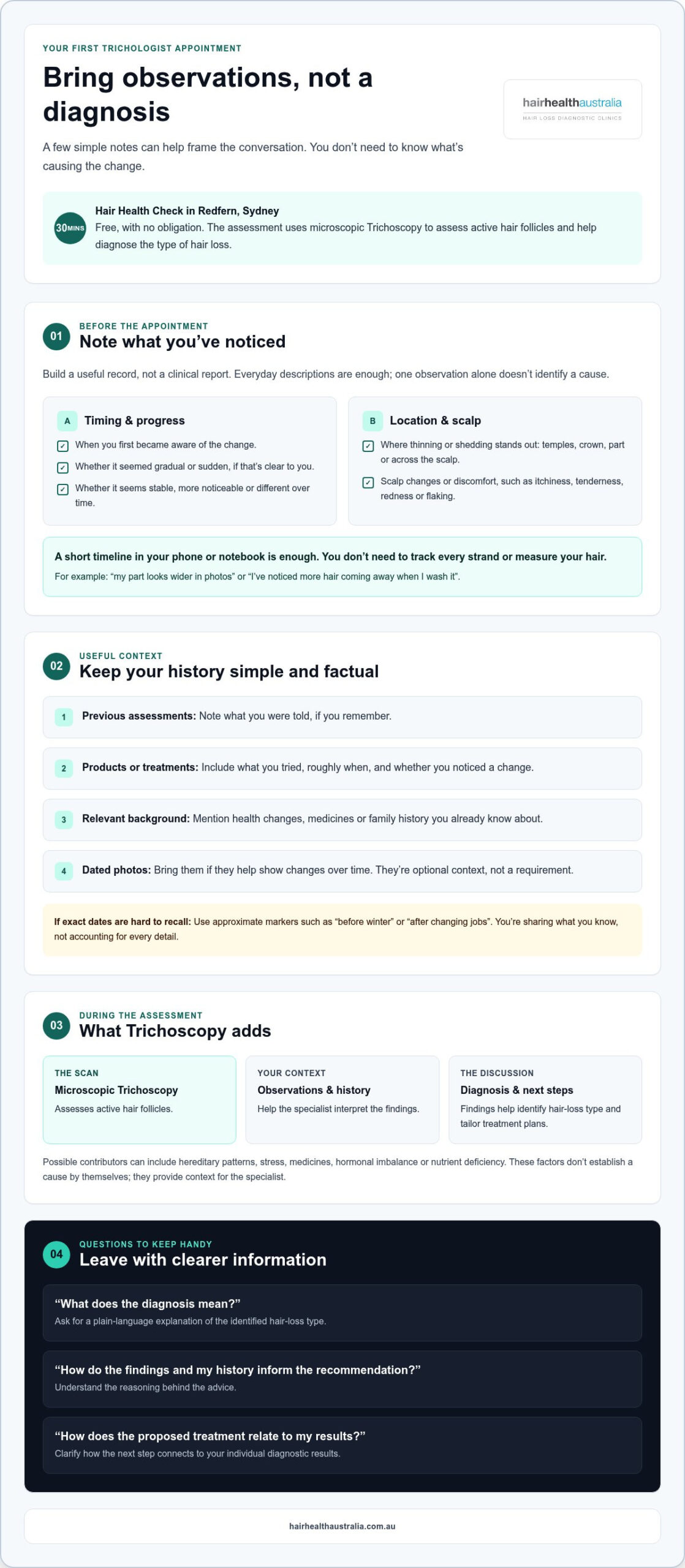
A practical checklist for the day of your first trichologist appointment
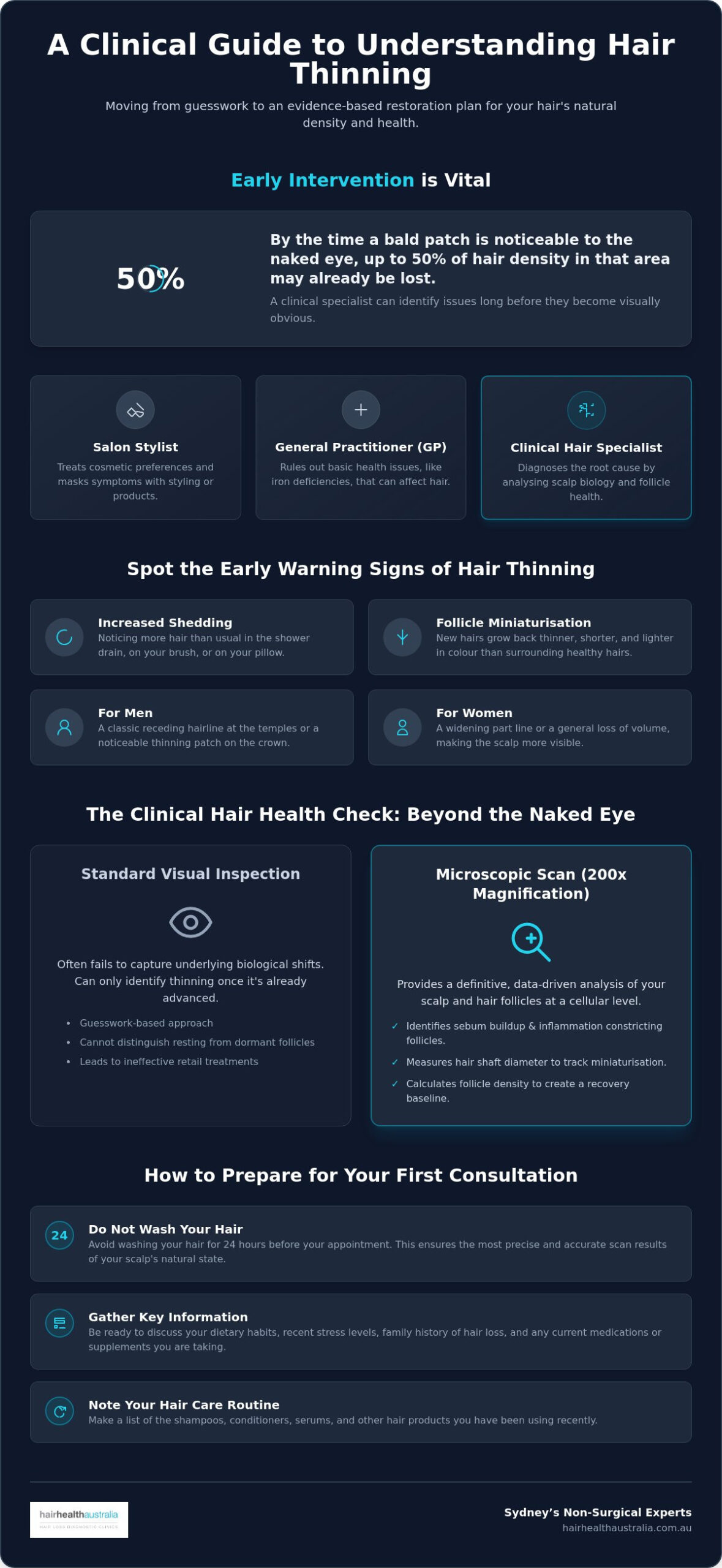
Preparing for your first trichologist appointment doesn’t require a folder of paperwork or a perfect account of every hair change. A short, organised summary can help you explain what’s been happening and follow the discussion. Bring what you already have, and treat records and product details as helpful context, not requirements.
Hair Health Australia’s microscopic hair assessment uses Trichoscopy to assess active hair follicles and help diagnose hair-loss type. Use the checklist below to gather information that may put your individual findings in context.
What information is useful to bring along?
Keep your notes brief and easy to refer to. Include details you can readily share instead of spending time trying to reconstruct information you don’t remember.
- A timeline: When you first noticed a change, whether it seemed gradual or sudden, and what has changed since.
- Your observations: Where you’ve noticed thinning or shedding, along with any scalp changes or discomfort.
- Relevant history: Health changes, medicines or family history you already know about and think may be relevant.
- Previous hair-loss products or treatments: What you tried and any changes you noticed. Product names or packaging details can help if they’re readily available.
- Existing records: Previous assessment results, health records or dated photos, if they help explain your history. These are optional, not a requirement.
Before you leave, follow any appointment-specific instructions you’ve received. Don’t assume there are standard washing or styling rules. Use the guidance provided for your appointment.
Which questions can help you leave with clarity?
Write down a few questions in advance so you can return to them during the conversation. You can also note the answers in your own words, making it easier to reflect on the information afterwards.
- What type of hair loss was identified?
- What does the scan show, and which findings support the explanation?
- How is a recommended treatment intended to work, and what happens next?
If a treatment is discussed, ask how its suitability relates to your results and what specialist follow-up involves. The aim is to understand the recommendation and the reasoning behind it, not to leave with a one-size-fits-all answer. It’s reasonable to ask for a plain-language explanation or to clarify a point you’re unsure about.
With your notes and questions ready, you can focus on understanding the assessment rather than trying to recall every detail on the spot. Hair Health Australia’s Hair Health Check is free, with no obligation, and takes ONLY 30 MINS.
Your next step in Sydney: Hair Health Australia’s free Hair Health Check
If you’re ready to move from personal observations to a clearer clinical assessment, Hair Health Australia’s Hair Health Check offers a straightforward next step in Sydney. The check is free, with no obligation, and takes ONLY 30 MINS. It’s an opportunity to have your hair assessed and understand what the findings may mean for your individual situation, without needing to arrive with a diagnosis or treatment decision already made.
What is included in the Hair Health Check?
The Hair Health Check includes a microscopic Trichoscopy scan and a full clinical diagnosis of hair-loss type. Trichoscopy assesses active hair follicles and helps identify the type of hair loss. It adds information to the clinical assessment beyond what you may have noticed in the mirror or remember over time.
The scan assesses active hair follicles and helps diagnose hair-loss type. Specialists explain the diagnosis and provide education about the findings. This gives you a clearer basis for discussing what may be appropriate next, with the conversation focused on your results rather than a general recommendation.
The diagnosis clarifies the type of hair loss identified and provides a starting point for considering individual options. Any treatment plan is tailored to your diagnostic results, so recommendations are connected to your assessment rather than assumed in advance.
How can you take the next step in Sydney?
The clinic is located in Redfern, Sydney. If you’ve been preparing for your first trichologist appointment, bring the timeline and questions you’ve gathered to help guide the discussion. You don’t need every detail or record. The aim is to get a clearer understanding of your hair-loss type and the information behind your next steps.
During the check, specialists explain the diagnosis and tailor treatment plans to individual results. Ask how any recommendation relates to the assessment, what it is intended to address and what follow-up support involves. Take the time to understand the explanation before deciding what feels right for you. The check has no obligation, so you can get information without committing to a treatment plan.
Hair Health Australia’s free Hair Health Check uses microscopic Trichoscopy to assess active follicles and help diagnose hair-loss type. It takes ONLY 30 MINS.
Take the next step with a clearer perspective
Preparing for your first trichologist appointment is about giving yourself a better starting point for understanding what’s happening. You don’t need to have every answer before you go. A few notes can give you a clearer basis for asking questions, considering your options and deciding what feels appropriate for you.
If you’re ready to take that step, Hair Health Australia’s Hair Health Check is available in Redfern, Sydney. The free, no-obligation check takes ONLY 30 MINS and uses a microscopic Trichoscopy scan to assess active hair follicles and help diagnose hair-loss type. Specialists explain the findings and tailor treatment plans to individual results, so you can consider your next step with a clearer understanding.
Book your free Hair Health Check or call 1800 908 898 or (02) 93190051 to arrange an assessment in Redfern, Sydney.
Frequently Asked Questions
Is a trichologist appointment worth it if I have only just noticed thinning?
An assessment can be worthwhile even if thinning has only just become noticeable. Preparing for your first trichologist appointment can help you describe the change clearly, while an individual assessment may clarify the hair-loss type instead of leaving you to rely on a guess. Hair Health Australia’s Sydney Hair Health Check uses microscopic Trichoscopy to assess active follicles and provide a full clinical diagnosis. It’s free, with no obligation, and takes ONLY 30 MINS.
What should I bring to my first trichologist appointment?
A short written timeline is a useful starting point. Note when you noticed a change, where it appears and whether it seems different now. You can add relevant health history, medicines, previous hair-loss products or treatments, and any changes you noticed. Existing dated photos or records may help explain your experience, but you don’t need to create a complete file. Follow any appointment-specific instructions you’ve received.
Should I wash my hair before a trichologist appointment?
Follow any appointment-specific instructions you’ve received rather than assuming you need to wash or style your hair a particular way. Preparation advice can differ between clinics, so instructions from another appointment may not apply here. If you haven’t received specific guidance, you can still prepare by noting your hair changes and questions. Hair Health Australia’s check uses microscopic Trichoscopy to assess active hair follicles and help diagnose hair-loss type.
What happens during Hair Health Australia’s Hair Health Check?
The check includes a microscopic Trichoscopy scan and a full clinical diagnosis of hair-loss type. The scan assesses active hair follicles, and specialists explain the findings and how a recommended treatment works. The Hair Health Check is free, with no obligation, and takes ONLY 30 MINS. Hair Health Australia’s clinic is in Redfern, Sydney, making it a local option for an individual assessment.
Is Hair Health Australia’s Hair Health Check free?
Yes. Hair Health Australia’s Hair Health Check is free, with no obligation. It includes a microscopic Trichoscopy scan to assess active hair follicles and a full clinical diagnosis of hair-loss type, and takes ONLY 30 MINS. If treatment is discussed, plans are tailored to individual diagnostic results. The check helps you understand your assessment and doesn’t require you to commit to a treatment plan.
What questions should I ask at my first trichologist appointment?
Ask what hair-loss type the assessment identified, which findings informed that diagnosis and how a recommended treatment is intended to work. You might also ask what specialist follow-up and education are part of your individual plan. Writing questions down beforehand can help you stay focused, and noting the answers in your own words gives you something to reflect on later. Aim to leave understanding the reasoning behind your next steps.