
Is that extra hair in the shower drain a sign of natural ageing, or is it the start of a medical condition you haven’t identified yet? It’s incredibly stressful to watch your scalp become more visible, especially when “miracle” chemist cures fail to deliver on their lofty promises. You’ve likely felt the frustration of trying to distinguish between standard hair thinning alopecia and more complex clinical conditions. With roughly 40.8% of Australian men experiencing some degree of baldness, and many women facing similar challenges, the need for professional clarity has never been more urgent.
We understand that you want more than just a quick fix; you want a science-based path forward that respects the biology of your hair. This guide provides a clear clinical framework to help you identify the specific nature of your hair loss. We’ll break down the critical differences between general thinning and medical alopecia, ensuring you have the knowledge to choose the right clinical path. By exploring the non-surgical options for male and female hair loss treatment available in Sydney, we’ll help replace your anxiety with a structured, professional plan for regrowth.
Key Takeaways
- Understand the biological distinction between temporary hair shedding and the progressive miniaturisation seen in clinical hair loss.
- Learn to categorise your symptoms by identifying the specific traits of androgenetic hair thinning alopecia versus patchy autoimmune responses.
- Utilise the ‘Pillow and Shower Test’ to establish a clear baseline for what constitutes normal hair loss in your daily routine.
- Navigate the Australian healthcare pathway by understanding when to transition from a general visual inspection to a specialised microscopic diagnostic scan.
- Gain clarity on how evidence-based, non-invasive clinical treatments can successfully stimulate dormant follicles to restore natural hair density.
Understanding Hair Thinning and Alopecia: More Than Just Shedding
Many people feel a surge of anxiety when they first hear the word alopecia. It sounds like a permanent, irreversible sentence. In reality, alopecia is simply the clinical umbrella term used to describe all types of hair loss. It doesn’t always mean total baldness. Understanding the spectrum of hair thinning alopecia is the first step toward regaining control over your scalp health. Whether you’re noticing a slightly wider part or more hairs on your pillow, these changes are biological signals that require a precise response rather than a panic-driven purchase from the chemist.
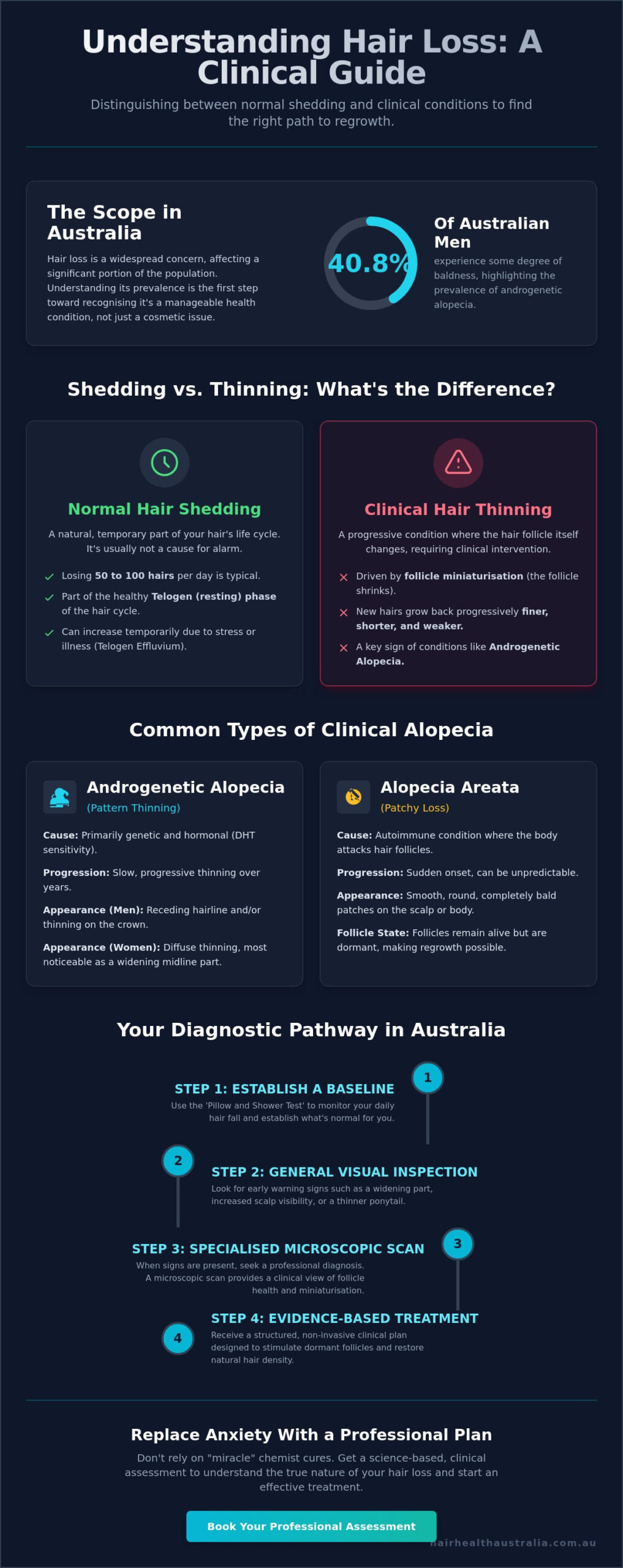
The primary challenge for most Australians is distinguishing between normal hair shedding and the early stages of a clinical condition. Everyone loses between 50 and 100 hairs a day as part of a healthy growth cycle. However, when the rate of loss exceeds the rate of regrowth, or when the new hairs emerge thinner and weaker, you’ve moved from shedding into the territory of thinning. Early intervention is vital. Once a hair follicle has completely miniaturised and become dormant for several years, it’s significantly more difficult to revive. Acting while the follicle is still active ensures a much higher success rate for clinical treatments.
The Difference Between Shedding and Thinning
Your hair follows a specific rhythm: the Anagen (growth) phase, the Catagen (transition) phase, and the Telogen (resting) phase. A condition called Telogen Effluvium often causes sudden, heavy shedding due to stress or illness. While alarming, this is usually temporary. True thinning is different. It’s driven by miniaturisation, a process where the follicle gradually shrinks. Over several cycles, the hair becomes finer, shorter, and less pigmented. This is the hallmark of androgenetic alopecia, and it requires a targeted clinical approach to reverse the shrinking process before the follicle ceases production entirely.
Why Terminology Matters for Your Treatment
Using the correct clinical terms shifts the focus from a cosmetic “flaw” to a manageable health condition. Many people waste hundreds of dollars on “thickening” shampoos that only coat the hair shaft without addressing the underlying biology. A stylist can help you hide the problem with a clever cut, but they can’t treat the follicle. Distinguishing between general thinning and specific conditions like Alopecia areata allows for a customised treatment plan. A professional diagnosis ensures you aren’t guessing with your health. It provides a clear, evidence-based roadmap that identifies exactly why your hair is changing and what can be done to stabilise and restore it.
The Different Faces of Alopecia: From Pattern Thinning to Patchy Loss
Identifying the specific cause of your hair loss is the cornerstone of effective treatment. While many people use the term “alopecia” to describe any form of balding, there are distinct Types of Hair Loss that require vastly different clinical approaches. Understanding whether you’re dealing with a genetic predisposition or an autoimmune response is essential for a successful recovery. It’s not just about the hair you lose; it’s about the biological mechanism behind the loss.
Androgenetic Alopecia: The “Pattern” of Thinning
This is the most prevalent form of hair thinning alopecia globally. In Australia, it affects roughly 40.8% of men and up to 56% of women over the age of 70. It’s primarily driven by a hormone called Dihydrotestosterone (DHT). This hormone binds to follicles, causing them to shrink and produce thinner, shorter hair over time. Men usually notice a receding hairline or a thinning crown. Women typically experience a general widening of the midline part, though the frontal hairline often remains intact. While it’s a progressive condition, it’s highly responsive to early clinical intervention and consistent management.
Alopecia Areata: When the Immune System Interferes
Unlike the slow progression of pattern loss, this type presents as sudden, smooth, circular patches. It’s an autoimmune condition where the body’s immune system mistakenly attacks the hair follicles. Triggers often include extreme stress, viral infections, or significant lifestyle changes. It’s a distressing experience, but there’s a silver lining: the follicles usually remain alive. They’re simply in a state of suspended animation. With the right clinical support, these follicles can be encouraged to re-enter the growth phase and produce healthy hair once again.
Beyond these common types, we also see Traction Alopecia, which is caused by repeated tension from tight hairstyles like braids or buns. If caught early, this is entirely reversible by changing styling habits. However, Scarring Alopecia (Cicatricial) is a more serious medical concern where inflammation destroys the follicle and replaces it with scar tissue. This type requires urgent medical attention to prevent permanent loss. Because the symptoms of these conditions can overlap, getting a professional assessment for male or female hair loss treatment is the only way to ensure you’re on the right path to regrowth.
Recognising the Early Warning Signs of Hair Loss
Catching the transition from healthy growth to active thinning requires more than a casual glance in the mirror. While we’ve established that losing some hair daily is normal, identifying the specific markers of hair thinning alopecia early can be the difference between successful restoration and permanent loss. Most people notice a change in how their hair “behaves” long before they see visible bald patches. Your hair might feel limp, struggle to hold its usual style, or seem unusually flyaway. These subtle shifts in texture often signal that the follicles are starting to miniaturise, producing weaker strands that lack their former vigour.
To determine if your shedding is cause for concern, you can perform a simple “Pillow and Shower Test” over the course of a week. While losing 50 to 100 hairs a day is biologically standard, finding large clumps on your pillowcase or a significantly clogged drain every single morning is a red flag. If you can consistently pull more than six strands away by gently running your fingers through a small section of hair, it’s time to move beyond chemist-bought shampoos and seek a clinical assessment. This persistent loss suggests that your growth cycle has been disrupted, moving too many hairs into the resting phase simultaneously.
Visual Indicators for Men and Women
The physical presentation of thinning varies significantly between the sexes, yet the underlying urgency remains the same. For men, the earliest sign is often a slight recession at the temples, creating a subtle “M-shape” hairline that gradually deepens. You might also notice the hair at the crown becoming sparser when viewed under bright bathroom lights. For women, the most reliable indicator is a widening midline part. If your scalp is becoming more visible when you style your hair, or if your ponytail feels noticeably lighter and requires an extra turn of the hair tie, these are clear symptoms of volume loss that warrant professional attention.
Scalp Health and Its Role in Alopecia
We often use the analogy that healthy hair is like healthy grass; it requires nutrient-rich “soil” to thrive. A scalp that is chronically oily, itchy, or prone to redness is often a scalp in distress. Excessive sebum production can sometimes accompany hormonal thinning, while persistent itching or scaling might indicate inflammation that actively hinders follicle function. Ignoring these surface-level symptoms can compromise follicle longevity. By addressing scalp health alongside targeted treatments, you create an optimal environment for regrowth. Identifying these warning signs early allows you to take decisive action before the follicles lose their capacity to produce hair entirely.
Navigating the Diagnostic Process in Australia
Most Australians start their journey by booking a standard appointment with their local GP. It’s a logical first step. A doctor will typically perform a visual inspection and may organise blood tests to rule out underlying physiological triggers. Common culprits include iron deficiency, particularly low ferritin levels, or thyroid imbalances. These systemic issues can mimic the symptoms of hair thinning alopecia, so clearing them from the diagnostic picture is essential. However, a standard GP consultation is often limited to what the naked eye can see, which may not be enough to identify the early stages of follicle miniaturisation.
The average cost of an initial dermatologist consultation in Australia is approximately $230.22, and while a GP referral can help you access a Medicare rebate, the wait times for specialists can be significant. This is why many people seeking faster clarity opt for a dedicated clinical hair health check. Unlike a general check-up, a specialised assessment focuses entirely on the scalp environment and follicle function. It moves beyond “wait and see” by using advanced diagnostic tools that provide a microscopic view of what’s happening beneath the surface. Understanding what to expect from this process is easier when you know what a qualified hair specialist does and how to find the right clinical support for regrowth.
The Power of Microscopic Hair Analysis
Digital trichoscopy is a non-invasive scanning technique that allows us to examine your scalp at high magnification. While a visual inspection might suggest your hair is simply “thinning,” microscopic analysis can identify the specific percentage of follicles that are shrinking or entering a dormant state. Microscopic analysis can detect hair loss up to 5 years before it becomes obvious to the naked eye. By measuring hair diameter and follicle density at a cellular level, we can establish a clinical baseline. This data is vital for tracking the progress of your treatment and ensuring the chosen path is actually working.
Questions to Ask Your Specialist
When you sit down for your assessment, it’s important to move beyond generalities. You should feel empowered to ask specific questions about your condition. Consider asking: Is my hair loss permanent or temporary? What percentage of my follicles are currently in the dormant phase? What are the non-surgical options available for my specific diagnosis? These answers provide the professional clarity needed to reduce anxiety and build a realistic expectation for regrowth. If you’re ready to stop guessing and start a science-based recovery, you can book a professional assessment for male or female hair loss treatment to get a definitive answer.
Modern Clinical Approaches to Managing Alopecia and Thinning
The era of simply accepting hair loss as an inevitable consequence of ageing or genetics has ended. We’ve seen a significant shift toward non-invasive, clinically-backed regrowth programmes that prioritises follicle health over temporary cosmetic fixes. The Australian hair loss treatment market was valued at USD 145.2 million in 2025, reflecting a growing demand for sophisticated, science-based interventions. This surge in interest is driven by a move away from the “miracle” cures sold at chemists and toward professional, individual-centric care. Managing hair thinning alopecia today is about precision; it’s about understanding the specific biological triggers of your condition and addressing them with systematic, evidence-based therapy. For a deeper understanding of how these strategies are applied in practice, our guide on alopecia management and clinical approaches to hair loss outlines the latest evidence-based treatments tailored to the Australian context.
At Hair Health Australia, we recognise that a one-size-fits-all approach rarely delivers the results patients deserve. A treatment that works for a receding hairline in a man may not be suitable for a woman experiencing diffuse thinning across the crown. Our Sydney-based specialists focus on creating a customised roadmap for every individual. By combining clinical expertise with modern technology, we aim to stabilise active loss and create the optimal environment for new growth. This professional clarity replaces the uncertainty of trial-and-error with a structured path toward restoration.
Non-Surgical Regrowth Science
The core objective of modern clinical therapy is the stimulation of dormant follicles. When follicles miniaturise due to androgenetic factors or environmental stress, they don’t disappear immediately; they simply stop producing robust hair. Our non-surgical programmes focus on waking up these dormant hairs through a combination of topical agents and clinical-grade scalp therapy. Consistency is the foundation of any successful clinical programme. By adhering to a methodical routine and participating in regular professional monitoring, patients can see a measurable increase in hair density without the need for invasive procedures. We focus on the long-term health of the scalp, ensuring the “soil” is nutrient-rich enough to support the “grass.”
Taking the First Step Toward Restoration
Reclaiming your hair health offers a profound psychological benefit. It moves you from a position of worry to one of empowerment. When you understand the clinical nature of your condition, the fear of permanent baldness begins to fade. You can Discover our Female Hair Loss Treatment options to see how we specifically address the unique patterns of thinning in women. If you’re ready to move beyond guesswork, the next step is a comprehensive diagnostic assessment at our Sydney clinic. Our specialists will provide the professional clarity you need to start your journey with confidence. Don’t wait for the loss to become obvious to everyone else. Book Your Professional Hair Assessment Today and take the first definitive step toward restoring your natural density.
Reclaiming Your Hair Health with Clinical Precision
Distinguishing between temporary shedding and the progressive nature of hair thinning alopecia is the most important step you can take for your scalp health. We’ve explored how identifying early warning signs and seeking a precise diagnosis can prevent the permanent loss of active follicles. Rather than relying on generic chemist solutions that often under-deliver, a clinical approach provides a roadmap tailored to your specific biological needs. It’s about moving from uncertainty to a structured, science-based plan for restoration.
With over 15 years of clinical experience in Sydney, our team utilises expert microscopic diagnostic technology to identify miniaturisation before it’s visible in the mirror. We specialise in non-surgical regrowth programmes designed to stimulate dormant follicles and restore natural density. If you’re ready to stop guessing about your hair loss and start a professional recovery journey, we’re here to guide you. Book a Clinical Hair Assessment at our Sydney Centre to secure a definitive diagnosis and a clear path forward. You don’t have to navigate this journey alone; professional clarity and evidence-based care are within reach.
Frequently Asked Questions
Is alopecia the same as permanent balding?
No, alopecia is the general medical term for all types of hair loss and does not always result in permanent baldness. Some forms, such as telogen effluvium, are temporary and reversible once the underlying cause is addressed. Other types, like androgenetic hair loss, are progressive but can be managed and stabilised with the right clinical intervention before the follicles become permanently dormant.
Can stress actually cause my hair to thin or fall out?
Yes, significant physical or emotional stress can trigger a condition called telogen effluvium. This causes a large number of follicles to enter the resting phase simultaneously, leading to noticeable shedding a few months after the stressful event. While this is different from the gradual miniaturisation seen in hair thinning alopecia, persistent stress can exacerbate existing genetic thinning if it isn’t managed effectively.
How do I know if my hair thinning is caused by hormones or genetics?
Genetic thinning typically follows a predictable pattern, such as a receding hairline in men or a widening part in women. Hormonal thinning, often linked to thyroid imbalances or pregnancy, tends to be more diffuse and affects the entire scalp. A clinical assessment using microscopic scanning is the only definitive way to identify whether DHT or systemic hormonal changes are driving your hair loss.
Does Medicare cover hair loss treatments in Australia?
Medicare provides rebates for dermatologist consultations if you have a valid referral from your GP. However, it does not typically cover the cost of the treatments themselves, such as medications or clinical regrowth programmes, as these are often classified as cosmetic. You should check with your private health insurer to see if your specific policy provides any coverage for medically diagnosed hair conditions.
Is it possible to regrow hair after an alopecia diagnosis?
Yes, regrowth is often possible if the hair follicles are still active and have not yet been replaced by scar tissue. Conditions like hair thinning alopecia and alopecia areata are particularly responsive to non-surgical clinical treatments. By using targeted stimulation to wake up dormant follicles, we can often restore density and improve the overall health of the hair shaft.
What is the difference between a hair specialist and a dermatologist for hair loss?
A dermatologist is a medical doctor who treats all conditions related to the skin, hair, and nails. A clinical hair specialist focuses exclusively on the biology of the scalp and the restoration of follicle function. While both can provide a diagnosis, a specialist centre often provides more intensive, non-surgical regrowth programmes and frequent monitoring to track the progress of your treatment over time.
How often should I wash my hair if I am noticing thinning?
You should maintain a regular washing routine, usually two to three times a week, to keep the scalp free from excess oil and debris. Many people stop washing their hair as frequently because they fear the shedding they see in the shower. In reality, a clean scalp environment is essential for follicle health and ensures that any topical clinical treatments can be absorbed effectively.
Can wearing hats or helmets cause traction alopecia?
No, wearing hats or helmets does not cause traction alopecia because they do not apply constant, pulling tension to the hair roots. Traction alopecia is caused by tight hairstyles like braids, extensions, or very high ponytails that physically pull the hair from the follicle. While a dirty hat might cause scalp irritation, it will not lead to the clinical miniaturisation associated with permanent hair loss.