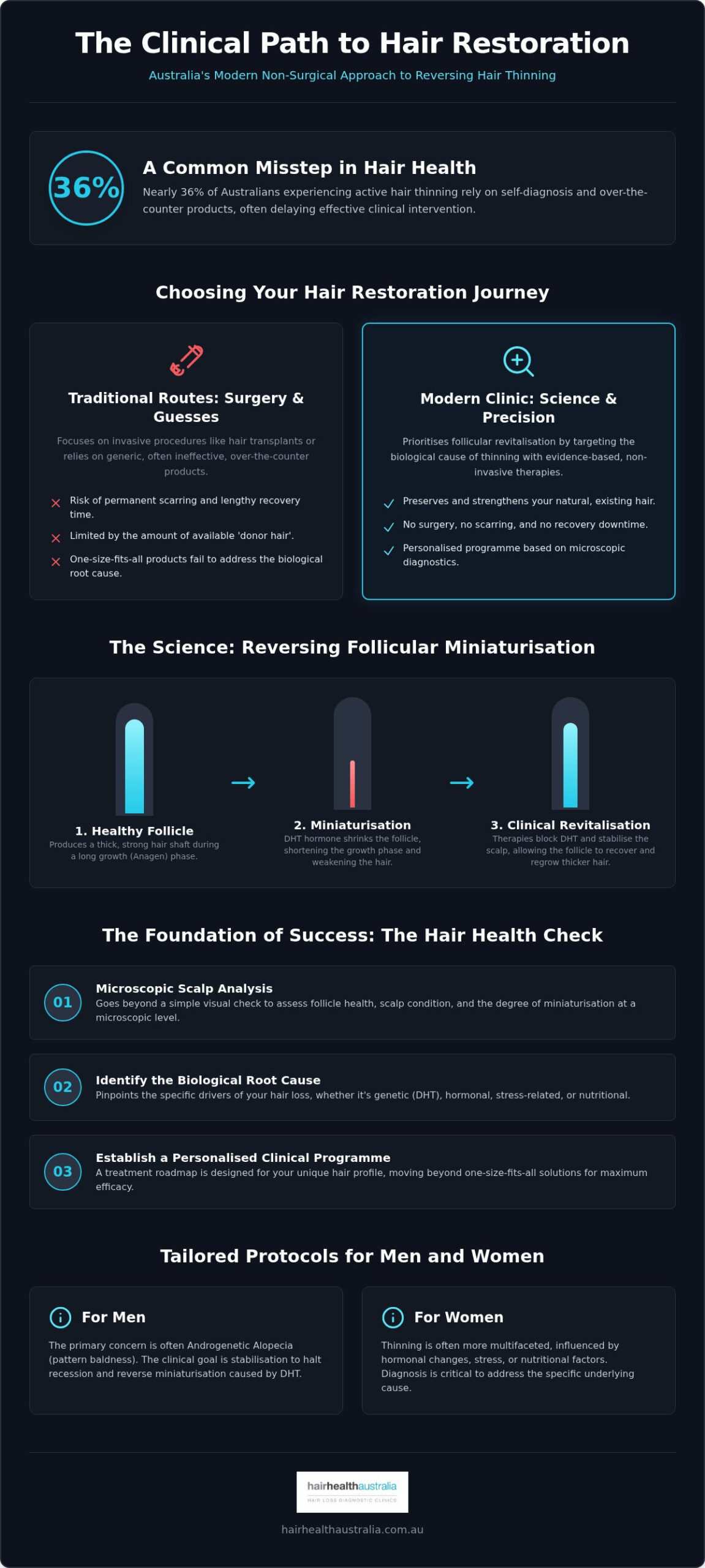
Nearly 36% of Australians experiencing active thinning currently rely on self-diagnosis rather than seeking professional clinical advice. It’s understandable why you might feel hesitant to take the next step. You’ve likely spent months navigating a sea of conflicting online advice or trialling over-the-counter shampoos that promised much but delivered little. If the fear of invasive surgery or permanent scarring has kept you from visiting a non-surgical hair loss clinic Australia, you aren’t alone. Most people simply want a solution that is grounded in science, not a scalpel.
We’re here to show you that restoring your hair density doesn’t require a trip to the operating theatre. This guide demonstrates how advanced clinical diagnostics and non-invasive protocols can revitalise your scalp health through a structured, evidence-based approach. You’ll learn how a comprehensive Hair Health Check identifies the biological root cause of your thinning. Following this, we explore the personalised clinical roadmaps available in 2026 that move beyond one-size-fits-all treatments. By the end, you’ll have the clarity needed to reclaim your confidence with a plan designed specifically for your unique hair profile.
Key Takeaways
- Understand why a professional non-surgical hair loss clinic Australia prioritises microscopic scalp analysis over simple visual checks to identify the biological root cause of thinning.
- Learn how modern clinical protocols work to reverse follicle miniaturisation and manage the impact of DHT without the risks or recovery time associated with surgery.
- Discover why preserving your natural hair is vital and how non-invasive methods bypass the ‘donor hair’ limitations often found in traditional transplant procedures.
- Identify the essential steps of a ‘Hair Health Check’ to establish a personalised, science-backed programme for restoring your hair density and confidence.
Defining the Modern Non-Surgical Hair Loss Clinic in Australia
A modern non-surgical hair loss clinic Australia represents a significant departure from traditional hair transplant facilities. While surgery focuses on the redistribution of hair follicles from a donor site to a thinning area, a clinical non-surgical approach prioritises follicular revitalisation. This means working with the hair you still have to improve its diameter, health, and longevity. Non-surgical hair restoration is a clinical protocol targeting the biological root causes of thinning.
Understanding the Australian regulatory landscape is essential for any patient. The Therapeutic Goods Administration (TGA) oversees the safety and efficacy of medical devices and treatments used in these clinics. There is a clear distinction between ‘cosmetic’ hair centres, which often focus on styling or temporary camouflage, and ‘clinical’ hair loss specialists who employ the Clinical Science of Hair Restoration. Clinical specialists use evidence-based data to guide their patients through a systematic recovery process.
The Shift Toward Non-Invasive Clinical Care
In 2026, we’re seeing a marked shift as more Australians choose clinical programmes over invasive surgery. This preference stems from a desire for professional oversight without the risks of scarring or lengthy surgical recovery. These clinics effectively bridge the gap between generic over-the-counter pharmacy products and the operating table. By providing a structured environment for managing pattern baldness, clinicians can help patients stabilise their condition before it reaches a stage where surgery is the only remaining option.
Specialised Protocols for Men vs. Women
Effective treatment requires an understanding that hair loss doesn’t present the same way for everyone. For men, the primary concern is usually Androgenetic Alopecia, which requires clinical stabilisation to prevent further recession. For women, thinning is often more multifaceted, influenced by hormonal changes, stress, or nutritional factors. Identifying the specific type of loss is the most critical step. This is why a comprehensive Hair Health Check is utilised to ensure that every programme is tailored to the individual’s biological needs rather than a generic template. This diagnostic precision ensures that the chosen protocol addresses the actual cause of the thinning.
The Clinical Science of Non-Invasive Hair Restoration
The biological process of hair loss is often misunderstood as a sudden event. In reality, it’s a gradual decline known as follicular miniaturisation. At a non-surgical hair loss clinic Australia, clinicians focus on halting this progression by addressing the micro-environment of the scalp. When the scalp’s health is compromised by inflammation, excess sebum, or poor circulation, the hair follicles struggle to receive the nutrients required for robust growth. Evidence-based clinical therapies work to stabilise this environment, ensuring that the hair cycle remains productive and sustainable over the long term. This combined approach targets the follicle from multiple angles, ensuring that both the internal biological triggers and external scalp conditions are optimised for restoration.
Addressing DHT and Follicular Miniaturisation
Genetic thinning is primarily driven by Dihydrotestosterone (DHT), a hormone that causes follicles to shrink over time. Clinical blockers and stimulants work together to stop the thinning cycle by shielding the follicle and encouraging cellular activity. Miniaturisation is a reversible process if caught before the follicle becomes dormant. By intervening during the early stages of this decline, clinicians can extend the Anagen (growth) phase of the hair cycle. This extension is vital. It prevents the hair from entering the resting phase prematurely, which is the defining characteristic of pattern thinning. Once the growth phase is lengthened, the hair has the time it needs to gain diameter and strength.
Advanced Delivery Systems for Regrowth
Many Australians attempt to manage hair loss with “DIY” pharmacy products, but these often yield disappointing results. The reason for this failure is usually poor absorption rather than the product itself. Professional clinical application outperforms at-home treatments because it incorporates medical-grade scalp preparation. This preparation involves deep-cleansing techniques that remove the barrier of keratinised skin and debris that would otherwise block topical treatments from reaching the follicle’s root. Systematic monitoring is also a key differentiator of a professional non-surgical hair loss clinic Australia. By using microscopic data to track progress every few months, clinicians can adjust the protocol in real-time based on how your scalp is responding. To determine which stage of this cycle your follicles are currently in, a professional assessment of your scalp health is the logical starting point.
Non-Surgical Protocols vs. Hair Transplants: A Clinical Framework
Choosing between clinical programmes and surgical intervention requires a clear understanding of your long-term hair goals. Surgery is essentially a redistribution of existing follicles from a donor site to a thinning area. It is a “plug-and-play” approach that provides coverage but does not address the underlying biology. In contrast, a non-surgical hair loss clinic Australia focuses on biological restoration. This path aims to keep your original hair healthy and active, rather than simply moving it from one part of the scalp to another.
One of the most significant differences lies in recovery and lifestyle impact. Surgical procedures involve anaesthesia, incisions, and often weeks of visible healing or downtime. Clinical non-surgical protocols allow for an immediate return to work and daily activities. More importantly, we must consider the limitation of “donor hair”. Every individual has a finite amount of hair available for transplanting. If you exhaust this supply early without stabilising your natural hair loss, you may find yourself with patchy results as your native hair continues to thin around the transplanted grafts. Preserving your existing hair is not just an alternative to surgery; it is a vital prerequisite for any long-term success.
Assessing Risk, Downtime, and Longevity
The reality of surgical scarring is a permanent consideration. While modern techniques are refined, the non-invasive nature of clinical therapy removes this risk entirely. It is a common misconception that surgery is a permanent fix that stops hair loss for good. Surgery does not stop the progression of genetic thinning in the surrounding, non-transplanted follicles. Consequently, most surgical patients still require ongoing non-surgical treatment to maintain their results and prevent a “halo” of thinning from forming behind the new hairline. Clinical therapy provides the stabilisation that surgery cannot offer on its own.
Who is the Ideal Candidate for Non-Surgical Therapy?
The most successful outcomes are typically seen in individuals with early to mid-stage thinning. At this point, the follicles are still viable and capable of being revitalised through targeted clinical intervention. Younger patients, in particular, are often better suited for non-surgical stabilisation first. Starting a programme early preserves the maximum amount of natural density and keeps surgical options open as a last resort in the future. For a deeper look at specific clinical options, you can explore our guide on the Best Hair Regrowth Treatment Australia 2026. This resource helps you align your expectations with the most effective science-backed protocols available today.
Microscopic Diagnostics: The Foundation of Non-Surgical Success
A visual inspection is simply insufficient for a professional hair loss diagnosis. While a mirror might show thinning, it doesn’t reveal the biological status of the underlying follicles. A reputable non-surgical hair loss clinic Australia relies on microscopic data to determine if a follicle is merely miniaturised or completely dormant. This distinction is vital; it determines whether a non-invasive protocol can still revitalise the hair or if the window for regrowth has closed. Without this level of detail, any treatment plan is based on guesswork rather than clinical evidence.
What to Expect During Your Hair Health Check
The process begins with a comprehensive history taking to understand your specific concerns and health background. This is followed by high-magnification scalp imaging, which allows clinicians to view your scalp at a level of detail invisible to the naked eye. During this phase, we analyse three primary indicators: follicle density, hair shaft thickness, and scalp inflammation levels. By looking at the ratio of terminal hairs to miniaturised vellus hairs, we can determine the current stage of your hair loss cycle. High inflammation or sebum buildup can often be a hidden contributor to thinning that a standard consultation would miss. These microscopic insights inform the creation of a personalised restoration programme that targets your specific biological needs. You can book your Hair Health Check to begin this diagnostic journey.
Setting Realistic Milestones for Regrowth
Data from the initial scan serves as a predictive tool. It helps our team provide an honest assessment of the level of regrowth you can realistically expect. In a clinical setting, we prioritise systematic monitoring through 3-month and 6-month review cycles. These milestones are essential for tracking the transition of follicles from the resting phase back into the active growth phase. We can see the hair shaft diameter increasing over time through follow-up scans, providing tangible proof of progress. We believe in “straight-talking” honesty; if the data indicates that a specific area is unlikely to respond to non-surgical treatment, we will tell you. This transparency ensures you don’t waste time or resources on protocols that aren’t suited to your current scalp condition. To move beyond uncertainty and secure a science-backed diagnosis, the first step is to arrange a clinical Hair Health Check today.
Choosing Hair Health Australia for Personalised Non-Surgical Care
Selecting the right partner for your hair restoration journey is a decision that impacts both your confidence and your long-term biological health. At Hair Health Australia, we maintain a singular, specialised focus on non-invasive recovery. We don’t perform hair transplant surgery. This distinction is significant; it means our entire clinical framework, from diagnostic technology to patient care, is dedicated to the science of natural regrowth and follicular stabilisation. By removing the surgical option from our service list, we’ve become experts in the protocols that preserve and revitalise your existing hair.
Our “results-first” philosophy ensures that every patient receives a plan tailored to their specific microscopic data. We avoid the one-size-fits-all marketing often found in the hair loss industry, choosing instead to provide realistic expectations based on clinical evidence. From your initial assessment through to long-term density maintenance, our team acts as a dedicated guide. We understand that hair loss is a personal experience, and our approach reflects a balance of medical authority and empathetic understanding. We’re here to replace uncertainty with a clear, science-backed path forward.
Our Sydney Clinical Expertise
Visiting a dedicated non-surgical hair loss clinic Australia offers the advantage of seasoned, local expertise. With over 15 years of specialised experience, our Sydney-based clinical team has refined the process of identifying and treating the root causes of thinning in both men and women. Our Sydney location is designed to provide a discreet, professional environment where you can discuss your concerns with total privacy. For those currently evaluating their options, we recommend reviewing our Choosing a Non-Surgical Hair Loss Clinic in Sydney guide to ensure you’re asking the right questions during your search.
Your Path to Hair Confidence
The transition from frustration to clarity begins with a single, decisive step. Early intervention remains the most effective way to protect your hair density before follicles reach a state of permanent dormancy. By undergoing a professional diagnostic scan, you replace guesswork with a clear, actionable roadmap. This systematic approach ensures that you aren’t just treating symptoms, but actively managing the biological factors driving your hair loss. Reclaiming your confidence is a process of education and precision. We invite you to start your journey with a professional Hair Health Check and discover the potential for restoration that a science-backed, non-surgical approach can provide.
Reclaiming Your Hair Density with Clinical Precision
Restoring your hair doesn’t have to involve the risks of invasive surgery or the uncertainty of over-the-counter products. By choosing a specialised non-surgical hair loss clinic Australia, you’re opting for a diagnostic-led approach that prioritises the biological health of your follicles. With over 15 years of clinical experience, our team uses advanced microscopic diagnostic technology to move beyond visual guesswork. We provide personalised programmes for men and women that focus on revitalising your natural hair density through science-backed protocols.
The foundation of long-term success lies in understanding the root cause of your specific thinning. Whether you’re managing early recession or more advanced thinning, a structured clinical roadmap replaces confusion with clarity. You don’t have to accept hair loss as inevitable; early intervention is the most powerful tool for preservation. It’s time to stop relying on temporary solutions and start a journey toward sustainable results and renewed confidence. We invite you to book your clinical Hair Health Check in Sydney today. Our experts are ready to provide the professional guidance you need to secure your hair’s future.
Frequently Asked Questions
Is non-surgical hair loss treatment permanent in Australia?
Non-surgical treatments aren’t a “one-time” permanent fix because they address an ongoing biological process. Genetic hair loss is progressive, meaning the follicles require continuous support to resist the effects of DHT. While these protocols can successfully stabilise thinning and restore density, the results generally persist only as long as the treatment is maintained. This is why a non-surgical hair loss clinic Australia focuses on sustainable, long-term management plans rather than temporary cosmetic solutions.
How much does a non-surgical hair loss programme cost in Sydney?
The cost of a clinical programme in Sydney depends entirely on the specific requirements of your personalised protocol. Factors such as the stage of thinning, the underlying cause identified during your diagnostic scan, and the combination of therapies required will influence the final investment. Because every scalp is unique, a one-size-fits-all price is often misleading. A comprehensive assessment is the only accurate way to determine the necessary steps and associated costs for your restoration journey.
Can a non-surgical clinic help if I’m already completely bald?
Clinical regrowth treatments are most effective when hair follicles are still active but miniaturised. If an area of the scalp is completely bald and the skin has become smooth and shiny, the follicles have likely reached a state of permanent dormancy or scarring. In these instances, non-surgical revitalisation is usually not possible. A microscopic diagnostic check is essential to determine if there is any viable follicular activity remaining before you begin any clinical programme.
How long does it take to see visible regrowth with clinical treatment?
Visible results typically emerge within three to six months of starting a consistent clinical programme. This timeline aligns with the natural biological hair growth cycle, as it takes time for resting follicles to transition back into the active Anagen phase. Initial changes often include reduced shedding and improved hair shaft diameter. We conduct systematic reviews at these intervals to track microscopic progress and ensure your scalp is responding optimally to the prescribed protocol.
Are non-surgical hair loss treatments covered by Medicare or private health?
In Australia, non-surgical treatments for pattern hair loss are generally considered cosmetic and aren’t subsidised by Medicare. Similarly, most private health insurance providers don’t offer coverage for these clinical regrowth programmes. While some specific medical conditions causing hair loss might have different implications, the vast majority of patients should expect to fund their treatment privately. It’s always best to check with your specific health fund for any exceptions regarding diagnostic consultations.
What is the difference between a trichologist and a hair transplant surgeon?
A trichologist is a specialist focused on the health of the hair and scalp, utilising non-surgical methods to treat thinning and biological disorders. They prioritise preserving and revitalising existing follicles through clinical protocols. A hair transplant surgeon is a medical doctor who performs invasive procedures to redistribute hair from donor areas to thinning sites. While surgeons focus on the physical movement of hair, a non-surgical hair loss clinic Australia focuses on the biological environment and follicular health.
Are there any side effects to clinical hair regrowth programmes?
Clinical hair regrowth programmes are generally non-invasive and well-tolerated, though specific side effects depend on the individual therapies used. Some patients might experience minor scalp irritation or temporary dryness during the initial stages of a programme. Because our protocols are personalised, we monitor your scalp’s reaction closely through regular review cycles. Any potential concerns are addressed by our Sydney clinical team to ensure your treatment remains both comfortable and effective throughout your restoration journey.
Can women receive the same non-surgical treatments as men?
Women can certainly benefit from non-surgical protocols, but their treatment plans are often tailored differently to those for men. Female hair thinning is frequently influenced by a complex mix of hormonal, nutritional, and stress-related factors. While some clinical tools are shared, the concentrations and combinations used in a female-specific programme are adjusted to address these unique biological triggers. A professional diagnostic assessment ensures that the chosen approach is safe and effective for the specific type of thinning present.