What if those sudden, smooth patches on your scalp aren’t just a sign of temporary stress, but a specific signal from your immune system that requires a clinical response rather than a generic pharmacy shampoo? It’s deeply distressing to discover visible gaps in your hair, particularly when you’re caught between the confusion of genetic thinning and the unpredictability of an autoimmune condition. Finding effective alopecia areata treatment Australia wide often feels like a cycle of trial and error that leaves you more anxious than when you started. You’ve likely felt the frustration of products that promise the world but deliver very little, alongside a genuine fear that invasive surgery might be your only remaining option.
We understand that you’re looking for more than a quick fix; you need a definitive clinical path forward. This 2026 recovery guide provides that clarity by combining expert insights with the latest non-surgical regrowth programmes available in Sydney. We’ll show you how advanced diagnostic technology, including microscopic scanning at 200x magnification, replaces visual guesswork with data-driven evidence. By the end of this guide, you’ll understand how a personalised, systematic approach can help manage your condition and restore both your hair density and your confidence without the need for a transplant.
Key Takeaways
- Learn why visual inspection alone is insufficient and how 200x microscopic scanning identifies the true state of your follicle health.
- Understand the critical differences between genetic thinning and autoimmune conditions to ensure you receive the correct clinical path forward.
- Discover how personalised, non-surgical regrowth protocols provide a modern approach to alopecia areata treatment Australia wide, focusing on dormant follicle stimulation.
- Identify the essential role of the Hair Health Check in creating a customised recovery plan tailored to your specific hair loss type and scalp environment.
- Gain clarity on how clinical advancements in 2026 are helping Australians restore hair density and confidence through evidence-based, non-surgical care.
Understanding Alopecia: More Than Just a Medical Term
Alopecia is a word that carries significant weight, yet many Australians don’t realise it’s actually a broad medical umbrella term rather than a specific condition. It simply translates to hair loss. Whether you’re noticing a receding hairline, general thinning, or distinct circular patches, these all fall under the category of alopecia. In Australia, where an active, outdoor lifestyle is central to our identity, the sudden loss of hair can feel like a direct hit to your confidence and social ease. It’s about more than just aesthetics; it’s about how you feel when you step out into the sun or meet friends at a local café.
Too often, individuals attempt to self-diagnose using internet forums or social media. This usually leads to a cycle of purchasing expensive, ineffective pharmacy shampoos that only address surface-level symptoms. Clinical success relies on identifying the root cause. Is it a temporary shedding event, or is it the beginning of permanent follicle miniaturisation? Without a professional assessment, you’re essentially guessing with your health and your wallet. Accuracy in diagnosis is the only way to move from uncertainty to a clear path of recovery.
The Clinical Difference Between Alopecia Types
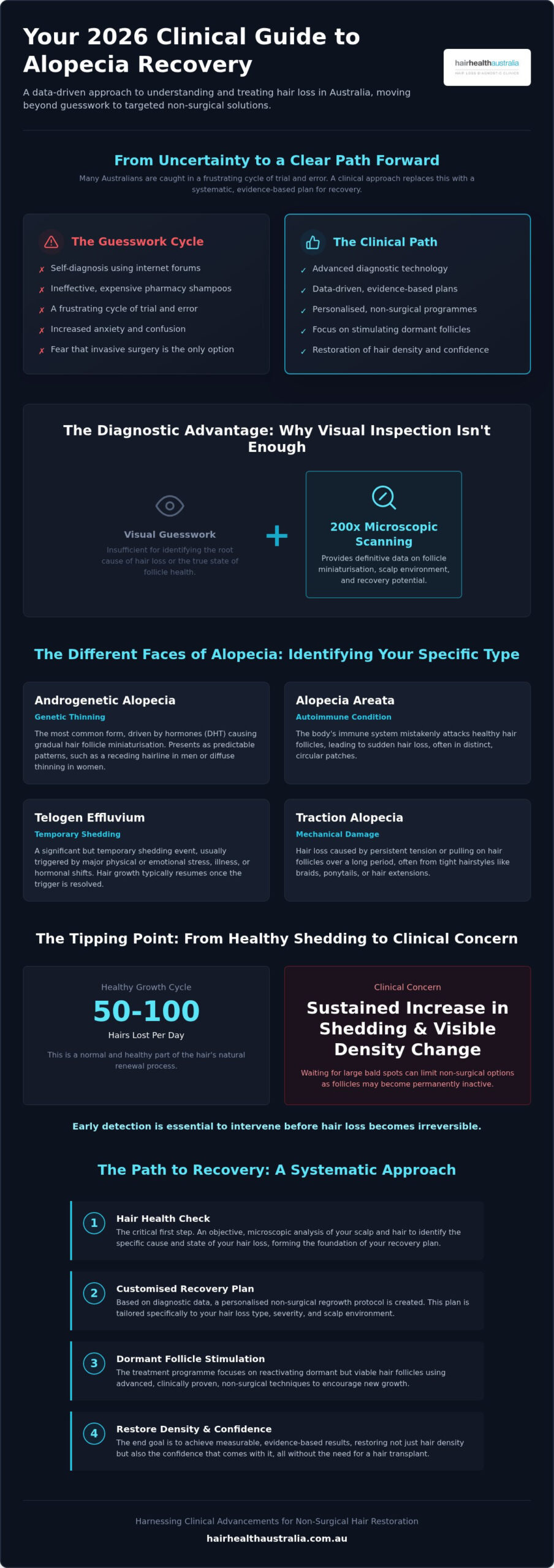
It’s vital to distinguish between androgenetic alopecia (genetic thinning) and Understanding Alopecia Areata, which is an autoimmune condition. While the former is a gradual process, the latter involves the immune system mistakenly attacking healthy hair follicles, often resulting in sudden, patchy loss. Australian specialists categorise these conditions by their underlying biological triggers and severity. Moving past the stigma of hair loss is a clinical necessity. The sooner you identify the specific type, the more effective your alopecia areata treatment Australia protocol will be.
When Your Hair Loss Becomes a Clinical Concern
Most people lose between 50 and 100 hairs a day as part of a healthy growth cycle. The tipping point occurs when you notice a sustained increase in shedding or visible changes to your scalp’s density. Waiting for large, visible bald spots to appear can limit your non-surgical recovery options, as dormant follicles eventually lose the ability to be reactivated. A specialised hair clinic provides the early detection needed to intervene before the loss becomes irreversible. Starting with a Hair Health Check allows for a clear, objective analysis of your scalp environment, ensuring your alopecia areata treatment Australia plan is based on data, not hope.
The Different Faces of Alopecia: Identifying Your Specific Type
Identifying the specific mechanism behind your hair loss is the most critical step in securing a successful recovery. While the term ‘alopecia’ is broad, the conditions it describes are diverse and require distinct clinical approaches. For many Australians, the journey begins with distinguishing between gradual thinning and sudden, patchy loss. Understanding these nuances ensures that your alopecia areata treatment Australia plan is accurately targeted to your biological needs.
The four most common types encountered in a clinical setting include:
- Androgenetic Alopecia: The most prevalent form of genetic thinning, affecting both men and women through a process of follicle miniaturisation.
- Alopecia Areata: An autoimmune condition where the body’s immune system mistakenly attacks healthy hair follicles, often resulting in distinct, circular patches.
- Telogen Effluvium: A temporary but significant shedding event usually triggered by physical or emotional stress, illness, or hormonal shifts.
- Traction Alopecia: Damage caused by persistent tension on the hair follicle, often from tight hairstyles or extensions.
Pattern Thinning in Men and Women
Androgenetic alopecia presents differently depending on your biology. In men, it typically follows a predictable pattern of a receding hairline or thinning at the crown. For women, it often manifests as a general diffuse thinning across the top of the scalp, while the front hairline remains intact. The primary driver here is Dihydrotestosterone (DHT), a hormone that causes follicles to shrink over time. Without intervention, these follicles eventually stop producing visible hair. Early detection is vital. Once a follicle has completely miniaturised, non-surgical recovery becomes significantly more challenging. Determining your current stage of thinning through a professional Hair Health Check is the most effective way to protect your existing density.
Autoimmune and Inflammatory Conditions
When the immune system becomes overactive, it can disrupt the hair’s natural growth cycle. In the case of alopecia areata, white blood cells surround and attack the bulb of the hair follicle, causing the hair to fall out prematurely. For those seeking support and community resources, the Australia Alopecia Areata Foundation provides invaluable assistance for patients navigating this unpredictable condition. We are also seeing a rise in Frontal Fibrosing Alopecia among post-menopausal Australian women. This is an inflammatory condition that causes a slow recession of the hairline and can lead to permanent scarring if left untreated. Distinguishing between reversible loss and scarring is a clinical priority, as it dictates the potential for successful alopecia areata treatment Australia and long-term regrowth.
The Diagnostic Advantage: Why Microscopic Scanning is Essential
Visual inspection is the traditional starting point for most hair loss consultations, but it remains fundamentally subjective. While Australian Government Information on Alopecia provides a solid foundation for understanding general symptoms, a naked-eye examination cannot reveal what’s happening beneath the surface of the scalp. Relying solely on what a practitioner can see during a standard check-up often leads to a delayed diagnosis. By the time thinning is visible to the naked eye, you may have already lost up to 50% of your hair density in that specific area. This is why a shift toward objective, data-driven analysis is vital for anyone seeking effective alopecia areata treatment Australia.
Microscopic analysis allows us to evaluate the scalp environment and individual follicle health with clinical precision. We focus on the ratio between terminal hairs, which are thick and healthy, and miniaturised hairs, which are fine, wispy, and struggling to grow. Identifying this ratio is the only way to provide an accurate prognosis. It tells us whether a follicle is simply dormant and capable of being reactivated, or if it has reached a stage of permanent miniaturisation. This level of detail ensures your recovery programme is built on biological facts rather than optimistic guesswork.
What to Expect During a Microscopic Hair Health Check
At our Sydney centre, the diagnostic process is entirely non-invasive and highly educational. We utilise specialised microscopic scanning technology to visualise your scalp at 200x magnification. This allows you to see ‘invisible’ thinning and early signs of inflammation that aren’t apparent in a mirror. During the session, we examine the hair bulb, the scalp’s oil production levels, and the presence of any follicular blockages. It’s a transparent process where you see the same data as the specialist. If you’re ready to move beyond visual guesswork, you can organise your microscopic hair analysis in Sydney to establish a clear baseline for your recovery.
Developing a Data-Driven Recovery Plan
Once we have gathered microscopic evidence, we can predict future loss patterns with a high degree of accuracy. This data allows us to set realistic expectations for your alopecia areata treatment Australia journey. We don’t believe in ‘one-size-fits-all’ pharmacy treatments because they don’t account for your unique scalp biology. Clinical evidence proves that a targeted approach, which addresses the specific needs of your follicles, delivers far more consistent results than generic topical solutions. By understanding exactly which follicles are viable, we can design a personalised regrowth programme that focuses your efforts where they will have the most significant impact on your hair density.
Non-Surgical Clinical Strategies for Alopecia Recovery
The approach to hair restoration in Australia is shifting. We’ve observed a significant movement toward clinical regrowth protocols, as more individuals seek to avoid the risks and downtime associated with invasive surgery. For many, the goal is to work with the body’s natural biology rather than resorting to a transplant. These non-surgical strategies focus on biological reactivation. By improving localised blood flow and enhancing nutrient delivery, we can effectively stimulate dormant follicles to re-enter the anagen, or growth, phase of the hair cycle. This multimodal approach is a cornerstone of effective alopecia areata treatment Australia wide, ensuring that the scalp environment is fully optimised for recovery.
Success in hair recovery is rarely the result of a single product. It requires a systematic combination of clinical therapy and disciplined home care. Maintaining these results over the long term involves a commitment to scalp health. Think of it as a fitness programme for your hair; consistency is what prevents future regression and keeps follicles productive. By addressing both the internal triggers and the external environment, we create a sustainable path toward restored hair density.
Stimulating Regrowth Without Invasive Procedures
The science of follicle stimulation centres on increasing cellular energy within the hair bulb. When follicles receive the correct signals and resources, they can overcome the miniaturisation process discussed earlier. Clinical-grade topicals are fundamentally different from standard over-the-counter options found in a local chemist. They often contain higher concentrations of active ingredients and are designed for superior scalp penetration. To understand how these protocols are structured, you can read our Clinical Hair Treatment: A Professional Guide to Non-Surgical Restoration.
Lifestyle and Nutritional Support for Hair Health
Your internal health directly influences the success of any clinical intervention. In the Australian climate, we often see a link between hair health and deficiencies in iron or Vitamin D. Despite our abundance of sunlight, Vitamin D deficiency is surprisingly common and can disrupt the hair growth cycle. Managing stress is also a clinical priority. High cortisol levels can trigger telogen effluvium flare-ups, which may complicate an existing autoimmune condition. Choosing specialised hair care products that support your clinical results is the final piece of the puzzle. The first step toward a multimodal recovery is a comprehensive clinical assessment to identify your specific nutritional and biological needs.
Restoring Your Confidence: The Hair Health Australia Approach in Sydney
At Hair Health Australia, we believe that effective recovery begins with a partner who values precision over marketing hype. Our philosophy is rooted in evidence-based, non-surgical care that prioritises the biological health of your follicles. Since 2009, our Sydney clinic has provided a stable, clinical environment where men and women can access specialised alopecia areata treatment Australia protocols. We don’t offer generic solutions. Instead, we organise every programme around the specific data gathered from your scalp during a 200x magnification scan. This transparency builds trust. It ensures your journey toward visible regrowth is both realistic and sustainable, replacing anxiety with a clear, clinical path forward.
Tailored Programmes for Diverse Hair Loss Needs
Men and women experience hair loss through very different biological lenses. While male pattern baldness is often a direct result of genetic sensitivity to DHT, female hair loss can involve a complex interplay of hormones, nutrition, and environmental stress. You can explore these nuances further in our guide on the Early Signs of Alopecia in Women: A Clinical Guide. Our Sydney specialists focus on the long game. We avoid the “quick fix” trap of temporary cosmetic concealers or ineffective pharmacy products. We aim for genuine, structural hair recovery that lasts. By addressing the unique hormonal and genetic factors at play, we create a customised environment where your hair has the best possible chance to thrive.
Taking the First Step Toward Hair Recovery
Your first consultation at our Sydney centre is a methodical investigation into the current state of your hair health. We use microscopic scanning to document your baseline density and follicle viability. This isn’t a one-off event. We track your progress with follow-up scans, allowing us to adjust your protocol based on actual results. This data-driven approach ensures you’re never left wondering if your treatment is working. Having local Sydney expertise means you have ongoing clinical support throughout your recovery. Our specialists provide the “straight-talking” honesty you need to make informed decisions about your health. If you’re ready to move from uncertainty to action, you can book your professional hair health check in Sydney today. It’s the most effective way to secure a definitive clinical assessment and begin your personalised alopecia areata treatment Australia programme.
Securing Your Clinical Path to Hair Recovery
The journey toward restored hair density doesn’t have to be defined by uncertainty or ineffective pharmacy trials. By moving from visual guesswork to data-driven microscopic analysis, you can finally understand the biological reality of your scalp. We’ve explored how identifying your specific type of hair loss and utilising advanced 200x magnification scanning are the essential first steps for any successful alopecia areata treatment Australia protocol. Since 2009, our Sydney specialists have focused on these non-surgical, clinically-backed methods to help Australians regain their confidence without the need for invasive surgery.
Your recovery depends on a personalised approach that addresses your unique hormonal and genetic profile. Whether you’re dealing with sudden patches or gradual thinning, a systematic regrowth plan offers a modern, evidence-based solution. The most effective way to begin this process is to establish a clear baseline of your follicle health. You can Book Your Professional Hair Health Check in Sydney today to receive a definitive assessment. We’re here to guide you through every stage of your restoration with honesty and clinical precision. You don’t have to face hair loss alone; a clear path back to thicker, healthier hair is within your reach.
Frequently Asked Questions
Is hair loss from alopecia permanent?
Hair loss isn’t always permanent; it depends entirely on the condition of your hair follicles. In cases of alopecia areata, the follicles often remain alive and capable of producing hair if the autoimmune trigger is managed. However, if androgenetic thinning is left untreated for years, follicles can eventually miniaturise and lose their functional capacity. Early intervention is the most effective way to ensure that your recovery remains a non-surgical possibility.
How is alopecia diagnosed in a Sydney hair clinic?
Diagnosis at our Sydney centre involves a sophisticated microscopic analysis at 200x magnification. Unlike a standard visual check from a GP, this technology allows us to see the exact state of your scalp health and follicle viability. We measure the ratio of healthy terminal hairs against thinning miniaturised hairs. This data-driven approach is essential for selecting the most effective alopecia areata treatment Australia protocol for your specific biological needs.
Can stress cause different types of alopecia in Australians?
Stress is a well-documented trigger for several hair loss conditions. It most commonly leads to Telogen Effluvium, where a sudden shock to the system pushes a large percentage of hairs into the shedding phase. For those with a predisposition to autoimmune issues, high cortisol levels can also spark or worsen patches of alopecia areata. Managing your internal environment is just as important as topical clinical care when seeking a long-term recovery.
What is the difference between alopecia areata and androgenetic alopecia?
The primary difference lies in the underlying cause. Alopecia areata is an autoimmune condition where the body’s immune system mistakenly attacks the hair bulb, leading to sudden patches of loss. Androgenetic alopecia is a genetic and hormonal process where follicles slowly shrink over time due to DHT sensitivity. Because the biological mechanisms are so different, they require distinct clinical strategies to reactivate the follicles and restore hair density successfully.
Are there non-surgical treatments for alopecia that actually work?
Yes, non-surgical treatments are highly effective when they are clinical-grade and personalised to the individual. These programmes work by stimulating blood flow, reducing scalp inflammation, and providing dormant follicles with the cellular energy they need to grow. While pharmacy-brand shampoos often provide only superficial benefits, a multimodal alopecia areata treatment Australia plan uses concentrated active ingredients and advanced technology to achieve measurable regrowth without the need for invasive transplant surgery.
How long does it take to see results from a clinical regrowth programme?
You should generally expect to see initial changes within three to six months of starting a clinical programme. Hair growth is a slow physiological process; a single strand only grows about one centimetre per month. The first signs of success usually include a significant reduction in daily shedding and an improvement in overall scalp health. Visible increases in density follow as dormant follicles transition back into the active anagen growth phase.
Does wearing hats or helmets cause traction alopecia?
Wearing hats or helmets doesn’t typically cause traction alopecia unless they are so tight that they pull consistently on the hair roots. Traction alopecia is primarily caused by physical tension from tight braids, ponytails, or hair extensions. However, dirty headwear can lead to scalp irritation or fungal issues, which may impact your overall hair health. It’s best to ensure any protective gear fits correctly and is kept clean to avoid secondary scalp complications.
Can diet and vitamins help with hair loss from alopecia?
Diet and vitamins play a vital supportive role in hair recovery but aren’t usually a standalone cure. Follicles require specific nutrients like Iron, Zinc, and Vitamin D to produce strong hair shafts. In the Australian climate, many individuals are surprisingly deficient in Vitamin D, which can disrupt the hair growth cycle. Addressing these nutritional gaps ensures your body has the raw materials needed to support the results of your specialised clinical treatments.