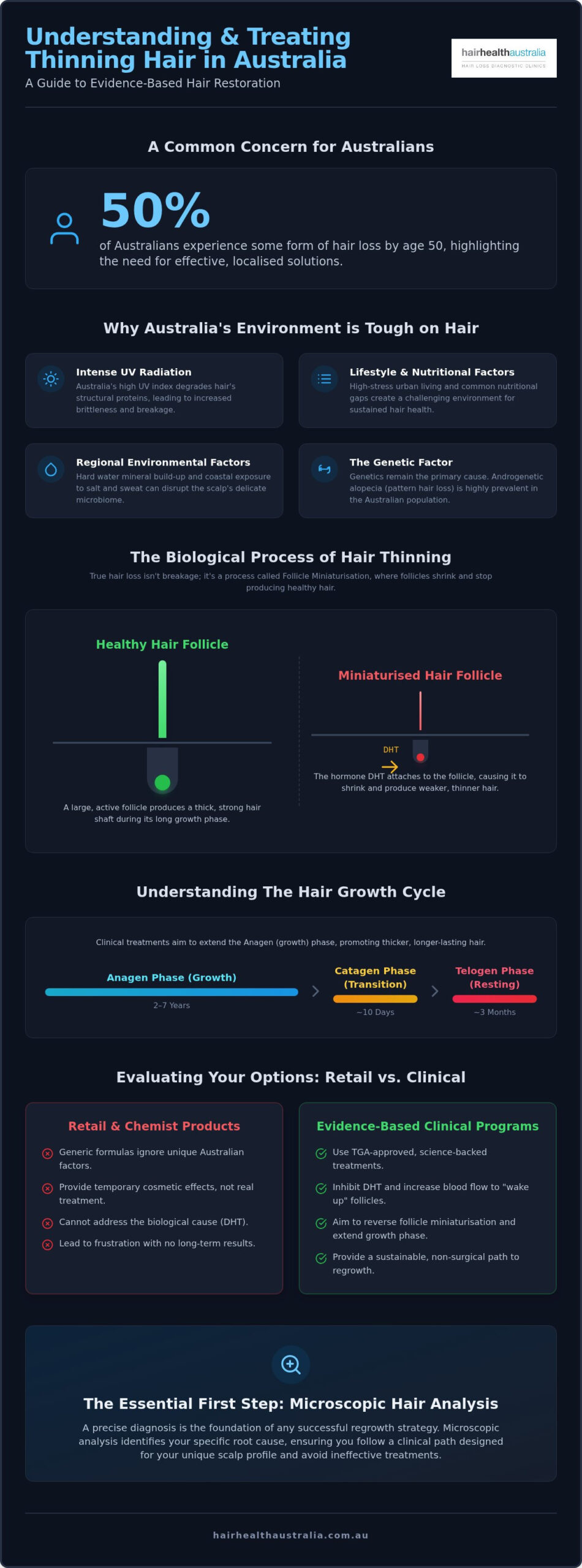
Did you know that approximately 50% of Australians experience some form of hair loss by the age of 50? It’s a staggering figure that highlights why so many people are searching for the best treatment for thinning hair Australia to reclaim their confidence. You’ve likely spent a small fortune on expensive chemist shampoos that failed to deliver, or perhaps you’re feeling overwhelmed by the sheer volume of conflicting advice found online. It’s deeply frustrating to feel like you’re losing control over your appearance while watching your hair density slowly decline.
We understand that the path to restoration should be built on evidence, not empty promises. You’ll learn how science-backed clinical treatments can actually restore your hair density without the risks or costs of invasive surgery. This 2026 guide explores why a professional diagnosis through microscopic follicle mapping is the essential first step to success. We’ll break down the latest TGA-approved options and explain how a personalised, non-surgical approach provides a sustainable path to regaining your natural look.
Key Takeaways
- Understand how the harsh Australian UV index and local lifestyle factors specifically impact hair protein and accelerate the thinning process.
- Identify the biological causes of follicle miniaturisation and the critical role DHT plays in halting natural hair production.
- Compare the limitations of retail products against clinical programs to find the best treatment for thinning hair Australia for your unique needs.
- Learn why microscopic hair analysis is essential for a precise diagnosis and how it forms the foundation of a successful regrowth strategy.
- Explore the benefits of a non-surgical, evidence-based recovery journey designed to restore hair density without the need for invasive procedures.
Understanding Thinning Hair in the Australian Climate
Australia’s UV index is consistently among the highest in the world. This intense radiation doesn’t just affect our skin; it actively degrades the structural proteins within the hair shaft, leading to increased brittleness and breakage. When combined with high-stress urban lifestyles and common nutritional gaps, these factors create a unique set of challenges for hair health. Many people find themselves searching for the best treatment for thinning hair Australia after noticing their density drop following a particularly hot summer or a period of high work stress.
It’s crucial to distinguish between temporary shedding and permanent thinning. Telogen Effluvium is a temporary form of hair loss often triggered by sudden shocks to the system, such as illness or extreme stress. Conversely, permanent thinning is a progressive biological change that requires a clinical response. Generic chemist shampoos often fail the Australian consumer because they’re designed for the average global market, ignoring our specific environmental conditions and the complex biological needs of a thinning scalp.
Environmental Stressors and Scalp Health
Regional factors play a significant role in follicle health across the country. In areas with hard water, mineral deposits can accumulate on the scalp, potentially clogging follicles and hindering growth. Additionally, the typical Australian coastal lifestyle involves frequent exposure to salt water and sweat, which can disrupt the scalp’s delicate microbiome if not managed correctly. Environmental damage from UV rays and pollutants triggers oxidative stress, which directly contributes to the premature onset of follicle miniaturisation by damaging the cellular structures responsible for hair production.
The Genetic Factor: Androgenetic Alopecia
While environmental factors are influential, genetics remain the primary cause of long-term density loss. Pattern hair loss is remarkably prevalent, with data suggesting that roughly 40.8% of Australian men experience some degree of baldness. This condition affects women just as significantly, often manifesting as a widening part or general thinning across the crown. The emotional toll of these changes shouldn’t be underestimated, as many individuals report heightened anxiety regarding their social perception and professional image.
Early intervention is the most critical factor for achieving successful regrowth. Once a follicle has completely miniaturised, non-surgical restoration becomes significantly more difficult. To move beyond the confusion of conflicting online advice, a professional Hair Health Check provides the diagnostic clarity needed to identify your specific root cause. This personalised approach ensures you aren’t wasting time on ineffective products, but rather following a clinical path designed for your unique scalp profile.
The Science of Follicle Recovery: How Regrowth Actually Works
Understanding the biological mechanics of your scalp is the first step toward effective restoration. Finding the best treatment for thinning hair Australia requires looking beneath the surface at how follicles actually function rather than just treating the hair shaft. True regrowth isn’t about coating the hair in silicones to make it look thicker; it’s about addressing the biological shutdown of the follicle itself. While there are several common causes of hair loss, the most frequent culprit is a process called follicle miniaturisation. This occurs when Dihydrotestosterone (DHT) attaches to hair follicles, causing them to shrink over time. As the follicle constricts, it produces thinner, shorter, and more brittle hair until it eventually stops producing hair altogether.
It’s important to distinguish this biological process from simple hair breakage. Breakage happens when the hair shaft snaps due to dryness or chemical damage, whereas actual hair loss occurs at the root level. Clinical treatments work by “waking up” these dormant follicles. By inhibiting DHT and increasing nutrient-rich blood flow to the scalp, non-surgical protocols can often reverse miniaturisation and restart the natural growth cycle.
The Hair Growth Cycle Explained
Hair growth is not a continuous process but a series of distinct phases. The Anagen phase is the active growth period where hair follicles produce new length, typically lasting between two and seven years. This is followed by the Catagen (transition) and Telogen (resting) phases. Clinical protocols are designed to extend the Anagen phase, allowing hair to grow thicker and stay attached for longer. Because of these natural cycles, you won’t see results overnight; it usually takes several months to witness visible changes in density as new hairs emerge from the scalp.
Non-Surgical vs. Surgical Approaches
Non-surgical restoration is increasingly becoming the preferred choice for residents in Sydney and across Australia. While hair transplant surgery is an option, it is often invasive and carries significant costs, with procedures typically ranging from A$11,000 to A$18,000. Furthermore, surgery doesn’t stop the thinning of your original, non-transplanted hair. Non-invasive programs focus on preserving your existing hair while simultaneously stimulating new growth in thinning areas. This holistic approach ensures a more natural transition and sustainable results over the long term. A thorough Hair Health Check can determine if your follicles are merely dormant or permanently lost, ensuring you choose the most effective path forward.
Evaluating Restoration Options: Retail vs. Clinical Programs
Walking through a local chemist often feels like a gamble. You’re met with rows of “growth” shampoos and serums promising rapid results, yet these retail products rarely deliver clinical outcomes. Most supermarket options focus on cosmetic thickening, which involves coating the hair shaft with proteins or polymers to provide a temporary illusion of volume. While this might improve your appearance for a few hours, it does nothing to address the underlying biological causes of thinning. The Better Health Channel explains patterned hair loss as a condition requiring specific clinical intervention rather than just a change in hair care routine.
Many Australians spend years trying different retail brands before realising that the best treatment for thinning hair Australia is a clinically supervised program. Clinical-grade active ingredients are used at much higher concentrations than what’s available on a supermarket shelf. These formulas are also paired with delivery systems designed to penetrate the scalp barrier, reaching the follicle where growth actually begins. Without professional monitoring, it’s impossible to know if your follicles are responding or if your protocol needs adjustment. A specialist tracks your progress and refines your plan, ensuring you aren’t wasting months on a strategy that isn’t working for your specific scalp profile.
The Pitfalls of Over-the-Counter Solutions
Self-diagnosing is one of the biggest risks for the Australian consumer. You might assume your thinning is hereditary, but it could be related to iron deficiencies, scalp inflammation, or environmental stress. Retail products like topical Minoxidil are often used without a broader plan, leading to disappointing results. Without addressing scalp health or DHT levels simultaneously, Minoxidil alone often acts as a temporary band-aid rather than a long-term solution. Using the wrong product for your specific type of hair loss can actually delay effective treatment, allowing further follicle miniaturisation to occur in the meantime.
The Clinical Advantage
Synergistic treatment programs outperform single products because they create an environment where regrowth is possible. This involves preparing the “soil” of the scalp by removing debris and reducing inflammation before applying active stimulants. By combining multiple methods, clinical protocols ensure that every factor inhibiting your hair growth is addressed at once. If you’re looking for a deeper dive into these methodologies, our Best Hair Regrowth Treatment Australia 2026 reference guide provides a detailed breakdown of how these advanced systems work together to restore density. Finding the best treatment for thinning hair Australia means choosing a protocol that treats the scalp as a complex biological system rather than just a surface to be cleaned.
The Secret to Success: Personalised Microscopic Hair Analysis
A simple visual inspection in a bathroom mirror or a general practitioner’s office is often insufficient for determining the cause of density loss. While a physical exam can identify obvious patches, it cannot see the biological changes occurring beneath the scalp’s surface. To find the best treatment for thinning hair Australia, we must look at the follicles under high magnification. This diagnostic approach removes the guesswork, allowing us to see exactly how many hairs are emerging from each pore and the degree of miniaturisation present in individual strands. By identifying these patterns early, we can intervene before a follicle reaches a point where regrowth is no longer biologically possible.
One of the most critical aspects of this analysis is identifying the “dead zone” versus follicles that are merely dormant. If a follicle has completely scarred over, non-surgical treatments will not be effective. However, many people assume their hair is gone forever when the follicles are actually just producing hairs so fine they are invisible to the naked eye. Data-driven diagnostics allow us to target these salvageable follicles with precision, leading to significantly higher success rates. Instead of hoping a generic serum works, you are following a protocol based on the verified health of your own scalp.
What Happens During a Hair Health Check?
During a professional consultation, we use specialised high-magnification scanning technology to examine the scalp and follicles at up to 200 times their natural size. This process allows us to measure hair diameter accurately and identify specific miniaturisation patterns that indicate the stage of your hair loss. We also assess the scalp microbiome, looking for excess sebum or inflammation that might be hindering growth. This initial scan serves as a vital baseline, providing a digital record that we use to track your progress and verify the increase in hair density over the coming months.
Customising Your Regrowth Protocol
The data gathered during your analysis determines the specific combination of clinical treatments required for your recovery. Because no two scalps are identical, a customised plan might involve a different ratio of growth stimulants, scalp cleansers, or nutritional support based on your unique findings. There is a profound psychological benefit to seeing your own follicles on a screen; it replaces anxiety with clarity and helps you understand the biological reality of your situation. For a deeper look at how these plans are structured, our Clinical Hair Treatment Guide outlines the transition from diagnosis to active restoration. Choosing the best treatment for thinning hair Australia starts with a clear, honest look at what is happening at the root level.
If you are tired of the uncertainty and want a definitive answer about your hair’s future, the first step is a professional assessment. You can book your Hair Health Check today to receive a personalised diagnostic report and a clear path toward restoring your hair density.
Starting Your Recovery Journey with Hair Health Australia
Residents across Sydney and Australia often feel trapped between ineffective retail products and the high costs of surgery. With over 15 years of specialised experience, we’ve developed a reputation for providing the best treatment for thinning hair Australia through a strictly non-surgical lens. Our approach is built on the understanding that hair restoration is a medical journey requiring patience and professional oversight. By choosing a clinic-led programme, you’re moving away from the “trial and error” of chemist shelves and into a structured environment where results are measured and verified.
The first 90 days of your clinical programme are perhaps the most critical. During this initial phase, the focus shifts from active loss to scalp stabilisation. You might notice a decrease in daily shedding as the follicles begin to receive the nutrients and stimulation they’ve been deprived of. It’s a period of biological recalibration where we prepare your scalp for the visible density increases that follow. Long-term success isn’t just about the initial growth; it’s about maintaining those results through sustainable habits and periodic reviews to ensure your follicles remain in the active Anagen phase.
Our Non-Surgical Philosophy
We are committed to providing evidence-based, painless restoration methods that respect the biology of your scalp. Whether you’re seeking Male Hair Loss Treatment for a receding hairline or Female Hair Loss Treatment for general thinning, our protocols are tailored to your specific diagnostic data. We don’t believe in a one-size-fits-all solution. Instead, we act as your dedicated guide, supporting you through every stage of the regrowth process with transparent communication and realistic expectations. Our goal is to replace the anxiety of balding with the confidence that comes from a scientifically sound plan. To find out more about ZABÉ Cosmetic and their non-invasive clinical enhancements, you can explore how medical aesthetic options support a broader rejuvenation journey.
Book Your Professional Assessment
Time is the most valuable asset in hair restoration. Every month you wait is another month where weakened follicles risk becoming permanently dormant. You don’t have to accept thinning hair as an inevitable part of ageing or stress. By acting now, you’re choosing to preserve your natural hair and invest in a future with visible density and health. The path to clarity begins with a single, data-driven step. Finding the best treatment for thinning hair Australia is no longer a matter of guesswork once you have the right diagnostic tools at your disposal.
Book your comprehensive Hair Health Check today to receive your personalised microscopic analysis and discover the most effective non-surgical path for your unique needs.
Take the First Step Toward Lasting Hair Density
Reclaiming your hair density is a biological process that requires clinical precision rather than retail guesswork. You’ve seen how the Australian climate and genetic factors like DHT necessitate more than just a standard shampoo. By moving from supermarket “thickening” products to evidence-based protocols, you can effectively address the root cause of follicle miniaturisation. Our specialist Sydney clinic focuses on non-surgical regrowth programs that prioritise long-term hair health and sustainable results.
The foundation of the best treatment for thinning hair Australia is always a clear, data-driven diagnosis. Utilising microscopic follicle mapping technology, we identify exactly which follicles are dormant and create a plan tailored to your scalp’s unique profile. It’s time to replace uncertainty with a science-backed strategy that works with your natural growth cycle. Book Your Personalised Hair Health Check Now to take the first definitive step toward a fuller, healthier head of hair. You don’t have to accept thinning as inevitable; we’re here to help you restore your confidence.
Frequently Asked Questions
What is the most effective treatment for thinning hair in Australia?
The most effective path is a personalised clinical protocol based on microscopic follicle mapping. While TGA-approved medications like Minoxidil and Finasteride are foundational, they work best when integrated into a broader non-surgical program. This ensures the scalp environment is optimised for growth. Identifying the root cause is essential to determine the best treatment for thinning hair Australia for your specific biology.
Can thinning hair actually grow back with clinical treatment?
Yes, thinning hair can often grow back provided the hair follicles are still active and have not yet reached a permanent “dead zone”. Clinical treatments work by reversing follicle miniaturisation and extending the active growth phase. By waking up dormant follicles through targeted stimulation and improved nutrient delivery, many patients see a visible increase in hair density and thickness over several months of consistent treatment.
How much does professional hair loss treatment cost in Sydney?
Professional hair loss treatment costs in Sydney vary significantly depending on the approach. Industry data for 2026 shows that surgical transplants typically range from A$11,000 to A$18,000, while PRP therapy sessions usually cost between A$300 and A$700 each. Non-surgical clinical programs are generally more accessible than surgery. A diagnostic consultation is the most accurate way to receive a tailored plan and a clear understanding of the investment required.
Is a hair transplant better than non-surgical clinical treatment?
Neither is objectively “better”, but they serve different purposes. A transplant is an invasive surgical procedure that moves existing follicles to bald areas but doesn’t prevent the thinning of your original hair. Non-surgical clinical treatments are often preferred because they are non-invasive and focus on preserving your current hair while stimulating new growth. Many Australians choose non-surgical paths to avoid the high costs and recovery time associated with surgery. For those researching other specialised medical surgeries such as hernia repair, click here.
How long does it take to see results from a hair regrowth program?
It typically takes between three and six months to see visible results from a hair regrowth program. This timeline is dictated by the natural hair growth cycle, as follicles need time to transition from the resting phase back into the active growth phase. While some patients notice reduced shedding within the first 90 days, significant improvements in density and hair shaft thickness usually become apparent after several months of clinical adherence.
Are there side effects to clinical hair loss treatments?
Most non-surgical clinical treatments are non-invasive and carry minimal risk of side effects. TGA-approved medications like Finasteride or Minoxidil can have specific side effects in some individuals, which is why professional oversight is essential. During your initial assessment, a specialist will review your medical history to ensure your protocol is both safe and effective. Clinical programs are designed to be a gentle yet powerful alternative to invasive surgical options.
Does Medicare cover hair loss consultations or treatments?
Medicare and private health insurance generally don’t cover hair loss consultations or treatments in Australia. These are classified as cosmetic procedures rather than essential medical services. This applies to both surgical transplants and non-surgical clinical programs. It’s advisable to check with your specific private health provider, but most Australians should expect to fund their hair restoration journey as a personal investment in their well-being and confidence.
Can stress cause permanent hair thinning?
Stress typically causes a temporary form of shedding known as Telogen Effluvium, which usually resolves once the stressor is removed. However, prolonged or severe stress can exacerbate hereditary thinning or trigger the early onset of permanent miniaturisation. If the hair doesn’t return to its original density after several months, it may indicate that the stress has unmasked an underlying condition that requires a more structured clinical intervention to resolve.