
What if the reason you haven’t found a female hair loss cure yet isn’t a lack of options, but a lack of the right, personalised approach? For many women, that distinction makes all the difference.
If you’ve spent months feeling frustrated by thinning hair, cycling through products that promise results and deliver disappointment, you’re not alone. Hair loss affects women of all ages, and the emotional weight it carries, from knocks to self-confidence to uncertainty about the future, is very real. The confusion around which treatments actually work only adds to that burden.
The good news is that effective solutions do exist, and the science behind them is stronger than ever. This article cuts through the noise to give you a clear, honest overview of the most clinically supported treatments available to women in 2026. You’ll learn what drives female hair loss, which non-invasive approaches are showing genuine results, and why working with a specialised clinic, rather than going it alone, can be the turning point in your hair health journey.
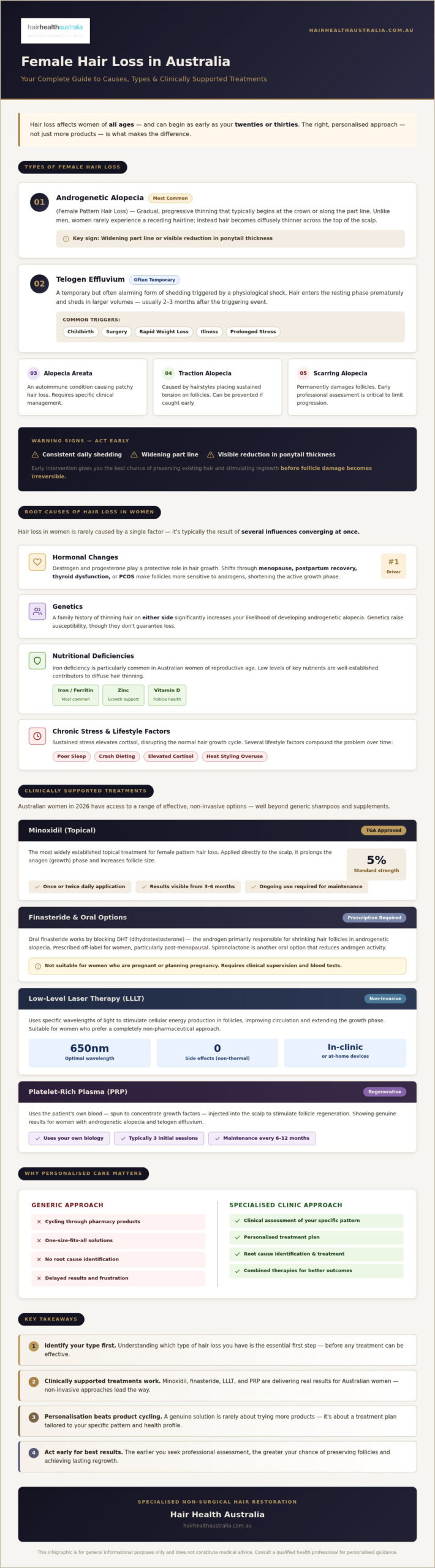
Key Takeaways
- Female hair loss has multiple underlying causes, and understanding which type you have — from androgenetic alopecia to other conditions — is the essential first step toward effective treatment.
- Clinically supported options such as minoxidil, finasteride, low-level laser therapy, and PRP treatments are delivering real results for Australian women in 2026, with non-invasive approaches leading the way.
- Finding a genuine female hair loss cure is rarely about trying more products — it’s about receiving a personalised treatment plan tailored to your specific hair loss pattern and health profile.
- Real women have experienced meaningful improvements in both hair density and confidence through specialised, non-surgical care — and their stories offer a roadmap for what’s possible.
- Booking a hair health check with a specialised clinic like Hair Health Australia is a straightforward, low-pressure way to get clarity on your options and take the first step toward lasting results.
Understanding Female Hair Loss: What You Need to Know
Hair loss in women is far more common than most people realise. It’s not a niche concern or a condition that only affects a small minority. Research consistently shows that a significant proportion of women will experience noticeable hair thinning at some point in their lives, with many cases beginning as early as the twenties or thirties. Despite this prevalence, the conversation around female hair loss remains underserved, leaving many women without clear answers or a reliable path forward.
The emotional toll is real and shouldn’t be minimised. Hair is deeply tied to identity, femininity, and self-expression for many women. Watching it thin or shed in greater quantities can trigger anxiety, social withdrawal, and a loss of confidence that affects daily life in ways that go well beyond appearance. Understanding what’s actually happening, biologically and medically, is the first step toward regaining control.
Different Types of Female Hair Loss
Not all hair loss is the same, and distinguishing between types is essential before exploring any female hair loss cure. The two most common presentations are:
- Androgenetic alopecia (female pattern hair loss): A gradual, progressive thinning that typically begins at the crown or along the part line. Unlike male pattern baldness, women rarely experience a receding hairline. Instead, the hair becomes diffusely thinner across the top of the scalp while the frontal hairline is largely preserved.
- Telogen effluvium: A temporary but often alarming form of shedding triggered by a physiological shock to the body. This can follow childbirth, surgery, rapid weight loss, illness, or prolonged stress. Hair enters the resting phase prematurely and sheds in larger volumes, usually two to three months after the triggering event.
Other less common types include alopecia areata (an autoimmune condition causing patchy loss), traction alopecia (caused by hairstyles that place sustained tension on follicles), and scarring alopecias that permanently damage follicles. Each requires a different clinical approach, which is precisely why professional assessment matters.
If you’re noticing consistent shedding, a widening part, or a visible reduction in ponytail thickness, those are signs worth taking seriously. Seeking professional help early gives you the best chance of preserving existing hair and stimulating regrowth before follicle damage becomes irreversible.
Understanding the Causes of Hair Loss
Hair loss in women is rarely caused by a single factor. It’s typically the result of several influences converging at once:
- Hormonal changes: Oestrogen and progesterone play a protective role in hair growth. When levels shift, whether through menopause, postpartum recovery, thyroid dysfunction, or polycystic ovarian syndrome (PCOS), follicles can become more sensitive to androgens, shortening the active growth phase.
- Genetics: A family history of thinning hair on either side significantly increases your likelihood of developing androgenetic alopecia. The genetic component doesn’t guarantee hair loss, but it does raise susceptibility.
- Nutritional deficiencies: Iron deficiency is particularly common in Australian women of reproductive age and is a well-established contributor to diffuse hair thinning. Low levels of ferritin, zinc, and vitamin D have also been associated with increased shedding.
- Chronic stress and lifestyle factors: Sustained psychological stress elevates cortisol, which can disrupt the normal hair growth cycle. Poor sleep, crash dieting, and overuse of heat styling tools compound the problem over time.
Because these causes overlap and interact, a one-size-fits-all approach simply doesn’t work. Identifying the specific drivers behind your hair loss, through proper clinical assessment rather than guesswork, is what separates ineffective product cycling from a treatment plan that actually delivers results.
Effective Treatments for Female Hair Loss in Australia
Once you understand what’s driving your hair loss, the next question becomes practical: what actually works? The landscape of clinically supported treatments has advanced considerably, and Australian women today have access to a range of options that go well beyond the generic shampoos and supplements lining pharmacy shelves. Finding the right female hair loss cure isn’t about trying everything at once; it’s about selecting the treatments most suited to your specific pattern, cause, and stage of loss.
Medications for Female Hair Loss
Two pharmaceutical options have the strongest clinical backing for women with androgenetic alopecia and related conditions.
Minoxidil remains the most widely used topical treatment for female hair loss. Applied directly to the scalp, it works by prolonging the anagen (active growth) phase of the hair cycle and widening blood vessels around follicles to improve nutrient delivery. It’s available in Australia in both two percent and five percent formulations. The five percent concentration has demonstrated stronger results in clinical studies, though it’s worth discussing the appropriate strength with a clinician, as individual responses vary. Consistency is essential: minoxidil requires ongoing use to maintain results, and many women begin noticing improvements after three to six months of regular application.
Finasteride is prescribed less frequently for women than for men, and it’s generally not recommended for women who are pregnant or planning pregnancy due to the risk of foetal harm. In post-menopausal women, however, low-dose finasteride has shown promising results for androgenetic alopecia in clinical settings. This is a conversation to have with a qualified clinician who can weigh the benefits against your individual health profile.
Nutritional support plays a complementary role. Iron deficiency is particularly prevalent among Australian women of reproductive age, and correcting a documented ferritin deficiency can meaningfully reduce shedding. Zinc, vitamin D, and biotin are also commonly assessed, though supplementation is most effective when there’s a confirmed deficiency rather than as a general preventive measure.
Innovative Non-Invasive Treatments
Non-invasive therapies have become a cornerstone of modern female hair loss treatment, and for good reason. They carry minimal side effect profiles and can be used alongside pharmaceutical options for a compounded effect.
- Low-level laser therapy (LLLT): This technology uses specific wavelengths of red light to stimulate cellular activity within follicles, increasing energy production and encouraging hair to shift from the resting phase back into active growth. It’s a well-tolerated, painless treatment that suits women at various stages of thinning.
- Platelet-rich plasma (PRP): PRP involves drawing a small amount of the patient’s own blood, concentrating the growth-factor-rich plasma through centrifugation, and injecting it into areas of thinning. The growth factors work to reactivate dormant follicles and support a healthier scalp environment. Multiple sessions are typically required, with maintenance treatments recommended thereafter.
- Emerging technologies: Scalp microneedling combined with topical actives, and advanced nutraceutical protocols tailored to specific deficiency profiles, are gaining traction in specialised clinical settings as part of comprehensive treatment plans.
What separates genuinely effective care from the noise is personalisation. A treatment protocol built around your specific diagnosis, lifestyle, and health history will consistently outperform any off-the-shelf approach. If you’re ready to move beyond guesswork, booking a hair health check with Hair Health Australia is a straightforward way to get a clear picture of where you stand and which treatments are most likely to deliver results for you.
Non-Surgical Solutions: Personalised Care for Hair Restoration
Choosing a non-surgical path for hair restoration isn’t settling for second best. For the vast majority of women experiencing thinning or shedding, non-invasive treatments represent the most clinically appropriate, sustainable, and well-tolerated route available. Unlike surgical interventions, they work with your body’s existing biology rather than around it, and they carry a significantly lower risk profile while still delivering meaningful, measurable results.
The real advantage of non-surgical care, however, isn’t any single treatment. It’s the framework around it. A personalised clinical approach, one that accounts for your specific diagnosis, health history, lifestyle, and stage of loss, is what separates genuine progress from the frustrating cycle of trying products that weren’t designed with your situation in mind. That distinction is central to finding a real female hair loss cure rather than a temporary fix.
What to Expect from Non-Surgical Treatments
The process begins with a thorough assessment. A specialist consultation typically involves a detailed review of your hair loss history, scalp examination, and discussion of relevant health factors such as hormonal shifts, nutritional status, and family history. This foundation is what makes subsequent treatment decisions purposeful rather than speculative.
From there, a structured treatment plan is developed around your specific presentation. Progress is monitored through regular check-ins, which serve a dual purpose: they allow your clinician to assess how your follicles are responding and to make timely adjustments if a particular approach needs refinement. Hair restoration is rarely linear, and having a specialist who can interpret changes and recalibrate your plan accordingly makes a significant practical difference.
Women who’ve gone through this process at specialised clinics in Sydney consistently describe the same turning point: the shift from feeling overwhelmed and reactive to feeling genuinely informed and in control. That clarity, grounded in professional guidance rather than guesswork, is often as valuable as the treatments themselves.
Combining Treatments for Best Results
No single therapy works in isolation as effectively as a well-integrated combination. A clinician might pair low-level laser therapy with topical minoxidil to simultaneously stimulate follicle activity and extend the active growth phase. PRP sessions might be scheduled alongside nutritional correction to support the scalp environment from both inside and out. The sequencing and timing of these combinations matters, which is why specialist oversight is essential rather than optional.
Lifestyle factors also play a meaningful supporting role. Consistent sleep, stress management, and a nutrient-dense diet don’t replace clinical treatment, but they do create conditions in which that treatment can work more effectively. A good specialist will discuss these elements as part of a holistic plan rather than treating them as an afterthought.
If you’re ready to move from uncertainty to a structured, evidence-based approach, booking a hair health check with Hair Health Australia is the practical next step. It’s a straightforward way to get a clear clinical picture and understand exactly which combination of non-invasive therapies is best suited to your hair loss pattern and goals.
Real-Life Success Stories: Women Who Found Their Cure
Reading about treatments is one thing. Hearing from women who’ve actually been through the process, who’ve sat where you’re sitting now, feeling uncertain and frustrated, and come out the other side with measurably thicker, healthier hair, is something else entirely. These accounts matter because they ground the clinical picture in lived experience.
Case Studies from Hair Health Australia
The women who come to Hair Health Australia arrive at different stages and with different stories, but a common thread runs through nearly all of them: they’ve already tried the over-the-counter route and found it wanting. What changes the outcome isn’t trying harder with the same approach. It’s finally receiving a clinical assessment that identifies what’s actually driving the loss.
One patient in her early forties had been experiencing diffuse thinning across her crown for nearly three years before her first consultation. Previous attempts with pharmacy-bought treatments had produced no meaningful change. Following a thorough assessment that identified a combination of androgenetic alopecia and a documented ferritin deficiency, she was placed on a structured programme combining topical minoxidil, low-level laser therapy sessions, and targeted nutritional correction. Within six months, she reported a visible improvement in density along her part line, and her follow-up scalp assessment confirmed measurable regrowth in previously dormant areas.
Another patient, a woman in her mid-thirties who had experienced significant shedding following a difficult pregnancy, came in convinced her hair would never fully recover. Her diagnosis pointed clearly to telogen effluvium with a hormonal component. Her personalised plan focused on PRP treatments to reactivate follicles, alongside lifestyle and nutritional guidance. The recovery wasn’t overnight, but it was steady and clinically trackable. That visibility, knowing exactly what was improving and why, was something she described as transformative in itself.
What these cases illustrate is that finding a genuine female hair loss cure isn’t about stumbling across the right product. It’s about having a specialist interpret your specific presentation and build a plan around it.
Advice and Tips from Women Who Regrew Their Hair
Women who’ve navigated this journey successfully tend to share a few consistent reflections:
- Start sooner than feels necessary. Hair loss responds better to treatment when follicles are still active. Waiting until thinning becomes severe limits what’s recoverable.
- Trust the process, not the timeline. Hair growth cycles are slow. Expecting visible change within weeks sets you up for unnecessary disappointment. Three to six months is a more realistic window for initial results.
- Don’t self-diagnose. The type of loss matters enormously for treatment selection. What works for androgenetic alopecia won’t necessarily help telogen effluvium, and vice versa.
- Consistency is non-negotiable. Skipping treatments or abandoning a plan before it has time to work is the single most common reason progress stalls.
- Lean on your clinical team. Regular check-ins aren’t just administrative. They’re where your plan gets refined based on how your hair is actually responding.
The emotional dimension of this journey deserves acknowledgement too. Many women describe the process of finally receiving a clear diagnosis as its own form of relief, separate from any physical improvement. Uncertainty is exhausting. Having a specialist explain exactly what’s happening, and exactly what can be done about it, changes the experience entirely.
If you’re ready to move from guesswork to a structured, evidence-based plan, book a hair health check with Hair Health Australia and get the clarity your situation deserves.
Taking the First Step: Book Your Hair Health Check Today
Everything covered in this article, the types of hair loss, the clinical treatments, the real-world outcomes, points toward a single practical conclusion: the most important thing you can do right now is get a proper assessment. Not another product. Not more research. A conversation with a specialist who can look at your specific situation and tell you exactly what’s happening and what can be done about it.
Booking a hair health check with Hair Health Australia is straightforward. You don’t need a referral, and the process is designed to be low-pressure from the start. It’s simply a clinical conversation, structured around understanding your hair loss history, your health, and your goals.
Why a Hair Health Check is Essential
Early intervention is one of the most consistently supported principles in hair loss treatment. Follicles that are thinning but still active respond far better to treatment than those that have been dormant for years. Waiting until loss becomes severe narrows your options considerably, which is why acting sooner, even if you’re unsure whether your concern is “serious enough”, is always the right call.
A professional assessment does something no product or online quiz can: it distinguishes between hair loss types, identifies contributing factors, and rules out underlying health conditions that may need addressing. That diagnostic clarity is the foundation of any genuine female hair loss cure. Without it, you’re selecting treatments based on guesswork rather than evidence.
During your hair health check, you can expect:
- A detailed review of your hair loss history, including when it started and how it’s progressed
- A thorough scalp examination to assess follicle health and loss patterns
- Discussion of relevant health factors, including hormonal history, nutritional status, and family background
- A clear explanation of what’s driving your specific presentation
- An outline of the treatment options most suited to your situation
Next Steps After Your Consultation
Leaving your consultation with a personalised treatment plan in hand changes the experience entirely. Instead of uncertainty, you have direction. Instead of trial and error, you have a structured programme with a clear clinical rationale behind each component.
From there, your progress is tracked through scheduled follow-up appointments. These aren’t just check-ins; they’re where your plan gets refined. Hair restoration isn’t always linear, and having a specialist monitor your response and adjust your protocol accordingly is what keeps results on track over time. Ongoing support is built into the process, not bolted on as an afterthought.
The women who see the strongest outcomes are those who commit to the plan, stay consistent, and lean on their clinical team when questions arise. That partnership, between patient and specialist, is what transforms a treatment plan into lasting results.
If you’re ready to stop guessing and start making genuine progress, book your hair health check with Hair Health Australia today. It’s the clearest, most direct path toward understanding your hair loss and doing something meaningful about it.
Your Path to Healthier, Fuller Hair Starts Here
Finding a genuine female hair loss cure isn’t about trying more products. It’s about getting the right clinical picture and a personalised plan built around your specific needs. That’s the thread running through everything covered in this article, from understanding what’s driving your loss to choosing the treatments most likely to work for your situation.
Three things matter most on this journey: acting early before follicle damage becomes harder to reverse, committing to a structured programme rather than guessing your way through options, and working with specialists who focus exclusively on non-invasive hair restoration for women.
Hair Health Australia offers exactly that, with personalised treatment plans designed for women, expert consultations centred on individual needs, and proven non-invasive solutions that deliver measurable results over time.
You don’t have to keep navigating this alone. Start your journey to healthier hair with a Hair Health Check today and take the first clear, confident step toward the results you deserve.
Frequently Asked Questions About Female Hair Loss
What are the most common causes of female hair loss?
Female hair loss most commonly stems from androgenetic alopecia (genetic predisposition), hormonal fluctuations, nutritional deficiencies, and chronic stress. Iron deficiency is particularly prevalent among Australian women of reproductive age and is a well-documented contributor to diffuse thinning. Thyroid dysfunction, polycystic ovarian syndrome, and postpartum hormonal shifts are also frequent underlying factors. Because these causes often overlap, identifying the specific drivers requires professional clinical assessment rather than self-diagnosis.
How effective are non-surgical treatments for hair regrowth?
Non-surgical treatments can deliver genuine, measurable results when they’re matched to the correct diagnosis and applied consistently. Options like low-level laser therapy, platelet-rich plasma, and topical minoxidil have strong clinical backing for women with androgenetic alopecia and related conditions. Effectiveness improves significantly when treatments are combined strategically under specialist supervision rather than used in isolation. The key variable isn’t the treatment itself; it’s whether the treatment suits your specific hair loss pattern and stage.
What role do hormones play in female hair loss?
Hormones are central to how hair grows and sheds. Oestrogen and progesterone support the active growth phase of the hair cycle, so when levels decline, such as during menopause or postpartum recovery, follicles can become more sensitive to androgens. This sensitivity shortens the growth phase and produces progressively finer, shorter strands over time. Conditions like PCOS and thyroid dysfunction compound this effect, which is why a hormonal assessment is often a valuable part of any female hair loss cure evaluation.
Can stress cause hair loss in women?
Yes, sustained psychological stress is a recognised trigger for telogen effluvium, a condition where hair prematurely enters the resting phase and sheds in higher volumes. The shedding typically occurs two to three months after the stressful event rather than immediately, which can make the connection difficult to identify without clinical guidance. While stress-related hair loss is generally temporary, it can become prolonged if the underlying stress isn’t addressed or if it coincides with other contributing factors like nutritional deficiencies.
How long does it take to see results from hair loss treatments?
Most women begin to notice meaningful improvement between three and six months into a consistent treatment programme. This timeline reflects the natural pace of the hair growth cycle rather than any limitation of the treatments themselves. Some women observe a reduction in shedding earlier, which is often the first sign that a treatment is working, before visible density improvements appear. Patience and consistency are non-negotiable; abandoning a plan before it has adequate time to work is the most common reason progress stalls.
Are there any side effects of hair loss medications?
Minoxidil is generally well-tolerated, though some women experience initial scalp irritation or a temporary increase in shedding during the first few weeks of use, which typically resolves as the hair cycle adjusts. Finasteride carries more significant considerations for women, particularly those who are pregnant or planning pregnancy, due to the risk of foetal harm; it’s only considered in specific clinical contexts such as post-menopausal women under specialist supervision. A qualified clinician will assess your individual health profile before recommending any pharmaceutical option.
What should I do if I notice thinning hair?
The most important step is to seek a professional assessment sooner rather than later. Follicles that are thinning but still active respond far better to treatment than those that have been dormant for an extended period. Don’t rely on pharmacy products or online symptom checkers to guide your decisions; the type of hair loss matters enormously for treatment selection, and an incorrect approach can delay real progress. Booking a hair health check with a specialised clinic gives you a clear clinical picture and a structured path forward based on your specific situation.