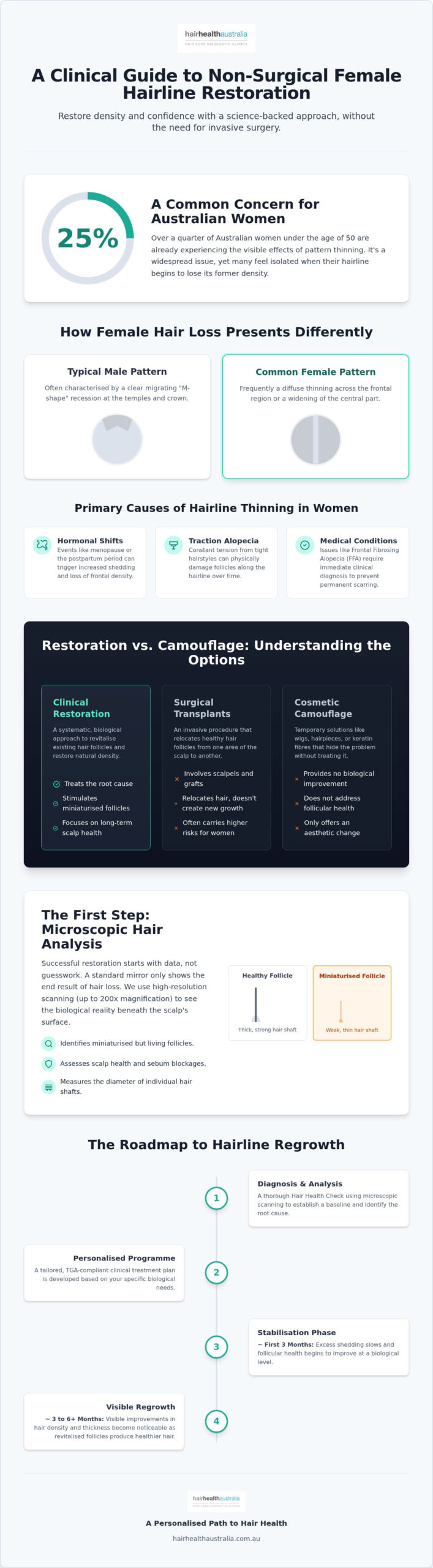
Did you know that over 25% of Australian women under the age of 50 are already experiencing the visible effects of pattern thinning? It is a statistic that highlights how common this concern is, yet many women still feel isolated when they notice their hairline beginning to recede or lose its former density. If you have spent months experimenting with unverified “miracle” oils found online only to see no change, it is time to shift your focus toward female hairline restoration non surgical methods that are grounded in clinical science and TGA-compliant standards.
We understand the frustration of losing confidence every time you try to style your hair back or check your reflection in the mirror. It is easy to feel that thinning is permanent or that you have waited too long to seek help. This 2026 clinical guide is designed to replace that uncertainty with a clear, professional path forward. You will learn how diagnostic-led protocols and microscopic hair analysis identify the specific biological reasons your hair is thinning. We will preview the most effective non-invasive treatment pathways available in Australia today, helping you understand how a tailored clinical programme can restore visible density and scalp health without the need for invasive surgery.
Key Takeaways
- Learn how modern clinical protocols focus on stimulating existing follicles to restore density without the need for invasive procedures.
- Discover why microscopic hair analysis is the essential first step for female hairline restoration non surgical to identify follicle miniaturisation before permanent loss occurs.
- Understand the differences between clinical regrowth programmes and surgical transplants, including why non-invasive options often carry lower risks for women.
- Gain a realistic understanding of the biological hair growth cycle and the typical three-to-six-month timeline required to see visible stabilising and regrowth.
- Identify the specific benefits of a personalised Hair Health Check at a specialised Sydney clinic to move beyond generic products that lack clinical validation.
What is Female Hairline Restoration (Non-Surgical)?
When we discuss female hairline restoration non surgical, we are referring to a systematic, clinical approach to revitalising hair density without the use of scalpels or grafts. Unlike surgical transplants that relocate hair from one area to another, non-surgical restoration focuses on the biological health of the existing follicles. By the year 2026, the shift in Australian clinical standards has moved away from unverified serums toward evidence-based protocols that target the root cause of thinning. These modern programmes prioritise the preservation of your natural hair while stimulating miniaturised follicles to return to a healthy growth phase.
For many Australian women, the way hair loss presents is fundamentally different from the traditional male “M-shape” recession. While men often see a clear migration of the hairline, women frequently experience a diffuse thinning across the frontal region or a widening of the central part. This condition, medically known as Pattern hair loss, can result in a visible loss of volume that makes styling hair away from the face feel difficult. The psychological weight of this change is significant; it’s not merely a cosmetic issue but one that often impacts self-esteem and social confidence. Advancements in 2026 diagnostic technology have made these non-surgical paths more viable than ever, allowing for high-precision treatments that were previously unavailable.
Restoration vs. Camouflage: Knowing the Difference
It’s vital to distinguish between hiding a problem and treating it. Cosmetic solutions like wigs, hairpieces, or keratin fibres are forms of camouflage. Similarly, scalp micropigmentation can be used to simulate density, though this requires professional-grade equipment from reputable Australian suppliers like Tatt Lab to ensure safety. While these provide an immediate aesthetic change, they do nothing to address underlying follicular health. Clinical restoration, however, aims to improve biological density. The success of these programmes depends on identifying “active” follicles that are miniaturising but still capable of regrowth. Once a follicle becomes completely dormant and scarred over, non-surgical options are less effective, which is why early clinical intervention is the gold standard for success.
Common Causes of Hairline Recession in Women
The frontal hairline is particularly sensitive to both internal and external stressors. Hormonal shifts during menopause or the postpartum period often trigger a sudden increase in shedding and a noticeable decrease in frontal density. In cities like Sydney, where lifestyle and climate often dictate tight hairstyles, traction alopecia remains a frequent concern. Constant tension can physically damage the follicles along the hairline over time. Additionally, conditions like Frontal Fibrosing Alopecia (FFA) require immediate clinical attention to prevent permanent scarring. Identifying these causes through a specialised Hair Health Check ensures your treatment plan is tailored to your specific biological needs.
The Role of Microscopic Hair Analysis in Restoration
A standard bathroom mirror only reveals the end result of hair thinning. It doesn’t show the biological struggle occurring beneath the scalp’s surface. Achieving successful female hairline restoration non surgical starts with data, not guesswork. While a visual check might suggest your hair is simply “gone,” microscopic analysis often reveals a different story. It allows us to identify follicles that are still alive but have miniaturised to the point of being invisible to the naked eye. This distinction is critical because it determines whether a clinical programme can still revitalise those hairs or if the follicle has reached a permanent dormant state.
In our Sydney clinic, we use high-resolution microscopic scanning to assess the environment of the scalp. We don’t just look at the hair; we examine the health of the scalp tissue, the presence of sebum blockages, and the diameter of individual hair shafts. This level of detail helps us predict the success rate of a non-surgical programme with far greater accuracy than a simple consultation. By comparing the density of your hairline to the “donor” areas at the back of your head, we establish a baseline for what your unique restoration potential looks like.
What Happens During a Clinical Hair Health Check?
Our diagnostic process is methodical and thorough. We begin by using a specialised microscopic camera to scan various zones of the scalp at up to 200x magnification. This allows us to observe the hair bulb health and measure follicle diameter in real time. We also check for inflammation or excessive oil production that might be stifling growth. You can learn more about our Hair Health Check to see how this data forms the foundation of your personalised protocol. This step ensures that every treatment recommendation is backed by your specific biological markers.
Why “Active Follicles” are the Key to Regrowth
The success of non-surgical restoration relies on the presence of active follicles. Hair loss is rarely an overnight event; it’s a slow process where the follicle produces increasingly thinner, weaker hairs until it eventually stops altogether. Scientific research into Current treatment concepts confirms that early intervention is far more effective at arresting this progression than attempting to revive follicles that have been dormant for years. Our clinical programmes target follicles currently stuck in the resting (telogen) phase. By providing the right clinical stimulus, we aim to “wake up” these follicles, encouraging them to enter a new growth phase and produce stronger, thicker hair shafts. It’s a process of biological rehabilitation that requires a precise, diagnostic-first approach.
Understanding these metrics allows you to move forward with confidence. Instead of hoping a generic product works, you’ll have a clear understanding of your scalp health. If you’re ready to see what’s happening beneath the surface, a professional assessment of your hair follicles is the most reliable way to begin your journey.
Non-Surgical Restoration vs. Hair Transplant Surgery
Deciding between an invasive procedure and a clinical programme is a pivotal moment for any woman noticing a receding hairline. While surgical clinics often frame Follicular Unit Extraction (FUE) as the only permanent solution, the reality for women is more complex. Surgery is a relocation of hair, not a cure for the biological causes of thinning. In contrast, female hairline restoration non surgical focuses on rehabilitating the scalp environment to support existing hair and stimulate new growth from miniaturised follicles. This approach addresses the root cause rather than just moving hair from one place to another.
One of the most significant differences lies in recovery. Surgical transplants require downtime, post-operative care, and often involve a period of visible scabbing. There is also the risk of “shock loss,” a condition where the trauma of surgery triggers temporary shedding of the surrounding healthy hair. For a woman already concerned about density, this can be a distressing setback. Clinical programmes involve no downtime or physical trauma. They work alongside your body’s natural growth cycles to gradually improve density and hair diameter without the risks associated with anaesthesia or surgical incisions.
Aesthetic outcomes also differ. A non-surgical approach aims for a soft, natural transition by revitalising your original hairline. Surgical grafts can sometimes appear “pluggy” or unnaturally straight if not executed with extreme precision, which is particularly noticeable along the delicate female frontal line. Scientific literature on current treatment concepts for female hair loss suggests that non-invasive therapies are often the most appropriate first line of defence, especially when follicles are still active.
When is Non-Surgical the Superior Choice?
Non-surgical protocols are often the superior choice for women experiencing diffuse thinning. Surgery requires a stable “donor” area, usually at the back of the head, to provide grafts. However, many women experience thinning across the entire scalp, meaning the donor hair itself may be unstable. Younger women should also prioritise non-invasive protocols. Starting with a clinical programme allows you to preserve your natural hair and treat the whole scalp, rather than just filling a specific gap that may continue to recede behind the surgical grafts.
The Limitations of Surgical Transplants for Women
Female donor hair is biologically different from male donor hair; it is often more susceptible to the same thinning factors affecting the hairline. If you choose surgery without addressing the underlying health of your hair, the transplanted grafts may eventually thin as well. This is why maintaining a clinical regimen is essential for long-term success. For a deeper look at your options, you can consult our Hair Loss Treatment for Women: The 2026 Australian Clinical Buying Guide to understand which path aligns with your goals.
The Roadmap to Hairline Regrowth: What to Expect
Success in female hairline restoration non surgical is not measured in days, but in months. Because hair growth is a biological process, it must follow the natural timeline of the follicular cycle. Many women feel discouraged when they don’t see immediate changes, but understanding the three-to-six-month reality is essential for staying the course. A professional clinical programme is designed to work in harmony with your body, moving through specific phases of recovery and growth that require patience and precision.
Phase 1: Stabilisation (Months 1-2). The first goal of any clinical protocol is to stop the “leakage.” This phase focuses on reducing excessive shedding and stabilising the existing hairline. You might not see new growth yet, but you should notice fewer hairs in the brush or shower. Phase 2: Revitalisation (Months 3-4). This is when the excitement begins. As miniaturised follicles are stimulated, fine “baby hairs” start to emerge along the hairline. These hairs are often light and thin initially but indicate that the follicles are returning to an active state. Phase 3: Maturation (Months 5-6+). During this final stage, those fine hairs transition into stronger, pigmented terminal hairs. You will notice a visible improvement in hairline density and a more defined shape as the hair shafts thicken and the overall coverage improves.
Components of a Professional Clinical Programme
A high-standard programme is multi-modal. It typically involves customised topical formulations that are compounded based on your specific diagnostic results. These are often paired with low-level light therapy to increase cellular energy within the follicles, alongside in-clinic treatments that clear the scalp of debris. We also address nutritional and lifestyle factors, ensuring your body has the raw materials needed to build healthy hair keratin. This holistic approach ensures we aren’t just treating the symptom, but supporting the entire biological system for sustainable results.
Maintaining Your Results Long-Term
Hair health is not a “one and done” event. To keep the density you’ve regained, you must adopt a maintenance mindset. Because the factors that caused thinning, such as hormones or genetics, are often ongoing, your follicles require continued support to stay in the growth phase. Regular follow-up scans are vital to track progress and adjust your protocol as your scalp health evolves. For a broader look at the industry standards, you can review our guide on the Best Hair Regrowth Treatment Australia 2026. Consistency is the bridge between temporary improvement and lasting confidence.
If you’re ready to start your own timeline of regrowth, the first step is a professional assessment. Book your clinical diagnostic scan today to determine your baseline and begin your journey toward a fuller hairline.
Start Your Restoration Journey at Our Sydney Clinic
Sydney women often face unique environmental stressors, from high UV levels to the fast-paced urban lifestyle that can impact scalp health. At Hair Health Australia, we provide a specialised centre for female hairline restoration non surgical that moves beyond the one-size-fits-all approach of generic online subscriptions. Mail-order kits often lack the diagnostic precision required to treat complex thinning effectively. By contrast, our Sydney clinic offers a professional space where your scalp is analysed by specialists using high-resolution technology. This ensures your protocol is as unique as your biology.
Choosing a clinical environment means you aren’t managing this process alone. We provide a supportive, private setting where sensitive hair concerns are handled with the professional care they deserve. Our focus is on transparency; we provide realistic expectations based on the current state of your follicles. If our analysis shows that your follicles are still active, there is a significant opportunity to revitalise your hairline and restore your confidence. Our clinical approach to female hairline restoration non surgical involves a partnership between you and our diagnostic team.
Personalised Care in the Heart of Sydney
Our team is committed to evidence-based results and realistic outcomes. We understand that female hair loss requires a different aesthetic and biological approach than male thinning. During your visit, you’ll meet specialists who prioritise education, ensuring you understand the science behind every step of your programme. For those still researching their options, our guide on Choosing a Non-Surgical Hair Loss Clinic in Sydney provides an essential checklist to help you make an informed decision.
Book Your Comprehensive Hair Health Check
The first step toward restoration is our diagnostic Hair Health Check. Preparing for your first microscopic analysis is simple. We recommend arriving with clean hair, free of heavy styling products or camouflage fibres, to allow for the clearest possible scan of the scalp surface. During this initial consultation, you will receive a detailed report on your follicular density, scalp health, and growth potential. You’ll leave with a clear, non-invasive treatment plan tailored to your specific needs.
Waiting too long is the only real mistake in hair restoration. While 2026 technology is more advanced than ever, its effectiveness relies on the presence of viable follicles. Acting while you still have visible baby hairs or thinning patches-rather than total loss-maximises your chances of a successful outcome. It’s time to replace uncertainty with a professional clinical roadmap. Book your Hair Health Check in Sydney today and take the first step toward reclaiming your hairline density.
Reclaiming Your Hairline with Clinical Confidence
The journey toward a fuller, more resilient hairline begins by moving past the confusion of unverified products and toward the precision of clinical science. By prioritising a diagnostic-first approach, you shift the focus from merely hiding hair loss to actively rehabilitating your scalp environment. We’ve explored how microscopic hair analysis provides the data necessary to identify active follicles, ensuring that your path forward is based on your unique biological profile rather than a one-size-fits-all solution.
Successful female hairline restoration non surgical is a methodical process that requires patience, consistency, and the guidance of a specialised Sydney clinical team. Whether you’re in the early stages of thinning or have been searching for a non-invasive alternative to surgery, the most critical factor is timing. Acting while your follicles are still responsive allows for the most effective results from our non-invasive regrowth protocols. You don’t have to navigate these changes alone; professional support is available to replace uncertainty with a clear, actionable roadmap.
Book Your Professional Hair Health Check in Sydney today to uncover the true potential of your hair health. Your future density depends on the steps you take now, and we’re here to guide you every step of the way with clarity and care.
Frequently Asked Questions
Can a woman’s hairline grow back without surgery?
Yes, a woman’s hairline can grow back without surgery provided the hair follicles are in a state of miniaturisation rather than being completely dormant. Clinical programmes for female hairline restoration non surgical work by stimulating blood flow and nutrient delivery to these weakened follicles. This process revitalises the hair’s diameter and strength. Success depends on acting before the follicle has reached a point of no return where scarring has occurred.
How long does it take to see results from non-surgical restoration?
You should expect to see the first visible signs of stabilisation within two months, with new growth typically appearing between three and six months. Hair growth is a slow biological process that follows the natural anagen phase. While some baby hairs may emerge earlier, it takes several growth cycles for these hairs to mature into the thicker, pigmented strands that provide noticeable density along the hairline.
Is non-surgical hairline restoration permanent?
Non-surgical restoration is an ongoing management strategy rather than a one-time fix. Because the underlying factors causing hair loss, such as genetics or hormonal shifts, are often permanent, the follicles require continued support to remain in the growth phase. If you stop the programme entirely, the follicles may eventually return to their previous state of miniaturisation over time. Maintenance ensures your results remain stable.
How do I know if my hair follicles are still alive?
A microscopic hair analysis is the only definitive way to determine if your follicles are still alive. During a clinical assessment, we use high-magnification scanning to look for vellus hairs, which are very fine, translucent hairs that are often invisible to the naked eye. The presence of these hairs confirms that the follicle is still active and capable of being revitalised through a structured clinical protocol.
What is the best non-surgical treatment for a receding hairline?
The most effective approach is a multi-modal clinical programme that combines several evidence-based therapies. This typically includes customised topical formulations, low-level light therapy, and scalp health treatments designed to clear follicular blockages. There is no single miracle product; the best results for female hairline restoration non surgical come from a systematic plan that addresses the specific biological causes identified during your diagnostic scan.
Are these clinical programmes safe for women with sensitive scalps?
Clinical programmes are generally very safe and are specifically formulated to be gentle on the scalp. Because our protocols are personalised, we can adjust the concentration of active ingredients to suit women with sensitive skin or inflammatory scalp conditions. Our Sydney team monitors your progress closely to ensure the treatments remain comfortable while effectively supporting your hairline restoration goals.
Will I need to use treatments forever to keep my hairline?
Most women will need some form of long-term maintenance to keep their restored hairline density. Once you achieve your desired results, the frequency of treatments can often be reduced to a maintenance phase. This ensures the follicles continue to receive the stimulus they need to resist the biological factors that originally caused the thinning, protecting your investment in your hair health.
Does non-surgical restoration work for menopausal hair loss?
Yes, non-surgical restoration is highly effective for treating menopausal hair loss. The drop in oestrogen during menopause often leads to an increase in follicle sensitivity to androgens, causing the hairline to thin. Our clinical protocols are designed to support the scalp during these hormonal shifts, providing the necessary nutrients and stimulation to maintain density and prevent further recession in the frontal region.