
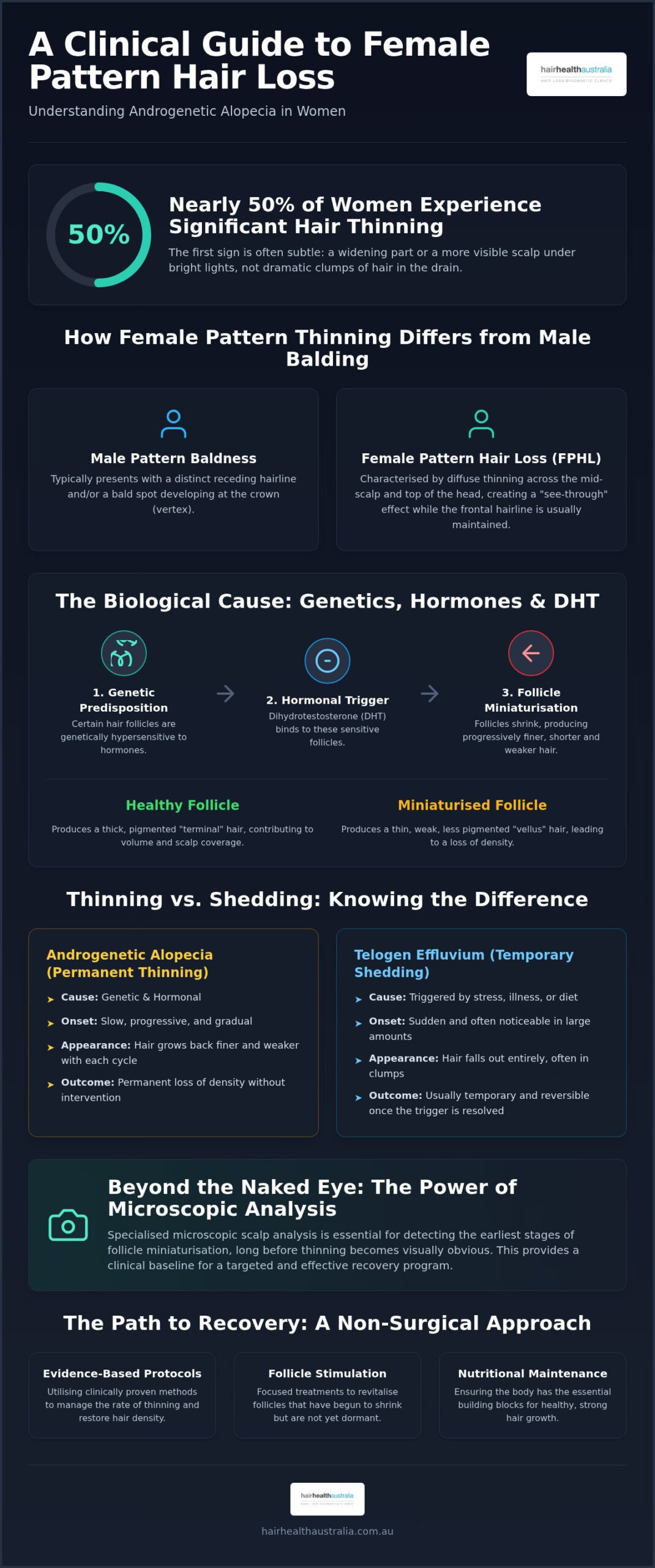
Did you know that nearly 50% of women will experience significant hair thinning during their lifetime? For many, the first sign isn’t clumps in the drain, but a subtle widening of the hair part or a scalp that feels more visible under bright bathroom lights. If you’ve found yourself questioning whether your thinning is due to temporary hormonal shifts or a permanent genetic trait, you aren’t alone. It’s frustrating to feel like you’re losing control over your appearance while searching for answers that actually make sense.
This clinical guide explains why the androgenetic alopecia women experience is a manageable biological condition rather than an inevitability. You’ll discover the specific biological triggers of female pattern thinning and how specialised microscopic analysis in Sydney can identify follicle changes before they become dormant. We’ll clarify the role of DHT in the female body and provide a clear path toward a successful, non-surgical recovery plan that focuses on evidence-based results and clinical certainty.
Key Takeaways
- Understand how the androgenetic alopecia women experience differs from male balding, typically presenting as diffuse thinning across the mid-scalp rather than a receding hairline.
- Learn about the role of Dihydrotestosterone (DHT) in shrinking hair follicles and how genetic predisposition makes certain follicles hypersensitive to normal hormone levels.
- Discover why microscopic scalp analysis is essential for detecting the earliest stages of follicle miniaturisation before thinning becomes visible to the naked eye.
- Identify the clinical markers that distinguish genetic pattern thinning from other conditions such as alopecia areata or temporary telogen effluvium.
- Explore evidence-based, non-surgical clinical protocols in Sydney that focus on follicle stimulation and nutritional maintenance to restore hair density without invasive surgery.
Defining Androgenetic Alopecia: Why Female Pattern Thinning is Unique
Androgenetic alopecia is the formal medical term for what many Australians know as female pattern hair loss (FPHL). While the name sounds complex, it simply describes the specific type of androgenetic alopecia women develop due to a genetic predisposition where hair follicles are sensitive to specific hormones. In Australia, this condition is the most frequent cause of chronic thinning. Statistics show it affects approximately 40% of women by age 50, with prevalence increasing significantly during the post-menopausal years due to shifting hormonal balances.
The Clinical Difference Between Men and Women
Specialists use the Ludwig Scale to categorise the severity of thinning in women, focusing on the density at the crown and top of the head. Unlike men, who often see a distinct receding hairline or a “bald spot” at the vertex, women typically maintain their frontal hairline while experiencing a gradual “see-through” effect across the mid-scalp. This specific presentation of pattern hair loss makes early detection difficult without specialised tools. FPHL is defined as a progressive reduction in the diameter of the hair shaft, a process called miniaturisation that eventually leads to a loss of overall volume and scalp coverage.
Common Misconceptions About Female Balding
A frequent myth is that thinning only impacts women in their senior years. In reality, about 12% of women aged 20 to 29 already show early clinical signs of the androgenetic alopecia women experience. Another major point of confusion is the difference between temporary shedding, known as telogen effluvium, and the permanent miniaturisation seen in genetic thinning. Shedding is often a temporary reaction to stress, diet, or illness where hair falls out in large amounts. In contrast, androgenetic alopecia is a slow, structural process where the hair grows back finer and shorter during each growth cycle. If you notice your ponytail feels significantly thinner or your scalp is visible under the harsh Australian sun or bright bathroom lights, it’s worth reviewing the early signs of alopecia in women to distinguish between these conditions.
Understanding that your hair loss has a clinical name is the first step toward regaining confidence. While genetics play a leading role, the progression of FPHL isn’t a fixed fate that you must simply accept. Modern clinical protocols allow us to manage the rate of thinning and, in many cases, revitalise follicles that have begun to shrink but are not yet dormant. The path to restoration begins with a professional Hair Health Check. This diagnostic process uses microscopic scanning to move beyond visual guesswork and establish a factual, clinical baseline for your personalised recovery programme.
The Biological Mechanism: Genetics, Hormones, and DHT in Women
To understand why the androgenetic alopecia women experience occurs, we must look at the cellular level where hormones and genetics intersect. The primary driver is Dihydrotestosterone (DHT), a derivative of testosterone that is present in both men and women. While women have much lower levels of androgens than men, those with a genetic predisposition possess hair follicles that are hypersensitive to even “normal” amounts of these hormones. Research into the genetics of androgenetic alopecia suggests that multiple genes contribute to this sensitivity, making the condition a complex biological puzzle rather than a simple hormonal imbalance.
This sensitivity triggers a process called miniaturisation. During this phase, the hair follicles gradually shrink, and the thick, pigmented “terminal” hairs are replaced by shorter, thinner, and less pigmented “vellus” hairs. You might notice your ponytail feels lighter or your hair no longer has the structural integrity it once had. This transition is often accelerated by significant hormonal shifts. For many Australian women, symptoms become more pronounced during menopause when oestrogen levels drop, or in cases of Polycystic Ovary Syndrome (PCOS), where androgen activity is naturally higher. Identifying these triggers through a specialised Hair Health Check allows for a targeted, non-surgical intervention before the follicles become completely dormant.
How DHT Affects the Hair Growth Cycle
The hair growth cycle consists of three main phases, but the anagen (growth) phase is the most critical. DHT shortens this phase significantly. Instead of growing for several years, the hair stays in the growth phase for only months or weeks. Consequently, the hair cannot reach its full length or thickness. This is why thinning hair often feels wispy and loses its ability to hold a style; it simply hasn’t had the time to develop into a strong, healthy strand. Intercepting this cycle early is the key to successful regrowth, as it’s much easier to revitalise a shrinking follicle than to wake one that has stopped producing hair entirely.
The Role of Lifestyle and Environment in Sydney
In a high-pressure city like Sydney, lifestyle factors often act as catalysts for genetic thinning. Chronic stress from demanding professional environments can elevate cortisol levels, which may further disrupt the delicate hormonal balance. Additionally, we frequently see secondary factors like iron deficiency or low Vitamin D levels in Australian women, which can starve the follicle of the nutrients it needs to combat the effects of androgenetic alopecia women face. A holistic clinical assessment is vital to ensure these environmental stressors aren’t undermining your recovery efforts.
Identifying Your Pattern: Thinning vs. Patchy Hair Loss
Recognising the specific way your hair is changing is the first step toward an effective treatment plan. While many people use the term “hair loss” as a catch-all, the androgenetic alopecia women experience has a very distinct visual signature. It typically presents as a widening of the mid-line part or a general loss of volume across the top of the head. This differs significantly from Alopecia Areata, which is characterised by sudden, smooth, circular patches of total hair loss that can appear anywhere on the scalp. If you notice distinct “holes” in your hair density rather than a gradual see-through effect, you may be dealing with an autoimmune response rather than genetic thinning.
Diffuse Alopecia is another term often used during clinical consultations. It refers to a transparent look where the scalp becomes visible through the hair, even if the hairline remains intact. To assess your own density, try this simple comparison: look at the thickness of your hair at the crown in a mirror and compare it to the hair at the nape of your neck. In cases of androgenetic alopecia, the hair at the back usually remains thick and robust, while the crown feels sparse. We also monitor for Frontal Fibrosing Alopecia, a less common but more aggressive condition where the hairline actually recedes and may be accompanied by redness or the loss of eyebrows. Distinguishing between these patterns is vital for treating female pattern hair loss correctly.
Telogen Effluvium vs. Androgenetic Alopecia
Many women confuse permanent thinning with a temporary condition called Telogen Effluvium. This is a reactive shedding process often triggered by high fevers, surgery, extreme stress, or rapid weight loss. A key clinical marker is the “3-month rule”: you’ll usually notice excessive shedding about 90 days after the stressful event occurred. While Telogen Effluvium can be alarming because hair falls out in large clumps, it’s usually temporary. Genetic thinning, however, doesn’t always involve heavy shedding; instead, the hair simply grows back finer and shorter until the scalp becomes visible.
When to Seek a Professional Hair Health Check
If you’ve noticed a persistent change in your hair density for more than six months, it’s time to move beyond over-the-counter supplements. Red flags that suggest genetic thinning include a visible scalp under bright lights, a ponytail that feels “half the size” it used to be, or hair that no longer grows past a certain length. Obtaining a definitive clinical diagnosis provides immense psychological relief, replacing the anxiety of the unknown with a structured recovery path. You don’t have to guess why your hair is changing. You can book a specialised Hair Health Check in Sydney to get a factual look at your follicle health and start a personalised, evidence-based programme.
Beyond the Naked Eye: The Role of Microscopic Scalp Analysis
Many women consult a GP or their hairstylist when they first notice thinning. While these professionals provide valuable support, a visual inspection often fails to detect the subtle, early-stage changes associated with the androgenetic alopecia women experience. By the time thinning is visible to the naked eye, you’ve often already lost a significant amount of hair density. Relying on visual guesswork can lead to delayed treatment, which is why a clinical approach requires a more detailed perspective.
Microscopic scalp scanning allows us to see what’s happening beneath the surface. We measure hair diameter and follicle density at a cellular level, providing a level of precision that a simple physical exam cannot match. This diagnostic step is essential for identifying “dormant” follicles, which are still alive but producing weak, wispy hair, versus “dead” follicles where hair production has ceased entirely. These baseline scans aren’t just for the initial diagnosis; they serve as an objective benchmark. They allow us to track your regrowth progress with scientific accuracy, ensuring your programme is delivering the expected results.
The Science of Follicle Miniaturisation
Scanning technology can detect follicle miniaturisation up to 50% before it becomes visible to the eye. This early detection window is the most effective time to begin a non-surgical intervention because the follicles are still active. During a scan, we also assess the health of the scalp environment, looking for excess sebum or inflammation that might be hindering hair growth. The ‘miniaturisation ratio’ is defined as the mathematical relationship between healthy terminal hairs and thinning vellus hairs within a specific scalp area. This metric provides a clear, clinical picture of how far the condition has progressed.
Personalising Your Regrowth Programme
The data gathered from a microscopic analysis is what allows us to move away from generic, over-the-counter treatments. A ‘one-size-fits-all’ approach often fails for androgenetic alopecia because every woman’s hormonal profile and genetic sensitivity are unique. By understanding your specific follicle density and miniaturisation rate, we can tailor a clinical programme that targets your needs exactly. It’s important to be discerning when choosing a non-surgical hair loss clinic in Sydney to ensure they use these evidence-based diagnostic tools rather than relying on visual assessments alone.
The first step toward clarity is seeing the facts for yourself. You can book a clinical microscopic analysis to establish your baseline and begin a structured, data-driven recovery plan.
Non-Surgical Clinical Recovery at Our Sydney Centre
At Hair Health Australia, we’ve spent over 15 years refining a philosophy rooted in clinical precision and empathetic care. We understand that the androgenetic alopecia women face requires more than a generic solution found in a chemist aisle. Our approach is strictly non-surgical, focusing on evidence-based protocols that work with your body’s natural growth cycles to restore density. By combining advanced technology with personalised care, we replace the uncertainty of thinning with a structured path toward recovery.
A successful clinical programme is built on three essential pillars: stimulation, nutrition, and maintenance. We begin by reawakening dormant follicles through targeted stimulation, followed by an intensive nutritional focus to provide the biological building blocks required for hair synthesis. Finally, we implement a maintenance strategy to protect your follicles from continued DHT sensitivity. Clinical-grade therapies offer a level of potency and customisation that pharmacy-shelf products simply cannot match. While over-the-counter options might provide a temporary boost, they rarely address the systemic miniaturisation process. Intervening early with professional protocols can significantly reverse the “see-through” effect, helping you reclaim the hair volume you’ve lost before follicles reach a point of no return.
The Advantage of Non-Invasive Therapy
Many women find the prospect of invasive hair transplant surgery daunting, particularly since the diffuse thinning pattern of androgenetic alopecia women often makes them poor candidates for surgical relocation. Non-surgical regrowth offers a natural-looking alternative by revitalising your own existing follicles. This results in a gradual, seamless restoration of density without the risks, scarring, or significant downtime associated with surgery. It is a sophisticated way to work with your biology rather than trying to bypass it. For a detailed breakdown of current clinical protocols, you can consult the Best Hair Regrowth Treatment Australia 2026 reference guide.
Starting Your Journey in Sydney
Our Sydney clinic provides a professional, supportive environment where your concerns are met with objective expertise and clinical honesty. During your initial consultation, we conduct a thorough microscopic scan to establish your baseline health and identify which follicles are viable for stimulation. We believe in providing clear expectations and evidence-based data so you can make an informed decision about your treatment. You don’t have to navigate the confusion of thinning hair alone. Schedule your comprehensive Hair Health Check today and take the first step toward a clearer, more confident path forward.
Taking Control of Your Hair Health
Understanding that the androgenetic alopecia women experience is a manageable biological condition is the first step toward reclaiming your confidence. By identifying the role of DHT and the process of follicle miniaturisation, you move from a place of uncertainty to one of clinical clarity. The key to successful restoration lies in identifying these changes early, often up to 50% before they are even visible in a bathroom mirror.
Since 2009, Hair Health Australia has acted as a dedicated guide for those seeking evidence-based, non-surgical alternatives to invasive procedures. Our specialised approach relies on clinical microscopic scanning to establish a factual baseline, ensuring your recovery programme is tailored to your unique follicle density. You don’t have to settle for over-the-counter guesswork when personalised, Sydney-based care is available.
The most important step you can take is to replace worry with data. Book Your Comprehensive Hair Health Check in Sydney today to see exactly what your follicles need to thrive. Regaining your hair density is a journey, and with a trusted clinical partner, it’s one you can navigate with complete confidence.
Frequently Asked Questions
Is androgenetic alopecia in women permanent or reversible?
Androgenetic alopecia is a progressive condition, which means it will continue to advance if left untreated. While the genetic predisposition itself is permanent, the physical thinning is often reversible if you intervene while the follicles are still active. Clinical treatments focus on reversing the miniaturisation process to restore hair diameter and density.
Once a hair follicle has been dormant for several years and replaced by scar tissue, it can no longer produce a new hair shaft. This is why early clinical intervention is the most critical factor in determining how much of your original volume can be successfully restored.
How do I tell the difference between normal shedding and androgenetic alopecia?
Normal shedding typically involves losing 50 to 100 hairs per day, which you might notice in your hairbrush or the shower drain. In contrast, the androgenetic alopecia women experience is defined by a change in the quality of the hair rather than just the quantity of fall. You’ll notice the hair growing back finer, shorter, and more transparent over time.
If you see a widening part or a more visible scalp but aren’t noticing large clumps of hair falling out, it’s likely a sign of genetic thinning. A professional scan can confirm whether your follicles are shrinking or if you’re simply experiencing a temporary shedding cycle.
Can stress cause androgenetic alopecia in women?
Stress does not cause the genetic sensitivity associated with this condition, but it can act as a powerful catalyst. While acute stress often leads to temporary shedding known as telogen effluvium, chronic stress can disrupt your hormonal balance and accelerate the onset of genetic thinning in those already predisposed to it.
Managing stress is an important part of a holistic recovery plan. High cortisol levels can starve the hair follicle of essential nutrients, making it harder for your body to combat the miniaturising effects of DHT on the scalp.
What is the most effective non-surgical treatment for female pattern thinning?
The most effective approach is a multi-targeted clinical programme that combines follicle stimulation with specific nutritional support. Because every woman’s hormonal profile is different, a personalised plan provides significantly better results than a one-size-fits-all pharmacy product. Evidence-based therapies that target the miniaturisation process directly offer the highest success rates for restoring density.
Does a widening part always mean I have androgenetic alopecia?
A widening part is the most common clinical marker of female pattern thinning, but it isn’t an absolute diagnosis. Other conditions, such as certain types of scarring alopecia or even temporary hormonal fluctuations, can cause similar patterns. A professional assessment is required to distinguish between a genetic trait and other underlying health issues that may require different care.
How does a microscopic hair scan help with a diagnosis?
A microscopic scan removes the guesswork by allowing us to see the hair and scalp at up to 200x magnification. This technology detects follicle miniaturisation long before it’s visible to the naked eye. By measuring the ratio of thick terminal hairs to thin vellus hairs, we can establish a factual baseline and create a recovery plan based on your specific cellular data.
Are there specific vitamins that help with genetic hair thinning?
Vitamins such as Iron, Vitamin D, and Biotin are essential for the biological production of hair, but they aren’t a standalone cure for androgenetic alopecia women face. Nutritional support ensures your follicles have the “fuel” to grow, but genetic thinning also requires clinical stimulation to overcome the hormonal triggers that cause the follicle to shrink in the first place.
Can wearing my hair in a tight ponytail cause androgenetic alopecia?
No, tight hairstyles cause a specific condition called Traction Alopecia, which results from physical tension pulling the hair from the root. While this is a different biological process than genetic thinning, wearing tight styles can exacerbate the appearance of sparse areas if you’re already experiencing androgenetic alopecia. We recommend looser styles to avoid putting unnecessary mechanical stress on already weakened follicles.