What if the change you see in the mirror says more about the lighting than your hair? If you’re wondering how to track hair regrowth progress, inconsistent photos, styling and hair position can make small changes look bigger, smaller or absent altogether. Checking every day can turn a gradual process into a source of unnecessary doubt.
It’s understandable to want clear evidence that your hair is changing. The most useful records come from consistent comparisons, not a single snapshot or someone else’s timeline. Hair regrowth is gradual, and progress can vary from person to person.
This guide explains how to create a practical baseline, take comparable photos and record changes without treating each one as a verdict. You’ll also learn how to look for patterns over time and when a clinical assessment may help explain what your records show. Hair Health Australia’s free, no-obligation Hair Health Check includes a microscopic Trichoscopy scan and full clinical diagnosis. It assesses active hair follicles and identifies your hair-loss type, putting personal observations into context. The check takes ONLY 30 MINS.
Key Takeaways
- Learn how to track hair regrowth progress with a simple baseline and records you can compare over time.
- Choose photos, brief notes or an app based on what you’ll use consistently, and focus on patterns rather than daily changes.
- Hair growth cycles and the causes of hair loss vary, so use your records to understand your own trend rather than expect a universal timeline.
- A clinical assessment can add diagnostic context. Hair Health Australia’s free, no-obligation Hair Health Check includes a Trichoscopy scan and full clinical diagnosis, and takes ONLY 30 MINS.
Why hair regrowth can be hard to track by appearance alone
A part that looks wider in the bathroom mirror or a patch that seems fuller in a photo can prompt questions. But hair position, styling and lighting all affect how much scalp is visible. Overhead light may highlight the scalp, while softer light can make hair look denser. A different part or freshly washed hair can also change the impression of fullness without showing a meaningful change in growth.
Reliable hair regrowth tracking means recording consistent observations over time, not treating one image as proof of a treatment outcome. Separating what you can see from what you can conclude is an important part of learning how to track hair regrowth progress. A photo documents visible coverage under particular conditions. By itself, it can’t confirm why hair loss is happening or whether follicles are active.
Why the mirror can give you a different impression each day
Hair naturally falls and sits differently from one day to the next. A change in your part, the way you’ve styled your hair or the angle you’re looking from can expose more or less scalp. Lighting matters too: bright light directly above your head can create a different impression from diffuse daylight.
That’s why one good hair day, or a day when your hair feels less cooperative, is weak evidence of a trend. Frequent checking can make ordinary variation feel loaded with meaning. If looking often is adding pressure, step back and rely on records made under similar conditions instead.
What a useful progress record can and cannot tell you
Photos and brief notes can help you compare visible features over time, such as how your part looks or how much scalp is apparent in a particular area. Their value depends on consistency. If the lighting, angle, hair position or styling changes between images, it becomes harder to tell whether a difference reflects your hair or the way it was recorded.
A photograph records appearance, not an active follicle count. It also can’t diagnose a hair-loss type or establish its cause. Those questions need clinical context. For an overview of the biology behind hair growth, see Hair Follicle and Growth Cycle. The cycle helps explain why visible changes may not tell the whole story, but a general reference can’t assess your individual scalp.
Keep your observations personal. Another person’s timeline reflects their own circumstances and isn’t a reliable benchmark for yours. If your records leave you unsure what you’re seeing, a Hair Health Check can add diagnostic context. It includes a microscopic Trichoscopy scan and full clinical diagnosis to identify hair-loss type and assess active hair follicles.
How the hair growth cycle affects visible regrowth progress
Hair doesn’t change all at once. Each follicle moves through a cycle of active growth, transition and rest, and neighbouring follicles aren’t necessarily at the same stage. A change at the scalp may therefore take time to become visible across an area. The hair growth cycle helps explain why a brief change in appearance isn’t, on its own, a clear sign of regrowth or continued loss.
Visible hair changes take time to assess because follicles cycle independently, and early changes may not yet alter the overall appearance of the scalp. Useful tracking relies on comparable records over time, rather than judging progress from one short-lived difference.
Why changes at the scalp may not look immediate
During the active phase, a follicle produces a hair. It then moves through a transition and resting phase before the cycle begins again. These stages help explain why a change in follicle activity may not quickly translate into obvious coverage: a new hair has to grow enough to affect how the area looks. The American Academy of Dermatology on Hair Loss also outlines different causes of hair loss, which can affect what changes are relevant to monitor.
Hair loss has more than one possible cause, and its pattern and course can differ between people. Treatment responses differ too. A change that appears over a short period may reflect how the hair is sitting or other day-to-day variation, rather than a lasting shift. Avoid treating one promising image as a definitive result, or one disappointing observation as proof that nothing is changing.
Why another person’s progress is not your measurement standard
Two people can start with different patterns, hair-loss types and personal circumstances. Their records may also be made under different conditions. Social media photos and personal anecdotes rarely show enough context to establish what caused a change or how it relates to your situation. They can offer perspective, but they aren’t clinical benchmarks.
Instead, compare your own observations made in a consistent way. Look for a pattern across records, and note when you changed your routine or noticed a difference. That gives you a more useful basis for questions than comparing your appearance with someone else’s reported timeline.
If you’re unsure what your observations mean, a clinical assessment can add context beyond appearance. Hair Health Australia’s free, no-obligation Hair Health Check includes a microscopic Trichoscopy scan and full clinical diagnosis of hair-loss type and active hair follicles. It takes ONLY 30 MINS and can help you understand your observations alongside individual findings.
Which hair regrowth tracking methods make comparisons more useful?
Photos, brief written notes and apps can each help you keep a record. The best choice is the one you’ll use consistently and can review without turning every entry into a verdict. Combining a photo with a short note can be useful: the image shows appearance, while the note records conditions that may affect the comparison.
Use the same views and similar conditions each time. A new angle, different lighting or a change in styling can make comparisons less meaningful. Consumer records can help you notice visible patterns, but they can’t diagnose your hair-loss type or count active follicles.
| Method | Strength | Limitation | Suitable use |
|---|---|---|---|
| Standardised photos | Show visible appearance across comparable views | Can be affected by lighting, angle and hair position | Comparing the same areas over time |
| Written notes | Add context about appearance and routine changes | Rely on memory and consistent wording | Recording details a photo won’t show |
| Tracking app | Keeps photos and notes together for later review | Doesn’t provide a clinical diagnosis | Organising records if you prefer digital tools |
How to take comparable hair progress photographs
Choose a few views of the areas you want to observe, then repeat those views as consistently as practical. Keep the camera distance, angle, lighting and background similar. Note whether your hair is freshly washed, styled or left in its usual position. These details won’t make a photo diagnostic, but they help you judge whether two images offer a fair comparison.
Avoid interpreting small differences as a confirmed result. A photograph documents how your hair looked in that moment; it doesn’t reveal what is happening at the follicle level.
What to record alongside photos and app entries
Keep notes brief. Record the date, what you noticed and any relevant changes to your hair-care or treatment routine. An app can make it easier to store entries in one place, but it remains a record-keeping tool, not a diagnostic authority. Choose a method that feels manageable, rather than adding tracking tasks you won’t maintain.
Your records can also help you describe your concerns during an assessment. Hair Health Australia’s Hair Health Check includes a Trichoscopy scan and full clinical diagnosis. Hair regrowth treatments for men and women are customised to individual diagnostic results. Your observations can inform the discussion, while clinical findings provide another kind of context.
In short, how to track hair regrowth progress depends less on the tool than on making your records comparable. Keep the process simple, and review the pattern rather than relying on one image or app entry.
How to build a simple hair regrowth tracking routine
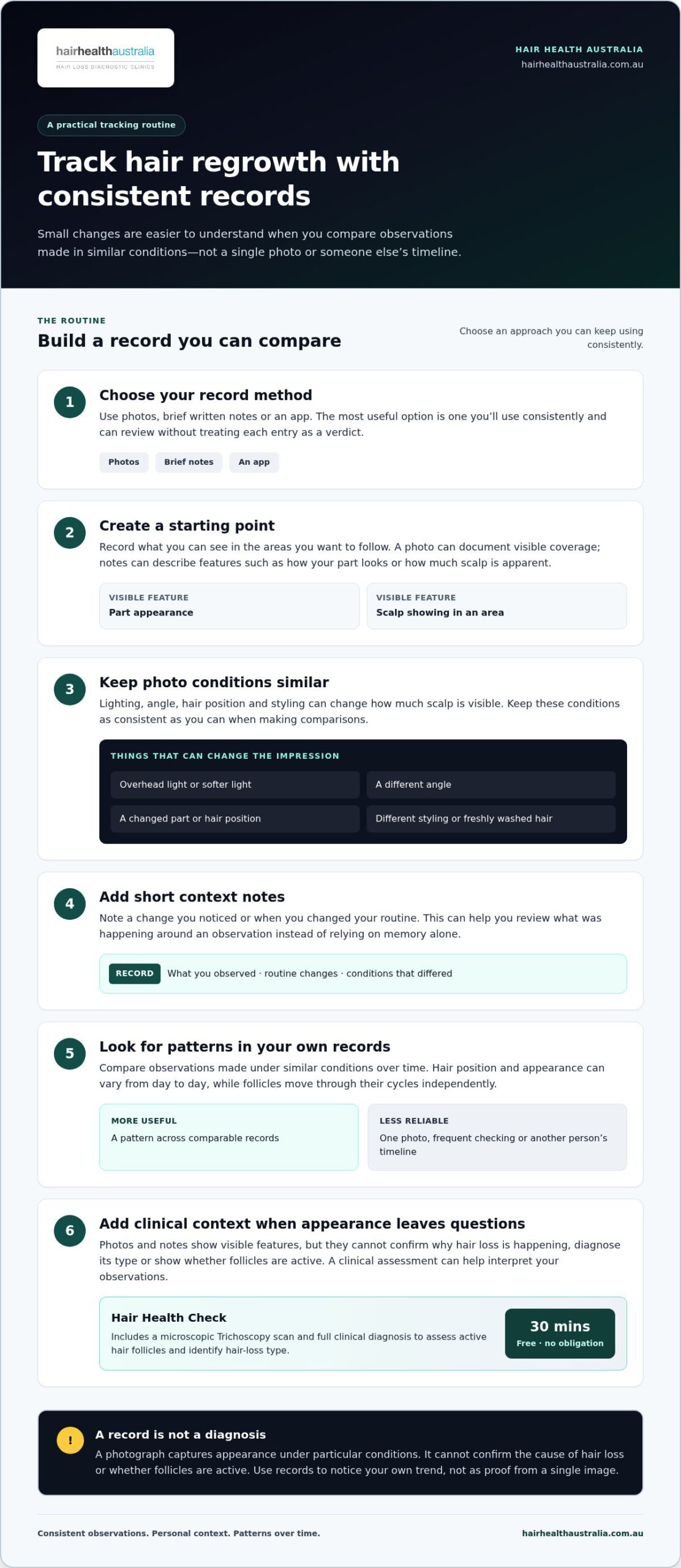
A useful routine should be easy to repeat, not another source of pressure. You don’t need to inspect your hair every day or follow a universal review schedule. Choose a manageable approach, then use it consistently enough to compare records and notice whether a pattern is emerging.
Set a baseline, repeat the same recording conditions, review the pattern and note any questions for a clinical discussion. This sequence helps keep your records organised without treating them as proof of a treatment result.
Set a baseline you can compare fairly
Before you begin, decide which areas you want to observe and choose a few clear views. Use similar camera distance, angle and lighting each time, and keep your hair in a comparable position. Add a short description, such as “centre part” or “temples”, so you remember what each image is meant to show.
Label each record with the date and view. For example, a file name such as “date_centre-part” can make older images easier to find and compare. Add a brief note if your hair was freshly washed or styled differently. Store the records somewhere private and straightforward to access, such as a folder on your device or a paper diary.
Review patterns without turning tracking into pressure
Choose a review rhythm you can sustain. There’s no need to make a judgement every time you look in the mirror. Instead, compare records made under similar conditions when you have enough observations to consider a pattern. If lighting or styling differs, mark that in your notes rather than drawing a firm conclusion from the image.
Keep a separate list of questions that come up as you review. You might note that a particular area seems different across several comparable records, or that you’re unsure whether a change is related to your routine. If you’re concerned about possible early signs of alopecia in women, record what you’ve observed and raise it in a clinical discussion rather than relying on comparisons with online photos.
Tracking is for organising observations, not diagnosing the cause of hair loss. Your records may help explain what you’ve noticed, while a clinical assessment can add information that photographs can’t provide. Hair Health Australia’s free, no-obligation Hair Health Check includes a microscopic Trichoscopy scan and full clinical diagnosis of hair-loss type and active hair follicles. It takes ONLY 30 MINS.
If you’d like clinical context for your observations, book a Hair Health Check.
When a clinical Hair Health Check can add context to your records
Your photos and notes can help you keep track of what you’ve observed, but they can’t identify the type or cause of hair loss. A clinical assessment adds a different perspective by considering your observations alongside an examination of the scalp and hair follicles. This can be useful if your records show a persistent change or if you’re unsure what a pattern means.
A Hair Health Check helps you understand your hair health more clearly and discuss next steps based on clinical findings. Bring your records if you have them. They can help explain what you’ve noticed, while the assessment provides diagnostic information a photograph alone can’t show.
What Trichoscopy assesses during the Hair Health Check
The Hair Health Check includes a microscopic Trichoscopy scan and full clinical diagnosis of hair-loss type and active hair follicles. Trichoscopy allows specialists to assess the scalp and follicles more closely than a standard photograph can. They explain your specific hair-loss type and how a recommended treatment works, helping put your personal observations into context.
How diagnosis can inform an individual next step
After your hair-loss type has been assessed, hair regrowth treatments for men and women are customised to your individual diagnostic results. Specialist support and education help you understand the recommendation and the findings behind it. The scan and diagnosis provide clinical context, while your specialist can explain what to expect from the recommended treatment.
For readers considering how to track hair regrowth progress, the distinction is useful: personal records show changes in appearance, while a clinical assessment can help explain what may be happening at the follicle level. Bring questions about your photos, notes or changes you’ve noticed, and discuss them alongside the assessment.
Hair Health Australia’s Hair Health Check is free, with no cost and no obligations, and takes ONLY 30 MINS. It’s available at the clinic in Redfern, Sydney. If you’re in Sydney and would value clinical context for your observations, you can arrange a free Hair Health Check.
Use your records to choose a clear next step
Your tracking routine doesn’t need to answer every question. Its purpose is to help you notice what’s changing, keep useful observations together and decide what you’d like to understand better. That can make the process feel more deliberate, especially when day-to-day appearance shifts make it tempting to draw a quick conclusion.
Let your records support your decisions rather than dictate them. If a pattern continues to concern you, or you’d like help understanding what you’ve observed, a clinical assessment can provide another perspective. Bring your notes and questions to discuss what they may mean alongside the findings.
Hair Health Australia’s free, no-obligation Hair Health Check includes Trichoscopy and full clinical diagnosis, and takes ONLY 30 MINS. Book your free Hair Health Check in Sydney to gain clearer context for your personal observations and discuss an individual next step.
Frequently Asked Questions
Can I track hair regrowth progress with photos alone?
Photos can help you document visible changes, but they can’t show the cause of hair loss or confirm whether follicles are active. A slight shift in camera height, overhead lighting or the way hair is brushed can alter how much scalp appears. Pair images with short notes, such as changes to your part or routine. If you need to understand what you’re seeing, a clinical assessment can add diagnostic context.
How often should I take hair regrowth progress photos?
There’s no single photo schedule that suits everyone. Checking too frequently may make normal changes in hair position or appearance feel more meaningful than they are. Choose a routine you can maintain without added stress, and avoid changing it each time you feel concerned. For example, decide in advance when you’ll review your records, rather than taking extra photos after a difficult hair day.
Can a hair growth app tell me whether my hair is regrowing?
An app can help organise your photos and observations, but its records aren’t a clinical diagnosis. Even a side-by-side comparison can be affected by differences in camera position, lighting or styling. If you want to understand what your records may mean, a clinician can assess your hair-loss type and active follicles using Trichoscopy. Treat app entries as a record to discuss, not as confirmation of regrowth.
What should I do if my hair looks thinner in one progress photo?
Don’t draw a firm conclusion from one image. Hair may appear thinner because it’s positioned differently, or because the light and camera angle expose more scalp. Compare the photo with another taken under similar conditions, and note anything that may explain the difference. If the concern continues across your observations, bring it up in a clinical assessment so it can be considered alongside other findings.
Does tracking hair regrowth mean I need to change my treatment?
No. A tracking record by itself can’t determine whether your treatment should change. Use it to describe what you’ve noticed, including when a change began and whether it appears consistently in your records. Discuss those details during a clinical assessment, where your hair-loss type and individual circumstances can be considered. Don’t make a treatment decision based on a single photo or an app comparison alone.
Is the Hair Health Check free, and how long does it take?
Yes. Hair Health Australia’s Hair Health Check in Sydney is free, with no cost and no obligations, and takes ONLY 30 MINS. It includes a microscopic Trichoscopy scan and full clinical diagnosis. The assessment identifies hair-loss type and assesses active hair follicles, helping put your personal observations into clinical context.