Did you know that by the age of 35, two-thirds of Australian men will already see their hair start to diminish? With approximately 40.8% of men across the country facing some degree of baldness, the demand for a reliable non-surgical baldness treatment in Australia has reached an all-time high. It’s completely normal to feel apprehensive about the "surgical look" or the potential for scarring associated with traditional transplants. You likely want a solution that is both clinically proven and compliant with the latest 2026 TGA therapeutic standards, ensuring safety without the need for invasive procedures.
We’re here to bridge the gap between clinical excellence and your personal hair restoration goals. This guide promises to reveal how modern biological protocols can reverse follicle miniaturisation and restore visible density while fitting seamlessly into your professional lifestyle. We will explore the most effective evidence-based treatments available today, providing you with the clarity needed to stabilise hair fall and regain your confidence through a structured, scientific approach.
Key Takeaways
- Understand why modern clinical protocols are becoming the preferred choice for Australians seeking to restore hair density without the risks or downtime of surgery.
- Learn the biological science behind follicle miniaturisation and how targeted interventions can effectively reverse the thinning process.
- Evaluate the long-term clinical benefits and cost-effectiveness of a non-surgical baldness treatment in Australia compared to traditional transplant procedures.
- Discover why a diagnostic-first approach, including microscopic scalp analysis, is the only reliable way to verify follicle viability and ensure a personalised result.
- Identify how evidence-based treatment plans can be seamlessly integrated into a professional lifestyle to stabilise hair fall and achieve visible regrowth.
Table of Contents
-
The Science of Hair Fall: How Non-Surgical Protocols Reverse Thinning
-
Why Hair Health Australia is the Preferred Choice for Non-Surgical Care
Understanding Non-Surgical Baldness Regrowth Treatment in Australia
The landscape of hair restoration across the country has undergone a significant transformation. In 2026, the clinical scope of non-surgical baldness regrowth treatment Australia has expanded beyond simple topical applications to include sophisticated biological interventions. Modern protocols now focus on the cellular health of the scalp, moving away from temporary fixes towards sustainable, long-term restoration. This shift is largely driven by a more informed public that prioritises TGA-compliant therapies over marketing hype. These clinical pathways are designed to rehabilitate the scalp environment, ensuring that every intervention is grounded in proven medical science rather than cosmetic guesswork.
The Move Away from Invasive Surgery
Many individuals initially consider hair transplants, yet the reality of the procedure often leads to hesitation. Common concerns include the risk of visible "strip" scarring, significant post-operative downtime, and the substantial financial investment required. Perhaps most importantly, surgery is a mechanical relocation of existing hair; it does not address the biological triggers that cause hair fall in the first place. Consequently, non-surgical protocols have become the first line of defence for those noticing early to moderate thinning. These methods aim to stabilise current hair and revitalise thinning areas without a single incision, making them a practical choice for busy professionals who cannot afford weeks of recovery. By choosing a non-surgical baldness treatment Australia, patients can maintain their daily routines while systematically improving their hair density.
Biological Regrowth vs. Cosmetic Cover-ups
It’s vital to distinguish between clinical regrowth programmes and cosmetic cover-ups like hair pieces or "spray-on" fibres. While a hair piece provides an immediate aesthetic change, it does nothing to improve the health of your scalp or follicles. In contrast, clinical treatments target the hair follicle itself to reverse the effects of Pattern hair loss (androgenetic alopecia). By focusing on the underlying biology, modern technology has effectively closed the gap between surgical results and non-invasive outcomes. Rather than just hiding the problem, clinical care aims to restore the follicle’s natural growth cycle. To understand your specific situation, a professional hair health check is the essential first step in identifying which follicles remain viable for restoration. This diagnostic-led approach ensures that your treatment plan is tailored to your unique biological profile, rather than a one-size-fits-all kit.
The Science of Hair Fall: How Non-Surgical Protocols Reverse Thinning
Understanding the biological mechanism of hair loss is essential for anyone considering a non-surgical baldness regrowth treatment Australia. Most people assume hair simply falls out and disappears, but the reality is a process called follicle miniaturisation. This occurs when the hair follicle gradually shrinks, producing thinner and shorter strands until it eventually stops producing visible hair altogether. According to the Patterned hair loss treatments in Australia guide, this condition is driven by a combination of genetics and hormones, specifically Dihydrotestosterone (DHT). In Australian men, DHT binds to receptors in the scalp, effectively "starving" the follicle. Modern clinical protocols are designed to interrupt this cycle, waking up dormant follicles and shifting them from the telogen (resting) phase back into the anagen (growth) phase. Visible density is only achieved when we successfully extend the anagen phase, allowing the hair to reach its full biological potential.
The Mechanism of Follicular Recovery
Clinical therapies, such as low-level laser therapy and specific growth factor protocols, work by stimulating cellular ATP (Adenosine Triphosphate). Think of ATP as the fuel that powers cellular repair and growth. By increasing this energy at a molecular level, we can encourage follicles to resume active production. This process is supported by enhancing scalp health and micro-circulation, ensuring that the blood flow delivers vital nutrients directly to the root. It’s important to remember that early intervention is critical. Once a follicle has been inactive for several years, it may reach a point of permanent fibrosis where non-surgical methods are less effective.
DHT Management and Stabilisation
A successful non-surgical baldness treatment Australia relies on two pillars: regrowth and stabilisation. We utilise clinical approaches to manage DHT levels at the scalp level, preventing further recession without the need for invasive procedures. By integrating topical applications with in-clinic therapies, we create a multi-modal environment that protects existing hair while stimulating new strands. This systematic care ensures your results are sustainable rather than temporary. If you’re ready to move beyond guesswork, a professional hair health check is the most reliable way to assess your current follicle status and determine the best path forward.
Comparing Clinical Restoration to Hair Transplant Surgery
Deciding between clinical restoration and invasive surgery is a pivotal moment for many Australians. While hair transplants are often marketed as a permanent, one-time fix, this is frequently a misconception. Surgery relocates hair from the back of the head to the front, but it doesn’t halt the progression of hair loss in the surrounding, non-transplanted follicles. Choosing a non-surgical baldness treatment Australia allows for a biological intervention that preserves your existing hair while stimulating new growth. This approach is often more suitable for individuals in the early to moderate stages of thinning who wish to avoid the risks and permanence of a surgical procedure. If the underlying cause of hair fall isn’t addressed, even transplanted hair can eventually be lost as the surrounding scalp health continues to decline.
Recovery Time and Lifestyle Impact
Post-operative recovery for a transplant can involve significant swelling, scabbing, and a necessary period of leave from work to allow the grafts to heal. In contrast, non-surgical clinical sessions are often described as "lunchtime" treatments. A busy professional can attend a session at a Sydney clinic and return to their office immediately, without any visible signs of a procedure. While surgery offers an immediate relocation of hair, the final aesthetic result still takes months to mature. Clinical regrowth programmes follow a similar timeline for visible results but without the physical trauma or social downtime associated with the operating theatre. This makes non-invasive protocols a much more practical choice for those with active social and professional lives.
Long-term Scalp Health
Transplants carry the hidden cost of donor area depletion. Every follicle moved from the donor site is one less available for the future, which can be problematic if hair loss continues to progress. Non-surgical plans focus on improving the health of the entire scalp, ensuring that existing hair remains thick and healthy rather than just focusing on "filling the gaps." For a deeper look at these protocols, our Clinical Hair Treatment Guide provides comprehensive insights into non-invasive restoration. Before committing to any path, a professional hair health check is essential to determine if your follicles are still viable for clinical regrowth. This diagnostic-first approach ensures you don’t spend thousands on surgery when a non-surgical baldness treatment Australia could achieve your goals more naturally.
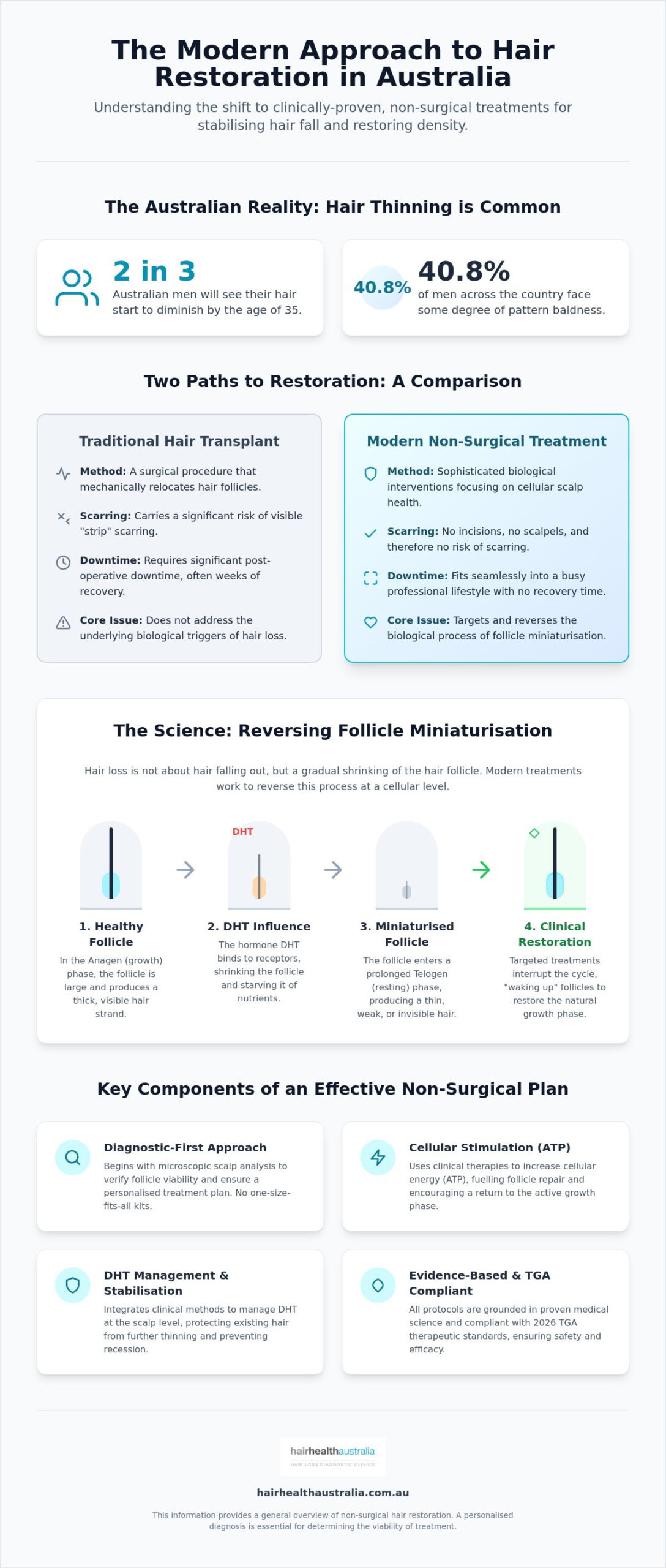
Key Components of an Effective Non-Surgical Regrowth Plan
A successful non-surgical baldness treatment Australia isn’t found in a generic supermarket kit or a one-size-fits-all subscription box. Clinical results require a tailored strategy that addresses your specific stage of thinning. Without a precise starting point, any intervention is essentially guesswork. We focus on a methodical progression that begins with data and ends with a customised, multi-modal protocol. This ensures that every action taken is directly linked to a biological need identified during your initial assessment. Precision is the difference between a temporary cosmetic change and a lasting clinical restoration.
The Diagnostic Foundation
Everything begins with a professional Hair Health Check. This isn’t just a visual inspection; it involves high-definition microscopic analysis to verify follicle viability. We need to see if the follicle is simply miniaturised or if it has reached a state of permanent inactivity. This diagnostic step is also vital for identifying the difference between genetic thinning and temporary shedding, such as Telogen Effluvium, which requires a completely different management path. By using this data, we can accurately predict the likely success rate of your restoration plan before you even begin. Data doesn’t lie. It provides the clarity needed to set realistic expectations and choose the most effective clinical pathway.
Multi-Modal Treatment Protocols
Single-method treatments often fail because they only address one aspect of the hair loss cycle. A robust clinical plan typically combines several layers of intervention, such as Low-Level Laser Therapy (LLLT), specific growth factor protocols, and clinical-grade topical formulas. This multi-modal approach creates a synergistic effect where each component supports the other. For instance, while one therapy might focus on managing DHT, another focuses on stimulating cellular ATP to wake up dormant follicles. Consistency is equally important; integrating clinical-grade shampoos and daily maintenance ensures the scalp environment remains optimal for regrowth. If you’re ready to see what’s possible for your hair, the first step is to book your diagnostic analysis today. This professional assessment ensures your plan is built on a foundation of scientific evidence rather than marketing promises.
Why Hair Health Australia is the Preferred Choice for Non-Surgical Care
At Hair Health Australia, we understand that hair restoration is a deeply personal journey that requires clinical precision rather than marketing slogans. Our approach to non-surgical baldness treatment Australia is built on a foundation of evidence-based results and a commitment to total transparency. Unlike larger, franchise-style clinics that may prioritise volume, our boutique Sydney centre focuses on providing a high-care environment where every patient receives the individual attention they deserve. We don’t believe in high-pressure sales tactics. Instead, we provide clear, realistic expectations based on your specific biological data. This professional integrity ensures that you feel confident and informed throughout every stage of your restoration process, knowing that your plan is designed for your unique scalp health.
A Personalised Path to Confidence
Our specialists are dedicated to your individual hair goals, not a monthly sales quota. We pride ourselves on a "straight-talking" approach; this means we only recommend a treatment protocol if our diagnostic analysis confirms you are a viable candidate for regrowth. If a non-surgical path isn’t likely to achieve the density you desire, we’ll tell you honestly. This dedication to ethics has made us a trusted name within the Sydney community, where we’ve helped many professionals achieve visible transformations. By focusing on the unique needs of each scalp, we ensure that your non-surgical baldness treatment Australia is as effective and sustainable as possible. We treat you as a partner in the process, seeking to empower you with knowledge about your own biology.
Taking the Next Step in Sydney
Your journey begins with a comprehensive diagnostic session at our Sydney centre. During this visit, we utilise high-resolution imaging to document your current hair density and follicle health with microscopic detail. This allows us to track your progress with clinical accuracy, providing tangible proof of your results as your treatment progresses over the coming months. You’ll experience a professional, private environment designed to make you feel at ease while we map out your path to restoration. Don’t leave your hair density to chance or generic supermarket solutions. The most reliable way to understand your options is to book a professional hair health check today. Secure your future hair density by starting with a scientifically-backed, non-invasive plan tailored specifically for you.
Secure Your Hair Density with a Scientific Approach
Restoring your hair density doesn’t require the invasive risks of surgery or the significant downtime of a hospital stay. By addressing the biological triggers of follicle miniaturisation, a non-surgical baldness treatment Australia offers a sustainable way to stabilise hair fall and revitalise thinning areas. We’ve established that a diagnostic-led foundation, powered by advanced microscopic technology, is the only way to ensure your restoration plan is rooted in biological fact rather than marketing promises.
At Hair Health Australia, our specialised Sydney clinic brings over 15 years of expertise to every consultation. We provide a professional, reassuring environment where your long-term scalp health is the primary focus. If you’re ready to replace uncertainty with a clear, clinical path forward, it’s time to act. You don’t have to navigate hair loss alone when science-backed solutions are within reach. Our team is committed to guiding you through a structured process that delivers realistic, visible results.
Book Your Comprehensive Hair Health Check in Sydney today and discover how our clinically-backed protocols can help you regain your confidence and your hair.
Frequently Asked Questions
Is non-surgical hair loss treatment permanent?
Non-surgical treatment is a long-term management strategy rather than a one-time permanent fix. Because hair loss is driven by ongoing biological factors like genetics and hormones, the follicles require consistent stimulation to maintain their revived growth cycle. If you stop a successful protocol, the underlying process of miniaturisation will eventually resume. Think of it as a specialised health regime for your scalp that preserves your results through regular, clinical care.
How much does non-surgical hair restoration cost in Australia?
The investment for a non-surgical baldness treatment in Australia varies based on the specific combination of therapies and the duration of the programme required. Every scalp is different, so we customise each protocol to match the individual’s stage of thinning and biological needs. A professional diagnostic assessment is the only way to receive an accurate quote that reflects the specific clinical interventions necessary for your restoration journey.
Can non-surgical treatments help a completely bald scalp?
Clinical regrowth is only possible if the hair follicles are still biologically active beneath the scalp surface. If an area has been completely bald for many years and the skin has become smooth or fibrotic, the follicles may have reached a point of permanent inactivity. This is why we utilise microscopic analysis during our diagnostic phase to verify follicle viability before recommending any non-surgical intervention.
Are there any side effects to clinical hair regrowth programs?
Clinical hair regrowth programmes are non-invasive and generally carry minimal side effects. Some individuals might experience temporary scalp sensitivity or slight redness immediately following certain in-clinic sessions, but these effects typically resolve quickly. Because our protocols avoid the incisions and anaesthesia required for surgery, the risk profile is significantly lower, making it a safe choice for most healthy adults.
How long does it take to see results from a non-surgical plan?
You should expect to see visible changes in hair density between three and six months after starting a consistent clinical plan. While the stabilisation of active hair fall often occurs much sooner, the process of regrowing thicker strands is tied to the natural hair growth cycle. Patience is essential as we work to transition dormant follicles back into their active growth phase.
Is non-surgical treatment suitable for women with thinning hair?
Yes, non-surgical protocols are highly effective for women experiencing diffuse thinning or female pattern hair loss. Many women choose a non-surgical baldness treatment in Australia because it offers a discreet, clinical way to restore volume without the downtime of surgery. We adapt our therapies to address the specific hormonal and biological triggers that often characterise female hair loss patterns.
Do I need a GP referral to visit a hair loss clinic in Sydney?
A GP referral is not required to book a consultation at our Sydney centre. You can contact us directly to arrange a professional hair health check and diagnostic analysis. This direct access allows you to begin your restoration journey as soon as you notice the first signs of thinning, which is often the most critical time for successful intervention.
Can I use non-surgical treatments after having a hair transplant?
Integrating non-surgical therapies after a transplant is a common clinical recommendation to protect your investment. While a transplant relocates hair to a specific area, it does not stop the natural thinning of the surrounding native hair. Ongoing clinical care helps to stabilise the rest of your scalp, ensuring that your overall hair density remains thick and uniform for the long term.