Non-surgical doesn’t mean risk-free. If you’re considering a topical treatment, device or clinic-based option, asking “are non-surgical hair treatments safe?” is a sensible first step. Safety depends on the treatment, your health history and how it’s used. An option that suits one person may not be right for another.
It’s understandable to feel unsure when side-effect information is difficult to compare and marketing claims sound confident. Treating hair loss without investigating its cause could also delay attention to an underlying issue. A personalised clinical assessment can help clarify what may be contributing to hair changes, discuss suitability and identify whether monitoring may be useful.
This article explains common types of non-surgical hair treatments, where safety concerns can arise and why evidence and correct use matter. Hair Health Australia provides tailored hair-loss care for men and women, with assessment and scalp health informing treatment discussions. You’ll find practical points to consider before deciding what to explore next, including if you’re looking for hair-loss care in Sydney.
Key Takeaways
- Whether are non-surgical hair treatments safe depends on the method, your circumstances and how treatment is selected and used.
- Different approaches target different factors in hair thinning, so identifying the likely cause can help avoid a mismatched treatment.
- Compare treatment options by considering the evidence, possible side effects and the role of clinical oversight.
- Prepare for an assessment by noting changes in your hair and scalp, relevant health information and medicines you currently take.
- Hair Health Australia’s personalised programmes for men and women begin with understanding individual concerns and circumstances.
Are non-surgical hair treatments safe? Understand what “safe” really means
It’s reasonable to ask about risks before starting hair-loss treatment. The direct answer is that safety varies by method and individual circumstances. Non-surgical options avoid transplant surgery, but that alone doesn’t make them risk-free, proven or suitable for everyone. What’s appropriate to consider depends partly on the cause of the hair changes and your health history.
Assessment matters because it helps connect the likely cause of hair loss and your personal health factors with an appropriate treatment discussion. General information can help you prepare questions, but it can’t determine what’s safe or suitable for you personally.
What counts as a non-surgical hair treatment?
Non-surgical hair treatments are approaches that don’t involve transplant surgery. They may include medicines or clinician-delivered approaches, along with other options intended to manage the appearance or progression of hair loss. These categories aren’t interchangeable. Each has its own intended use, evidence and possible adverse effects. A treatment discussed for inherited pattern hair loss, for example, may not address another cause of shedding.
That’s why a broad marketing label such as “non-invasive” shouldn’t be treated as proof of effectiveness or safety. Consider what the method is intended to do, what evidence supports that use, what its limitations are and what risks may apply.
What does “safe” mean in hair-loss care?
Safety involves more than whether a treatment is surgical. It includes whether the approach suits your circumstances, whether it’s used as directed and whether appropriate monitoring and follow-up are available. Medicines and procedures can have different precautions, so information should relate to the specific method being considered. Don’t assume a treatment suitable for someone else will also suit you.
Some effects may be expected and temporary, while severe, unexpected or worsening symptoms warrant prompt clinical advice. The appropriate response depends on the treatment and symptoms, so follow its instructions and seek advice if you’re concerned. The cause of hair loss matters too: pattern thinning, sudden shedding and scalp changes may call for different assessment and care.
A personalised hair health check can help you discuss your concerns, relevant health factors and possible next steps. Hair Health Australia’s non-surgical programmes for men and women are tailored around individual circumstances, rather than treating one approach as right for everyone.
How non-surgical hair treatments work, and why risks differ
Hair thinning can have different causes, and treatments don’t all work in the same way. Some approaches aim to address processes associated with follicle changes; others may focus on scalp health or the appearance of thinning. That distinction matters: a method intended for one cause may not be useful or appropriate for another. Likely benefits and risks depend on the specific method.
Evidence also varies. A treatment’s popularity or confident marketing isn’t proof that it works for every type of hair loss. Consider what the evidence supports for the intended use, what limitations are known and whether risks have been assessed for that particular approach.
Why the cause of hair loss changes the treatment discussion
Pattern hair loss is one possible cause, but changes in density or shedding can have other explanations. A sudden, persistent or unexplained change deserves clinical assessment rather than an assumption that it’s pattern thinning. Identifying the likely cause helps guide a more relevant discussion and reduces the risk of choosing a mismatched approach. For a general overview of treatments for patterned hair loss, Better Health Channel provides Australian consumer information. The related guide, “Clinical Hair Treatment: A Professional Guide to Non-Surgical Restoration”, explores how professional assessment fits into care.
How treatment type, health history and use affect safety
Suitability can depend on age, health history, current medicines and other individual circumstances. These factors may affect whether a treatment is appropriate, what precautions apply and what follow-up is needed. For medicines, rely on current Australian guidance and treatment-specific information rather than general claims or advice intended for someone else. Don’t start or change a medicine based only on an article.
Correct use matters too. Following the relevant instructions and discussing concerns early can help keep care informed. If an approach involves ongoing monitoring, clarify what changes should be reviewed and when. A clinical assessment can help connect the type of hair change and your personal health information with options worth discussing.
If you’re unsure where to begin, a hair health check offers a way to discuss your concerns and possible next steps. Hair Health Australia’s programmes for men and women are tailored to individual circumstances, rather than assuming one method suits everyone.
Common safety concerns: compare evidence, side effects and clinical oversight
Non-surgical treatments can still have risks, limitations or uncertain benefits. A label such as “natural”, “non-invasive” or “clinically inspired” doesn’t establish that a method is effective or safe for you. Use the comparison below to frame questions, not to rank options. Evidence and precautions depend on the specific treatment and its intended use.
| Method category | Purpose | Evidence questions | Safety considerations |
|---|---|---|---|
| Medicines | May target processes associated with certain types of hair loss. | What condition and intended use does the evidence address? What are the limitations? | Check current Australian information and treatment-specific cautions, including whether personal health factors or other medicines matter. |
| Clinician-delivered approaches | May aim to support hair or scalp care through a clinical procedure. | What evidence supports this particular method and intended outcome? | Ask what the procedure involves, what effects may occur and what monitoring or follow-up is appropriate. |
| Devices or other non-medicine approaches | May be used to address hair or scalp concerns, or alter the appearance of thinning. | Is there reliable evidence for this method, rather than testimonials alone? | Consider the instructions, intended use and any precautions relevant to the device or approach. |
General treatment information describes possible uses and known limitations; personalised clinical advice considers your health history, current medicines, hair-loss pattern and the specific method being considered. Testimonials and before-and-after images can’t establish safety or predict your result. Lighting, styling and individual differences can affect how images appear.
Which side effects and warning signs should readers understand?
Possible effects differ by treatment, so check reliable, current information specific to the method rather than relying on a generic list. If you experience a concerning or unexpected reaction, seek prompt clinical guidance instead of continuing without review. The appropriate next step depends on the treatment and your symptoms.
How to assess evidence and treatment claims
Look for evidence that relates to the particular method and intended use. Marketing language, personal stories and guaranteed-result claims aren’t substitutes for clinical evidence, and no image can promise an individual outcome. Harvard Health Publishing offers an educational discussion of the safety and efficacy of common treatments; for medicines in Australia, also check current Australian regulatory information and treatment-specific advice.
For a further treatment-focused overview, see “Best Hair Regrowth Treatment Australia 2026: A Clinical Reference Guide”. The question “are non-surgical hair treatments safe” is best answered by weighing the evidence and risks for the specific method, then considering whether it fits your circumstances.
How to make a safer, informed decision about hair treatment
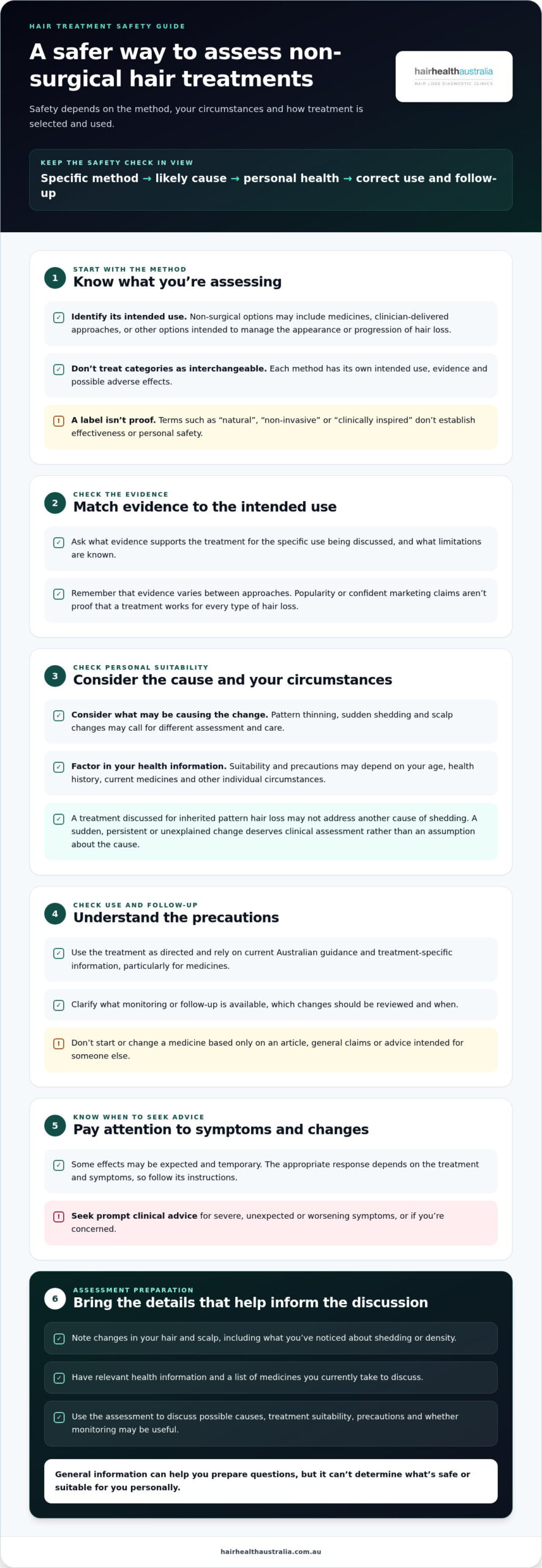
A considered decision starts with understanding what’s changed, rather than choosing a treatment based on a headline or someone else’s results. If you’re asking, “are non-surgical hair treatments safe for me?”, use an assessment to connect your hair-loss concerns and health circumstances with options that may be appropriate to discuss.
- Note the changes. Record when you first noticed thinning or shedding, whether it has changed over time and any scalp concerns. This makes the conversation more specific.
- Bring relevant information. Share your health history, current medicines and any previous treatments. These details may affect how suitability and precautions are considered.
- Discuss options and trade-offs. Ask what cause is being considered, what a treatment is intended to do, what evidence supports it, what possible effects or limitations apply, and whether there are alternatives.
- Agree on a review plan. Clarify how progress will be assessed, when the approach will be reviewed and what changes should prompt follow-up. Set realistic, individual goals without assuming one method works for everyone.
What to discuss before starting a treatment
Make sure the discussion covers potential benefits as well as uncertainties. Useful questions include: “How does this option relate to my hair-loss concerns?”, “What effects should I look out for?” and “How will we decide whether it’s helping?” For medicines, ask about current Australian guidance and treatment-specific cautions. A clear plan should also explain how to use the treatment appropriately and when to seek advice if you have concerns.
When to seek professional assessment
Arrange an assessment if thinning is persistent, begins suddenly or has no clear explanation. That doesn’t mean a particular cause can be assumed. It means there’s value in investigating the change before committing to an approach, so the discussion can focus on what may be contributing and what next steps are reasonable. For more on preparing for an assessment, see “Choosing a Non-Surgical Hair Loss Clinic in Sydney: The 2026 Essential Checklist”.
A hair health check provides a structured way to discuss your hair changes, health information and possible treatment considerations. Hair Health Australia tailors its non-surgical programmes for men and women, with individual circumstances informing the care discussion. To take that next step, book a hair health check.
How Hair Health Australia approaches non-surgical hair care
Hair loss can raise personal questions, and a treatment plan shouldn’t start with assumptions. Hair Health Australia provides personalised, non-surgical hair-loss programmes for men and women, centred on clinically backed care, assessment and scalp health. The starting point is understanding what you’ve noticed and what matters to you, then discussing options in light of your individual circumstances.
Why assessment comes before a treatment plan
A hair health check is a practical first step for exploring your concerns and what may be relevant to discuss. It doesn’t guarantee that a particular treatment will suit you, and an assessment doesn’t mean you need to proceed with treatment. Instead, it helps make the conversation more individual. The pattern and timing of hair changes, scalp concerns and relevant health information can all help inform which options are worth considering.
Different causes of hair loss may call for different approaches. A treatment that’s appropriate in one situation may not fit another, so a tailored discussion is more useful than applying a standard plan to everyone. You can also raise questions about evidence, possible limitations and how progress might be reviewed. The aim is clarity, not pressure to choose a particular approach.
What readers can expect from a personalised approach
Hair Health Australia’s programmes are tailored rather than presented as one-size-fits-all. Individual circumstances help shape the discussion, while the clinic’s focus on clinically backed non-surgical care and scalp health provides a considered basis for exploring next steps. Suitability and outcomes vary, and no result should be treated as guaranteed.
If you’re weighing up whether non-surgical hair treatments are safe for your situation, an assessment can help you raise the right questions before making a decision. Consider bringing a clear history of your hair changes, relevant health information and a list of medicines you currently take. These details can support a more informed discussion of your concerns and possible options.
There’s no need to decide everything at once. A hair health check can help you understand what to consider and whether further discussion is appropriate for you. To begin, arrange a hair health check.
Take a considered next step for your hair health
So, are non-surgical hair treatments safe? They may be appropriate for some people, but safety depends on the treatment, the cause of hair loss and your individual health circumstances. Evidence, correct use and suitable monitoring matter too. A personalised assessment can help clarify which options may be relevant, rather than relying on broad claims or assuming one approach suits everyone.
Hair Health Australia provides tailored, non-surgical hair-loss programmes for men and women, with care focused on clinically backed methods. Its Sydney-based hair health assessment pathway offers a practical starting point to discuss your concerns and possible next steps. An assessment isn’t a promise of a particular treatment or result; it’s an opportunity to make a more informed decision.
If you’re ready to explore your options, arrange a hair health check. A calm, individual conversation can help you move forward with greater clarity and confidence.
Frequently Asked Questions
Are non-surgical hair treatments safe for everyone?
No. Whether non-surgical hair treatments are safe for you depends on the method, the cause of hair loss and personal factors such as your health history and current medicines. An option that suits one person may not be appropriate for another. An assessment can help clarify which approaches are relevant to discuss, what precautions may apply and how progress could be reviewed. General information can’t determine your individual suitability.
Can non-surgical hair treatments cause side effects?
Yes, some can, but possible effects vary between treatments. Check current, reliable information that relates to the specific method, rather than assuming all non-surgical options have the same risks. Follow the treatment’s instructions and seek clinical advice if you experience an unexpected or concerning reaction. Don’t continue without review if you’re worried about symptoms. A clinician can help explain the relevant precautions and what follow-up may be appropriate.
Is non-surgical hair treatment safer than a hair transplant?
There isn’t one answer that applies to every person or treatment. Non-surgical care and hair transplant surgery involve different approaches, considerations and potential risks, so “safer” depends on the option and individual circumstances. Non-surgical doesn’t automatically mean risk-free, just as surgery shouldn’t be assessed through broad assurances. Discuss the likely benefits, limitations, risks and suitability of the specific approach you’re considering before making a decision.
How do I know whether a hair-loss treatment is right for me?
Start by assessing what may be contributing to your hair changes and discussing your health circumstances. A suitable treatment discussion should cover its intended use, supporting evidence, possible effects, limitations and how progress will be reviewed. Bring a history of your hair changes and current medicines to an assessment. Hair Health Australia provides tailored hair-loss programmes for men and women in Sydney, with individual concerns guiding the discussion rather than a one-size-fits-all plan.
Can I use hair-loss treatments if I take other medicines?
Possibly, but don’t assume a hair-loss treatment is suitable alongside your current medicines. Tell the clinician assessing you about prescription medicines, non-prescription products and relevant health information. For a medicine being considered, check current Australian guidance and its specific cautions with an appropriate health professional. Don’t stop or change an existing medicine without advice from the professional who manages it. Suitability depends on your full circumstances and the treatment involved.
When should I seek professional advice about hair thinning?
Seek an assessment if thinning is persistent, starts suddenly or has no clear explanation. A change in hair density or shedding can have different causes, and it isn’t possible to identify yours from a general article. Discussing the change can help clarify what may be contributing and what next steps are appropriate. Note when you first noticed it, how it has changed and any scalp concerns to make the conversation more useful.
Do non-surgical hair treatments work for every cause of hair loss?
No. Hair-loss approaches are not interchangeable, and a treatment intended for one cause may not address another. The evidence and likely usefulness also vary by method and intended use. That’s why identifying the likely cause is an important part of deciding what options to discuss. If you’re unsure what may be behind your hair changes, an individual assessment can help guide a more relevant conversation without assuming a diagnosis or promising a particular outcome.