What if the most useful first step isn’t choosing a treatment, but understanding why your hair is thinning? If you’re considering a non-surgical hair loss clinic Sydney residents can access, you’ll want a clear picture of the assessment, possible approach and commitment involved before deciding what to do.
Hair loss can have different causes, and a programme focused on supporting hair growth is not the same as cosmetic hair replacement or transplant surgery. A personalised assessment can help you discuss your hair and scalp concerns, whether a non-surgical programme may suit your circumstances, and what expectations are realistic. It’s a practical starting point, not a promise of a particular result.
In this article, you’ll learn how non-surgical hair loss care works, what an assessment can help you consider and how an individualised care pathway differs from cosmetic options. We’ll also cover what to discuss about commitment and progress, so you can take a considered next step with Hair Health Australia’s personalised care for men and women in Sydney.
Key Takeaways
- A non-surgical hair loss clinic Sydney can help you explore options through an assessment-led approach, rather than treating every case of thinning the same way.
- Noting when hair loss began, how it has changed and what concerns you most can make an assessment more useful.
- Clinical regrowth care, cosmetic hair systems and transplant surgery address different needs. Understanding the distinctions helps you focus on the option that fits your circumstances.
- An individualised programme and progress discussions can help you understand the proposed approach and keep expectations realistic.
- A hair health check is a considered first step towards understanding your concerns and possible next steps, not a promise of a particular result.
What does a non-surgical hair loss clinic in Sydney do?
A non-surgical hair loss clinic Sydney residents can visit provides assessment-led support for people concerned about thinning or pattern baldness. Non-surgical hair loss care is an individualised approach to understanding hair and scalp health and considering options that may support regrowth, without surgery or cosmetic coverage. The aim is to consider your circumstances and appropriate next steps, not to promise a particular result.
Hair thinning can have different causes and patterns. Family history, health and personal circumstances may all be relevant, so noticing a change doesn’t confirm its cause. An individual assessment helps put your concern in context and consider whether a non-surgical programme is suitable. General background on hair loss and its different types is available in Understanding Hair Loss, but it can’t establish what’s happening in your individual case.
Hair Health Australia provides personalised, non-surgical programmes for men and women, focused on thinning hair, pattern baldness, follicle stimulation and scalp health. Its hair health check is a considered starting point for discussing your concerns and possible next steps.
Clinical regrowth care and cosmetic hair replacement are different
These approaches serve different needs. A regrowth-focused programme considers hair health and whether an individualised course of care may be appropriate. A hair system or wig changes visible appearance by providing cosmetic coverage; it doesn’t address the underlying cause of hair loss. Neither approach suits everyone.
Sydney Hair Clinic’s presentation of hair systems illustrates the distinction: a system is a cosmetic hair-replacement option, rather than a programme focused on hair health. Transplant surgery is different again, involving a surgical procedure. When comparing options, first identify your priority: cosmetic coverage, a non-surgical approach to thinning, or information about surgery.
- Non-surgical regrowth care: considers hair and scalp health through an individualised programme.
- Hair systems and wigs: provide cosmetic coverage to change appearance.
- Transplant surgery: is a surgical approach, not non-surgical clinical care.
Who may consider non-surgical hair loss care?
Men and women noticing thinning or pattern baldness may wish to explore non-surgical care. Whether a particular programme is suitable depends on individual hair health, the nature of the concern and personal circumstances. A symptom or photograph alone can’t establish the cause or determine the right approach.
You don’t need to arrive at an assessment with a firm conclusion. It can help to describe what you’ve noticed, when it began and what you want to understand. From there, you can consider the findings and whether an individualised programme makes sense for you, with expectations grounded in your situation.
How a Sydney hair loss assessment can guide your treatment pathway
An assessment gives structure to the questions behind hair thinning. Instead of jumping straight to a treatment, it brings together what you’ve noticed, relevant context and your hair health concerns. For someone considering a non-surgical hair loss clinic Sydney, this can clarify what to discuss next and whether an individualised programme may be appropriate.
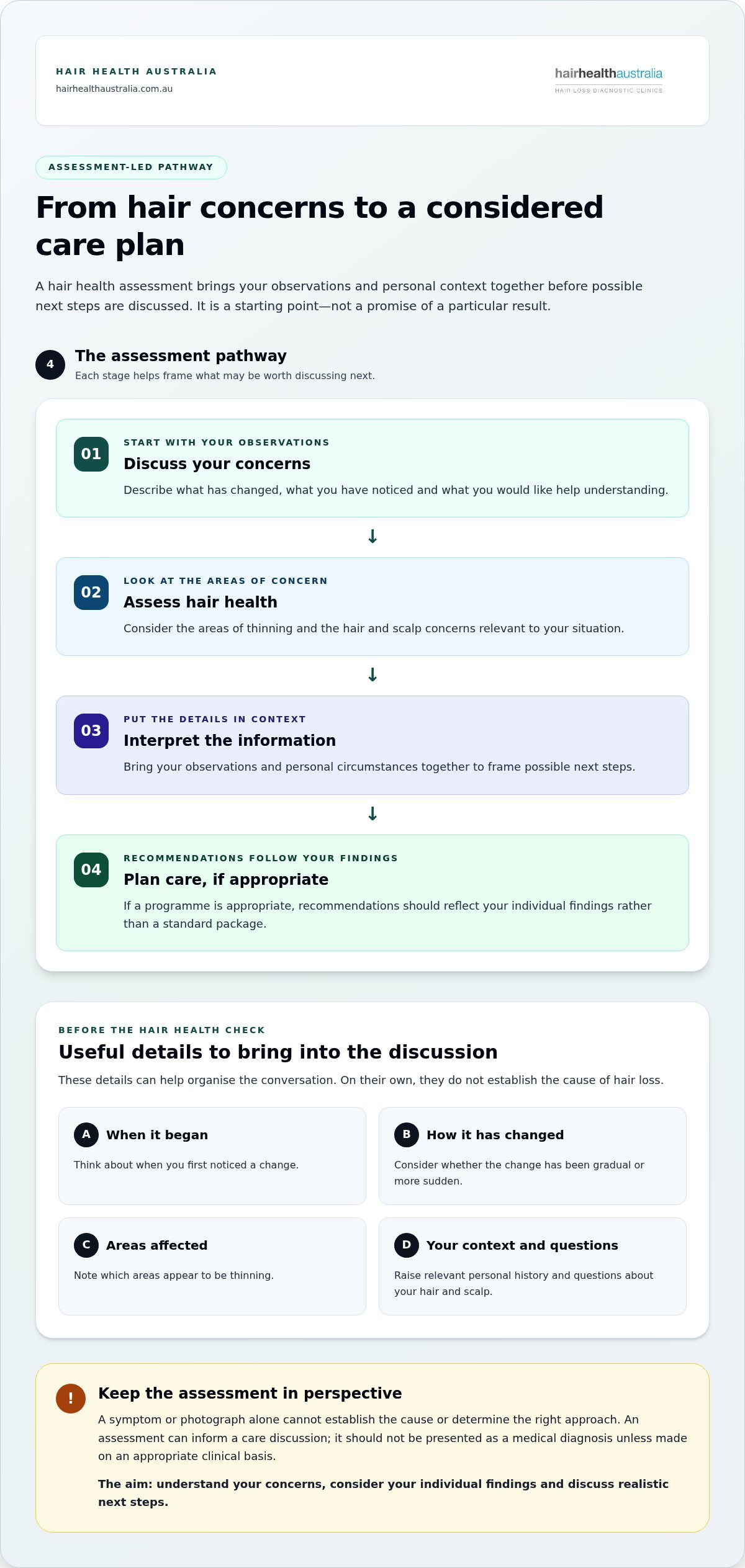
The process can be understood in four steps:
- Discuss your concerns. Describe what has changed, what you’ve noticed and what you’d like help understanding.
- Assess hair health. Consider the areas of thinning and the hair and scalp concerns relevant to your situation.
- Interpret the information. Bring your observations and personal context together to frame possible next steps.
- Plan care. If a programme is appropriate, recommendations should reflect your individual findings rather than a standard package.
What information can a hair health check bring together?
Before your hair health check, think about when you first noticed a change, whether it has been gradual or more sudden, and which areas appear affected. You can also raise relevant personal history and questions about your hair and scalp. These details help frame the discussion; they don’t, by themselves, establish the cause of hair loss.
A hair health check is a starting point for discussing your concerns before considering a programme. It can help organise what you’ve observed and what you want to find out, without treating an online image or a single symptom as a diagnosis.
How assessment findings shape a personalised plan
Recommendations should follow from the information gathered, not from a one-size-fits-all offer. The pattern of thinning, when it began and your personal circumstances may all affect which next steps are worth discussing. Hair Health Australia’s programmes are personalised for men and women, with a focus on thinning hair, pattern baldness, follicle stimulation and scalp health.
An assessment can inform a care discussion, but it shouldn’t be presented as a medical diagnosis unless it’s made on an appropriate clinical basis. If the cause is unclear or your concerns suggest a need for medical evaluation, that distinction matters. General information about non-invasive hair loss treatments can introduce different approaches, but it can’t determine which option suits your circumstances.
The value of the check is clarity, not a guaranteed outcome. Before deciding whether to proceed, make sure you understand what a proposed programme is intended to address, how it relates to your concerns and what questions remain.
If you’re ready to organise your concerns and explore possible next steps, you can start with a hair health check.
Clinical regrowth, hair systems or surgery: what is the difference?
These options are sometimes grouped together because they relate to hair loss, but they serve different purposes. A clinical regrowth programme considers hair and scalp health; a hair system changes appearance by providing coverage; transplant surgery is a procedure. Knowing the distinction helps you focus on the support you’re seeking, rather than comparing options as if they do the same job.
| Option | Purpose | Approach | May address |
|---|---|---|---|
| Non-surgical clinical care | Consider hair health and potential regrowth support. | An individualised assessment and programme. | People exploring a non-surgical approach to thinning or pattern baldness. |
| Hair system or wig | Change the visible appearance of hair. | Cosmetic coverage using a hairpiece or system. | People prioritising coverage or an appearance change. |
| Transplant surgery | Address hair loss through a surgical procedure. | A procedure involving the movement of hair follicles. | People considering a surgical option after appropriate assessment. |
Non-surgical clinical care versus hair replacement systems
A hair system and a clinical programme answer different priorities. Someone seeking cosmetic coverage—such as hairpieces or follicle simulation and camouflage treatments from specialists like Ogzy Skin & Scalp Tattoo—may value the appearance an aesthetic solution provides, while someone concerned with thinning may want to explore an approach focused on hair health. One isn’t automatically a substitute for the other, and neither is right for every person or cause of hair loss.
Hair Health Australia provides personalised, non-surgical hair loss programmes for men and women. Its focus is hair health, including thinning hair and pattern baldness, rather than changing appearance with a hairpiece. Readers comparing cosmetic approaches can explore Non-Surgical Hair Replacement Sydney Options separately, keeping in mind that replacement and regrowth care have distinct aims.
Non-surgical care versus transplant surgery
Transplant surgery is a procedural option. It differs from non-surgical care in its approach and the decisions involved, so the two shouldn’t be treated as interchangeable. Whether surgery is appropriate depends on individual circumstances and assessment; it isn’t inherently the best choice for everyone.
This article focuses on Hair Health Australia’s personalised non-surgical programmes for men and women. They offer a pathway centred on hair health rather than a surgical procedure, but suitability and response can vary. An assessment can help clarify which concerns matter and what options may be relevant, without promising a particular outcome.
In short, consider your priority: supporting hair health, achieving cosmetic coverage, or exploring a surgical procedure. If you’re looking for a non-surgical hair loss clinic Sydney pathway, Hair Health Australia focuses on individualised regrowth care. This distinction can help you ask more focused questions and decide what to explore next.
What Sydney clients can expect from a non-surgical treatment journey
A non-surgical hair loss clinic Sydney pathway should help you understand what care involves before you commit to a programme. The journey moves from discussing your concerns to considering an individualised approach, then reviewing how things are going. It isn’t a guaranteed route to regrowth; the right next step depends on your hair health and circumstances.
In practical terms, the process may involve:
- Starting with an assessment: discuss what you’ve noticed and what you hope to address.
- Considering suitability: use the information gathered to explore whether a non-surgical programme fits your needs.
- Discussing an individualised programme: understand what the proposed care is intended to address and what it involves.
- Reviewing progress: discuss changes and concerns so they can inform conversations about your care.
Some causes or stages of hair loss may call for a different clinical approach. An assessment can help frame whether a programme is suitable; it shouldn’t be treated as a guarantee that a particular option will work for everyone. Hair Health Australia’s personalised programmes are designed for men and women, with a focus on thinning hair, pattern baldness, follicle stimulation and scalp health.
How to set realistic expectations
Response can vary with individual hair health and the approach recommended. Before proceeding, discuss what the programme is intended to address, what it can’t promise and how progress will be considered. Ask questions if any part of the recommendation is unclear. This keeps decisions grounded in your circumstances, rather than in general claims or someone else’s results.
It’s also reasonable to clarify what would count as meaningful progress for you. Your priorities might include understanding a change in hair density or feeling confident about the plan, not simply expecting visible regrowth. A measured conversation about goals and limitations can help you decide whether the commitment feels appropriate.
What ongoing care and progress discussions are for
Non-surgical care may involve ongoing commitment, so progress discussions have a practical purpose: they give you an opportunity to review what you’ve noticed, raise questions and consider whether the plan remains suitable. They don’t guarantee a particular outcome, and a discussion isn’t proof that a programme will produce the same response for everyone.
There’s no single timeline or review schedule that applies to every person. The focus is on interpreting progress in light of your individual circumstances and discussing any relevant adjustments to the care plan. For further context on non-surgical restoration, see Clinical Hair Treatment: A Professional Guide to Non-Surgical Restoration.
If you’d like to begin by discussing your hair health and possible next steps, arrange a hair health check.
Hair Health Australia: a Sydney pathway to non-surgical hair loss care
Hair Health Australia provides personalised, non-surgical hair loss programmes for men and women in Sydney. The focus is understanding each person’s concerns and considering care in light of their circumstances, rather than beginning with a one-size-fits-all treatment or a promised result.
A hair health check offers a considered first step. You can explain what you’ve noticed, ask questions and discuss possible next steps before deciding whether a programme feels suitable. The check is not a guarantee of regrowth, and expectations should remain realistic. Its value is helping frame an informed discussion about your hair health.
A tailored approach for men and women
Hair loss concerns differ from person to person. Hair Health Australia’s programmes are designed for men and women, with a focus on thinning hair, pattern baldness, follicle stimulation and scalp health. An individualised approach keeps the discussion centred on your concerns and circumstances, rather than assuming the same recommendation suits everyone.
Women exploring their options may also find it useful to read Hair Loss Treatment for Women: The 2026 Australian Clinical Buying Guide for further context. Whatever your starting point, an assessment helps you discuss the concern before considering a care pathway. It’s not a reason to diagnose yourself from a symptom or choose a treatment based only on a general description.
Take a considered first step in Sydney
If you’re unsure where to begin, note what you’ve observed and what you’d like to understand. You might write down when the change first caught your attention, which areas concern you and what questions you have about hair and scalp health. This can make the conversation more focused and help keep your priorities clear.
From there, the hair health check can help bring your concerns into a clearer discussion of possible next steps. A non-surgical hair loss clinic Sydney pathway should make space to talk about suitability, what a proposed programme is intended to address and any limitations. If care is recommended, the decision remains yours. Take time to consider the information and whether the approach fits your needs.
Hair Health Australia’s approach is grounded in personal assessment and realistic expectations. Hair loss has different causes, and a non-surgical programme won’t be suitable for every person or situation. A clear conversation can help you understand what’s being proposed without implying a fixed timeline or guaranteed outcome.
If you’re ready to discuss your concerns and explore possible next steps, book your hair health check.
Take a considered next step for your hair health
Deciding to explore care doesn’t mean you need to have chosen a treatment or know why your hair is thinning. Begin with practical questions: what changes have you noticed, what would you like to understand, and what would make a care plan feel right for you? A non-surgical hair loss clinic Sydney pathway can turn those questions into a focused discussion without asking you to assume a particular result.
Hair Health Australia’s hair health check is a starting point for discussing your individual concerns and possible next steps. It can help you consider whether personalised non-surgical care for men or women fits your circumstances, with realistic expectations rather than a guaranteed outcome. You don’t need to decide on a programme before understanding the approach. Take the first step at your own pace: book your hair health check. A clearer understanding of your options can make the next decision feel more manageable.
Frequently Asked Questions
Is non-surgical hair loss treatment effective?
It may help support hair health for some people, but results aren’t guaranteed and depend on individual factors. The cause and extent of hair loss, personal hair health and the recommended approach all matter. Be cautious of claims that promise the same outcome for everyone. A useful discussion covers what a programme is intended to address, its limitations and how progress will be considered in your circumstances.
Can a non-surgical hair loss clinic help both men and women?
Yes. Hair Health Australia provides personalised hair loss programmes for men and women in Sydney. Hair loss concerns differ between individuals, so recommendations should take account of the person’s situation rather than assume one approach suits everyone. If you’re concerned about thinning, an assessment gives you an opportunity to explain what you’ve noticed and discuss whether non-surgical care may be relevant to your needs.
What happens during a hair health check?
A hair health check is a starting point for discussing your concerns and possible next steps. You can describe when you noticed a change, which areas concern you and any relevant personal context. The discussion helps organise those observations before considering whether a personalised programme may be suitable. It isn’t a promise of a particular result, nor should a check alone be treated as a medical diagnosis.
How long does non-surgical hair loss treatment take to show results?
There isn’t one timeframe that applies to everyone, and a specific result or date can’t be guaranteed. Response depends on individual hair health and the care approach considered. Before starting, discuss what progress might reasonably mean in your circumstances and how it may be reviewed. Another person’s experience isn’t a reliable prediction of your outcome.
Is non-surgical treatment suitable for advanced hair loss?
It depends on the individual situation, so the stage of hair loss alone can’t determine suitability. An assessment can help clarify your concerns and whether a non-surgical programme is a reasonable option to discuss. If the cause or extent of hair loss needs medical evaluation, distinguish that from a general hair health discussion. Avoid choosing a treatment based only on photographs or online descriptions.
How much does non-surgical hair loss treatment cost in Sydney?
The cost depends on the individual programme and the care recommended, so there isn’t a single figure that applies to every person. Before deciding whether to proceed, discuss the proposed approach and its costs. Hair Health Australia’s hair health check can be a starting point for discussing your concerns and potential next steps.
Is a hair system the same as hair regrowth treatment?
No. A hair system changes appearance by providing cosmetic coverage, while regrowth-focused care considers hair health and a potential non-surgical treatment pathway. They address different priorities, and neither is automatically right for every person. If you’re deciding what to explore, consider whether your immediate priority is coverage or an approach focused on your own hair and scalp health.