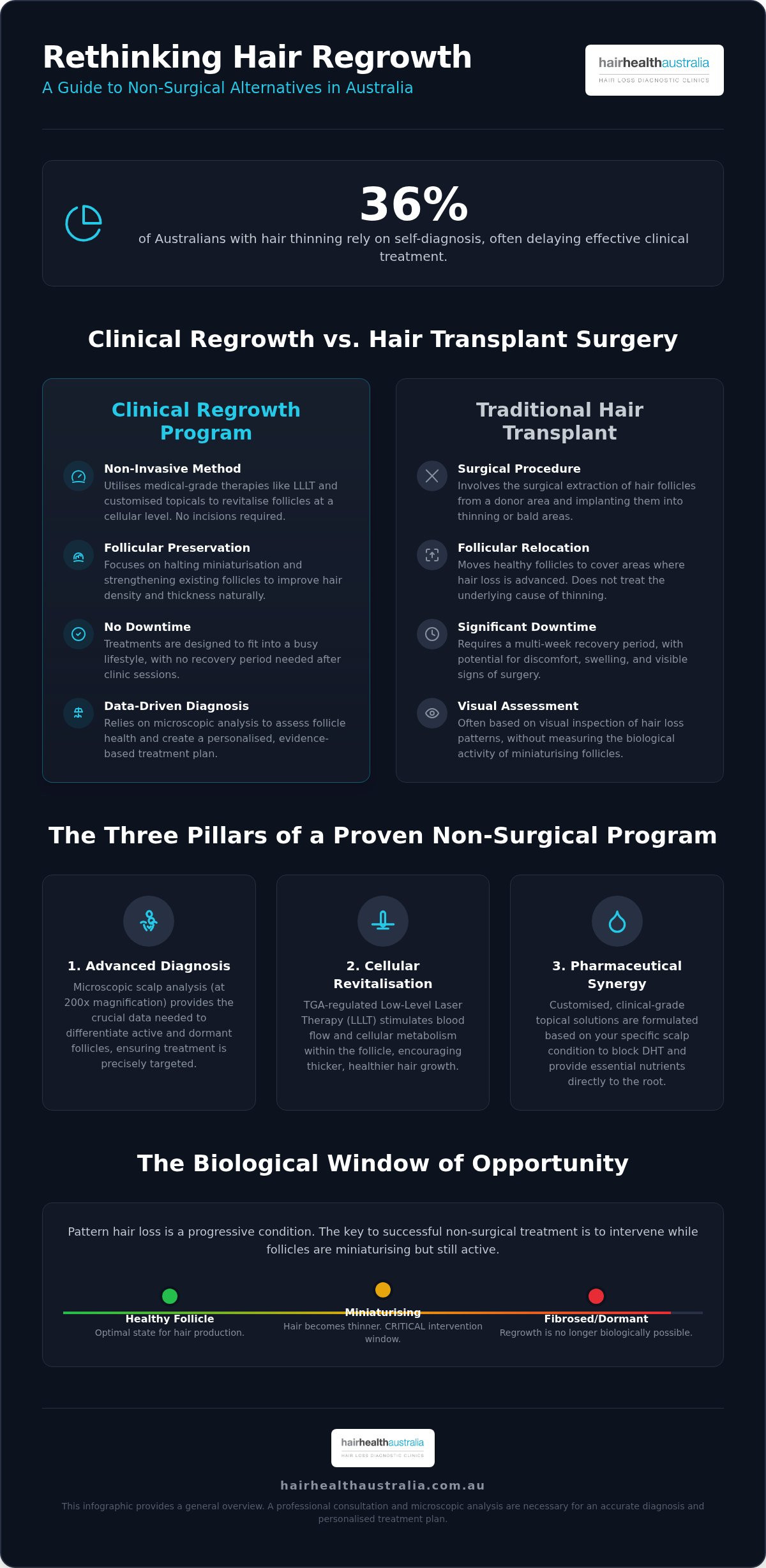
Approximately 36% of Australians experiencing hair thinning rely on self-diagnosis rather than seeking professional clinical advice, often spending years on “miracle” products that fail to deliver. While the high cost and surgical risks of a hair transplant might feel like the only definitive answer, the reality is that many individuals can achieve significant regrowth without ever entering an operating theatre. It’s understandable to feel overwhelmed by conflicting online claims and the anxiety of potential scarring. You’re looking for clarity, not another marketing gimmick, and you deserve a path that is both scientifically sound and transparent.
This guide introduces the evidence-based hair transplant alternatives Australia provides in 2026, prioritising non-invasive clinical protocols that target follicular miniaturisation at its source. We’ll outline how microscopic scalp analysis and TGA-regulated treatments, such as medical-grade laser therapy and customised topical solutions, can halt active shedding and improve visible density. You’ll discover a structured, scientific approach to regrowth that replaces surgical uncertainty with a personalised plan grounded in Australian clinical standards, ensuring your journey to hair health is both safe and effective.
Key Takeaways
- Understand why Australian patients are shifting toward non-invasive protocols that offer clinical results without the downtime or surgical risks associated with traditional procedures.
- Learn how advanced microscopic analysis differentiates between active and dormant follicles to ensure your treatment plan is based on biological data rather than guesswork.
- Compare the financial and physical investment of surgical procedures against the proven hair transplant alternatives Australia provides in 2026.
- Discover the “three pillars” of hair regrowth, focusing on how Low-Level Laser Therapy (LLLT) and pharmaceutical synergy revitalise thinning hair at a cellular level.
- Identify the critical questions to ask a Sydney-based specialist to verify the clinical validity and TGA compliance of their non-surgical programs.
The Rise of Non-Surgical Hair Transplant Alternatives in Australia
The landscape of hair restoration in Australia has undergone a significant transformation. More individuals are now prioritising non-invasive methods over surgical intervention, driven by a desire for low-downtime solutions that fit a busy lifestyle. In 2026, clinical hair transplant alternatives Australia offer a pathway to density without the scalpel. These protocols are distinct from cosmetic “hair systems” or hairpieces, which merely mask thinning. Biological regrowth therapies focus on revitalising the scalp’s natural ecosystem to produce thicker, healthier strands. Central to this approach is follicular preservation. It’s far more effective to save a weakened follicle than to attempt to replace it later through surgery.
TGA Standards and Clinical Validity
Australian patients benefit from some of the strictest medical regulations in the world. The Therapeutic Goods Administration (TGA) oversees the devices and medications used in reputable clinics, ensuring they meet rigorous safety benchmarks. This oversight is why clinical-grade concentrations often outperform standard pharmacy-grade options found on supermarket shelves. While “hair tourism” in overseas markets might seem cost-effective initially, it lacks the systematic care and verified standards found locally. Choosing an Australian clinic means accessing protocols that are monitored for quality and consistency, providing a level of security that surgery abroad cannot match.
The Biological Window of Opportunity
Understanding Pattern hair loss is essential for anyone considering alternatives to surgery. This condition involves follicular miniaturisation, where hair strands become progressively thinner until the follicle stops producing hair altogether. Timing is everything in this process. Once a hair follicle has completely fibrosed and the scalp surface becomes smooth, biological regrowth is no longer a viable option. Therefore, the primary clinical objective of any successful programme is to halt active hair fall immediately. By intervening while follicles are still active, you can reverse thinning and avoid the need for invasive procedures. A Hair Health Check is the most reliable way to determine if you are still within this critical window and to establish a baseline for your recovery.
Why Accurate Diagnosis is the Foundation of Regrowth
Relying on a mirror for a diagnosis is a common mistake that leads many Australians to believe surgery is their only option. A standard visual inspection is subjective and fails to account for the biological activity beneath the skin. While you might see thinning, you can’t see the health of the follicle itself. Accurate data is the only way to determine if hair transplant alternatives Australia provides are right for your specific situation. Without this, you risk investing in treatments that aren’t suited to your biological needs.
The Power of Microscopic Hair Analysis
Microscopic scanning allows us to measure hair shaft diameter with clinical precision. This is vital for detecting early genetic thinning long before it’s noticeable to the naked eye. By booking a professional Hair Health Check, you can view your scalp at 200x magnification. This level of detail helps us distinguish between permanent genetic loss and temporary conditions like telogen effluvium, which is often triggered by stress or illness. Identifying active vs. dormant follicles ensures we don’t waste time on areas that can no longer be revived.
A healthy scalp environment is the prerequisite for any regrowth protocol. Excess sebum or chronic inflammation can block follicles and hinder the absorption of growth stimulants. Understanding Patterned hair loss treatments in Australia requires looking at the scalp as a whole ecosystem. We use baseline data from your initial scan to track every micron of progress, allowing us to adjust your clinical protocol as your scalp health improves.
Personalised Protocols vs. Generic Products
Generic products from a local chemist often fail because they follow a “one-size-fits-all” model. They don’t account for the varying degrees of DHT sensitivity or the specific stage of male or female pattern baldness you’re experiencing. Clinical data allows for the precise customisation of DHT blockers and growth stimulants. This tailored approach ensures you’re receiving the right concentration of active ingredients for your specific thinning pattern. It’s about moving away from guesswork and toward a systematic, evidence-based plan.
When exploring the most effective hair transplant alternatives Australia offers, a personalised clinical roadmap is always the most reliable path to success. If you’re ready for a clearer picture of your options, it’s time to book a professional Hair Health Check to begin your diagnostic journey.
Comparing Clinical Regrowth vs. Hair Transplant Surgery
When weighing up the hair transplant alternatives Australia offers, the comparison often begins with the financial commitment. While a surgical procedure in an Australian clinic typically ranges from A$11,000 to over A$30,000, clinical regrowth programs represent a more manageable and scalable investment. Beyond the initial price tag, the recovery profiles are vastly different. A clinical approach allows for an immediate return to professional and social activities; surgery, however, requires significant healing time, often involving visible scabbing and swelling that can last for weeks.
A common misconception is that a transplant serves as a final solution. Surgery merely redistributes existing hair. It doesn’t address the underlying cause of thinning in the non-transplanted areas. This is why Diagnosing hair loss through a clinical lens is so important. Without a structured regrowth plan, the surrounding natural hair continues to fall, often leaving the transplanted grafts looking isolated and unnatural over time. Clinical protocols ensure that your existing hair is protected alongside any new growth.
The Financial and Lifestyle ROI
Many Australians choose clinical therapy to avoid the aesthetic risks associated with invasive surgery. Older methods often resulted in an unnatural “pluggy” appearance or linear scarring. Modern Best Hair Regrowth Treatment Australia 2026 protocols focus on maintaining your natural hairline and density. By prioritising the health of your existing follicles, you preserve a natural hair exit angle that surgery often struggles to replicate. This approach offers a higher lifestyle ROI, as you don’t have to explain a sudden, drastic change in your appearance or hide away during a long recovery period.
Biological Impact: Saving Your Natural Follicles
Clinical therapy focuses on strengthening your natural hair rather than just moving it around. This is particularly important for younger patients who may not have a stable donor area yet. By addressing follicular miniaturisation early, you maintain a consistent density across the whole scalp. This non-invasive route eliminates the risks of surgical complications such as infection, nerve damage, or poor graft uptake. For most individuals, effective hair transplant alternatives Australia provides are the preferred starting point, allowing you to exhaust biological regrowth options before ever considering a scalpel.
The Three Pillars of a Proven Non-Surgical Program
A successful non-surgical protocol is never a matter of luck. It’s the result of a coordinated clinical effort that addresses the biological causes of hair loss from multiple angles. For those seeking hair transplant alternatives Australia, the most effective programmes are built on a foundation of synergy. By combining targeted pharmaceutical intervention with cellular stimulants and professional scalp care, we create an environment where natural hair can thrive. This multi-faceted approach ensures that every stage of the hair’s growth cycle receives the support it needs to function at its peak.
Cellular Stimulation and Laser Therapy
Medical-grade Low-Level Laser Therapy (LLLT) is a cornerstone of modern hair restoration. Unlike low-powered laser combs or consumer caps found online, clinical-strength LLLT devices provide the specific wavelength and power density required to reach the follicle base. This stimulation is designed to extend the Anagen (growth) phase of the hair cycle, preventing the premature shedding associated with genetic thinning. Light energy absorbed by the hair follicle triggers a biochemical reaction that increases ATP production, providing the cellular energy required to transition follicles from a dormant state back into the active growth phase. This process effectively re-energises the mitochondria to promote thicker and more resilient strands.
DHT Blockers and Scalp Nutrition
The second and third pillars involve managing the chemical environment of the scalp. Dihydrotestosterone (DHT) is the primary hormone responsible for shrinking hair follicles in pattern loss. Clinical protocols focus on neutralising DHT at the site of the follicle without the systemic side effects often associated with oral medications. This is paired with professional scalp cleansing to remove hardened sebum and environmental debris that can physically block new growth. A clean, nutrient-rich scalp ensures that topical growth activators can penetrate deeply to increase localised blood flow and deliver essential minerals. To understand how these elements work together, you can refer to our Clinical Hair Treatment: A Professional Guide for a deeper dive into non-surgical restoration.
Sustainable results require consistency and regular clinical monitoring. Hair growth is a slow biological process; therefore, adjusting the protocol based on microscopic data is vital for long-term success. We track your progress every step of the way to ensure your plan remains optimised for your evolving needs. If you’re ready to see how these three pillars can be applied to your situation, the first step is to arrange a clinical Hair Health Check to assess your current scalp condition.
Choosing a Specialist Hair Loss Clinic in Sydney
Selecting the right partner for your hair restoration journey is as critical as the treatment itself. In Sydney, a dedicated non-surgical clinic offers a level of focus that high-volume surgical centres often lack. These specialists prioritise the long-term biological health of your hair rather than surgical throughput. It feels like a consultation with a trusted specialist who is both knowledgeable and approachable, replacing uncertainty with a clear, actionable roadmap. This individual-centric approach ensures your plan is designed for your specific scalp environment.
When evaluating hair transplant alternatives Australia, you must ensure the clinic adheres to rigorous clinical standards. Ask if they provide microscopic evidence of regrowth at every stage. Inquire if their protocols are TGA-compliant and if they offer personalised formulations tailored to your specific diagnostic data. Data drives every decision. A reliable Sydney specialist will provide a steady and composed presence, guiding you through the science of your regrowth with complete honesty and transparency.
Clinical Care vs. Pharmacy “DIY”
Self-treating with over-the-counter products is often a gamble that results in lost time and further thinning. Without a professional microscopic diagnosis, you’re essentially guessing which biological pathway needs support. Guesswork is the enemy of results. Specialist clinics provide access to high-potency formulations and medical-grade technology that generic pharmacy products cannot match. Regular monitoring allows your specialist to adjust your programme in real-time, ensuring that as your scalp health improves, your treatment remains optimised for maximum density.
Taking the First Step Toward Regrowth
The “wait and see” approach is the most common reason hair loss becomes permanent. Once a follicle has reached the point of no return due to advanced follicular miniaturisation, the window for non-surgical intervention closes. A diagnostic scan at our Sydney centre removes the guesswork, providing the clarity required to stop active hair fall and begin the regrowth process. At Hair Health Australia, we’ve been dedicated to evidence-based regrowth since 2009, helping Australians achieve visible results without the need for a scalpel.
Your journey to thicker hair begins with a single, data-driven step. Organise your personalised Hair Health Check at our Sydney clinic today.
Your Path to Sustainable Hair Restoration
The journey to restoring hair density doesn’t have to involve a scalpel or significant surgical downtime. By prioritising a diagnosis-led approach, you can move away from the uncertainty of generic products and toward a plan that respects your unique biology. The synergy of medical-grade laser therapy, targeted DHT management, and professional scalp care creates the optimal environment for natural regrowth. These hair transplant alternatives Australia provides in 2026 are grounded in clinical validity and Australian standards, offering a viable route for those who intervene before thinning becomes permanent.
Since 2009, Hair Health Australia has specialised in non-invasive protocols that target the root cause of thinning. Our process utilises advanced microscopic diagnostic technology to ensure your treatment is based on objective data. If you’re ready to gain clarity and take control of your hair health, the next step is a professional consultation. Book Your Clinical Hair Health Check in Sydney to receive a personalised protocol tailored to Australian standards. Taking action today is the most effective way to preserve your natural follicles and secure a future of thicker hair.
Frequently Asked Questions
Are non-surgical hair transplant alternatives as effective as surgery?
Clinical alternatives are highly effective for halting hair fall and increasing density in areas where follicles remain active. While surgery provides a physical redistribution of hair, it doesn’t address the underlying biological causes of thinning. For many, the hair transplant alternatives Australia offers are a superior first step because they preserve natural follicles and avoid surgical risks. The effectiveness is measured by the stabilisation of loss and the revitalisation of miniaturised hairs at a cellular level.
How long does a clinical regrowth program take to show results?
Visible results typically emerge between three to six months, aligning with the natural biological hair growth cycle. The first phase of any clinical programme focuses on halting active shedding, which often occurs within the first few weeks. Significant density improvements require patience as miniaturised follicles transition back into the Anagen growth phase. We use microscopic tracking during your follow-up appointments to verify progress before changes are visible to the naked eye.
What is the best hair transplant alternative for women in Australia?
The most effective approach for women involves a combination of medical-grade Low-Level Laser Therapy (LLLT) and customised topical growth activators. Since female hair loss is often diffuse rather than concentrated in one area, non-surgical protocols are ideal for improving overall volume and scalp health. These treatments target the hormonal and nutritional factors specific to female pattern thinning. A personalised clinical plan ensures that the concentration of active ingredients is optimised for your specific diagnostic results.
Are there any side effects to clinical hair loss treatments?
Clinical protocols are designed to be non-invasive with a high safety profile. Unlike some oral medications that can have systemic effects, our topical and light-based therapies focus on localised scalp health. Some clients may experience minor, temporary scalp sensitivity or dryness as the skin adjusts to new growth stimulants. Because our protocols are tailored to your specific diagnostic data, we can adjust the concentration of active ingredients to minimise any discomfort while maintaining clinical efficacy throughout your programme.
Can I use non-surgical treatments if I have already had a hair transplant?
Clinical support is essential for protecting the natural hair surrounding your transplanted grafts. A transplant does not stop the progression of genetic thinning in non-treated areas; therefore, ongoing maintenance is required to prevent a “patchy” appearance over time. Integrating hair transplant alternatives Australia provides can help strengthen your existing follicles and improve the overall density of your scalp. This ensures your surgical results remain aesthetically pleasing and natural-looking for the long term.
Is microscopic hair analysis necessary for a hair loss diagnosis?
Microscopic analysis is the only way to accurately assess follicular viability and measure hair shaft diameter. A visual check cannot distinguish between a dormant follicle and one that has completely fibrosed. By viewing the scalp at 200x magnification, we can identify the specific pattern of loss and rule out temporary conditions. This data is the foundation of a successful programme, as it allows us to target treatments precisely where they will be most effective.
Are these treatments covered by private health insurance in Australia?
Most hair loss treatments are classified as cosmetic procedures by Australian private health insurers and are not typically covered by standard policies. Similarly, these clinical protocols are not eligible for Medicare rebates. However, many clients find the long-term investment in a non-surgical programme more manageable than the high upfront costs of surgery. We recommend checking with your specific provider to see if any aspects of your diagnostic consultations might be eligible for a claim under specialised extras.
What happens to my hair if I stop the clinical treatment program?
If you cease treatment, the underlying biological factors driving genetic thinning will eventually resume their natural course. Since pattern loss is a progressive condition, the follicles will slowly begin the miniaturisation process again without the support of growth stimulants and DHT blockers. The hair you have preserved or regrown during the programme won’t fall out overnight. We focus on establishing a sustainable maintenance phase to help you keep your results with minimal ongoing effort.