What if the most effective way to restore your hairline isn’t by moving follicles from the back of your scalp to the front, but by revitalising the hair you already have? When investigating alternatives to hair transplant surgery Sydney residents often worry about the fear of surgical scarring, such as linear or dot scars. It’s a valid concern, especially when you consider that surgery alone won’t stop the future thinning of your non-transplanted hair. You’re likely looking for a clinical solution that addresses the biological root of hair loss rather than just its location.
This guide will show you how to restore natural hair density using sophisticated, non-invasive regrowth programmes that are customised to your unique scalp health. We’ll look at why microscopic hair analysis is the gold standard first step to achieving lasting results. We will also explore how modern, TGA-regulated therapies provide a clear, risk-free path to hair restoration without the high upfront costs or the downtime required by surgical procedures, allowing you to maintain your professional schedule while you regrow.
Key Takeaways
- Understand the clinical alternatives to hair transplant surgery Sydney offers that focus on revitalising existing follicles rather than merely relocating them.
- Learn why microscopic hair analysis is the gold standard diagnostic tool for identifying the biological cause of thinning before committing to a programme.
- Discover how non-invasive regrowth programmes provide a risk-free path to restored density with zero downtime for busy professionals.
- Explore the role of medical-grade therapies in stimulating dormant follicles and maintaining the health of your natural, non-transplanted hair.
- Identify the necessity of a personalised, evidence-based plan tailored to your specific scalp health for sustainable, long-term results.
Why Sydney Residents are Choosing Alternatives to Hair Transplant Surgery
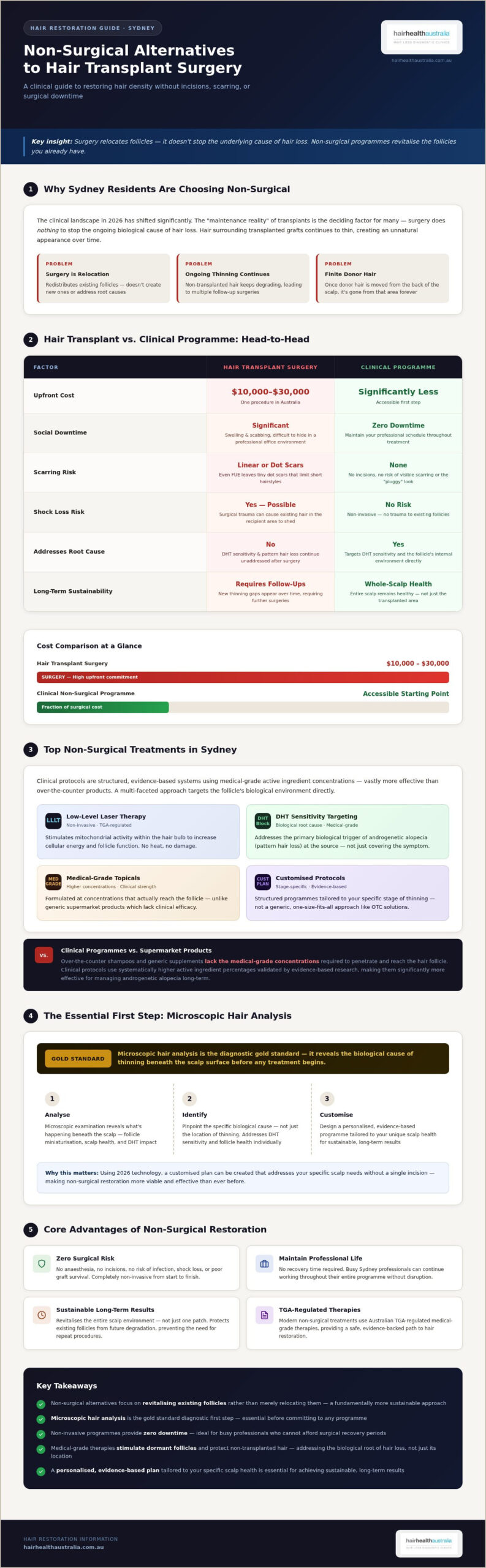
In 2026, the clinical landscape for hair restoration in Australia has shifted significantly. More people are looking for alternatives to hair transplant surgery Sydney clinics provide, moving away from invasive procedures toward biological restoration. The primary reason is a growing understanding that surgery is a method of relocation, not creation. It redistributes existing follicles from a “donor site” to a thinning area, but it does nothing to stop the underlying causes of hair loss.
For many, the “maintenance reality” is the deciding factor. If you undergo a transplant but don’t address the ongoing process of Pattern hair loss, the hair surrounding the transplanted grafts will continue to thin. This often leads to an unnatural appearance over time, requiring subsequent surgeries to “fill in” the new gaps. Clinical programmes offer a more sustainable path by revitalising the follicles you still have and protecting them from future degradation. This approach ensures the entire scalp remains healthy, not just the specific area where hair was moved.
The Hidden Risks and Costs of Surgical Procedures
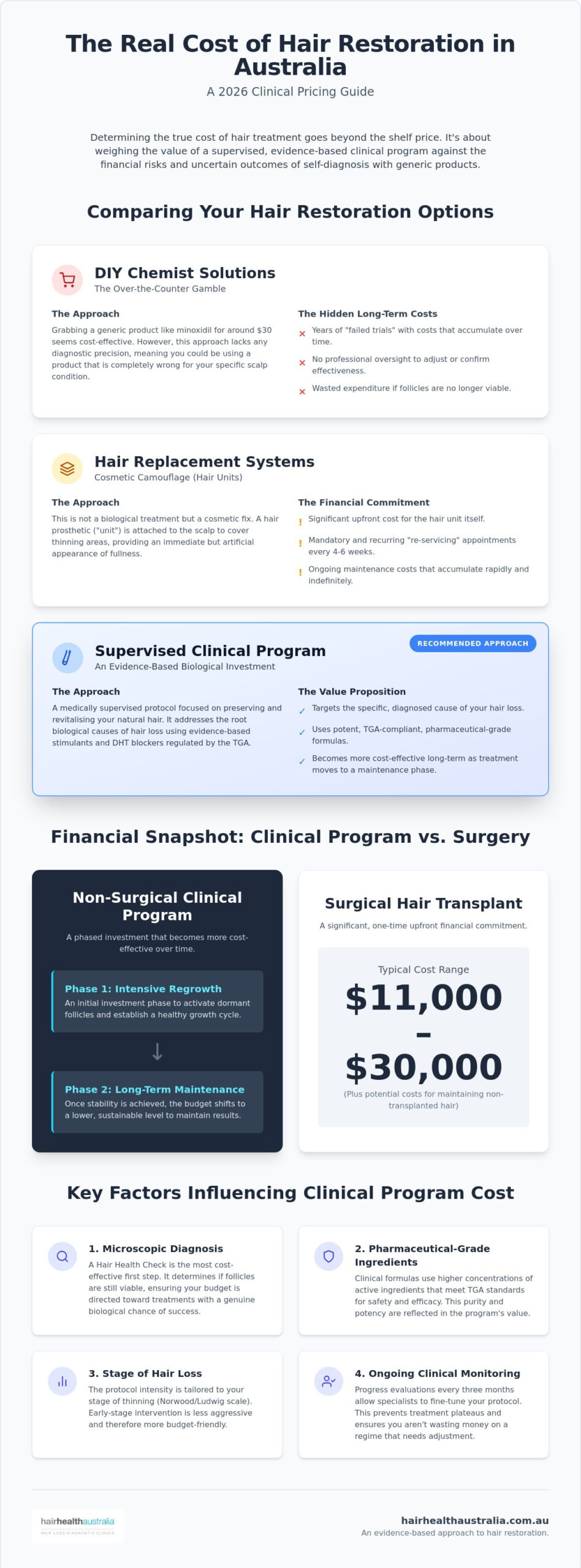
Invasive transplants come with specific clinical risks that many Sydney residents find unappealing. One such risk is “shock loss,” where the trauma of the surgery causes existing hair in the recipient area to shed. While often temporary, it adds a layer of uncertainty to the recovery process. The financial commitment is also substantial. With surgical costs in Australia often reaching between $10,000 and $30,000, many individuals find that clinical regrowth programmes offer a more accessible and logical first step. There is also the social factor to consider. Avoiding visible scarring and the “pluggy” look of poorly executed grafts is a top priority for those in professional circles.
- Visible Scarring: Even modern FUE techniques can leave tiny “dot” scars that limit how short you can wear your hair.
- Social Downtime: The recovery period often involves swelling and scabbing that is difficult to hide in a busy Sydney office environment.
- Relocation Limits: You only have a finite amount of donor hair. Once it is moved, it’s gone from the back of your head forever.
The Shift Towards Biological Hair Restoration
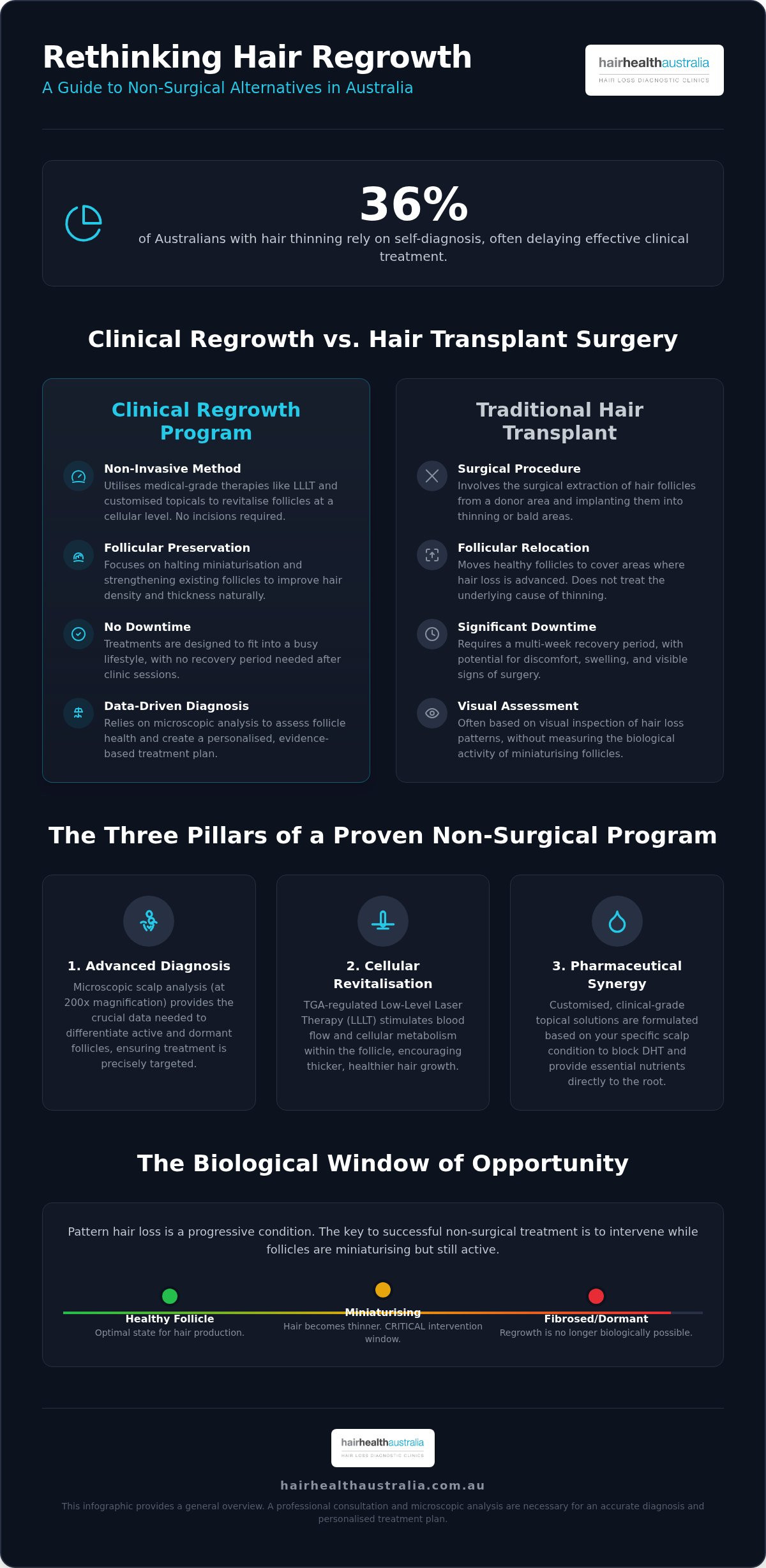
The 2026 approach to hair health focuses on the follicle’s internal environment. Modern clinical programmes target the biological triggers of thinning, such as DHT sensitivity, at the source. Instead of just covering a bald spot, these treatments aim to increase the diameter and health of existing strands. This is why we recommend a specialised microscopic hair analysis as the essential first step. It allows us to see exactly what’s happening beneath the scalp surface. Using 2026 technology, we can create a plan that addresses your specific needs without a single incision, making non-surgical paths more viable and effective than ever before.
Top Non-Surgical Hair Loss Treatments in Sydney
When exploring alternatives to hair transplant surgery Sydney residents often discover that the most effective path involves a multi-faceted clinical approach. Rather than simply moving hair from one location to another, non-surgical protocols focus on the biological health of the follicle itself. These programmes utilise medical-grade ingredients and advanced technology to reverse the thinning process and protect existing hair from further degradation. By addressing the scalp environment and internal triggers, it’s possible to achieve significant density without ever visiting a surgical theatre.
Clinical Regrowth Programmes vs. Over-the-Counter Solutions
Many individuals begin their journey with supermarket shampoos or generic supplements. These products often fail because they lack the medical-grade concentrations required to reach the follicle. Clinical protocols are vastly different; they are structured, evidence-based systems that use higher active ingredient percentages. A professional programme is also customised to your specific stage of thinning. As highlighted in the Cleveland Clinic Journal of Medicine, a systematic approach to androgenetic alopecia is essential for managing the condition effectively over the long term.
The core of these programmes typically includes:
- Low-Level Laser Therapy (LLLT): This non-invasive technology stimulates mitochondrial activity within the hair bulb, increasing ATP production to fuel new growth.
- Topical and Oral DHT Blockers: These act as the cornerstone of genetic hair loss management by inhibiting the hormone responsible for follicle shrinkage.
- Nutraceutical Support: High-potency nutrients optimise the scalp environment, ensuring the body has the necessary building blocks for healthy hair production.
Scalp Health and Follicle Revitalisation
A healthy scalp is the foundation of any successful regrowth strategy. Clinical treatments work to reduce chronic inflammation and clear sebum buildup that can otherwise stifle emerging hairs. By improving microcirculation, these protocols ensure that dormant follicles receive a steady supply of oxygen and nutrients. Follicular miniaturisation is the primary target of non-surgical therapy, a process where the hair follicle progressively shrinks and produces increasingly fine strands until growth ceases entirely.
Unlike surgical options, these clinical paths require no recovery time and fit seamlessly into a busy lifestyle. You can continue your daily routine in Sydney while your hair undergoes a biological transformation. Before deciding on a specific treatment path, it’s highly beneficial to undergo a comprehensive hair health check to determine which clinical protocol best suits your current scalp condition.
Hair Transplant vs. Clinical Programmes: A Direct Comparison
Deciding between surgery and clinical programmes requires a clear understanding of the difference between moving hair and saving it. Surgical procedures are inherently invasive. They require the harvesting of follicles from a donor site to be implanted elsewhere. In contrast, clinical alternatives to hair transplant surgery Sydney residents often prefer involve non-invasive light and topical therapies. These work with your body’s existing biology to strengthen the hair you still have. It’s a choice between a surgical “fix” and a biological restoration.
The “donor area” problem is a critical consideration that many overlook. Every individual has a finite supply of healthy follicles at the back and sides of the head. If you exhaust this supply in your 30s through surgery, you may have no options left if thinning continues in your 50s. Clinical programmes focus on long-term sustainability. They aim to keep your natural hair for as long as possible, which is a more logical strategy for your appearance 5 to 10 years down the track.
Cost and Value Analysis for Sydney Patients
While surgery often presents as a one-off cost, it rarely addresses the full scope of hair loss. A transplant fills a specific gap but doesn’t stop the progression of genetic thinning in the surrounding areas. This is why many patients who undergo surgery eventually find themselves needing clinical programmes anyway to maintain their results. Investing in clinical care early preserves your natural density. It’s a proactive approach that often yields better value than reactive surgery, as it protects your entire scalp rather than just a small section.
Recovery and Lifestyle Impact
The lifestyle impact of these two paths is vastly different. Surgery involves significant downtime, often requiring a week or more away from work. Patients must also manage the “ugly duckling” phase, where the scalp appears red and scabby before the transplanted hair sheds and eventually regrows. Clinical visits are different. They offer “lunchbreak” convenience with zero recovery time. There’s no risk of an artificial-looking hairline because the regrowth is entirely your own. It’s a gradual, natural improvement that doesn’t draw unwanted attention. Before making a final decision, a comprehensive hair health check can clarify which path aligns best with your lifestyle and hair goals.
The Essential First Step: Microscopic Hair Analysis
Before committing to any treatment path, you must have objective data regarding your scalp health. A simple visual inspection is insufficient for a professional diagnosis because it cannot detect the early stages of follicle miniaturisation. When researching alternatives to hair transplant surgery Sydney residents often overlook the fact that what looks like permanent loss might actually be dormant follicles capable of revitalisation. Microscopic scanning allows us to measure follicle diameter and density with clinical precision, providing a clear map of your current condition. This scientific data is the only way to accurately predict your regrowth potential and identify which follicles are still active and which have truly ceased function.
What to Expect During a Clinical Hair Scan
The process involves high-magnification imaging of the scalp to see what the naked eye misses. We focus on the hair-to-follicle ratio to determine the exact stage of thinning across different zones of your scalp. By measuring the diameter of individual strands, we can see if a follicle is producing a healthy hair or a thin, “vellus” hair that is at risk of disappearing entirely. This scientific approach allows us to track the progress of your regrowth programme with verifiable evidence rather than relying on subjective mirrors. You can learn more about our Microscopic Hair Health Check in Sydney to see how this technology provides a baseline for your results.
Why Diagnosis Dictates Your Treatment Success
The reason many people fail to see results from generic treatments is a lack of specific diagnosis. It is vital to differentiate between male pattern baldness, which is genetic and progressive, and temporary thinning like Telogen Effluvium, which is often triggered by stress, medication, or nutrition. Treating the wrong cause of hair loss leads to failed results and a significant waste of time and investment. A Sydney-based specialist interprets your scan data to ensure your plan targets the actual biological trigger of your thinning. This level of accuracy is what makes non-surgical alternatives to hair transplant surgery Sydney clinics offer so effective compared to self-diagnosis. To get started with a precise understanding of your scalp health, book a clinical hair health check and speak with a specialist who understands the local clinical standards.
Starting Your Non-Surgical Journey with Hair Health Australia
Choosing a path forward can feel overwhelming when you are faced with conflicting information about hair restoration. At Hair Health Australia, we simplify this process by providing evidence-based alternatives to hair transplant surgery Sydney residents can rely on for long-term results. Since 2009, our clinic has remained committed to a methodology that is personalised, clinical, and entirely transparent. We believe that every individual deserves a clear understanding of their scalp health before committing to any treatment. This moves you away from the uncertainty of self-diagnosis and toward a clear clinical path grounded in scientific verification.
Our Sydney-based clinical expertise ensures that your journey is supported by specialists who understand the latest 2026 standards in follicle revitalisation. We don’t just provide a service; we act as a dedicated guide to help you navigate the biological complexities of hair thinning. By focusing on the root cause rather than just the visible symptoms, we help you achieve a level of density that looks and feels natural. This approach is particularly effective for busy Sydney professionals who require a solution that fits into their active lifestyle without the burden of surgical recovery or visible scarring.
Personalised Regrowth Programmes Tailored for You
Our methodology is built on the understanding that hair loss is a biological process, not just a cosmetic concern. We create personalised regrowth programmes that combine various medical-grade modalities for maximum impact. For some, this might involve a combination of medical-grade Low-Level Laser Therapy and specific topical DHT blockers. For others, the focus may be on intensive scalp health and nutraceutical support. We recognise that male and female hair loss patterns differ significantly, requiring unique hormonal considerations to achieve sustainable density. Regular check-ins and progress monitoring are central to our approach, ensuring your programme evolves as your follicles respond to treatment.
Book Your Consultation at Our Sydney Clinic
Preparing for your initial hair health assessment is a straightforward process. We recommend coming to our Sydney centre with a clear history of when your thinning began and any previous treatments you’ve attempted. During this assessment, we perform the “gold standard” microscopic scan discussed earlier to establish your baseline. You will walk away with a comprehensive understanding of your follicle viability and a realistic, data-driven expectation of what can be achieved over the coming months. It is time to stop worrying about future loss and start taking control of your hair’s health. Book your clinical hair analysis in Sydney today to begin your journey toward restored density and confidence.
Secure the Future of Your Natural Hair Density
Restoring your hair doesn’t have to involve the risks or visible scarring associated with invasive procedures. By prioritising biological restoration over simple follicle relocation, you ensure that your entire scalp remains healthy and productive for years to come. The most effective alternatives to hair transplant surgery Sydney offers are those grounded in data-driven diagnostics and clinical precision. Microscopic analysis remains the essential first step, allowing you to identify dormant follicles and create a personalised plan that targets the root cause of your thinning.
Hair Health Australia has provided Sydney with expert clinical care since 2009, bringing over 15 years of experience to every consultation. Our non-invasive protocols are designed for the active professional, offering zero downtime while utilising specialised microscopic diagnostic technology to track your progress accurately. It’s time to replace uncertainty with a proven, scientific strategy for your hair’s future. Book Your Comprehensive Hair Health Check in Sydney today. You don’t have to accept hair loss; with the right clinical guidance, you can regain both your density and your confidence.
Frequently Asked Questions
Is it possible to regrow hair without surgery if I am already balding?
It’s possible to regrow hair if your follicles are still active but dormant. This is why we use microscopic scanning to distinguish between permanent loss and thinning. If a follicle is miniaturised, non-surgical protocols can increase its diameter and health. However, if the follicle has completely scarred over, regrowth is not achievable. This makes early intervention critical for success.
How much do alternatives to hair transplants cost in Sydney?
Clinical alternatives to hair transplant surgery Sydney residents choose are generally more financially accessible than surgical procedures. While we don’t quote fixed prices without a diagnosis, these programmes avoid the high upfront costs of grafts. The total investment depends on the duration of your protocol and the specific modalities required. Many clients find this approach provides better long-term value by preserving their natural hair density.
How long does it take to see results from a non-surgical hair programme?
You should expect to see changes in alignment with the natural hair growth cycle. Most clients notice a reduction in hair fall within the first 90 days of a consistent programme. Visible new growth typically appears around the 6-month mark, with significant improvements in overall density usually taking up to 12 months. Patience and consistency are vital for achieving these biological milestones.
Are the results of non-surgical hair treatments permanent?
Results from non-surgical treatments require ongoing management because genetic hair loss is a progressive condition. While the hair you regrow is your own natural hair, the biological triggers that cause thinning, such as DHT sensitivity, remain present. Continuing a maintenance protocol ensures that your follicles stay protected from future miniaturisation. It’s a long-term commitment to your scalp health rather than a one-off fix.
Can women use these alternatives to hair transplant surgery?
Yes, women can certainly benefit from these clinical alternatives. Female hair loss often follows unique hormonal patterns that require a specific approach to restoration. Our clinic provides dedicated Female Hair Loss Treatment that addresses these underlying causes without the invasive nature of surgery. We focus on restoring volume and density while ensuring the scalp environment is optimised for healthy growth.
What is the most effective non-surgical hair loss treatment in 2026?
The most effective approach in 2026 is a personalised, multimodal programme rather than a single product. This typically combines TGA-regulated Low-Level Laser Therapy with medical-grade topical solutions and nutraceutical support. By targeting the follicle from multiple biological angles, we achieve better results than a one-size-fits-all solution. Every effective programme starts with a microscopic analysis to ensure the treatment matches the specific cause of thinning.
Do I need a referral from a GP to visit a Sydney hair loss clinic?
You don’t need a referral from a GP to visit our Sydney clinic. Most of our clients book their initial hair health assessment directly with us to begin their diagnostic journey. This allows for a faster transition from identifying the problem to implementing a clinical solution. We provide a professional environment where you can discuss your concerns with a specialist who focuses exclusively on hair restoration.
What happens if I stop my non-surgical hair regrowth programme?
If you stop your regrowth programme, the biological process of thinning will eventually resume. Because genetic hair loss is driven by internal factors, your follicles will lose the protection provided by the clinical protocol. Over several months, you may notice a return to your previous rate of thinning. This is why we transition clients to a simplified maintenance phase once their density goals are achieved.