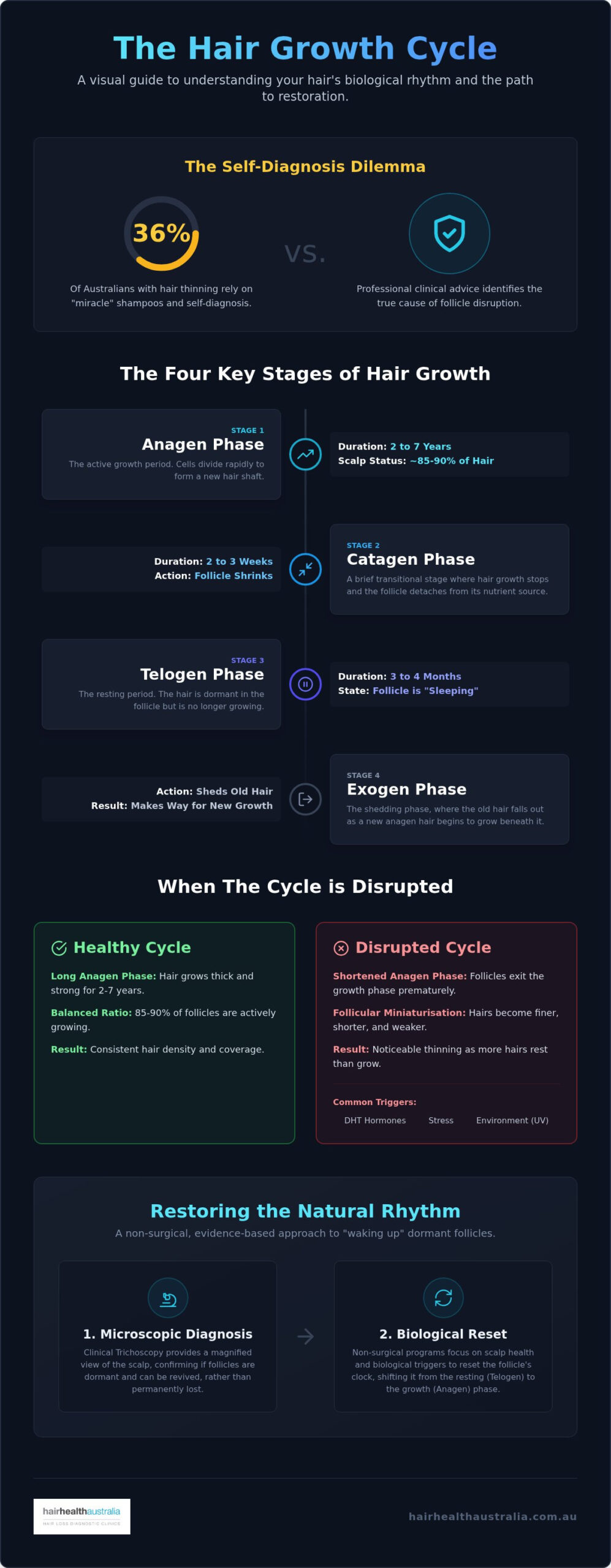
Preparing for Your First Trichologist Appointment: What to Know

You don’t need to arrive with all the answers, just useful observations. Preparing for your first trichologist appointment can feel daunting when you’re unsure which changes matter or what the assessment involves. You don’t need to diagnose the cause yourself. Notes about when thinning or shedding began, where you’ve noticed it and any changes in your hair or scalp can make the conversation more useful.

A clinical assessment can add detail that memory and a quick glance in the mirror may miss. At Hair Health Australia’s Hair Health Check in Redfern, Sydney, a microscopic Trichoscopy scan assesses active hair follicles and helps diagnose the type of hair loss. The check is free, with no obligation, and takes ONLY 30 MINS. Specialists explain the findings and tailor treatment plans to your individual diagnostic results.

This guide covers what to note before your appointment, what to expect during an assessment and questions that can help you understand your next steps. You’ll be better prepared to discuss your concerns and leave with clearer information about your options.

Key Takeaways

  • When preparing for your first trichologist appointment, note when changes began and what you’ve observed, without trying to diagnose the cause yourself.
  • Microscopic Trichoscopy assesses active hair follicles and helps identify the type of hair loss.
  • Use the assessment to understand the diagnosis, the reasoning behind recommendations and how proposed next steps relate to your results.
  • A simple checklist of your hair-change timeline, relevant history and questions can help you feel organised. Records and product details are useful context, not requirements.
  • Hair Health Australia’s Sydney Hair Health Check is free, with no obligation, and takes ONLY 30 MINS.

Preparing for your first trichologist appointment: start with what you have noticed

Noticing more hair in your brush, a wider-looking part or a change in your hairline can feel unsettling. You don’t need to arrive with a theory about why it’s happening. Start by describing what you’ve observed, when it began and whether it has changed. These details help frame the conversation without turning your notes into a self-diagnosis.

Hair changes can involve shedding, density, the hairline or the condition of your scalp. One observation alone doesn’t identify a cause, and patterns vary between people. If you’re curious about the field, What is Trichology? offers background on its focus on hair and scalp health. For your appointment, everyday descriptions are enough: “my part looks wider in photos” or “I’ve noticed more hair coming away when I wash it”.

What changes should you write down before the appointment?

Jot down a few observations while they’re fresh. You’re building a useful record, not preparing a clinical report. Include what you’ve noticed, even if you’re unsure whether it’s relevant. The assessment can help put those details into context.

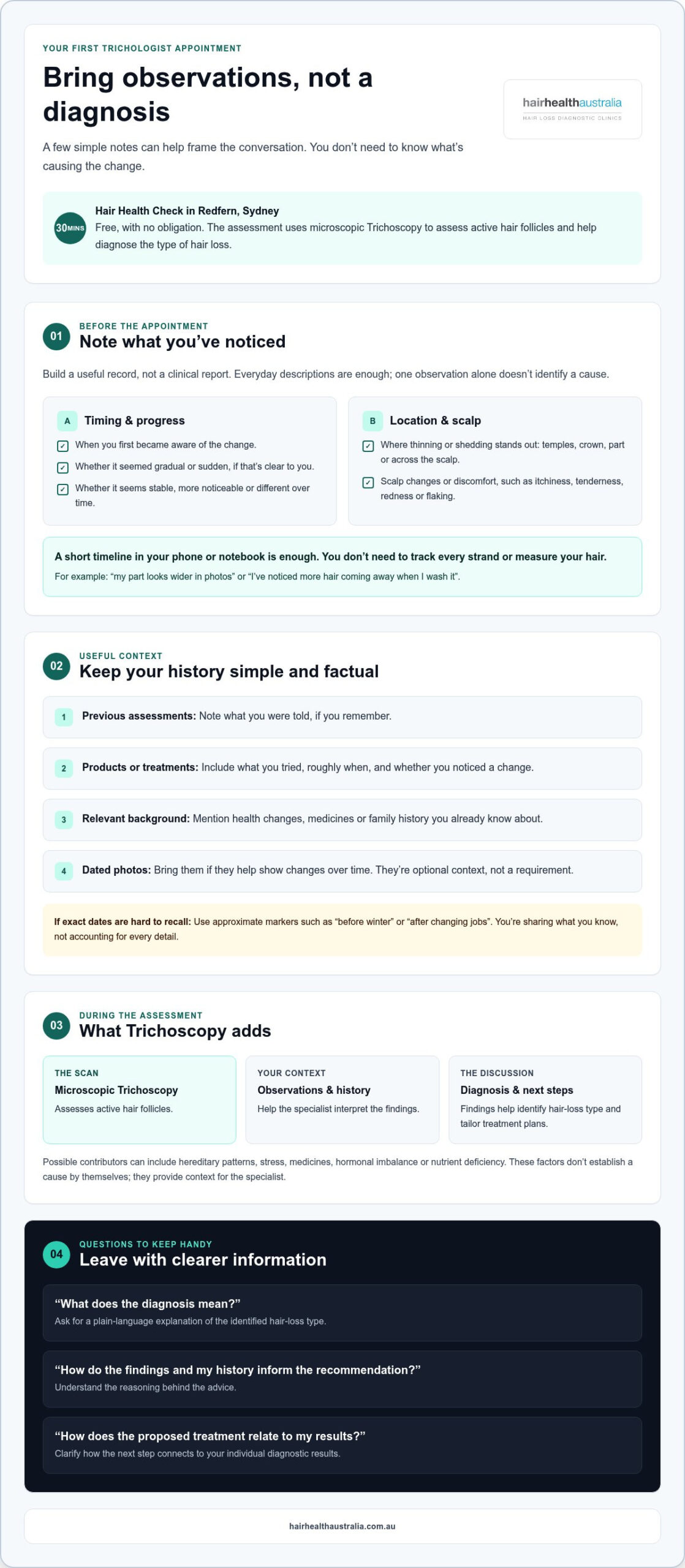
  • Timing: Note when you first became aware of the change. Describe it as gradual or sudden if that’s clear to you.
  • Location: Record where thinning or shedding stands out, such as around the temples, crown, part or across the scalp.
  • Scalp observations: Mention visible changes or discomfort, such as itchiness, tenderness, redness or flaking. Describe what you experience rather than trying to label a condition.
  • Progress: Note whether the change seems stable, more noticeable or different in certain areas over time.

A dated record can make a first assessment more focused by showing when changes began and how they developed, rather than relying on memory alone. A short timeline in your phone or notebook is enough. You don’t need to track every strand or measure your hair.

How can you describe your hair-loss history clearly?

When preparing for your first trichologist appointment, keep your history simple and factual. A few dates or brief notes can help organise what you remember, especially if changes have happened over an extended period.

  • List any previous assessments and what you were told, if you remember.
  • Note products or treatments you’ve tried, roughly when you used them and whether you noticed a change.
  • Include relevant health changes, medicines or family history that you already know about.
  • Bring dated photos if they help show changes over time. They’re optional context, not a requirement.

If you can’t recall exact dates, use approximate markers such as “before winter” or “after changing jobs”. The aim is to share what you know, not account for every detail. Your notes give the specialist a clearer starting picture, while the assessment helps interpret the pattern and guide a discussion about next steps.

What happens at a first trichologist appointment and what can it clarify?

A first appointment is an opportunity to move from noticing a change to understanding what type of hair loss may be involved. At Hair Health Australia’s Hair Health Check, microscopic Trichoscopy is used as part of the assessment. This scan assesses active hair follicles and helps diagnose hair-loss type. Your observations and history add context, and the findings inform a discussion about suitable next steps.

What can a microscopic Trichoscopy scan show?

The Trichoscopy scan assesses active hair follicles. It forms part of the Hair Health Check’s full clinical diagnosis of hair-loss type. The scan gives the specialist follicle information to consider alongside what you’ve noticed about density or shedding.

During Hair Health Australia’s Hair Health Check, microscopic Trichoscopy assesses active hair follicles and helps diagnose the type of hair loss.

Thinning or shedding can look similar to you while having different explanations. A scan adds a closer view to the clinical assessment, within its scope of assessing active follicles and helping identify hair-loss type. The findings are used to tailor treatment plans, rather than assuming the same approach suits everyone.

Why does the appointment focus on your individual history?

Scan findings are considered alongside your personal history. Possible contributors to hair changes include hereditary patterns, stress, medicines, hormonal imbalance or nutrient deficiency. These factors don’t establish a cause by themselves, and a timeline or family history can’t prove what is happening. They do give the specialist useful context for interpreting the findings and discussing your situation without relying on a general assumption.

Preparing for your first trichologist appointment can also help you make the most of the explanation. Share relevant details you already know, then ask how they relate to the diagnosed hair-loss type. Specialists explain the diagnosis and educate clients about how recommended treatment works. Treatment plans are tailored to individual diagnostic results.

  • Ask what the diagnosis means: Request a plain-language explanation of the identified hair-loss type.
  • Understand the reasoning: Ask how the scan findings and your history inform the recommendation.
  • Clarify the next step: Make sure you understand how a proposed treatment is intended to work for your individual results.

Clear answers can replace some uncertainty with a more grounded understanding. If you’re looking for a Sydney assessment that uses microscopic Trichoscopy, the Hair Health Check provides a focused way to discuss your findings and individual next steps.

How to assess appointment advice: diagnosis, explanation and next steps

A useful appointment should leave you clearer about what was assessed, what the findings mean and how any recommendation relates to your situation. A product suggestion on its own doesn’t explain the type of hair loss or why an option may suit you. Hair Health Australia’s Hair Health Check uses microscopic Trichoscopy to assess active follicles and support a clinical diagnosis of hair-loss type. The value is in connecting the assessment to an understandable explanation and an individual next step.

Use this simple comparison to organise what you hear during the discussion:

Stage What to understand
Observation What changes you’ve noticed and what the assessment examines.
Diagnosis The hair-loss type identified through the clinical assessment.
Explanation How the findings relate to your individual situation and the reasoning behind the advice.
Proposed next step What treatment or follow-up is recommended, and how it connects to the diagnosis.

What makes an explanation useful and specific?

A clear explanation names the diagnosed hair-loss type and describes the relevant assessment findings in plain language. If a recommendation is made, ask how it follows from those findings rather than accepting a product suggestion without context. You can also ask what the proposed treatment is intended to address, how it relates to your results and what follow-up involves.

You don’t need technical terms to get a clear explanation. Straightforward questions can help you understand the decision-making:

  • What hair-loss type did the assessment identify?
  • Which findings informed that conclusion?
  • How does the recommendation relate to my results?
  • What should I understand about the recommended next steps?

If an answer isn’t clear, ask for it to be explained another way. Understanding the reasoning matters as much as hearing a recommendation.

How should you think about a recommended treatment plan?

A treatment plan should make sense in light of your diagnosis, rather than feel like a one-size-fits-all prescription. Hair Health Australia customises hair regrowth treatment plans for men and women based on diagnostic results, with specialist follow-up. Preparing for your first trichologist appointment includes thinking about what you need to understand before deciding on next steps.

Ask how the proposed plan connects to your assessed hair-loss type, what each recommendation is intended to do and how progress or follow-up will be discussed. Treatment plans are individual, so ask how the recommendation relates to your results. If you’d like to understand how assessment informs tailored recommendations, explore the Hair Health Check.
Preparing for Your First Trichologist Appointment: What to Know

A practical checklist for the day of your first trichologist appointment

Preparing for your first trichologist appointment doesn’t require a folder of paperwork or a perfect account of every hair change. A short, organised summary can help you explain what’s been happening and follow the discussion. Bring what you already have, and treat records and product details as helpful context, not requirements.

Hair Health Australia’s microscopic hair assessment uses Trichoscopy to assess active hair follicles and help diagnose hair-loss type. Use the checklist below to gather information that may put your individual findings in context.

What information is useful to bring along?

Keep your notes brief and easy to refer to. Include details you can readily share instead of spending time trying to reconstruct information you don’t remember.

  • A timeline: When you first noticed a change, whether it seemed gradual or sudden, and what has changed since.
  • Your observations: Where you’ve noticed thinning or shedding, along with any scalp changes or discomfort.
  • Relevant history: Health changes, medicines or family history you already know about and think may be relevant.
  • Previous hair-loss products or treatments: What you tried and any changes you noticed. Product names or packaging details can help if they’re readily available.
  • Existing records: Previous assessment results, health records or dated photos, if they help explain your history. These are optional, not a requirement.

Before you leave, follow any appointment-specific instructions you’ve received. Don’t assume there are standard washing or styling rules. Use the guidance provided for your appointment.

Which questions can help you leave with clarity?

Write down a few questions in advance so you can return to them during the conversation. You can also note the answers in your own words, making it easier to reflect on the information afterwards.

  • What type of hair loss was identified?
  • What does the scan show, and which findings support the explanation?
  • How is a recommended treatment intended to work, and what happens next?

If a treatment is discussed, ask how its suitability relates to your results and what specialist follow-up involves. The aim is to understand the recommendation and the reasoning behind it, not to leave with a one-size-fits-all answer. It’s reasonable to ask for a plain-language explanation or to clarify a point you’re unsure about.

With your notes and questions ready, you can focus on understanding the assessment rather than trying to recall every detail on the spot. Hair Health Australia’s Hair Health Check is free, with no obligation, and takes ONLY 30 MINS.

Your next step in Sydney: Hair Health Australia’s free Hair Health Check

If you’re ready to move from personal observations to a clearer clinical assessment, Hair Health Australia’s Hair Health Check offers a straightforward next step in Sydney. The check is free, with no obligation, and takes ONLY 30 MINS. It’s an opportunity to have your hair assessed and understand what the findings may mean for your individual situation, without needing to arrive with a diagnosis or treatment decision already made.

What is included in the Hair Health Check?

The Hair Health Check includes a microscopic Trichoscopy scan and a full clinical diagnosis of hair-loss type. Trichoscopy assesses active hair follicles and helps identify the type of hair loss. It adds information to the clinical assessment beyond what you may have noticed in the mirror or remember over time.

The scan assesses active hair follicles and helps diagnose hair-loss type. Specialists explain the diagnosis and provide education about the findings. This gives you a clearer basis for discussing what may be appropriate next, with the conversation focused on your results rather than a general recommendation.

The diagnosis clarifies the type of hair loss identified and provides a starting point for considering individual options. Any treatment plan is tailored to your diagnostic results, so recommendations are connected to your assessment rather than assumed in advance.

How can you take the next step in Sydney?

The clinic is located in Redfern, Sydney. If you’ve been preparing for your first trichologist appointment, bring the timeline and questions you’ve gathered to help guide the discussion. You don’t need every detail or record. The aim is to get a clearer understanding of your hair-loss type and the information behind your next steps.

During the check, specialists explain the diagnosis and tailor treatment plans to individual results. Ask how any recommendation relates to the assessment, what it is intended to address and what follow-up support involves. Take the time to understand the explanation before deciding what feels right for you. The check has no obligation, so you can get information without committing to a treatment plan.

Hair Health Australia’s free Hair Health Check uses microscopic Trichoscopy to assess active follicles and help diagnose hair-loss type. It takes ONLY 30 MINS.

Take the next step with a clearer perspective

Preparing for your first trichologist appointment is about giving yourself a better starting point for understanding what’s happening. You don’t need to have every answer before you go. A few notes can give you a clearer basis for asking questions, considering your options and deciding what feels appropriate for you.

If you’re ready to take that step, Hair Health Australia’s Hair Health Check is available in Redfern, Sydney. The free, no-obligation check takes ONLY 30 MINS and uses a microscopic Trichoscopy scan to assess active hair follicles and help diagnose hair-loss type. Specialists explain the findings and tailor treatment plans to individual results, so you can consider your next step with a clearer understanding.

Book your free Hair Health Check or call 1800 908 898 or (02) 93190051 to arrange an assessment in Redfern, Sydney.

Frequently Asked Questions

Is a trichologist appointment worth it if I have only just noticed thinning?

An assessment can be worthwhile even if thinning has only just become noticeable. Preparing for your first trichologist appointment can help you describe the change clearly, while an individual assessment may clarify the hair-loss type instead of leaving you to rely on a guess. Hair Health Australia’s Sydney Hair Health Check uses microscopic Trichoscopy to assess active follicles and provide a full clinical diagnosis. It’s free, with no obligation, and takes ONLY 30 MINS.

What should I bring to my first trichologist appointment?

A short written timeline is a useful starting point. Note when you noticed a change, where it appears and whether it seems different now. You can add relevant health history, medicines, previous hair-loss products or treatments, and any changes you noticed. Existing dated photos or records may help explain your experience, but you don’t need to create a complete file. Follow any appointment-specific instructions you’ve received.

Should I wash my hair before a trichologist appointment?

Follow any appointment-specific instructions you’ve received rather than assuming you need to wash or style your hair a particular way. Preparation advice can differ between clinics, so instructions from another appointment may not apply here. If you haven’t received specific guidance, you can still prepare by noting your hair changes and questions. Hair Health Australia’s check uses microscopic Trichoscopy to assess active hair follicles and help diagnose hair-loss type.

What happens during Hair Health Australia’s Hair Health Check?

The check includes a microscopic Trichoscopy scan and a full clinical diagnosis of hair-loss type. The scan assesses active hair follicles, and specialists explain the findings and how a recommended treatment works. The Hair Health Check is free, with no obligation, and takes ONLY 30 MINS. Hair Health Australia’s clinic is in Redfern, Sydney, making it a local option for an individual assessment.

Is Hair Health Australia’s Hair Health Check free?

Yes. Hair Health Australia’s Hair Health Check is free, with no obligation. It includes a microscopic Trichoscopy scan to assess active hair follicles and a full clinical diagnosis of hair-loss type, and takes ONLY 30 MINS. If treatment is discussed, plans are tailored to individual diagnostic results. The check helps you understand your assessment and doesn’t require you to commit to a treatment plan.

What questions should I ask at my first trichologist appointment?

Ask what hair-loss type the assessment identified, which findings informed that diagnosis and how a recommended treatment is intended to work. You might also ask what specialist follow-up and education are part of your individual plan. Writing questions down beforehand can help you stay focused, and noting the answers in your own words gives you something to reflect on later. Aim to leave understanding the reasoning behind your next steps.
Solutions for a Widening Hair Parting: What to Do Next

What if a widening part is a clue, not a diagnosis? Noticing more scalp along your part can be unsettling, especially when advice about products, home care and treatment points in different directions. The solutions for a widening hair part depend on what’s behind the change, and appearance alone can’t tell you the cause.

A wider-looking part is worth paying attention to, but it doesn’t mean you need to assume the worst or choose a treatment straight away. Hair density can change for different reasons, so a useful next step is to understand what may be happening in your case.

This article covers possible reasons for a widening part, practical ways to manage its appearance and how clinically guided treatment may support regrowth. It also explains how assessment can replace guesswork with clearer information. At Hair Health Australia, the free Hair Health Check uses Trichoscopy to assess active hair follicles and help diagnose the type of hair loss. It takes ONLY 30 MINS and comes with no obligation. If treatment is appropriate, it’s customised to you based on diagnostic results.

Key Takeaways

  • A wider-looking part is an observation, not a diagnosis. Different factors can contribute, so avoid drawing conclusions from appearance alone.
  • Compare solutions for a widening hair part by their purpose: cosmetic coverage can disguise visible scalp, while care changes and clinical options serve different needs.
  • Make a discussion more useful by noting when you first noticed a change, its pattern and any relevant health or medication history.
  • Consistent photos taken in similar lighting can help you track visible changes without relying on day-to-day impressions.
  • Hair Health Australia’s Hair Health Check in Redfern uses Trichoscopy to assess active follicles. If treatment is appropriate, it’s customised to you based on diagnostic results.

What a widening hair part can signal, and what it cannot tell you

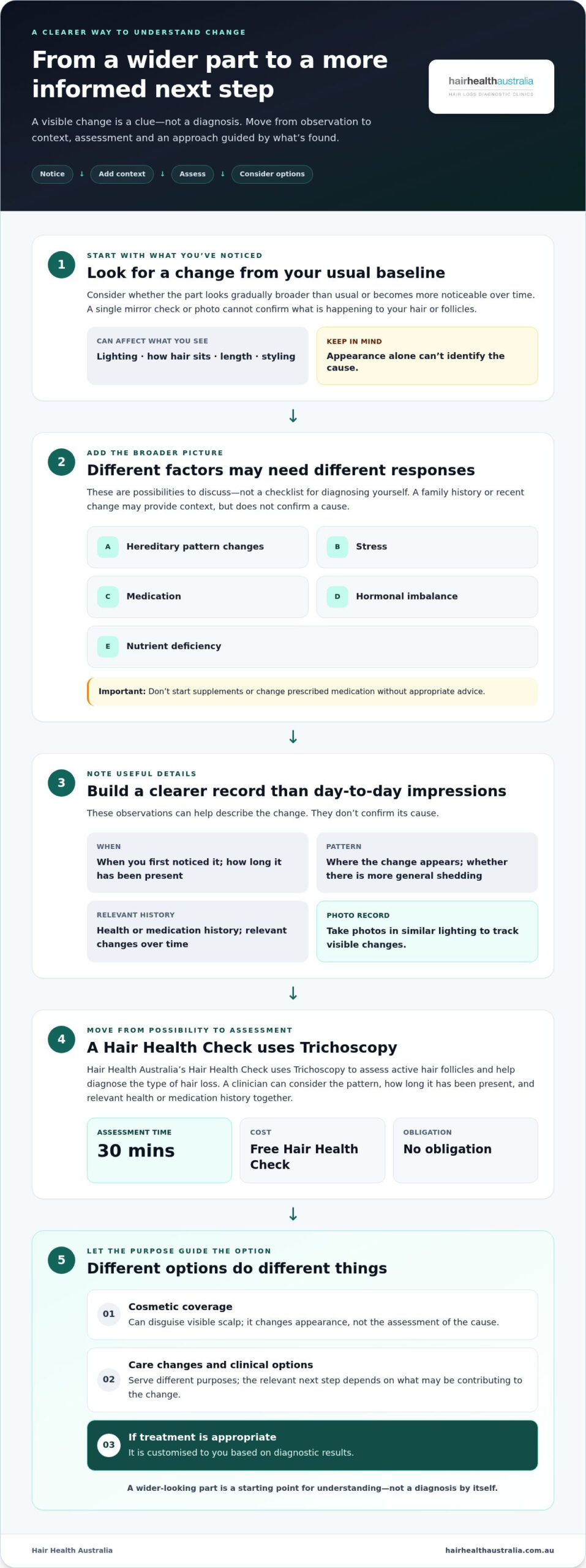
Seeing more scalp along a part you’ve worn the same way for years can feel unsettling. It’s reasonable to wonder whether your hair is changing, but the visible part is only one detail. Lighting, how your hair sits, its length and the way it’s styled can all affect how much scalp you see. One glance in the mirror can’t confirm what is happening to your hair or follicles.

A widening part is a clue that needs context, not a diagnosis. It describes an appearance, not a single cause. Changes in hair density can be associated with different factors, including hereditary pattern changes, stress, medication, hormonal imbalance or nutrient deficiency. These possibilities are reasons to seek clarity, not a checklist for diagnosing yourself.

When does a wider part become worth investigating?

Consider whether your part looks gradually broader than your usual baseline, rather than judging from one photo or mirror check. A persistent change, or one that becomes more noticeable over time, is worth paying attention to. That doesn’t mean you need to panic or assume a particular outcome. It means there may be value in understanding the change instead of repeatedly checking its appearance.

Hair grows in cycles, and what you can see at the scalp doesn’t reveal the full activity of each follicle. The Hair follicle is part of the structure involved in hair growth, but a mirror can’t show its condition or explain why density may have changed. Treat a single observation as a starting point, not a conclusion.

Why appearance alone cannot identify the cause

Visible scalp and the process affecting your hair are related, but they aren’t interchangeable. A part may look wider because there’s less hair covering that area, yet appearance alone can’t establish whether the change follows a particular pattern or what may be contributing to it. Different causes can affect hair growth or density in different ways, so the same visible concern may call for a different response from one person to another.

Look at the broader picture rather than treating one feature as proof. You might notice a gradual change along the part, more general shedding or another change in how your hair looks. These observations can help you describe what you’ve noticed, but they don’t confirm a cause. For related information, our article on Early Signs of Alopecia in Women explores signs to be aware of without treating one change as conclusive.

This distinction matters when comparing solutions for a widening hair part. Cosmetic adjustments may change how visible the scalp looks, while care and treatment decisions depend on what may be contributing to the change. Understanding the difference helps you avoid treating an appearance as though it were a diagnosis. Next, compare the practical options and consider what information could guide an individual approach.

Why a hair part may widen: causes that need different responses

A similar change in how much scalp is visible can have different explanations. Hereditary pattern hair loss is one possibility for men and women, but it isn’t the only one. Stress, some medications, hormonal imbalance and nutrient deficiency may also contribute to changes in hair shedding or density. The appearance of a part alone can’t show which, if any, of these factors is involved.

Pattern thinning and other possible contributors

Hereditary pattern hair loss can develop gradually, but the timing and distribution of change vary between people. Other factors may be relevant too. For example, a change in health, medication or hormonal circumstances can form part of the history a clinician considers. Nutrient levels may also be relevant in some cases. These are possibilities to discuss, not a self-diagnosis checklist or a reason to start supplements or change prescribed medication without appropriate advice.

A possible contributing factor is not the same as a confirmed cause. A stressful period or a medication change may be worth mentioning, but it doesn’t establish why your part looks different. Likewise, a family history of hair loss can provide useful context without proving that hereditary pattern hair loss explains your own change.

Why the same visible change may call for a different response

A useful assessment looks beyond the part itself. The pattern of change, how long it has been present and relevant health or medication history can help clarify what type of hair loss may be involved. A clinician considers these details together rather than selecting a remedy based on one visible sign. This matters because a response suited to one type of hair loss may not address another.

There isn’t one universal approach for every person. Starting with a product or routine before understanding the likely hair-loss type can leave the main question unanswered. The aim is to use the available information to guide your next step, not to assume that all thinning has the same cause or response. For more context on considerations specific to women, see Hair Loss Treatment for Women: The 2026 Australian Clinical Buying Guide.

To move from possibilities to clearer information, Hair Health Australia’s free Hair Health Check uses Trichoscopy to assess active hair follicles and help diagnose hair-loss type. It takes ONLY 30 MINS and comes with no obligation. If treatment is appropriate, it’s customised to you based on diagnostic results. Explore the Hair Health Check assessment to begin with information rather than guesswork.

That’s the practical principle behind solutions for a widening hair part: understand the likely type of change before deciding which response fits. Your observations and history can help shape the discussion, while an assessment can provide a more objective basis for considering what to do next.

Comparing solutions for a widening hair part without guesswork

Options for a wider-looking part serve different purposes. Cosmetic coverage can change how visible the scalp appears. Everyday hair-care adjustments may help you avoid unnecessary strain on your hair. A clinical assessment can help identify the hair-loss type and inform whether treatment may be appropriate. These options have different roles, and none should be treated as a guaranteed way to reverse hair loss.

Option Purpose Limit
Cosmetic coverage Hair-thickening fibres, root-concealing powders or a different parting can temporarily make scalp less noticeable. These approaches change appearance, not the underlying cause or follicle activity.
General hair-care changes Gentler handling and avoiding sustained tension from tight hairstyles can reduce avoidable strain on hair. Care habits alone may not address a medical or hereditary cause of thinning.
Clinical assessment Assessment can help clarify the hair-loss type and guide consideration of a suitable response. Findings inform the next step, but don’t guarantee regrowth or a particular outcome.

Appearance-focused steps versus addressing the underlying cause

General hair-care changes are a separate consideration. Handling hair gently and reducing persistent tension may help limit avoidable mechanical strain, but these steps aren’t a substitute for understanding ongoing or noticeable thinning. Products and routines can be easy to try, yet shouldn’t be assumed to address every cause. For cosmetic fullness, resources like thecollectiveatx.com illustrate how styling and extensions can offer temporary aesthetic volume without altering natural hair growth. The distinction is straightforward: coverage manages visibility, while care habits support gentler handling. Neither establishes a diagnosis.

When a personalised clinical approach may help

If you want to understand what may be contributing to the change, assessment can provide a clearer basis for deciding what to do next. Hair Health Australia’s Hair Health Check uses Trichoscopy to assess active hair follicles and help diagnose hair-loss type. It takes ONLY 30 MINS, is free and comes with no obligation. Any treatment plan is customised to you based on diagnostic results, rather than assuming one approach suits everyone.

The findings can help put potential regrowth into context and indicate which options may be relevant, without promising a particular result. For an overview of professional, non-surgical approaches, Clinical Hair Treatment: A Professional Guide to Non-Surgical Restoration offers related context. To understand the assessment process, explore the Hair Health Check in Sydney.

In short, solutions for a widening hair part aren’t interchangeable. You can use cosmetic steps to manage appearance while considering whether a clinical assessment could help clarify the cause and guide an individual next step.

Solutions for a Widening Hair Parting: What to Do Next

What to observe and prepare before seeking help for a wider part

A few clear notes can make a discussion about your hair more useful. You don’t need to arrive with a diagnosis or a complete record. Focus on what you’ve noticed, when it began and any relevant context. This keeps the conversation grounded in your experience rather than guesses based on one mirror check.

  1. Note when you first noticed the change. A rough timeframe is helpful, even if you can’t recall an exact date. Record whether it seemed to appear gradually or you noticed it suddenly, and whether it has looked stable or more noticeable since.
  2. Describe the pattern you see. Is the change mainly along your usual part, or do you notice less density elsewhere as well? You don’t need to interpret the pattern. A straightforward description separates what you’ve observed from what you think might be causing it.
  3. Gather relevant history. Jot down health changes, medication changes and family history of hair loss that may be useful to discuss. Include approximate timing where you can, but don’t stop or alter prescribed medication based on your notes.

Record changes consistently without over-monitoring

If it would be useful, take photographs to document how your hair looks over time. Keep the conditions as similar as possible: use comparable lighting and angles, and place your part in the same position. Different light, styling or part placement can change how much scalp appears in an image. Photos show visible appearance, but they can’t diagnose a cause or assess follicle activity. There’s no need to check constantly. Use photos only if they help you keep a calm, practical record.

Prepare useful context for a clinical discussion

Bring your notes and any photographs you’ve chosen to keep. Mention whether the change seems to be progressing and share relevant family, health or medication history without drawing conclusions about what it means. You can also prepare questions in advance, such as:

  • What type of hair loss might the assessment indicate?
  • What information supports that finding?
  • What might be relevant to potential regrowth in my situation?
  • What treatment expectations should I understand before deciding what to do?

These details can help make an assessment more focused, but you don’t need to have everything organised perfectly. If you’re weighing up solutions for a widening hair part, begin with what you’ve observed and let clinical findings guide the next discussion.

Hair Health Australia’s free Hair Health Check uses Trichoscopy to assess active hair follicles and help diagnose hair-loss type. Start with a free Hair Health Check to discuss your observations and understand what your results may mean for next steps.

How a Hair Health Check can guide your next step in Sydney

If you’re unsure what a widening part means, an objective assessment can help replace speculation with clearer information. Hair Health Australia’s free Hair Health Check in Redfern, Sydney, includes a Trichoscopy scan and a full clinical diagnosis of hair-loss type. The appointment takes ONLY 30 MINS and comes with no obligation, giving you a straightforward way to understand what may be happening before considering treatment.

What Trichoscopy assesses during the Hair Health Check

Trichoscopy is a microscopic scan used to examine the scalp and hair follicles more closely than you can through a mirror or photograph. During the Hair Health Check, it assesses active hair follicles and helps identify the type of hair loss. This provides more useful information than judging the visible width of your part alone, because appearance doesn’t show follicle activity.

The findings can also help indicate potential for regrowth. That indication is not a promise or a guaranteed result. It should be understood in the context of your assessment and individual findings, rather than as a prediction based only on how much scalp is visible. A clearer picture of hair-loss type can make the next conversation more specific.

From clinical findings to a personalised next step

After assessment, specialists can explain your identified hair-loss type and how a recommended treatment works. The aim is to connect the findings with a relevant next step, not to assume the same option suits everyone. Hair Health Australia’s treatments are customised for each individual based on diagnostic results. If treatment is appropriate, those results inform the plan and help set expectations about possible outcomes.

Use the discussion to ask what the scan indicates, how the diagnosis relates to the change you’ve noticed and what potential regrowth means in your case. Understanding the reasoning behind a recommendation can help you weigh it against your priorities and decide whether you want to proceed. The check itself is free and comes with no obligation, so attending does not commit you to treatment.

For anyone comparing solutions for a widening hair part, this step brings together visible changes, follicle assessment and a clinical diagnosis. It gives you a more informed basis for considering what to do next, while keeping the decision personal. Hair Health Australia’s Sydney clinic is in Redfern, providing a local starting point for people in the area.

Take the next step with a free, no-obligation assessment. Book your free Hair Health Check to discuss your results and the options that may be relevant to you.

Take a clear next step at your own pace

You don’t have to choose a treatment simply because your part looks different. A considered next step is to understand what may be contributing to the change, then decide what feels right for you. The most suitable solutions for a widening hair part depend on individual findings, not a one-size-fits-all recommendation.

Hair Health Australia’s free Hair Health Check is no cost, comes with no obligation and takes ONLY 30 MINS. Trichoscopy assesses active follicles and helps diagnose hair-loss type, giving you clearer information to discuss potential next steps. If treatment is appropriate, the plan is customised based on your diagnostic results.

Start with information, not pressure. Start with your free Hair Health Check and take the next step with greater clarity and confidence.

Frequently Asked Questions

Can a widening hair part appear before I notice increased shedding?

Yes, a part can look wider before you’re aware of extra shedding. Gradual changes in density may be easier to notice in a familiar part than in the amount of hair left on a brush or in the shower. Shedding can also be difficult to judge because it varies with washing and styling habits. If the change persists, note what you observe rather than relying on shedding alone to assess it.

Can hair breakage make my part look wider?

Yes, breakage can affect how much hair appears to cover an area, although it isn’t the same as a change in hair density at the follicle. Short, snapped strands or uneven lengths near the part may suggest breakage, while a change in visible scalp can have other explanations. These signs can overlap, so appearance alone may not settle the question. Mention breakage and any recent changes in hair care during an assessment.

Can a tight hairstyle affect how much scalp I can see along my part?

It can. A tightly pulled style may shift hair away from the part and expose more scalp temporarily. Repeated tension from tight hairstyles can also contribute to hair loss in areas under strain. Try wearing your hair more loosely and notice whether the appearance changes, but don’t assume styling explains persistent thinning. If the change continues or you notice hair loss where the style pulls, discuss it with a clinician.

How can lighting affect the appearance of a hair part?

Lighting can make the same part look different from one check to the next. Strong overhead light, camera flash or sunlight can highlight scalp between strands, while softer light may make it less noticeable. Damp or freshly brushed hair can also separate and expose more scalp. For a fair comparison, use similar lighting and styling each time. A single photo taken in different conditions isn’t reliable evidence of a change.

Is there one normal width for a hair part?

No. There isn’t one standard width that applies to everyone. Your part’s appearance can vary with hair texture, density, styling, the direction of growth and how you position the part. Comparing yours with someone else’s may create concern without offering useful information. Your own usual appearance is a more relevant reference. If it seems persistently different, consider solutions for a widening hair part in light of your individual assessment, not a width comparison.

How long does it take to know whether a hair regrowth treatment is working?

There isn’t one timeframe that applies to every treatment or person. Changes may be gradual, and day-to-day appearance can fluctuate with styling, lighting and hair length. Follow the guidance provided for your individual treatment plan, and ask what signs of progress are relevant and when they should be reviewed. Consistent, comparable photographs may help document visible changes, but they can’t confirm treatment response on their own.

Hair Density Test Sydney: What to Expect & Next Steps

What can a hair density test in Sydney tell you about thinning? If you’re unsure whether hair loss is progressing or which areas are affected, a closer assessment can provide more information than appearance alone. A microscopic scan can examine active follicles and help identify hair loss type. It’s different from a hair-sample test, so it helps to understand what each method can show.

This guide explains what a microscopic hair density assessment examines, how to understand the findings and what to expect from a local Hair Health Check. At Hair Health Australia’s Redfern clinic, the free, no-obligation check takes ONLY 30 MINS. It uses microscopic Trichoscopy to assess active hair follicles and diagnose hair loss type. A specialist explains the findings and how they relate to your situation, so you can consider next steps with more clarity.

We’ll also cover how to prepare, how follicle findings can inform a customised treatment plan and what to consider when comparing assessment methods. The aim is to help you understand what the scan can tell you and how to make use of the results.

Key Takeaways

  • A hair density test Sydney assessment can help clarify which areas are affected by examining active follicles, rather than relying on appearance alone.
  • Visual checks, microscopic Trichoscopy and hair-sample mineral analysis examine different things and answer different questions.
  • Before your assessment, note when you first noticed changes, where they’re occurring and any products or treatments you’ve tried.
  • Use the findings to discuss your hair loss type and individual next steps, including whether a customised treatment plan may be suitable.
  • The Redfern Hair Health Check is free, with no cost or obligations, and takes ONLY 30 MINS.

What a hair density test in Sydney is designed to assess

A hair density test examines the follicles in areas where you’ve noticed thinning. It can help clarify which areas are affected and what type of hair loss may be involved. That context matters because different patterns can have different explanations. Understanding what’s happening is a useful first step before considering treatment.

At Hair Health Australia, the Hair Health Check uses microscopic Trichoscopy to assess active hair follicles and diagnose hair loss type. In brief: Trichoscopy is a microscopic examination of the hair and scalp that helps assess active follicles and identify the type of hair loss. The term is explained in more detail in this overview of Trichoscopy. A microscopic Hair Health Check gives the specialist a closer view to discuss alongside your concerns, rather than relying on a visual impression alone.

Why visual changes alone may leave questions unanswered

Hair can look different depending on lighting, styling and viewing angle. A part may seem wider when your hair is pulled back, while a receding hairline can be difficult to compare from memory. Photos can help you notice changes over time, but they don’t show the follicles themselves.

A microscopic assessment adds detail to what you can see. It helps move the discussion from “Does my hair look thinner?” to “What do the follicles in this area show?” The scan is one part of understanding the concern. The specialist can explain what the findings indicate and how they relate to your hair loss type.

Who may consider a hair density assessment in Sydney?

You may consider an assessment if you’ve noticed early thinning, a part that appears to be changing or a hairline that seems to be receding. It can also help if hair loss has been developing for longer and you want a clearer picture of the areas involved. Men and women can seek information at different stages, whether a change feels recent or has developed gradually.

Noticing a change doesn’t mean you need to make an immediate treatment decision. An assessment can give you a more informed starting point: what the microscopic findings show, how they relate to your concern and what questions to discuss next. At Hair Health Australia’s Redfern clinic in Sydney, the Hair Health Check uses Trichoscopy to assess active follicles and diagnose hair loss type. An earlier assessment can help you discuss a change sooner and understand your individual situation.

What Trichoscopy can reveal about active follicles and hair loss type

Trichoscopy is the microscopic scan used during Hair Health Australia’s Hair Health Check. It gives a closer view of the scalp and hair follicles in the area being assessed. The specialist uses it to evaluate active follicles and diagnose hair loss type. The findings can help explain what’s happening in areas of concern and inform a discussion about next steps.

In a hair density test Sydney assessment, Trichoscopy examines active hair follicles under magnification. Specialists use the findings to help identify hair loss type and customise treatment recommendations to the individual’s diagnostic results. The scan provides clinical information about the area examined. Its value is in connecting those observations with an explanation that’s relevant to your situation.

Understanding active follicle count and potential regrowth

Assessing active follicles means looking at which follicles in the examined area appear active. This helps build a picture of current hair-producing activity in that area. The findings shouldn’t be reduced to a single number or compared with an assumed benchmark. They need to be understood in the context of the hair loss pattern and type.

Follicle findings can help inform a discussion about potential regrowth. Individual diagnostic results are used to customise treatment recommendations, rather than assuming one approach suits everyone.

What a density assessment does not establish by itself

Identifying a hair loss type does not necessarily establish every factor that may contribute to it. Trichoscopy supports assessment and diagnosis, but its findings are not a complete explanation of every possible cause or a prediction of how hair will respond.

Interpretation matters. A specialist explains what the scan shows, how the findings relate to your concerns and how a recommended treatment works. That discussion helps you understand the reasoning behind a suggested next step, without having to interpret microscopic images on your own.

If you’d like the findings explained in relation to your hair concerns, the Hair Health Check provides a practical starting point. The specialist discusses your assessment and an individual plan based on the diagnostic results.

Hair density test versus visual checks and hair-sample analysis

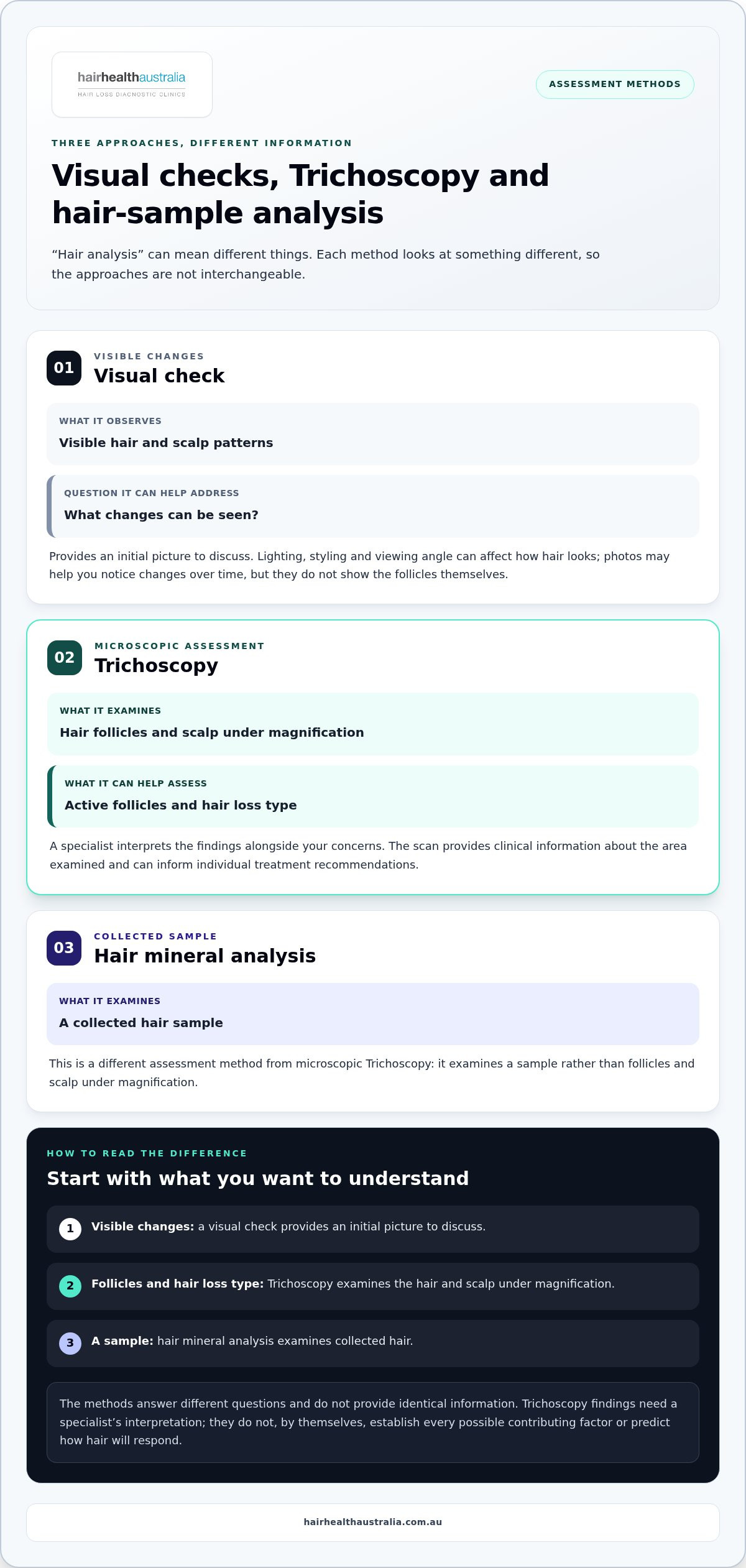
“Hair analysis” can refer to different assessment methods. A visual check considers visible changes, microscopic Trichoscopy examines follicles, and hair mineral analysis examines a collected sample. Knowing the difference helps you match the method to the question you want answered. These approaches are not interchangeable and do not provide identical information.

Approach What it observes Question it can help address Role in decision-making
Visual check Visible hair and scalp patterns What changes can be seen? Provides an initial picture to discuss
Microscopic Trichoscopy Hair follicles and scalp under magnification What do the follicles show, and what type of hair loss may be present? Supports clinical assessment and discussion of next steps
Hair-sample mineral analysis A collected hair sample What mineral-related information does the sample analysis report? Offers a different form of sample-based information

Microscopic Trichoscopy compared with a visual check

A visual check can help identify apparent changes, such as a part that looks wider or a hairline that appears different. Lighting, styling and viewing angle can affect what you notice, and appearance alone doesn’t show follicles under magnification.

During Hair Health Australia’s Hair Health Check, Trichoscopy provides a microscopic view to assess active follicles and help diagnose hair loss type. This adds detail to the visible pattern and supports a more informed discussion. Visual observation is still useful context, while the microscopic findings need to be interpreted in relation to your concerns.

Hair density testing compared with hair mineral analysis

The key difference is what the method examines. Trichoscopy looks at follicles microscopically, while hair mineral analysis uses a collected hair sample. For example, TCM Clinic describes a sample-based hair mineral analysis format. That is an example of a different analysis method, not an endorsement or a substitute for a follicle-focused assessment.

If your main question is about visible density, active follicles or hair loss type, a microscopic assessment is designed to examine those features. If you’re asking about information reported from a hair sample, mineral analysis has a different focus. The methods shouldn’t be treated as interchangeable.

A hair density test Sydney readers are considering is most useful when its method matches the concern they want to understand. Knowing whether an assessment examines visible patterns, follicles or a sample helps you make sense of its findings and discuss suitable next steps.

Hair Density Test Sydney: What to Expect & Next Steps

How to prepare for a Sydney hair density test and use the findings

A little preparation can make your assessment discussion more focused. Think about what you’ve noticed and when it began. Has thinning appeared gradually, or did you first spot a change in a particular area? Note whether it affects your part, temples, crown or hairline, and whether you’ve noticed changes elsewhere on your scalp.

Before your assessment, note when the change began, which areas are affected, any products or treatments you’ve tried, and the questions you want answered. You don’t need to arrive with a diagnosis. Your notes can help you describe your experience clearly and give the specialist useful context alongside the microscopic findings.

Questions to bring to the assessment

Writing down a few questions means you can refer to them during the discussion. Ask what type of hair loss the findings indicate and what the active follicle observations mean in your case. If a treatment is discussed, ask how it is customised to your diagnostic results and how the specialist will explain the treatment mechanism and expected results.

Turning assessment findings into an informed next step

Once the findings are explained, you can consider what they mean for your situation instead of choosing a treatment based only on appearance or assumptions. Hair Health Australia’s specialists discuss your hair loss type and explain how a recommended treatment works. Treatment plans are customised to individual diagnostic results for men and women considering hair regrowth treatment.

Mention any hair regrowth products or treatments you’ve tried, including what you used and when. This gives the specialist context about your concerns and previous experience. You can also ask what the assessment shows and how the proposed next step relates to the findings. The aim is to leave with a clearer understanding of your options.

When comparing non-surgical hair loss care, consider whether the assessment findings are explained clearly and how recommendations are tailored. Hair Health Australia’s Hair Health Check at the Redfern clinic takes ONLY 30 MINS and is free, with no cost or obligations.

To discuss your concerns and understand your findings, book your free Hair Health Check in Sydney.

Book a free hair density test in Sydney with Hair Health Australia

If you’re looking for a hair density test Sydney assessment, Hair Health Australia’s Hair Health Check offers a practical way to discuss changes you’ve noticed and understand what the findings may mean. The check is free, with no cost and no obligations, and takes ONLY 30 MINS at the clinic in Redfern, Sydney.

What the Hair Health Check includes

The assessment uses microscopic Trichoscopy to examine active hair follicles. The scan helps specialists assess the follicles and diagnose hair loss type, giving you a clearer basis for discussing your concerns than appearance alone. The specialist explains the findings during the check, so you can understand what was observed and ask questions.

Specialists use diagnostic results to customise treatment plans to each individual. If a hair regrowth treatment is discussed, you can learn how it relates to your findings and how the recommended approach works. Your results and next steps are specific to your situation.

It may help to arrive ready to describe when you first noticed a change, which areas concern you and any products or treatments you’ve tried. That context supports a more relevant conversation about the scan. You don’t need to decide on treatment before attending, and there’s no obligation to proceed with treatment after the check.

Taking the next step in Redfern

A microscopic assessment can be a useful starting point if uncertainty about thinning makes it difficult to work out what to do next. The Hair Health Check brings the scan, diagnosis of hair loss type and explanation of findings together, followed by a discussion of options tailored to the diagnostic results. You can understand the findings and consider your next step at your own pace.

Learning about clinical hair treatment and non-surgical restoration can also help you understand the kind of treatment discussion that may follow an assessment. The Hair Health Check focuses on your follicles, hair loss type and individual findings, so the conversation is grounded in your assessment.

If you’re ready to discuss your hair concerns in person, book a free Hair Health Check at Hair Health Australia’s Redfern clinic. The check takes ONLY 30 MINS, is free with no obligations, and gives you an opportunity to understand the findings before considering a customised treatment plan.

Book your free Hair Health Check.

Take a clearer next step for your hair health

Uncertainty can make it hard to know whether to keep monitoring a change or explore treatment. A focused assessment gives you the opportunity to discuss what you’ve noticed, understand the findings and decide what feels appropriate for you. You don’t need to arrive having already made a treatment decision.

If you’re considering a hair density test Sydney assessment, Hair Health Australia’s Redfern Hair Health Check offers a clinical setting to ask questions and discuss your individual results. Microscopic Trichoscopy helps assess active follicles and diagnose hair loss type, while the specialist explains what the findings mean for your next steps. The check is free, with no cost or obligation to proceed with treatment.

Take the first step towards a clearer understanding of your hair health. Book your free Hair Health Check at Hair Health Australia’s Redfern clinic in Sydney.

Frequently Asked Questions

Can a hair density test tell me whether my hair loss is permanent?

A hair density test can’t confirm whether hair loss is permanent or predict an individual outcome. Trichoscopy assesses active follicles and helps diagnose hair loss type. The findings can inform a discussion about potential regrowth and a treatment plan customised to your diagnostic results and circumstances. A specialist can explain what the scan suggests and discuss next steps.

Should I book a hair density test if my thinning is only just starting?

An early assessment can help clarify the changes you’re noticing and what type of hair loss may be involved. For a hair density test Sydney appointment, note when you first spotted thinning and the areas that concern you, such as your part, temples or crown. This gives the specialist a useful timeline to discuss alongside the findings.

Can stress or medication contribute to hair loss?

Stress and some medications are among the possible contributors to hair loss. Other causes can include hereditary patterns, hormonal imbalance, nutrient deficiency and less common factors. The Hair Health Check assesses hair loss type, and a specialist discusses the findings and suitable next steps with you. If you suspect a medication is affecting your hair, don’t stop or change it without discussing this with the clinician who prescribed it.

Can women book a hair density test in Sydney?

Yes, Hair Health Australia provides hair loss treatment for women as well as men. Women experiencing thinning, changes to their part or other hair concerns can have a Hair Health Check in Sydney. The assessment uses Trichoscopy to examine active follicles and diagnose hair loss type. If treatment is discussed, the plan is customised to the individual’s diagnostic results rather than assumed from gender or appearance alone.

Can I have a hair density test if my hair loss is advanced?

Yes, Hair Health Australia sees people at any stage of the hair loss cycle, including more progressed stages. The assessment examines active follicles and helps diagnose hair loss type, giving you information to discuss even if thinning has been present for some time. The findings can help shape an individual discussion about possible next steps.

What should I note before a hair density assessment?

Note when you first noticed thinning, which areas are affected and what changes you’ve observed over time. You might also write down questions about hair loss type, active follicle findings and how a recommended treatment works. Mention any products or treatments you’ve tried. Hair-sample preparation instructions relate to sample-based testing and don’t automatically apply to microscopic Trichoscopy, which examines follicles rather than a collected sample.

How to Track Hair Regrowth Progress: A Clear, Practical Guide

What if the change you see in the mirror says more about the lighting than your hair? If you’re wondering how to track hair regrowth progress, inconsistent photos, styling and hair position can make small changes look bigger, smaller or absent altogether. Checking every day can turn a gradual process into a source of unnecessary doubt.

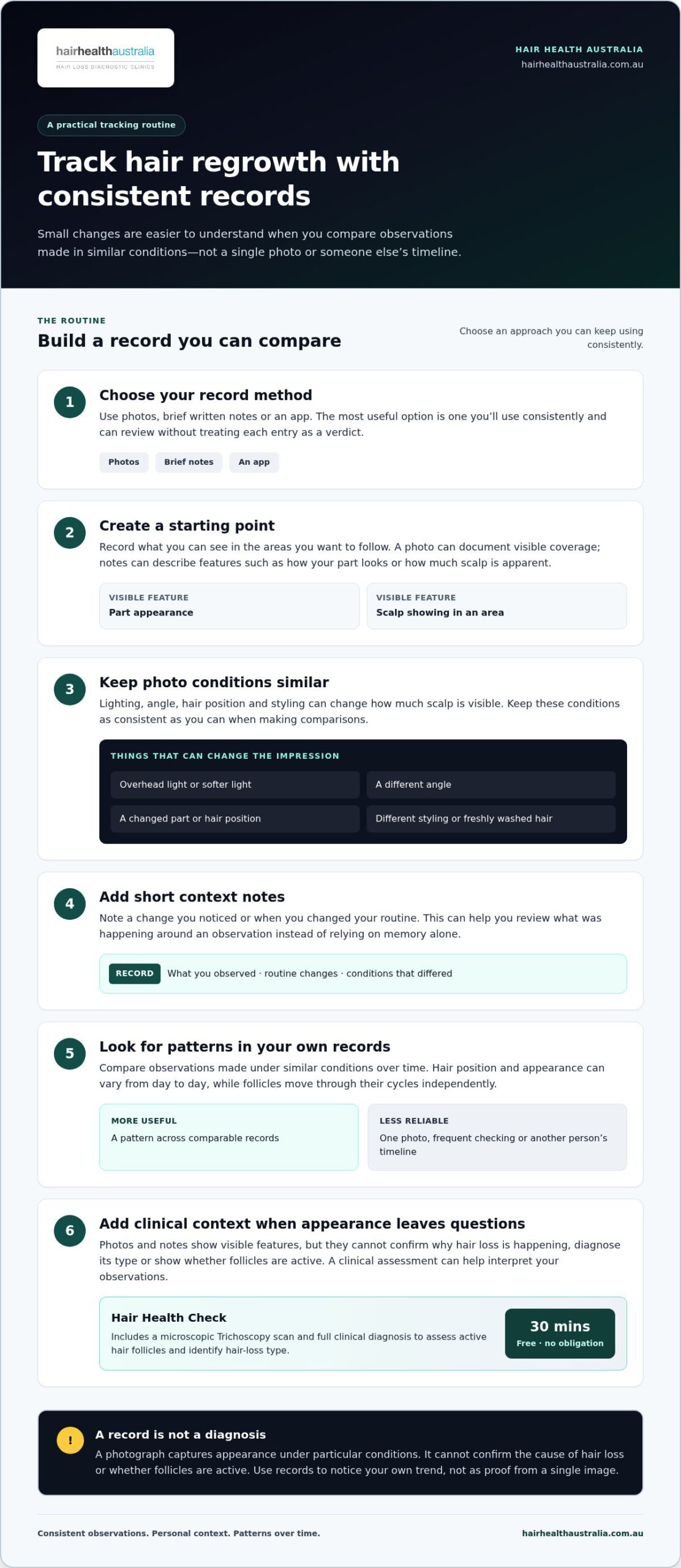
It’s understandable to want clear evidence that your hair is changing. The most useful records come from consistent comparisons, not a single snapshot or someone else’s timeline. Hair regrowth is gradual, and progress can vary from person to person.

This guide explains how to create a practical baseline, take comparable photos and record changes without treating each one as a verdict. You’ll also learn how to look for patterns over time and when a clinical assessment may help explain what your records show. Hair Health Australia’s free, no-obligation Hair Health Check includes a microscopic Trichoscopy scan and full clinical diagnosis. It assesses active hair follicles and identifies your hair-loss type, putting personal observations into context. The check takes ONLY 30 MINS.

Key Takeaways

  • Learn how to track hair regrowth progress with a simple baseline and records you can compare over time.
  • Choose photos, brief notes or an app based on what you’ll use consistently, and focus on patterns rather than daily changes.
  • Hair growth cycles and the causes of hair loss vary, so use your records to understand your own trend rather than expect a universal timeline.
  • A clinical assessment can add diagnostic context. Hair Health Australia’s free, no-obligation Hair Health Check includes a Trichoscopy scan and full clinical diagnosis, and takes ONLY 30 MINS.

Why hair regrowth can be hard to track by appearance alone

A part that looks wider in the bathroom mirror or a patch that seems fuller in a photo can prompt questions. But hair position, styling and lighting all affect how much scalp is visible. Overhead light may highlight the scalp, while softer light can make hair look denser. A different part or freshly washed hair can also change the impression of fullness without showing a meaningful change in growth.

Reliable hair regrowth tracking means recording consistent observations over time, not treating one image as proof of a treatment outcome. Separating what you can see from what you can conclude is an important part of learning how to track hair regrowth progress. A photo documents visible coverage under particular conditions. By itself, it can’t confirm why hair loss is happening or whether follicles are active.

Why the mirror can give you a different impression each day

Hair naturally falls and sits differently from one day to the next. A change in your part, the way you’ve styled your hair or the angle you’re looking from can expose more or less scalp. Lighting matters too: bright light directly above your head can create a different impression from diffuse daylight.

That’s why one good hair day, or a day when your hair feels less cooperative, is weak evidence of a trend. Frequent checking can make ordinary variation feel loaded with meaning. If looking often is adding pressure, step back and rely on records made under similar conditions instead.

What a useful progress record can and cannot tell you

Photos and brief notes can help you compare visible features over time, such as how your part looks or how much scalp is apparent in a particular area. Their value depends on consistency. If the lighting, angle, hair position or styling changes between images, it becomes harder to tell whether a difference reflects your hair or the way it was recorded.

A photograph records appearance, not an active follicle count. It also can’t diagnose a hair-loss type or establish its cause. Those questions need clinical context. For an overview of the biology behind hair growth, see Hair Follicle and Growth Cycle. The cycle helps explain why visible changes may not tell the whole story, but a general reference can’t assess your individual scalp.

Keep your observations personal. Another person’s timeline reflects their own circumstances and isn’t a reliable benchmark for yours. If your records leave you unsure what you’re seeing, a Hair Health Check can add diagnostic context. It includes a microscopic Trichoscopy scan and full clinical diagnosis to identify hair-loss type and assess active hair follicles.

How the hair growth cycle affects visible regrowth progress

Hair doesn’t change all at once. Each follicle moves through a cycle of active growth, transition and rest, and neighbouring follicles aren’t necessarily at the same stage. A change at the scalp may therefore take time to become visible across an area. The hair growth cycle helps explain why a brief change in appearance isn’t, on its own, a clear sign of regrowth or continued loss.

Visible hair changes take time to assess because follicles cycle independently, and early changes may not yet alter the overall appearance of the scalp. Useful tracking relies on comparable records over time, rather than judging progress from one short-lived difference.

Why changes at the scalp may not look immediate

During the active phase, a follicle produces a hair. It then moves through a transition and resting phase before the cycle begins again. These stages help explain why a change in follicle activity may not quickly translate into obvious coverage: a new hair has to grow enough to affect how the area looks. The American Academy of Dermatology on Hair Loss also outlines different causes of hair loss, which can affect what changes are relevant to monitor.

Hair loss has more than one possible cause, and its pattern and course can differ between people. Treatment responses differ too. A change that appears over a short period may reflect how the hair is sitting or other day-to-day variation, rather than a lasting shift. Avoid treating one promising image as a definitive result, or one disappointing observation as proof that nothing is changing.

Why another person’s progress is not your measurement standard

Two people can start with different patterns, hair-loss types and personal circumstances. Their records may also be made under different conditions. Social media photos and personal anecdotes rarely show enough context to establish what caused a change or how it relates to your situation. They can offer perspective, but they aren’t clinical benchmarks.

Instead, compare your own observations made in a consistent way. Look for a pattern across records, and note when you changed your routine or noticed a difference. That gives you a more useful basis for questions than comparing your appearance with someone else’s reported timeline.

If you’re unsure what your observations mean, a clinical assessment can add context beyond appearance. Hair Health Australia’s free, no-obligation Hair Health Check includes a microscopic Trichoscopy scan and full clinical diagnosis of hair-loss type and active hair follicles. It takes ONLY 30 MINS and can help you understand your observations alongside individual findings.

Which hair regrowth tracking methods make comparisons more useful?

Photos, brief written notes and apps can each help you keep a record. The best choice is the one you’ll use consistently and can review without turning every entry into a verdict. Combining a photo with a short note can be useful: the image shows appearance, while the note records conditions that may affect the comparison.

Use the same views and similar conditions each time. A new angle, different lighting or a change in styling can make comparisons less meaningful. Consumer records can help you notice visible patterns, but they can’t diagnose your hair-loss type or count active follicles.

Method Strength Limitation Suitable use
Standardised photos Show visible appearance across comparable views Can be affected by lighting, angle and hair position Comparing the same areas over time
Written notes Add context about appearance and routine changes Rely on memory and consistent wording Recording details a photo won’t show
Tracking app Keeps photos and notes together for later review Doesn’t provide a clinical diagnosis Organising records if you prefer digital tools

How to take comparable hair progress photographs

Choose a few views of the areas you want to observe, then repeat those views as consistently as practical. Keep the camera distance, angle, lighting and background similar. Note whether your hair is freshly washed, styled or left in its usual position. These details won’t make a photo diagnostic, but they help you judge whether two images offer a fair comparison.

Avoid interpreting small differences as a confirmed result. A photograph documents how your hair looked in that moment; it doesn’t reveal what is happening at the follicle level.

What to record alongside photos and app entries

Keep notes brief. Record the date, what you noticed and any relevant changes to your hair-care or treatment routine. An app can make it easier to store entries in one place, but it remains a record-keeping tool, not a diagnostic authority. Choose a method that feels manageable, rather than adding tracking tasks you won’t maintain.

Your records can also help you describe your concerns during an assessment. Hair Health Australia’s Hair Health Check includes a Trichoscopy scan and full clinical diagnosis. Hair regrowth treatments for men and women are customised to individual diagnostic results. Your observations can inform the discussion, while clinical findings provide another kind of context.

In short, how to track hair regrowth progress depends less on the tool than on making your records comparable. Keep the process simple, and review the pattern rather than relying on one image or app entry.

How to Track Hair Regrowth Progress: A Clear, Practical Guide

How to build a simple hair regrowth tracking routine

A useful routine should be easy to repeat, not another source of pressure. You don’t need to inspect your hair every day or follow a universal review schedule. Choose a manageable approach, then use it consistently enough to compare records and notice whether a pattern is emerging.

Set a baseline, repeat the same recording conditions, review the pattern and note any questions for a clinical discussion. This sequence helps keep your records organised without treating them as proof of a treatment result.

Set a baseline you can compare fairly

Before you begin, decide which areas you want to observe and choose a few clear views. Use similar camera distance, angle and lighting each time, and keep your hair in a comparable position. Add a short description, such as “centre part” or “temples”, so you remember what each image is meant to show.

Label each record with the date and view. For example, a file name such as “date_centre-part” can make older images easier to find and compare. Add a brief note if your hair was freshly washed or styled differently. Store the records somewhere private and straightforward to access, such as a folder on your device or a paper diary.

Review patterns without turning tracking into pressure

Choose a review rhythm you can sustain. There’s no need to make a judgement every time you look in the mirror. Instead, compare records made under similar conditions when you have enough observations to consider a pattern. If lighting or styling differs, mark that in your notes rather than drawing a firm conclusion from the image.

Keep a separate list of questions that come up as you review. You might note that a particular area seems different across several comparable records, or that you’re unsure whether a change is related to your routine. If you’re concerned about possible early signs of alopecia in women, record what you’ve observed and raise it in a clinical discussion rather than relying on comparisons with online photos.

Tracking is for organising observations, not diagnosing the cause of hair loss. Your records may help explain what you’ve noticed, while a clinical assessment can add information that photographs can’t provide. Hair Health Australia’s free, no-obligation Hair Health Check includes a microscopic Trichoscopy scan and full clinical diagnosis of hair-loss type and active hair follicles. It takes ONLY 30 MINS.

If you’d like clinical context for your observations, book a Hair Health Check.

When a clinical Hair Health Check can add context to your records

Your photos and notes can help you keep track of what you’ve observed, but they can’t identify the type or cause of hair loss. A clinical assessment adds a different perspective by considering your observations alongside an examination of the scalp and hair follicles. This can be useful if your records show a persistent change or if you’re unsure what a pattern means.

A Hair Health Check helps you understand your hair health more clearly and discuss next steps based on clinical findings. Bring your records if you have them. They can help explain what you’ve noticed, while the assessment provides diagnostic information a photograph alone can’t show.

What Trichoscopy assesses during the Hair Health Check

The Hair Health Check includes a microscopic Trichoscopy scan and full clinical diagnosis of hair-loss type and active hair follicles. Trichoscopy allows specialists to assess the scalp and follicles more closely than a standard photograph can. They explain your specific hair-loss type and how a recommended treatment works, helping put your personal observations into context.

How diagnosis can inform an individual next step

After your hair-loss type has been assessed, hair regrowth treatments for men and women are customised to your individual diagnostic results. Specialist support and education help you understand the recommendation and the findings behind it. The scan and diagnosis provide clinical context, while your specialist can explain what to expect from the recommended treatment.

For readers considering how to track hair regrowth progress, the distinction is useful: personal records show changes in appearance, while a clinical assessment can help explain what may be happening at the follicle level. Bring questions about your photos, notes or changes you’ve noticed, and discuss them alongside the assessment.

Hair Health Australia’s Hair Health Check is free, with no cost and no obligations, and takes ONLY 30 MINS. It’s available at the clinic in Redfern, Sydney. If you’re in Sydney and would value clinical context for your observations, you can arrange a free Hair Health Check.

Use your records to choose a clear next step

Your tracking routine doesn’t need to answer every question. Its purpose is to help you notice what’s changing, keep useful observations together and decide what you’d like to understand better. That can make the process feel more deliberate, especially when day-to-day appearance shifts make it tempting to draw a quick conclusion.

Let your records support your decisions rather than dictate them. If a pattern continues to concern you, or you’d like help understanding what you’ve observed, a clinical assessment can provide another perspective. Bring your notes and questions to discuss what they may mean alongside the findings.

Hair Health Australia’s free, no-obligation Hair Health Check includes Trichoscopy and full clinical diagnosis, and takes ONLY 30 MINS. Book your free Hair Health Check in Sydney to gain clearer context for your personal observations and discuss an individual next step.

Frequently Asked Questions

Can I track hair regrowth progress with photos alone?

Photos can help you document visible changes, but they can’t show the cause of hair loss or confirm whether follicles are active. A slight shift in camera height, overhead lighting or the way hair is brushed can alter how much scalp appears. Pair images with short notes, such as changes to your part or routine. If you need to understand what you’re seeing, a clinical assessment can add diagnostic context.

How often should I take hair regrowth progress photos?

There’s no single photo schedule that suits everyone. Checking too frequently may make normal changes in hair position or appearance feel more meaningful than they are. Choose a routine you can maintain without added stress, and avoid changing it each time you feel concerned. For example, decide in advance when you’ll review your records, rather than taking extra photos after a difficult hair day.

Can a hair growth app tell me whether my hair is regrowing?

An app can help organise your photos and observations, but its records aren’t a clinical diagnosis. Even a side-by-side comparison can be affected by differences in camera position, lighting or styling. If you want to understand what your records may mean, a clinician can assess your hair-loss type and active follicles using Trichoscopy. Treat app entries as a record to discuss, not as confirmation of regrowth.

What should I do if my hair looks thinner in one progress photo?

Don’t draw a firm conclusion from one image. Hair may appear thinner because it’s positioned differently, or because the light and camera angle expose more scalp. Compare the photo with another taken under similar conditions, and note anything that may explain the difference. If the concern continues across your observations, bring it up in a clinical assessment so it can be considered alongside other findings.

Does tracking hair regrowth mean I need to change my treatment?

No. A tracking record by itself can’t determine whether your treatment should change. Use it to describe what you’ve noticed, including when a change began and whether it appears consistently in your records. Discuss those details during a clinical assessment, where your hair-loss type and individual circumstances can be considered. Don’t make a treatment decision based on a single photo or an app comparison alone.

Is the Hair Health Check free, and how long does it take?

Yes. Hair Health Australia’s Hair Health Check in Sydney is free, with no cost and no obligations, and takes ONLY 30 MINS. It includes a microscopic Trichoscopy scan and full clinical diagnosis. The assessment identifies hair-loss type and assesses active hair follicles, helping put your personal observations into clinical context.

What Is a Trichoscopy Exam? A Clear Guide to Scalp Imaging

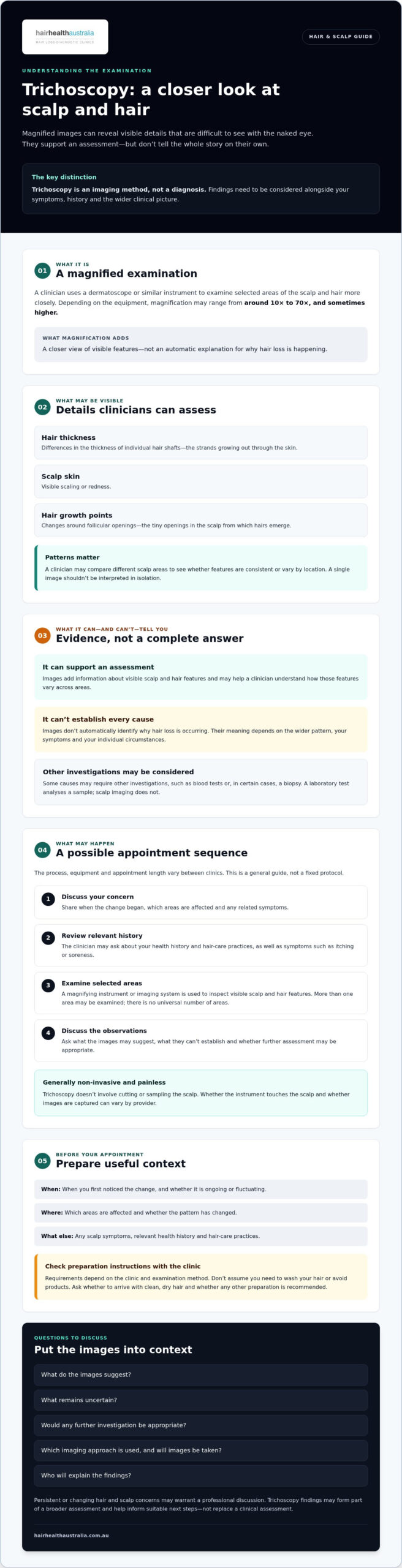
Could a close-up view of your scalp tell the whole story behind hair loss? Not on its own. If you’re wondering what is a trichoscopy exam, it’s a non-invasive way for a clinician to examine your scalp and hair under magnification. The images can reveal details that are difficult to see with the naked eye, but their meaning depends on the wider pattern and your individual circumstances.

It’s understandable to feel unsure about what happens during a scalp examination or whether magnified images can provide a definite diagnosis. Trichoscopy is generally painless and doesn’t involve cutting or sampling the scalp. However, it has limits: some causes of hair loss may require other investigations, such as blood tests or, in certain cases, a biopsy.

This guide explains what the examination involves, what clinicians may look for and what the findings can and can’t confirm. You’ll also learn how to prepare and what to discuss with a clinician. If you’re considering a hair health check in Sydney, trichoscopy findings may form part of a broader assessment and help inform suitable next steps, rather than being treated as a diagnosis on their own.

Key Takeaways

  • Learn what is a trichoscopy exam and how magnified scalp and hair images can support an assessment.
  • Understand what may happen during the examination, while recognising that clinic procedures can vary.
  • See which visible features imaging may help assess, and why it can’t establish every cause of hair loss on its own.
  • Prepare useful details about your symptoms and hair history, and check any preparation instructions with the clinic.
  • Know when persistent or changing hair and scalp concerns may warrant a professional discussion, and what to ask about next steps.

What Is a Trichoscopy Exam, and What Does It Examine?

Trichoscopy is a magnified examination of the scalp and hair. A clinician uses a dermatoscope or similar instrument to view details that may be difficult to see with the naked eye. Depending on the equipment, magnification can range from around 10 times to 70 times, and sometimes higher. The images help the clinician assess visible features, but their meaning depends on your symptoms, history and the wider clinical picture.

If you’re asking what is a trichoscopy exam, the key distinction is that it’s an imaging method, not a diagnosis. An ordinary visual check gives an overall view of the scalp and hair, while trichoscopy provides a closer look at selected areas. A laboratory test is different: it analyses a sample, such as blood, and can help investigate issues that scalp images can’t establish. For background on the method, see Trichoscopy.

What features can trichoscopy make easier to see?

Magnified images may show features of the scalp skin and hair shafts, including differences in hair thickness, visible scaling or redness, and changes around hair growth points. A hair shaft is the strand that grows out through the skin. A follicular opening is the tiny opening in the scalp from which a hair emerges. These observations don’t identify every cause of hair loss by themselves.

A clinician may compare images from different scalp areas to see whether features are consistent or vary from one location to another. That pattern can add useful evidence, but a single image shouldn’t be interpreted in isolation.

Is trichoscopy the same as a hair loss diagnosis?

No. Images can support an assessment, but they don’t automatically reveal why hair loss is happening. The clinician may consider how long the concern has been present, whether it’s changing, any scalp symptoms, your health and hair history, and findings from a broader examination. If needed, other investigations may help assess possible causes that imaging can’t confirm.

Think of trichoscopy as one potential part of a clinical assessment, not a substitute for one. Ask the clinician what the images suggest, what remains uncertain and whether further investigation is appropriate. This puts the visual findings into context and can clarify possible next steps.

What Happens During a Trichoscopy Exam?

A trichoscopy appointment usually begins with a conversation, followed by a closer look at selected areas of the scalp and hair. The sequence, equipment and appointment length vary between clinics, so check with the provider about their process. DermNet NZ explains how this examination of the scalp and hair can help clinicians assess visible features more closely.

What may happen before the scalp images are taken?

The clinician may ask when you first noticed a change, whether it’s ongoing or fluctuating, and which areas are affected. They may also ask about symptoms such as itching or soreness, your health history and relevant hair-care practices. These details help put visible findings in context.

Preparation instructions depend on the clinic and examination method. Don’t assume you need to wash your hair or avoid products beforehand. Ask whether to arrive with clean, dry hair and whether any other preparation is recommended.

How are the scalp and hair examined?

A magnifying instrument or imaging system may be used to view selected scalp areas. The clinician might examine more than one area, depending on your concern, but there’s no universal number or fixed protocol. Some providers capture images; others assess features directly. Whether the instrument touches the scalp and how long the examination takes can also vary. Ask what to expect if you’re unsure.

A typical sequence may look like this, but confirm the details with your practitioner:

  1. Discuss your concern: Share when the change began, where it’s happening and any related symptoms.
  2. Review relevant history: Answer questions about your health and hair-care routine.
  3. Examine selected areas: The clinician uses magnification to inspect visible scalp and hair features.
  4. Discuss observations: Ask what the images may suggest, what they can’t establish and whether further assessment is needed.

The examination is generally non-invasive, but the method and experience aren’t identical at every clinic. Before attending, ask which imaging approach is used, whether images are taken and who will explain the findings.

If you’re in Sydney and seeking a broader discussion about hair concerns, Hair Health Australia’s hair health check may be a relevant next step. Confirm directly whether it includes trichoscopy and which examination methods are used.

What Can a Trichoscopy Exam Show, and What Can It Not Confirm?

Magnified images can reveal visible differences in the scalp and hair, helping a clinician compare patterns across areas. A pattern is evidence to interpret, not proof of a particular condition. In other words, what is a trichoscopy exam can help answer is what features are visible, not necessarily what caused them.

How might trichoscopy contribute to assessing hair loss?

Differences in hair thickness, scalp appearance or follicular openings may contribute to an assessment of conditions such as androgenetic alopecia, alopecia areata or telogen effluvium. These are examples, not conclusions that can be drawn from one feature alone. Signs can overlap, so the clinician considers where they appear and how they fit with your symptoms and history. A review of trichoscopy for diagnosing alopecias describes its role as one source of clinical evidence.

Think of the images as one part of the picture:

What imaging may show What it cannot establish alone
Visible features of the scalp and hair shafts, including differences between examined areas. The full cause of hair loss or whether a particular condition is definitely present.
Patterns that may support a clinician’s consideration of a hair or scalp condition. Underlying medical factors, such as a nutritional deficiency or thyroid problem.
Changes that may prompt closer clinical discussion or further assessment. Whether treatment is suitable, or what the outcome of treatment would be.

When might other tests or assessments be considered?

It depends on the person. A clinician may consider further assessment if your symptoms, history and visible findings don’t provide enough clarity, or if a possible cause can’t be evaluated through scalp images. Blood tests may help investigate certain underlying factors. A scalp biopsy may be considered in some cases where further examination of scalp tissue is needed. Neither is automatically required after trichoscopy.

The appropriate next step depends on clinical judgement, not a fixed pathway. Ask what the images do and don’t suggest, whether other assessment is relevant to your situation, and why. Avoid using online images or a single feature to self-diagnose. Findings need to be interpreted in the context of a broader assessment.

What Is a Trichoscopy Exam? A Clear Guide to Scalp Imaging

How Should You Prepare for a Trichoscopy Exam and Understand the Findings?

Preparation instructions vary between clinics and examination methods, so check directly rather than changing your hair-care routine based on general advice. Ask whether you should arrive with clean, dry hair and whether to avoid styling products. If you’re unsure what is a trichoscopy exam likely to involve at your clinic, ask what method is used and what to expect before you attend.

What information should you bring to an assessment?

A clear account of what you’ve noticed can help the practitioner understand your concern and interpret any images in context. You don’t need to prepare a formal report. A few notes on your phone may be enough.

  • Timeline and pattern: When did the change begin, and which areas are affected? Note whether it seems stable, gradual or changing.
  • Symptoms: Record any scalp discomfort, itching or other changes you’ve noticed, and when they occur.
  • Relevant background: List medicines, health factors, hair-care practices or previous assessments that may be useful to discuss.
  • Your questions: Write down what you want to understand about the examination, the images and possible next steps.

What questions can help you understand the results?

Ask the practitioner to explain their observations in plain language. It’s reasonable to ask what was visible, how it relates to your concern and what the images can’t tell you. If an observation is uncertain, ask what information could help clarify it rather than assuming it confirms a specific cause.

  • Which features did you observe, and how do they relate to my symptoms?
  • Are these findings conclusive, or are there other possible explanations?
  • Would any further assessment be appropriate in my situation, and why?
  • What follow-up do you recommend, and when should I seek another clinical opinion?

A good explanation distinguishes what was observed from what remains uncertain. If you leave without understanding the findings or suggested follow-up, ask for clarification. You can also seek another clinical opinion if you remain concerned or feel your questions haven’t been addressed.

If you’re in Sydney and would like to discuss your hair concerns as part of an assessment, explore a hair health check. Confirm with the clinic whether it includes trichoscopy and which examination methods are used.

When Is a Trichoscopy Exam a Useful Next Step for Hair Concerns?

A professional discussion may be helpful if hair loss persists, changes over time or comes with scalp symptoms that concern you. You don’t need to know the cause before asking for an assessment. Understanding what is a trichoscopy exam is only one part of deciding what may help: a clinician can discuss whether magnified imaging is relevant to your concern and what else might be considered.

Trichoscopy is one potential assessment component, not a guaranteed answer, diagnosis or treatment. Its value lies in interpreting visible features alongside your history and symptoms, then explaining what they do and don’t indicate. If a finding is uncertain, ask what could clarify it and whether follow-up is appropriate.

What should you consider when choosing a hair assessment?

Look for clear information about what the assessment involves, its limitations and how findings will be discussed. Before proceeding, ask who conducts the assessment, who interprets any images and what follow-up is available. Check whether the clinic uses trichoscopy as part of its process. Don’t assume every hair assessment includes it.

How does an assessment fit into a treatment discussion?

An assessment can help frame a conversation about possible next steps, but suitable options depend on the individual concern and the information gathered. A treatment recommendation isn’t automatic, and no imaging result can promise regrowth or establish that a particular programme is right for you. Ask how a suggested option relates to your assessment, what its purpose is and what uncertainties remain.

Hair Health Australia is a Sydney-focused clinic offering personalised, non-surgical hair loss treatment programmes for men and women. Its hair health check provides an opportunity to discuss your concerns and possible next steps. Confirm directly which examination methods are used, including whether trichoscopy is part of the assessment. An assessment and a treatment recommendation are distinct steps.

If you’re ready to discuss ongoing or changing hair concerns, book a hair health check and ask what the assessment includes. A clear conversation can help you understand your options without assuming one image or examination will provide every answer.

Take the Next Step with Clearer Information

Trichoscopy gives a clinician a closer view of scalp and hair features, but the images are only one part of a broader assessment. Understanding what is a trichoscopy exam also means knowing its limits: visible patterns may inform a discussion, but they don’t always identify the cause or determine suitable treatment on their own.

If hair or scalp changes are persistent or concerning, discussing them with a clinician can help clarify what to consider next. Ask what an assessment involves, how findings will be interpreted and whether further investigation may be relevant. Hair Health Australia offers personalised, non-surgical hair loss treatment programmes for men and women in Sydney. A hair health check is an opportunity to discuss your concerns and possible next steps. Confirm directly whether it includes trichoscopy.

Arrange a hair health check to start a conversation about your hair concerns. With clear information and an individual assessment, you can take your next step with greater confidence.

Frequently Asked Questions

What is a trichoscopy exam?

A trichoscopy exam is a magnified examination of the scalp and hair using a dermatoscope or similar imaging instrument. If you’re asking what is a trichoscopy exam, think of it as a closer visual assessment, not a test that automatically identifies the cause of hair loss. A clinician may examine selected areas and interpret visible features alongside your symptoms, health and hair history, and any other relevant assessment.

Is a trichoscopy exam painful or invasive?

A trichoscopy exam is generally painless and non-invasive. It involves viewing the scalp and hair under magnification, rather than cutting or taking a sample of the scalp. The exact method can vary between clinics, including whether the instrument touches your scalp or images are captured. If you’re worried about discomfort or unsure what will happen, ask the clinic to explain its examination approach before you attend.

Can trichoscopy diagnose the cause of hair loss?

Trichoscopy can provide useful visual evidence, but it can’t confirm every cause of hair loss on its own. Images may show features that inform a clinician’s assessment, while factors such as your symptoms, health history and examination findings also matter. Blood tests may be considered to investigate some underlying causes, and a biopsy may be relevant in selected cases. Neither is automatically required; further assessment depends on your circumstances.

How long does a trichoscopy exam take?

A trichoscopy examination may take around 5 to 30 minutes, according to the research information for this article. The time can vary depending on the areas examined, the imaging method and whether the appointment includes discussion of your history or findings. Ask the clinic how long to allow for your appointment, as examination processes differ and an assessment may include more than image-taking.

Do I need to prepare my hair before trichoscopy?

Preparation instructions vary, so check directly with the clinic rather than assuming you should wash or leave your hair unwashed. Some guidance recommends avoiding washing for one to two days and not using styling products, but your provider’s instructions should take priority. Ask whether to arrive with clean, dry hair and whether products such as gel or hairspray could affect the examination method used.

Can trichoscopy tell the difference between types of hair loss?

Trichoscopy may help a clinician assess patterns associated with conditions such as androgenetic alopecia, alopecia areata or telogen effluvium. It doesn’t always distinguish them conclusively: visible signs can overlap, and findings need to be considered alongside your symptoms and history. Avoid diagnosing yourself from an image or one feature. Ask the practitioner what the pattern may suggest, what remains uncertain and whether further assessment is appropriate.

What happens after a trichoscopy exam?

After the examination, the practitioner may explain the visible features, how they relate to your concern and whether follow-up is appropriate. Further tests aren’t automatic, and imaging doesn’t guarantee a diagnosis or treatment plan. Ask what the findings can and can’t establish, and what next steps make sense for you. If you’re in Sydney, Hair Health Australia’s hair health check is an opportunity to discuss hair concerns. Confirm directly which examination methods it includes.

Stimulate Hair Follicles for Growth: 2026 Clinical Guide

That visible patch of scalp you’ve been noticing isn’t necessarily a sign of permanent loss, but rather a biological SOS from follicles that have shifted into a dormant state. If you are searching for how to stimulate hair follicles for hair growth, you’ve likely already realised that supermarket supplements and “miracle” oils rarely bridge the gap between marketing hype and medical reality. It’s incredibly frustrating to watch your hair density diminish while feeling like you’re just guessing at a solution. We understand the anxiety that comes with every morning spent checking the mirror for progress that hasn’t arrived yet.

This clinical guide provides a scientifically proven roadmap to revitalise those dormant follicles and restore your hair’s natural density without the need for invasive surgery. We will move past the confusion of the retail aisle to explore a systematic approach to scalp health, focusing on evidence-based methods that actually work. By the end of this article, you’ll understand how professional diagnostic tools like microscopic trichoscopy can identify recovery potential and why a personalised, non-surgical strategy is the most effective way to reclaim your confidence and your hair.

Key Takeaways

  • Understand the critical difference between dormant and dead follicles to determine your actual potential for natural regrowth.
  • Learn the clinical science behind how to stimulate hair follicles for hair growth by improving vasodilation and essential nutrient delivery to the hair bulb.
  • Evaluate the evidence-based efficacy of medical-grade therapies, such as Low-Level Laser Therapy (LLLT), compared to common home remedies and retail products.
  • Discover why a professional microscopic hair scan is the essential first step in identifying follicle viability and creating a personalised care plan.
  • Identify a clear, non-surgical roadmap to increase hair density and stop the shedding process using proven clinical protocols.

Understanding the Hair Follicle Lifecycle: Is Regrowth Possible?

To understand how to stimulate hair follicles for hair growth, we must first view the follicle as a complex, living organ rather than a simple strand of protein. Each follicle operates on a biological clock, transitioning through phases of active production, regression, and rest. This hair follicle lifecycle determines the density and length of your hair. When the system is healthy, the Anagen (growth) phase lasts for years. However, when follicles are under stress, this phase shortens, leading to thinner, weaker strands. Follicular stimulation is the clinical process of extending the Anagen growth phase to prevent premature shedding.

A common misconception is that hair loss happens instantly. In reality, most people experience a process called miniaturisation. This is a gradual biological shift where the follicle physically shrinks, producing finer hair with each successive cycle until the strand becomes almost invisible. While the follicle is miniaturised, it remains viable and capable of recovery. This represents a critical window for intervention before the follicle loses its capacity for production entirely.

The Difference Between Dormant and Dead Follicles

Distinguishing between a dormant follicle and one that has permanently ceased production is the most vital step in any recovery journey. Dormant follicles are “wakeable”; they are alive but stuck in an extended resting phase or producing microscopic “vellus” hairs. Conversely, scarred or dead follicles have lost their biological machinery, making non-surgical recovery impossible. Because you can’t see the status of a follicle with the naked eye, a professional Hair Health Check is essential. This specialised microscopic scan allows us to see beneath the surface and identify exactly which areas have the potential for revitalisation.

Why Follicle Health Declines: Identifying the Culprits

Several factors contribute to the decline of follicle vitality, with genetics and the hormone Dihydrotestosterone (DHT) playing a primary role. DHT binds to receptors in the scalp, essentially choking the follicle and triggering the miniaturisation process. In Australia, environmental stressors add another layer of complexity. Intense UV exposure can cause oxidative stress on the scalp, damaging the skin’s barrier and hindering the follicle’s ability to thrive. This environmental damage often goes unnoticed until thinning becomes visible. Additionally, poor micro-circulation often starves the hair bulb of oxygen and nutrients. When the blood vessels delivering life-sustaining elements to the scalp are restricted, even a nutrient-rich diet won’t result in healthy hair growth because the building blocks simply aren’t reaching their destination.

In addition to circulation, systemic health factors such as sleep quality influence how the body allocates nutrients for repair. For individuals whose hair health may be affected by the physiological stress of chronic sleep loss, specialised services like Enas Wellness provide nutritional strategies to manage insomnia and support the biological conditions necessary for hair follicle recovery.

The Science of Follicle Stimulation: Clinical Mechanisms That Work

Effective stimulation isn’t about applying a cosmetic product to the surface of the scalp. It requires a fundamental shift in the follicle’s internal environment. To understand how to stimulate hair follicles for hair growth, we must look at the biological “supply line” that feeds the hair bulb. Even the most expensive hair-growth vitamins will fail if the micro-circulatory system is too constricted to deliver those nutrients. We focus on “opening the pipes” through vasodilation, ensuring oxygen and essential building blocks reach the dermal papilla where hair production begins.

This process also involves boosting Adenosine Triphosphate (ATP) levels. ATP acts as the cellular fuel required to kickstart a follicle out of its dormant state and back into the active growth phase. Without this energy surge, the follicle remains in a state of suspended animation, unable to produce a healthy hair fibre regardless of how many topical oils you apply.

Increasing Micro-Circulation and Scalp Blood Flow

Clinical-grade stimulation differs significantly from a standard scalp massage. While manual massage provides a temporary surface-level glow, professional therapies use specific medical-grade topicals and technology to trigger deep-tissue vasodilation. This increased blood flow serves a dual purpose. It delivers fresh oxygen and nutrients while simultaneously performing a “cleansing” function. By flushing away metabolic waste and inflammatory markers from the follicle site, we create a pristine environment for new growth to take hold. If you aren’t sure whether your circulation is currently supporting growth, a professional Hair Health Check can provide the diagnostic clarity you need.

Blocking DHT: Protecting Follicles from Hormonal Shrinkage

Dihydrotestosterone (DHT) is the primary driver of follicle miniaturisation. This hormone binds to androgen receptors at the base of the hair, effectively “choking” the supply of life-sustaining blood. Over time, the follicle becomes so small it can no longer produce visible hair. Clinical strategies focus on inhibiting this binding process directly at the scalp level. By using targeted blockers, we can neutralise DHT’s impact without the systemic side effects often associated with oral medications. This creates a powerful synergy. While the blockers protect the follicle from hormonal attack, growth stimulants work to rebuild its strength and restore its size. It’s a two-pronged approach that addresses both the cause of the thinning and the mechanics of recovery.

Comparing Home Remedies vs. Professional Clinical Therapies

Many Australians start their restoration journey with over-the-counter solutions found in supermarket aisles. It’s a logical first step when you notice the first signs of thinning. However, understanding how to stimulate hair follicles for hair growth requires a realistic look at what these products can actually achieve. While retail items offer convenience, they often lack the potency and delivery mechanisms required to reverse established miniaturisation. Relying on a single “miracle” oil or shampoo is a common mistake that often leads to wasted time and further loss.

True restoration usually requires a multi-modal approach. This involves combining DHT blockers, targeted nutrient delivery, and cellular stimulation to address hair loss from every biological angle. A professional diagnostic approach moves beyond the guesswork of retail marketing to focus on what your scalp actually needs to recover.

Scalp Massages and Oils: What the Evidence Actually Says

Rosemary oil and caffeine shampoos have gained significant traction. Clinical data suggests these ingredients can support scalp health by providing mild antioxidant benefits and temporary surface-level stimulation. However, they rarely penetrate deep enough to reach the dermal papilla, which is the “engine room” of the follicle. Manual scalp massages do improve surface circulation, but they don’t provide the sustained, deep-tissue vasodilation needed for significant regrowth. For most individuals, these natural methods should be viewed as supportive maintenance rather than a primary recovery strategy. They work best when used to keep a healthy scalp in good condition, not to wake up dormant follicles that have been inactive for years.

Low-Level Laser Therapy (LLLT) and Medical-Grade Stimulants

Low-Level Laser Therapy, or photobiomodulation, represents a major shift from topical application to cellular repair. This technology uses specific wavelengths of light to stimulate mitochondria within the follicle cells. This process increases cellular energy production and repairs damaged tissues at the root. In a clinical centre, the equipment used delivers significantly higher energy density and consistency than portable home devices. This difference is crucial for results. Clinical-grade LLLT must meet strict Australian standards for safety and efficacy, ensuring the light reaches the necessary depth to trigger a genuine biological response. Consistency is the final piece of the puzzle. While a home device might be used sporadically, a structured clinical program ensures the follicles receive the precise “dosage” of stimulation required to see a visible increase in density. If you’re ready to move past trial and error, a professional Hair Health Check is the most reliable way to determine which clinical therapies will work for your specific hair type.

Stimulate Hair Follicles for Growth: 2026 Clinical Guide

A Step-by-Step Approach to Revitalising Your Scalp

Reviving dormant follicles isn’t a matter of luck. It’s a methodical clinical process. To understand how to stimulate hair follicles for hair growth effectively, you must follow a structured path that starts with evidence and ends with visible density. This journey moves from precise diagnostics to active stimulation and, finally, to long-term maintenance. Each stage is designed to remove the biological barriers that have been preventing your hair from thriving. We focus on results that are measurable, moving past the uncertainty of retail products.

Step 1: Professional Microscopic Hair Analysis

Before any treatment begins, we must determine if your follicles are capable of recovery. A microscopic hair analysis is the gold standard for this diagnosis. During this scan, we examine the scalp at up to 200x magnification to assess follicle spacing and individual hair shaft diameter. We also look for signs of scalp inflammation or sebum blockages that might be hindering growth. This data is critical. It allows us to distinguish between permanent loss and temporary dormancy, ensuring we only recommend a best hair regrowth treatment plan that is likely to succeed for your specific condition.

Step 2: Implementing a Targeted Non-Surgical Protocol

Once we’ve established viability, the next step is clearing the scalp of debris and excess sebum. These “plugs” can physically block the exit of new hairs and prevent topical stimulants from reaching the follicle root. After clearing the path, we implement a customised programme. The goal is to learn how to stimulate hair follicles for hair growth by creating the perfect environment for the hair bulb to flourish. This usually involves a combination of medical-grade topical stimulants and light-based therapies like LLLT. The frequency of your clinical visits is tailored to the severity of your thinning. While everyone’s biology is different, most patients begin to see the first signs of stabilisation and improved hair quality within the first 90 days of consistent therapy.

As the protocol progresses, Step 4 involves microscopic tracking. We don’t rely on “feeling” that it’s working; we use high-resolution scans to prove it. This allows us to see new “vellus” hairs maturing into thicker “terminal” hairs long before they are visible in a bathroom mirror. Finally, in Step 5, we adjust your maintenance plan. As your hair density improves, the intensity of the stimulation can often be reduced to a sustainable level that preserves your results for the long term. If you’re tired of guessing, the first step is to book your microscopic hair scan today.

Targeted Hair Restoration at Hair Health Australia Sydney

Hair Health Australia stands as a dedicated leader in non-surgical hair restoration within Sydney. Our commitment to clinical excellence ensures that every patient receives care rooted in modern science rather than marketing trends. We provide a supportive, professional environment where your concerns are met with objective, evidence-based solutions. While the retail market is flooded with generic kits, we recognise that hair loss is a deeply individual experience. A one-size-fits-all approach often fails because it ignores the unique biological markers of your scalp. By choosing a specialised centre, you shift from being a consumer of products to a participant in a clinical recovery process.

Why a Personalised Clinical Check is Your Best First Step

Many people lose years of potential regrowth by relying on guesswork. They cycle through various supplements and shampoos, often while their follicles continue to miniaturise. Our specialists focus on identifying the underlying cause of your thinning, whether it’s hormonal, environmental, or nutritional. We don’t just treat the symptoms; we address the biological “why” behind the loss. This diagnostic precision is the only way to truly understand how to stimulate hair follicles for hair growth for your specific hair type. We invite you to stop the trial-and-error cycle and book a Hair Health Check at our Sydney centre. This assessment provides the clarity needed to invest your time and resources into a protocol that actually works.

Our Non-Invasive Approach to Sustainable Hair Density

Our philosophy centres on long-term follicle health rather than temporary cosmetic cover-ups. While some seek immediate surgical results, our non-surgical methods offer a smarter, less invasive path to restoring density. We focus on revitalising the follicles you already have, leveraging their natural capacity for growth. Choosing a non-surgical hair loss clinic ensures you are guided by professionals who prioritise the health of your scalp as much as the appearance of your hair. It’s vital to remember that as long as your follicles are in a dormant state, recovery remains a very real possibility. Taking control of your hair health today means you won’t have to wonder “what if” tomorrow. We are here to act as your dedicated guide, helping you learn how to stimulate hair follicles for hair growth through a systematic, clinical roadmap.

Reclaim Your Hair Density with Clinical Precision

Restoring your hair density is a journey that begins with biological understanding, not surface-level cosmetic fixes. The key to recovery lies in identifying dormant follicles during the critical window of miniaturisation before permanent loss occurs. Understanding how to stimulate hair follicles for hair growth requires a systematic approach that combines deep-tissue vasodilation with cellular energy repair. By moving past the trial and error of supermarket products, you can focus on clinical protocols that have a documented impact on the hair bulb.

With over 15 years of clinical experience in Sydney, our dedicated non-surgical regrowth specialists use advanced microscopic diagnostic technology to remove the uncertainty from your recovery. We invite you to take the first definitive step toward a fuller head of hair. Book Your Professional Hair Health Check in Sydney Today to assess your follicle viability and receive a personalised roadmap for restoration. It’s often possible to save and revitalise your hair if you act while the follicles are still dormant. You don’t have to manage this process alone.

Frequently Asked Questions

Can dead hair follicles be stimulated back to life?

No, once a hair follicle has reached a state of permanent scarring or fibrosis, it cannot be stimulated back to life. However, many people mistake dormant follicles for dead ones. Dormant follicles are still alive but have stopped producing visible hair due to the miniaturisation process. This is why a professional assessment at our Sydney clinic is vital to determine if your follicles are truly lost or simply need the clinical intervention required to resume growth.

How long does it take to stimulate hair follicles for visible growth?

Visible results typically require three to six months of consistent clinical therapy. The biological process of shifting follicles from the resting phase back into the active growth phase takes time. You’ll usually notice a reduction in shedding within the first 90 days, followed by a gradual increase in density. This timeline is a key part of how to stimulate hair follicles for hair growth, as patience is essential while your scalp’s natural cycles reset.

Does scalp massage actually help with hair regrowth?

Scalp massage provides a temporary boost to surface-level blood circulation, which can support general scalp health. While it may help deliver nutrients more effectively, it is rarely enough to reverse clinical thinning or pattern baldness on its own. For genuine regrowth, you need targeted treatments that address hormonal factors like DHT and provide deep-tissue stimulation. We view manual massage as a helpful supplementary habit rather than a primary solution for restoring lost hair density.

What is the best clinical treatment for stimulating hair follicles in 2026?

The most effective approach in 2026 involves a multi-modal protocol that combines medical-grade Low-Level Laser Therapy (LLLT) with targeted topical stimulants. This combination addresses the two main requirements for growth: increasing cellular energy (ATP) and blocking the miniaturising effects of DHT. At our Sydney centre, we customise these treatments based on your microscopic scan results. This ensures you’re using the most potent non-surgical tools available to learn how to stimulate hair follicles for hair growth effectively.

Are there specific foods that help stimulate hair follicles?

Nutrition plays a foundational role in follicle health, but diet alone won’t reverse genetic thinning. Foods rich in iron, zinc, biotin, and lean proteins provide the building blocks your hair needs to grow. However, if your follicles are being restricted by DHT or poor micro-circulation, these nutrients won’t reach the hair bulb effectively. We recommend a balanced diet as part of a broader clinical strategy—concepts often explored by metabolic health experts like drrenatolobo.com.br—to ensure your scalp’s supply lines are open and functional.

It depends entirely on whether the follicles are still viable or have been replaced by scar tissue. If an area has been completely bald and smooth for many years, the chances of stimulation are lower. However, if there is still fine “vellus” hair present, regrowth may be possible. A microscopic analysis at Hair Health Australia is the only reliable way to assess your potential. We focus on saving follicles before they reach the point of permanent closure.

What is the difference between home laser caps and clinical LLLT?

The primary differences are energy output and therapeutic consistency. Clinical LLLT devices used in our Sydney centre are medical-grade units that deliver a much higher light density and more precise wavelengths than portable home caps. This ensures the light energy actually penetrates deep enough to reach the hair bulb. While home devices offer convenience, they often lack the power required to trigger a significant biological response in follicles that have already begun the miniaturisation process.

Hair Loss Guide for Professional Women in Sydney 2026

What if the thinning you notice in the bathroom mirror isn’t an inevitable sign of ageing, but a clinical puzzle that modern science can solve without a single day of downtime? For many, the first sign of a widening part or a receding hairline brings a wave of anxiety that’s hard to shake in a professional environment. You’ve likely spent hours searching for a reliable hair loss treatment for professional women Sydney, only to be met with conflicting online advice or the fear that invasive surgery is the only path forward.

We understand that your time is your most valuable asset and your professional image is paramount. You shouldn’t have to choose between painful procedures and losing your confidence. This guide explores how you can restore visible hair density through non-surgical, clinically-backed programmes that prioritise a scientific diagnosis over guesswork. You’ll discover the role of advanced Trichoscopy in identifying root causes and learn about the latest evidence-based protocols designed to deliver results without interrupting your career. From understanding TGA-approved options to the benefits of personalised microscopic analysis, we provide the clarity you need to take control of your hair health with total certainty.

Key Takeaways

  • Learn why microscopic hair analysis (Trichoscopy) is the only way to accurately distinguish between active and dormant follicles, ensuring your treatment is based on data rather than guesswork.
  • Understand how high-pressure careers and cortisol levels impact hair health, and why a specific hair loss treatment for professional women Sydney must be tailored to these unique environmental factors.
  • Compare the benefits of non-surgical regrowth programmes against invasive surgery, focusing on protocols that stimulate your existing hair without requiring lengthy recovery periods.
  • Discover how to integrate clinical hair restoration into a busy work week with discreet services and flexible scheduling designed for the Sydney CBD professional.
  • Identify the logical first step in your restoration journey by accessing a no-obligation Hair Health Check to establish a clear, scientific baseline for your recovery.

Understanding Hair Loss in the Sydney Professional Context

Sydney’s corporate culture is notoriously demanding. For women in leadership or high-stakes roles, the physical manifestation of stress often appears in the form of thinning hair. This isn’t merely a cosmetic concern; it’s a physiological response to a high-pressure environment. We’re seeing an increasing number of women seek a hair loss treatment for professional women Sydney because the competitive nature of our city leaves little room for the loss of confidence that accompanies hair thinning. In a professional setting, your image often reflects your vitality and command, making hair density a silent but significant factor in how you present yourself to the world.

High-performance careers often lead to chronically elevated cortisol levels. This hormone, while necessary for the “fight or flight” response, can be detrimental to hair follicles when sustained over long periods. It can push follicles into a resting phase prematurely, leading to a condition called Telogen Effluvium. While this type of shedding is often temporary, it can sometimes mask or exacerbate Pattern hair loss, which is a progressive genetic condition. Differentiating between a temporary reaction to a stressful project and a long-term clinical issue requires a specialized approach. The psychological toll of this uncertainty shouldn’t be underestimated. Many women report feeling a sense of “imposter syndrome” or a loss of professional edge when they no longer feel they look their best.

Common Triggers: Stress, Hormones, and Environment

“Sydney stress” is a tangible factor in hair health. Between the intense deadlines in the CBD and the daily commute, the body’s endocrine system is frequently under fire. Hormonal shifts often coincide with peak professional responsibility, such as during perimenopause or following a pregnancy. These biological changes can trigger thinning that feels sudden and overwhelming. Furthermore, the urban Sydney environment plays a role. Constant exposure to recycled office air-conditioning and city pollutants can lead to scalp inflammation. This creates a poor environment for hair growth, making it harder for follicles to thrive even if your genetics are on your side.

Signs You Should Seek a Clinical Diagnosis

Identifying the problem early is essential for effective restoration. You don’t need to wait until the thinning is obvious to others before taking action. Look for these specific indicators during your morning routine:

  • A widening centre part: You might notice more scalp becoming visible, particularly under the bright, unforgiving lights of a boardroom or lift.
  • Loss of volume: Your usual professional styles or ponytails feel thinner, or your hair lacks the “body” it once had.
  • Persistent shedding: Finding an unusual amount of hair on your desk, pillow, or in the shower for more than three consecutive weeks.

If these signs sound familiar, the most effective path forward is to stop guessing. A professional Hair Health Check provides the scientific baseline needed to understand your scalp’s current state. This diagnostic step ensures that any subsequent treatment is targeted, efficient, and appropriate for your specific hair profile.

The Science of Diagnosis: Microscopic Hair Analysis

Many professional women spend months cycling through premium salon products or pharmacy supplements without seeing a measurable change in their hair density. The limitation of these “trial and error” methods is that they treat the hair shaft as a cosmetic feature rather than the follicle as a biological organ. Relying on a standard visual inspection is often insufficient because by the time thinning is visible to the naked eye, you may have already lost up to 50% of your hair density in that area. To find an effective hair loss treatment for professional women Sydney, we must look beneath the surface to understand the specific health of your scalp environment.

Trichoscopy, or microscopic hair analysis, allows us to see what the naked eye cannot. It provides a high-magnification view of the follicles, allowing us to distinguish between those that are permanently lost and those that are merely dormant. This distinction is vital for setting realistic expectations. If a follicle is dormant or miniaturised, there is often significant potential for regrowth. As noted in clinical discussions regarding Treating female pattern hair loss, early and accurate diagnosis is the most influential factor in the success of non-surgical restoration. By identifying the specific stage of the hair growth cycle your follicles are in, we can move away from generic advice and towards a targeted, scientific protocol.

What Happens During a Microscopic Hair Health Check?

The diagnostic process is entirely non-invasive and efficient, designed to fit into a busy professional schedule. We use a specialised microscopic camera to capture high-resolution images of the scalp across different zones. During this session, we examine the hair bulb’s health, the diameter of individual hair shafts, and the condition of the scalp skin. We look for signs of inflammation, sebum blockage, or follicle miniaturisation that might be hindering your growth. This data-driven session is a structured way to learn more about our comprehensive hair health check and establish exactly what is happening at a cellular level.

The Data-Driven Approach to Restoration

Transparency is a cornerstone of our clinical process. By establishing a digital baseline during your first visit, we can measure your progress with mathematical precision. You don’t have to rely on a subjective “feeling” that your hair is thicker; you can see the objective increase in shaft diameter and follicle activation in follow-up scans. For women in analytical or data-heavy professions, this evidence-based approach replaces uncertainty with clarity. We use these results to customise your hair loss treatment for professional women Sydney, ensuring the programme targets your specific triggers. If you’re ready to move past the uncertainty of over-the-counter products, booking a no-obligation Hair Health Check is the most efficient way to start your restoration journey.

Non-Surgical Treatment Protocols vs. Invasive Options

Choosing the right hair loss treatment for professional women Sydney involves weighing the immediate appeal of surgical intervention against the long-term stability of clinical restoration. While hair transplants are often marketed as a permanent fix, they’re increasingly viewed as a secondary option for women. The primary goal for most professionals is to restore density across the entire scalp rather than simply relocating hair from one area to another. Non-surgical protocols focus on revitalising your existing follicles, which preserves the natural flow and distribution of your hair without the clinical risks associated with theatre-based procedures.

For a woman managing a demanding career in the CBD or North Sydney, discretion is often as important as the results themselves. Non-surgical programmes are designed to be entirely seamless, requiring zero downtime and leaving no visible signs of clinical intervention. This allows you to maintain your professional commitments and social calendar without the need for extended leave or the awkwardness of post-operative healing. By choosing a path that stimulates biological regrowth, you’re investing in a solution that works with your body’s natural cycles.

The Problem with “Quick Fix” Surgical Solutions

Invasive hair transplant surgery carries inherent risks that many professionals find unacceptable, including potential scarring, infection, and the unpredictable nature of graft uptake. A significant drawback often overlooked is that surgery doesn’t address the underlying biological causes of thinning. If the hormonal or environmental triggers aren’t managed, the non-transplanted hair will continue to thin around the surgical sites, often leading to patchy results over time. Furthermore, the recovery period for a transplant can span several weeks, involving swelling and visible scabbing that simply doesn’t suit a high-performance work schedule. Surgery is a reactive measure; it doesn’t stop the progression of hair loss, it only attempts to mask the symptoms.

Clinical Non-Surgical Restoration: How it Works

Our non-surgical approach is rooted in the science of follicle revitalisation. By using targeted clinical-grade topicals and advanced light therapies, we work to reverse the miniaturisation process that causes hair to become fine and brittle. This process is backed by an extensive clinical and pathophysiological review of how follicles respond to cellular stimulation. The objective is to move dormant follicles back into the active growth phase, increasing both the number of hairs and the diameter of each individual strand.

Consistency is the foundation of any successful hair loss treatment for professional women Sydney. Unlike a one-off surgery, a clinical programme is a structured journey that requires regular, manageable appointments to sustain hair density. To help you navigate the various options available in the current market, we recommend reading our buying guide for female hair loss treatment. This resource provides a transparent breakdown of what to look for in a clinical provider, ensuring you choose a programme grounded in evidence rather than marketing hype.

Hair Loss Guide for Professional Women in Sydney 2026

Integrating Treatment into a High-Performance Lifestyle

Sydney professionals often find that their biggest barrier to starting a hair loss treatment for professional women Sydney is the perceived time commitment. Between back-to-back meetings and the daily commute, finding space for clinical care requires a partner who understands the value of efficiency. We’ve structured our services to ensure that restoration doesn’t become another source of stress. Unlike generic online subscription kits that provide one-size-fits-all solutions via the post, a local Sydney specialist offers the precision of face-to-face diagnostics. This ensures your programme is adjusted in real-time based on your scalp’s actual response, not a set of predetermined algorithms.

Maintaining your hair health routine while travelling for business is another common concern. Our clinical programmes are designed with portability in mind. We provide structured guidance on how to manage your topical applications or light therapies while you’re interstate or overseas, ensuring that a trip to Melbourne or an international flight doesn’t derail your progress. Having a dedicated specialist to consult means your routine remains consistent regardless of your itinerary.

The Convenience of the Redfern Clinic

Our location in Redfern provides strategic accessibility for those working in the Sydney CBD, Surry Hills, or the Inner South. We understand that your day is governed by a strict schedule, so we prioritise punctuality and efficient appointment structures. You can easily transition from a morning briefing to your session and be back in the office for your next commitment. If you’re ready to see how easily this fits into your week, you can book your Sydney hair clinic appointment online.

Discretion and Professionalism

For women in high-profile roles, reputation management is a primary consideration. A high-street salon can often feel too public and lacks the clinical privacy required for a medical concern. Our clinic provides a professional, objective environment where your privacy is the priority. This isn’t a cosmetic indulgence; it’s a systematic clinical process. Ensuring you feel comfortable during both the diagnostic and treatment phases is essential for long-term success. It’s about replacing the “salon gossip” atmosphere with the quiet confidence of a specialist consultation.

When you’re evaluating your options, it’s helpful to use a checklist for choosing a Sydney clinic to ensure the provider meets your standards for professionalism and evidence-based care. The right hair loss treatment for professional women Sydney should feel like a partnership with a specialist who respects your time as much as your results. To take the first step toward a denser, healthier head of hair, we invite you to book a no-obligation Hair Health Check today.

Why Professional Women Choose Hair Health Australia

Professional women in Sydney require a level of clinical precision that matches the standards they maintain in their own careers. When you’re looking for an effective hair loss treatment for professional women Sydney, you deserve a provider that values evidence over hyperbole. At Hair Health Australia, we’ve built our reputation on a “straight-talking” philosophy that prioritises transparency and scientific verification. We understand that thinning hair can be a source of significant uncertainty, and our role is to replace that doubt with a clear, actionable path forward. Our commitment to evidence-based restoration means we don’t offer “miracle” cures; instead, we provide systematic, non-surgical protocols that are proven to work at a cellular level.

A personalised approach isn’t just a preference; it’s a clinical necessity for female hair loss. Unlike male pattern baldness, which often follows a predictable path, female thinning is frequently influenced by a complex interplay of hormonal shifts, nutritional status, and the high-cortisol environment of the Sydney corporate world. We treat every client as an individual, using our diagnostic data to tailor a programme that addresses your specific triggers. This results-oriented focus ensures that your time and energy are invested in treatments that have the highest probability of success for your particular scalp condition.

Real Results for Sydney Professionals

Success in our clinic is measured through objective clinical density improvements rather than subjective observations. By establishing a digital baseline during your initial consultation, we can track the progress of your follicles with mathematical accuracy. One of the most reassuring aspects of our process is the “potential for regrowth” assessment. Through microscopic scanning, we can determine exactly which follicles are dormant and capable of being revitalised, giving you total confidence in the viability of your restoration programme. Our clinical approach represents the gold standard for non-surgical hair restoration services within the New South Wales professional community.

Your Path Forward: The Free Hair Health Check

The most significant step you can take toward restoring your hair density is moving from uncertainty to diagnosis. You can book your session at our Redfern clinic directly without the need for a referral from a GP. This initial consultation is designed to be comprehensive and educational, providing you with a high-magnification view of your own scalp health. You’ll walk away from this session with a definitive diagnosis of the root cause of your thinning and a realistic, structured plan for restoration. This is a no-obligation opportunity to consult with a specialist who is dedicated to your long-term hair health. To begin your journey with a scientific baseline, Book your free Hair Health Check in Sydney today.

Restoring Your Confidence Through Clinical Precision

You don’t have to accept thinning hair as a permanent trade-off for a high-performance career. By prioritising a scientific diagnosis through clinically-backed Trichoscopy diagnostics, you can distinguish between temporary shedding and progressive loss with total clarity. This data-driven approach ensures that your hair loss treatment for professional women Sydney is targeted specifically to your biological needs. Choosing non-surgical protocols means you can achieve visible regrowth and increased density without the risks or lengthy recovery periods of invasive surgery.

Our specialist clinic in Redfern is dedicated to providing evidence-based solutions in a discreet, professional environment that respects your time. It’s time to stop the guesswork and start a programme that integrates seamlessly into your life with zero downtime. Reclaiming your hair density starts with understanding the root cause, and we’re here to provide the expertise you need to move forward with certainty. Take control of your hair health today by accessing the diagnostic data your scalp deserves.

Book Your Free Hair Health Check in Sydney to discover a realistic plan for your restoration. We’re ready to partner with you on a journey toward lasting hair health and renewed professional confidence.

Frequently Asked Questions

Is hair loss treatment for women covered by private health insurance in Australia?

Most private health insurance providers in Australia do not cover hair loss treatment for women, as it is typically classified as a cosmetic or elective procedure. This includes Medicare, which does not provide rebates for non-surgical restoration or diagnostic scanning. We recommend contacting your specific fund to verify if your extras cover includes any dermatological or clinical scalp assessments, though most clients find these services are an out-of-pocket investment in their professional image.

How long does it take to see results from a non-surgical regrowth programme?

Visible results from a non-surgical regrowth programme generally become apparent within three to six months of consistent treatment. This timeline aligns with the natural biological hair growth cycle, where follicles require time to transition from a dormant phase to an active growth phase. We use periodic microscopic scans to track your progress objectively. You’ll often see an increase in hair shaft diameter and scalp health before the overall increase in density becomes visible.

Can I continue to colour or style my hair during clinical treatment?

Can I continue to colour or style my hair during clinical treatment?

Microscopic hair analysis, known as Trichoscopy, is entirely non-invasive and painless. It involves using a specialised high-resolution digital camera that rests gently against the scalp to capture detailed images of your follicles and hair bulbs. There are no needles, skin scrapings, or discomfort involved. Most professional women find the process fascinating, as it provides a clear, real-time view of their scalp health on a screen, allowing for a transparent and scientific diagnosis of the root cause.

What happens if the scan shows my follicles are no longer active?

If the scan reveals that certain follicles are no longer active or have undergone permanent fibrosis, we will be completely transparent about the expected outcomes. Non-surgical protocols are most effective for revitalising dormant or miniaturised follicles. If our analysis shows that regrowth is not biologically possible in a specific area, we will help you manage your expectations and focus on preserving and thickening the surrounding hair. Our goal is to provide a realistic, evidence-based plan rather than false promises.

How much does hair loss treatment typically cost for women in Sydney?

The cost for a hair loss treatment for professional women Sydney varies based on the specific protocol required and the duration of the programme. In the wider Sydney market, non-surgical clinical sessions often range from $300 to $800 each, with multi-session packages being a common way to manage the investment. Because every scalp condition is unique, we provide a detailed cost breakdown only after your initial Hair Health Check, ensuring your plan is tailored to your specific clinical needs.

Do I need a GP referral to visit a hair loss specialist in Sydney?

You do not need a GP referral to visit our specialist clinic in Redfern. We operate as a direct-access clinical service, allowing professional women to book their Hair Health Check at a time that suits their schedule. This streamlined process removes the need for multiple appointments elsewhere and allows you to begin your diagnostic journey immediately. Simply contact us to arrange your session, and we will provide a comprehensive assessment of your hair and scalp health during your first visit.

Hair Growth Cycle Stages: An Australian Clinical Guide to Regrowth

Did you know that roughly 36% of Australians experiencing hair thinning rely on “miracle” shampoos and self-diagnosis rather than seeking professional clinical advice? It’s incredibly frustrating to invest time and money into generic products that fail to address why your hair is actually falling out. You might feel a surge of anxiety during the exogen phase, mistaking natural shedding for permanent baldness. We understand that clinical terminology often feels like a barrier to finding real answers. This article provides a clear breakdown of the hair growth cycle stages Australia patients encounter, moving past the jargon to focus on biological facts.

You’ll learn that your follicles aren’t necessarily dead; they might simply be stuck in a resting phase. We promise to show you how non-surgical clinical diagnostics in Sydney, such as microscopic Trichoscopy, can identify these specific disruptions. We will explore the biological phases from growth to shedding and outline a non-surgical path to waking up your dormant follicles. By the end of this guide, you’ll have a science-based plan to restore your hair’s natural rhythm and regain your confidence without the need for invasive surgery.

Key Takeaways

  • Learn to identify the four distinct hair growth cycle stages Australia patients must monitor to distinguish between standard shedding and actual follicle disruption.
  • Discover why microscopic hair analysis, known as Trichoscopy, is the only reliable way to confirm if follicles can be “woken up” through clinical intervention.
  • Understand how non-surgical programs effectively reset the biological clock of your hair, moving follicles from resting phases back into active growth.
  • Identify the specific roles of DHT and follicular miniaturisation in thinning, providing clarity on why generic retail products often fail to deliver results.
  • Establish a realistic, evidence-based path to restoration that focuses on scalp health and biological triggers rather than invasive surgical options.

Understanding the Hair Growth Cycle: Why Your Follicles “Sleep”

Every hair on your scalp is produced by a hair follicle, which is a complex, self-renewing organ. These follicles don’t just grow hair continuously; they operate on a sophisticated biological rhythm. Unlike some animals that shed their coats seasonally, the human hair growth cycle is asynchronous. This means each of your roughly 100,000 follicles is in a different stage at any given time. This staggered timing is what keeps your hair looking thick and consistent. If your follicles were to synchronise, you would experience periods of total baldness followed by full regrowth. When you notice thinning, it’s often because this delicate timing has been disrupted, leading to more hairs resting than growing. Understanding the hair growth cycle stages Australia residents experience is vital for identifying these shifts early.

The Biological Clock of Your Hair

Your follicles receive constant biochemical signals that dictate whether they should actively produce a hair shaft or enter a period of dormancy. A common misconception is that thinning hair always means the follicle is gone forever. In many clinical cases, the follicles are simply “sleeping” or stuck in a prolonged resting phase. These dormant follicles are often still viable and capable of being “woken up” with the right clinical stimulation. Distinguishing between this temporary cycle disruption and permanent pattern baldness requires a professional eye. We look for signs of life that are invisible to the naked eye, focusing on rehabilitating the follicle’s internal clock rather than just treating the hair you see in the mirror.

Why Australians Should Monitor Their Cycle

The Australian climate and lifestyle play a significant role in follicle health. High UV levels can lead to scalp inflammation, while Sydney’s humidity and the stress of urban life can trigger a condition known as Telogen Effluvium. This occurs when a sudden shock to the body’s system, whether environmental, physical, or emotional, shunts a large percentage of follicles into the shedding phase at once. Because our environment is so demanding, monitoring your cycle becomes a proactive part of self-care. A comprehensive hair health check provides the diagnostic clarity needed to see if your thinning is a result of these external pressures or an internal biological shift. By identifying the specific hair growth cycle stages Australia patients are currently experiencing, we can implement a non-surgical plan to reset your growth cycle and restore density.

The Four Key Stages of the Hair Growth Cycle Explained

The hair on your head is always in motion, even when it appears static. To understand thinning, we must look at the individual hair growth cycle stages Australia patients navigate daily. Your visible hair density is essentially a mathematical ratio: the number of hairs in the growth phase versus those in the resting and shedding phases. When this ratio shifts, thinning becomes apparent. This happens because the timing of these stages has been compromised, often by internal biological triggers or external stressors.

Anagen and Catagen: Growth and Transition

The Anagen phase is the active growth period lasting 2 to 7 years. During this time, cells in the hair bulb divide rapidly, creating new hair growth that can reach significant lengths. In a healthy scalp, approximately 85% to 90% of your hair is in this stage at any given time. However, various factors can prematurely truncate this window. Hormonal effects on hair follicles, particularly the sensitivity to certain androgens, can cause follicles to miniaturise. This leads to shorter, finer strands that lack the pigment and strength of healthy hair.

Following this is the Catagen phase, a brief transitional stage lasting about two to three weeks. During this period, the hair follicle shrinks and detaches from the dermal papilla, which is its source of nutrients. It is a necessary pause in the biological process, marking the end of active growth before the follicle enters a period of rest.

Telogen and Exogen: Resting and Shedding

The Telogen phase is a resting period where the hair remains in the follicle but no longer grows. This typically lasts around three to four months. Many people mistake this phase for permanent loss, but the follicle is simply dormant, often with a new Anagen hair beginning to form underneath. If your hair feels thinner, it might be because a higher percentage of your follicles have moved into this resting state simultaneously.

The final stage, which frequently causes the most anxiety, is Exogen. This is the specific shedding phase where the old hair is released from the scalp. It is vital to understand that shedding is a part of the renewal process. It’s normal to shed between 50 and 100 hairs per day as part of a healthy hair growth cycle stages Australia profile. When you see hair in the shower or on your brush, it is often just the Exogen phase completing its work. If you’re concerned that your shedding rate exceeds these clinical norms, a professional hair health check can provide the data needed to differentiate between normal renewal and premature cycle disruption.

Disruptions to the Cycle: Recognising Premature Thinning

Thinning hair is rarely an overnight event. Instead, it is typically the result of a progressive change in the hair growth cycle stages Australia residents experience due to genetic or environmental factors. One of the most critical processes to understand is follicular miniaturisation. This occurs when the follicle becomes physically smaller over time, producing hair that is increasingly fine, short, and lacklustre. Unlike permanent follicle death, miniaturisation is often a reversible process if caught early enough through clinical intervention. Recognising these shifts before the follicle becomes completely dormant is the key to successful regrowth.

The Role of DHT in Cycle Shortening

Dihydrotestosterone (DHT) is the primary driver of genetic thinning. This hormone binds to receptors in the scalp, essentially “suffocating” the follicle and forcing it into a premature resting state. As the Anagen phase is truncated, the hair doesn’t have enough time to grow to its full potential. Over several cycles, robust terminal hairs transform into “vellus” hairs, which are the fine, translucent strands often seen at the hairline. Understanding the DHT blocker science is essential for anyone looking to halt this process and protect their existing density. Without addressing this hormonal interference, the follicle will continue to shrink until it can no longer produce a visible hair.

Local environmental triggers also play a significant role in Australian hair health. Many people deal with harsh water conditions or nutritional gaps, particularly in iron or vitamin D, which are essential for maintaining the growth phase. These factors can exacerbate genetic thinning, making the hair appear sparser than it otherwise would. Identifying these triggers allows us to create a more targeted, non-surgical plan for restoration.

Telogen Effluvium: The Sudden Shedding Event

While genetic thinning is gradual, Telogen Effluvium (TE) is a sudden “shock” to the hair growth cycle. This condition shunts a significant portion of follicles into the resting phase simultaneously. It usually occurs three to four months after a triggering event, such as a severe illness, high-stress period, or rapid weight loss. Because of this delay, many people don’t immediately connect the shedding to the original cause. The good news is that TE is typically temporary. With professional guidance and a structured clinical plan, we can help stabilise the cycle and encourage these follicles to return to the active growth phase, ensuring your hair growth cycle stages Australia profile returns to its healthy, asynchronous rhythm.

Hair Growth Cycle Stages: An Australian Clinical Guide to Regrowth

How to Identify Which Stage Your Hair Follicles Are In

Relying on a bathroom mirror or a generic online quiz often leads to more anxiety than clarity. While you might notice a wider part line or a receding temple, these visual cues only show the end result of a problem, not the underlying cause. To truly understand the hair growth cycle stages Australia patients are experiencing, we must look beneath the surface. A healthy, productive cycle is defined by consistent hair shaft diameters and a high density of active follicles. Without clinical magnification, you cannot distinguish between a follicle that is permanently inactive and one that is merely dormant and awaiting the right stimulus.

The Microscopic Advantage

Trichoscopy is a non-invasive diagnostic tool that magnifies the scalp by up to 200 times. This level of detail allows us to differentiate between robust terminal hairs and miniaturised vellus hairs that are barely visible to the naked eye. When we perform Microscopic Hair Analysis Australia, we scan for specific clinical markers that indicate follicle health. We look for “yellow dots”, which represent follicles blocked by sebum or keratin, and “black dots”, which can signify hairs that have broken off at the scalp level. These microscopic insights are the only way to verify if your follicles can be rehabilitated through non-surgical means.

Signs Your Cycle is Stuck in Telogen

While microscopic analysis provides the definitive answer, there are physical indicators that your cycle has stalled. You might feel that your hair has reached a “growth plateau” where it won’t grow past a certain length. This usually indicates a shortened Anagen phase, where hairs are falling out before they can reach their full potential. This “invisible thinning” occurs when the ratio of hairs in the growth phase drops, even if you don’t see large clumps of hair in the drain. Common signs that your cycle timing is disrupted include:

  • Increased scalp visibility even if your daily shedding seems normal.
  • A distinct lack of fine new “baby hairs” along the hairline or part line.
  • Hair that feels noticeably thinner and more “wispy” at the ends than at the roots.
  • A feeling that your hair density has decreased uniformly across the scalp.

These symptoms suggest your hair growth cycle stages Australia profile is skewed toward the resting phase. To move beyond guesswork and establish a clear clinical baseline, you should book a professional hair health check to receive a personalised diagnostic report and a non-surgical restoration plan.

Restoring the Cycle: Non-Surgical Clinical Treatments in Sydney

Once we’ve identified the specific hair growth cycle stages Australia patients are navigating, the focus shifts to restoration. Clinical intervention aims to “reset” the follicle, effectively shortening the resting phase and extending the active Anagen phase. This is achieved through a multi-faceted approach that addresses the biological environment of the scalp. Unlike surgical options that merely move hair from one area to another, non-surgical programs work to rehabilitate your existing follicles. By improving blood flow and delivering essential nutrients directly to the follicle base, we can encourage dormant hairs to return to a state of active growth.

Personalisation is the cornerstone of effective treatment. Because no two scalps are identical, a one-size-fits-all product from a chemist rarely provides the necessary potency or precision. We utilise clinical-strength topicals and advanced light therapies to stimulate cellular activity. These methods are designed to counteract the effects of DHT and environmental stressors discussed earlier. It’s important to maintain realistic expectations during this process. Because the biological cycle of a follicle cannot be rushed, visible regrowth typically takes between 3 and 6 months to become apparent. This timeline aligns with the natural resting and transition periods of the hair.

Clinically-Backed Regrowth Protocols

Our protocols often involve the use of growth factor therapies that nourish the dermal papilla. This is the “control centre” of the follicle that dictates hair thickness and length. A healthy growth environment also requires meticulous scalp health management. We address issues like inflammation and sebum buildup to ensure that new hairs have an unobstructed path to the surface. For a detailed look at modern options, you can explore our Best Hair Regrowth Treatment Australia 2026 guide. These clinically-backed methods provide a structured alternative to invasive procedures, focusing on long-term follicle vitality.

Your Path Forward at Hair Health Australia

The journey to restoration begins with an objective assessment. At our Sydney clinic, we move past guesswork by conducting a comprehensive Hair Health Check. This diagnostic phase ensures that any programme we design is tailored specifically to your needs and current cycle stage. We believe in transparency and evidence-based results, providing you with a clear roadmap for your hair’s recovery. You don’t have to accept thinning as an inevitability. Take the first step toward reclaiming your density and book your clinical diagnosis today.

Reclaiming Your Hair’s Natural Growth Rhythm

Understanding the hair growth cycle stages Australia residents navigate is the first step toward moving past the frustration of temporary fixes. We’ve explored how follicles often enter a dormant state rather than dying off completely, and how external stressors can prematurely trigger shedding. By identifying these disruptions through specialised microscopic Trichoscopy diagnostics, you can replace uncertainty with a science-based plan for restoration. Your hair density is a reflection of biological timing; with the right clinical support, that timing can be corrected.

At Hair Health Australia, we bring over 15 years of Australian clinical experience to every consultation. Our clinically-proven non-surgical methods are designed to nourish the follicle and extend the active growth phase without the need for invasive procedures. We invite you to Book Your Free Microscopic Hair Health Check in Sydney to gain a precise understanding of your scalp’s current health. It’s time to stop guessing and start a professional journey toward thicker, healthier hair. We’re here to guide you through every stage of your recovery.

Frequently Asked Questions

How long does each stage of the hair growth cycle last?

The duration of each stage varies significantly, with the Anagen (growth) phase lasting between two and seven years for a healthy adult. This is followed by the Catagen (transition) phase, which typically concludes within two to three weeks. The Telogen (resting) phase remains stable for approximately three to four months before the hair is finally shed. Understanding these hair growth cycle stages Australia wide helps patients set realistic expectations for regrowth timelines.

Can you restart the hair growth cycle once it has stopped?

Follicles that have entered a dormant or “sleeping” state can often be restarted through targeted clinical stimulation. It’s a common misconception that thinning always indicates permanent follicle death. In many cases, the follicle is simply stuck in a prolonged resting phase or undergoing miniaturisation. By using non-surgical methods to address the biological triggers of hair loss, we can effectively “wake up” these follicles and transition them back into the active Anagen phase.

Why is my hair shedding more than usual lately?

Increased shedding often indicates that a higher percentage of your follicles have entered the Exogen (shedding) phase simultaneously. This can be triggered by seasonal changes, nutritional gaps, or a temporary condition called Telogen Effluvium, which shunts hairs into the resting phase following stress or illness. While it’s normal to lose 50 to 100 hairs daily, excessive shedding in Sydney’s humid environment or after personal stress warrants a professional diagnostic check to ensure your cycle hasn’t been disrupted.

Is it normal for the hair cycle to slow down with age?

Yes, it’s biologically normal for the hair growth cycle to shift as we age, often resulting in a shorter Anagen phase and a longer Telogen phase. This transition causes hair to grow back finer and slower, a process known as follicular miniaturisation. While these changes are natural, they don’t have to be permanent. Our clinical programs in Sydney focus on extending the growth phase and maintaining follicle vitality to counteract age-related thinning without resorting to surgery.

What happens if the anagen phase is shortened?

A shortened Anagen phase leads to hair that never reaches its full potential length and becomes increasingly fine and translucent. This is the primary mechanism behind most forms of pattern thinning. When the growth period is truncated, the follicle spends more time resting and less time producing robust hair shafts. Over several cycles, this results in a visible loss of density, as the new hairs produced are significantly weaker and more susceptible to premature shedding.

How can I tell the difference between normal shedding and hair loss?

Normal shedding involves losing roughly 50 to 100 hairs per day as part of the natural renewal process. True hair loss, however, is characterised by a lack of regrowth or a noticeable change in the quality of the hair being produced. If you notice your part line widening or your scalp becoming more visible despite “normal” shedding, your hair growth cycle stages Australia profile may be compromised. Microscopic Trichoscopy is the gold standard for distinguishing between these two states.

Do non-surgical treatments actually work for all stages of the cycle?

Non-surgical treatments are specifically designed to target follicles in the Anagen and Telogen phases. By delivering growth factors and stimulating blood flow, these programs encourage resting follicles to reset and enter the growth phase while simultaneously nourishing active follicles to stay in Anagen longer. While they cannot “regrow” hair on a completely scarred or dead scalp, they are highly effective for rehabilitating miniaturised follicles that are still biologically active but currently dormant.

What is the best way to monitor my hair growth cycle at home?

While you can monitor visual cues like hair density at the temples or the amount of hair in your brush, home monitoring has significant limitations. You cannot see the microscopic changes in follicle diameter or identify early-stage miniaturisation in the mirror. The most effective way to monitor your cycle is through regular professional assessments. A clinical hair health check in Sydney provides a detailed baseline, allowing us to track your progress with microscopic precision over time.