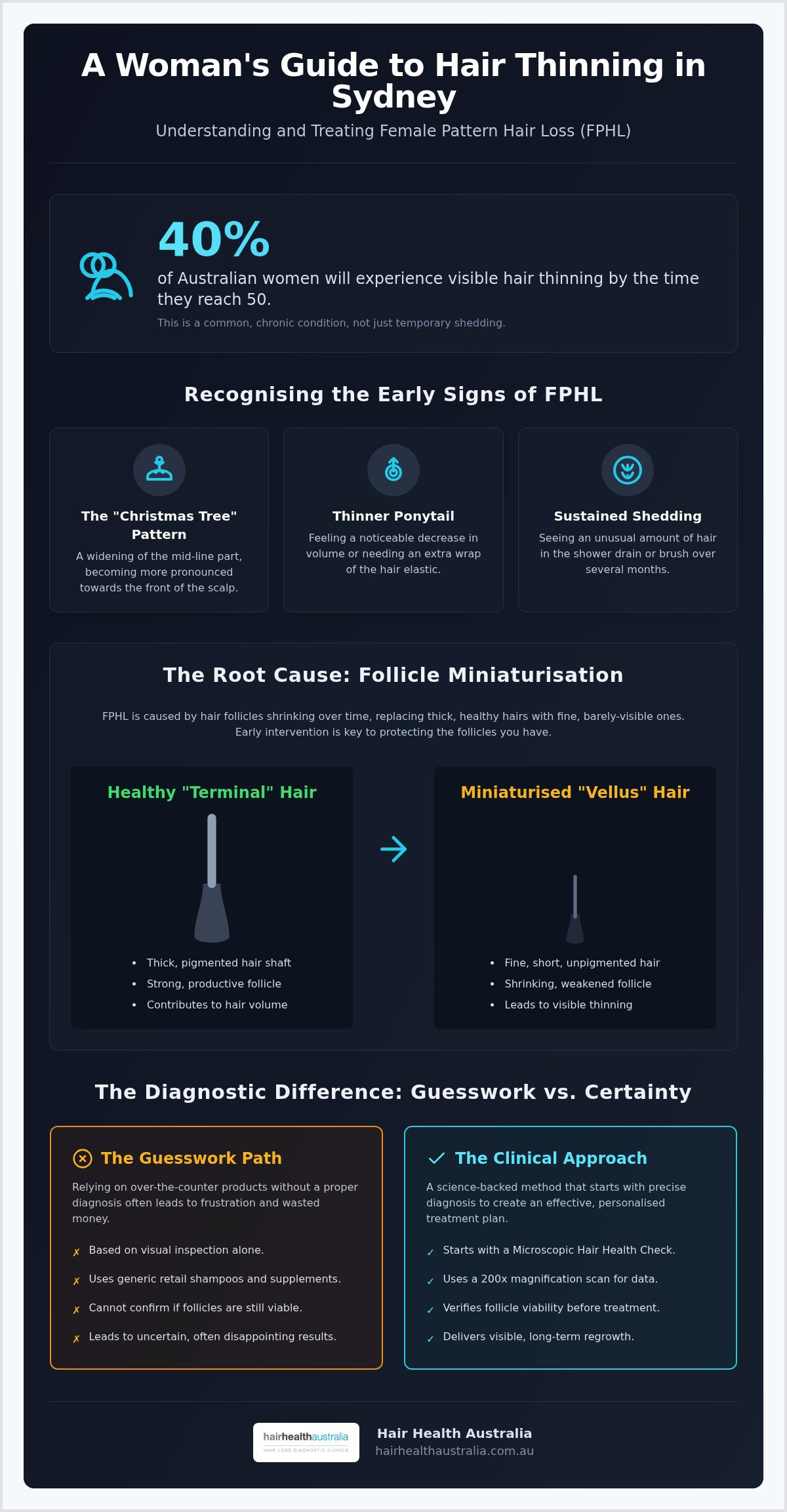
Did you know that approximately 40% of Australian women will experience visible hair thinning by the time they reach 50? For many women across NSW, the first sign of a problem isn’t a handful of hair in the shower, but a widening part that slowly transforms into a “Christmas tree” pattern. It’s a distressing transition that makes styling difficult and leaves you wondering if what you’re seeing is temporary shedding or permanent loss. Finding the best treatment for female pattern baldness Sydney has to offer starts with moving past the guesswork and into clinical certainty.
We understand that your hair is a vital part of your identity, and watching its density fade can feel overwhelming. This 2026 guide is designed to replace that uncertainty with a clear, science-backed roadmap to restoration. You’ll discover the most effective non-surgical clinical treatments available today that focus on stopping thinning and revitalising your natural hair volume. We will preview the diagnostic power of a specialised Hair Health Check at our Redfern clinic and outline a sustainable maintenance plan that moves beyond temporary fixes to deliver visible, long-term regrowth.
Key Takeaways
- Learn to recognise the specific “Christmas tree” thinning pattern of Female Pattern Hair Loss and why early clinical intervention is vital for Sydney women.
- Discover why a microscopic assessment is the foundation for finding the best treatment for female pattern baldness Sydney clinics provide, moving beyond retail guesswork.
- Understand the clinical difference between generic over-the-counter products and personalised regrowth programs that utilise targeted growth stimulants.
- Identify the essential credentials and “straight-talking” professional standards you should expect from a specialised hair loss centre in Sydney.
- Explore how a non-invasive, evidence-based approach can restore your hair density and provide a sustainable plan for long-term maintenance.
Understanding Female Pattern Baldness (FPHL) in Sydney
Female Pattern Hair Loss (FPHL), clinically known as androgenetic alopecia, is the most common cause of hair thinning among women in Australia. While it is often associated with ageing, many women in Sydney begin noticing changes as early as their 20s or 30s. This condition isn’t a temporary shedding phase; it’s a chronic progression that requires a targeted clinical strategy. Identifying the Pattern hair loss early is the first step toward finding the best treatment for female pattern baldness Sydney has available.
For many, the first sign is the “Christmas tree” pattern. This involves a widening of the mid-line part that becomes more pronounced toward the front of the scalp, resembling the shape of an evergreen tree. Unlike male baldness, which often results in a receding hairline or a smooth crown, FPHL typically presents as diffuse thinning across the top of the head while the front hairline remains relatively intact. This makes the loss subtle at first, but the cumulative effect on hair volume is significant.
It’s essential to distinguish FPHL from Telogen Effluvium. The latter is a temporary reaction to stress, illness, or hormonal shifts like pregnancy, usually resulting in sudden, heavy shedding. FPHL, by contrast, is a genetic predisposition where the hair gradually loses its volume over years. This slow change can be emotionally taxing. We see many women who feel a loss of confidence or find it increasingly difficult to style their hair as their scalp becomes more visible. Acknowledging this impact is a core part of our clinical approach.
The Science of Follicle Miniaturisation
At the heart of FPHL is a biological process where hair follicles become increasingly sensitive to hormonal changes. Over several growth cycles, the follicles begin to shrink. This results in “terminal” hairs, the thick, pigmented ones we want, being replaced by “vellus” hairs, which are short, fine, and lack pigment. Miniaturisation is the fundamental mechanism where healthy hair follicles progressively dwindle in size until they can no longer produce visible hair. Once a follicle has completely miniaturised, it’s much harder to revive, which is why clinical intervention focuses on protecting the follicles you still have.
Identifying the Early Signs of Thinning
Early detection is your greatest advantage. If you can catch the thinning in its early stages, particularly in your 30s or 40s, the potential for regrowth and density maintenance is significantly higher. You don’t need to wait for visible patches to take action. Keep an eye on these common indicators:
- A part line that looks wider in the bathroom mirror than it did a year ago.
- A ponytail that feels noticeably thinner or requires an extra wrap of the elastic.
- An unusual amount of hair left in the shower drain or hairbrush over a sustained period.
If these signs feel familiar, the next logical step is a professional diagnosis. A Hair Health Check provides the microscopic evidence needed to confirm if miniaturisation is occurring. This clarity is essential before committing to the best treatment for female pattern baldness Sydney specialists recommend for your specific hair profile.
The Diagnostic Difference: Why a Microscopic Hair Health Check is Essential
Many women begin their restoration journey by purchasing retail shampoos or supplements after a quick glance in the mirror. While this is a common first step, visual inspection alone cannot identify the underlying biological state of your scalp. To secure the best treatment for female pattern baldness Sydney clinics provide, you must move beyond guesswork. A clinical diagnosis ensures that the program you choose is actually capable of addressing your specific stage of thinning.
The Hair Health Check is the clinical gold standard for this process. By utilising a 200x magnification scan, we can see beneath the surface of the hair to examine the health of the follicles and the scalp environment. While Australian government health advice outlines the general symptoms of thinning, a microscopic assessment provides the data required for a professional treatment plan. It allows us to verify follicle viability before you invest time or money into a regrowth program.
What Your Scalp Reveals Under the Microscope
The microscope reveals details that are invisible to the naked eye, such as sebum crystallisation or scalp inflammation. These conditions can physically hinder hair growth, regardless of how many supplements you take. We also perform a precise count of active follicles per square centimetre. This data point is vital for predicting your regrowth potential and managing expectations.
Critically, the scan helps us distinguish between dormant follicles and those that are permanently lost. If a follicle is merely dormant, it can often be revitalised with the right clinical stimulants. However, if the follicle has been replaced by scar tissue, no amount of topical treatment will bring it back. This “straight-talking” honesty is what sets a clinical approach apart from a retail one.
Your Clinical Consultation in Sydney
When you visit our Sydney clinic in Redfern for a diagnostic scan, the process is thorough and educational. We don’t just show you the images; we explain what they mean for your future hair density. We use this microscopic evidence to create a personalised hair restoration roadmap tailored to your biology. You can learn more about how these diagnostics fit into a broader strategy in our reference guide on the Best Hair Regrowth Treatment Australia 2026. If you’re ready to stop the uncertainty, a professional Hair Health Check is the most reliable place to start.
Comparing the Best Treatments for Female Pattern Baldness
Many Sydney women find themselves overwhelmed by the sheer volume of “miracle” cures available online or at the local chemist. However, the best treatment for female pattern baldness Sydney offers isn’t a single product, but a coordinated clinical strategy. While retail solutions offer convenience, they often lack the potency and professional oversight required to reverse miniaturisation effectively. A clinical approach focuses on evidence, not just marketing claims.
Clinical programmes focus on a multi-pronged approach. This often includes female-specific doses of DHT blockers and growth stimulants that are far more sophisticated than standard over-the-counter options. As noted by Harvard Medical School on treatments, addressing the hormonal and vascular aspects of hair loss simultaneously yields the most consistent results. By combining these with Low-Level Laser Therapy (LLLT), we can stimulate cellular activity within the follicle, encouraging a return to the “terminal” growth phase where hair is thicker and more pigmented.
While surgical hair transplants are a common topic in hair restoration, they are rarely the first choice for women with diffuse thinning. Because female pattern loss typically affects the entire top of the scalp, finding a stable “donor” site is difficult. Non-surgical clinical protocols are generally superior for restoring overall density without the risks and high costs associated with invasive surgery.
Clinical Regrowth Programmes vs. Chemist Shop Solutions
Generic minoxidil from a chemist shop often fails because it’s used in isolation. Without a clean scalp environment or the addition of complementary stimulants, the active ingredients struggle to penetrate the follicle effectively. A professional clinical programme uses multi-modal therapy. This means we combine topical applications with oral support and light therapy, all monitored by a specialist. These professional-grade formulations are designed to be more stable and effective than mass-produced retail versions.
The Non-Surgical Advantage for Women
For the busy Sydney professional, the non-surgical route offers a significant lifestyle benefit: zero downtime. You can maintain your treatment schedule without taking time off for recovery or dealing with post-operative bandaging. This approach provides several key advantages:
- Natural Integration: Density is restored gradually across the entire scalp, avoiding the “pluggy” appearance of older surgical techniques.
- Sustainability: Clinical programmes focus on the long-term health of your existing hair, rather than just moving follicles from one spot to another.
- Safety: By avoiding invasive procedures, you eliminate the risk of surgical scarring, infections, or long recovery periods.
This methodical, non-invasive approach ensures that your restoration journey is as discreet as it is effective, allowing you to regain your confidence without interrupting your daily life.
Choosing a Hair Loss Clinic in Sydney: A Locals Guide
Selecting the right clinic is a decision that impacts both your confidence and your long-term results. The best treatment for female pattern baldness Sydney offers is one that balances advanced technology with a personalised, human touch. Your chosen specialist should act as a dedicated guide, providing the clinical data you need to make an informed choice about your hair’s future. It’s important to look for a provider with a long-standing reputation, such as those with over 15 years of experience in the Australian market, to ensure they understand the local clinical landscape.
A “straight-talking” approach is essential for building trust. A reputable specialist won’t hesitate to tell you if your follicles have reached a stage where non-surgical intervention may have limited efficacy. This level of honesty is vital because it saves you from investing in programs that won’t deliver the density you expect. For a more detailed breakdown of what to look for in a provider, refer to our Choosing a Non-Surgical Hair Loss Clinic in Sydney guide. Accessibility is also a practical factor; choosing a clinic in a central location like Redfern makes it easier to attend the regular check-ins required to monitor your progress.
Questions to Ask Your Sydney Specialist
During your initial consultation, the quality of the answers you receive is just as important as the technology being used. Don’t be afraid to ask direct questions to gauge the clinic’s expertise:
- Can you show me microscopic evidence of my hair follicle health? A visual scan at 200x magnification should be the starting point for any clinical discussion.
- What are the realistic expectations for regrowth in my specific case? Results vary based on the stage of loss, so you need a prognosis tailored to you, not a generic success rate.
- Is the treatment program customised to my hormonal profile? FPHL is often driven by hormonal sensitivity, so the protocol must reflect your individual biology.
Environmental Factors for Sydney Hair Health
Sydney’s unique climate plays a significant role in your scalp’s health. High humidity levels during the summer months can increase sebum production, which may lead to scalp inflammation if not managed correctly. Additionally, our intense UV levels don’t just damage the skin; they can degrade the protein structure of your hair, making it brittle and more prone to breakage. Protecting your treated hair with appropriate scalp care and avoiding excessive sun exposure is vital for maintaining clinical results. Local water quality, specifically the chlorine levels in Sydney’s supply, can also irritate a sensitive scalp, making a professional-grade cleansing routine even more important for those undergoing treatment.
If you’re ready to move forward with a specialist who values precision and clinical honesty, you can book your Hair Health Check at our Sydney clinic today.
The Hair Health Australia Approach to Female Regrowth
At Hair Health Australia, we’ve refined a methodology that bridges the gap between over-the-counter guesswork and invasive surgery. Our Hair Loss Treatment for Women is built on over 15 years of clinical observation and success within the Australian market. We recognise that for a program to be effective, it must address the biological reality of your scalp, not just the visible symptoms. This commitment to evidence-based care is why we’re consistently recognised for providing the best treatment for female pattern baldness Sydney women can access to restore their natural density.
Our protocols are entirely non-invasive and clinically backed. We focus on revitalising the follicle from within, using multi-modal therapies that respect the delicate hormonal balance of the female body. By prioritising patient education, we ensure you understand the science behind every step of your restoration. This fosters a partnership that supports long-term scalp health rather than a quick, unsustainable fix. We don’t just aim for a temporary boost in volume; we work toward a sustainable maintenance plan that keeps your hair looking its best for years to come.
Personalised Restoration Protocols
No two scalps are identical, which is why we never offer a one-size-fits-all solution. Every program we design is a direct response to the data gathered during your microscopic scan. We utilise high-potency, clinical-grade stimulants that are specifically formulated to maximise density in areas where miniaturisation has been detected. Unlike generic products, these formulations are applied under clinical supervision, ensuring the scalp environment is optimised for maximum absorption. At our Redfern clinic, we provide ongoing support and progress monitoring, allowing us to adjust your protocol as your hair responds to the treatment.
Starting Your Journey Today
The most difficult part of addressing hair loss is often the decision to stop waiting and start acting. We believe that clarity is the best antidote to the stress of thinning. By booking a no-obligation scan at our Sydney centre, you’re gaining a professional insight into your hair’s future. Our team is dedicated to providing a steady, composed environment where your concerns are met with scientific precision and empathetic care. If you’re ready to reclaim your hair density and move toward a more confident version of yourself, the path forward is straightforward and supported by experts. Book your free Hair Health Check at our Sydney clinic today.
Take Control of Your Hair Restoration Journey
Restoring your hair density is a methodical process that begins with clinical evidence rather than retail guesswork. As we have explored, the most effective results come from a combination of professional microscopic diagnosis and non-surgical, evidence-based protocols. Finding the best treatment for female pattern baldness Sydney offers means partnering with a specialist who provides a transparent prognosis and a personalised roadmap tailored to your specific biology.
Our Redfern clinic combines over 15 years of Australian experience with advanced microscopic analysis to ensure your restoration plan is grounded in science. By identifying the state of your follicles early, you can implement a sustainable maintenance strategy that protects your existing density while encouraging new growth. You don’t have to manage this transition alone or rely on products that don’t address the underlying miniaturisation of your hair.
We invite you to Book Your Free Sydney Hair Health Check today. This no-obligation consultation is the first step toward reclaiming your confidence and achieving the hair volume you deserve. With the right clinical support and a dedicated guide, a fuller and healthier future for your hair is well within reach.
Frequently Asked Questions
Is female pattern baldness reversible with clinical treatment?
Clinical treatment can revitalise miniaturised follicles that are still active, but it cannot regrow hair once a follicle has completely scarred over. Success depends on how early you begin your program. By using the best treatment for female pattern baldness Sydney specialists provide, you can often restore significant density and stop the progression of thinning. It is about restoring what is dormant rather than creating new follicles.
How much does female hair loss treatment cost in Sydney?
The cost of a hair restoration program in Sydney varies based on the severity of your thinning and the specific technologies required for your case. Clinical programs are typically structured as a series of sessions or a long-term maintenance plan rather than a one-off fee. We recommend a Hair Health Check to receive an accurate, individualised quote based on your microscopic hair density and follicle health.
When planning for the cost of these clinical programs, some individuals choose to liquidate unused assets to fund their treatments; for example, selling unwanted jewellery to a reputable service like Silver Buyers Sydney can provide immediate financial flexibility for your personal care goals.
Will I need to use these treatments forever to keep my hair?
You will likely need a sustainable maintenance plan to keep the results you achieve during the initial regrowth phase. Because female pattern thinning is a progressive genetic condition, stopping treatment entirely allows the miniaturisation process to resume. Most women transition to a less intensive maintenance schedule once they’ve reached their desired hair density, ensuring their results stay stable over the long term.
Can stress cause female pattern baldness to accelerate?
High levels of stress can trigger a temporary shedding condition called Telogen Effluvium, which often makes underlying pattern thinning appear much worse. While stress isn’t the primary cause of genetic hair loss, it can certainly accelerate the visible loss of volume. Managing your overall health and stress levels is a vital component of any clinical hair restoration strategy to ensure your follicles remain in the growth phase.
Are there any side effects to non-surgical hair regrowth programs?
Non-surgical clinical programs are generally well tolerated with very few reported side effects. Some women might experience minor scalp irritation or dryness depending on the specific topical stimulants used in their personalised protocol. Because these programs avoid invasive surgery, you don’t have to worry about the risks of infection, anaesthesia, or scarring associated with transplant procedures. We monitor your scalp health closely throughout your journey.
How long does it take to see results from a clinical hair program?
Most women begin to see visible improvements in hair texture and density within three to six months of starting a clinical program. Hair grows in cycles, so it takes time for revitalised follicles to produce new, terminal strands that reach the surface of the scalp. We use regular microscopic scans to track these changes at the follicle level before they become obvious in the mirror.
Does Medicare cover hair loss treatments in Australia?
Medicare generally does not cover hair loss treatments in Australia as they are classified as cosmetic procedures. However, if your hair loss is caused by an underlying medical condition, some diagnostic blood tests ordered by your GP might be bulk billed. It’s always best to check with your private health insurer to see if your specific policy offers any rebates for clinical hair programs or consultations.
Can I treat thinning hair if I am going through menopause?
You can certainly treat thinning hair during menopause, and many women find this is the most effective time to start a program. The drop in oestrogen during this period often makes the follicles more sensitive to DHT, leading to faster thinning. A specialised program for the best treatment for female pattern baldness Sydney clinics offer can help counter these hormonal shifts and preserve your natural hair density.