
Up to 90% of new mothers in Australia experience significant hair shedding within months of giving birth. While it’s common to see clumps of hair in the shower or notice your temples looking thinner, the experience is often deeply distressing. It’s frustrating to feel dismissed when you’re told it’s just hormones, especially when you’re worried about whether your hair will ever return to its pre-pregnancy volume. If you’re searching for an effective postpartum hair loss treatment, you need more than just reassurance; you need clinical clarity on what’s actually happening to your follicles.
We understand that the line between normal physiological shedding and long-term thinning can feel blurred. This guide is designed to bridge that gap, providing a clear look at why this telogen effluvium occurs and when it might be masking a deeper issue like a nutritional deficiency or triggered genetic thinning. You’ll discover how a professional diagnosis can stop the cycle of anxiety and which clinical treatments are available to help you regain your hair density and confidence. We will walk you through the science of hair recovery so you can move forward with a plan grounded in evidence rather than guesswork.
Key Takeaways
- Understand why hormonal shifts cause telogen effluvium, keeping hair in the growth phase during pregnancy before a sudden shift leads to shedding.
- Learn the standard recovery timeline and why the “First Birthday Rule” is a critical benchmark for determining if your shedding is still within the normal range.
- Differentiate between cosmetic products that simply coat the hair and a clinical postpartum hair loss treatment that targets the follicle to restore density.
- Discover how microscopic hair analysis can identify follicle miniaturisation or underlying deficiencies before thinning becomes visible to the naked eye.
- Identify when to seek a professional Hair Health Check to ensure temporary shedding isn’t masking a more permanent form of hair loss.
What is Postpartum Hair Loss? The Science of Telogen Effluvium
Postpartum hair loss is a physiological reaction to the significant hormonal shifts that occur after childbirth. Medically termed the science of telogen effluvium, this condition isn’t a form of permanent balding, but rather a temporary disruption of the natural hair growth cycle. It’s often shocking to see large amounts of hair in your hairbrush or the shower drain, yet understanding the biological mechanism behind this shedding is the first step toward finding an effective postpartum hair loss treatment.
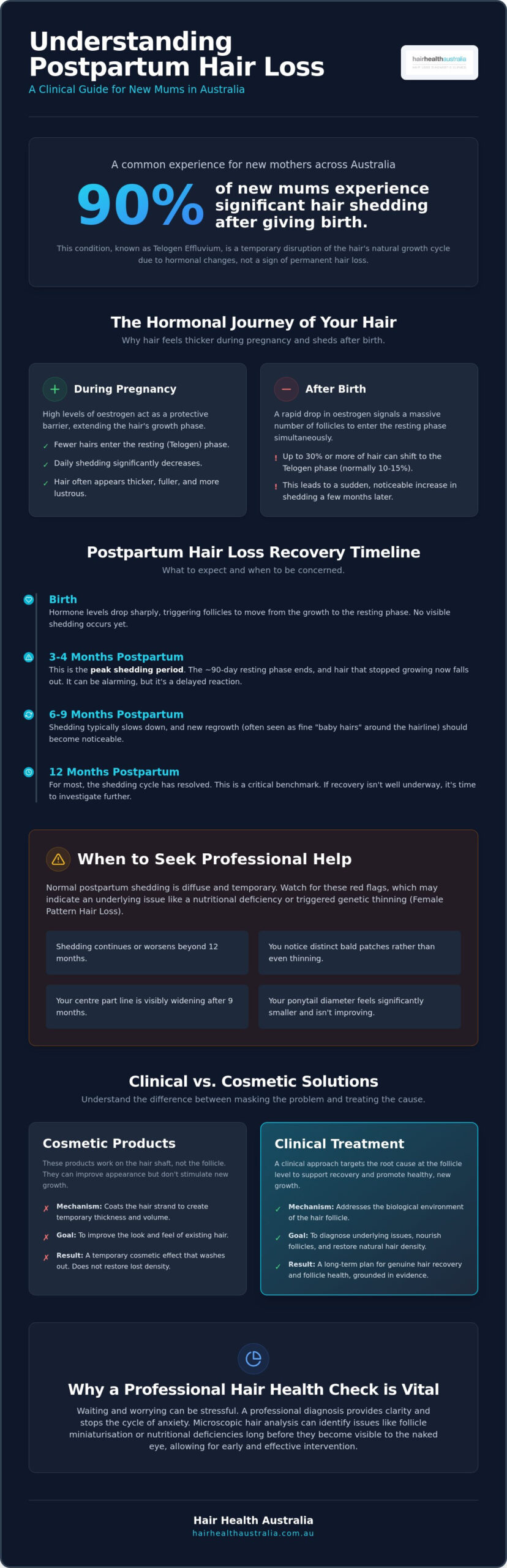
During pregnancy, your body experiences a surge in oestrogen. These high levels act as a protective barrier for your hair follicles, keeping them in the active growth phase for much longer than usual. Many women notice their hair feels thicker and more lustrous during the second and third trimesters because the daily shedding that usually occurs simply stops. However, once the baby is born, oestrogen levels drop rapidly. This “hormonal crash” signals a massive number of follicles to exit the growth phase simultaneously and enter the resting phase. This is why experts classify the condition as “shedding” (effluvium) rather than “loss” (alopecia), as the follicle itself remains alive and capable of producing new hair.
The Three Phases of Hair Growth
To understand why this happens, we must look at the three distinct stages every hair follicle moves through. The first is the Anagen phase, where hair actively grows for several years. Next is the Catagen phase, a brief transitional period where the hair follicle shrinks and detaches from its blood supply. Finally, the Telogen phase is the resting period. Under normal conditions, about 10% to 15% of your hair is in this stage at any given time. Postpartum, this percentage can jump to 30% or higher, leading to the visible thinning many mums experience across their entire scalp.
Why the 3-Month Delay Happens
A common source of confusion for new parents is why the shedding doesn’t begin immediately after delivery. The biological reset requires a specific window of time. Once the follicle enters the telogen phase, the hair stays anchored in the scalp for approximately 90 days before it eventually falls out. This is why most women notice the peak of their shedding around the three to four-month mark. While finding handfuls of hair is distressing, it’s a delayed response to the hormonal changes that occurred months earlier. If the shedding persists beyond the expected recovery window, a professional Hair Health Check can determine if a more targeted postpartum hair loss treatment is required to support your recovery.
The Recovery Timeline: When Should You Be Concerned?
For most Australian mums, the peak of hair shedding occurs around four months after labour. While the process usually resolves within six to twelve months, current research on postpartum hair loss suggests that the recovery window isn’t the same for everyone. GPs often refer to the “First Birthday Rule,” suggesting you wait until your child is one year old before seeking clinical help. However, waiting a full year can be a missed opportunity if your shedding is actually masking a more complex issue. If you notice visible thinning at the crown or a widening part line, seeking a postpartum hair loss treatment early can prevent long-term density loss.
It’s important to monitor the pattern of your hair loss. Normal postpartum shedding is diffuse, meaning it happens evenly across the entire scalp. If you see specific “red flags,” such as patchy loss or a noticeable recession at the temples that doesn’t show signs of regrowth by the nine-month mark, it’s a signal that your follicles may need additional support. Identifying these issues early allows for a more targeted approach to restoration.
Postpartum Shedding vs. Female Pattern Hair Loss
Pregnancy can sometimes “unmask” genetic thinning that was already present but dormant. While telogen effluvium is temporary, the physiological stress of childbirth can trigger Female Pattern Hair Loss (FPHL). You might notice a widening part line or a significant reduction in your ponytail diameter that doesn’t improve after the nine-month mark. Distinguishing between these two conditions is vital. If your hair doesn’t start to fill back in by six months, a microscopic Hair Health Check can determine if your follicles are actually miniaturising or just resting.
Nutritional Triggers: Ferritin and Thyroid
Nutritional status is a primary driver of hair recovery. Pregnancy and breastfeeding often deplete iron stores, leading to low ferritin levels. In Australia, a “normal” ferritin result on a standard blood test might be as low as 30 ng/mL, but for optimal hair regrowth, clinical standards often require levels closer to 70 or 80 ng/mL. Without enough iron, the follicle lacks the energy to re-enter the growth phase. Additionally, postpartum thyroiditis affects between 5% and 10% of women in the first year after birth. This condition can alter hair texture and volume, making it difficult for a standard postpartum hair loss treatment to work effectively without first addressing the underlying hormonal imbalance.
Treating Postpartum Hair Loss: Clinical vs. Cosmetic Solutions
When searching for a postpartum hair loss treatment, it’s vital to distinguish between cosmetic management and clinical restoration. Many products marketed to new mums, such as volumising shampoos or thickening sprays, serve as a surface-level fix. These formulas typically utilise proteins or polymers to coat the hair shaft, creating the illusion of volume. While they provide an immediate boost to your confidence, they do not address the underlying biological slowdown of the follicle. A clinical approach focuses on the root itself, aiming to shorten the resting phase and stimulate the production of new, healthy keratin.
Safety is the primary concern for breastfeeding mothers. While many pharmaceutical options are restricted during this period, several non-surgical and non-invasive therapies are highly effective. Choosing a path that is both safe for your baby and potent enough to restore your hair density requires a professional understanding of how different ingredients and technologies interact with your physiology. We prioritise evidence-based methods that support your body’s natural recovery without introducing unnecessary risks.
Cosmetic Management for Immediate Confidence
While you wait for your follicles to re-enter the growth phase, tactical grooming can minimise the visibility of thinning. Many women find that a “postpartum fringe” or a shorter, layered haircut helps disguise recession at the temples. However, you must be cautious with styling habits. The common “mum bun” can be particularly damaging; constant tension from tight elastics can lead to traction alopecia, further thinning the hair around your hairline. To protect your recovering strands, we recommend:
- Using wide-tooth combs to detangle hair while wet.
- Switching to silk or satin scrunchies to reduce friction.
- Lowering the heat settings on styling tools to prevent bridal hair breakage.
Clinical Interventions for Faster Recovery
For those seeking a more robust postpartum hair loss treatment, clinical interventions can significantly accelerate the regrowth process. Low-Level Laser Therapy (LLLT) is a popular non-invasive option that uses specific wavelengths of light to stimulate cellular activity and blood flow within the scalp. This increased energy helps dormant follicles return to the anagen phase more quickly. Additionally, targeted nutraceuticals can provide the specific building blocks, such as biotin and zinc, necessary for keratin synthesis. If your shedding appears to be transitioning into long-term thinning, a clinical-grade topical stimulant may be introduced to maintain follicle health. Identifying the right combination of these therapies often starts with a microscopic Hair Health Check to ensure the treatment matches your specific needs.
Why a Professional Hair Health Check is Vital for New Mums
For many new mothers, the most challenging part of postpartum shedding is the uncertainty. While a general practitioner might offer a cursory visual inspection and suggest waiting a full year for recovery, this approach often fails to identify underlying complications. A professional microscopic hair analysis is the gold standard for diagnosis because it allows us to see what the naked eye cannot. We can identify miniaturisation, which is the process where hair follicles physically shrink. This is a hallmark of genetic thinning rather than simple hormonal shedding. This distinction is vital for choosing the correct postpartum hair loss treatment.
Choosing a specialised hair clinic in Sydney provides you with access to diagnostic technology and expertise that goes far beyond general medical advice. Instead of a vague “wait and see” recommendation, you receive a definitive roadmap. This clarity replaces anxiety with an actionable plan. It ensures you aren’t wasting time on ineffective remedies while your hair density continues to decline. A clinical diagnosis provides the peace of mind that comes from knowing exactly what’s happening to your scalp.
What Happens During a Clinical Scan?
During a clinical scan, we use high-definition magnification to examine the scalp environment in detail. We look for follicle blockages, sebum build-up, or signs of inflammation that could be hindering new growth. By measuring hair density across different zones, such as comparing the stable occipital area at the back to the more vulnerable frontal region, we can accurately identify your specific loss pattern. This data creates a precise baseline. It allows us to track the success of your regrowth programme with objective evidence rather than subjective guesswork.
Personalised Care: Moving Beyond One-Size-Fits-All
It’s tempting to try the latest supplement your best friend recommends, but hair health is deeply individual. Your scalp chemistry, nutritional profile, and hormonal balance are unique to you. A one-size-fits-all approach rarely yields results because it doesn’t account for these variables. Our focus is on tailoring a programme to your lifestyle as a busy parent, ensuring treatments are non-invasive and manageable. For a deeper look at your options, our guide on hair loss treatment for women provides a comprehensive breakdown of clinical standards for restoration.
If you’re concerned about the rate of your shedding, the first step is obtaining an accurate diagnosis. You can book your Hair Health Check today to start your journey back to full hair density.
Regaining Your Confidence: The Path to Hair Restoration
While the physical act of shedding is a biological certainty for many, the emotional toll it takes shouldn’t be underestimated. It’s important to remember that most cases of thinning are manageable with the right expertise. If you’ve noticed that your hair density isn’t returning as expected, or if the shedding feels excessive, seeking a professional postpartum hair loss treatment is a proactive step toward recovery. Early intervention is particularly vital if you suspect your loss is atypical, as addressing the root cause early can significantly shorten your journey back to full volume.
Hair Health Australia is dedicated to supporting Sydney mums through this transition. Our approach is rooted in non-surgical, evidence-based care that respects the unique physiological state of a new parent. We don’t rely on guesswork; we use clinical data to build a restoration programme that works with your body. By moving beyond temporary cosmetic fixes, you can focus on long-term follicle health and the sustainable return of your pre-pregnancy density. Your recovery journey is about more than just aesthetics; it’s about restoring your sense of self.
The Emotional Impact of Hair Loss
For many women, hair is a core component of their identity. It’s often the final piece of the puzzle in “feeling like yourself” again after the profound changes of pregnancy and birth. We believe in reducing the stigma associated with seeking help for hair thinning. It isn’t “just a cosmetic issue” when it affects your self-esteem and daily confidence. Understanding the early signs of alopecia in women can help you distinguish between temporary shedding and conditions that require more intensive clinical support. Acknowledging these feelings is the first step toward a confident recovery.
Your Clinical Journey in Sydney
When you begin a postpartum hair loss treatment with us, the first 12 weeks are focused on stabilising the scalp environment and encouraging follicles to re-enter the growth phase. We understand that your time is limited, so our programmes are designed to be efficient and easily integrated into your life as a new mum. Consistency is key, and we provide the guidance needed to maintain your results even amidst the demands of motherhood. Taking the first step is often the most empowering part of the process. We invite you to Book your Hair Health Check today and let our specialists guide you back to the hair density you deserve.
Secure Your Hair’s Future with Clinical Clarity
Navigating the changes of motherhood is a significant transition, and your hair health shouldn’t be an additional burden. We’ve explored how hormonal shifts trigger telogen effluvium, but we’ve also identified that waiting for a natural recovery can sometimes overlook underlying issues like iron deficiency or genetic thinning. Recognising the difference between normal shedding and follicle miniaturisation is the key to protecting your long-term hair density and ensuring your follicles have the support they need to thrive.
When you’re ready to move beyond temporary volumising products, a targeted postpartum hair loss treatment offers a path grounded in science. Our Sydney clinic provides specialised care for female hair thinning patterns through clinically-backed, non-surgical regrowth programmes. By utilising expert microscopic diagnostic scanning, we provide an accurate diagnosis that moves you from uncertainty to an actionable recovery plan. This precision ensures you aren’t wasting time on ineffective remedies during this vital recovery window.
Don’t leave your hair density to chance. Book Your Comprehensive Hair Health Check at our Sydney Clinic today. Regaining your pre-pregnancy confidence is possible, and we’re here to support you with professional, empathetic guidance as you return to feeling like yourself again.
Frequently Asked Questions
How long does postpartum hair loss actually last?
Postpartum hair loss typically begins two to four months after childbirth and usually resolves within six to twelve months for most women. While the peak shedding occurs around the four-month mark, you should see a noticeable reduction in hair fall as your hormones stabilise. If the shedding persists beyond your child’s first birthday, it may indicate an underlying issue like iron deficiency or thyroid dysfunction that requires a professional assessment.
Can I take hair growth supplements while breastfeeding?
You can take specific hair growth supplements while breastfeeding, but it’s essential to choose clinical-grade products formulated for safety during lactation. Many “hair, skin, and nails” vitamins contain high levels of certain ingredients that may not be suitable. We recommend focusing on iron, zinc, and biotin, provided they align with your postnatal healthcare plan. Always consult with a specialist to ensure your chosen postpartum hair loss treatment is safe for both you and your baby.
Is it normal to see bald patches after having a baby?
It is not typical to see distinct, smooth bald patches after having a baby, as postpartum shedding is usually diffuse across the entire scalp. While you may notice significant thinning at the temples or a wider part line, circular or patchy loss often suggests a different condition, such as alopecia areata. If you discover localised bald spots, you should seek a clinical diagnosis immediately to rule out autoimmune triggers or scalp infections.
Does breastfeeding make hair loss worse?
Current research suggests a potential association between longer breastfeeding duration and a higher likelihood of reporting hair loss, but breastfeeding itself is not the primary cause. The metabolic demands of milk production can deplete your iron and nutrient stores, which are vital for follicle health. Maintaining a high-protein diet and monitoring your ferritin levels can help mitigate the impact on your hair volume while you continue to nurse and recover.
Will my hair ever be as thick as it was before pregnancy?
Most women return to their pre-pregnancy hair volume within a year, but for some, the hair may feel slightly different in texture or density. In cases where pregnancy has triggered underlying genetic thinning, the hair may not fully recover its previous thickness without clinical intervention. Using a microscopic scan to monitor follicle health can help determine if your hair is returning to its baseline or if further support is needed to restore volume.
What is the best shampoo for postpartum hair loss in Australia?
There is no single shampoo that stops shedding, as shampoos are cosmetic products that do not reach the follicle. However, Australian mums should look for pH-balanced, sulfate-free formulas that support scalp health without causing breakage. While volumising shampoos can temporarily coat the hair to make it look fuller, they should be used alongside a clinical postpartum hair loss treatment if you want to address the root cause of the thinning.
Can I prevent postpartum shedding during pregnancy?
You cannot prevent the physiological shift of telogen effluvium, as the drop in oestrogen after birth is a natural biological process. However, you can prepare your body by ensuring your iron and vitamin D levels are optimal before you give birth. Ensuring your follicles are in the best possible health during pregnancy can help your hair cycle reset more efficiently once the shedding phase begins a few months after your delivery.
When should I see a hair loss specialist in Sydney?
You should consider seeing a hair loss specialist in Sydney if your shedding persists beyond twelve months or if you notice your part line is widening significantly. Early intervention is also recommended if you experience scalp pain, itching, or if the loss occurs in distinct patches. A professional Hair Health Check provides the diagnostic clarity needed to distinguish between temporary shedding and permanent thinning, allowing you to start an effective recovery plan sooner.