A five-star rating on a screen doesn’t always translate to a full head of hair in the mirror. You’ve likely spent hours scrolling through national hair institute reviews Sydney, feeling a mix of hope and deep scepticism about the glossy transformations promised in marketing brochures. It’s perfectly natural to feel overwhelmed by the volume of conflicting information and the significant financial commitment involved in hair restoration. Replacing uncertainty with evidence-based clarity is the first step toward genuine restoration.
This guide provides the framework to cut through the noise with clinical precision, showing you how to distinguish between marketing hype and genuine patient outcomes. We’ll explore the critical differences between surgical and non-surgical pathways, provide a framework for evaluating Sydney clinic standards, and help you determine which treatment level matches your specific stage of thinning. By the end, you’ll have the clarity needed to choose a path that prioritises your scalp health and long-term density over quick fixes.
Key Takeaways
- Decode the clinical substance behind national hair institute reviews Sydney by identifying specific mentions of thorough diagnostic procedures and realistic recovery timelines.
- Distinguish between the invasive nature of hair transplant surgery and the restorative benefits of non-surgical regrowth programmes designed to sustain your natural density.
- Learn why a specialised microscopic hair analysis is the non-negotiable first step in identifying whether your follicles are currently dormant or beyond restoration.
- Use our clinical framework to evaluate Sydney clinics based on their diagnostic technology and their commitment to providing personalised, evidence-based treatment plans.
Understanding the National Hair Institute (NHI) and the Sydney Hair Loss Market
The Sydney hair loss market is one of the most established in the Southern Hemisphere. For decades, the focus remained squarely on surgical interventions, but the conversation is changing. Patients now prioritise understanding the biological “why” behind their thinning before committing to the “how” of restoration. Reading national hair institute reviews Sydney is a logical starting point, but it requires a discerning eye to understand how the market has evolved from a “transplant-first” mindset to a more diagnostic-led approach.
The National Hair Institute, particularly its presence in Edgecliff, has been a fixture in this landscape for over 30 years. Led by Dr Barry White, whose background spans pharmacy and medicine, the clinic helped pioneer the surgical restoration model in Australia. When you look at national hair institute reviews Sydney, you are seeing a legacy built on traditional hair transplant techniques. However, a long history doesn’t always account for the modern shift toward non-invasive follicle preservation and cellular-level diagnostics.
The Legacy of Hair Restoration in Sydney
The Australasian Society of Hair Restoration Surgery has historically set the benchmark for surgical excellence in Australia. While these standards are vital for those with advanced permanent loss, they’ve also created a perception that surgery is the only definitive solution. Modern patients are starting to realise that surgery is a finite resource. Longevity in the industry is valuable, but it must be balanced with the adoption of advanced diagnostic technology. This technology identifies whether surgery is actually necessary or if non-surgical follicle stimulation is a more sustainable path for your specific stage of thinning.
Why Edgecliff and the CBD are Hubs for Hair Health
Sydney’s Eastern Suburbs and the CBD have become the epicentre for specialised hair care. This concentration of expertise means patients expect high consultation standards and easy accessibility. Proximity is particularly important for those undertaking long-term clinical programmes. Unlike a one-off surgery, non-surgical restoration requires consistent monitoring and adjustments based on how your scalp responds to treatment. Starting with a Hair Health Check in these central hubs ensures you’re making a choice based on clinical data rather than persuasive marketing claims.
How to Evaluate National Hair Institute Reviews in Sydney
Star ratings are a surface-level metric. A 4.5-star rating tells you very little about the clinical methodology or the patient’s biological compatibility with the treatment. When reading national hair institute reviews Sydney, you need to look for specific markers of clinical honesty. Does the reviewer mention a comprehensive scalp analysis? Did the specialist manage their expectations regarding the limitations of a transplant? These details are far more valuable than a generic comment about the clinic’s decor or staff friendliness.
Identifying the substance behind the feedback requires a methodical approach. You aren’t just looking for success stories; you’re looking for evidence of a systematic clinical process. Focus on these indicators:
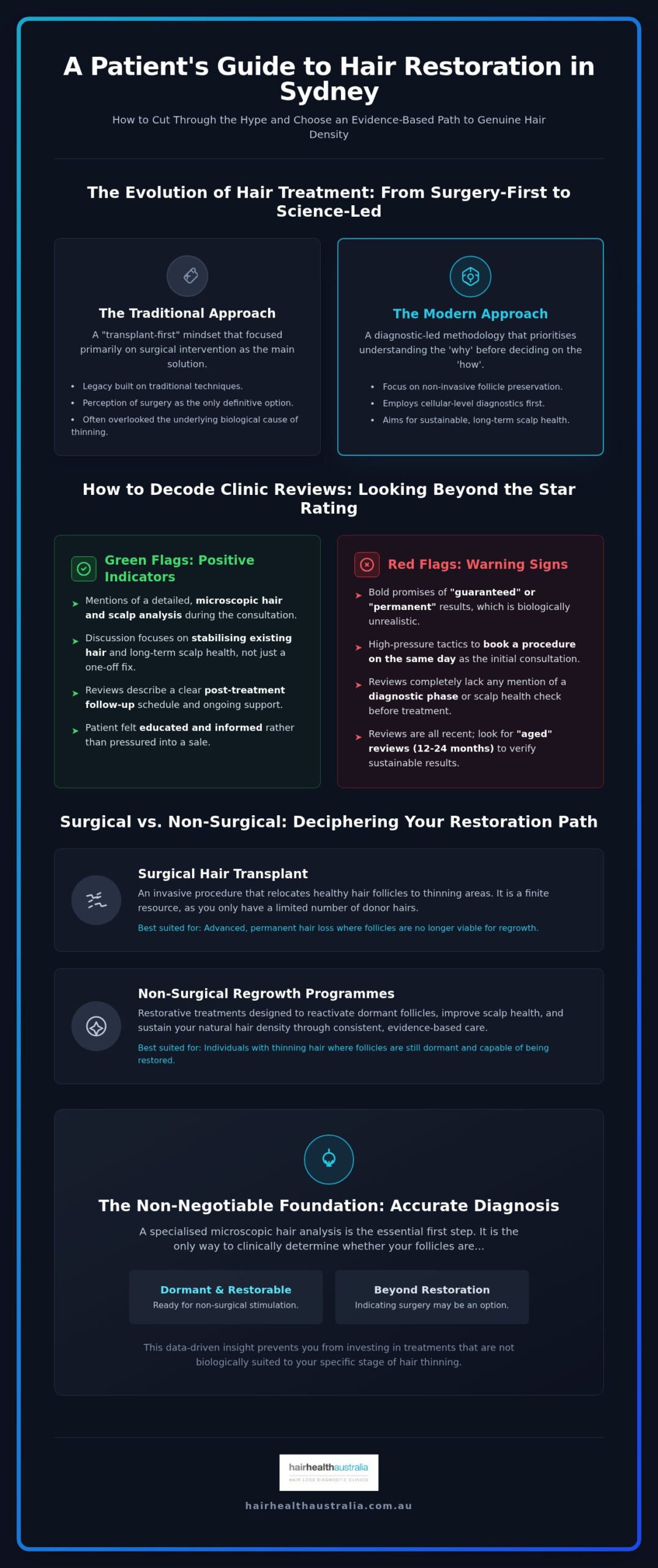
- Green Flags: Mentions of microscopic hair analysis, discussions on stabilising existing hair, and detailed post-treatment follow-up schedules.
- Red Flags: Promises of “guaranteed” results, pressure to book a procedure on the day of consultation, or reviews that lack any mention of a diagnostic phase.
Hair restoration is a slow biological process. Results seen at three months are often temporary or misleading. Look for “aged” reviews where patients provide updates at the 12 to 24-month mark. This is the only way to verify if the density achieved is sustainable or if the underlying cause of thinning was properly addressed.
A 5-Step Framework for Reading Clinic Reviews
To get the most out of your research, follow this structured approach to filter out marketing noise:
- Diagnostic Detail: Search for mentions of “microscopic scans” or “follicle health checks.” If these aren’t mentioned, the clinic might be skipping the most vital step.
- The Education Factor: Did the patient feel like they were in a medical consultation or a sales pitch? Genuine clinics prioritise patient education over closing a deal.
- Maintenance Focus: Sustainable results require more than a one-off procedure. Look for reviews that discuss long-term scalp health and follicle stimulation programmes.
- Specialist Consistency: Check if the review names the specific practitioner who performed the work.
- Recovery Realism: Genuine reviews often mention the patience required during the regrowth cycle.
Authenticity Check: Sydney Forums vs. Directory Sites
Directory sites often feature curated testimonials that lean toward marketing. In contrast, independent forums like the Hair Restoration Network offer a more “straight-talking” environment. Here, Sydney residents share unfiltered photos and long-term progress logs. These discussions are invaluable for seeing how a clinic handles complications or less-than-perfect results. Always prioritise reviewers whose hair loss pattern matches your own. Before committing to a surgical path based on national hair institute reviews Sydney, it’s safer to undergo a professional Hair Health Check to verify your actual restoration potential.
Surgical vs. Non-Surgical: Deciphering Your Restoration Path
Deciding between surgical intervention and a clinical regrowth programme is a pivotal moment in your restoration journey. While national hair institute reviews Sydney often highlight the visual impact of hair transplants, surgery is not a universal solution for every stage of thinning. The fundamental difference lies in the unit of restoration: surgical models focus on moving “grafts” from one area to another, whereas non-surgical clinical programmes focus on revitalising the “follicle” itself. This distinction is critical because once a donor site is depleted through surgery, it cannot be replaced.
Assessing your position on the Norwood Scale is essential for determining the most logical and cost-effective entry point. For those experiencing early-stage thinning (Norwood 1 to 3), non-surgical restoration is frequently the more biologically sound choice. Surgery at this stage can be a high-cost gamble, especially when you consider the hidden factors such as post-operative downtime, potential donor site scarring, and the finite nature of your donor hair supply. If you exhaust your donor hair too early, you’ll have no resources left to address future recession.
When is a Hair Transplant Appropriate?
Surgery is a viable option for those with advanced, stable hair loss and high donor density. However, patients must be wary of hyperbolic claims regarding massive graft counts in a single session. A successful transplant relies on the survival rate of the grafts, not just the quantity moved. Without a clinical maintenance plan to manage the surrounding native hair, many patients experience “island” balding. This occurs when the transplanted patch remains while the natural hair around it continues to recede, creating an unnatural and disjointed appearance that often requires further corrective surgery.
The Power of Non-Surgical Clinical Regrowth
Modern clinical programmes provide a non-invasive alternative that stimulates dormant follicles without the need for anaesthetic or surgical recovery. These programmes utilise clinical-grade topicals and DHT blockers to halt the miniaturisation process that causes hair to thin and eventually disappear. By focusing on scalp health and follicle stimulation, these methods serve as the essential “first line of defence.” Before committing to the permanence of surgery based on national hair institute reviews Sydney, a professional Hair Health Check can determine if your follicles are still viable for non-surgical restoration, potentially saving you from invasive procedures.
Key Questions to Ask During Your Sydney Hair Loss Consultation
Entering a consultation in Edgecliff or the Sydney CBD requires more than just hope. It requires a script of clinical questions to test the practitioner’s expertise. While national hair institute reviews Sydney might provide a general sense of satisfaction, they don’t replace the need for a rigorous personal assessment. You should arrive prepared to challenge the specialist on their diagnostic methodology and their long-term vision for your hair health.
One of the most critical questions involves the 5-year outlook. Ask the specialist: “What happens to my hair in five years if I do nothing?” A genuine expert will provide a realistic projection based on your current rate of miniaturisation and family history. They should also be transparent about the commitment required. Regrowth is a biological process, not an overnight event. If a clinic promises rapid results without discussing a 6 to 12-month commitment, it’s a significant red flag. You need a partner who values long-term density over a quick sale.
Diagnostic Standards: Microscopic vs. Visual Inspection
A simple visual inspection is insufficient for an accurate diagnosis. By the time hair loss is visible to the naked eye, you’ve likely already lost up to 50% of your hair density in that area. This is why you must demand data-driven proof. Professional microscopic hair analysis identifies follicle miniaturisation long before it becomes obvious. It allows the specialist to see the ratio of terminal hairs to vellus hairs, providing a clear picture of your restoration potential. Don’t commit to a programme until you’ve seen these scans for yourself.
Comparing Treatment Protocols in Sydney
Not all treatment plans are created equal. You need to know if you’re receiving a generic pharmaceutical solution or a personalised protocol tailored to your scalp’s specific needs. Ask about the clinic’s policy on follow-up scans and progress tracking. A clinical approach should include regular microscopic reviews every few months to ensure the treatment is stimulating the follicles as intended. You should also enquire about the clinic’s focus on scalp health and nutrition. A holistic approach ensures the environment for growth is as healthy as the follicles themselves. Before you rely solely on national hair institute reviews Sydney to make your decision, book a comprehensive Hair Health Check to get the data you need for an informed choice.
Why a Personalised Clinical Approach is the Smartest Choice
The process of research often starts with national hair institute reviews Sydney, but it must eventually lead to a definitive clinical decision. Choosing a path that focuses on sustainable, non-surgical regrowth is often the most prudent strategy for long-term hair health. While surgery addresses the symptoms of hair loss by moving existing follicles, a clinical approach treats the biological environment of the scalp. This ensures that the hair you still have remains healthy and that dormant follicles are given every opportunity to recover. It’s a strategy rooted in preservation rather than just relocation.
At Hair Health Australia, our clinical standards provide a deeply reassuring alternative to invasive surgical procedures. We prioritise microscopic evidence over anecdotal reviews, ensuring every patient receives a plan tailored to their specific hair cycle. This systematic approach replaces the one-size-fits-all mentality of many surgical clinics with a methodical, data-driven journey. It’s about moving beyond the uncertainty found in online forums and partnering with a trusted Australian specialist who understands the nuances of local clinical standards. By focusing on follicle stimulation, you’re investing in the health of your entire scalp rather than just a specific patch of grafts.
Restoring Confidence Without the Scalpel
There are significant emotional and physical advantages to choosing a non-invasive restoration path. You avoid the risks associated with anaesthetic, the physical trauma of donor site scarring, and the lengthy post-operative recovery periods. Instead, personalised clinical programmes adapt to your specific hair health journey, allowing for adjustments as your scalp environment improves. To ensure you’re making the right choice, it’s vital to understand the non-surgical hair loss clinic Sydney standards that define a high-quality provider. These standards ensure your treatment is grounded in science rather than sales targets.
Next Steps: Booking Your Sydney Hair Health Check
Your first visit to a clinical specialist should be an educational experience rather than a sales presentation. During a comprehensive Hair Health Check, you’ll see your scalp under high-magnification microscopic analysis. This diagnostic data is the only way to determine if your follicles are still active or if they’ve become permanently inactive. Addressing thinning early is essential; once a follicle has fully miniaturised and scarred over, non-surgical restoration is no longer an option. Now is the time to transition from passive research to active preservation. Book your clinical hair assessment at Hair Health Australia today to secure the future of your natural density and gain the clarity you need to move forward with confidence.
Securing Your Hair Health with Clinical Certainty
Deciding on a hair restoration path is a significant step that requires moving beyond the subjective nature of national hair institute reviews Sydney. While reviews offer a glimpse into others’ experiences, your biological needs remain unique. Real restoration starts with understanding the current state of your follicles and identifying whether they are dormant or permanently inactive. This transition from passive research to clinical diagnosis is where uncertainty ends and a clear strategy begins.
With over 15 years of clinical expertise in Sydney, our team focuses on providing non-surgical, evidence-based regrowth protocols that prioritise your long-term density. By utilising specialised microscopic diagnostic technology, we replace guesswork with verifiable data. This ensures you only invest in treatments that are biologically viable for your specific stage of thinning. Take the first step toward genuine clarity. Book Your Comprehensive Sydney Hair Health Check today and discover a restoration path built on clinical precision rather than marketing hype. Your journey to restored confidence is a partnership grounded in science and realistic expectations.
Frequently Asked Questions
Are the National Hair Institute reviews in Sydney generally reliable?
Online feedback offers a window into patient satisfaction and clinic atmosphere, but it lacks clinical context. When reading national hair institute reviews Sydney, it’s essential to distinguish between a patient’s personal journey and the biological success of a treatment. Reviews are often written during the initial recovery phase or shortly after surgery. For a truly reliable assessment, look for long-term updates that track density maintenance over 18 to 24 months.
What is the average cost of hair loss treatment in Sydney clinics?
Costs vary significantly based on the technology and duration of the programme. Surgical procedures generally require a higher upfront investment compared to non-surgical clinical programmes. However, the total cost depends on the stage of thinning and the level of follicle stimulation required. It’s best to check with individual providers for their specific fee structures rather than relying on broad industry averages which don’t reflect your personalised needs.
Can I regrow hair without having a hair transplant surgery?
Yes, regrowth is frequently possible without invasive surgery provided your hair follicles haven’t become permanently inactive. Non-surgical clinical programmes focus on stimulating dormant follicles and improving scalp health to restore natural density. These methods are particularly effective for those in the earlier stages of thinning. Success depends on a precise diagnosis to ensure the treatment protocol matches your specific biological requirements and hair growth cycle.
What should I look for during a hair loss consultation in Edgecliff?
A professional consultation in Edgecliff should prioritise diagnostics over sales talk. You should expect a thorough examination that includes microscopic hair analysis rather than just a visual inspection. A reputable specialist will provide a realistic prognosis and explain the underlying causes of your thinning. They should also discuss long-term maintenance strategies to preserve your existing hair, ensuring the plan is tailored to your individual needs rather than a one-size-fits-all approach.
How long does it take to see results from a non-surgical hair programme?
Hair restoration is a biological process that follows the natural growth cycle. Most patients begin to notice stabilised loss and early signs of regrowth within four to six months of consistent treatment. Significant improvements in density and hair quality usually become visible at the 12-month mark. Patience is required because the follicles need time to move from the dormant phase back into the active growth phase through regular stimulation.
Is microscopic hair analysis necessary for a hair loss diagnosis?
Microscopic hair analysis is considered a clinical gold standard for an accurate diagnosis. It allows specialists to identify miniaturisation and follicle health that aren’t visible to the naked eye. By measuring the ratio of terminal hairs to vellus hairs, practitioners can determine your actual restoration potential. Without this data-driven approach, any treatment plan is based on guesswork, which can lead to poor results or unnecessary surgical interventions.
Does the National Hair Institute offer non-surgical options for women?
The National Hair Institute in Edgecliff has a long-standing reputation for surgical restoration. However, women seeking non-invasive treatments should verify if current protocols include follicle stimulation programmes. Many Sydney patients now opt for clinical regrowth plans that avoid the risks of surgery. At Hair Health Australia, we provide dedicated female hair loss treatments that focus on microscopic diagnosis and non-surgical restoration, ensuring a personalised approach to density and scalp health.
Why do some Sydney forum users advise against transplants for younger men?
Forum users often advise caution for younger men because hair loss is a progressive condition. Undergoing a transplant too early can lead to “island” balding if the surrounding native hair continues to recede. Since donor hair is a finite resource, using it prematurely can leave a patient with no options for future restoration. Many specialists recommend stabilising the loss through non-surgical clinical programmes before considering any permanent surgical intervention.