
What if the answer to your thinning part line isn’t found in a viral “miracle” serum, but in a precise clinical diagnosis at a dedicated women’s hair loss clinic Sydney? It’s exhausting to watch your hair lose its density while trying to separate expensive marketing fluff from genuine medical science. You’ve likely felt the frustration of coastal humidity making thinning more obvious or worried that your only real option is invasive surgery. We understand that for many women, the reflection in the mirror feels like it’s changing faster than you can find answers.
This 2026 clinical recovery guide provides a clear, evidence-based path to hair restoration tailored specifically for the Australian lifestyle. You deserve a plan that addresses the root cause of thinning rather than just masking the symptoms. We’ll preview the most effective non-surgical protocols available today, including follicle-first scalp analysis and emerging AI-designed therapies, to help you regain both your hair density and your confidence through a manageable, professional plan.
Key Takeaways
- Identify the biological drivers behind female pattern thinning and how to navigate the emotional challenges of hair loss with professional support, including specialised mental health services from the Gender Identity Center for gender-diverse individuals.
- Understand why microscopic scalp analysis is a critical first step for a precise diagnosis, offering a deeper look at follicle health than a standard visual inspection.
- Evaluate the significant results achievable through clinical-grade regrowth programmes compared to basic over-the-counter chemist alternatives.
- Learn how to defend your hair against Sydney’s specific environmental stressors, such as intense UV exposure and coastal humidity.
- Explore how a specialised women’s hair loss clinic Sydney can design a bespoke, non-surgical recovery plan tailored to your unique hair health goals.
Understanding Female Pattern Thinning and Hair Loss in Australia
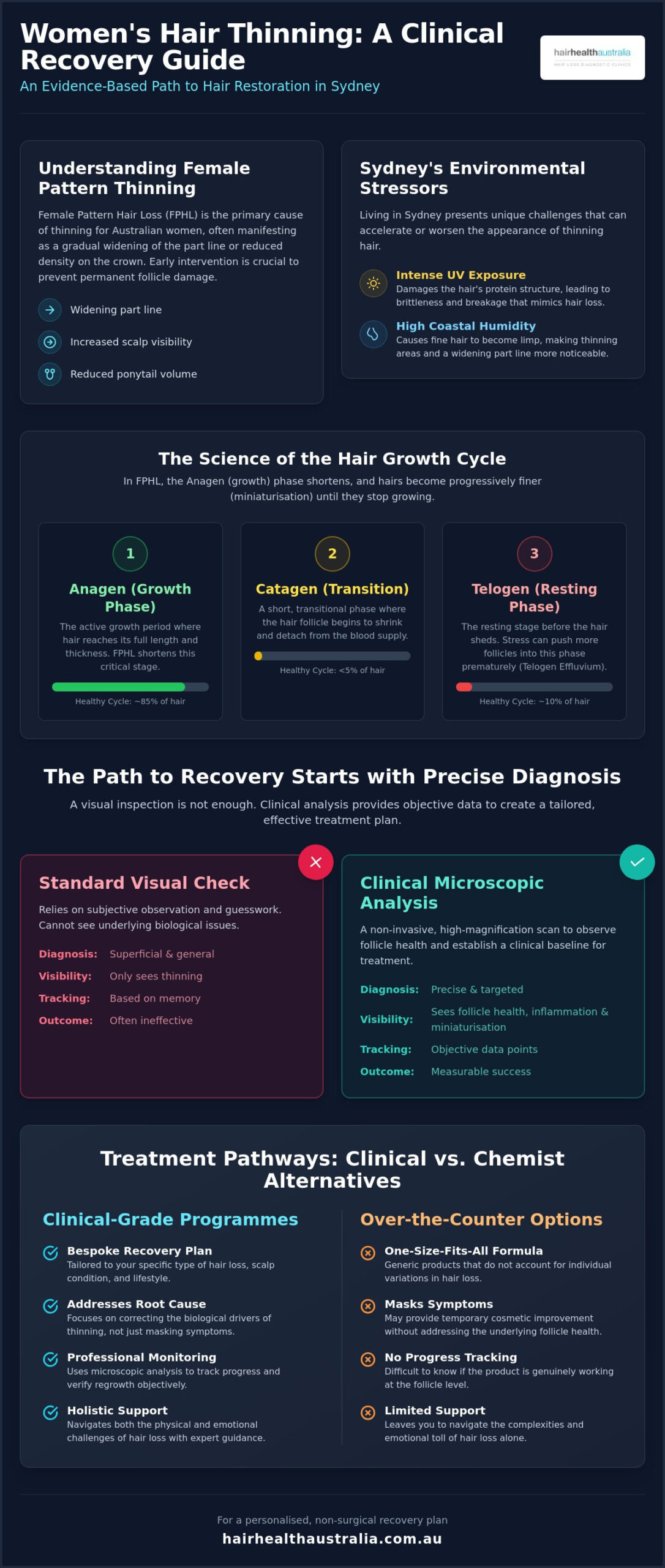
Female pattern hair loss (FPHL) remains the primary cause of thinning for women across Australia. While society often treats thinning as a predominantly male concern, the emotional impact on women is profound and frequently overlooked. Pattern hair loss typically manifests as a gradual widening of the part line or a noticeable loss of density across the crown. In 2026, clinical standards at a professional women’s hair loss clinic Sydney focus on early intervention. Identifying these changes early is the most effective way to prevent permanent follicle miniaturisation before the scalp becomes smooth and unresponsive to non-surgical treatment.
Living in Sydney introduces environmental challenges that can worsen the appearance of thinning hair. Intense UV levels during the summer months can damage the hair shaft’s protein structure, leading to brittleness and breakage that mimics true hair loss. High coastal humidity also plays a role. It causes finer hairs to go limp, making a widening part line more visible to the naked eye. Unlike male balding, which often results in a receding hairline, female thinning is usually more diffuse. Common visual indicators include:
- A part line that appears wider than it was in previous years.
- Increased scalp visibility when the hair is tied back or under bright light.
- A reduction in “ponytail volume” or overall hair thickness.
- Visible thinning at the temples or crown area.
The Science of the Hair Growth Cycle
Your hair follows a specific biological rhythm consisting of three main stages. The Anagen phase is the active growth period, Catagen is the short transition phase, and Telogen is the resting stage before the hair eventually sheds. In cases of FPHL, the Anagen phase becomes significantly shorter. This means the hair doesn’t have enough time to reach its full length or thickness. Miniaturisation is the process where hair becomes progressively finer until it stops growing.
Hormones, Stress, and the Sydney Lifestyle
Many women are surprised to find their blood tests return “normal” results despite visible thinning. This occurs because the follicles themselves are often hypersensitive to androgens, even when hormone levels are within a standard range. Additionally, Sydney’s high-pressure professional environment frequently triggers Telogen Effluvium. This is a form of temporary shedding where stress pushes a large percentage of follicles into the resting phase prematurely. For those over the age of 50, hormonal shifts during menopause mean that approximately two-thirds of women will experience some degree of density change. Visiting a women’s hair loss clinic Sydney provides the diagnostic clarity needed to separate these causes. You can begin this process with a professional hair health check to establish a clinical baseline and identify your specific triggers.
The Role of Microscopic Analysis in Modern Hair Diagnostics
A visual inspection by a GP or a quick check by your hair stylist is often insufficient for a long-term recovery plan. While they may notice your hair feels finer, they cannot see the biological markers occurring beneath the surface. At a specialised women’s hair loss clinic Sydney, we use high-magnification microscopic analysis to bridge this diagnostic gap. This non-invasive process allows us to observe follicle health in real-time, identifying issues like sebum blockages, scalp inflammation, or the early stages of miniaturisation that are invisible to the naked eye.
A clinical scan provides the data needed to remove the emotional guesswork from your recovery. It reveals the ratio of active follicles to dormant ones, allowing us to establish a precise clinical baseline. This baseline is essential for measuring the success of Female pattern hair loss treatments over the typical 6 to 12 month window required for visible regrowth. By documenting the starting point with microscopic precision, we can verify progress through objective data rather than relying on subjective memory.
What to Expect During a Clinical Hair Health Check
The Hair Health Check is a methodical, step-by-step process designed to give you total clarity. We use specialised lenses to map different zones of the scalp, identifying where thinning is most aggressive. This provides the straight-talking honesty you need. If a follicle has been dormant for too long and the scalp has become smooth, we’ll be transparent about that reality. Our focus is on identifying which areas are realistically regrowable so we can build an efficient, non-surgical plan.
Why Medical Diagnosis Trumps Chemist-Bought Guesswork
Many women spend months, and often hundreds of dollars, on chemist-bought serums that aren’t suited to their specific condition. The risk of self-treating is high. You might be using a product for generic thinning when you actually have a condition like Frontal Fibrosing Alopecia, which requires a completely different clinical approach. Professional diagnosis at a women’s hair loss clinic Sydney identifies these specific conditions early, preventing irreversible scarring. For a deeper understanding of these early markers, you can explore our guide on Early Signs of Alopecia in Women: A Clinical Guide to Detection and Recovery.
Clinical vs. Over-the-Counter: Evaluating Ladies’ Hair Loss Treatments
Choosing between a shelf-bought solution and a professional women’s hair loss clinic Sydney is often the difference between merely managing symptoms and treating the biological cause. Many women begin their recovery journey with a basic 2% minoxidil solution from a local chemist. While this remains a common entry point, using it in isolation frequently leads to underwhelming results because it fails to address the unique scalp environment or underlying hormonal triggers. A comprehensive clinical approach for the assessment of female hair loss ensures that all physiological factors are considered before a treatment pathway is finalised.
The market is also saturated with “miracle” organic oils and botanical serums. While these products can be excellent for conditioning the hair shaft or improving shine, they rarely possess the molecular weight required to penetrate the scalp and stimulate the hair follicle at a cellular level. It is vital to distinguish between scalp moisturisation and true follicle stimulation. Over several years, the cumulative cost of these failed DIY experiments often exceeds the investment in a structured clinical programme. In 2026, professional protocols prioritise a two-stage approach: first, we focus on stabilising active loss, and only then do we move into an intensive regrowth phase.
Non-Surgical Regrowth Protocols for 2026
Modern recovery plans rely on multi-modal therapy. This strategy combines high-strength topical stimulants with clinical treatments designed to improve scalp vascularity and cellular health. By waking up dormant follicles through multiple biological pathways, we can achieve significant density increases without the downtime or scarring associated with surgery. For a detailed breakdown of these methods, you can refer to our Best Hair Regrowth Treatment Australia 2026: A Clinical Reference Guide.
The Limits of Surgery for Women
Hair transplant surgery is often marketed as a definitive solution, yet it is frequently unsuitable for the diffuse thinning patterns seen in most ladies. Transplants require a dense “donor site” from which to move hair follicles, a resource many women with thinning parts simply don’t have. Stabilising the loss through clinical means is always the first priority to ensure you don’t continue to lose hair around the transplanted area. Non-surgical clinical care is the primary defence against further thinning. By visiting a specialised women’s hair loss clinic Sydney, you can access a recovery plan that focuses on preserving and revitalising your natural hair without the need for invasive procedures.
Practical Steps for Managing Hair Fall and Scalp Health in Sydney
Managing hair loss in Sydney requires a strategy that accounts for the city’s unique environmental pressures. The combination of intense UV radiation and persistent coastal salt spray creates a challenging environment for a sensitive scalp. UV damage doesn’t just affect the skin. It degrades the hair’s cuticle and can cause oxidative stress at the follicle level. Similarly, salt water from the harbour and chlorine from local pools can strip the scalp of its essential lipid barrier. This leads to inflammation, which is a known contributor to increased hair fall. Establishing a clinical washing routine is the foundation of follicle health, ensuring environmental pollutants are removed before they can cause damage.
Maintaining follicle health also depends heavily on internal factors. In Australia, many women face deficiencies in Iron, Zinc, and Vitamin D. Iron is particularly critical for the hair growth cycle. Low ferritin levels often lead to diffuse thinning across the crown. While we live in a sun-drenched city, many Sydney-siders are Vitamin D deficient due to diligent sun-safe habits. Supplementation should always be guided by a professional diagnosis at a women’s hair loss clinic Sydney to ensure you’re addressing a genuine biological deficiency rather than guessing with generic vitamins.
Sydney’s active lifestyle introduces another specific risk: Traction Alopecia. High-impact gym sessions or coastal runs often mean hair is scraped back into tight top-knots or ponytails. Over time, this constant mechanical tension damages the follicles along the hairline. If you notice thinning around the temples or forehead, it’s time to switch to looser styles or silk scrunchies. Protecting the physical integrity of the hair is just as vital as the clinical treatments you apply.
Home Care Best Practices
A clinical washing routine requires a pH-balanced cleanser that removes excess sebum without irritating a thinning scalp. When you apply topical treatments, ensure the product makes direct contact with the skin rather than just the hair shaft. This ensures maximum follicle absorption. Avoid heavy silicones. These ingredients may provide temporary shine, but they often weigh down fine hair and can clog pores, which hinders the effectiveness of regrowth recovery serums.
Lifestyle Adjustments for Hair Retention
Managing the “stress-shed” is a priority for many busy Sydney professionals. Chronic stress can push follicles into a resting state prematurely, leading to significant shedding months after a stressful event. To protect your scalp during outdoor exercise, wear a breathable hat or stay in the shade during peak UV hours. If you observe persistent thinning despite these lifestyle changes, don’t wait for it to grow back on its own. Seeking a professional analysis at a women’s hair loss clinic Sydney is the most reliable way to identify the root cause. You can start this process by booking a comprehensive hair health check to get a clear diagnostic baseline and a manageable plan for recovery.
Personalised Non-Surgical Hair Regrowth at Hair Health Australia
At Hair Health Australia, we believe that effective recovery shouldn’t be a matter of guesswork or invasive surgery. Our philosophy is rooted in a science-led, non-surgical approach that prioritises the biological health of your follicles. While generic online subscriptions often send the same topical solution to every customer, our women’s hair loss clinic Sydney provides a bespoke experience. We understand that your hair loss is as individual as your DNA, requiring a plan that adapts to your specific diagnostic data. This tailored method ensures we’re treating the root cause of your thinning rather than just the surface symptoms.
Being a Sydney-based clinic allows us to provide a level of care that digital-only services cannot match. Our experts live and work in the same environment as you, meaning we possess a deep understanding of how local factors like the harsh Australian sun or coastal humidity influence your scalp health. We don’t just provide a product; we provide a clinical partnership. This includes ongoing monitoring and regular microscopic progress tracking to ensure your treatment remains effective as your hair cycles evolve. It’s about replacing uncertainty with the reassurance of objective, data-driven results.
Why Sydney Women Choose Our Clinical Approach
We focus on non-invasive follicle stimulation designed to revitalise existing hair rather than moving follicles via surgical grafts. This approach minimises risk and eliminates the need for recovery downtime, which is essential for busy professionals. Many of our local Sydney clients have achieved significant density improvements by following a structured, professional plan that respects the natural growth cycle. For a deeper look at these methodologies, read our Clinical Hair Treatment: A Professional Guide to Non-Surgical Restoration.
Booking Your Professional Analysis
Taking the first step means moving from searching for answers to implementing a proven solution. When you visit our Redfern clinic, we’ll conduct a thorough analysis to determine what is realistically achievable for your specific condition. We’re committed to transparent clinical outcomes and will never promise “miracle” results that science cannot back up. We provide honest, straight-talking advice based on what your scalp scan reveals. You can book your microscopic hair health check at our Sydney clinic today to begin your journey toward restored density and confidence with a professional women’s hair loss clinic Sydney.
Take the First Step Toward Clinical Hair Recovery
Restoring your hair density starts with moving beyond generic serums and embracing a diagnostic-led approach. We’ve explored how microscopic analysis identifies the biological root cause of thinning, allowing for a strategy that addresses follicle health directly. By combining advanced clinical technology with an understanding of the unique Sydney environment, it’s possible to achieve significant regrowth without the need for invasive surgery. You deserve a recovery plan that is as individual as your own biology.
Choosing a specialised women’s hair loss clinic Sydney ensures your journey is guided by experts who prioritise evidence-based results over marketing hype. Our non-surgical protocols are designed to stabilise active loss and stimulate dormant follicles through systematic, professional care. If you’re ready to replace uncertainty with a clear path forward, the next logical step is a professional assessment of your current scalp health.
Book Your Comprehensive Microscopic Hair Health Check today to gain total clarity on your follicle health. You don’t have to navigate thinning alone. With the right clinical support and a manageable regrowth plan, restoring your hair density and confidence is an achievable reality for 2026.
Frequently Asked Questions
Is ladies’ hair loss permanent, or can it be reversed?
Hair loss isn’t always permanent, but the possibility of reversal depends on the current health of your follicles. If thinning is caught in the early stages of miniaturisation, non-surgical treatments can often revitalise the follicle and restore density. However, once a follicle has been dormant for several years and the scalp becomes smooth, regrowth is no longer clinically possible. This is why early diagnostic scanning at a women’s hair loss clinic Sydney is vital for a successful recovery.
How much does professional ladies’ hair loss treatment cost in Sydney?
Professional treatment costs vary based on the severity of your thinning and the specific clinical protocols required for your recovery. While generic over-the-counter products are cheaper initially, they often lack the efficacy of a structured, multi-modal programme. Most clinical recovery plans are customised after a diagnostic scan, ensuring you only invest in the treatments your scalp actually requires. This targeted approach often proves more cost-effective than years of unsuccessful DIY attempts.
Can stress really cause my hair to fall out in clumps?
Severe physical or emotional stress can trigger a condition called Telogen Effluvium, which causes hair to shed in noticeable amounts. This occurs when stress pushes a large percentage of follicles into the resting phase simultaneously. While this type of shedding is usually temporary, it can often unmask underlying female pattern thinning that was previously unnoticed. A professional analysis helps distinguish between a temporary stress-shed and a long-term genetic condition that requires clinical intervention.
What is the difference between female pattern baldness and alopecia?
Alopecia is the general medical term for all types of hair loss, while female pattern baldness is a specific, genetic form of the condition. There are many other variants, such as Alopecia Areata, which is an autoimmune response resulting in patchy loss. Identifying the exact variant you have is the first step toward an effective recovery. A women’s hair loss clinic Sydney uses microscopic technology to determine which specific type of alopecia is affecting your hair density.
Does minoxidil work for all women, or are there better clinical options?
Minoxidil doesn’t work for every woman, as its effectiveness depends on the presence of specific enzymes in the scalp. Many women find that basic chemist-bought solutions provide limited results. Modern clinical options often involve high-strength, customised formulations combined with scalp health treatments that improve absorption. These multi-modal protocols target the follicle through several biological pathways, often succeeding where generic topical treatments have failed to produce visible regrowth.
How long does it take to see results from a non-surgical regrowth programme?
You should expect to see the first signs of clinical improvement within three to six months, with more significant density changes occurring at the 12-month mark. Hair grows in slow cycles, so patience is a necessary part of the recovery process. Initial success is often measured by a reduction in daily shedding, followed by the appearance of finer baby hairs that gradually thicken into mature terminal hairs over time.
Can my hairdresser tell if I have a medical hair loss condition?
Your hairdresser may be the first to notice changes in your hair density or texture, but they aren’t trained to provide a medical diagnosis. They see the hair shaft, whereas a clinical specialist looks at the follicle and scalp health beneath the surface. While a stylist can recommend better cutting techniques to mask thinning, a clinical professional is required to identify the biological drivers and prescribe a corrective treatment plan.
Is it safe to colour my hair while undergoing clinical treatment?
It’s generally safe to colour your hair during treatment, provided your scalp isn’t currently inflamed or irritated. We recommend choosing ammonia-free or gentle dyes to avoid further stressing the follicles. It’s also wise to inform your clinician about your colouring routine. They can adjust your topical application schedule to ensure your clinical treatments don’t interfere with your hair colour or vice versa, maintaining both hair health and aesthetic goals.