
Female Pattern Hair Loss Treatment in Sydney: Medication Options

Female pattern hair loss treatment in Sydney may involve topical minoxidil at concentrations of 2 to 5%, with oral medicines also considered in some cases. The right approach depends on whether gradual thinning reflects a pattern hair loss condition or another cause; losing about 50 to 100 hairs a day can be normal.

It can be unsettling to notice more scalp or a widening part, especially when everyday shedding makes it difficult to tell what is changing. Female pattern hair loss often causes thinning over the top of the scalp, while some shedding is a normal part of the hair growth cycle. The distinction matters because treatment depends on the cause and pattern of hair loss.

This guide explains how female pattern hair loss differs from normal shedding, outlines medication options such as topical and oral treatments, and describes how diagnosis and follow-up may work. It also covers why treatment may need to continue and why progress is assessed over time, helping you approach the next step with a clearer understanding of care.

Key Takeaways

  • About 50 to 100 hairs shed daily can be normal; gradual thinning over the top of the scalp may point to a different pattern.
  • Hair-loss assessment considers the pattern and possible causes, since conditions that look similar can require different management.
  • Topical minoxidil and selected oral medicines are among the options discussed, with the choice depending on the treatment plan.
  • Hair treatments take time to assess, and follow-up helps review response and guide ongoing care.
  • Understand the realistic aim of treatment: slowing further loss, with regrowth possible but not an outcome for everyone.

What is female pattern hair loss or female pattern baldness?

Female pattern hair loss, also called female pattern baldness, is a form of non-scarring alopecia. Hair follicles remain intact, but gradual thinning commonly appears across the top of the scalp. Around 40% of women show signs of hair loss by age 50. It can occur at any age, though it becomes more common after menopause. The hairline often remains relatively preserved, unlike some patterns of male hair loss.

Genetics commonly play a role, and inherited susceptibility can come from either or both parents. Some women have no family history of baldness. In affected follicles, sensitivity to androgens can influence hair growth, but this does not necessarily mean there is an underlying hormonal abnormality. An individual assessment considers the distribution and pace of thinning, family history, health changes and any relevant medicines.

Diagnosis is usually clinical. A clinician examines the scalp and hair pattern, including thinning across the crown, part and hairline. Chronic telogen effluvium can resemble female pattern hair loss, although the causes and management differ. Sudden round bald patches can suggest alopecia areata, while scalp inflammation or scarring may point to another condition. These distinctions help guide the assessment rather than assuming every change is pattern hair loss.

Health checks depend on the symptoms and examination. Blood tests may help investigate associated medical conditions, including autoimmune conditions. Routine hormonal testing isn’t required for most women, but signs of androgen excess can make it relevant. A scalp biopsy may be considered if the pattern is atypical or another condition needs to be ruled out. It involves taking a small skin sample for examination under local anaesthetic.

Medicare or private health insurance doesn’t automatically cover every hair-loss consultation or treatment. Any contribution depends on the service and applicable eligibility or policy terms, so diagnosis and treatment costs can vary. This is separate from identifying the cause: a clinical assessment determines which investigations or care are appropriate.

Pregnancy and breastfeeding affect how medication options should be considered. Tell the treating clinician before starting or continuing any hair-loss medicine, so the plan can account for pregnancy or breastfeeding and review each medicine’s suitability.

Personalised planning brings together the pattern of loss, possible triggers, examination results and health history. The aim is to distinguish gradual follicle-related thinning from temporary shedding or conditions that damage follicles. Non-scarring alopecia leaves follicles intact, while scarring alopecia destroys them and can cause permanent loss. If the diagnosis isn’t straightforward, further assessment can help clarify the cause before treatment is chosen.

Hair growth cycle and normal shedding

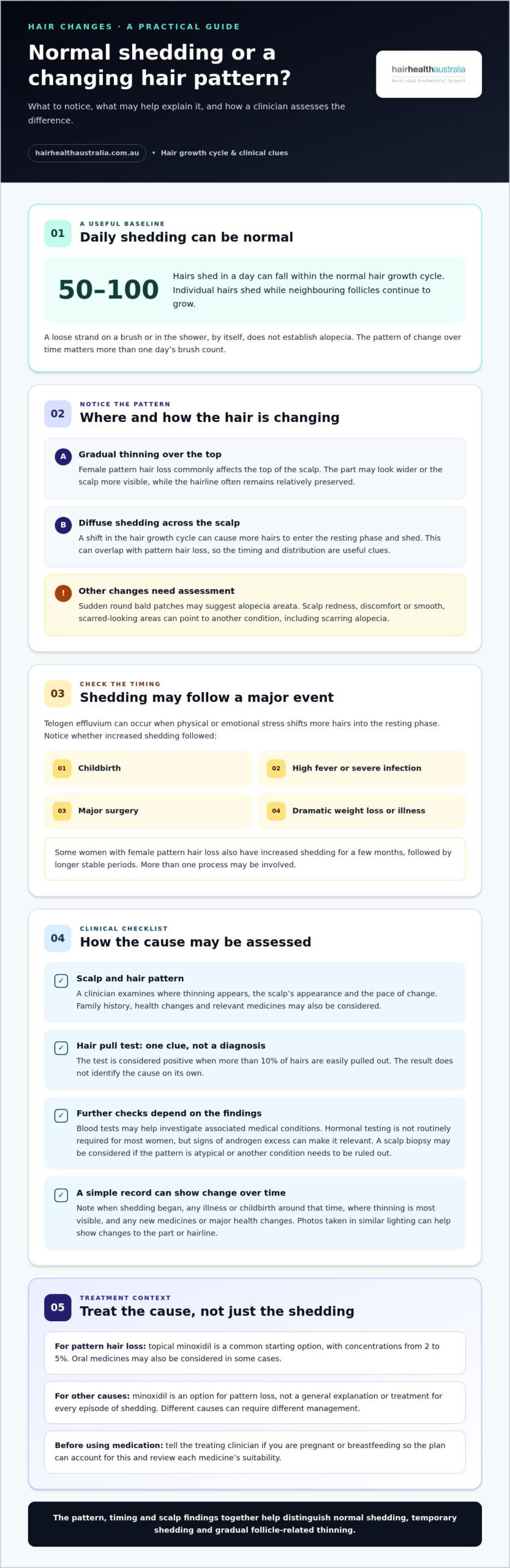
Each scalp hair moves through a repeating cycle of growth, transition and rest before shedding. These phases don’t happen in synchrony, so individual hairs fall while neighbouring follicles continue producing hair. Losing about 50 to 100 hairs daily is normal. A loose strand on a brush or in the shower, by itself, doesn’t establish alopecia. The pattern over time matters more: gradual thinning can make the part look wider or the scalp more visible.

During telogen effluvium, physical or emotional stress can shift more hairs into the resting phase. Shedding may become noticeable after childbirth, a high fever, severe infection, major surgery, dramatic weight loss or an underlying illness. Some women with female pattern hair loss also experience increased shedding for a few months, followed by longer stable periods. These changes can overlap, so the timing of shedding and other health events can help explain what is happening.

Notice where thinning appears and how it changes. Diffuse shedding across the scalp differs from gradual loss concentrated over the crown, while sudden round patches may suggest alopecia areata. Scalp redness, discomfort or smooth, scarred-looking areas also need assessment, because scarring alopecia can destroy hair follicles. Photos taken in similar lighting can help show changes to the part or hairline, rather than relying on a single day’s brush count.

A hair pull test is one clinical clue: it’s considered positive when more than 10% of hairs are easily pulled out. The result doesn’t identify the cause on its own. A clinician considers the shedding pattern, scalp appearance and recent events together. A scalp biopsy may help when the pattern is atypical or another condition needs ruling out. Hormonal assessment depends on accompanying signs, while minoxidil is a treatment option for pattern loss, not a general explanation for every episode of shedding.

Track changes in a simple record: note when shedding began, whether it followed an illness or childbirth, and where thinning is most visible. Include new medicines or major health changes for discussion during an assessment. This helps distinguish a temporary shift in the hair growth cycle from progressive follicle miniaturisation. If you’re unsure how to interpret changes, a hair health check can be a useful next step in understanding your hair and scalp.

Telogen effluvium is temporary hair loss caused by shedding resting hairs after a shock to the system, while new hair continues to grow.

Topical and oral medications

For female pattern hair loss, medication aims to slow thinning or stimulate regrowth. Topical minoxidil is a common starting option, with concentrations from 2 to 5%. It acts on the scalp rather than addressing every possible cause of diffuse shedding. The distinction matters: androgenetic alopecia affects follicles in a characteristic pattern, while temporary shedding can follow illness or other stressors. Treatment choice follows the diagnosis and the person’s health circumstances.

A 2% minoxidil lotion is applied at approximately 1 mL per application. A 5% foam or lotion is used once daily, with response assessed after 6 to 12 months. The 2% solution is less likely than the 5% solution to cause irritation or unwanted hair growth elsewhere on the body. Application technique also matters: the product is directed to the affected scalp area, not the hair shafts. Follow the prescribed directions and discuss persistent irritation during follow-up.

Oral minoxidil is another option. Low-dose oral or sublingual minoxidil is listed at 0.25 to 1 mg for female pattern hair loss. Oral spironolactone, at 25 to 50 mg, may be used as an introductory combination treatment. These medicines work differently, so a treatment plan can weigh the pattern of loss, health history and other medicines. They require clinician oversight rather than self-directed dosing.

Other medicines may be considered for selected patients. Spironolactone and cyproterone acetate are oral options used in some treatment plans. Dutasteride is approved in Australia by the Therapeutic Goods Administration for benign prostatic hyperplasia, not hair loss. Topical finasteride solutions at 0.1 to 0.25% are under investigation for androgenetic alopecia. These distinctions help separate established options from treatments still being studied.

Expect treatment to be assessed over time, not after a few applications. A clinical effect may take 3 to 6 months to become noticeable, and spironolactone may produce noticeable growth after 6 months. Topical or oral treatment generally needs daily continuation because benefits can be lost after stopping. Follow-up can compare scalp coverage and shedding, review tolerability, and inform whether the plan should continue or change. Response varies, and the main aim is often to slow progression, with regrowth possible for some women.

An open-label comparison for hair loss reported increased hair growth in 68% of patients treated with finasteride and 38% treated with saw palmetto.
Female Pattern Hair Loss Treatment in Sydney: Medication Options

Dermatologist consultations and follow-up

A dermatologist’s assessment starts by clarifying the pattern, timing and pace of hair loss. They may ask when thinning began, whether it followed illness or childbirth, and whether close relatives have genetic hair loss. The scalp examination looks for the distribution of thinning, follicle changes, inflammation and signs of scarring. These details help distinguish female pattern hair loss from conditions that need different management.

Medical history adds context to the examination. Tell the doctor about health changes, medicines and other symptoms, including signs that may suggest androgen excess. Routine hormonal testing isn’t required for most women with female pattern hair loss, but a doctor may recommend it if other signs point to excess androgens. Blood tests can also help investigate medical conditions associated with hair loss, rather than assuming every change is hormonal.

Further investigation depends on what the scalp examination and medical history show. A scalp biopsy may be considered if the pattern is atypical or another condition needs to be ruled out. It can help distinguish non-scarring loss, where follicles remain intact, from scarring alopecia, where follicles are destroyed. Sudden patches, scalp discomfort or visible scarring may prompt closer assessment. The findings guide whether treatment should target pattern thinning or another cause.

Follow-up gives the doctor a way to review treatment response and tolerability over time. For topical or oral medication, a review can consider whether use has been consistent, whether irritation or other effects have appeared, and whether thinning has stabilised. It can take months to assess a response, so changes over a short period don’t give the full picture. Keeping a consistent record of scalp appearance and shedding can make comparisons more useful.

If there’s no response after 6 months of treatment, referral to a dermatologist should be considered. This review can revisit the original diagnosis, check for another cause and reassess the treatment plan. It also helps separate medical aims, such as slowing progression, from cosmetic goals, such as improving visible coverage. Hair regrowth isn’t the only measure: stabilisation and scalp health also matter.

Prepare for an appointment by noting when changes began, treatments already used and relevant health events. Bring a list of medicines and mention any family history, even if relatives experienced thinning rather than complete baldness. These details help make the assessment more individual. Ask how progress will be reviewed and what findings might lead to a change in care. A clear follow-up plan connects the examination to practical decisions.

Female pattern hair loss treatment options

Clinical treatment aims to slow or halt progression, but regrowth may not occur for everyone. Options depend on the diagnosis, health history and pattern of thinning.

Treatment approaches

Treatment combines an accurate diagnosis with a plan suited to the person’s hair-loss pattern and health. Topical minoxidil is a key option, while oral medicines such as spironolactone may be considered in selected plans. This matters because alopecia areata, scarring loss and female pattern hair loss have different causes, so the same treatment won’t suit every presentation.

For androgenetic alopecia, topical minoxidil may be used on the affected scalp, with oral minoxidil or spironolactone considered where appropriate. The choice depends on factors such as the extent of thinning, existing medicines and health circumstances. Ongoing use is generally needed to maintain benefits. Before starting, discuss each medicine’s purpose, application and review plan.

Some medicines require particular care in how they’re described. Dutasteride is approved in Australia by the Therapeutic Goods Administration for benign prostatic hyperplasia, not hair loss. Topical finasteride solutions or lotions at 0.1 to 0.25% are under investigation for androgenetic alopecia. A receding hairline or thinning crown shouldn’t lead to assuming that medicines used for male pattern loss suit women.

Non-scarring pattern loss differs from conditions that damage follicles. Alopecia areata can cause sudden, round patches, while scarring alopecia can permanently destroy follicles. Identifying these signs affects the treatment pathway. Hair transplantation is also described as an option for some women with female pattern hair loss, but it is surgery and doesn’t suit every pattern. A clinical assessment helps clarify which approach addresses the cause.

Treatment results and timelines

Results vary, and treatment is assessed over months rather than days. A clinical effect may take 3 to 6 months to become noticeable; response to topical 5% minoxidil is assessed after 6 to 12 months. These timeframes matter when judging progress: early shedding or unchanged coverage doesn’t, by itself, show the eventual response.

For spironolactone, noticeable hair growth generally appears after 6 months. The main aim remains slowing progression, although some women experience regrowth. Ongoing treatment is usually needed to maintain benefits, so follow-up considers both visible change and tolerability. If progress is limited, the diagnosis and plan can be reviewed rather than assuming every medication works the same way.

For women considering female pattern hair loss treatment in Sydney, explore a hair health check as a practical starting point for discussing treatment options and next steps.

Hair Health Australia: Male Hair Loss Treatment

Hair Health Australia offers Female Hair Loss Treatment for women seeking support with thinning hair and pattern loss. Its non-surgical regrowth programs use clinically backed methods focused on hair density and scalp health. This may suit you if you’ve learned about medication options and want to explore a treatment program for female hair loss. The approach focuses on addressing thinning without promising a particular outcome. Because hair loss has different causes, treatment choices should match the pattern and individual circumstances. For information about Female Hair Loss Treatment, contact Hair Health Australia or visit hairhealthaustralia.com.au.

Choose a considered next step

The next step is to turn what you’ve noticed into a clear plan. Consider what matters most to you, whether that’s slowing further thinning, supporting visible density or understanding which approach fits your circumstances. For female pattern hair loss treatment in Sydney, a focused conversation can connect your concerns with a suitable treatment pathway, without treating every kind of shedding as the same problem.

Hair Health Australia offers Female Hair Loss Treatment and Male Hair Loss Treatment. If you’re ready to explore support for female hair loss, share your concerns and learn about the options available through its treatment program. Questions about suitability, ongoing care and what to expect are a useful starting point.

Contact Hair Health Australia to discuss your hair health and take a considered step towards understanding your options.

Frequently Asked Questions

What causes female pattern hair loss and how is it diagnosed?

Female pattern hair loss is usually genetic, but a family history isn’t always present. Diagnosis is generally based on the scalp’s appearance and the distribution of thinning. For an assessment, note when the change began, whether it followed an illness or medication change, and whether close relatives have experienced thinning. This timeline can help distinguish a gradual pattern from sudden shedding or patchy loss, which may need a different assessment.

What treatments for female pattern hair loss are available in Sydney?

Options can include topical minoxidil and prescription medicines such as spironolactone, with the approach matched to the diagnosis and health history. For female pattern hair loss treatment in Sydney, Hair Health Australia offers Female Hair Loss Treatment through non-surgical regrowth programs. Treatment discussions can cover the aim of care, how it fits your circumstances and how progress will be reviewed, rather than treating every type of hair loss in the same way.

How effective is topical minoxidil for female pattern hair loss, and how is it used?

Topical minoxidil can help slow thinning and support regrowth, though the response differs between people. For women, a 2% lotion is applied at approximately 1 mL per application; 5% foam or lotion is used once daily. Apply it to the affected scalp area according to its directions. The 2% solution is less likely than the 5% solution to cause irritation or unwanted hair growth elsewhere.

What prescription medicines are used for female pattern hair loss in women in Australia?

Prescription options may include oral spironolactone, cyproterone acetate and low-dose oral minoxidil, selected according to individual circumstances. Topical finasteride solutions are under investigation for androgenetic alopecia. These medicines aren’t interchangeable, so discuss treatment selection and monitoring with the treating clinician.

What are the risks and side effects of hair loss treatments for women?

Topical minoxidil can cause scalp irritation or unwanted hair growth elsewhere on the body; the 2% solution is less likely to cause these effects than the 5% solution. Oral medicines have different considerations, and tolerability depends on the medicine and the person. Before treatment, discuss current medicines, health history and any effects that emerge. This gives the treating clinician useful information for reviewing the plan.

Can women use hair transplants or other procedures for pattern hair loss in Sydney?

Hair transplantation is described as an option for some women, with results potentially more permanent and dramatic than medical treatment. It is surgery, distinct from non-surgical approaches such as medication. Hair Health Australia offers non-surgical Female Hair Loss Treatment, not hair transplant surgery. Discussing the pattern and extent of hair loss can help clarify whether a medical treatment approach addresses your concern and what goals to set.
What Is Frontal Fibrosing Alopecia? Signs, Diagnosis and Next Steps

Could a hairline that seems to be moving back, or eyebrows that are thinning, point to more than ordinary hair changes? If you’re asking “what is frontal fibrosing alopecia”, it’s a form of scarring hair loss that commonly causes gradual recession along the front and sides of the hairline. Similar changes can have other explanations, though, and an online description can’t confirm the cause.

Frontal fibrosing alopecia may also affect the eyebrows. Some people notice itching, tenderness or smooth-looking skin where hair has been lost. Because scarring can make hair loss permanent, timely medical assessment matters, but a changing hairline doesn’t automatically mean you have this condition. This guide explains commonly described signs, how diagnosis may involve an examination and sometimes a scalp biopsy, and what practical next steps may look like. It’s intended to help you prepare for a conversation with a health professional, not to help you self-diagnose or promise regrowth or a cure.

Key Takeaways

  • To understand what is frontal fibrosing alopecia, learn how this scarring condition can affect the front and sides of the hairline. Recession alone doesn’t confirm it.
  • The exact cause isn’t fully understood, so be cautious about claims that one trigger or theory explains every case.
  • Note the pattern of changes, including eyebrow thinning, scalp redness or scale, itching and discomfort, and share your observations with a health professional.
  • Assessment may involve discussing your history, examining your scalp and eyebrows, considering other causes and deciding whether tests are needed.
  • If you’re concerned about progressive hair loss that may be scarring, seek timely medical assessment before considering a general hair-loss programme.

What is frontal fibrosing alopecia, and where does it affect the hair?

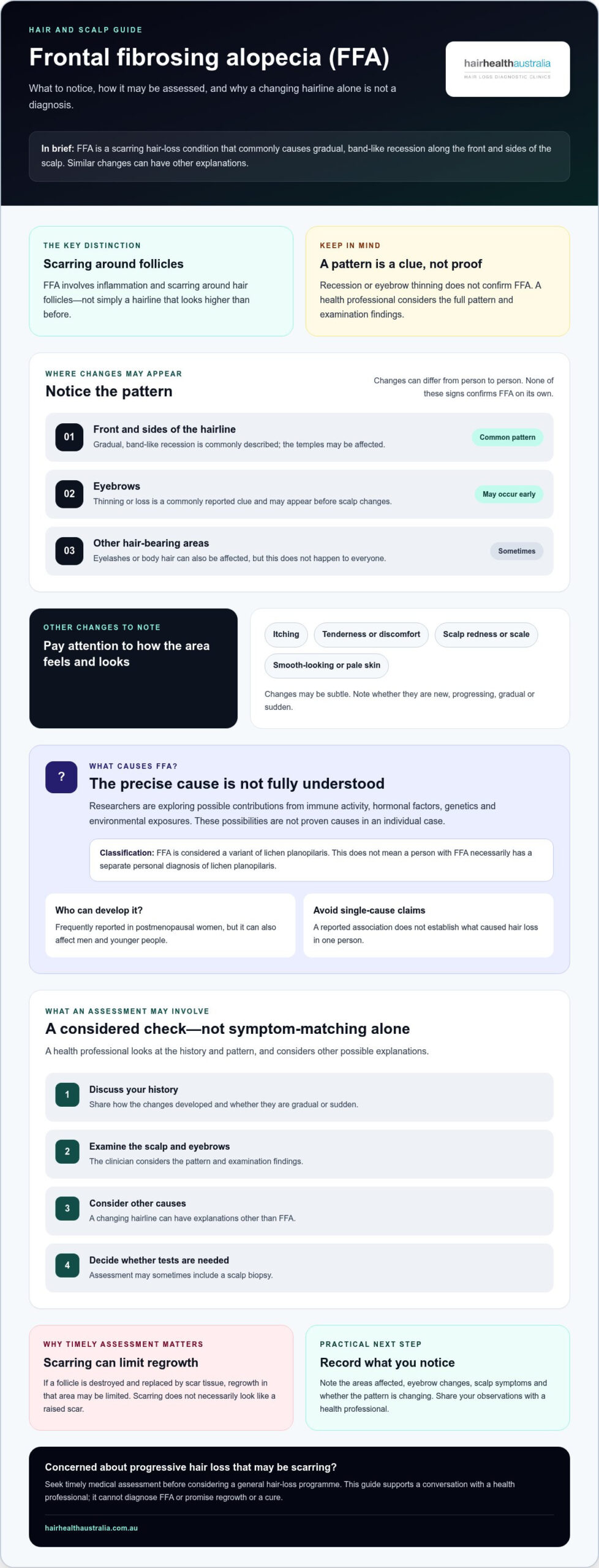
If you’re asking what is frontal fibrosing alopecia, the key distinction is that it involves inflammation and scarring around hair follicles, not simply a hairline that looks higher than before. Frontal fibrosing alopecia (FFA) is a scarring hair-loss condition that commonly causes gradual, band-like recession along the front and sides of the scalp. The change may become noticeable over time as the hairline shifts back, rather than as sudden, widespread shedding.

The pattern can be a useful clue, but it isn’t proof. A receding hairline can have other explanations, and FFA may look different from person to person. A clinician considers the pattern alongside other changes and examination findings. The overview of frontal fibrosing alopecia describes its presentation and possible differences from other hair-loss conditions, but it can’t determine what’s causing your hair changes.

What does the word scarring mean in frontal fibrosing alopecia?

In FFA, inflammation can damage follicles, the structures in the skin from which hairs grow. If a follicle is destroyed and replaced by scar tissue, regrowth in that area may be limited. This doesn’t necessarily look like a visible, raised scar. The skin can appear smooth or pale, and changes may be subtle. An early assessment can help a clinician check for signs of ongoing inflammation and consider whether the hair loss is scarring.

Which areas can frontal fibrosing alopecia affect?

FFA most often affects the frontal hairline and temples, sometimes leaving a narrow band of lost hair. Thinning or loss of eyebrow hair is another commonly reported clue, and in some people it appears before scalp changes. Eyelashes or body hair can also be affected, but this doesn’t happen to everyone. These signs deserve attention when they’re new or progressing, though none confirms FFA on its own.

Note where changes are occurring and whether they’re gradual or sudden. If you’re also trying to understand broader hair changes, read this guide to early signs of alopecia in women. For a changing hairline or eyebrow loss that raises concern about scarring, seek assessment from an appropriate medical professional rather than relying on appearance alone.

What causes frontal fibrosing alopecia, and who can develop it?

People often search for what is frontal fibrosing alopecia because they want to know why it has happened. The precise cause isn’t fully understood, and current evidence doesn’t point to one explanation for every person. Researchers are exploring possible contributions from immune activity, hormonal factors, genetics and environmental exposures. These possibilities shouldn’t be treated as proven causes in an individual case.

Clinically, FFA is considered a variant of lichen planopilaris, another type of scarring hair loss. This describes how specialists classify the condition. It doesn’t mean that someone with FFA necessarily has a separate personal diagnosis of lichen planopilaris. A clinician assesses the overall pattern and examination findings to consider what may be happening.

A risk association may help guide research, but it doesn’t prove what caused FFA in any one person. A reported link between a factor and the condition cannot, by itself, establish that the factor triggered someone’s hair loss. Avoid treating online claims about a single cause as a diagnosis or as a reason to make major changes without professional advice.

Is frontal fibrosing alopecia an autoimmune condition?

Immune involvement is suspected: inflammation around follicles may reflect the immune system contributing to follicle damage. However, describing FFA as definitively caused by autoimmunity would overstate what is known. Itching or hairline recession alone can’t establish the underlying mechanism. A clinician considers the full presentation, including how the changes developed and what an examination shows, rather than inferring a cause from one clue.

Can younger people and men develop FFA?

FFA is frequently reported in postmenopausal women, but it isn’t exclusive to this group. It can also affect men and younger people. If someone’s age or sex doesn’t match the pattern they’ve read about, that doesn’t rule FFA in or out. Less typical presentations are another reason to seek a considered assessment instead of relying on demographic assumptions or symptom-matching alone.

If you have broader questions about hair changes, Hair Health Australia’s Hair Health Check may be an option for discussing those concerns. It shouldn’t be treated as an FFA diagnostic service. If you suspect progressive scarring hair loss, seek appropriate medical assessment before considering a general hair-loss programme.

Could these signs be FFA, or another type of hair loss?

If you’re wondering what is frontal fibrosing alopecia based on changes you’ve noticed, remember that signs can suggest a possibility without proving it. Gradual change at the frontal or temple hairline, eyebrow thinning, or redness and scale around individual follicles may prompt an assessment. Itching, tenderness or discomfort can also occur, but some people have few or no symptoms.

Which early signs may prompt an assessment?

Look for changes over time rather than relying on one day’s appearance. A hairline that seems to be receding gradually, particularly alongside eyebrow thinning, is worth discussing with a health professional. A clinician may also look for perifollicular redness or scale, meaning irritation or flaking around hair follicles. Not having itch or tenderness doesn’t rule FFA out. You don’t need to wait for several signs to appear before seeking advice.

Pattern or clue What assessment may clarify
Gradual recession at the front or temples, sometimes with eyebrow thinning Whether the distribution and progression fit a scarring pattern or another cause
Redness or scale around follicles, with possible itch or discomfort Whether there are signs of inflammation, noting symptoms may be absent
Smooth patches, diffuse shedding or patterned thinning Whether another type of hair loss may better explain the changes

How is FFA different from alopecia areata or pattern hair loss?

FFA often involves a slowly receding band at the front or sides of the scalp. Alopecia areata may cause smooth, distinct patches, while pattern hair loss more often produces gradual thinning in a characteristic distribution. Diffuse shedding can have other explanations. These are general patterns, not rules. Conditions can overlap, and appearance alone may not distinguish them reliably.

A clinician may notice a “lonely-hair” sign, where isolated hairs remain in an area of recession. It’s a clinical clue, not a home diagnostic test, and it can’t confirm FFA on its own. Examination helps put such findings in context and assess other possible causes. If hairline or eyebrow changes are progressing, arrange an assessment rather than waiting for every sign in a checklist. Online comparisons can help you describe what you’ve noticed, but they can’t determine the diagnosis.

What Is Frontal Fibrosing Alopecia? Signs, Diagnosis and Next Steps

How is frontal fibrosing alopecia diagnosed?

Knowing what is frontal fibrosing alopecia helps explain why diagnosis involves more than comparing a hairline with a picture online. A clinician considers the pattern of hair loss, symptoms and examination findings together. They may ask when the changes began, whether they’re progressing, and about scalp or skin symptoms, relevant health history, and changes to eyebrows or other hair.

The assessment commonly follows four steps:

  • Discuss the changes: Describe when you first noticed them and how they’ve changed, including any itch, tenderness or discomfort.
  • Examine the scalp and eyebrows: The clinician checks the distribution of hair loss and the skin around the follicles.
  • Consider other causes: Similar-looking changes can have different explanations, so your history and examination help guide the assessment.
  • Decide whether tests are needed: Further investigation depends on how clear the findings are and whether confirmation is needed.

FFA diagnosis combines clinical findings and, when indicated, further investigations. A biopsy isn’t automatically required for everyone, and no specific test or outcome can be assumed before an individual assessment.

What happens during a scalp and hairline examination?

A clinician may inspect the hairline and temples, looking at the pattern of loss, follicle openings, and any redness or scale around follicles. They may also examine your eyebrows or other areas if you’ve noticed changes there. This helps place each clue in context, as a single feature doesn’t establish a diagnosis. The examination is guided by your symptoms and history.

When might dermoscopy or a biopsy be considered?

Dermoscopy is a magnified examination of the skin and scalp that lets a clinician view structures around hair follicles more closely. It may help assess signs such as redness or scale. If the findings remain uncertain, a scalp biopsy, in which a small skin sample is examined, may help clarify or confirm the diagnosis. Whether either is appropriate depends on the clinical assessment.

If you’re concerned about progressive hair loss that may be scarring, seek appropriate medical assessment. For broader hair concerns, you can also explore Hair Health Australia’s Hair Health Check as a way to discuss your concerns. It isn’t a confirmed FFA diagnostic service and doesn’t replace medical diagnosis.

What should you do if you suspect frontal fibrosing alopecia?

If you’ve been asking what is frontal fibrosing alopecia because your hairline or eyebrows are changing, the next step is an assessment, not a self-diagnosis. If hair loss appears progressive or may be scarring, arrange an appointment with an appropriate medical professional, such as your GP or a dermatologist. Early assessment can help clarify what’s happening and whether further investigation or management is appropriate.

Management depends on the individual findings. If FFA is diagnosed, a clinician may discuss options aimed at reducing inflammation or slowing further hair loss. These goals differ from restoring hair in areas where follicles have already been affected by scarring. Regrowth in those areas may not be possible, so treatment shouldn’t be understood as a guaranteed reversal or cure.

What questions should you take to an appointment?

A few notes can help you explain what you’ve noticed and make the conversation more useful. Consider recording:

  • When you first noticed changes to your hairline or eyebrows, and whether they seem to be progressing.
  • Any itch, tenderness, redness, scale or other skin changes, including when they occur.
  • Relevant health history and any other changes to your hair or skin.
  • Questions about which diagnoses are being considered, whether tests may help, and what follow-up is appropriate.

You could also take dated photos in consistent lighting to help describe changes over time. They won’t diagnose the cause, but may support a clearer discussion with your clinician.

Where can a Sydney reader start?

In Sydney, you can start by discussing your concerns with a GP, who can advise on appropriate next steps, including whether assessment by a dermatologist is suitable. Explain that you’re concerned about possible scarring hair loss. Hair Health Australia provides personalised, non-surgical hair-loss programmes for men and women, but it hasn’t been verified as offering FFA diagnosis or treatment. If scarring alopecia is suspected, medical assessment is important before considering a general hair-loss programme.

If you’d like to discuss broader hair concerns with Hair Health Australia, you can request a Hair Health Check. It isn’t a substitute for medical assessment or a confirmed diagnostic service for FFA. Seek appropriate medical advice about suspected scarring first, then consider what support may suit your wider hair-health concerns.

Take a measured next step for your hair health

Understanding what is frontal fibrosing alopecia can help you recognise why a changing hairline or thinning eyebrows may deserve attention, but these signs alone can’t confirm the cause. FFA involves scarring hair loss, and diagnosis depends on clinical assessment. If changes are progressing or you’re concerned about possible scarring, speak with an appropriate medical professional, such as your GP or a dermatologist.

Where FFA is diagnosed, management is individualised and may aim to reduce inflammation or slow further loss. It can’t be assumed to restore hair in areas already affected by scarring, so be wary of promises of a cure or guaranteed regrowth.

For broader hair concerns, Hair Health Australia provides personalised hair-loss services for men and women, including in Sydney. A Hair Health Check may offer an opportunity to discuss those concerns, but it isn’t a confirmed FFA diagnostic service and doesn’t replace medical assessment. Request a Hair Health Check to discuss your wider hair-health concerns. For suspected scarring, speak with a medical professional first.

Frequently Asked Questions

What is frontal fibrosing alopecia?

Frontal fibrosing alopecia (FFA) is a form of scarring hair loss that commonly affects the front and sides of the scalp. It can also involve the eyebrows and, less often, other body-hair areas. The pattern and symptoms vary between people. A clinician assesses the changes and considers other possible causes before confirming whether someone has FFA. A receding hairline or eyebrow thinning alone isn’t enough to diagnose it.

What are the first signs of frontal fibrosing alopecia?

Possible early signs include gradual recession at the front or temples, eyebrow thinning, and redness or scale around hair follicles. Some people also experience itch or tenderness, while others have little discomfort. These changes can have other causes, so they’re clues rather than proof of FFA. If you notice progressive changes, arrange a professional assessment instead of relying on an online checklist or waiting for every sign to appear.

Is frontal fibrosing alopecia permanent?

Hair loss caused by scarring may be permanent because affected follicles may not regrow hair. However, the course of FFA varies between individuals. If diagnosed, management may aim to reduce inflammation or slow further loss, rather than restore hair in areas already scarred. A clinician can discuss realistic expectations based on your findings. Be cautious of claims that promise a cure or guaranteed regrowth, as these outcomes can’t be assured.

Can frontal fibrosing alopecia affect younger people?

Yes. FFA is often reported in postmenopausal women, but it can also affect younger people and men. A person’s age doesn’t confirm or rule out the condition, and a changing hairline can have several explanations. If you notice progressive hairline recession or eyebrow changes, arrange an assessment with an appropriate medical professional. They can consider the pattern and your history rather than relying on age or online symptom lists alone.

Is frontal fibrosing alopecia the same as alopecia areata?

No. FFA and alopecia areata are different forms of hair loss, with different typical patterns and underlying processes. FFA commonly causes gradual recession at the front or sides of the hairline, while alopecia areata can cause smooth patches. These patterns aren’t definitive, and other scalp conditions can also affect hair. A clinician compares the distribution and examination findings to assess which explanation is most likely.

Should I see a doctor if my hairline is receding?

Consider seeking medical advice if recession is progressing, appears band-like, affects your eyebrows, or occurs with scalp redness, scale, itch or tenderness. These features don’t prove FFA, but assessment can help identify possible causes and appropriate next steps. In Sydney, you can start by discussing your concerns with a GP, who can advise whether further medical assessment is appropriate. Avoid starting treatment based only on an online description.

Hair Doctor: A Clinical Guide to Hair Loss Specialists in Sydney

If you’ve spent months experimenting with thickening shampoos and expensive salon serums, have you ever stopped to ask if you’re treating a cosmetic preference or a clinical condition? Most Australians experiencing thinning feel a genuine sense of anxiety, often caught between the fear of permanent baldness and the dread of invasive surgery. It’s frustrating when the distinction between a retail stylist and a medical specialist feels blurred, leaving you unsure where to turn for real answers.

Finding a qualified hair doctor in Sydney is the first step toward replacing that uncertainty with a clear, evidence-based diagnosis. This guide explains how a clinical specialist uses microscopic scanning technology to identify the root cause of your thinning, rather than just masking the symptoms. You’ll discover how to access a non-surgical restoration plan tailored specifically for the harsh Australian climate and the science behind modern follicular regrowth. We’ll outline the exact diagnostic process that moves you from guesswork to a structured, clinical path toward restoring your hair’s natural density and health.

Key Takeaways

  • Understand the specific role of a clinical hair doctor in diagnosing follicle biology and how they differ from general practitioners or salon stylists.
  • Learn why a specialised microscopic hair analysis is the essential first step to distinguish between active and dormant follicles before starting any treatment.
  • Compare the advantages of non-surgical restoration programmes, focusing on zero downtime and cost-effectiveness compared to invasive surgical options.
  • Identify the key information you need to bring to your consultation, from dietary habits to stress levels, to ensure an accurate clinical assessment.
  • Discover how to prepare for your diagnostic scan, including the importance of not washing your hair for 24 hours to ensure the most precise results.

What is a Hair Doctor and When Should You See One?

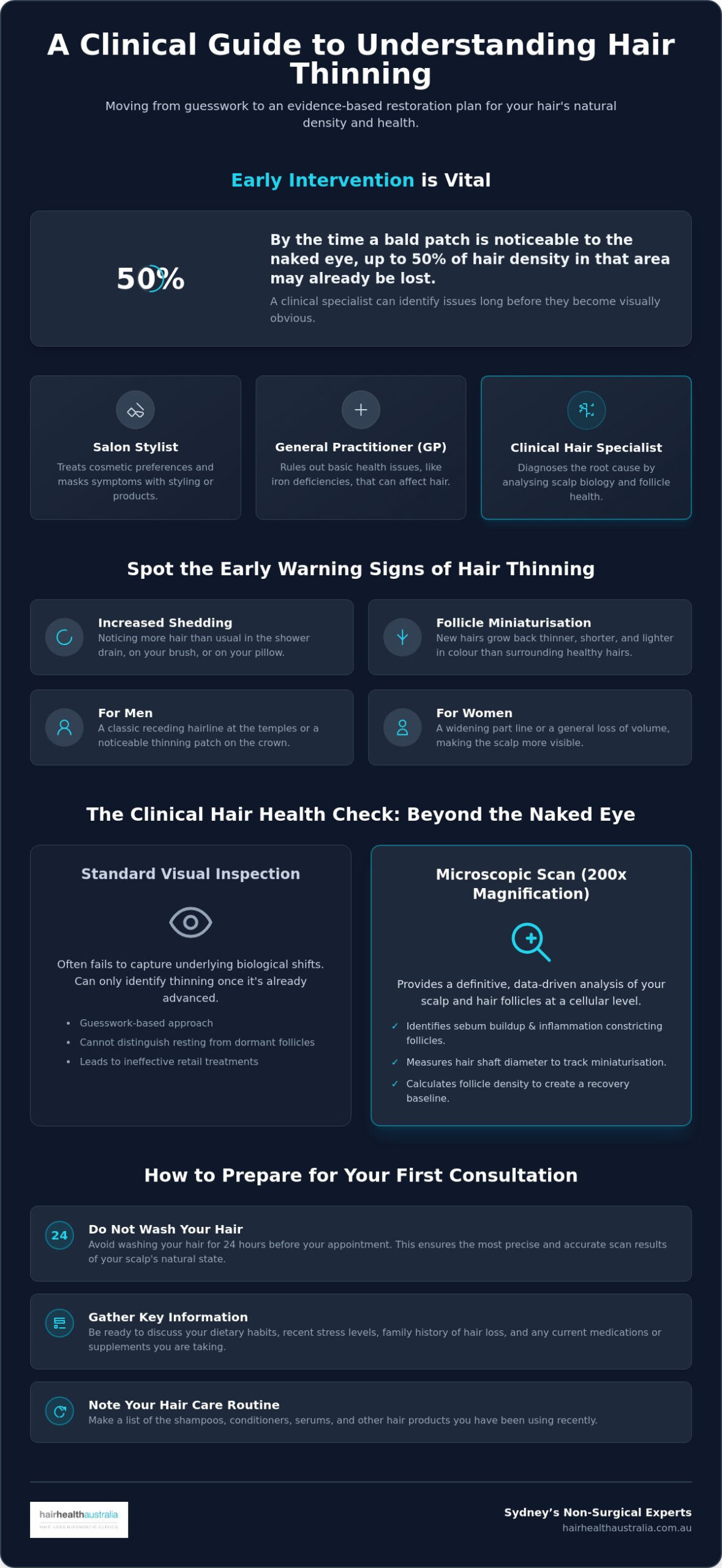
The term “hair doctor” is often used to describe any professional who treats thinning, but in a clinical setting, it refers to specialists who understand the intricate biology of the scalp and follicles. While a general practitioner (GP) can rule out basic iron deficiencies and a dermatologist treats complex skin diseases, a clinical hair specialist focuses specifically on the life cycle of the hair itself. A hair specialist is a professional who diagnoses the root cause of thinning through evidence-based analysis. Many people wait until they see a visible bald patch before seeking help, but this is a significant mistake for long-term recovery. By the time a patch is noticeable to the naked eye, you may have already lost up to 50% of the hair density in that specific area, making early intervention vital.

Trichologist vs. Dermatologist: Understanding the Roles

Trichologists focus on the clinical aspects of hair health, such as nutrition, lifestyle, and the physical state of the scalp. They are experts in identifying the various stages of a comprehensive overview of hair loss and how environmental factors in Sydney, like intense UV exposure, affect follicle health. Conversely, a dermatologist is a medical doctor who specialises in skin diseases and is necessary for treating autoimmune-related alopecia or scarring conditions. These professionals often collaborate to provide a comprehensive restoration plan. A clinical specialist might manage your non-surgical regrowth programme while a dermatologist handles specific medical prescriptions, ensuring every angle of your scalp health is covered.

The Red Flags: Symptoms That Require Professional Analysis

One of the most subtle signs of trouble is the “miniaturisation” process. This occurs when the hair follicle physically shrinks, producing a strand that is thinner, shorter, and lighter in colour than the surrounding hair. Over time, these follicles stop producing visible hair altogether. If you notice more hair in the shower drain than usual or find excessive strands on your pillow, your body is providing an early warning sign of telogen effluvium or early-stage pattern thinning.

For men, a receding hairline at the temples or a thinning crown is a classic indicator of genetic loss. Women typically experience a widening part line or a general loss of volume that makes the scalp more visible under bright lights. Identifying these shifts early through a professional Hair Health Check allows for a much more effective, non-invasive response before the follicles become permanently dormant. A hair doctor can determine if your shedding is a temporary reaction to stress or the beginning of a progressive condition that requires a structured restoration plan.

The Clinical Hair Health Check: Beyond the Naked Eye

A standard visual inspection by a GP or a hair stylist often fails to capture the underlying biological shifts occurring beneath the scalp’s surface. While they might notice general thinning, they cannot determine whether a follicle is simply resting or has reached a state of permanent dormancy. This is where a clinical hair doctor utilises advanced diagnostic tools to provide a definitive answer. By moving beyond what is visible to the naked eye, we can identify the specific symptoms and causes of hair loss that are unique to your physiology. Relying on guesswork often leads to wasted time on ineffective retail products, whereas cellular-level data allows us to build a customised treatment programme from day one.

Microscopic Scanning: What We See Under 200x Magnification

Using specialised microscopic scanning technology at 200x magnification allows us to observe the scalp environment in vivid detail. We frequently identify significant sebum buildup or chronic scalp inflammation that physically constricts the follicle, effectively suffocating healthy growth. This high-resolution view also lets us measure the hair shaft diameter across different zones of the head to track the precise progression of miniaturisation. Follicle density is calculated by counting the number of active hairs within a specific square centimetre, providing a mathematical baseline for your recovery. This level of detail ensures that your hair doctor isn’t just guessing about your progress but is instead tracking real, measurable improvements in hair health and density.

Environmental Factors in Sydney: UV and Scalp Health

Living in Sydney presents unique challenges for hair maintenance that are often overlooked in generic treatment plans. The intense Australian UV levels can lead to significant oxidative stress, which damages the protein structure of the hair and inflames the delicate scalp skin. Additionally, the specific mineral content in local water and our high coastal humidity levels often affect the hair cuticle’s integrity, making strands more prone to breakage and thinning. Sydney residents require specific scalp protection protocols within their regrowth plan to counteract these local environmental stressors. Understanding these external impacts is a core part of a professional Hair Health Check, ensuring your restoration path is grounded in the reality of the Australian climate. If you’ve noticed your hair feels different after a summer outdoors, a clinical assessment can help determine if environmental damage is accelerating your thinning.

Non-Surgical Restoration vs. Hair Transplant Surgery

Deciding between clinical restoration and surgical intervention is a pivotal moment for anyone facing thinning. While Follicular Unit Extraction (FUE) is a popular surgical method, it requires significant downtime and a substantial financial commitment. Surgical procedures often involve weeks of healing and potential scarring, whereas non-surgical clinical programmes offer zero downtime, allowing you to maintain your daily routine in Sydney without interruption. It’s essential to understand that surgery is fundamentally a relocation of hair follicles, not a cure for the biological triggers of loss. A hair doctor focuses on the underlying health of your scalp to ensure your follicles remain productive for years to come.

Cost-effectiveness is another major factor. Surgery carries a high upfront price tag, yet it does nothing to stop the progression of thinning in the surrounding areas. By choosing a non-surgical hair loss clinic in Sydney, you invest in a long-term strategy that preserves your existing natural hair while stimulating new growth at a fraction of the surgical cost. This proactive approach is often the most sustainable path for those in the early to mid-stages of thinning, where the goal is to stop loss before it requires more drastic measures.

How Non-Surgical Clinical Programmes Work

Our clinical protocols focus on revitalising the scalp environment to support healthy hair production. We utilise follicle stimulants designed to “wake up” dormant hairs that have entered a premature resting phase. These are combined with clinical-grade topicals that effectively block Dihydrotestosterone (DHT) at the scalp level, which is a primary driver of genetic thinning. This medical treatment for hair loss is further supported by nutritional guidance and strict scalp hygiene. We view the scalp as “fertile soil”; by removing sebum buildup and providing essential micronutrients, we create the optimal conditions for follicles to thrive naturally.

The Limitations of Surgery

Surgery is not a universal solution. It relies entirely on a healthy “donor area” at the back of the head. If your thinning is extensive, you may lack sufficient follicles to achieve a dense, natural look. There is also the distinct risk of a “patchy” appearance if your natural hair continues to thin around the transplanted grafts. This is why a hair doctor will often recommend clinical therapy even after a transplant. Without addressing the root biological cause, the newly moved hair may eventually stand alone as the surrounding original hair disappears. Maintaining the health of your scalp remains the most effective way to protect your appearance and ensure a seamless, high-density result.

Hair Doctor: A Clinical Guide to Hair Loss Specialists in Sydney

Preparing for Your First Hair Specialist Consultation

Your initial appointment with a hair doctor is a comprehensive data-gathering mission designed to uncover the specific biological triggers behind your thinning. To get the most out of this session, you should arrive prepared to discuss your medical history in detail. This includes your dietary habits, recent stress levels, and family history of hair loss. It’s also vital to bring an organised list of any current medications or supplements you’re taking, as many common prescriptions can inadvertently influence the hair growth cycle. Unlike a standard medical check-up, this consultation focuses on connecting your internal health with the external physical state of your follicles.

The diagnostic process typically begins with a clinical intake before moving into a specialised microscopic analysis. One of the most important preparation steps is to avoid washing your hair for at least 24 hours prior to your scan. This allows your natural sebum levels and scalp environment to remain undisturbed, providing a more accurate baseline for the specialist to examine. If the scalp is too clean, we may miss subtle signs of inflammation or oil imbalances that are contributing to your loss. Once you’re in the clinic, the journey moves from a verbal history to a high-resolution microscopic scan, where we can observe the health of your scalp in real-time.

Questions to Ask Your Specialist

During your consultation, you should feel empowered to ask technical questions to gain clarity on your condition. Ask where you currently sit on the Norwood scale for men or the Ludwig scale for women, as this helps establish a clinical baseline. You should also ask if your follicles are merely dormant or if they have become permanently scarred, which determines the potential for regrowth. Finally, ask for a realistic timeline on when you can expect to see measurable changes in hair density. A transparent hair doctor will provide objective answers based on your specific diagnostic data rather than making vague promises.

Managing Expectations: The Reality of Hair Growth

Understanding the biological hair cycle is essential for maintaining your commitment to a restoration plan. Hair moves through three distinct phases: Anagen (growth), Catagen (transition), and Telogen (resting). Because of these natural cycles, most clinical results take between 3 to 6 months to become visible to the naked eye. Consistency in your clinical programme is the most significant factor for long-term success. It’s important to remember that “stabilisation,” where we stop the active shedding, is the first major win before any significant regrowth occurs. If you’re ready to move beyond guesswork and secure a clinical diagnosis, you can book a professional Hair Health Check to begin your restoration journey.

Hair Health Australia: Sydney’s Non-Surgical Experts

Choosing a clinic for restoration should feel like a medical consultation, not a retail transaction. Hair Health Australia has established itself as Sydney’s centre for non-surgical excellence, specialising in evidence-based protocols since 2009. If you’re looking for a hair doctor who prioritises long-term scalp health, much like how Bright Sight Eye Specialists prioritises ocular health, our team provides the clinical environment you need. We move away from the one-size-fits-all approach common in the industry, instead focusing on the unique biological markers identified during your initial assessment.

Our commitment to “straight-talking” honesty is the foundation of our patient relationships. We don’t use hyperbolic marketing or make promises that the biology cannot support. Instead, we provide realistic expectations based on the current state of your follicles and your specific hair loss type. This transparency builds a narrative of trust, ensuring you feel fully informed and confident in your restoration journey without the fear of invasive procedures.

Our Clinical Philosophy: Science Over Surgery

Our clinical philosophy focuses on the existing follicle network. We aim to revitalise and protect the hair you still have while stimulating dormant follicles to return to the growth phase. By using advanced diagnostic technology, we track your progress with mathematical precision, adjusting your programme as your scalp health improves. For a deeper look at the latest clinical standards, you may wish to review our Best Hair Regrowth Treatment Australia 2026 reference guide. This methodical approach ensures that every step we take is backed by data and tailored to the Australian climate.

Take the First Step Toward Recovery

Early intervention is the single most effective tool for both men and women facing thinning. The sooner a professional hair doctor can assess your scalp, the higher the likelihood of successfully stabilising loss and regrowing density. You can read more about our specific methodologies in our guide on Clinical Hair Treatment. When you’re ready to stop the guesswork and start a structured path to recovery, the first step is to book your Hair Health Check at our Sydney clinic. We’re here to act as your dedicated guide, replacing anxiety with a clear, scientific plan for your hair’s future.

Secure a Scientific Path to Regrowth

Restoring your hair density doesn’t have to involve the uncertainty of retail products or the invasive nature of surgery. By consulting a specialised hair doctor, you transition from guesswork to a structured clinical programme grounded in cellular data. We’ve explored how advanced microscopic scanning identifies the root cause of thinning and why non-surgical protocols offer a sustainable, zero-downtime alternative for Sydney residents. Early intervention remains the most powerful tool in your possession; it ensures that your follicles are protected before they reach a stage of permanent dormancy.

Our team at Hair Health Australia provides specialist care for men and women, utilising clinically-backed non-surgical protocols that have been refined since 2009. We invite you to move beyond temporary fixes and embrace a personalised restoration plan tailored to your unique biology and the local environment. Book your comprehensive Hair Health Check in Sydney today to receive a clear diagnosis and a professional roadmap for your recovery. You don’t have to face thinning alone. With the right clinical guidance and advanced diagnostic technology, you can regain both your hair density and your confidence.

Frequently Asked Questions

Is a hair doctor the same as a trichologist?

While the terms are often used interchangeably by the public, a trichologist is a specialist specifically trained in the science of the hair and scalp. A hair doctor can refer to a trichologist or a medical practitioner who has chosen to specialise in hair loss disorders. Trichologists focus on the biological health of the follicle and provide non-surgical restoration paths, whereas medical doctors may also handle surgical referrals or systemic health issues.

Can a hair doctor help with a receding hairline?

Yes, a specialist can identify whether a receding hairline is the result of genetic pattern thinning or a temporary reaction to environmental stressors. By using microscopic analysis, we can determine if the follicles along the hairline are still active or have begun the miniaturisation process. Once the cause is identified, a clinical plan can be implemented to stabilise the hairline and encourage new growth in the affected areas.

How much does a consultation with a hair specialist cost in Sydney?

Consultation fees in Sydney vary depending on the clinic and the complexity of the diagnostic tools used. Some medical centres may have an initial gap fee of approximately $50 for general appointments, while dedicated hair clinics typically have their own set rates for comprehensive microscopic scans and health checks. It is best to contact your chosen clinic directly to confirm their current pricing for a professional assessment.

Does Medicare cover hair loss consultations or treatments?

Medicare generally does not provide coverage for hair loss treatments as they are typically classified as cosmetic procedures. You may be able to claim a portion of the consultation fee if you see a GP or dermatologist for an underlying medical condition causing the loss. However, specialised non-surgical restoration programmes and diagnostic scans are almost always out-of-pocket expenses for the patient.

Can a hair doctor prescribe medication for hair regrowth?

Prescription capabilities depend on the specific qualifications of the professional you consult. A medical practitioner specialising in hair loss can provide prescriptions for TGA-approved medications. Clinical trichologists focus on high-strength, non-prescription topicals, nutritional support, and scalp hygiene protocols. Many patients achieve excellent results through these non-invasive methods, which focus on creating the optimal environment for natural regrowth without the need for systemic drugs.

How long does it take to see results after seeing a specialist?

It typically takes between 3 to 6 months to see measurable changes in hair density and coverage. This timeframe is necessary because of the natural biological hair growth cycle, which cannot be rushed. The first sign of success in a clinical programme is usually a significant reduction in active shedding, followed by the gradual appearance of finer new hairs as dormant follicles are revitalised.

Is hair loss treatment permanent or do I need to continue it?

Most treatments for progressive conditions, such as genetic thinning, require ongoing maintenance to preserve the results. If the underlying biological trigger for the loss remains, the follicles may eventually return to a thinning state if the treatment is stopped entirely. A hair doctor will work with you to transition from an intensive restoration phase to a sustainable long-term maintenance plan that fits your lifestyle.

What is the most successful non-surgical hair loss treatment?

The most successful treatment is always the one tailored to your specific diagnosis. Research shows that combination therapies involving topical medications and follicle stimulants have a proven 83% success rate in retaining existing hair. At our Sydney clinic, we find that a personalised approach combining microscopic scalp clearing with targeted follicle stimulation provides the most consistent and visible results for both men and women.