Advanced Hair Analysis in Sydney: What a Detailed Hair Health Check Can Reveal

If thinning has you wondering what’s changing, a quick visual check may not answer every question. An advanced hair analysis Sydney assessment can help organise observations about your hair and scalp, giving you a clearer basis for discussing next steps. The most useful outcome is not simply a label, but a better understanding of what you’ve noticed and what may be suitable for you.

It’s understandable to want certainty about the cause or progression of hair loss. An assessment can help frame your concerns, but it can’t establish every underlying cause on its own. The methods used also vary, so “advanced hair analysis” doesn’t mean the same assessment everywhere.

This guide explains what a detailed hair health check may consider, what its findings can and can’t establish, and how those observations can inform realistic next steps. You’ll also learn how to prepare for a Sydney assessment and how Hair Health Australia’s personalised, non-surgical hair-loss care for men and women can fit into a discussion about treatment.

Key Takeaways

  • An advanced hair analysis Sydney assessment can organise observations about hair and scalp concerns, but it can’t establish every underlying cause on its own.
  • Hair density, the distribution of thinning and scalp condition may be considered where relevant.
  • A visual check can be a useful starting point; a more structured assessment may add context, depending on what it involves.
  • Make your assessment more useful by noting when changes began, which areas are affected and what you want to understand.
  • Use the findings to discuss realistic, individualised next steps for hair health and non-surgical care.

What advanced hair analysis in Sydney can, and cannot, tell you

Unexplained thinning can feel unsettling, particularly when you’re unsure whether it’s changing or what might be contributing to it. A structured hair health assessment can help organise what you’re noticing and give you a clearer basis for discussing next steps. It should not be treated as a promise of a definitive answer or a particular result.

“Advanced hair analysis” isn’t a standardised term. Depending on the service, it may describe a structured assessment of hair and scalp concerns rather than one specific test. The useful focus is to consider observations alongside your concerns and personal history, then discuss what the information may mean for individualised care.

What is assessed during a detailed hair health check?

A hair health check may take account of when you first noticed a change, which areas seem affected and whether the pattern has shifted. Visible hair patterns and scalp condition can also be considered where relevant. These details help frame a conversation about hair density and scalp health, rather than treating one observation as the whole picture.

Context matters. Describing how long you’ve noticed a change and whether it has been gradual or more noticeable over time can help explain what concerns you. Trichology refers to the scientific study of the hair and scalp, but an assessment still needs to interpret observations in light of your circumstances. The specific elements of a check can vary.

Why analysis is not a guaranteed diagnosis

Hair changes can have more than one contributing factor. A scan, photograph or visible pattern may offer useful information, but an isolated finding can’t establish every cause. Some concerns may require broader clinical interpretation, so it’s important to distinguish what an assessment observes from what it can conclude.

A hair analysis can help clarify what to discuss next; it can’t guarantee certainty about the cause or the outcome of care.

That distinction is practical, not a reason to dismiss the assessment. Findings can guide a considered conversation about suitable options, including personalised, non-surgical hair-loss care for men and women. They don’t guarantee that a particular approach will work or that your hair will change in a specific way. Hair Health Australia’s hair health check provides a starting point for discussing your concerns and possible next steps.

How advanced hair analysis examines hair and scalp concerns

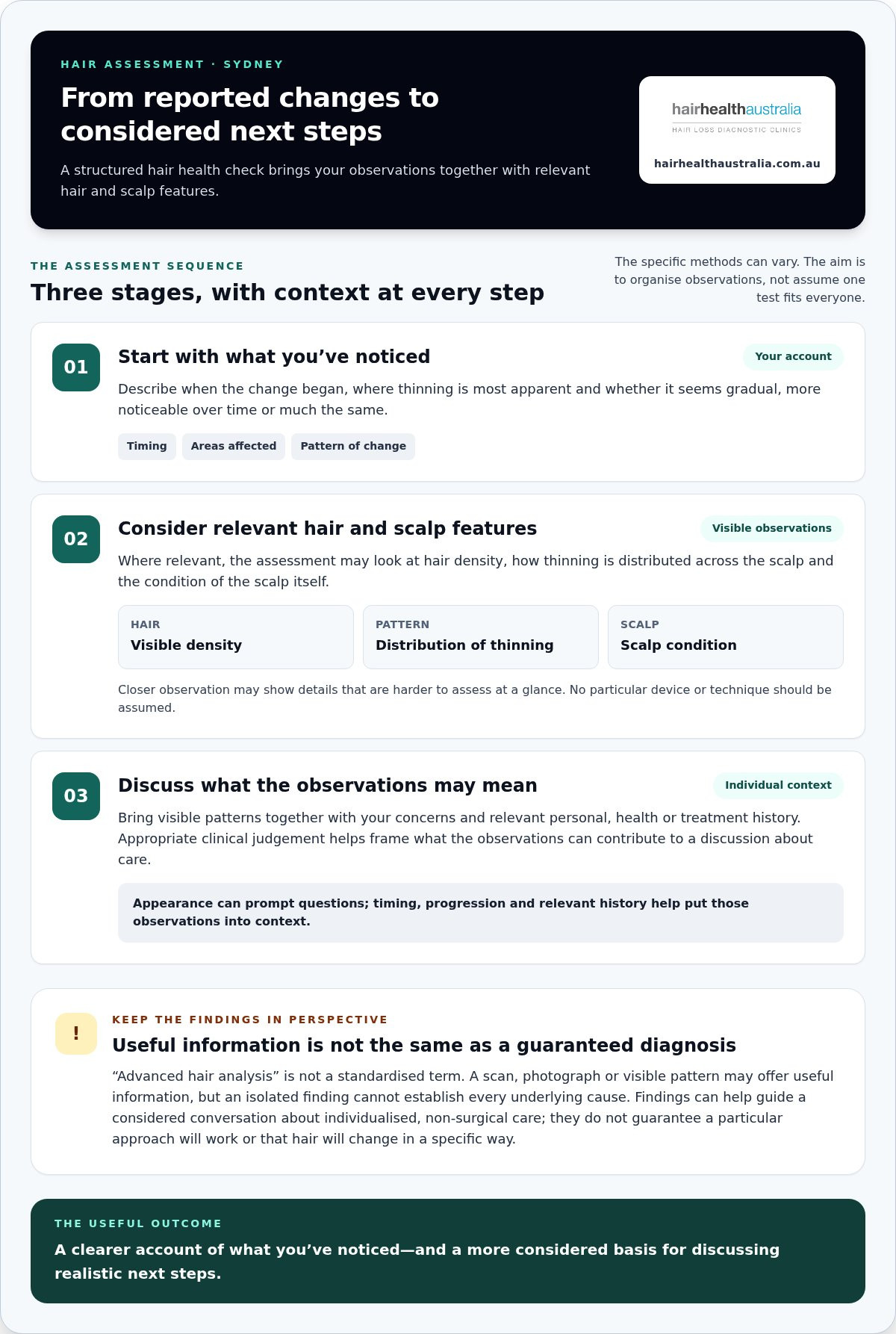
A useful assessment follows a clear sequence: first, understand what you’ve noticed; next, consider relevant features of your hair and scalp; then discuss what the observations may mean for your next steps. The aim is not to apply a one-size-fits-all checklist. Suitable assessment methods depend on your concerns and circumstances, so don’t assume every advanced hair analysis Sydney appointment uses the same tools or measures.

Where relevant, the discussion may consider hair density, how changes are distributed across the scalp and the condition of the scalp itself. These are areas to explore, not conclusions on their own. Bringing your concerns and observations together helps make any discussion of care more individualised.

From reported changes to visible patterns

Start with what you’ve noticed: when the change began, where thinning is most apparent and whether it seems to have progressed or stayed similar. For instance, you might describe a change around the part or a difference in density across a particular area. Pattern and duration give observations context, but they don’t diagnose the cause. Relevant health or treatment history may also be considered as part of a broader conversation.

What closer observation may add

Looking more closely at the hair and scalp may reveal details that are harder to assess at a glance, such as differences in visible density or scalp condition. The method used depends on the individual assessment, so no particular device or technique should be assumed. Any closer observation still needs to be interpreted alongside your reported history and appropriate clinical judgement.

Context makes hair observations more useful than appearance alone. A visible pattern can prompt questions, while your account of timing, progression and relevant history helps frame them. Together, these details can support a considered discussion rather than a conclusion based on one feature.

The final step is to talk through what was observed and what it may mean for your concerns. This can shape a discussion about personalised, non-surgical hair-loss care, with realistic expectations rather than an assumed outcome. Hair Health Australia’s hair health check is a practical starting point for discussing your concerns in a structured way.

Visual inspection versus advanced hair analysis: what is the difference?

A visual check and a more structured hair assessment serve related but distinct purposes. Looking at the hair and scalp can help identify visible patterns; a detailed assessment may organise those observations alongside your concerns and relevant history. Neither approach is automatically right or wrong. The useful question is what information each can contribute and how it’s interpreted.

Aspect Visual inspection More structured assessment
Purpose Notice visible features and broad patterns. Consider observations in a more organised way alongside reported concerns.
Information gathered Visible hair distribution, apparent thinning and scalp changes. Relevant visible features, with personal history and concerns providing context.
Strengths Offers a straightforward starting point and can help identify areas to discuss. May add detail and provide a clearer basis for discussing possible next steps.
Limitations Some details may be harder to see, and appearance alone doesn’t explain every change. More detail still needs interpretation; it can’t guarantee a diagnosis or treatment response.

When a visual check may be useful

Visual inspection can reveal broad patterns, such as where thinning appears most noticeable or whether there are visible scalp changes. What’s readily seen may vary with lighting, hairstyle and hair length. That doesn’t make a visual check inadequate or inaccurate; it means the view has limits. If your concerns aren’t fully explained by what’s visible, additional context may help guide the discussion.

What a more detailed assessment can contribute

A structured check can bring relevant observations together and establish a clearer starting point for a conversation about your hair and scalp. The approach should suit the individual, and the term “advanced hair analysis Sydney” doesn’t guarantee that every clinic uses the same methods. Additional detail can support a more informed discussion, but it doesn’t establish a cause by itself or predict how treatment will work.

Technology can support an assessment, but it doesn’t replace clinical interpretation. A device or image may make certain features easier to observe, yet findings still need to be considered alongside what you’ve noticed and other relevant context. More equipment isn’t automatically more certainty. The value lies in how observations are interpreted and used to inform realistic, individualised next steps.
Advanced Hair Analysis in Sydney: What a Detailed Hair Health Check Can Reveal

How to prepare for a Sydney hair analysis and use the findings

A little preparation can make an advanced hair analysis Sydney appointment more useful. You don’t need to diagnose the issue or arrive with a detailed theory. A clear account of what you’ve noticed helps keep the conversation focused on your concerns and the information that may guide suitable next steps.

What to note before your appointment

Before your visit, jot down a few details to refer to during the discussion:

  • Timeline: when you first noticed a change and whether it seems to have progressed, eased or stayed much the same.
  • Areas affected: where thinning or other changes are most noticeable, and whether you’ve observed changes elsewhere.
  • Relevant circumstances: any recent health or treatment changes you think may be useful context.
  • Your questions: what you’d most like to understand, such as what was observed or what options may be appropriate.

These notes are prompts, not a self-diagnosis. Follow any appointment-specific preparation instructions provided by the clinic. Otherwise, there’s no need to assume you need special products or a particular routine beforehand.

Turning assessment findings into next steps

After the assessment, aim to understand what was observed, what those observations may suggest and where their limits are. If any part of the explanation is unclear, ask for it to be put in plain language. Knowing what an assessment can and can’t establish helps you weigh the information without treating one finding as a complete answer.

Findings may provide a starting point for discussing individual options, including personalised, non-surgical hair-loss care where appropriate. The right conversation should reflect your concerns and circumstances, not assume that everyone needs treatment. It should also set realistic expectations: an assessment can inform a plan, but it can’t promise regrowth or a particular outcome.

When considering care options, look for a clear connection between the observations and the proposed non-surgical treatment. Hair Health Australia’s hair health check can help start a tailored discussion about your hair concerns.

Book an advanced hair analysis in Sydney with a personalised care focus

A hair health check is most useful when it turns concerns into an informed conversation about what may be appropriate for you. Hair Health Australia provides personalised, non-surgical hair-loss care for men and women, with a focus on hair density and scalp health. The assessment can help frame that discussion while keeping expectations realistic.

What a personalised hair health check supports

Hair concerns can look different from one person to another. The changes you’ve noticed, where they appear and what matters most to you all help shape a considered discussion. A hair health check provides an opportunity to talk through your hair and scalp concerns and consider possible next steps in light of your individual needs.

Where suitable, that discussion may include Hair Health Australia’s clinically backed, non-surgical hair-loss programmes. An assessment doesn’t mean everyone needs treatment, and it can’t promise a particular result. Its value is in helping you understand the observations, ask questions and consider options with clearer expectations. When comparing non-surgical care options, focus on how each relates to your concerns and what a realistic plan involves.

Take the next step in Sydney

An advanced hair analysis Sydney appointment can be a practical step if you want a clearer picture of what you’ve noticed and a more informed basis for deciding what to do next. The aim is guidance that reflects your concerns, not pressure to choose treatment or an assurance of results. Use the discussion to understand what was observed, what it may mean and which options, if any, are worth considering.

If you’re ready to talk through your hair concerns, book a hair health check with Hair Health Australia. It’s a practical first step towards a more individual view of your hair health.

Take a clearer next step for your hair health

A detailed hair health check can bring your concerns into focus, but observations need context and don’t guarantee a diagnosis or a particular result. The value of advanced hair analysis Sydney is in using relevant findings to support a considered conversation about what may be suitable for you.

Hair Health Australia provides personalised, non-surgical hair-loss programmes for men and women, using clinically backed methods with a focus on hair density and scalp health. A hair health check is a practical starting point to discuss what you’ve noticed and explore possible next steps with realistic expectations. Not everyone needs the same approach, and care should reflect individual concerns.

Ready to discuss your hair concerns? Book your Hair Health Check with Hair Health Australia in Sydney.

Frequently Asked Questions

What is advanced hair analysis?

Advanced hair analysis is a structured way to assess hair and scalp concerns. In Sydney, the exact methods can differ between clinics, but an assessment may consider what changes you’ve noticed, visible hair patterns and scalp condition. It can help organise observations and support a discussion about suitable next steps. It isn’t one standard test, and its findings alone may not establish every cause of hair loss.

Is advanced hair analysis more accurate than a visual inspection?

Not automatically. A visual inspection can be a useful starting point for noticing visible thinning, distribution or scalp changes. A more structured assessment may add detail or consider observations alongside your concerns and history. However, more detail doesn’t guarantee a more certain diagnosis. The value depends on the assessment and how its findings are interpreted, rather than simply whether equipment is used.

What happens during a hair analysis appointment in Sydney?

A hair analysis appointment generally involves discussing your concerns and considering relevant features of your hair and scalp. You may be asked when changes began and where they’re most noticeable. The assessment approach varies, so don’t assume every Sydney clinic uses the same tools or measurements. Findings can then inform a conversation about what they may mean and what next steps could be appropriate.

Can hair analysis identify the cause of hair loss?

Hair analysis can provide observations that help inform a discussion, but it can’t necessarily identify the cause on its own. Hair changes may have several contributing factors, and a visible pattern or isolated finding isn’t a definitive diagnosis. Relevant personal history and appropriate clinical interpretation matter. If the assessment can’t explain your concerns, further clinical evaluation may be needed to understand them.

How should I prepare for a hair health check?

Prepare by noting when you first noticed changes, which areas are affected and whether you think they’ve progressed. Write down any relevant recent circumstances and the questions you’d like answered. You don’t need to diagnose yourself or use special products unless the clinic gives specific instructions. These notes can help you explain your concerns clearly and make the discussion more useful.

Does advanced hair analysis guarantee hair regrowth?

No. An assessment can help clarify observations and inform a discussion about possible care, but it can’t guarantee regrowth or predict a particular treatment response. Options should be considered in light of your individual concerns and realistic expectations. Hair Health Australia provides personalised, non-surgical hair-loss programmes for men and women, with clinically backed care focused on hair density and scalp health.

Who should consider a hair analysis in Sydney?

A hair analysis may be worth considering if you’re noticing thinning, changes in hair distribution or scalp concerns and want a clearer basis for discussing them. It can also help if you’re unsure what information to bring to a conversation about hair-loss care. For Sydney residents, a hair health check can support an individualised discussion without assuming that everyone needs treatment.
Hair Regrowth Clinic: Finding the Right Specialist in Australia

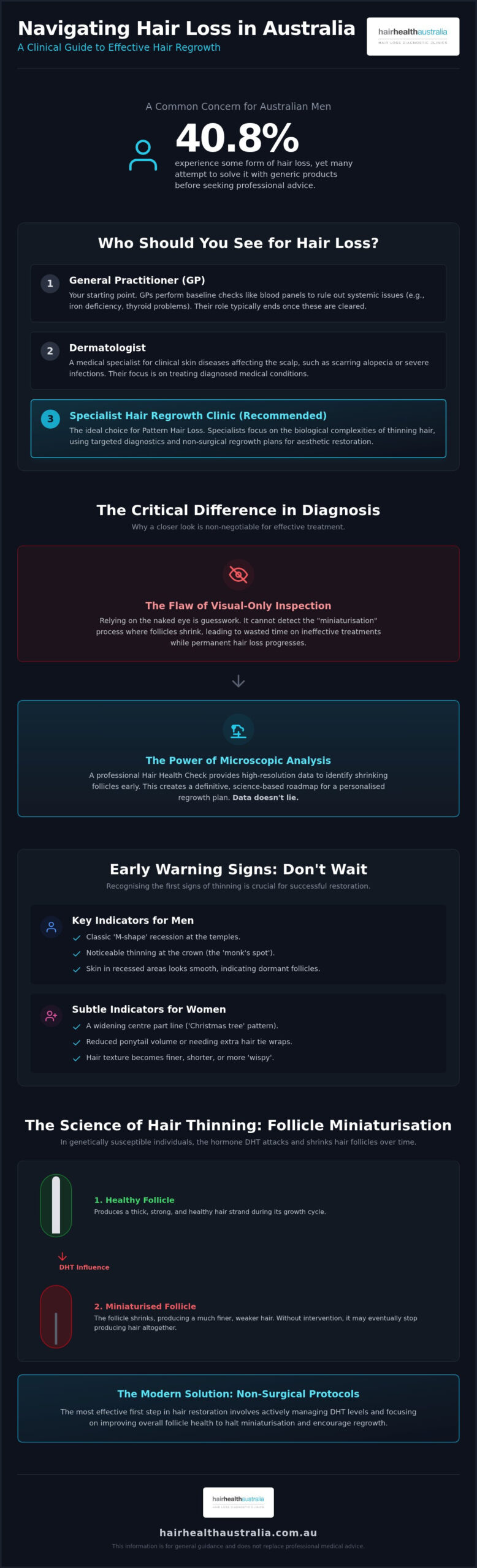
Approximately 40.8% of Australian men experience some form of hair loss, yet many spend years attempting to solve the issue with generic pharmacy foams before ever stepping into a professional hair regrowth clinic. It’s understandable to feel frustrated when you’ve invested significant time and money into over-the-counter products only to see more of your scalp in the mirror each morning. You might even worry that your thinning is permanent or that a costly, invasive transplant is your only remaining path.

Finding the right specialist shouldn’t feel like a gamble. We believe in straight-talking honesty regarding what’s possible for your hair and scalp health. This article will help you evaluate the Australian healthcare landscape to find a provider who prioritises a precise clinical diagnosis over surgical shortcuts. You’ll learn how microscopic analysis provides the data needed for a personalised, non-invasive regrowth plan, ensuring you receive professional guidance tailored to your specific hair loss type.

Key Takeaways

  • Understand the distinction between general practitioners and specialised trichologists or dermatologists when seeking professional medical guidance for hair loss.
  • Recognise early warning signs, such as excessive shedding or a widening part line, to ensure you seek a clinical diagnosis while follicles are still viable.
  • Discover how microscopic hair analysis provides a definitive, data-driven roadmap by identifying miniaturised follicles before they are lost permanently.
  • Identify a reputable hair regrowth clinic by prioritising Australian-based specialists who offer comprehensive diagnostic scans as the foundation of their care.
  • Learn why modern, non-surgical protocols focusing on follicle health and DHT management are often the most effective first step in hair restoration.

What is a Hair Doctor and Who Should You See?

Searching for a hair loss specialist in Australia often leads to a confusing mix of results. You’ll find GPs, dermatologists, and trichologists, each offering a different perspective on your scalp health. Understanding where you fit in this hierarchy is the first step toward effective restoration. You need to know whether your issue requires a medical script for a disease or a clinical plan for regrowth.

The GP, the Dermatologist, and the Trichologist

Your journey usually begins with your local GP. They perform vital baseline checks, such as blood panels to rule out iron deficiencies or thyroid dysfunction. However, once systemic medical issues are cleared, a GP’s role often ends. This is where a specialised hair regrowth clinic steps in. While a dermatologist treats clinical skin diseases like scarring alopecia or scalp infections, a specialist clinic focuses on the aesthetic and biological complexities of Pattern hair loss.

These facilities provide more targeted regrowth equipment and consistent monitoring than a general practice, which may only offer a quick prescription or generic advice. Matching your goals to the right level of professional care ensures you don’t waste time on treatments that aren’t suited to your specific condition. If your concern is primarily about volume, receding hairlines, and thinning rather than a medical rash, a clinical specialist is your best partner.

Why Visual Inspection Often Leads to Misdiagnosis

Relying on a standard visual inspection is a common mistake in early-stage hair loss management. A specialist simply looking at your scalp under standard office lights cannot see the “miniaturisation” process occurring beneath the surface. This process involves the gradual shrinking of follicles, which is the hallmark of genetic thinning. Without clinical data, it’s difficult to differentiate between temporary stress-induced shedding and permanent follicle decline.

Starting a treatment plan without a confirmed microscopic diagnosis often leads to wasted money and significant emotional frustration. This is why a comprehensive Hair Health Check is essential. It provides the high-resolution data needed to create a plan based on science rather than guesswork. Data doesn’t lie. Follicles don’t disappear overnight, but they do require early detection through specialised technology to remain viable. It’s about seeing what the naked eye misses before the hair is gone for good.

When to Organise a Professional Hair Consultation

Hair loss rarely happens overnight. It’s usually a gradual process that many Australians ignore until the scalp becomes visible under bright lights. Recognising the shift from normal daily shedding to active thinning is crucial for successful restoration. If you notice more hair than usual in the shower drain or scattered across your pillowcase, your follicles may be entering a premature resting phase. While losing 50 to 100 strands a day is typical, seeing consistent clumps indicates it’s time to visit a hair regrowth clinic for a professional assessment.

Beyond shedding, pay close attention to changes in hair texture. When strands become finer, shorter, or take on a “wispy” appearance, it’s a sign of miniaturisation. This occurs when the hair follicle shrinks, producing a weaker hair with each growth cycle. A receding hairline that has moved significantly from its original position or a widening part line are also definitive markers that the underlying biology of your scalp has changed. Early intervention is the most effective way to maintain your current density.

Early Warning Signs for Men

For men, the most common indicator is the classic “M-shape” recession at the temples, often accompanied by thinning at the crown, known as the “monk’s spot.” As of 2026 clinical standards, Dihydrotestosterone (DHT) is recognised as the primary androgen responsible for the progressive miniaturisation of hair follicles in genetically susceptible individuals. It’s important to distinguish between a “maturing” hairline, which is a natural adult shift, and active recession that continues to move backward. If the skin in the recessed areas looks smooth and shiny, the follicles may already be dormant.

Subtle Indicators for Women

Women often experience a different progression, frequently described as the “Christmas tree” pattern. This involves a widening of the centre part line that is most prominent at the front of the scalp. You might also notice a significant reduction in the volume or “swing” of your ponytail, or find that you need to wrap your hair tie an extra time to keep it secure. While many women experience temporary shedding after pregnancy, a hair regrowth clinic can help determine if this has transitioned into permanent Patterned hair loss. Organising a specialised hair health check can provide the clinical clarity needed to stop this progression before it becomes more difficult to manage.

The Clinical Edge: Microscopic Hair Analysis

Visual guesswork is replaced by clinical precision when you visit a specialised hair regrowth clinic. While a standard consultation might rely on what is visible to the naked eye, microscopic hair analysis allows us to look deeper into the biological state of your scalp. This technology is the cornerstone of effective non-surgical treatment. It identifies miniaturised follicles long before they disappear entirely. By measuring follicle density in specific regions, we can predict the future progression of your hair loss with accuracy.

Establishing this baseline is the primary objective of a “Hair Health Check”. It moves the conversation away from vague concerns toward specific clinical metrics. Data replaces doubt. You can book a microscopic hair analysis to find your answer and begin a targeted recovery journey based on your unique scalp profile.

What Happens During a Professional Scalp Scan?

During a diagnostic session, we use high-magnification cameras to view the scalp at 50x to 200x zoom. This level of detail reveals issues that are invisible during a standard haircut or GP visit. We look for sebum blockages that can stifle growth, signs of scalp inflammation, and irregular follicle spacing. A critical part of this process involves comparing the “permanent zone” at the back of the head with the thinning areas. This zone is genetically resistant to pattern loss. This comparison provides a clear picture of your regrowth potential. Follicles don’t lie.

Using Data to Personalise Your Regrowth Plan

Generic pharmacy solutions often fail the individual. They adopt a one-size-fits-all approach to a highly complex biological problem. Your scalp chemistry and follicle health are unique. Your treatment protocol must be equally specific. By using digital tracking, your hair doctor can provide objective proof that regrowth is occurring. We measure the increase in hair diameter and follicle activity over time. There is significant psychological reassurance in seeing your active follicles on a screen. It transforms an uncertain process into a methodical, clinical progression where every step is verified.

Hair Regrowth Clinic: Finding the Right Specialist in Australia

Non-Surgical Paths to Hair Restoration

Recent years have seen a significant shift in Australian clinics toward non-surgical restoration protocols. While invasive surgery was once considered the primary answer for advanced thinning, many now prefer evidence-based clinical programs that avoid the risks and downtime of a surgical suite. These modern pathways focus on the two main drivers of follicle health: blocking Dihydrotestosterone (DHT) and stimulating local blood flow. By using a combination of targeted topical and oral therapies, a professional hair regrowth clinic can stabilise thinning and encourage new growth in areas where follicles remain active.

Maintaining a healthy scalp environment is the foundation of sustainable results. It’s not just about the hair itself; it’s about the biological “soil” the hair grows in. Clinical-grade low-level laser therapy (LLLT) plays a vital role here by using specific wavelengths of light to energise follicles at a cellular level. This process, known as photobiomodulation, increases ATP production, effectively “waking up” dormant follicles and extending the growth phase of the hair cycle. When combined with professional-grade scalp cleansers, this approach ensures that new growth isn’t stifled by sebum blockages or inflammation.

Clinically-Backed Regrowth Programs

Successful restoration rarely comes from a single miracle product found on a pharmacy shelf. Multi-therapy approaches consistently outperform single-product treatments because they address hair loss from multiple biological angles simultaneously. In Australia, it’s essential to look for programs that utilise TGA-listed ingredients and adhere to strict clinical standards. For a detailed look at the current landscape, you can refer to the Best Hair Regrowth Treatment Australia 2026. This clinical reference guide outlines why a structured, professional approach is superior to generic alternatives.

Managing Realistic Expectations for Growth

Patience is a requirement for any clinical restoration journey. Hair regrowth is a marathon, not a sprint. You should expect a 4 to 6 month window before visible changes in density occur. This timeline aligns with the natural biological cycles of your hair follicles. During the initial phase, the priority is often stabilising your current hair loss to prevent further thinning. Once the environment is optimised, the focus shifts to regrowing lost density through consistent treatment. Follicles must be alive to be revived via clinical means. If you’re ready to see what’s possible for your hair, the first step is to book a clinical diagnostic scan to assess your follicle viability.

Choosing a Hair Regrowth Clinic in Sydney

Selecting a provider in a competitive market like Sydney requires a discerning eye. You’ll find many options, but the right hair regrowth clinic should offer more than just products; it should offer a history of clinical success. Look for a clinic with a long-standing Australian reputation. Hair Health Australia, for instance, has been operating in the Sydney CBD since 2009. This longevity reflects a commitment to evidence-based care and consistent results within the local community. Longevity matters. It proves the clinic has successfully guided thousands of patients through the complexities of hair restoration.

Prioritise specialists who insist on a comprehensive diagnostic scan as the absolute first step. A clinic that suggests treatment before viewing your follicles at a microscopic level is relying on guesswork. If your goal is to avoid invasive surgery, ensure the facility specialises specifically in non-surgical restoration. This focus ensures their expertise is dedicated to the latest topical, oral, and light-based therapies rather than surgical turnover. To help you evaluate your options, check the Essential Checklist for Sydney Clinics.

The Hair Health Australia Approach

Our commitment to personalised, science-led restoration is at the core of our Sydney centre. We don’t believe in one-size-fits-all packages. Instead, we use our specialised microscopic diagnostic technology to build a program around your specific hair loss type. Our non-invasive programs are designed for both men and women, focusing on follicle revival without the need for surgical intervention. Our straight-talking clinical team is here to help you understand your recovery options clearly. We provide realistic expectations based on your data, not hyperbolic marketing claims. It’s a partnership focused on your long-term scalp health.

Your Next Steps to Recovery

Preparing for your first consultation is simple. Think about when you first noticed the thinning and what products you’ve already tried. You should ask your specialist about the specific zoom levels used in their scans and how they track your progress over time. Taking action while your follicles are still active is the most important factor in your success. Once a follicle has completely miniaturised and the scalp becomes smooth, non-surgical options are no longer viable. Don’t wait until the damage is permanent. You can Book your Hair Health Check in Sydney today to secure the future of your hair.

Secure the Future of Your Hair Health

Identifying the underlying cause of thinning is the most critical step in your restoration journey. By moving beyond generic pharmacy products and seeking a specialised hair regrowth clinic, you replace uncertainty with clinical data. We’ve explored how microscopic analysis identifies miniaturised follicles while they’re still viable, allowing for a personalised, non-surgical plan that avoids the risks of invasive surgery.

Since 2009, our Sydney CBD centre has utilised advanced microscopic diagnostic technology to provide straight-talking honesty to both men and women. We focus on evidence-based protocols that prioritise follicle health and long-term density. If you’re ready to stop the guesswork and start a science-led recovery, now is the time to act. You can Book Your Microscopic Hair Health Check in Sydney today and gain the clarity you need to move forward with confidence. You don’t have to navigate hair loss alone; professional guidance is available to help you maintain the hair you have and stimulate the growth you want.

Frequently Asked Questions

Is a hair doctor the same as a dermatologist in Australia?

No, they are distinct professions within the Australian health landscape. A dermatologist is a medical specialist who treats clinical diseases of the skin and scalp. In contrast, a specialist at a hair regrowth clinic focuses on the biology of non-scarring hair loss and thinning. While a dermatologist might treat a medical rash, a clinical hair specialist uses advanced tools to measure miniaturisation and design non-invasive restoration programs for both men and women.

Do I need a referral from my GP to see a hair loss specialist?

You don’t typically need a GP referral to visit a private specialist clinic in Australia. While seeing your local GP is a sensible first step to rule out systemic health issues like iron deficiency through blood tests, you can book a diagnostic scan directly with a specialist. This direct access allows you to begin a targeted analysis of your scalp health without the long waiting periods often associated with public dermatological referrals.

How much does a hair loss consultation typically cost in Sydney?

Consultation costs in Sydney vary based on the clinic’s location and the diagnostic technology included in the session. While some general practices may offer a basic visual check, a specialised hair regrowth clinic in the Sydney CBD typically provides a more in-depth assessment involving high-resolution microscopic analysis. It’s best to contact a reputable provider directly to confirm their current fees. This initial investment ensures you receive a data-driven roadmap tailored to your specific follicle health.

Can a hair doctor help with female pattern thinning?

Yes, specialised clinics offer dedicated programs designed specifically for female pattern thinning. This condition is biologically distinct from male hair loss and often presents as a widening part line or a reduction in hair volume. A specialist will use microscopic tools to measure the degree of miniaturisation and identify follicle spacing issues. They then create a non-invasive plan that addresses the specific hormonal and nutritional requirements necessary for healthy female hair regrowth.

What happens if my hair follicles have already died?

If a hair follicle has completely miniaturised and the scalp has become smooth and shiny, non-surgical revival is no longer possible. Clinical treatments rely on the presence of a viable, living follicle to stimulate growth. This is why early intervention is so critical for success. A professional diagnostic scan can determine which follicles are still active and which have reached a dormant state, ensuring you don’t waste time on ineffective treatments.

Are the treatments prescribed by a hair clinic permanent?

Most clinical treatments for genetic hair loss require ongoing maintenance to sustain your results. Because the underlying cause of pattern thinning is often genetic, stopping treatment will eventually lead to the follicles returning to their previous state of decline. Think of it as a long-term health routine for your scalp. Your specialist will help you develop a sustainable, non-invasive plan that maintains your hair density and fits easily into your daily lifestyle.

How long does it take to see results from a clinical regrowth program?

You should expect to see visible results from a clinical program within four to six months of consistent treatment. This timeline is dictated by the natural biological growth cycles of your hair follicles. Initially, the program focuses on stabilising shedding and improving the scalp environment. Over time, you’ll notice finer hairs becoming thicker and more pigmented. Progress is tracked through digital microscopic scans to provide objective proof of recovery during your journey.

Can a hair doctor help me avoid hair transplant surgery?

Many patients seek professional clinical guidance specifically to avoid invasive surgery. By using advanced microscopic analysis to identify thinning in its early stages, a specialist can often restore significant density through non-surgical means. If your follicles are still viable, a structured clinical program can produce impressive results, potentially removing the need for a transplant entirely. It’s about using science to maximise your natural hair potential while you still have the chance.

National Hair Institute Reviews Sydney: A Guide to Choosing Your Hair Loss Clinic

A five-star rating on a screen doesn’t always translate to a full head of hair in the mirror. You’ve likely spent hours scrolling through national hair institute reviews Sydney, feeling a mix of hope and deep scepticism about the glossy transformations promised in marketing brochures. It’s perfectly natural to feel overwhelmed by the volume of conflicting information and the significant financial commitment involved in hair restoration. Replacing uncertainty with evidence-based clarity is the first step toward genuine restoration.

This guide provides the framework to cut through the noise with clinical precision, showing you how to distinguish between marketing hype and genuine patient outcomes. We’ll explore the critical differences between surgical and non-surgical pathways, provide a framework for evaluating Sydney clinic standards, and help you determine which treatment level matches your specific stage of thinning. By the end, you’ll have the clarity needed to choose a path that prioritises your scalp health and long-term density over quick fixes.

Key Takeaways

  • Decode the clinical substance behind national hair institute reviews Sydney by identifying specific mentions of thorough diagnostic procedures and realistic recovery timelines.
  • Distinguish between the invasive nature of hair transplant surgery and the restorative benefits of non-surgical regrowth programmes designed to sustain your natural density.
  • Learn why a specialised microscopic hair analysis is the non-negotiable first step in identifying whether your follicles are currently dormant or beyond restoration.
  • Use our clinical framework to evaluate Sydney clinics based on their diagnostic technology and their commitment to providing personalised, evidence-based treatment plans.

Understanding the National Hair Institute (NHI) and the Sydney Hair Loss Market

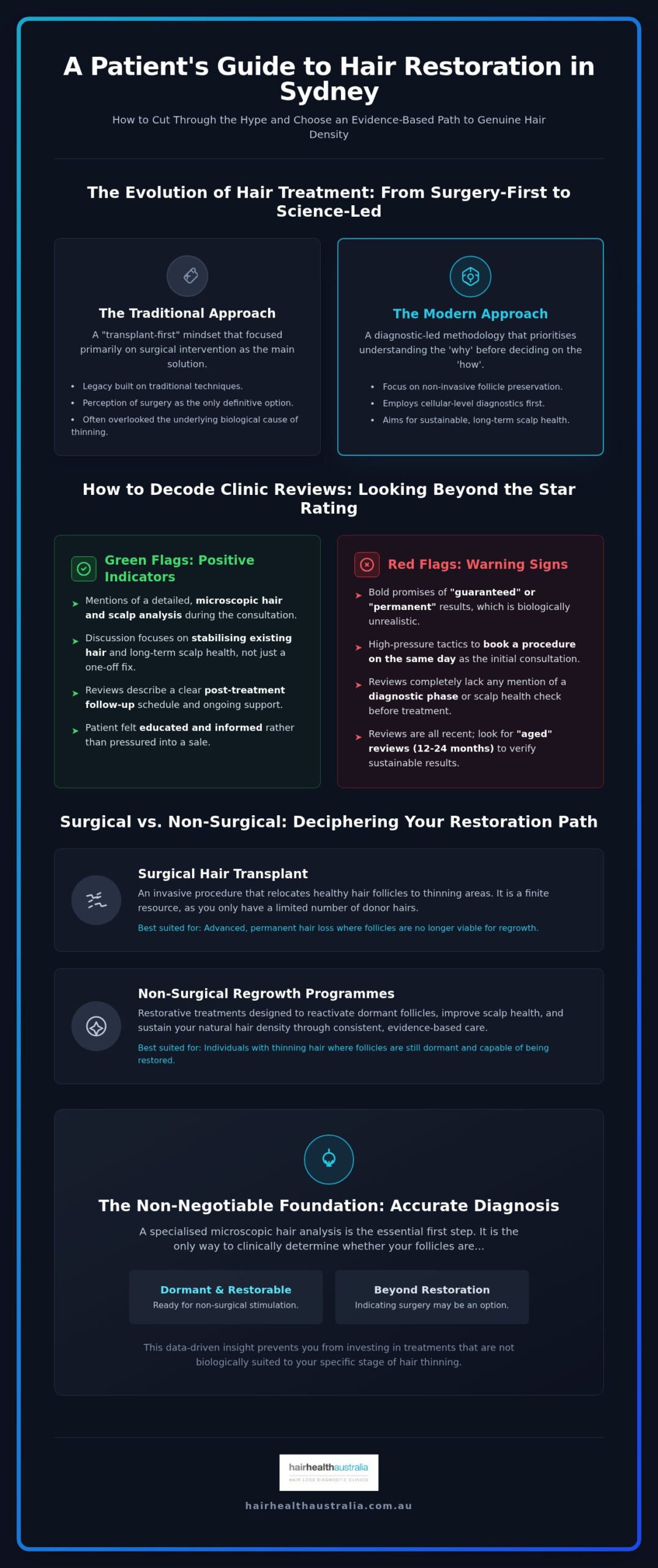
The Sydney hair loss market is one of the most established in the Southern Hemisphere. For decades, the focus remained squarely on surgical interventions, but the conversation is changing. Patients now prioritise understanding the biological “why” behind their thinning before committing to the “how” of restoration. Reading national hair institute reviews Sydney is a logical starting point, but it requires a discerning eye to understand how the market has evolved from a “transplant-first” mindset to a more diagnostic-led approach.

The National Hair Institute, particularly its presence in Edgecliff, has been a fixture in this landscape for over 30 years. Led by Dr Barry White, whose background spans pharmacy and medicine, the clinic helped pioneer the surgical restoration model in Australia. When you look at national hair institute reviews Sydney, you are seeing a legacy built on traditional hair transplant techniques. However, a long history doesn’t always account for the modern shift toward non-invasive follicle preservation and cellular-level diagnostics.

The Legacy of Hair Restoration in Sydney

The Australasian Society of Hair Restoration Surgery has historically set the benchmark for surgical excellence in Australia. While these standards are vital for those with advanced permanent loss, they’ve also created a perception that surgery is the only definitive solution. Modern patients are starting to realise that surgery is a finite resource. Longevity in the industry is valuable, but it must be balanced with the adoption of advanced diagnostic technology. This technology identifies whether surgery is actually necessary or if non-surgical follicle stimulation is a more sustainable path for your specific stage of thinning.

Why Edgecliff and the CBD are Hubs for Hair Health

Sydney’s Eastern Suburbs and the CBD have become the epicentre for specialised hair care. This concentration of expertise means patients expect high consultation standards and easy accessibility. Proximity is particularly important for those undertaking long-term clinical programmes. Unlike a one-off surgery, non-surgical restoration requires consistent monitoring and adjustments based on how your scalp responds to treatment. Starting with a Hair Health Check in these central hubs ensures you’re making a choice based on clinical data rather than persuasive marketing claims.

How to Evaluate National Hair Institute Reviews in Sydney

Star ratings are a surface-level metric. A 4.5-star rating tells you very little about the clinical methodology or the patient’s biological compatibility with the treatment. When reading national hair institute reviews Sydney, you need to look for specific markers of clinical honesty. Does the reviewer mention a comprehensive scalp analysis? Did the specialist manage their expectations regarding the limitations of a transplant? These details are far more valuable than a generic comment about the clinic’s decor or staff friendliness.

Identifying the substance behind the feedback requires a methodical approach. You aren’t just looking for success stories; you’re looking for evidence of a systematic clinical process. Focus on these indicators:

  • Green Flags: Mentions of microscopic hair analysis, discussions on stabilising existing hair, and detailed post-treatment follow-up schedules.
  • Red Flags: Promises of “guaranteed” results, pressure to book a procedure on the day of consultation, or reviews that lack any mention of a diagnostic phase.

Hair restoration is a slow biological process. Results seen at three months are often temporary or misleading. Look for “aged” reviews where patients provide updates at the 12 to 24-month mark. This is the only way to verify if the density achieved is sustainable or if the underlying cause of thinning was properly addressed.

A 5-Step Framework for Reading Clinic Reviews

To get the most out of your research, follow this structured approach to filter out marketing noise:

  1. Diagnostic Detail: Search for mentions of “microscopic scans” or “follicle health checks.” If these aren’t mentioned, the clinic might be skipping the most vital step.
  2. The Education Factor: Did the patient feel like they were in a medical consultation or a sales pitch? Genuine clinics prioritise patient education over closing a deal.
  3. Maintenance Focus: Sustainable results require more than a one-off procedure. Look for reviews that discuss long-term scalp health and follicle stimulation programmes.
  4. Specialist Consistency: Check if the review names the specific practitioner who performed the work.
  5. Recovery Realism: Genuine reviews often mention the patience required during the regrowth cycle.

Authenticity Check: Sydney Forums vs. Directory Sites

Directory sites often feature curated testimonials that lean toward marketing. In contrast, independent forums like the Hair Restoration Network offer a more “straight-talking” environment. Here, Sydney residents share unfiltered photos and long-term progress logs. These discussions are invaluable for seeing how a clinic handles complications or less-than-perfect results. Always prioritise reviewers whose hair loss pattern matches your own. Before committing to a surgical path based on national hair institute reviews Sydney, it’s safer to undergo a professional Hair Health Check to verify your actual restoration potential.

Surgical vs. Non-Surgical: Deciphering Your Restoration Path

Deciding between surgical intervention and a clinical regrowth programme is a pivotal moment in your restoration journey. While national hair institute reviews Sydney often highlight the visual impact of hair transplants, surgery is not a universal solution for every stage of thinning. The fundamental difference lies in the unit of restoration: surgical models focus on moving “grafts” from one area to another, whereas non-surgical clinical programmes focus on revitalising the “follicle” itself. This distinction is critical because once a donor site is depleted through surgery, it cannot be replaced.

Assessing your position on the Norwood Scale is essential for determining the most logical and cost-effective entry point. For those experiencing early-stage thinning (Norwood 1 to 3), non-surgical restoration is frequently the more biologically sound choice. Surgery at this stage can be a high-cost gamble, especially when you consider the hidden factors such as post-operative downtime, potential donor site scarring, and the finite nature of your donor hair supply. If you exhaust your donor hair too early, you’ll have no resources left to address future recession.

When is a Hair Transplant Appropriate?

Surgery is a viable option for those with advanced, stable hair loss and high donor density. However, patients must be wary of hyperbolic claims regarding massive graft counts in a single session. A successful transplant relies on the survival rate of the grafts, not just the quantity moved. Without a clinical maintenance plan to manage the surrounding native hair, many patients experience “island” balding. This occurs when the transplanted patch remains while the natural hair around it continues to recede, creating an unnatural and disjointed appearance that often requires further corrective surgery.

The Power of Non-Surgical Clinical Regrowth

Modern clinical programmes provide a non-invasive alternative that stimulates dormant follicles without the need for anaesthetic or surgical recovery. These programmes utilise clinical-grade topicals and DHT blockers to halt the miniaturisation process that causes hair to thin and eventually disappear. By focusing on scalp health and follicle stimulation, these methods serve as the essential “first line of defence.” Before committing to the permanence of surgery based on national hair institute reviews Sydney, a professional Hair Health Check can determine if your follicles are still viable for non-surgical restoration, potentially saving you from invasive procedures.

National Hair Institute Reviews Sydney: A Guide to Choosing Your Hair Loss Clinic

Key Questions to Ask During Your Sydney Hair Loss Consultation

Entering a consultation in Edgecliff or the Sydney CBD requires more than just hope. It requires a script of clinical questions to test the practitioner’s expertise. While national hair institute reviews Sydney might provide a general sense of satisfaction, they don’t replace the need for a rigorous personal assessment. You should arrive prepared to challenge the specialist on their diagnostic methodology and their long-term vision for your hair health.

One of the most critical questions involves the 5-year outlook. Ask the specialist: “What happens to my hair in five years if I do nothing?” A genuine expert will provide a realistic projection based on your current rate of miniaturisation and family history. They should also be transparent about the commitment required. Regrowth is a biological process, not an overnight event. If a clinic promises rapid results without discussing a 6 to 12-month commitment, it’s a significant red flag. You need a partner who values long-term density over a quick sale.

Diagnostic Standards: Microscopic vs. Visual Inspection

A simple visual inspection is insufficient for an accurate diagnosis. By the time hair loss is visible to the naked eye, you’ve likely already lost up to 50% of your hair density in that area. This is why you must demand data-driven proof. Professional microscopic hair analysis identifies follicle miniaturisation long before it becomes obvious. It allows the specialist to see the ratio of terminal hairs to vellus hairs, providing a clear picture of your restoration potential. Don’t commit to a programme until you’ve seen these scans for yourself.

Comparing Treatment Protocols in Sydney

Not all treatment plans are created equal. You need to know if you’re receiving a generic pharmaceutical solution or a personalised protocol tailored to your scalp’s specific needs. Ask about the clinic’s policy on follow-up scans and progress tracking. A clinical approach should include regular microscopic reviews every few months to ensure the treatment is stimulating the follicles as intended. You should also enquire about the clinic’s focus on scalp health and nutrition. A holistic approach ensures the environment for growth is as healthy as the follicles themselves. Before you rely solely on national hair institute reviews Sydney to make your decision, book a comprehensive Hair Health Check to get the data you need for an informed choice.

Why a Personalised Clinical Approach is the Smartest Choice

The process of research often starts with national hair institute reviews Sydney, but it must eventually lead to a definitive clinical decision. Choosing a path that focuses on sustainable, non-surgical regrowth is often the most prudent strategy for long-term hair health. While surgery addresses the symptoms of hair loss by moving existing follicles, a clinical approach treats the biological environment of the scalp. This ensures that the hair you still have remains healthy and that dormant follicles are given every opportunity to recover. It’s a strategy rooted in preservation rather than just relocation.

At Hair Health Australia, our clinical standards provide a deeply reassuring alternative to invasive surgical procedures. We prioritise microscopic evidence over anecdotal reviews, ensuring every patient receives a plan tailored to their specific hair cycle. This systematic approach replaces the one-size-fits-all mentality of many surgical clinics with a methodical, data-driven journey. It’s about moving beyond the uncertainty found in online forums and partnering with a trusted Australian specialist who understands the nuances of local clinical standards. By focusing on follicle stimulation, you’re investing in the health of your entire scalp rather than just a specific patch of grafts.

Restoring Confidence Without the Scalpel

There are significant emotional and physical advantages to choosing a non-invasive restoration path. You avoid the risks associated with anaesthetic, the physical trauma of donor site scarring, and the lengthy post-operative recovery periods. Instead, personalised clinical programmes adapt to your specific hair health journey, allowing for adjustments as your scalp environment improves. To ensure you’re making the right choice, it’s vital to understand the non-surgical hair loss clinic Sydney standards that define a high-quality provider. These standards ensure your treatment is grounded in science rather than sales targets.

Next Steps: Booking Your Sydney Hair Health Check

Your first visit to a clinical specialist should be an educational experience rather than a sales presentation. During a comprehensive Hair Health Check, you’ll see your scalp under high-magnification microscopic analysis. This diagnostic data is the only way to determine if your follicles are still active or if they’ve become permanently inactive. Addressing thinning early is essential; once a follicle has fully miniaturised and scarred over, non-surgical restoration is no longer an option. Now is the time to transition from passive research to active preservation. Book your clinical hair assessment at Hair Health Australia today to secure the future of your natural density and gain the clarity you need to move forward with confidence.

Securing Your Hair Health with Clinical Certainty

Deciding on a hair restoration path is a significant step that requires moving beyond the subjective nature of national hair institute reviews Sydney. While reviews offer a glimpse into others’ experiences, your biological needs remain unique. Real restoration starts with understanding the current state of your follicles and identifying whether they are dormant or permanently inactive. This transition from passive research to clinical diagnosis is where uncertainty ends and a clear strategy begins.

With over 15 years of clinical expertise in Sydney, our team focuses on providing non-surgical, evidence-based regrowth protocols that prioritise your long-term density. By utilising specialised microscopic diagnostic technology, we replace guesswork with verifiable data. This ensures you only invest in treatments that are biologically viable for your specific stage of thinning. Take the first step toward genuine clarity. Book Your Comprehensive Sydney Hair Health Check today and discover a restoration path built on clinical precision rather than marketing hype. Your journey to restored confidence is a partnership grounded in science and realistic expectations.

Frequently Asked Questions

Are the National Hair Institute reviews in Sydney generally reliable?

Online feedback offers a window into patient satisfaction and clinic atmosphere, but it lacks clinical context. When reading national hair institute reviews Sydney, it’s essential to distinguish between a patient’s personal journey and the biological success of a treatment. Reviews are often written during the initial recovery phase or shortly after surgery. For a truly reliable assessment, look for long-term updates that track density maintenance over 18 to 24 months.

What is the average cost of hair loss treatment in Sydney clinics?

Costs vary significantly based on the technology and duration of the programme. Surgical procedures generally require a higher upfront investment compared to non-surgical clinical programmes. However, the total cost depends on the stage of thinning and the level of follicle stimulation required. It’s best to check with individual providers for their specific fee structures rather than relying on broad industry averages which don’t reflect your personalised needs.

Can I regrow hair without having a hair transplant surgery?

Yes, regrowth is frequently possible without invasive surgery provided your hair follicles haven’t become permanently inactive. Non-surgical clinical programmes focus on stimulating dormant follicles and improving scalp health to restore natural density. These methods are particularly effective for those in the earlier stages of thinning. Success depends on a precise diagnosis to ensure the treatment protocol matches your specific biological requirements and hair growth cycle.

What should I look for during a hair loss consultation in Edgecliff?

A professional consultation in Edgecliff should prioritise diagnostics over sales talk. You should expect a thorough examination that includes microscopic hair analysis rather than just a visual inspection. A reputable specialist will provide a realistic prognosis and explain the underlying causes of your thinning. They should also discuss long-term maintenance strategies to preserve your existing hair, ensuring the plan is tailored to your individual needs rather than a one-size-fits-all approach.

How long does it take to see results from a non-surgical hair programme?

Hair restoration is a biological process that follows the natural growth cycle. Most patients begin to notice stabilised loss and early signs of regrowth within four to six months of consistent treatment. Significant improvements in density and hair quality usually become visible at the 12-month mark. Patience is required because the follicles need time to move from the dormant phase back into the active growth phase through regular stimulation.

Is microscopic hair analysis necessary for a hair loss diagnosis?

Microscopic hair analysis is considered a clinical gold standard for an accurate diagnosis. It allows specialists to identify miniaturisation and follicle health that aren’t visible to the naked eye. By measuring the ratio of terminal hairs to vellus hairs, practitioners can determine your actual restoration potential. Without this data-driven approach, any treatment plan is based on guesswork, which can lead to poor results or unnecessary surgical interventions.

Does the National Hair Institute offer non-surgical options for women?

The National Hair Institute in Edgecliff has a long-standing reputation for surgical restoration. However, women seeking non-invasive treatments should verify if current protocols include follicle stimulation programmes. Many Sydney patients now opt for clinical regrowth plans that avoid the risks of surgery. At Hair Health Australia, we provide dedicated female hair loss treatments that focus on microscopic diagnosis and non-surgical restoration, ensuring a personalised approach to density and scalp health.

Why do some Sydney forum users advise against transplants for younger men?

Forum users often advise caution for younger men because hair loss is a progressive condition. Undergoing a transplant too early can lead to “island” balding if the surrounding native hair continues to recede. Since donor hair is a finite resource, using it prematurely can leave a patient with no options for future restoration. Many specialists recommend stabilising the loss through non-surgical clinical programmes before considering any permanent surgical intervention.

Non-Surgical Hair Replacement Australia: The 2026 Clinical Buying Guide

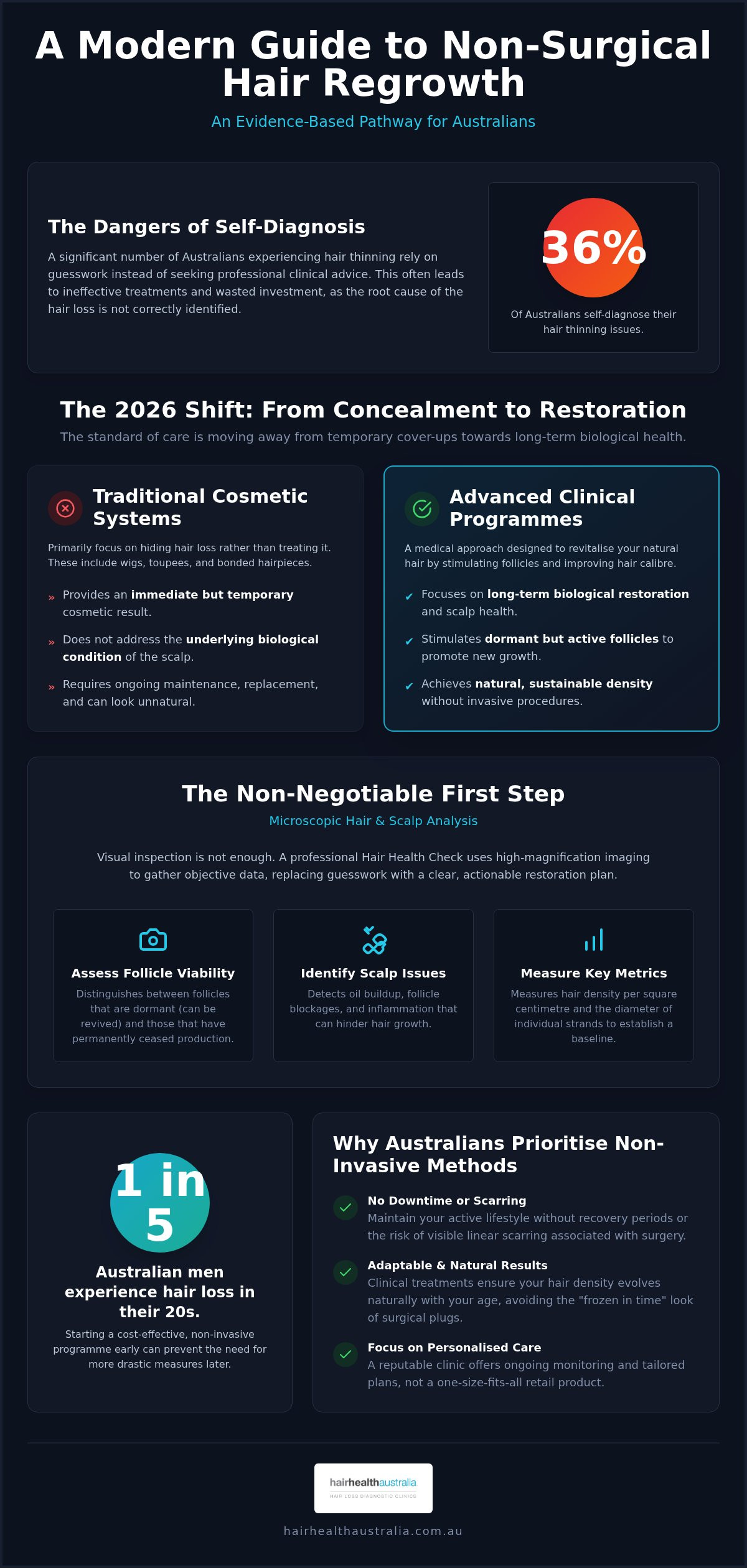
Did you know that nearly 36% of Australians experiencing hair thinning rely on self-diagnosis rather than seeking professional clinical advice? It’s a staggering figure that highlights just how much uncertainty surrounds the industry. If you’ve spent late nights staring at a receding hairline or a thinning crown, you aren’t alone. The search for non surgical hair regrowth australia often leads to a confusing crossroads between temporary cosmetic hairpieces and genuine clinical restoration. You deserve a solution that doesn’t just mask the problem but addresses the underlying biology of your scalp.

We understand the anxiety of losing your hair and the fear of ending up with an unnatural result. This guide provides a clear, evidence-based pathway to restoring your hair density using protocols specifically designed for the Australian climate and lifestyle. You’ll discover how advanced microscopic hair analysis and tailored clinical plans help you achieve natural results without the scarring or downtime of a transplant. We’ll walk you through the 2026 standards for follicle stimulation and the exact steps to reclaim your confidence through a structured, medical approach.

Key Takeaways

  • Learn why microscopic hair analysis is the essential first step to accurately identify active follicles and move beyond the limitations of visual self-diagnosis.
  • Understand the 2026 shift from traditional cosmetic hairpieces to advanced clinical protocols that prioritise biological restoration and long-term scalp health.
  • Discover how non surgical hair regrowth australia has evolved into a scientific discipline that focuses on achieving natural density without the need for invasive procedures.
  • Identify the critical criteria for selecting a Sydney-based specialist who offers ongoing clinical monitoring and personalised care rather than a one-size-fits-all retail approach.
  • Find out why a professional ‘Hair Health Check’ is the non-negotiable starting point for establishing realistic expectations and a clear pathway to hair restoration.

What is Non-Surgical Hair Replacement in Australia?

Non-surgical hair replacement in Australia is no longer just a euphemism for a toupee or a simple wig. By 2026, this field has matured into a sophisticated clinical discipline that balances immediate cosmetic needs with long-term biological restoration. It acts as a broad umbrella category, covering everything from high-end hair systems to medical-grade follicle stimulation. For many Australians, the goal has shifted from merely hiding a problem to actively restoring hair density through science-backed protocols.

Understanding the clinical management of hair loss is the first step toward making an informed decision about your scalp health. While traditional methods often focused on concealing the scalp with heavy, unnatural pieces, modern non surgical hair regrowth australia protocols prioritise the vitality of the hair follicle itself. This evolution reflects a growing demand for treatments that are sustainable, discreet, and grounded in verified diagnostic data. It is about moving beyond the “cover-up” and focusing on a systematic plan for hair health.

The Distinction Between Cosmetic and Clinical Solutions

The choice between cosmetic and clinical paths depends largely on the current stage of your thinning and your personal goals. Cosmetic systems involve external additions, such as high-grade lace pieces or bonded hair systems, which provide an immediate transformation. These are excellent for those with advanced loss who require an instant result, though they do not change the underlying biological condition of the scalp.

Clinical programmes focus on revitalising your natural hair. These non-invasive treatments are designed to stimulate dormant follicles and improve the calibre of existing hair strands. If your hair loss is in the early to mid-stages, clinical intervention is often the superior route because it maintains your biological hair. The most effective way to determine which path is right for you is through a professional Hair Health Check, which uses microscopic scanning to assess follicle viability.

Why Sydney Residents Prioritise Non-Invasive Methods

Sydney’s active, outdoor lifestyle makes traditional surgical options less appealing for many professionals. Surgery often involves significant downtime and the risk of visible linear scarring, which can be difficult to manage in a social or professional setting. Non-invasive methods allow you to maintain your daily routine without the need for bandages or recovery periods.

Clinical regrowth programmes also offer a more adaptable aesthetic. As you age, your hair naturally changes in colour and texture; clinical treatments ensure that your hair density evolves with you, avoiding the “frozen in time” look associated with surgical plugs. Given that 1 in 5 Australian men experience hair loss in their 20s, starting a non-invasive, cost-effective programme early can often prevent the need for more drastic measures later in life.

The Essential First Step: Microscopic Hair Analysis

Visual inspection of your hairline in the bathroom mirror is often the first sign of trouble, but it’s an insufficient basis for a professional diagnosis. While you might see thinning, a mirror cannot reveal the biological health of the follicle beneath the scalp surface. Successful non surgical hair regrowth australia begins with microscopic hair analysis. This diagnostic tool allows a specialist to distinguish between hair that is temporarily dormant and follicles that have permanently ceased production. Understanding this distinction is the difference between a successful restoration and a wasted investment.

The success of any restoration programme depends heavily on the environment of your scalp. Microscopic scanning identifies oil buildup, follicle blockages, or subtle inflammation that might be hindering your growth. By identifying the specific Patterned hair loss you are experiencing, we can tailor a clinical response that addresses the root cause rather than just the visible symptoms. This objective data replaces the anxiety of the unknown with a clear, actionable plan.

What Happens During a Professional Hair Health Check?

During this assessment, we use high-magnification imaging to inspect the hair shaft and the openings of the follicles. We measure hair density per square centimetre and the diameter of individual strands across different zones of the scalp. This level of detail is vital for tracking progress over time, as it reveals changes long before they are visible to the naked eye. If you are ready to move beyond guesswork and see what is actually happening at the root, you can book a comprehensive Hair Health Check in Sydney to gain total clarity on your situation.

Using Data to Predict Your Regrowth Potential

Diagnostic data is your best defence against investing in ineffective treatments. It allows us to identify follicle miniaturisation; a process where hair strands become progressively thinner, shorter, and less pigmented until the follicle eventually closes. If we catch this biological shift early, the process is frequently reversible through targeted clinical stimulation. Establishing a scientific baseline means we don’t have to guess if a treatment is working. We can compare high-resolution images from month one to month six to see real, measurable changes in hair calibre. This data-driven approach ensures your time and resources are focused solely on methods with the highest probability of success for your unique scalp profile. It provides the straight-talking honesty you need before starting any clinical journey.

Clinical Regrowth vs. Cosmetic Hair Systems

When searching for non surgical hair regrowth australia, many people are confronted with two vastly different paths. The first is biological restoration, which focuses on rehabilitating your existing follicles to grow thicker, healthier hair. The second involves cosmetic hair systems, which are high-quality external pieces bonded to the scalp. While both fall under the non-surgical umbrella, they offer different outcomes, maintenance requirements, and psychological impacts. Understanding which approach aligns with your lifestyle is a critical part of the clinical journey.

The primary difference lies in sustainability versus immediacy. A cosmetic system provides a full head of hair in a single afternoon, but it does not address the underlying biological causes of thinning. Conversely, clinical regrowth takes time but results in hair that is naturally yours. Choosing between these options requires a clear-eyed look at the stage of your hair loss and your long-term goals for scalp health.

Biological Restoration: Stimulating Your Own Follicles

Biological restoration is the preferred route for those in the early to mid-stages of thinning. These programmes typically involve a combination of follicle stimulants and DHT blockers to halt the miniaturisation process. According to established medical perspectives on Hair loss diagnosis and treatment, consistency is the foundation of success. It’s not a quick fix; you’ll generally need four to six months of disciplined treatment before visible changes in density occur.

The advantage of this path is that the results are completely natural and evolve with you. There are no bonds to manage or pieces to service. To determine if your follicles are still active enough for this approach, a professional Hair Health Check is necessary to map out your regrowth potential.

Cosmetic Systems: When to Consider a Hairpiece

If hair loss has progressed to the point where the follicles have permanently closed, cosmetic systems become a viable alternative. These modern systems use a fine membrane that mimics the appearance of the scalp, with individual hairs knotted into the base to create a realistic look. They are often bonded with medical-grade adhesives that allow you to swim, shower, and exercise with confidence. For those seeking premium quality, you can learn more about Premium Human Hair Extensions and Wigs to see how modern craftsmanship provides an immediate and natural-looking result.

However, no one should enter into a bonded system without understanding the maintenance. These pieces require professional re-servicing every four to six weeks as your natural hair grows underneath. There’s also a psychological adjustment to consider. While a piece provides immediate density, many Australians find that the long-term satisfaction of regrowing their own biological hair provides a deeper sense of confidence. If you still have viable follicles, prioritising your natural hair is almost always the more sustainable and cost-effective choice.

Selecting the right partner for your hair restoration journey is as critical as the treatment itself. In a market saturated with quick fixes and retail-heavy franchises, you must distinguish between a sales-driven environment and a clinical one. A professional clinic prioritises diagnostics over transactions. They won’t pressure you into a long-term contract during your first visit. Instead, they focus on establishing a clear, evidence-based baseline for your scalp health through objective testing.

When evaluating options for non surgical hair regrowth australia, look for transparency in their records. Authentic testimonials should reflect realistic timelines rather than overnight miracles. Be wary of any provider that promises identical success for every client; biology is individual and results vary. A reputable Sydney clinic will be honest about what can be achieved based on your specific level of follicle miniaturisation. This straight-talking approach builds the trust necessary for a long-term clinical relationship.

The Value of a Personalised Clinical Protocol

Generic, off-the-shelf products often fail because they ignore the unique variables of your scalp. A one-size-fits-all kit purchased online cannot account for your specific hormonal profile or scalp sensitivity. Clinical success requires a protocol that is adjusted as you progress. Your specialist should monitor how your skin and follicles react to stimulants, making precise calibrations to ensure both safety and efficacy. For a deeper look at what to verify before your first appointment, review our guide on Choosing a Non-Surgical Hair Loss Clinic in Sydney: The 2026 Essential Checklist.

Local Sydney Expertise and Environmental Factors

The Australian climate presents unique challenges for hair health. High UV levels and fluctuating humidity in Sydney can impact scalp hydration and the effectiveness of certain topical treatments. A local specialist understands these environmental stressors and ensures your programme complies with Australian health regulations and standards. Additionally, the convenience of a Sydney-based clinic allows for regular, face-to-face monitoring. This ongoing support is vital for maintaining the momentum of your programme and catching any issues before they stall your progress. Professional oversight ensures you aren’t just applying products, but following a systematic path to restoration.

If you are tired of generic advice and want a plan tailored to your specific needs, the best way forward is to speak with a professional. You can start your journey with a professional diagnostic assessment to see which clinical options are most suitable for your scalp profile.

Non-Surgical Hair Replacement Australia: The 2026 Clinical Buying Guide

The Hair Health Australia Approach to Non-Surgical Restoration

At Hair Health Australia, our methodology is built on the principle that effective restoration requires more than just a topical solution. It demands a systematic, evidence-based approach that prioritises the long-term health of your scalp. We don’t believe in one-size-fits-all packages or aggressive sales tactics. Instead, we act as your dedicated guide, providing a professional environment where medical authority meets empathetic understanding. Our goal is to replace the uncertainty of hair loss with the clarity of a proven clinical plan.

The foundation of our success is the straight-talking consultation. We take the time to explain the biological factors contributing to your thinning and set realistic expectations for your journey. By integrating advanced diagnostics with targeted follicle stimulation and comprehensive scalp care, we create a synergistic effect that maximises your results. This integrated protocol ensures that every action we take is informed by the specific data gathered during your initial assessment. We empower you through education, ensuring you understand the “why” behind every step of your non surgical hair regrowth australia programme.

Customised Treatment Programmes for Men and Women

Biology differs between the sexes, and so should the clinical response. While male hair loss is frequently driven by genetic predispositions, female thinning often involves a complex interplay of hormones, nutritional deficiencies, and stress. We tailor the strength and composition of our clinical treatments to address these specific drivers. For women, this means a nuanced approach that supports scalp vitality while accounting for systemic health factors. If you are seeking more detailed information on female-centric protocols, our Hair Loss Treatment for Women: The 2026 Australian Clinical Buying Guide provides a comprehensive breakdown of these specialised options.

Your Path to Confidence: What to Expect Next

Your journey begins with a transition from the diagnostic phase to your first active clinical session. This isn’t a process that happens overnight. We monitor your progress meticulously using microscopic imaging over a 6 to 12 month period. These regular check-ins allow us to verify that your follicles are responding as expected and to make any necessary adjustments to your protocol. Seeing the measurable increase in hair diameter and density on screen provides the reassurance you need to stay committed to the process.

Restoring your hair is a journey that requires patience, precision, and professional oversight. If you are ready to move away from temporary fixes and toward a permanent clinical solution, we are here to help. Take the first step toward restoration; enquire with our Sydney specialists today to book your diagnostic Hair Health Check and reclaim your confidence with a plan that actually works.

Reclaiming Your Confidence Through Clinical Restoration

Choosing the right path for your scalp health requires moving beyond temporary cosmetic fixes and embracing a scientific approach. By prioritising microscopic hair analysis, you ensure that every step of your journey is based on objective diagnostic data rather than guesswork. Whether you are dealing with early thinning or a receding hairline, the most effective results come from a personalised plan that addresses your unique biological needs. This is the cornerstone of modern non surgical hair regrowth australia; it’s about restoring what is naturally yours through disciplined, evidence-based care.

As Sydney leading non-surgical clinical specialists, we provide the precision diagnostics and ongoing support necessary to achieve sustainable density. Our personalised programmes for men and women are designed to work with your lifestyle while delivering natural results you can trust. Don’t let uncertainty delay your progress any longer. The first step toward a fuller head of hair is a professional assessment of your follicle viability. Book Your Clinical Hair Health Check in Sydney today to establish your baseline and begin your restoration journey. We are ready to help you rediscover your confidence with a plan grounded in clinical excellence.

Frequently Asked Questions

Is non-surgical hair replacement permanent?

Non-surgical solutions are not a one-time permanent fix like surgery, but they offer sustainable, long-term results through consistent care. Clinical regrowth programmes focus on maintaining the health of your existing follicles, which requires ongoing stimulation to prevent the return of miniaturisation. If you stop treatment, the biological factors driving hair loss may resume. For cosmetic systems, the hair itself is permanent, but the bond requires professional servicing every four to six weeks.

Can I swim and exercise with a non-surgical hair replacement system?

You can absolutely maintain an active lifestyle, including swimming and high-intensity exercise, with a modern hair replacement system. These units are secured using medical-grade adhesives that are resistant to water, sweat, and humidity. While you don’t need to restrict your movements, we recommend waiting 24 to 48 hours after a fresh bonding session before submerging your head in water. This ensures the adhesive has fully cured for maximum security during your Sydney coastal activities.

How much does non-surgical hair replacement cost in Australia?

The cost of non-surgical hair restoration in Australia varies based on the technology used and the extent of your thinning. Industry data from 2026 indicates that monthly treatment plans can start from approximately A$24, while more intensive growth factor therapies or high-end cosmetic systems involve higher initial investments. Since every scalp is unique, we recommend a diagnostic assessment to determine the most cost-effective clinical pathway for your specific stage of hair loss.

What is the difference between a hair system and a clinical regrowth programme?

A hair system is a cosmetic solution where a fine membrane of hair is bonded to your scalp for immediate density. In contrast, a clinical regrowth programme focuses on biological restoration, using stimulants to revitalise your natural follicles. While a system provides an instant transformation, non surgical hair regrowth australia protocols aim for a sustainable result that uses your own hair. The right choice depends on whether your follicles are still active or have permanently closed.

How long does it take to see results from a clinical hair restoration programme?

Patience is essential when undertaking a biological restoration journey. Most clients begin to see measurable changes in hair calibre and density within four to six months of consistent treatment. This timeline aligns with the natural growth cycle of the hair follicle. We use microscopic imaging during regular check-ins at our Sydney clinic to track these subtle improvements long before they are visible to the naked eye, ensuring your programme remains on the right track.

Will people be able to tell I have had a hair replacement treatment?

Modern clinical treatments and cosmetic systems are designed to be completely undetectable. Clinical regrowth uses your own natural hair, so the increase in density appears gradual and authentic. For those choosing cosmetic systems, high-quality lace and skin membranes mimic the scalp perfectly, while professional styling ensures a seamless blend with your existing hair. You can feel confident that your results will look natural under the bright Australian sun and in close-up social interactions.

Is non-surgical hair replacement suitable for women with thinning hair?

Yes, non-surgical protocols are highly effective for women experiencing thinning or patterned loss. Female hair loss often requires a nuanced approach that considers hormonal fluctuations and nutritional health. Our clinical programmes are specifically tailored to address these factors, focusing on improving hair diameter and scalp health without invasive surgery. Nearly 40% of Australian women experience visible thinning during menopause, making these non-invasive, clinical interventions a vital resource for restoring hair volume and self-esteem.

Do I need a referral from a GP to visit a hair loss clinic in Sydney?

You do not need a referral from a General Practitioner to visit our Sydney clinic. We operate as a specialised private facility where you can book a diagnostic Hair Health Check directly. This initial assessment serves as your professional gateway to treatment, allowing us to perform the necessary microscopic analysis and scalp evaluation. While a referral isn’t required, we always encourage open communication with your regular doctor regarding any clinical programmes you choose to undertake for your hair health.