
What if the sudden shedding on your brush isn’t a sign of treatment failure, but the very first clinical proof of follicular recovery? Standing in front of the bathroom mirror each morning wondering how long does it take to see hair regrowth results can be an exhausting experience, particularly when sensationalised marketing promotes the myth of overnight transformations. Human hair biology simply doesn’t work that way. Scalp hair follows an unyielding biological baseline, growing at approximately one centimetre each month while moving through complex cellular cycles beneath the surface.
You shouldn’t have to endure constant uncertainty or worry that your routine isn’t working. In this clinical guide, you’ll discover the realistic biological timeline for hair regrowth, clear month-by-month expectations, and the exact difference between treatment-induced shedding and ongoing thinning. We’ll also examine how specialised microscopic analysis can verify dormant follicle reactivation months before new hair becomes visible to the naked eye, giving you a clear, evidence-based roadmap for your restoration journey.
Key Takeaways
- Understand the precise physiological phases of the hair growth cycle to uncover how long does it take to see hair regrowth results across structured treatment programmes.
- Learn why early shedding between weeks two and eight signals positive follicle renewal rather than treatment failure.
- Discover the clinical 12-month timeline, detailing when cellular stabilisation transitions into noticeable cosmetic density and shaft maturation.
- Identify deceptive at-home tracking traps, such as overhead lighting and hair dampness, that distort your perceived progress.
- Explore how microscopic follicle analysis and tailored non-surgical care confirm subterranean reactivation long before changes appear in the mirror.
The Biology of Hair Regrowth: Why Real Results Demand Time
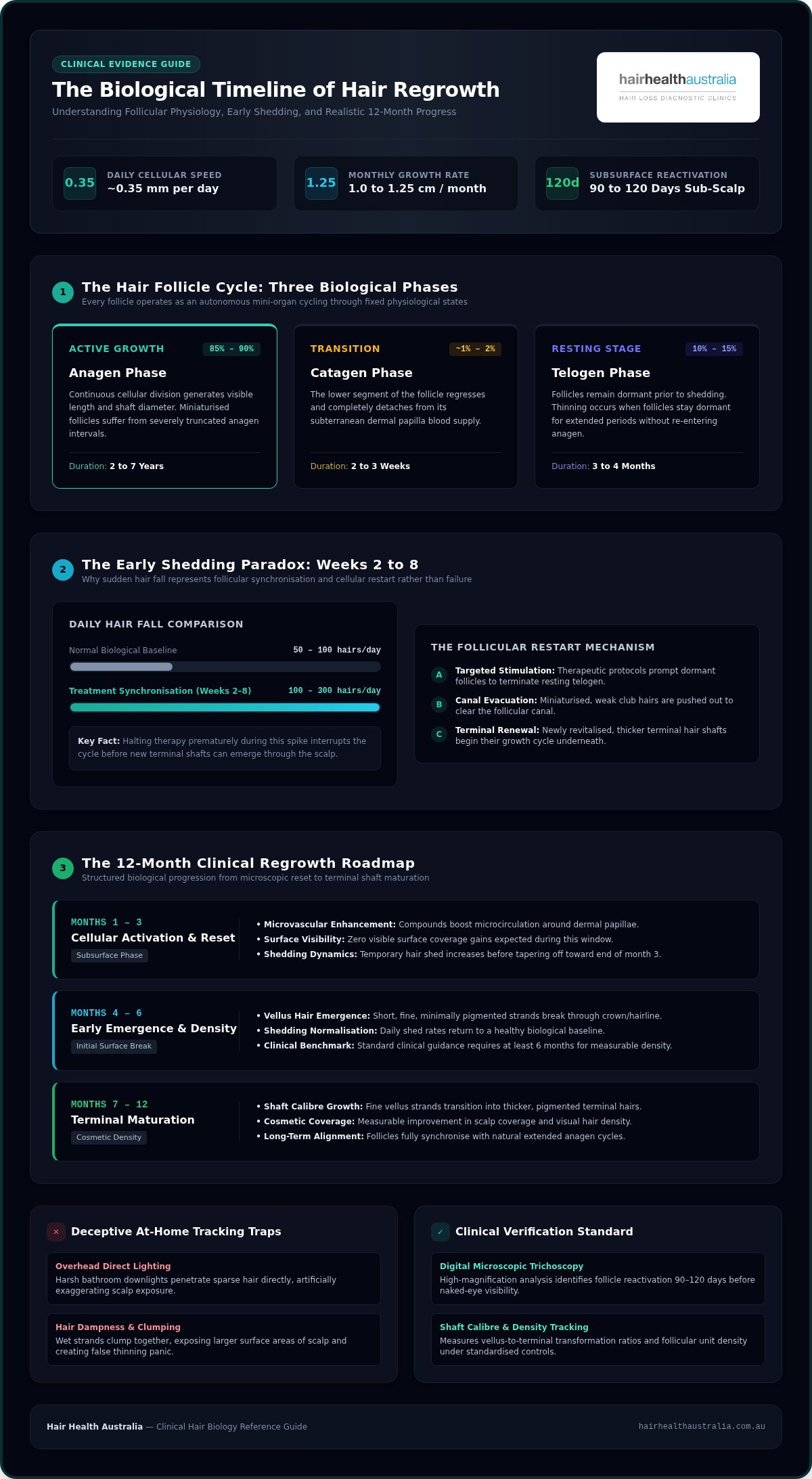
A static timeline rarely tells the full story. Many men and women ask how long does it take to see hair regrowth results without considering whether their individual follicles are actively cycling, dormant, or experiencing progressive miniaturisation. Therapeutic interventions don’t force instant cosmetic changes; they work by resetting cellular mechanisms deep within the scalp tissue. Human cellular biology dictates that scalp hair grows at a fixed physiological speed of approximately 0.35 millimetres daily, translating to roughly 1.0 to 1.25 centimetres per month. Real change requires patient, methodical alignment with your natural biological clock.
The Anagen, Catagen, and Telogen Phases Explained
Every individual follicle functions as an independent mini-organ governed by the physiological stages of the hair follicle growth cycle:
- Anagen (Active Growth): Spans two to seven years under optimal conditions, with approximately 85% to 90% of your healthy follicles dividing continuously to generate visible length and shaft diameter.
- Catagen (Transitional Phase): Lasts roughly two to three weeks, during which the lower segment of the follicle regresses and detaches from its subterranean dermal papilla blood supply.
- Telogen (Resting Phase): Persists for three to four months. Between 10% and 15% of your follicles normally rest here before shedding and re-entering the anagen stage.
When pattern thinning sets in, follicles spend progressively shorter intervals in anagen and extended periods dormant in telogen. Effective therapy must reactivate these dormant structures, a biological shift that requires at least 90 to 120 days beneath the surface before a new hair shaft can even emerge through the skin.
Why Early Shedding Is Actually a Positive Clinical Sign
Experiencing an uptick in hair fall during initial therapy can provoke immediate concern. When starting targeted protocols, many individuals notice a temporary increase in daily shedding between weeks two and eight, sometimes rising from a baseline of 50 to 100 hairs daily up to 100 to 300 hairs. Rather than indicating clinical failure, this transitional phase represents follicular synchronisation.
Therapeutic stimulation prompts follicles to shed weak, miniaturised club hairs that were resting in telogen. This process vacates the follicular canal, allowing newly revitalised, thicker terminal shafts to emerge. Halting your routine prematurely during this transitional shedding window disrupts this essential cellular restart. Establishing an initial baseline through a professional hair health check helps confirm whether sub-surface reactivation is underway, providing clear reassurance precisely when at-home observations might feel confusing.
Clinical Timeline: What to Expect from Months 1 to 12
Genuine restoration unfolds as a structured, twelve-month progression rather than an overnight transformation. When patients evaluate how long does it take to see hair regrowth results, setting realistic benchmarks at key stages prevents premature discouragement. As highlighted in standard Mayo Clinic hair loss diagnosis and treatment guidance, effective non-surgical therapies typically require at least six continuous months to demonstrate measurable density gains. Understanding each developmental quarter helps you stay consistent as cellular changes transition into visible coverage.
Months 1 to 3: Cellular Activation and Follicular Reset
The opening ninety days focus entirely on subsurface biological stabilisation. Active therapeutic compounds enhance microvascular circulation surrounding the dermal papillae, prompting miniaturised follicles to reset their internal cycles. You will not see increased surface coverage during this window. In fact, due to the natural synchronization described earlier, daily hair shedding often increases temporarily before tapering off toward the end of month three.
Months 4 to 6: Early Visible Density and Follicle Awakenings
Between months four and six, the first physical evidence of regrowth breaks through the scalp surface. These emerging strands typically appear as short, fine, minimally pigmented vellus hairs across areas like the crown or hairline. Shedding rates during routine shampooing stabilise back to a healthy baseline. While these fine hairs might remain subtle under everyday bathroom mirrors, high-magnification digital trichoscopy readily detects new follicular activity across treated zones.
Months 7 to 12: Terminal Maturation and Visible Coverage
The final half of the twelve-month cycle delivers significant cosmetic change. Fine vellus hairs gradually mature into thicker, pigmented terminal shafts with improved tensile strength and structural caliber. Clinical trials evaluating oral and topical protocols demonstrate that combination therapies achieve measurable improvement in over 92% of compliant male patients by month twelve. During this phase, crown whorls fill in and widening part lines contract under standard ambient lighting.
To establish verified benchmarks for your own restoration timeline, booking a professional hair health check enables our Sydney clinical team to map your follicular baseline and track microscopic caliber improvements quarter by quarter.
Critical Factors That Influence Your Personal Regrowth Speed
Every individual arrives at a clinic with a distinct scalp biology. While standard clinical timelines offer a helpful baseline, your personal recovery pace hinges on several physiological variables. Understanding how long does it take to see hair regrowth results requires evaluating whether your follicles are simply sluggish, heavily miniaturised, or dealing with systemic hormonal disruption. By identifying these variables early, you can set accurate expectations rather than measuring yourself against generalised averages.
Follicle Miniaturisation: Why Early Intervention Shortens Timelines
The duration and severity of follicular miniaturisation represent the single greatest variable in therapeutic response time. When dihydrotestosterone (DHT) binds to susceptible androgen receptors, it shortens the growth cycle over successive generations of hair. Follicles that have begun thinning within the past twelve to twenty-four months typically respond within four to six months of targeted care. Conversely, structures that have remained severely dormant for five or ten years require prolonged stimulation to expand their shaft diameter. If a follicle becomes completely fibrosed and replaced by scar tissue, non-surgical revival is no longer biologically possible, which makes timely clinical assessment vital.
Underlying Triggers: Genetic Thinning vs Telogen Effluvium
Your underlying diagnosis directly determines the recovery trajectory. The two most common causes of hair thinning follow entirely different timelines:
- Androgenetic Alopecia: Pattern loss in both men and women represents a chronic, progressive sensitivity to circulating androgens. It demands continuous therapeutic intervention to halt miniaturisation and maintain newly restored density over twelve-month cycles.
- Telogen Effluvium: Triggered by acute physical stress, systemic illness, or nutritional shortfalls, this condition pushes up to 30% of follicles prematurely into resting phase. Once the underlying physiological stressor is resolved, spontaneous recovery often begins within three to six months.
Women navigating postpartum changes, peri-menopause, or diffuse thinning face distinct hormonal environments. Our specialised hair loss treatment for women guide details how these gender-specific shifts alter restoration pathways.
Treatment Regimen: Standalone Topical Solutions vs Clinical Programs
The structure of your chosen protocol plays a decisive role in speed and final cosmetic density. Single over-the-counter options typically address only one biological pathway, such as dilating local microvessels. In contrast, comprehensive clinical protocols combine cellular stimulants, DHT reduction, and scalp preparation to address the condition systematically. As outlined in the American Academy of Dermatology hair loss treatment guidance, combining targeted therapies consistently yields superior density gains compared to single monotherapies, helping shorten the path from early cellular activity to visible coverage.
How to Track Hair Regrowth Accurately Without Deceptive Home Checks
Daily mirror checks are the quickest path to treatment frustration. When asking how long does it take to see hair regrowth results, relying on casual bathroom inspections often creates the false impression that nothing is happening. Follicles operate beneath the scalp surface, initiating structural repairs long before newly emerged shafts become visible to the naked eye. Shifting from emotional daily scrutiny to objective clinical metrics ensures you stay the course with confidence.
The Limitations of Smartphone Selfies and Mirror Checks
Consumer cameras and bathroom lighting introduce extreme visual distortion. A slight change in overhead illumination casts sharp shadows across the crown, exaggerating scalp exposure. Several common variables regularly compromise home checks:
- Overhead Downlights: Directional ceiling spotlights pierce through fine strands, making normal coverage appear sparse.
- Hair Hydration and Styling: Wet or product-heavy hair clumps together into clusters, falsely exposing wide gaps along the scalp.
- Lens Distortions: Uncalibrated smartphone wide-angle lenses alter perspective, washing out fragile new growth.
These optical variations often convince patients to abandon effective protocols precisely when microscopic recovery is taking place.
Why Microscopic Hair Analysis Detects Early Progress First
Clinical digital trichoscopy eliminates visual guesswork by magnifying the scalp surface from 20× up to 70×. This diagnostic capability identifies early follicular reactivation up to three months before changes register in everyday photographs. Instead of waiting for visible density, microscopic imaging directly measures the emergence of non-pigmented vellus hairs, tracks follicular unit density per square centimetre, and records minute increases in shaft diameter across targeted treatment zones.
Objective Benchmarks Used in Professional Hair Clinics
Specialised clinics employ standardised diagnostic parameters to quantify therapeutic response over time. Rather than relying on subjective impressions, practitioners systematically assess:
- Anagen-to-Telogen Ratio: Verifying that dormant resting follicles have successfully transitioned back into active production.
- Terminal-to-Vellus Calibre: Measuring the gradual thickening of hair shafts as follicular miniaturisation reverses.
- Scalp Health Indicators: Monitoring perifollicular erythema, sebum oxidation, and dermal barrier integrity.
Evaluating clinical credentials ensures you partner with experts who utilise these diagnostic tools. Review our criteria on choosing a non-surgical hair loss clinic in Sydney to understand clinical verification standards.
To eliminate daily uncertainty and measure your subterranean follicle activity with clinical precision, book an in-depth hair health check at our Sydney clinic today.
Maximising Regrowth Results with Targeted Non-Surgical Care
Achieving meaningful cosmetic recovery does not require invasive surgical procedures or long recovery times. When patients ask how long does it take to see hair regrowth results, the answer often depends on whether they rely on hit-or-miss retail options or commit to structured clinical protocols. Specialised non-surgical restoration offers an evidence-based pathway that arrests miniaturisation at the root while reviving compromised scalp environments. Tailoring your therapeutic program to your unique pattern of thinning ensures every active follicle receives maximum regenerative support.
The Advantages of Personalised Non-Invasive Therapies
Custom non-surgical protocols protect and enhance your natural follicular reserves. By focusing on biological stimulation rather than surgical relocation, these therapies provide clear benefits:
- Zero Operative Downtime: Avoids the surgical incisions, potential donor-site scarring, and extended recovery windows linked with hair transplants.
- Protection of Native Follicles: Prevents post-operative shock loss while systematically thickening the vulnerable, miniaturised hairs surrounding the thinning area.
- Natural Density Integration: Fosters progressive, organic hair thickening that develops seamlessly with your existing hair over time.
Our dedicated guide to clinical hair treatment restoration explores these advanced non-invasive modalities in greater depth.
Why Over-the-Counter Products Often Disappoint
Mass-market retail treatments rarely yield the substantive transformations seen in clinical settings. Generic formulations available on Australian chemist shelves usually offer fixed, low-potency concentrations that cannot overcome advanced follicular miniaturisation. These off-the-shelf options also fail to address critical scalp barrier issues, sebum congestion, or specific hormonal drivers. Without diagnostic clarity, individuals frequently spend months applying solutions that are poorly matched to their underlying pattern of hair loss.
Start Your Regrowth Journey with an In-Depth Diagnosis
A systematic clinical evaluation removes guesswork from your restoration timeline. Since launching our dedicated Sydney practice circa 2009, Hair Health Australia has helped men and women restore density through tailored male hair loss treatment and female hair loss treatment programs. Microscopic follicle scanning reveals precisely how many viable, dormant structures remain available for rejuvenation across your scalp.
Take control of your hair journey today: Book a comprehensive Hair Health Check at our Sydney clinic to establish your diagnostic baseline and begin a structured non-surgical path toward lasting recovery.
Take Control of Your Follicular Health Today
Restoring natural hair density is a methodical clinical journey, not a test of guesswork. As we have explored, determining how long does it take to see hair regrowth results depends on biological realities: initial cellular resets during the first ninety days, the emergence of early vellus hairs by month six, and true terminal thickening across a full twelve-month commitment. Daily mirror checks only fuel anxiety. Objective microscopic evaluation provides the verified clarity you need to stay confident throughout each stage of renewal.
Backed by over 15 years of dedicated Australian clinical experience since 2009, Hair Health Australia delivers customised, non-surgical hair restoration protocols tailored specifically to your pattern of thinning. Our high-magnification diagnostic scans examine subterranean follicle viability long before visual improvements register under household lights.
Book your comprehensive Hair Health Check in Sydney today to discover exactly what your follicles need and begin your structured journey toward lasting, healthy regrowth.
Frequently Asked Questions
How long does it take to see hair regrowth results with non-surgical treatments?
Most patients observe early microscopic changes within three to four months, while noticeable cosmetic improvements emerge between six and twelve months. Understanding how long does it take to see hair regrowth results involves recognising that cellular revival precedes surface length. Non-surgical clinical protocols require steady compliance to help miniaturised roots transition from dormant resting cycles into robust active growth.
Why does my hair seem to fall out faster when I start a new regrowth treatment?
Initial shedding between weeks two and eight indicates that your therapy is actively working. Stimulated follicles simultaneously push out thin, miniaturised telogen hairs to make room for stronger shafts. This temporary shed typically stabilises by the end of the third month, paving the way for newly synchronised anagen development.
Can dead hair follicles be stimulated to regrow hair naturally?
Completely fibrosed follicles that have turned into scar tissue cannot be revived by non-surgical therapies. However, dormant or severely miniaturised follicles that still maintain blood supply can be stimulated back into producing healthy terminal hair. An in-depth clinical scan at our Sydney clinic verifies which follicles remain salvageable before beginning care.
How can I tell if my hair regrowth treatment is actually working?
Digital trichoscopy provides the earliest confirmation by magnifying your scalp up to 70 times to measure emerging vellus hairs and increased follicle density. At home, reduced daily shedding during washing and less scalp visibility under soft, natural lighting after six months offer clear practical confirmation that your follicles are responding.
What is the difference between vellus hair and terminal hair during regrowth?
Vellus hairs are fine, short, and lightly pigmented strands that represent the earliest visible stage of follicular reactivation. As active therapy continues over six to twelve months, these delicate hairs receive improved dermal nourishment, gradually maturing into thick, deeply pigmented terminal hairs that deliver meaningful cosmetic coverage.
Is it possible to speed up the hair regrowth timeline?
Human hair growth has a hard biological ceiling of approximately one centimetre per month, meaning you cannot force cellular division to accelerate beyond natural parameters. You can, however, prevent delays by combining multi-modal therapies that address follicular stimulation, DHT inhibition, and scalp health simultaneously rather than relying on isolated retail products.
Will I lose my regrown hair if I stop treatment after 12 months?
Ceasing non-surgical maintenance allows genetic hair loss triggers to resume, causing newly revived follicles to miniaturise once again. For individuals asking how long does it take to see hair regrowth results last, therapies function as ongoing management rather than a permanent cure. Sustaining your progress requires simple long-term maintenance routines designed by your Sydney hair specialist.