
A shiny, smooth patch can suggest lost follicles, but it can’t confirm they’re dead. Learning how to tell if hair follicles are dead or dormant means looking for clues such as fine, miniaturised hairs, then assessing the scalp under magnification. Dormant follicles may still produce hair, while a professional examination can help distinguish them from follicles that have been permanently damaged.
It’s understandable to worry that thinning or patchy areas mean regrowth is no longer possible. Scalp appearance alone can be misleading, and the cause of hair loss matters: stress, illness, nutritional deficiencies, hormonal sensitivity and scalp inflammation can all affect hair growth.
This article explains the hair growth and rest phases, signs that may point to dormant or lost follicles, and possible causes of follicle dormancy. You’ll also learn how treatment may support living follicles and why identifying the cause is an important first step.
Key Takeaways
- Hair follicles cycle through growth, transition, rest and shedding, so a pause in visible growth doesn’t automatically mean a follicle is dead.
- Fine, miniaturised hairs may suggest follicles are still active; a smooth, shiny area can be a warning sign, but appearance alone can’t confirm follicle loss.
- Scalp examination under magnification can help distinguish dormant follicles from permanently damaged ones, while severe cases may need further assessment.
- Treatments such as minoxidil may support living, dormant follicles, but oils, supplements and massage can’t recreate follicles that have been destroyed.
- Hormonal sensitivity, illness, stress, nutritional deficiencies and scalp inflammation can contribute to dormancy, so understanding the cause helps guide treatment.
Can treatments wake up dormant hair follicles?
Sometimes. Treatment may help living follicles return to the growth cycle, but it can’t recreate follicles destroyed by scarring or injury. A hair loss specialist can examine the scalp under magnification and assess whether follicles appear dormant or permanently lost. Even badly damaged follicles may still be alive, so visible thinning alone doesn’t settle the question.
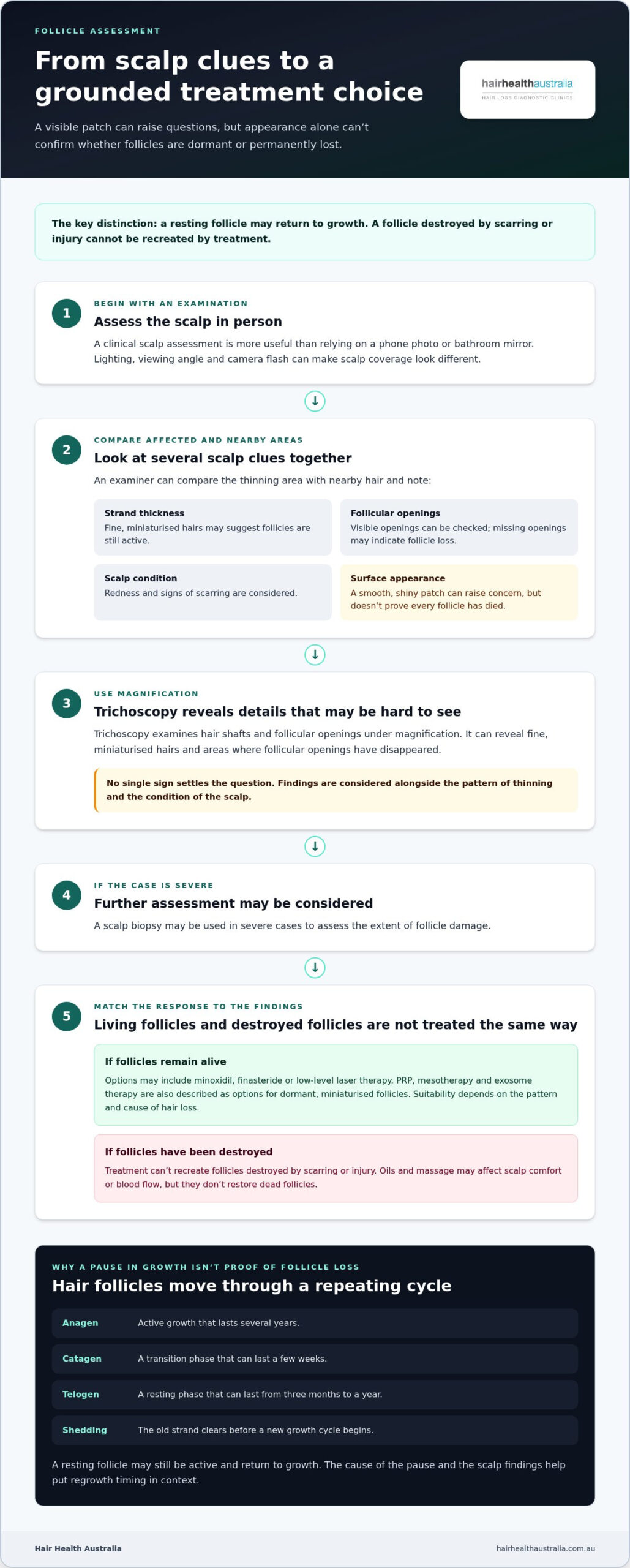
Start with a clinical scalp assessment rather than relying on a phone photo or bathroom mirror. Lighting, viewing angle and camera flash can make scalp coverage look different, especially across a thinning crown. An examiner can compare affected areas with nearby hair, noting strand thickness, visible follicular openings, redness and any signs of scarring. A hair health check can help organise concerns about hair loss into an assessment of the scalp and its changes.
Trichoscopy uses magnification to examine hair shafts and follicular openings. It can reveal fine, miniaturised hairs that are difficult to see unaided. The examiner also checks for areas where follicular openings have disappeared, which can indicate follicle loss. These findings are considered alongside the pattern of thinning and scalp condition, rather than treated as a single sign in isolation.
A smooth, shiny patch may raise concern, particularly if it has no visible pores, fine hairs or dark dots. But a bald-looking area doesn’t prove that every follicle has died. Small hairs can be hidden by longer strands, and reflections can make the scalp look smoother. Compare the same area in consistent lighting, and don’t treat a single close-up image as a diagnosis. A scalp biopsy may be used in severe cases to assess the extent of follicle damage.
When follicles remain alive, treatment options can include minoxidil, finasteride or low-level laser therapy. These may help dormant follicles re-enter the growth cycle, but suitability depends on the pattern and cause of hair loss. PRP, mesotherapy and exosome therapy are also described as options for dormant, miniaturised follicles, not destroyed ones. Treatment should follow an assessment that distinguishes miniaturisation from scarring.
Scalp oils and massage may affect scalp comfort or blood flow, but they don’t restore dead follicles. Rosemary and peppermint oils are associated with scalp-stimulating properties, but that doesn’t show they can revive permanently lost follicles. The practical next step is to identify whether follicular openings and fine hairs remain, then match treatment to those findings. This keeps hair health decisions grounded in evidence, not promises of natural regrowth.
Hair follicle growth and rest phases
Hair follicles cycle through growth, transition, rest and shedding, rather than producing a strand continuously. Knowing these stages helps explain why a pause in visible hair growth doesn’t, by itself, mean a follicle is dead.
Stages of the Hair Growth Cycle
The hair growth cycle is the repeating sequence in which each follicle grows a strand, transitions, rests and sheds it. During anagen, active growth lasts several years. Catagen is the transition phase and can last a few weeks. Telogen is the resting phase, and shedding clears the old strand before a new cycle begins. These stages matter because a follicle can be resting while remaining active.
Dormancy and Regrowth Timing
Follicles can remain in the resting, or telogen, phase from three months to a year. Regrowth timing depends on the cycle and what prompted the pause, so there’s no fixed dormancy period for everyone. After acute stress, shedding typically resolves on its own a few months later. Tracking when shedding began alongside changes in health or stress can help put regrowth timing in context.
Each follicle follows its own cycle, which is why neighbouring hairs don’t all grow or shed together. Anagen produces the visible strand; catagen slows activity as the follicle transitions. During telogen, the strand can remain in place before shedding. The next growth phase starts within the follicle. This sequence helps explain why a patch can look thinner before new strands become visible.
Shedding is part of this cycle. A person normally sheds about 100-150 hairs every day, as older strands make way for new growth. A change in shedding can be more noticeable after acute stress, but the shed hair itself doesn’t show whether its follicle has stopped working. The timing and pattern of loss matter: general shedding differs from gradual thinning associated with androgenetic alopecia.
The cycle also explains why “dormant” doesn’t mean permanently inactive. A resting follicle isn’t producing a visible strand at that moment, but it can return to growth. By contrast, scarring alopecias can damage follicles and change scalp tissue, affecting the potential for regrowth. The distinction matters: cycle timing describes normal follicle behaviour, while persistent or patterned loss can point to an underlying condition that needs assessment.
Note the timing, distribution and changes in shedding rather than judging one day’s hair fall. A hair health check can help assess these patterns alongside scalp changes and growth stages.
What do dead hair follicles look like?
Fine hairs, visible follicular openings and gradual thinning can suggest that follicles remain active. A smooth, shiny patch with no visible openings, fine vellus hairs or dark dots can suggest follicle loss, but appearance alone can’t establish whether follicles are permanently lost. If you’re wondering how to tell if hair follicles are dead or dormant, compare signs across the affected area rather than relying on one feature.
Signs of Dormant or Miniaturised Follicles
Miniaturised follicles produce finer, shorter strands than surrounding hair while remaining intact. Look for a mix of thicker hairs and delicate, pale hairs in a thinning area. That variation can indicate that follicles are still producing hair, even if coverage has reduced. The pattern matters: gradual thinning across the top of the head can differ from a sharply defined bare patch.
A friend may be able to spot small hairs in an area that looks thin from above. Part the hair gently and inspect the scalp in even light, looking for fine strands rather than relying on shine or colour in a phone photo. In androgenetic hair loss, follicles may progressively miniaturise over 5-15 years before final scarring. This gradual change can leave visible hairs in an area with reduced density.
Signs of Permanently Lost Follicles
Follicles destroyed by scarring alopecia or injury can be replaced by scar-like tissue. The skin may look smooth and shiny, with no visible pores, fine vellus hairs or dark dots. A defined area with these features raises concern about permanent follicle loss, particularly if scalp texture has changed. These signs differ from miniaturisation, where fine hairs remain.
Dermoscopy can show whether follicular openings are absent in a particular area. These openings are tiny points where hairs emerge, so their absence can help distinguish a bare, scarred patch from one with very fine strands. Scarring alopecias, including lichen planopilaris, can damage follicles; advanced traction alopecia can also cause permanent loss. The cause and distribution help explain what the visible skin shows.
Use appearance as a clue, not a final verdict. Hair colour, lighting and viewing angle can hide small strands or make scalp skin appear unusually reflective. Compare the area with nearby hair and note whether thinning follows a pattern or forms a distinct patch. A smooth-looking crown, for example, can still contain miniaturised hairs that are hard to see without close inspection. This comparison can help you understand how to tell if hair follicles are dead or dormant, but it can’t confirm a diagnosis.
Persistent redness, scaling or a change in scalp texture alongside a bare area can point to inflammation or scarring. These changes deserve attention because ongoing damage can affect follicles, unlike ordinary variation in hair density. By contrast, tiny hairs emerging among longer strands are evidence of visible hair production. These details help distinguish reduced follicle activity from permanent tissue change.
Treatments that cannot revive dead follicles
No shampoo, serum, supplement, oil, massage, platelet-rich plasma (PRP) or laser cap can revive a destroyed follicle. These treatments may affect scalp condition or support living follicles, but they can’t recreate follicular tissue replaced by scarring. The distinction matters: treatments aimed at inactive follicles won’t restore hair where the follicle itself is permanently lost.
Minoxidil may stimulate growth when follicles are alive but dormant. It doesn’t revive inactive follicles, so the presence of miniaturised hairs or follicular openings can affect whether treatment is relevant. Finasteride is another treatment used for hair loss, but it doesn’t recreate destroyed follicles either. The aim is to support remaining follicle activity, not regenerate tissue that no longer exists.
PRP, exosome therapy and mesotherapy are used for living, dormant follicles, not dead ones. A scalp assessment helps determine whether there are signs of remaining activity before these approaches are considered. For example, fine hairs in a thinning area differ from a smooth, scarred patch with absent follicular openings. This distinction helps set expectations and separates treatment aimed at existing follicles from attempts to restore lost ones.
Massage may increase blood flow to the scalp and may help dormant follicles, but it’s less effective on completely inactive follicles. Oils, including rosemary or peppermint, may be used for scalp care, but they don’t rebuild a destroyed follicle. Supplements have the same limitation. Nutrients can support overall hair health when intake is inadequate, but supplements don’t bring a permanently lost follicle back.
Laser caps and topical products also have limits. Low-level laser therapy may help dormant follicles re-enter the growth cycle, but a laser cap can’t revive dead follicles. A thicker-looking result depends on living follicles producing hair, not on a product restoring absent follicular structures. Follow the treatment’s directions and assess progress through visible changes, rather than assuming more frequent use can overcome follicle loss.
Once follicles are permanently lost, a hair transplant is the only way to restore hair in those areas. The procedure moves living follicles from a donor area to a region where follicles have been lost. It doesn’t revive the original follicles. This is different from non-surgical treatments, which aim to support hair growth from follicles that remain alive.
So, can dead follicles be revived? No. Treatments may support dormant follicles, but they can’t bring back follicles destroyed by scarring or injury. The useful next step is to determine whether the scalp still shows signs of living follicles, such as fine hairs or visible openings. That assessment helps distinguish options intended to support hair growth from methods that can’t address permanent follicle loss.
Causes of follicle dormancy
Follicles can become dormant after hormonal changes, nutritional deficiencies, illness, stress, scalp inflammation or certain medications. Permanent damage is different: scarring alopecia, injury and advanced traction alopecia can destroy follicles and replace them with scar-like tissue. Persistent scalp folliculitis can also damage follicles and contribute to inactivity if left untreated.
Hormonal sensitivity can gradually alter follicle activity and hair thickness. In androgenetic hair loss, affected follicles may produce progressively finer strands rather than stop abruptly. This miniaturisation can reduce visible coverage while follicles remain present. Identifying the pattern and whether fine hairs remain helps distinguish reduced activity from damage that has destroyed follicular tissue.
Nutritional deficiencies can affect hair health because follicles rely on nutrients to produce hair. Biotin, zinc and iron are among the nutrients important for hair growth and follicle health. A deficiency is one possible cause, not a reason to start supplements without understanding what is driving the change. Illness can also disrupt normal growth, while some medications can contribute to hair loss.
Stress is another possible trigger for changes in the hair cycle. After acute stress, increased shedding typically resolves on its own a few months later. This pattern differs from ongoing scalp inflammation, which can affect the skin around follicles. Redness, tenderness or persistent irritation alongside hair loss can help identify inflammation as a factor to assess.
Scalp conditions need particular attention. Persistent folliculitis involves inflamed hair follicles; ongoing inflammation can damage them and lead to inactivity. Scarring alopecias, including lichen planopilaris, can destroy follicles, while advanced traction alopecia can cause lasting loss where repeated pulling has damaged the scalp. Injury can also destroy follicles at the affected site.
The cause matters because treatment needs to match the follicle’s condition. Minoxidil may stimulate growth in follicles that are alive but dormant; it can’t revive follicles destroyed by scarring. Addressing an ongoing trigger, such as scalp inflammation, differs from supporting miniaturised follicles. A scalp examination can assess the loss pattern, visible openings and signs of inflammation before treatment decisions are made.
Track when thinning began, where it appears and any scalp symptoms or recent health changes. These details help connect possible causes with visible changes. For a focused assessment of hair and scalp concerns, book a hair health check.
Hair Health Australia: Male Hair Loss Treatment
Hair Health Australia provides Male Hair Loss Treatment and Female Hair Loss Treatment through non-surgical regrowth programmes for thinning hair and pattern baldness. If you’re noticing ongoing changes in density, a tailored treatment may be a relevant next step after considering the possible causes and signs of follicle activity. Treatment decisions should reflect your hair-loss pattern and scalp health, since dormant follicles differ from those permanently damaged by scarring.
For readers seeking support with hair loss, Hair Health Australia focuses on clinically backed approaches to regrowth and scalp health. Explore the treatment options or contact Hair Health Australia to discuss your next step, or visit hairhealthaustralia.com.au.
Take a considered next step
An assessment is most useful when it starts with what you’ve noticed and what you want to change. Before seeking support, note where thinning first appeared, how it has changed, and any scalp symptoms or health changes you’ve observed. These details help frame the discussion around your priorities, rather than assumptions based on a single photo. Understanding how to tell if hair follicles are dead or dormant can help you ask informed questions, while your hair-loss pattern and goals shape the conversation. A clear record of your observations makes it easier to discuss what matters most to you.
Hair Health Australia offers Male Hair Loss Treatment and Female Hair Loss Treatment for people seeking support with hair loss. Explore the treatment option that aligns with your needs, then book a hair health check to take the next step. A thoughtful, informed approach can help you move forward with greater confidence.
Frequently Asked Questions
Can You Reactivate Them Naturally?
Natural approaches can support general scalp and hair health, but they can’t revive follicles that have been destroyed. A nutrient-rich diet with vitamins, minerals and protein supports hair health, while avoiding harsh chemicals and excessive heat helps maintain a healthy scalp environment. Massage may increase blood flow, but it’s less effective for completely inactive follicles. Oils and supplements don’t recreate lost follicular tissue, so don’t treat them as a substitute for assessment.
How long does it take a follicle to die?
There isn’t one timeline for every cause of hair loss. In scarring alopecias such as lichen planopilaris, or advanced traction alopecia, follicles may die within months. By contrast, androgenetic hair loss can involve gradual miniaturisation over 5-15 years before final scarring. The difference between these patterns matters: rapid changes with scalp inflammation deserve prompt assessment, while gradual thinning follows a different course.
What should I do if I think something is wrong with my hair follicles?
Arrange a medical assessment if you notice persistent thinning, a distinct bald patch or scalp inflammation. Before the appointment, record when the change began, where it appears and whether it’s spreading. Note recent illness, stress, medication changes or scalp symptoms, as these can help identify possible causes. Consult a doctor or dermatologist before using a derma-roller, since the scalp condition needs to be considered.
What is the difference between dead and dormant hair follicles?
A dormant follicle is temporarily inactive or producing a finer, miniaturised strand; a destroyed follicle can no longer produce hair because scarring or injury has damaged its structure. This distinction affects what treatment can do. For example, minoxidil may stimulate growth from living, dormant follicles, but it can’t restore a follicle replaced by scar-like tissue. Visible clues help guide assessment, though they don’t settle the diagnosis alone.
Can a dermatologist tell if hair follicles are dead or dormant, and how?
Yes. A dermatologist can examine the scalp under magnification, compare affected areas and look for follicular openings, fine hairs and signs of scarring or inflammation. Dermoscopy, also called trichoscopy, shows these details more clearly than a mirror or phone photo. If the pattern is severe or unclear, a scalp biopsy may be used to assess follicle damage. The findings help distinguish miniaturisation from scarring loss.
What tests or scalp examinations assess hair follicle activity?
Scalp examination under magnification is a key way to assess follicle activity. Trichoscopy lets the examiner inspect hair shafts and follicular openings across the affected area, including fine strands that are difficult to see unaided. The examiner also considers thinning patterns and scalp changes. In severe cases, a biopsy can assess the extent of damage. Together, these findings provide more useful information than judging a patch by appearance alone.
Can dormant hair follicles be reactivated, and which treatments work?
Some treatments can support living, dormant follicles. Options include minoxidil, finasteride and low-level laser therapy; treatment choice depends on the hair-loss pattern and cause. PRP, mesotherapy and exosome therapy are also used for dormant, miniaturised follicles, not destroyed ones. These approaches don’t suit every situation. The useful first step is to identify whether follicles remain active, then match treatment to the findings rather than choose a product based on a broad claim.
Can dead hair follicles regrow, or is hair transplantation the only option?
A follicle destroyed by scarring or injury can’t regrow hair, and shampoo, supplements, oils, massage or laser caps can’t recreate it. A hair transplant moves living follicles from a donor area to an area where follicles have been lost; it doesn’t revive the original follicles. Non-surgical regrowth treatments instead aim to support follicles that remain alive. This distinction matters when weighing expectations and possible approaches.