You wake up, glance at your pillowcase, and feel that familiar jolt of adrenaline as you count the strands left behind. It’s a heavy, sinking feeling that many Australians are experiencing right now. If you’ve spent your mornings searching for the link between stress and hair loss australia, you’re likely frustrated by temporary fixes that don’t address the biological root of the problem. You know that a generic chemist shampoo won’t fix a nervous system under fire; you’re simply tired of wondering if this shedding is a passing phase or the start of permanent balding.
We understand that this uncertainty is often more exhausting than the hair loss itself. This clinical guide explains the biological “pause” your body triggers during high-stress periods and how to restart your growth cycle. You will learn to differentiate between temporary telogen effluvium and genetic thinning, providing you with a clear, non-surgical pathway to restore your hair’s natural density without the need for invasive procedures.
We’ll explore the latest 2026 clinical standards for recovery, moving from microscopic diagnostics to personalised programmes that replace “wait and see” with evidence-based action.
Key Takeaways
- Understand how the “fight or flight” response disrupts your growth cycle by redirecting vital nutrients away from your scalp and towards your core organs.
- Learn to identify the specific signs of stress and hair loss australia to distinguish between temporary shedding and the early stages of genetic pattern baldness.
- Discover why a microscopic Hair Health Check is the essential first step in creating a tailored, non-surgical recovery plan that targets your unique scalp environment.
- Explore how clinical stabilisation can wake up dormant follicles and halt the active shedding phase without the need for invasive surgery.
- Gain practical insights into building follicular resilience through targeted nutrition and lifestyle adjustments suited to the high-pressure Australian environment.
The Cortisol Connection: How Stress Disrupts the Australian Hair Growth Cycle
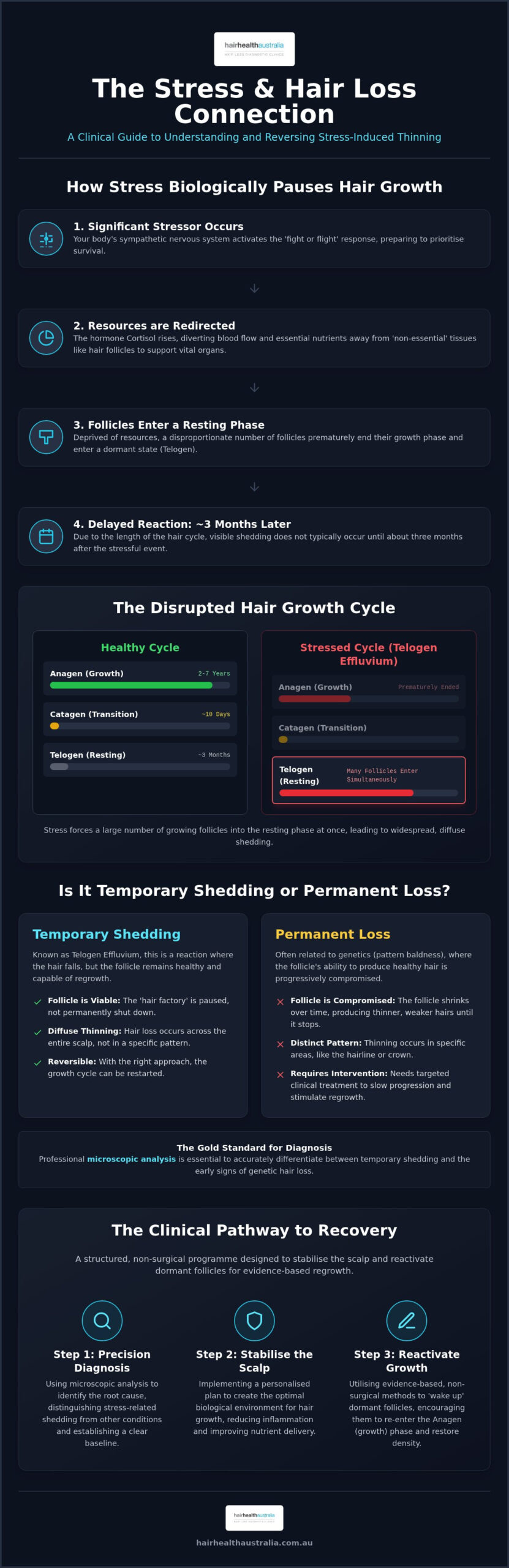
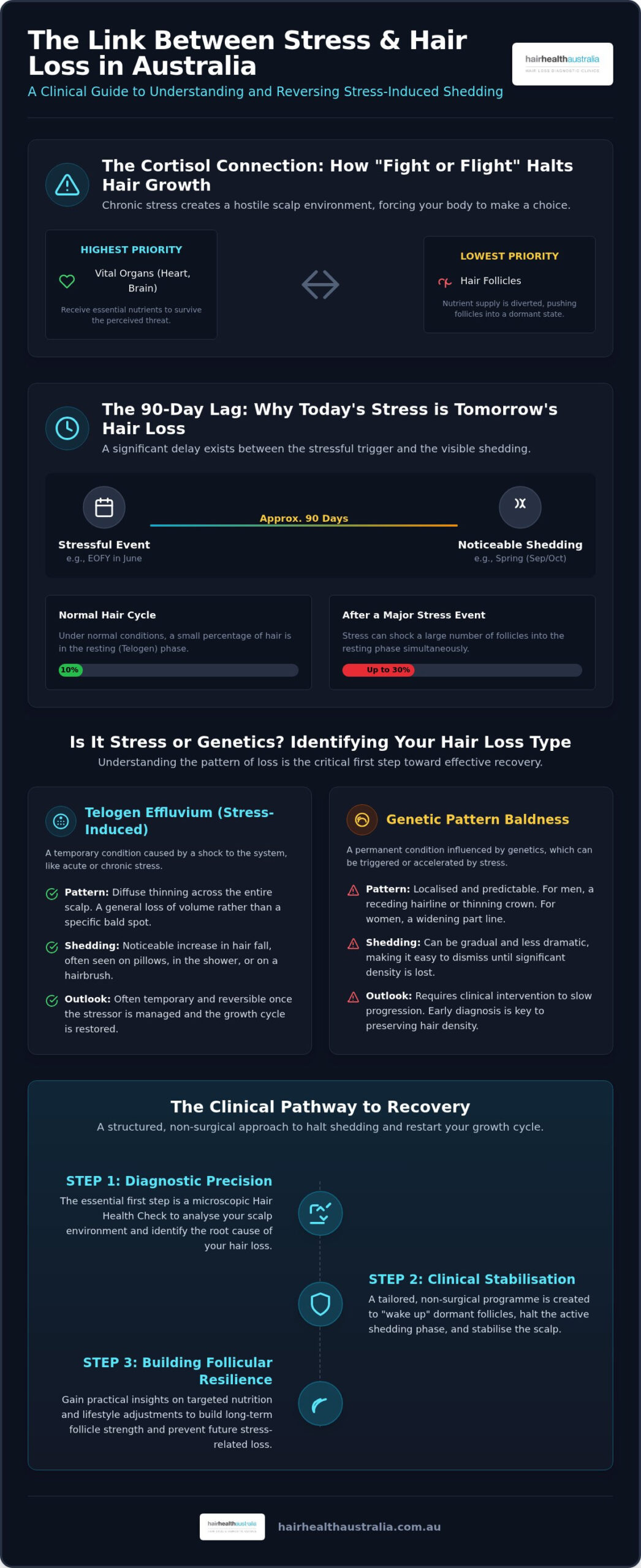
When your body enters a “fight or flight” state, it undergoes a metabolic triage. It instinctively prioritises vital organs like the heart, lungs, and brain while diverting essential nutrients away from non-essential systems. Unfortunately, your hair follicles are at the bottom of this biological priority list. Chronic stress creates a hostile scalp environment where the chemical balance required for healthy growth is replaced by a flood of stress hormones.
Cortisol, the body’s primary stress hormone, plays a destructive role in follicular health. High levels of cortisol signal the follicles to terminate their active growth phase and enter a state of hibernation. Telogen Effluvium is the primary stress-related shedding condition where a significant percentage of hairs are pushed prematurely into a resting state. This disruption is a leading cause of stress and hair loss australia wide, especially among professionals balancing high-pressure careers with the unique demands of the Australian lifestyle.
The Three-Month Lag: Why Stress Today Affects Your Hair Tomorrow
To understand recovery, you must first understand the natural hair cycle. This cycle consists of Anagen (growth), Catagen (transition), and Telogen (resting). Under normal conditions, only about 10 percent of your hair is in the Telogen phase at any time. However, a major stressful event can shock up to 30 percent of your follicles into this resting state simultaneously.
There is a distinct 90-day lag between the stressor and the physical shedding. This often aligns with the “Australian stress calendar.” If you experienced intense pressure during the end-of-financial-year (EOFY) crunch in June, you might not notice significant thinning until the spring months of September or October. Because the trigger happened months ago, many people fail to make the connection, leading to unnecessary anxiety about the cause of their hair loss.
Acute vs. Chronic Stress: Different Impacts on Density
The way stress manifests on your scalp depends on the duration of the pressure. Acute stress is a sudden, high-intensity shock to the system, such as a physical injury or a significant personal loss. This usually results in rapid, diffuse shedding where hair falls out in larger clumps. While alarming, this is often temporary if the body is allowed to recover.
Chronic stress is more insidious. It’s the slow, persistent pressure of long-term workplace demands or ongoing personal strain. This type of stress can often mask the early signs of genetic pattern baldness. Because the thinning is gradual, it’s easy to dismiss until the loss of density becomes visually obvious. This often creates a psychological loop: the anxiety of seeing hair on the pillowcase triggers further cortisol spikes, which can prolong the shedding phase. Breaking this cycle requires a professional Hair Health Check to accurately diagnose the type of loss and implement a clinical recovery plan.
Identifying the Type: Telogen Effluvium vs. Genetic Pattern Baldness
Determining whether your hair loss is a temporary reaction to pressure or the beginning of a permanent shift in density is a critical first step. Many Australians mistake the sudden appearance of hair on their clothes for permanent balding, leading to unnecessary panic. Conversely, dismissing gradual thinning as “just stress” can result in the loss of valuable time where clinical intervention for genetic conditions is most effective. Understanding the visual cues and biological mechanisms behind stress and hair loss australia wide allows for a more targeted and successful recovery plan.
The primary differentiator is the pattern of loss. Stress-induced shedding is typically diffuse, meaning you will notice a general reduction in volume across the entire scalp. You might find handfuls of hair in the shower or a significant amount caught in your hairbrush. In contrast, male or female pattern baldness is localised. For men, this usually begins at the temples or the crown; for women, it often manifests as a widening part line while the frontal hairline remains intact.
It is also vital to recognise that stress often acts as a biological “trigger” for dormant genetic conditions. If you have a predisposition to pattern baldness, a period of intense physiological strain can accelerate the process, making a permanent condition appear suddenly. Misdiagnosing this as temporary shedding can be a setback. A professional Hair Health Check is the most reliable way to distinguish between these two distinct pathways.
Telogen Effluvium: The Biological Pause
As discussed in the previous section, Telogen Effluvium is the most common form of stress-related hair loss. It is characterised by a sudden, widespread thinning that occurs when the body’s resources are diverted elsewhere. In Australia, we frequently see this triggered by high-pressure career changes, significant illness, or rapid weight loss. While the condition is usually temporary, the scalp environment often requires clinical stabilisation to ensure that the follicles return to their active growth phase rather than remaining in a weakened state.
When Stress Triggers Alopecia Areata
In some instances, the body’s response to stress is more aggressive. Alopecia areata is an autoimmune condition where the immune system attacks the hair follicles, resulting in distinct, smooth, circular patches of hair loss. This is fundamentally different from the diffuse thinning seen in Telogen Effluvium. Because this condition involves an internal immune response, waiting for “natural” recovery is often ineffective. Clinical intervention is essential to manage the inflammation and encourage the follicles to resume normal function before the loss becomes more extensive.
Diagnostic Precision: Why a Sydney Hair Health Check is Essential
Visual inspection is the standard first step for most, but it rarely provides the full picture. A GP or hairdresser might notice thinning, yet they cannot see the biological activity beneath the scalp. To truly understand the relationship between stress and hair loss australia residents need more than a superficial glance. We need to distinguish between follicles that are permanently shrinking and those that have simply entered a temporary state of dormancy.
Making an incorrect assumption at this stage is risky. Treating genetic thinning as temporary stress loss leads to permanent hair displacement. Conversely, using harsh chemical treatments on a scalp already sensitised by stress can exacerbate the problem. You should book your comprehensive Hair Health Check to find the root cause before committing to a treatment path.
Microscopic Scanning: Measuring Follicle Health
Our clinical approach utilises high-resolution microscopic scanning to examine the scalp at a cellular level. This technology allows us to calculate the exact percentage of hairs in the Anagen (growth) versus Telogen (resting) phases. We also analyse the scalp environment, checking for excess sebum or inflammation that might be hindering regrowth. By gathering this data, we can move away from guesswork and design a personalised recovery programme tailored to your specific diagnostic results.
Genetic vs. Environmental Triggers: The Clinical Verdict
One of the most significant benefits of clinical analysis is the ability to identify follicle miniaturisation. This is the hallmark of male or female pattern baldness, where the follicle physically shrinks over time. Stress-related loss, however, typically involves healthy follicles that have just stopped producing hair. Determining which factor is at play is the only way to ensure you aren’t wasting money on ineffective chemist shampoos.
Gaining this “clinical verdict” is often the first step in recovery. Uncertainty is a major driver of cortisol, and cortisol is a major driver of stress and hair loss australia wide. Once you have a clear diagnosis, the anxiety of the unknown dissipates. You are no longer “hoping” for a result; you are following a systematic, data-backed plan. This baseline also allows us to measure your progress objectively, ensuring that every stage of your recovery is verified by visible, microscopic improvement.
Clinical Recovery Pathways: Waking Up Dormant Follicles
Many Australians instinctively reach for over-the-counter “hair vitamins” at the local chemist when they first notice shedding. While these supplements are marketed as a cure-all, they often fail to address the physiological reality of stress-induced loss. If your follicles have entered a dormant phase due to high cortisol levels, providing more raw nutrients like biotin or zinc won’t solve the problem. The issue isn’t a lack of building blocks; it’s that the “biological machinery” has been switched off. Clinical intervention is required to signal the follicle to restart its growth cycle.
Successfully managing stress and hair loss australia wide requires a transition from generic retail products to targeted clinical pathways. We focus on using TGA-approved follicle stimulants that act as a biological catalyst. These treatments are designed to “wake up” hairs stuck in the Telogen phase, encouraging them to return to the active Anagen phase. By bypassing the digestive system and applying concentrated, medical-grade solutions directly to the scalp, we can achieve results that oral vitamins simply cannot match.
Non-Surgical Regrowth Programmes: What to Expect
Our non-surgical regrowth programmes are designed to be both intensive and non-invasive. We focus on improving micro-circulation and nutrient delivery at the follicular level, ensuring that each hair has the blood supply it needs to thrive. Consistency is the cornerstone of this process. Because hair growth is a slow biological function, sticking to a structured clinical protocol is the only way to achieve sustainable density. You can learn more about our specialised Male Hair Loss Treatment Programs in Sydney and how they are tailored to individual diagnostic results.
Stabilising the Scalp: The Foundation of Growth
Regrowth cannot happen in a hostile environment. Chronic stress often leads to an overproduction of sebum and localised scalp inflammation, which can “choke” the follicle. Part of our clinical approach involves stabilising this environment using professional-grade lotions and cleansers that balance pH levels and remove DHT-laden oils. This creates the optimal foundation for new growth to take hold.
It’s important to remember that clinical recovery is a journey rather than an overnight fix. While the active shedding phase can often be halted quickly, visible regrowth typically takes three to six months to become apparent. This timeline aligns with the natural rhythm of your hair’s growth cycle. Before starting any regimen, you should arrange your clinical Hair Health Check to ensure your recovery plan is based on data rather than guesswork.
Managing the Aussie Lifestyle: Preventing Future Stress-Loss
Integrating clinical hair care into a high-pressure Australian lifestyle doesn’t have to be a burden. It’s about building a safety net for your follicles. While lifestyle changes like meditation or improved sleep are helpful, they don’t always address the physiological damage already done to the scalp. Preventing future instances of stress and hair loss australia requires a combination of clinical maintenance and personal resilience. By treating your scalp health as a standard part of your wellness routine, you ensure your hair can withstand the inevitable periods of professional or personal pressure.
For professionals in Sydney’s high-stress industries, periodic monitoring is the key to longevity. A regular Hair Health Check allows us to identify subtle shifts in your growth cycle before they manifest as visible thinning. This proactive stance transforms Hair Health Australia from a reactive service into a long-term partner in your scalp health journey. We don’t just help you regrow hair; we help you protect the density you have against the unique environmental and lifestyle stressors of 2026.
Nutritional Support for Follicular Resilience
Your hair is a reflection of your internal health. During periods of high cortisol, the body’s demand for specific minerals increases significantly. Iron, Zinc, and Biotin are critical for maintaining the structural integrity of the hair shaft and the function of the follicle. In the Australian diet, even with access to high-quality produce, stress can lead to poor absorption or neglected nutrition. If you’re skipping meals or relying on processed snacks during late nights at the office, you’re likely creating a deficiency that exacerbates shedding. Combining professional-grade supplements with your clinical treatment plan ensures your body has the resources it needs to support the regrowth we’ve initiated.
Your Next Steps: Moving from Uncertainty to Action
The journey from thinning to recovery follows a deliberate, four-stage clinical path. First, we diagnose the specific cause through microscopic analysis. Next, we stabilise the scalp environment to halt active shedding. then, we regrow dormant follicles using TGA-approved stimulants. Finally, we maintain those results through consistent care and lifestyle adjustments. This systematic approach is the most effective way to address the complexities of stress and hair loss australia wide. Taking control of this process provides a significant psychological benefit. It replaces the helplessness of watching hair fall out with the confidence of a structured, evidence-based plan.
Don’t wait for the next high-pressure season to see more thinning. Contact our Sydney clinic today to begin your recovery and protect your hair for the years ahead.
Reclaim Your Confidence Through Clinical Precision
You don’t have to accept thinning as an inevitable side effect of a demanding lifestyle. While the biological link between stress and hair loss australia is significant, it’s often a reversible phase rather than a permanent sentence. By moving away from over-the-counter guesswork and toward evidence-based diagnostics, you can identify exactly why your growth cycle has stalled. Understanding whether your shedding is a temporary reaction to cortisol or an accelerated genetic trait provides the clarity needed to act.
Our trusted Sydney clinic brings over 15 years of experience to every consultation. We utilise expert microscopic analysis to ensure an accurate diagnosis, which forms the foundation of our specialised non-surgical regrowth protocols. This methodical approach ensures that your treatment is as unique as your scalp environment. You can take the first step toward restoration and leave the anxiety of shedding behind.
Book Your Comprehensive Hair Health Check at our Sydney Clinic and move from uncertainty to a structured recovery path. You have the power to restart your growth cycle; we are here to provide the clinical expertise to make it happen.
Frequently Asked Questions
Can stress cause permanent hair loss in men and women?
Stress-induced loss like Telogen Effluvium is typically temporary, but it can trigger or accelerate permanent genetic thinning. If follicles remain dormant for too long without clinical intervention, the loss of density becomes much harder to reverse. It’s essential to identify if the stress has unmasked an underlying condition like male or female pattern baldness. These genetic conditions require ongoing management to prevent permanent displacement, making early diagnostic precision vital for long-term recovery.
How long does it take for hair to grow back after a period of stress?
Once the stressor is removed and the scalp environment is stabilised, you can expect to see visible regrowth within three to six months. This timeline is dictated by the natural hair growth cycle, as follicles need time to transition from the resting phase back into the active growth phase. Patience is vital during this period. If you don’t see progress after six months, a clinical assessment is necessary to check for other hidden biological factors.
Will my hair grow back on its own if I reduce my stress levels?
While hair can regrow once stress levels subside, it often requires clinical assistance to return to its original density. Chronic stress can leave the scalp inflamed or nutritionally depleted, making it difficult for follicles to restart the growth process without help. Relying solely on lifestyle changes might lead to a partial recovery. A structured programme ensures the follicles are properly stimulated and have the necessary scalp conditions for a full return to health.
How can I tell the difference between stress shedding and male pattern baldness?
Stress shedding is usually diffuse, meaning you’ll notice thinning across the entire scalp and hair falling out in larger quantities. Male pattern baldness follows a specific pattern, typically starting with a receding hairline or thinning at the crown. If you’re unsure which type you’re experiencing, a microscopic scan is the only way to verify whether your follicles are shrinking or simply resting. This distinction is crucial for choosing the correct clinical recovery path.
Are there specific vitamins that stop stress-related hair loss?
Vitamins alone cannot stop active shedding caused by a nervous system response. While nutrients like Iron, Zinc, and Biotin support the structural integrity of the hair shaft, they don’t address the hormonal triggers that push hair into the resting phase. Using supplements should be seen as a supporting step within a broader clinical treatment plan rather than a standalone solution for stress and hair loss australia. Professional stabilisation of the scalp is usually required first.
What is Telogen Effluvium and is it common in Australia?
Telogen Effluvium is a temporary shedding condition triggered by physical or emotional shock, and it is increasingly common in the high-pressure Australian workforce. It occurs when a large percentage of follicles enter the resting phase simultaneously. Given our fast-paced lifestyle and environmental factors, many Aussies experience this after major life events, illness, or prolonged workplace pressure. It remains one of the most frequent reasons for seeking professional hair health advice in our Sydney clinic.
Can a hair clinic in Sydney help with stress-induced thinning?
Yes, a specialised Sydney clinic provides the diagnostic tools and medical-grade treatments that general practitioners or hairdressers cannot offer. We use microscopic analysis to identify the exact cause of your thinning and create a personalised, non-surgical regrowth programme. By addressing the scalp environment and stimulating dormant follicles, we help Sydney professionals manage stress and hair loss australia more effectively than home-based remedies. This ensures your recovery is based on clinical data rather than guesswork.
Does cortisol directly kill hair follicles?
Cortisol doesn’t “kill” the follicles, but it effectively puts them into a forced hibernation. High levels of this hormone signal the body to divert energy away from hair production, causing the follicle to stop growing and enter the Telogen phase prematurely. While the follicle remains alive, prolonged dormancy can lead to a gradual loss of density. This is why clinical stabilisation is needed to “wake” the follicles back up and return them to the growth phase.