
Could a hairline that seems to be moving back, or eyebrows that are thinning, point to more than ordinary hair changes? If you’re asking “what is frontal fibrosing alopecia”, it’s a form of scarring hair loss that commonly causes gradual recession along the front and sides of the hairline. Similar changes can have other explanations, though, and an online description can’t confirm the cause.
Frontal fibrosing alopecia may also affect the eyebrows. Some people notice itching, tenderness or smooth-looking skin where hair has been lost. Because scarring can make hair loss permanent, timely medical assessment matters, but a changing hairline doesn’t automatically mean you have this condition. This guide explains commonly described signs, how diagnosis may involve an examination and sometimes a scalp biopsy, and what practical next steps may look like. It’s intended to help you prepare for a conversation with a health professional, not to help you self-diagnose or promise regrowth or a cure.
Key Takeaways
- To understand what is frontal fibrosing alopecia, learn how this scarring condition can affect the front and sides of the hairline. Recession alone doesn’t confirm it.
- The exact cause isn’t fully understood, so be cautious about claims that one trigger or theory explains every case.
- Note the pattern of changes, including eyebrow thinning, scalp redness or scale, itching and discomfort, and share your observations with a health professional.
- Assessment may involve discussing your history, examining your scalp and eyebrows, considering other causes and deciding whether tests are needed.
- If you’re concerned about progressive hair loss that may be scarring, seek timely medical assessment before considering a general hair-loss programme.
What is frontal fibrosing alopecia, and where does it affect the hair?
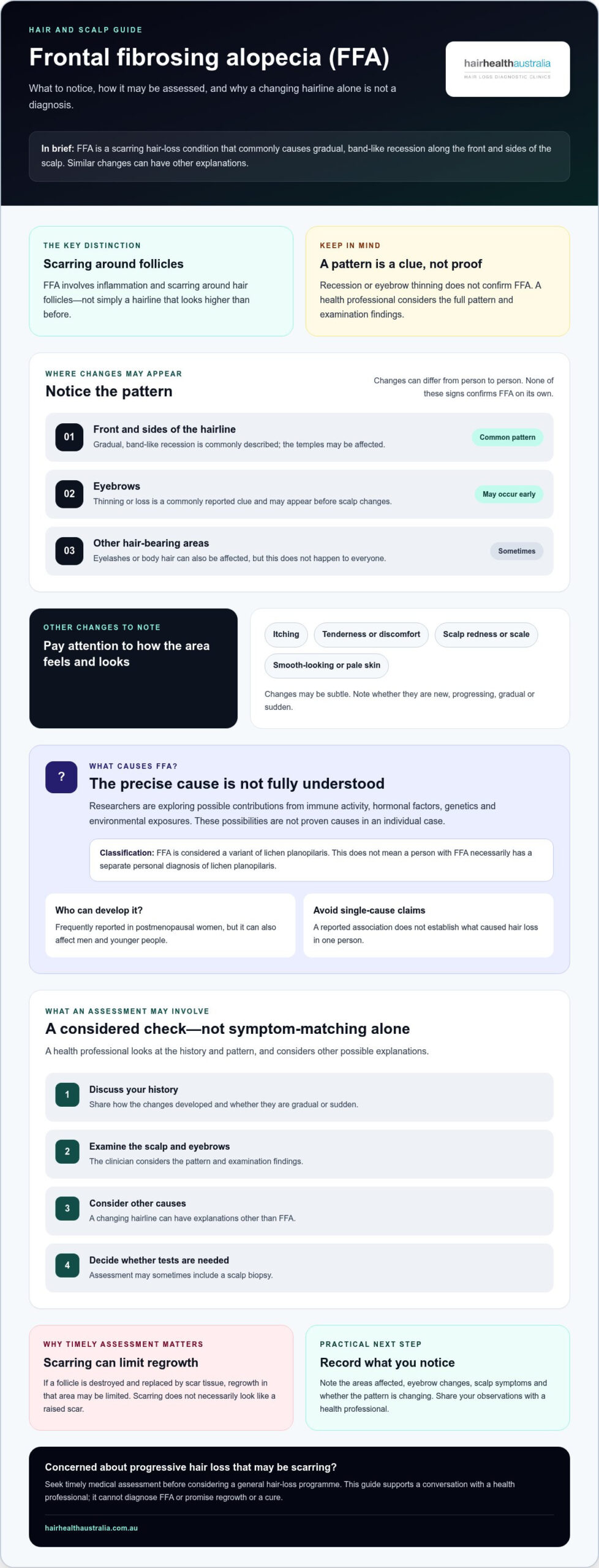
If you’re asking what is frontal fibrosing alopecia, the key distinction is that it involves inflammation and scarring around hair follicles, not simply a hairline that looks higher than before. Frontal fibrosing alopecia (FFA) is a scarring hair-loss condition that commonly causes gradual, band-like recession along the front and sides of the scalp. The change may become noticeable over time as the hairline shifts back, rather than as sudden, widespread shedding.
The pattern can be a useful clue, but it isn’t proof. A receding hairline can have other explanations, and FFA may look different from person to person. A clinician considers the pattern alongside other changes and examination findings. The overview of frontal fibrosing alopecia describes its presentation and possible differences from other hair-loss conditions, but it can’t determine what’s causing your hair changes.
What does the word scarring mean in frontal fibrosing alopecia?
In FFA, inflammation can damage follicles, the structures in the skin from which hairs grow. If a follicle is destroyed and replaced by scar tissue, regrowth in that area may be limited. This doesn’t necessarily look like a visible, raised scar. The skin can appear smooth or pale, and changes may be subtle. An early assessment can help a clinician check for signs of ongoing inflammation and consider whether the hair loss is scarring.
Which areas can frontal fibrosing alopecia affect?
FFA most often affects the frontal hairline and temples, sometimes leaving a narrow band of lost hair. Thinning or loss of eyebrow hair is another commonly reported clue, and in some people it appears before scalp changes. Eyelashes or body hair can also be affected, but this doesn’t happen to everyone. These signs deserve attention when they’re new or progressing, though none confirms FFA on its own.
Note where changes are occurring and whether they’re gradual or sudden. If you’re also trying to understand broader hair changes, read this guide to early signs of alopecia in women. For a changing hairline or eyebrow loss that raises concern about scarring, seek assessment from an appropriate medical professional rather than relying on appearance alone.
What causes frontal fibrosing alopecia, and who can develop it?
People often search for what is frontal fibrosing alopecia because they want to know why it has happened. The precise cause isn’t fully understood, and current evidence doesn’t point to one explanation for every person. Researchers are exploring possible contributions from immune activity, hormonal factors, genetics and environmental exposures. These possibilities shouldn’t be treated as proven causes in an individual case.
Clinically, FFA is considered a variant of lichen planopilaris, another type of scarring hair loss. This describes how specialists classify the condition. It doesn’t mean that someone with FFA necessarily has a separate personal diagnosis of lichen planopilaris. A clinician assesses the overall pattern and examination findings to consider what may be happening.
A risk association may help guide research, but it doesn’t prove what caused FFA in any one person. A reported link between a factor and the condition cannot, by itself, establish that the factor triggered someone’s hair loss. Avoid treating online claims about a single cause as a diagnosis or as a reason to make major changes without professional advice.
Is frontal fibrosing alopecia an autoimmune condition?
Immune involvement is suspected: inflammation around follicles may reflect the immune system contributing to follicle damage. However, describing FFA as definitively caused by autoimmunity would overstate what is known. Itching or hairline recession alone can’t establish the underlying mechanism. A clinician considers the full presentation, including how the changes developed and what an examination shows, rather than inferring a cause from one clue.
Can younger people and men develop FFA?
FFA is frequently reported in postmenopausal women, but it isn’t exclusive to this group. It can also affect men and younger people. If someone’s age or sex doesn’t match the pattern they’ve read about, that doesn’t rule FFA in or out. Less typical presentations are another reason to seek a considered assessment instead of relying on demographic assumptions or symptom-matching alone.
If you have broader questions about hair changes, Hair Health Australia’s Hair Health Check may be an option for discussing those concerns. It shouldn’t be treated as an FFA diagnostic service. If you suspect progressive scarring hair loss, seek appropriate medical assessment before considering a general hair-loss programme.
Could these signs be FFA, or another type of hair loss?
If you’re wondering what is frontal fibrosing alopecia based on changes you’ve noticed, remember that signs can suggest a possibility without proving it. Gradual change at the frontal or temple hairline, eyebrow thinning, or redness and scale around individual follicles may prompt an assessment. Itching, tenderness or discomfort can also occur, but some people have few or no symptoms.
Which early signs may prompt an assessment?
Look for changes over time rather than relying on one day’s appearance. A hairline that seems to be receding gradually, particularly alongside eyebrow thinning, is worth discussing with a health professional. A clinician may also look for perifollicular redness or scale, meaning irritation or flaking around hair follicles. Not having itch or tenderness doesn’t rule FFA out. You don’t need to wait for several signs to appear before seeking advice.
| Pattern or clue | What assessment may clarify |
|---|---|
| Gradual recession at the front or temples, sometimes with eyebrow thinning | Whether the distribution and progression fit a scarring pattern or another cause |
| Redness or scale around follicles, with possible itch or discomfort | Whether there are signs of inflammation, noting symptoms may be absent |
| Smooth patches, diffuse shedding or patterned thinning | Whether another type of hair loss may better explain the changes |
How is FFA different from alopecia areata or pattern hair loss?
FFA often involves a slowly receding band at the front or sides of the scalp. Alopecia areata may cause smooth, distinct patches, while pattern hair loss more often produces gradual thinning in a characteristic distribution. Diffuse shedding can have other explanations. These are general patterns, not rules. Conditions can overlap, and appearance alone may not distinguish them reliably.
A clinician may notice a “lonely-hair” sign, where isolated hairs remain in an area of recession. It’s a clinical clue, not a home diagnostic test, and it can’t confirm FFA on its own. Examination helps put such findings in context and assess other possible causes. If hairline or eyebrow changes are progressing, arrange an assessment rather than waiting for every sign in a checklist. Online comparisons can help you describe what you’ve noticed, but they can’t determine the diagnosis.
How is frontal fibrosing alopecia diagnosed?
Knowing what is frontal fibrosing alopecia helps explain why diagnosis involves more than comparing a hairline with a picture online. A clinician considers the pattern of hair loss, symptoms and examination findings together. They may ask when the changes began, whether they’re progressing, and about scalp or skin symptoms, relevant health history, and changes to eyebrows or other hair.
The assessment commonly follows four steps:
- Discuss the changes: Describe when you first noticed them and how they’ve changed, including any itch, tenderness or discomfort.
- Examine the scalp and eyebrows: The clinician checks the distribution of hair loss and the skin around the follicles.
- Consider other causes: Similar-looking changes can have different explanations, so your history and examination help guide the assessment.
- Decide whether tests are needed: Further investigation depends on how clear the findings are and whether confirmation is needed.
FFA diagnosis combines clinical findings and, when indicated, further investigations. A biopsy isn’t automatically required for everyone, and no specific test or outcome can be assumed before an individual assessment.
What happens during a scalp and hairline examination?
A clinician may inspect the hairline and temples, looking at the pattern of loss, follicle openings, and any redness or scale around follicles. They may also examine your eyebrows or other areas if you’ve noticed changes there. This helps place each clue in context, as a single feature doesn’t establish a diagnosis. The examination is guided by your symptoms and history.
When might dermoscopy or a biopsy be considered?
Dermoscopy is a magnified examination of the skin and scalp that lets a clinician view structures around hair follicles more closely. It may help assess signs such as redness or scale. If the findings remain uncertain, a scalp biopsy, in which a small skin sample is examined, may help clarify or confirm the diagnosis. Whether either is appropriate depends on the clinical assessment.
If you’re concerned about progressive hair loss that may be scarring, seek appropriate medical assessment. For broader hair concerns, you can also explore Hair Health Australia’s Hair Health Check as a way to discuss your concerns. It isn’t a confirmed FFA diagnostic service and doesn’t replace medical diagnosis.
What should you do if you suspect frontal fibrosing alopecia?
If you’ve been asking what is frontal fibrosing alopecia because your hairline or eyebrows are changing, the next step is an assessment, not a self-diagnosis. If hair loss appears progressive or may be scarring, arrange an appointment with an appropriate medical professional, such as your GP or a dermatologist. Early assessment can help clarify what’s happening and whether further investigation or management is appropriate.
Management depends on the individual findings. If FFA is diagnosed, a clinician may discuss options aimed at reducing inflammation or slowing further hair loss. These goals differ from restoring hair in areas where follicles have already been affected by scarring. Regrowth in those areas may not be possible, so treatment shouldn’t be understood as a guaranteed reversal or cure.
What questions should you take to an appointment?
A few notes can help you explain what you’ve noticed and make the conversation more useful. Consider recording:
- When you first noticed changes to your hairline or eyebrows, and whether they seem to be progressing.
- Any itch, tenderness, redness, scale or other skin changes, including when they occur.
- Relevant health history and any other changes to your hair or skin.
- Questions about which diagnoses are being considered, whether tests may help, and what follow-up is appropriate.
You could also take dated photos in consistent lighting to help describe changes over time. They won’t diagnose the cause, but may support a clearer discussion with your clinician.
Where can a Sydney reader start?
In Sydney, you can start by discussing your concerns with a GP, who can advise on appropriate next steps, including whether assessment by a dermatologist is suitable. Explain that you’re concerned about possible scarring hair loss. Hair Health Australia provides personalised, non-surgical hair-loss programmes for men and women, but it hasn’t been verified as offering FFA diagnosis or treatment. If scarring alopecia is suspected, medical assessment is important before considering a general hair-loss programme.
If you’d like to discuss broader hair concerns with Hair Health Australia, you can request a Hair Health Check. It isn’t a substitute for medical assessment or a confirmed diagnostic service for FFA. Seek appropriate medical advice about suspected scarring first, then consider what support may suit your wider hair-health concerns.
Take a measured next step for your hair health
Understanding what is frontal fibrosing alopecia can help you recognise why a changing hairline or thinning eyebrows may deserve attention, but these signs alone can’t confirm the cause. FFA involves scarring hair loss, and diagnosis depends on clinical assessment. If changes are progressing or you’re concerned about possible scarring, speak with an appropriate medical professional, such as your GP or a dermatologist.
Where FFA is diagnosed, management is individualised and may aim to reduce inflammation or slow further loss. It can’t be assumed to restore hair in areas already affected by scarring, so be wary of promises of a cure or guaranteed regrowth.
For broader hair concerns, Hair Health Australia provides personalised hair-loss services for men and women, including in Sydney. A Hair Health Check may offer an opportunity to discuss those concerns, but it isn’t a confirmed FFA diagnostic service and doesn’t replace medical assessment. Request a Hair Health Check to discuss your wider hair-health concerns. For suspected scarring, speak with a medical professional first.
Frequently Asked Questions
What is frontal fibrosing alopecia?
Frontal fibrosing alopecia (FFA) is a form of scarring hair loss that commonly affects the front and sides of the scalp. It can also involve the eyebrows and, less often, other body-hair areas. The pattern and symptoms vary between people. A clinician assesses the changes and considers other possible causes before confirming whether someone has FFA. A receding hairline or eyebrow thinning alone isn’t enough to diagnose it.
What are the first signs of frontal fibrosing alopecia?
Possible early signs include gradual recession at the front or temples, eyebrow thinning, and redness or scale around hair follicles. Some people also experience itch or tenderness, while others have little discomfort. These changes can have other causes, so they’re clues rather than proof of FFA. If you notice progressive changes, arrange a professional assessment instead of relying on an online checklist or waiting for every sign to appear.
Is frontal fibrosing alopecia permanent?
Hair loss caused by scarring may be permanent because affected follicles may not regrow hair. However, the course of FFA varies between individuals. If diagnosed, management may aim to reduce inflammation or slow further loss, rather than restore hair in areas already scarred. A clinician can discuss realistic expectations based on your findings. Be cautious of claims that promise a cure or guaranteed regrowth, as these outcomes can’t be assured.
Can frontal fibrosing alopecia affect younger people?
Yes. FFA is often reported in postmenopausal women, but it can also affect younger people and men. A person’s age doesn’t confirm or rule out the condition, and a changing hairline can have several explanations. If you notice progressive hairline recession or eyebrow changes, arrange an assessment with an appropriate medical professional. They can consider the pattern and your history rather than relying on age or online symptom lists alone.
Is frontal fibrosing alopecia the same as alopecia areata?
No. FFA and alopecia areata are different forms of hair loss, with different typical patterns and underlying processes. FFA commonly causes gradual recession at the front or sides of the hairline, while alopecia areata can cause smooth patches. These patterns aren’t definitive, and other scalp conditions can also affect hair. A clinician compares the distribution and examination findings to assess which explanation is most likely.
Should I see a doctor if my hairline is receding?
Consider seeking medical advice if recession is progressing, appears band-like, affects your eyebrows, or occurs with scalp redness, scale, itch or tenderness. These features don’t prove FFA, but assessment can help identify possible causes and appropriate next steps. In Sydney, you can start by discussing your concerns with a GP, who can advise whether further medical assessment is appropriate. Avoid starting treatment based only on an online description.