Your scalp needs sun protection before your hair lengths do. When coverage thins, the skin along your part or crown is more exposed to Australian UV, even if you’re already using products to protect your hair. Protecting thinning hair from sun damage starts with covering that exposed skin.
It’s understandable to wonder whether sun exposure is causing your hair to thin. UV can burn and damage the scalp, while also weakening the hair shaft, which may leave strands dry, brittle and more prone to breakage. These effects aren’t the same as ongoing hair loss, so it helps to address the exposed scalp first and understand changes in hair density separately.
This guide explains how to build a practical routine with physical cover and sunscreen for exposed areas, and how to reduce damage to your hair lengths. You’ll also learn when a changing scalp spot needs medical attention and when persistent thinning may warrant a clinical assessment. The aim is to help you protect your scalp with confidence while recognising that sun care and hair-loss advice are two different concerns.
Key Takeaways
- Protecting thinning hair from sun damage starts with covering exposed scalp skin, using a broad-brimmed UPF 50+ hat and sunscreen on areas the hat doesn’t cover.
- Check the UV forecast and reapply sunscreen every two hours during outdoor activities to help maintain protection.
- UV can affect scalp skin and hair fibres differently; dryness or breakage isn’t the same as a change in hair density.
- For a new or changing scalp spot, see your GP. Persistent thinning is a separate concern that may benefit from clinical assessment.
- A Hair Health Check uses microscopic Trichoscopy to assess active follicles and identify hair-loss type. It’s free, with no obligations, and takes ONLY 30 MINS.
How sun exposure affects thinning hair and the scalp
If your hair is thinning, a wider part, receding hairline or sparse crown can leave more scalp skin uncovered outdoors. That makes sun exposure a reasonable concern, but it helps to separate two different effects: UV can damage the hair fibre, and it can also affect the skin beneath it. One does not automatically explain the other.
Sun-exposed scalp skin is skin receiving UV through reduced hair coverage; sun-damaged hair fibres are strands whose outer structure has been weakened by UV. Protecting thinning hair from sun damage means recognising both concerns, rather than treating brittle hair as proof of a scalp or follicle problem.
What UV exposure can do to the hair shaft
The visible part of a hair strand is a fibre, not living tissue. With repeated UV exposure, its protective outer layer and keratin structure can be affected. Hair may feel drier or rougher, lose some of its smoothness and become more brittle, making breakage easier. Sunlight can also fade hair colour. Dyed or lightened hair may show colour changes more noticeably, although the degree varies with the hair and amount of exposure.
These changes concern the hair shaft, not necessarily the follicle beneath the skin. A strand that feels rough or snaps more readily is showing fibre damage; that observation alone can’t establish why hair density is changing. Visible damage to the lengths and ongoing thinning are separate clues, and each needs to be understood on its own terms.
Why thinning hair leaves more scalp exposed
Hair coverage isn’t uniform across the head. A part can widen, the temples may recede, or the crown can become sparse, leaving skin more directly exposed to sunlight. Even areas that look covered can have gaps between strands, and hair shifts with movement, wind or styling. Coverage can reduce exposure, but it shouldn’t be relied on as consistent sun protection for exposed skin.
The scalp can burn like other areas of skin. For a general explanation of sunburn on the scalp, see how UV exposure can cause an inflammatory skin response. A tender, red or peeling scalp after time outdoors may indicate sunburn, while changes to hair fibres may appear as dryness or breakage. These are different effects, even if they happen during the same day outside.
Pay attention to the skin itself, too. A new, changing or persistent spot on the scalp is not a hair-fibre issue, and it shouldn’t be assessed as part of a hair-regrowth consultation. Arrange advice from your GP about a spot that concerns you. If your main concern is persistent thinning, that is separate: UV-related hair-shaft changes don’t diagnose its cause or show whether follicles are affected.
Sun damage or hair loss: understand what thinning can tell you
Protecting your hair from UV is sensible, but it won’t diagnose why it’s thinning or reverse the underlying cause. Sun exposure can affect hair fibres and scalp skin; changes in hair density may have a different explanation. Keeping these observations separate helps you decide whether to adjust sun protection, seek medical advice or have persistent thinning assessed.
Sun protection and hair-loss assessment answer different questions: one reduces UV exposure, while the other investigates changes in hair density and their possible causes.
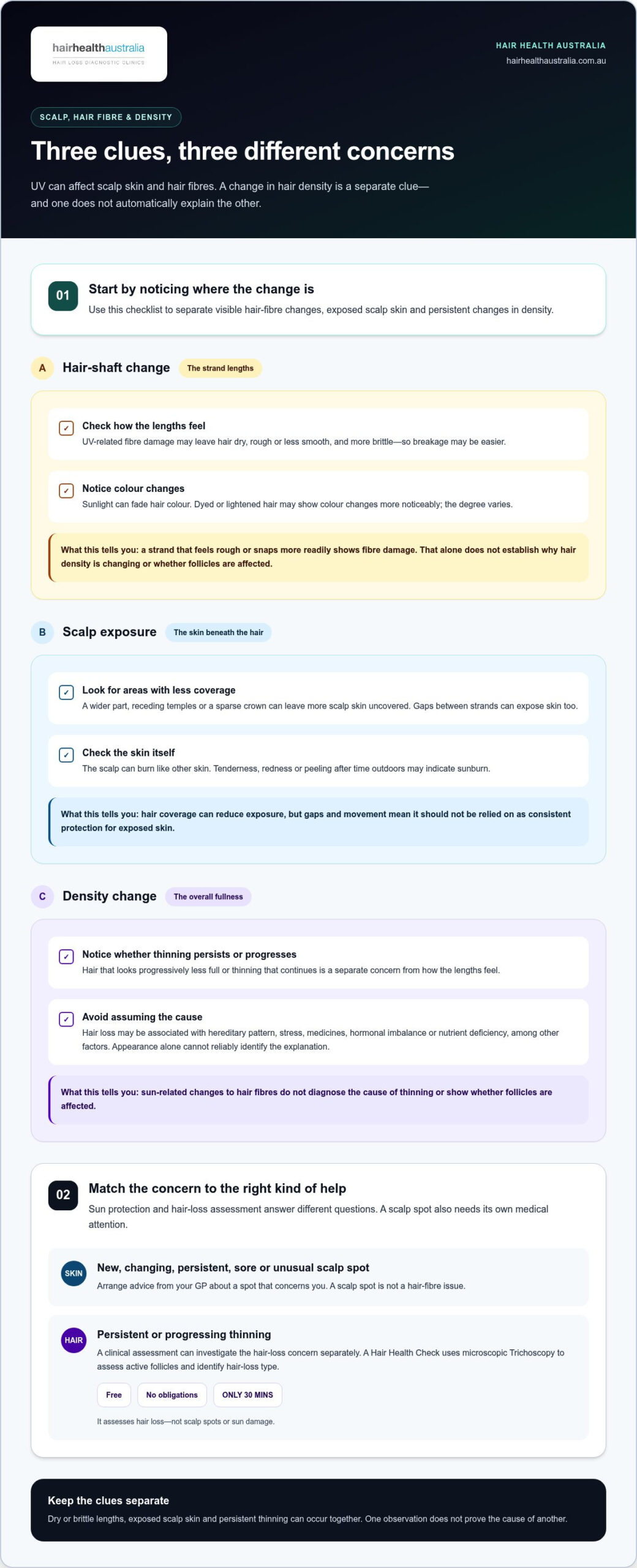
Notice which kind of change you’re seeing:
- Hair-shaft change: lengths feel dry, rough or brittle, or their colour looks faded.
- Scalp exposure: a wider part, receding areas or sparse coverage reveal more skin.
- Density change: hair looks progressively less full, or thinning persists regardless of how the lengths feel.
These signs can occur together, but one doesn’t prove the cause of another. Hair loss may be associated with hereditary pattern, stress, medicines, hormonal imbalance or nutrient deficiency, among other factors. Appearance alone can’t reliably identify which explanation applies, so avoid assuming that sun exposure is responsible simply because the scalp is more visible.
Signs that point to hair-shaft sun damage
UV-related fibre damage may show up as lengths that feel rough, dry or brittle, or as colour that appears faded. Dyed and lightened hair can show colour changes more clearly. These signs can coexist with thinning, but they don’t reveal why density has changed or whether follicles are affected. Cosmetic hair care may improve how lengths feel, but it shouldn’t be mistaken for a way to restore density.
A useful distinction is where the change occurs. If the strands feel different along their length, that suggests a hair-fibre concern. If the part appears wider or coverage continues to decrease, that’s a change in density worth considering separately. Neither observation alone is a diagnosis.
When thinning needs a separate assessment
If thinning is persistent or progressing, don’t assume better sun protection will explain or resolve it. A clinical assessment can investigate the hair-loss concern on its own terms. At Hair Health Australia, a free, no-obligation Hair Health Check uses microscopic Trichoscopy to assess active follicles and identify hair-loss type. It takes ONLY 30 MINS and can inform a customised treatment plan. It assesses hair loss, not scalp spots or sun damage.
For ongoing thinning, a Hair Health Check offers a separate way to investigate what may be contributing to hair loss. If you notice a new, changing, sore or unusual spot on your scalp, contact your GP for medical advice instead. A scalp spot and persistent thinning are distinct concerns, and they need the appropriate assessment.
Compare sun-protection options for a thinning scalp
For protecting thinning hair from sun damage, start with measures that shield exposed scalp skin. Hair-length products may help address fibre exposure, but they don’t replace a hat or sunscreen on bare skin. In Australia, Cancer Council guidance recommends sun protection when the UV Index is 3 or above. Check the local forecast before heading outdoors, including in Sydney, as conditions can change through the day.
| Option | Main purpose | How to use it |
|---|---|---|
| UPF 50+ hat | Physically covers scalp skin and hair. | Choose a well-fitting hat with a broad brim that shades the crown, hairline and ears. UPF 50 fabric is classified as excellent protection under the Australian and New Zealand standard and blocks about 98% of UV radiation. |
| Shade | Reduces direct sun exposure. | Use shade during outdoor activities, but don’t rely on it alone. UV can still reach you in shaded areas. |
| Timing | Helps limit time in stronger UV. | Check the UV Index and, where practical, plan outdoor tasks for times when UV is lower. A cooler or cloudy day doesn’t necessarily mean UV is low. |
| Scalp sunscreen | Protects exposed skin, including a part or sparse crown. | Use broad-spectrum, water-resistant SPF 50 or higher sunscreen on uncovered areas. Apply 20 minutes before going outdoors and reapply every two hours, following the product label. |
| Hair sunscreen or other hair products | Hair-care option for the lengths. | Use as directed for the hair, but don’t treat oils or cosmetic products as substitutes for scalp coverage or sunscreen. |
Hats, shade and timing: reduce direct exposure
A hat is a straightforward first layer, especially if your parting or crown is exposed. Check that it sits comfortably and covers the areas where hair is sparse. Shade can make a break outdoors more comfortable, while planning activities around the UV forecast helps reduce direct exposure. Neither removes all UV risk, so combine these steps when you’ll be outside for an extended period.
Sunscreen and hair products: match the product to the area
Apply sunscreen to visible scalp skin along the part, hairline or crown, taking care to cover the skin rather than only coating nearby strands. Hair can make application fiddly, so part it to reach the exposed area and follow the label for application and reapplication. A hair product labelled for UV protection is intended for hair care; it doesn’t substitute for sunscreen on exposed scalp skin. Keep the purpose clear: cover the scalp first, then consider the lengths.
Build a simple sun-protection routine for thinning hair
A routine doesn’t need to be complicated. Make checking UV and covering exposed scalp part of your everyday habits, then add a few practical steps before longer outdoor activities. For protecting thinning hair from sun damage, keep the priorities clear: shield scalp skin first, protect hair lengths separately, and reapply sunscreen as directed.
Before heading outdoors in Australia
Check your local UV Index forecast. Cancer Council Australia recommends sun protection when the UV Index is 3 or above, and advises using broad-spectrum, water-resistant SPF 50 or higher sunscreen. For an ordinary day, keep a hat and sunscreen accessible. Before a long walk, sport or day outdoors, allow time to apply sunscreen before leaving.
- Check the UV conditions. Look up the forecast for your location and plan ahead if UV is expected to reach 3 or above. Don’t use temperature or cloud cover alone to judge UV.
- Cover the exposed scalp. Put on a well-fitting broad-brimmed hat, paying attention to sparse areas and the crown. Shade is useful too, but treat it as an extra layer rather than a complete replacement for other protection.
- Apply sunscreen to uncovered skin. Part the hair where needed and cover the visible scalp, including the parting, hairline and crown. Cancer Council guidance is to apply sunscreen 20 minutes before going outdoors. Follow the product label, and take care not to miss narrow strips of skin between strands.
- Consider the hair lengths. If you use a hair product intended to protect lengths, apply it according to its directions. It complements scalp protection; it doesn’t take the place of a hat or sunscreen on exposed skin.
During and after time in the sun
For a brief daily outing, checking the forecast and covering exposed areas can make the routine manageable. On a longer outdoor day, carry sunscreen so you can reapply it every two hours, as Cancer Council recommends, and follow the label. If you swim or continue spending time outside, return to shade or put your hat back on, and reapply sunscreen according to its directions.
Use a quick scalp check when you adjust your hat or reapply: look along the part, around the hairline and over the crown. If sunscreen or hair product makes a visible part difficult to see, gently separate the hair to check the skin underneath. This helps you catch missed areas rather than relying on memory.
Afterwards, wash gently if needed and condition the lengths to help them feel softer. This can support comfort and manageability, but it can’t undo UV exposure. If thinning persists or progresses, a separate hair-loss assessment may help identify its type. Hair Health Australia’s Hair Health Check uses microscopic Trichoscopy to assess active follicles. It’s free, with no obligations, and takes ONLY 30 MINS.
When to seek help for thinning hair or scalp changes
Sun protection helps reduce UV exposure, but it can’t explain why hair is thinning. Persistent or progressive thinning may have several causes, including hereditary pattern, stress, medicines, hormonal changes or nutrient deficiency. If you’ve noticed ongoing changes in density, consider a hair-loss assessment rather than assuming sun exposure is the cause.
Keep scalp skin concerns separate. If you find a new, changing, sore or unusual spot, contact your GP for medical advice. A hair-regrowth consultation is not a skin examination, and a hair-loss check isn’t intended to assess a spot for sun damage. Having the right concern assessed in the right setting helps avoid confusion.
What a clinical hair-loss check can clarify
Hair Health Australia’s Hair Health Check focuses on hair loss, not sun damage. It includes microscopic Trichoscopy, a scan used to assess active follicles and help identify hair-loss type, alongside a clinical diagnosis. The check is free, with no cost and no obligations, and takes ONLY 30 MINS.
This assessment can help distinguish ongoing changes in density from damage to the visible hair lengths. It doesn’t assess scalp spots or determine whether a particular spot is caused by UV exposure. For a spot that concerns you, your GP is the appropriate next step.
A clear next step for ongoing thinning
If thinning continues, an assessment can provide a clearer starting point than trying to infer the cause from dryness, breakage or scalp exposure alone. Trichoscopy findings and the clinical diagnosis help inform recommendations tailored to individual results. Any treatment discussion is separate from sun care: the Hair Health Check doesn’t prevent or treat UV damage to the scalp or hair fibres.
Before an assessment, it may help to note when you first noticed the thinning and whether it seems to be changing. You can also mention relevant medicines or health changes to the clinician, as these may be useful context. Avoid stopping prescribed medicines or starting supplements based on appearance alone; discuss those questions with an appropriate health professional.
If ongoing thinning is your concern, book your free Hair Health Check to discuss a clinical assessment of hair-loss type and active follicles. Hair Health Australia’s clinic is in Redfern, Sydney. Keep protecting exposed scalp skin outdoors, and seek GP advice separately for any new or changing spot.
Make scalp protection part of your routine
Small, repeatable habits can make sun care easier to maintain. Keep your hat and sunscreen where you’ll remember them, and build a quick scalp check into getting ready to head outdoors. If your hair continues to thin, treat that as a separate concern rather than assuming sun exposure explains it. A clear assessment can help you understand what to consider next.
Hair Health Australia’s free, no-obligation Hair Health Check uses microscopic Trichoscopy to assess active follicles and diagnose hair-loss type. It takes ONLY 30 MINS. This is a clinical assessment of hair loss, not sun-damage care or an examination of scalp spots. For a new or changing spot, speak with your GP.
If persistent thinning is on your mind, book your free Hair Health Check at Hair Health Australia in Redfern, Sydney. The microscopic scan and clinical diagnosis provide a clear starting point for discussing recommendations customised to your diagnostic results. Keep protecting your scalp outdoors, and take the next step towards understanding your hair loss.
Frequently Asked Questions
Can the sun cause thinning hair?
Sun exposure usually damages the hair shaft or scalp skin, rather than directly causing ongoing follicle-related hair loss. A severe scalp sunburn may trigger temporary shedding in some cases, which can become noticeable a few months later. That doesn’t mean UV is the cause of every thinning pattern. If your hair density keeps changing, consider other possible causes and seek an assessment rather than relying on sun protection to explain it.
How do I protect my scalp from the sun if my hair is thinning?
Cover sparse areas with a broad-brimmed hat and apply sunscreen to exposed scalp skin, including the parting or crown. Check the local UV Index before outdoor plans and use shade as an additional measure. If you’ll be outside for an extended period, carry sunscreen for reapplication. A quick check in a mirror can help you spot uncovered strips around the hairline.
Is sunscreen safe to apply to the scalp?
Yes, sunscreen intended for skin can generally be applied to exposed scalp areas, provided you follow its label directions. Part the hair so you can apply it to the skin rather than only coating strands, and avoid getting it in your eyes. If a particular formulation irritates your skin, stop using it and seek advice from a pharmacist or GP. Sunscreen protects exposed skin; hair products serve a different purpose.
Does a hat protect thinning hair from UV damage?
A hat can cover both the scalp and hair, reducing direct exposure while you’re wearing it. For more reliable coverage, choose a well-fitting broad-brimmed style that shades the crown, hairline, ears and neck. A cap may leave parts of the scalp or sides uncovered, so use sunscreen on exposed skin as well. Hats can shift during a walk or outdoor activity, so check that sparse areas remain covered.
What are signs of sun damage on the scalp?
A sunburnt scalp may feel tender, look red or become dry and peel, though redness can be harder to see on some skin tones. Blistering or significant pain after exposure warrants prompt medical advice. Separately, keep an eye out for a new or changing spot, a sore area that doesn’t settle, or a mark that looks unusual for you. Ask your GP to assess skin changes rather than treating them as a hair-loss concern.
Can sun-damaged hair grow back?
Hair fibres that have become rough, brittle or faded don’t heal themselves, because the visible strand isn’t living tissue. Gentle washing and conditioning may improve how the lengths feel, but they won’t restore a damaged strand to its original state. Hair grows from follicles in the scalp, so new growth depends on follicle activity. If the issue is reduced density rather than damaged lengths, a separate hair-loss assessment can help clarify the concern.
When should I get thinning hair checked?
Arrange an assessment if thinning persists, progresses or concerns you, particularly if you can see a gradual change in your part, temples or crown. Hair loss can have several causes, so don’t assume sun exposure explains it. Hair Health Australia’s Hair Health Check in Sydney uses microscopic Trichoscopy to assess active follicles and diagnose hair-loss type. It’s free, with no obligations, and takes ONLY 30 MINS. For a new or changing scalp spot, see your GP.