Male diffuse thinning treatment: understand the cause before choosing a solution

Could choosing a male diffuse thinning treatment before understanding the cause lead you down the wrong path? Noticing less density across your scalp can be unsettling, especially when it’s unclear whether the change has been gradual or sudden. Online advice can add to the confusion, with different claims about results, side effects and long-term commitment.

The right next step is to understand what may be driving the thinning. Diffuse hair loss can have different causes, and the pattern, timing and changes in your health or routine can all help guide an assessment. A treatment that may suit one cause might not be appropriate for another.

This article explains why individual assessment matters, what information to bring to a hair health appointment and what questions to ask a professional in Sydney. You’ll also learn how to compare treatment pathways, including non-surgical options, with realistic expectations. Hair Health Australia provides personalised male hair-loss treatment in Sydney, but no approach can promise regrowth or a particular result. A clear discussion of your concerns, possible options and potential risks can help you make an informed decision.

Key Takeaways

  • Compare changes in density across your scalp with older photos to help describe the pattern and when you first noticed it.
  • Genetic pattern hair loss and temporary shedding are among the possible causes, so a similar appearance doesn’t confirm the reason.
  • Bring notes about your thinning timeline, symptoms and relevant health changes to an assessment.
  • Discuss how each male diffuse thinning treatment option relates to the suspected cause, including its limitations and potential risks.
  • Use your appointment in Sydney to ask what assessment involves, what options may suit you and what expectations are realistic.

What male diffuse thinning looks like, and why the pattern matters

Thinning across the scalp can feel different from watching the hairline recede. You may notice less coverage over a wider area, rather than a clear change at the temples. The pattern can offer useful clues, but appearance alone can’t identify the cause or show which male diffuse thinning treatment may be suitable.

Pattern vs cause

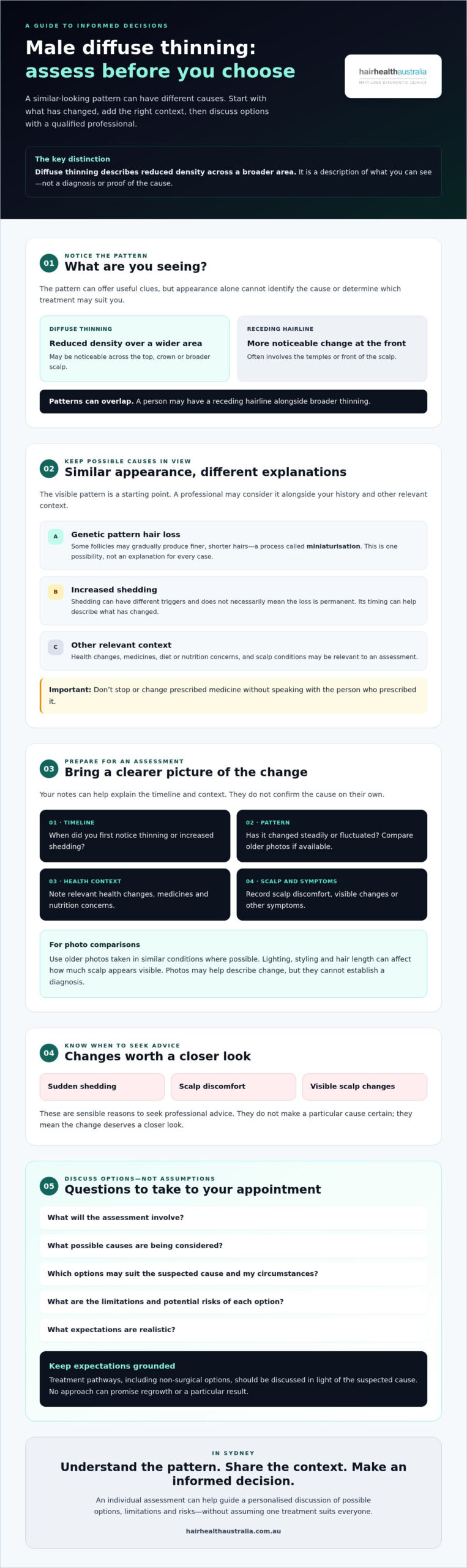
Diffuse thinning describes reduced hair density across a broader scalp area. It’s a way of describing what you can see, not a diagnosis. The underlying cause needs to be considered separately.

How diffuse thinning differs from a receding hairline

A receding hairline usually involves more noticeable change around the temples or front of the scalp. With diffuse thinning, reduced density may be easier to spot across the top or crown, or over a wider area. Individual patterns vary, and the two can overlap: a person may have a receding hairline alongside broader thinning. For background on one common form of patterned loss, see Pattern hair loss. A guide to men’s hair-loss patterns can offer a closer comparison.

What changes should prompt closer attention?

Note when you first noticed the change and whether it has continued steadily or fluctuated. You could also record whether you’ve seen more hair shedding than usual, and when it began. These details help describe what’s happening, but can’t confirm the reason on their own.

Sudden shedding, scalp discomfort or visible changes to the scalp are sensible reasons to seek professional advice. This doesn’t mean a particular cause is certain; it means the change deserves a closer look. A professional can consider the pattern alongside your history and other relevant context before discussing next steps. In Sydney, a hair health check can provide an opportunity to discuss your individual pattern and possible options.

Why male diffuse thinning can have more than one cause

A similar spread of reduced density can develop through different processes. Genetic pattern hair loss may gradually affect follicle growth, while increased shedding can make hair look thinner over a shorter period. Health changes, medicines, nutrition and scalp conditions may also be relevant context for a professional assessment. The visible pattern is a starting point, not enough information to select a treatment.

Appearance alone cannot confirm the cause of diffuse thinning. That distinction matters because a male diffuse thinning treatment should be considered in light of the suspected cause, your health history and individual circumstances, rather than chosen from appearance alone.

Gradual thinning and hair follicle miniaturisation

With genetic pattern hair loss, some follicles can gradually produce finer, shorter hairs. This process is called miniaturisation. As the hairs become less substantial, overall coverage may reduce, sometimes without a clearly defined bald patch. Genetic hair loss is one possibility, not an explanation for every case of diffuse thinning.

Slow changes can be hard to recognise from day to day. Hair length, styling and lighting can also affect how much scalp appears visible. Consistent photos taken in similar conditions may help you describe changes over time, but they can’t establish a diagnosis.

Shedding, health changes and other possible contributors

Increased shedding can have different triggers and doesn’t necessarily mean the loss is permanent. A qualified health professional can consider whether the timing might relate to changes in your health, medicines, diet or scalp, among other factors. Don’t stop or alter prescribed medicine without speaking with the person who prescribed it.

Before an appointment, note when shedding or thinning began and list relevant health changes, medicines and nutrition concerns. Share any scalp symptoms or visible changes, too. These details provide context, but don’t prove a cause. Any specific cause, need for tests or likely recovery timeframe depends on individual assessment and should be discussed with a qualified professional.

If you’re unsure what your pattern may indicate, a hair health check can be a starting point for discussing your concerns and possible next steps. Assessment can help guide a personalised approach, without assuming that one treatment will suit everyone.

How to assess male diffuse thinning before choosing treatment

Choosing a treatment before the cause is reasonably understood can lead to a poor fit. A male diffuse thinning treatment should be considered in context: the pattern, how it has changed, your health history and any scalp symptoms all matter. A professional may review your history and scalp findings, but the assessment process can vary. Ask what each step can and can’t establish.

What information to prepare before an appointment

A few clear notes can make the conversation more useful. Use this framework to organise what you’ve noticed:

  1. Pattern: Note where density seems reduced, such as across the top, crown or a wider area. Mention whether the hairline has changed as well.
  2. Timeline: Record when thinning or shedding began and whether it has continued steadily, appeared suddenly or fluctuated. Photos taken in similar conditions may help you compare changes over time.
  3. Symptoms: Write down any scalp discomfort or visible changes, and when they occur.
  4. Health context: Bring a current list of medicines and supplements, and note relevant health or nutrition changes. Don’t stop prescribed medicine without advice from the prescriber.

Prepare questions, too: What possible causes fit my pattern? What remains uncertain? Which options may be suitable, and what risks, limitations or follow-up should I understand?

What an individualised assessment should clarify

Ask how your history and observed pattern inform the working explanation, and which findings support it. A scalp image, scan or single test shouldn’t be assumed to identify every possible cause. If the picture is unclear, ask whether further medical advice or assessment is appropriate before deciding on treatment.

Assessment methods differ, so check what a provider uses and what the results can tell you. For more background on one technique, consult a guide to microscopic hair analysis, while keeping in mind that a single method doesn’t replace consideration of your wider history. Specialised services such as rootedscalpclinic.co.uk illustrate how personalised scalp analysis can also be paired with cosmetic solutions to achieve fuller-looking hair.

The aim isn’t to force a quick answer. It’s to understand what is known, what needs further review and why a particular option is being discussed. In Sydney, a hair health check can be a starting point for discussing your individual pattern and possible next steps.
Male diffuse thinning treatment: understand the cause before choosing a solution

Male diffuse thinning treatment options: compare them by cause and suitability

There isn’t one treatment pathway for every pattern of diffuse thinning. Options depend on the suspected cause, your health circumstances and what an appropriate professional considers suitable. Use this comparison to prepare questions, not to self-diagnose or choose treatment without advice.

Treatment category Intended context Discussion points Limitations
Clinician-guided treatment for genetic pattern loss When assessment supports a pattern consistent with genetic hair loss Ask about suitability, potential side effects, precautions, monitoring and ongoing commitment. May not address other causes of shedding; response and suitability vary between individuals.
Management of an identified health or nutritional contributor When history or professional assessment suggests a relevant factor to investigate or address Discuss what evidence supports the suspected contributor and whether medical follow-up is appropriate. Changing supplements or medicines without advice may be unsuitable; improvement cannot be assumed.
Care for a scalp condition When scalp symptoms or findings need professional review Ask what the findings suggest and whether a qualified health professional should assess them. A visible scalp change alone doesn’t confirm a specific condition or treatment.
Observation and review When the cause or pattern remains uncertain and monitoring is recommended Agree what changes to track and when to seek further advice. Monitoring doesn’t establish a diagnosis or guarantee that thinning will resolve.

Questions to ask about clinician-guided options

For any proposed male diffuse thinning treatment, ask why it fits your assessed pattern and what alternatives have been considered. Discuss possible side effects, contraindications, follow-up and ongoing commitment before deciding. Specific medicines, precautions and availability should be checked against current Australian guidance with an appropriate health professional. Don’t self-prescribe or change prescribed treatment based on online advice.

Be cautious of one-size-fits-all promises

An option considered for genetic pattern loss may not address shedding linked to another factor. Be wary of guarantees, dramatic timelines or testimonials presented as evidence of what will happen for you. A more useful conversation explains the reasoning, uncertainties and realistic limits of each option. For broader context, consult a clinical hair-treatment guide or an Australian hair-regrowth reference, and check that information against current professional advice.

Hair Health Australia offers personalised, non-surgical hair-loss treatment programmes in Sydney. To discuss your individual pattern and possible next steps, arrange a hair health check. Assessment can help inform a plan, but no particular result can be promised.

Your next steps for male diffuse thinning treatment in Sydney

If you’re weighing up what to do next, you don’t need to arrive with a diagnosis or a preferred treatment. The useful first step is to understand what the thinning may relate to and what information could guide a suitable discussion. An assessment may be worth considering if the change concerns you, is continuing or is accompanied by symptoms. If you’re unsure, you can still ask what kind of advice is appropriate.

Questions to ask before starting a treatment programme

Use an appointment to understand the reasoning behind any proposed plan, not just its name. These questions can help you make a considered decision:

  • What pattern or possible cause is this programme intended to address? Ask how your history and observed changes inform that explanation.
  • What information is needed to personalise recommendations? Find out whether you should bring notes about timing, health changes, medicines or supplements.
  • What are the limitations and potential risks? Ask what the approach may not address, what concerns to watch for and when to seek further advice.
  • How will progress be reviewed? Clarify what follow-up involves, what changes will be considered and who to contact if you have concerns.

You can also ask what remains uncertain. A clear explanation should distinguish between what is known about your situation and what would need further professional input. Take time to consider the answers before committing to a plan.

How to take the next step with Hair Health Australia

Hair Health Australia provides personalised, non-surgical male hair-loss treatment in Sydney. A hair health check can be a starting point to discuss your individual pattern and possible next steps. It’s reasonable to ask what information is needed, what the check can help explore and whether further medical advice may be appropriate. No single approach suits everyone, and a discussion should not be taken as a promise of regrowth or a particular result.

If you’re ready to explore your options, complete a hair health check. It can help open a conversation about whether a personalised male diffuse thinning treatment pathway may be relevant to your circumstances. From there, decisions can be made with realistic expectations, based on your needs rather than a one-size-fits-all claim.

Make your next step an informed one

Diffuse thinning describes a change in hair density, not the reason behind it. Because similar patterns can have different causes, the most useful next step is to discuss your timeline, symptoms and relevant health context with a professional before choosing a male diffuse thinning treatment.

In Sydney, Hair Health Australia offers personalised, non-surgical male hair-loss treatment programmes. A hair health check can help you discuss your individual pattern and explore possible next steps. Ask what an option is intended to address, what its limitations may be and how progress would be reviewed. No treatment can guarantee regrowth or a particular outcome, so clear information and realistic expectations matter.

Ready to start that conversation? Complete a hair health check to discuss your next steps with Hair Health Australia. You can take things one informed decision at a time.

Frequently Asked Questions

What causes diffuse thinning in men?

Diffuse thinning in men can have several possible contributors, including genetic hair loss, increased shedding, health changes, medicines or scalp conditions. The visible pattern alone can’t confirm which explanation applies. A professional can consider when the change began, your health history and scalp findings before discussing options. Bring a current list of medicines and supplements, and don’t start or stop prescribed medicines based only on online information. Ask an appropriate health professional for advice about your circumstances.

Can diffuse thinning in men grow back?

Whether hair density improves depends on the cause, how long the change has been present and how you respond to an appropriate plan. Some shedding may be temporary, while other forms of hair loss may need ongoing management. No treatment can guarantee regrowth for every person. Ask a qualified professional what outcomes are realistic in your case, what limitations to expect and how progress would be reviewed. If the cause is unclear, discuss that before choosing an approach.

Is diffuse thinning the same as male pattern baldness?

No. Diffuse thinning describes reduced density across a broader area, while male pattern hair loss often follows recognisable patterns. However, patterns can overlap, and different causes may look similar. A label or photograph can’t confirm what’s causing your thinning. If the change is new, progressing quickly or accompanied by scalp symptoms, seek professional advice. Describe when you first noticed it and how it has changed, rather than relying on appearance alone to choose a treatment.

How is diffuse thinning diagnosed?

Assessment usually begins with questions about when thinning started, how it has changed, your health history and relevant medicines. A professional may also examine your hair and scalp, and consider further checks if appropriate. The process depends on your circumstances and the provider, so ask what an appointment includes and what its findings can establish. No single visual check should be treated as a guaranteed way to identify every possible cause.

What is the best treatment for male diffuse thinning?

There’s no single best option for everyone. A suitable male diffuse thinning treatment depends on the likely cause, your health context, preferences and potential risks. Ask a qualified professional why an option may suit your situation, what limitations or side effects to consider, and how its suitability will be reviewed. Be cautious of guaranteed results or recommendations made without considering your circumstances. Treatment choices should follow an individual discussion, not a one-size-fits-all claim.

When should I seek professional advice about diffuse thinning?

Consider seeking advice if thinning persists, changes, causes concern or is difficult to explain, particularly if it begins suddenly or occurs with scalp symptoms or other health changes. This doesn’t automatically mean the cause is serious, but a discussion may help clarify what to consider next. In Sydney, Hair Health Australia’s hair health check can help you explore your individual pattern and possible next steps. Ask what the check can clarify and whether further medical advice may be appropriate.
Hair Transplant vs Non-Surgical Cost Comparison: 2026 Australian Guide

What if the A$18,000 you spend on a hair transplant is actually just the down payment on a lifetime of additional maintenance? Many Australians facing thinning hair experience immediate sticker shock when they see surgical quotes ranging from A$8,000 to A$30,000. When conducting a hair transplant vs non-surgical cost comparison, it’s natural to feel hesitant. You’re likely weighing these high costs against fears of “pluggy” results or permanent scarring while trying to understand which path offers the best long-term value for your hair health.

This 2026 guide provides a definitive financial roadmap to help you find the best path for your scalp and your budget. We believe in replacing uncertainty with clinical clarity. You’ll discover the true cost of surgical grafts in Sydney, the biological benefits of non-surgical programmes, and why protecting your existing follicles is the most cost-effective strategy you can adopt. We’ll break down the hidden expenses of surgery and the reality of ongoing clinical care so you can make an informed decision with confidence. It’s time to move past the confusion and focus on results that last.

Key Takeaways

  • Analyse the significant difference in upfront investment between five-figure surgical quotes and the accessible entry costs of clinical regrowth programmes.
  • Conduct a comprehensive hair transplant vs non-surgical cost comparison that accounts for hidden expenses like “shock loss” and the high probability of needing secondary procedures.
  • Understand the biological advantage of non-surgical treatments which focus on stabilising and thickening your existing hair to prevent further loss.
  • Compare the long-term value and risk profiles of invasive surgical relocation against the gradual, evidence-based density restoration of clinical therapies.
  • Discover how a professional Hair Health Check at our Sydney clinic provides the diagnostic clarity needed to avoid costly mistakes and choose the right path for your scalp.

The Upfront Price Tag: Hair Transplant vs Non-Surgical Clinical Programmes

Choosing between a permanent surgical procedure and a clinical regrowth programme starts with understanding the immediate financial commitment. When you evaluate a hair transplant vs non-surgical cost comparison, the most striking difference is the capital required on day one. Surgery is a front-loaded investment, often demanding a five-figure sum before the first incision is made. Clinical programmes, by contrast, allow for a phased approach that prioritises diagnostic accuracy before any long-term financial commitment is finalised.

Initial Surgical Costs in Australia

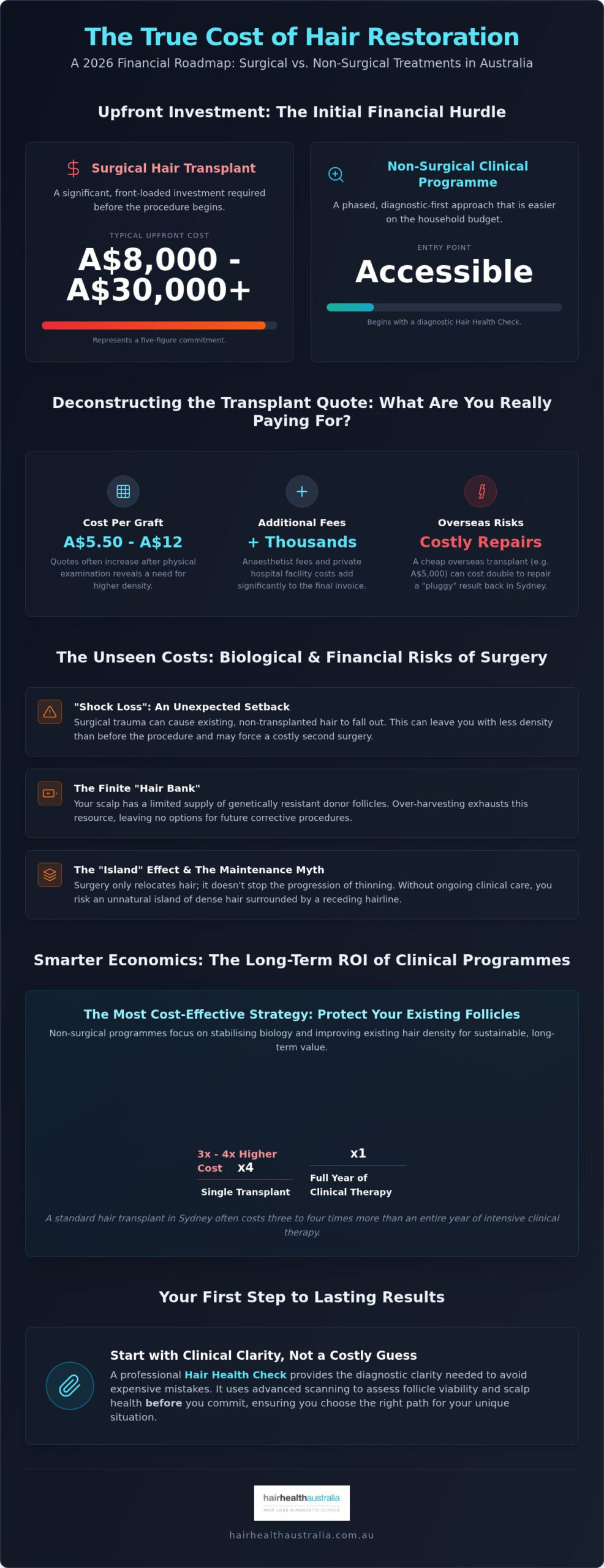
In 2026, Australian clinics typically charge between A$8,000 and A$30,000 for a transplant. This price depends heavily on the technique chosen; Follicular Unit Extraction (FUE) is generally more expensive than Follicular Unit Transplantation (FUT) because it’s a more labour-intensive process. You can expect to pay between A$5.50 and A$12 per graft. However, the quote you receive for 2,000 grafts often increases after a physical examination. Surgeons may identify that higher density is required to achieve a natural look, especially if Pattern hair loss has progressed further than initially thought. Beyond the surgeon’s fee, you must account for anaesthetist fees and private hospital facility costs, which can add thousands to the final invoice.

Clinical Programme Entry Points

Clinical programmes offer a more accessible entry point for those who aren’t ready for a surgical bill. The journey begins with a comprehensive Hair Health Check. This diagnostic phase uses advanced scanning to assess follicle viability and scalp health. In Sydney, these programmes are often structured as staged investments, which is easier on the household budget than a single surgical bill. You might start with a specialised treatment kit or opt for monthly clinical sessions. This allows you to monitor progress and adjust your investment based on real-time biological responses rather than committing to a massive upfront cost.

The “sticker shock” of Australian prices leads many to consider overseas options in Turkey or Thailand. While a A$5,000 transplant sounds appealing, the long-term cost of repairing a “pluggy” or over-harvested donor area in Sydney can easily double your original budget. A single standard hair transplant in Sydney often costs three to four times more than an entire year of intensive clinical therapy.

The Hidden Costs of Hair Transplant Surgery in Australia

Surgery is not merely a financial transaction; it is a biological exchange. When you perform a hair transplant vs non-surgical cost comparison, the initial invoice is only the beginning of the investment. One often overlooked reality is “shock loss”, a condition where the trauma of surgery causes existing, non-transplanted hair to fall out. This can leave you with less density than you had before the procedure, potentially forcing you into a second surgery much sooner than you anticipated.

There is also the finite nature of donor hair to consider. Your scalp has a limited supply of follicles that are genetically resistant to thinning. If a surgeon over-harvests this area, you have effectively exhausted your “hair bank”. Unlike a bank account, you cannot deposit more follicles later. If the results are unsatisfactory or your natural recession continues, you may lack the resources for a corrective procedure. This is why many Male pattern baldness treatments involve ongoing clinical care even after a successful transplant.

The Maintenance Myth of Surgery

Many patients believe surgery eliminates the need for daily maintenance. In reality, reputable surgeons almost always prescribe clinical-grade topical treatments post-operatively. They do this because surgery only relocates hair; it does not stop the biological progression of thinning in the surrounding areas. If you stop clinical care, you risk developing an unnatural “island” of transplanted hair surrounded by a receding hairline. The financial impact of this “patchy” look often leads to expensive corrective surgeries or a permanent reliance on clinical programmes you could have started years earlier.

Recovery and Downtime Expenses

The total cost includes more than just the medical bill. Recovery requires significant downtime, often necessitating up to two weeks off work to allow the grafts to take and the swelling to subside. For those travelling to see a Sydney-based specialist, accommodation and travel for follow-up reviews add further strain to the budget. There is also a psychological cost during the “ugly duckling” phase, where transplanted hair falls out before new growth begins. Before committing to such an intensive and invasive process, a Hair Health Check is a vital step to see if your goals can be achieved through non-invasive means.

Investing in Biology: The Long-Term ROI of Non-Surgical Regrowth

While surgery attempts to relocate hair, clinical programmes focus on a biological investment in your existing follicles. The goal is to stabilise thinning and thicken miniaturised hairs before they are lost permanently. When you look at a hair transplant vs non-surgical cost comparison over a five-year horizon, the financial logic shifts. A single surgical session in Sydney might cost A$15,000 upfront, but if your natural hair continues to thin around the grafts, you may face another A$10,000 for a second procedure within three years. Clinical programmes provide a steady, predictable investment that protects the hair you already have.

The true return on investment for hair restoration is measured by the preservation of your natural density, which provides a foundation for all future aesthetic options. For many, especially when exploring treatments for female pattern hair loss, a non-invasive approach is often the most sustainable path. By focusing on the underlying health of the follicle, you aren’t just buying a temporary fix; you’re investing in a biological asset that appreciates as your density improves.

Scalp Health as a Financial Asset

A healthy scalp environment is the bedrock of hair density and serves as a significant financial asset. Microscopic analysis allows us to identify specific issues like inflammation or clogged follicles that might be hindering growth. This diagnostic precision prevents you from wasting money on generic, ineffective products that don’t address your specific biological needs. By maintaining optimal scalp health, you “future-proof” your hair and reduce the likelihood of needing aggressive, high-cost interventions later in life. It’s a proactive strategy that values prevention over expensive repairs.

The Flexibility of Clinical Programmes

Unlike the “all-in” financial risk of a surgical day, clinical restoration offers remarkable flexibility. You can scale your investment based on real-time results. If your hair responds exceptionally well to initial phases, your maintenance requirements may adjust over time. This staged approach ensures that every dollar spent is tied to a measurable biological outcome. You can learn about our clinical hair restoration approach to see how we tailor these protocols to your individual needs. This method avoids the high-stakes gamble of surgery and replaces it with a systematic, evidence-based progression.

Hair Transplant vs Non-Surgical Cost Comparison: 2026 Australian Guide

Decision Matrix: Assessing Value Beyond the Dollar Amount

Evaluating value requires looking past the initial invoice. While a hair transplant vs non-surgical cost comparison often focuses on the price per graft, the real metric is the long-term impact on your lifestyle and health. Surgery offers a perceived “instant” fix, yet the final aesthetic result isn’t visible for at least 12 months. Clinical programmes require a simple daily commitment but offer a gradual, natural restoration of density without the risks of anaesthesia or surgical scarring. Your choice depends on whether you prefer a high-stakes surgical event or a systematic, biological approach.

When is Surgery the Wrong Investment?

Surgery is often a poor investment if your hair loss is still active and aggressive. Operating on an unstable scalp is a significant financial gamble. You may lose the native hair surrounding the new grafts within months, leading to a patchy and unnatural appearance. We frequently advise young men in Sydney to avoid early surgery. Their hair loss patterns aren’t yet established. This makes it impossible for a surgeon to predict where future thinning will occur. Stabilising your condition clinically is the only way to ensure any future surgical work isn’t undermined by ongoing recession. It’s a safer bet for your budget and your biology.

The Case for Non-Surgical Priority

Prioritising clinical restoration allows you to maximise your native hair density. This reduces the total “area” that might eventually require surgical coverage. In many cases, it can save you thousands of dollars in future graft costs by making surgery unnecessary or much smaller in scale. There’s also immense peace of mind in choosing a non-invasive path that doesn’t involve a painful recovery phase. You can Check the signs of male pattern thinning to see if your current stage is better suited for biological restoration.

The Sydney factor is also vital for long-term success. Being close to your specialist allows for regular progress monitoring and diagnostic scans. This ensures your protocol is working as intended. This local connection allows for adjustments that a one-off surgical session cannot provide. If you’re ready to see exactly where your hair health stands before making a major financial commitment, booking a Hair Health Check is your most logical first step.

Self-diagnosing hair loss based on internet research or forum anecdotes is a significant financial risk. While a hair transplant vs non-surgical cost comparison provides a broad framework, it cannot account for your unique biological profile. Choosing a restoration path without a clinical diagnosis is like buying a car without checking the engine; you might pay for an expensive exterior while the underlying mechanics are failing. Our Sydney clinic prioritises a diagnostic-first approach to ensure every dollar you invest is directed toward a viable biological outcome. This prevents the initial cost of surgery from clouding your judgement about what your scalp actually requires.

The Diagnostic Advantage

A standard visual inspection in a mirror only reveals the symptoms of hair loss, not the underlying cause. During a professional Hair Health Check, we utilise microscopic scanning to look beneath the surface. This technology identifies whether follicles are permanently scarred or simply dormant. By identifying the specific cause of thinning, whether it’s related to scalp health or follicle miniaturisation, we can customise a programme that fits both your budget and your biological needs. This prevents the common mistake of spending thousands on surgical grafts when clinical stimulation could have restored the same area with significantly less risk. It’s about finding the highest value for your hair health rather than just the most expensive procedure.

Your Path Forward in Sydney

Taking control of your hair loss journey requires moving away from guesswork and toward an evidence-based plan. At our Sydney clinic, we believe in transparency and clinical honesty. We provide a personalised hair transplant vs non-surgical cost comparison that reflects your actual needs rather than a generic industry average. Our specialists prioritise long-term scalp health over the quick, cosmetic fixes that often lead to disappointment or the need for corrective work later. We focus on protecting your existing density and stimulating new growth through proven, non-invasive methods. Before you commit to a surgical quote, ensure you have all the facts about your follicle viability. Book your Hair Health Check today to discover your best path forward.

Securing Your Hair’s Future with Clinical Clarity

Choosing between surgical relocation and biological restoration requires a clear-eyed hair transplant vs non-surgical cost comparison that looks beyond the initial sticker price. While surgery demands a significant upfront investment, clinical programmes provide a scalable, evidence-based path that prioritises the health of your existing follicles. By focusing on stabilising loss and increasing density through non-invasive means, you avoid the risks of shock loss and the finite constraints of donor hair depletion. It’s about investing in the long-term viability of your natural hair rather than just a cosmetic fix.

Our Sydney-based specialists bring over 15 years of experience to every consultation, utilising expert microscopic hair analysis to ensure your plan is rooted in data rather than guesswork. We invite you to book your comprehensive Hair Health Check at our Sydney clinic to explore our clinically-backed non-surgical regrowth programmes. Taking the first step toward restoration shouldn’t feel like a gamble. With the right diagnostic insights, you can move forward with confidence and achieve the density you deserve.

Frequently Asked Questions

Is a hair transplant cheaper than long-term clinical treatment?

A hair transplant isn’t always the most economical choice. While a surgical procedure has a high upfront cost of A$8,000 to A$30,000, it doesn’t stop the biological progression of thinning in your native hair. When you perform a hair transplant vs non-surgical cost comparison, you must account for the high probability of needing secondary surgeries later. Clinical programmes offer a predictable, phased investment that protects your existing density, often providing better long-term financial value.

What is the average cost of a hair transplant in Sydney in 2026?

In 2026, the average investment for a hair transplant in Sydney typically falls between A$11,000 and A$18,000 according to consumer data. However, complex cases requiring high graft counts can reach up to A$30,000. These figures usually cover the surgeon’s fee, but you should also budget for anaesthetist fees and private hospital facility charges. Prices per graft generally range from A$5.50 to A$12 depending on whether you choose the FUE or FUT technique.

Do non-surgical hair loss treatments actually work for receding hairlines?

Clinical treatments are highly effective for receding hairlines provided the hair follicles are still viable. Many people mistake dormant follicles for permanent loss. Non-surgical programmes use clinically-backed methods to stimulate these follicles and improve scalp health. If you catch thinning early, you can often restore significant density without the need for invasive surgery. A professional diagnosis is the only way to confirm if your hairline can be restored through biological stimulation.

Can I get a hair transplant if my hair is still actively falling out?

Performing surgery while hair loss is still active is a significant financial and aesthetic risk. If your loss isn’t stabilised first, you may continue to lose the “native” hair surrounding your new grafts. This often results in an unnatural appearance that requires expensive corrective work. Most reputable specialists in Sydney recommend starting a clinical programme to stabilise your condition before even considering a surgical quote to ensure your investment isn’t undermined by ongoing recession.

How much does a Hair Health Check cost at a Sydney clinic?

The cost of a diagnostic consultation varies across Sydney clinics depending on the technology used. Most professional centres provide a comprehensive assessment that includes microscopic scanning to evaluate your scalp health and follicle viability. This initial check is a critical investment. It prevents you from spending thousands on treatments that might not suit your specific biological profile. It’s always best to contact your chosen clinic directly to confirm their current assessment fees.

Are there hidden costs associated with “cheap” overseas hair transplants?

Overseas transplants often carry significant hidden costs that aren’t visible in the low initial quote. While a package in Turkey might cost A$5,000, it lacks the essential post-operative care provided by a local Sydney specialist. If complications occur or the results look unnatural, corrective surgery in Australia can cost double the original price. You also lose the ability to have regular progress reviews, which are vital for maintaining the health of your transplanted hair.

What happens if my hair transplant fails or looks unnatural?

If a transplant fails or produces “pluggy” results, your options depend on your remaining donor hair. Because donor hair is a finite resource, you cannot simply “buy” more if the first procedure exhausts your supply. In many cases, we use non-surgical clinical programmes to thicken the surrounding native hair and improve overall density. This helps mask unnatural results and restores a more balanced appearance without the trauma and expense of another invasive surgical procedure. You can also discover HAIRLINEINK USA to see how scalp micropigmentation is used to camouflage scarring and create the appearance of denser hair follicles.

Patience is essential when investing in biological regrowth. While some clients notice improvements in scalp health and reduced shedding within weeks, visible regrowth typically takes 3 to 6 months. This timeline reflects the natural growth cycle of the human hair follicle. For a comprehensive hair transplant vs non-surgical cost comparison, remember that surgery also takes 12 months to show final results. Clinical programmes offer a gradual, steady restoration that builds density over time.