Could the very supplements you’re using to save your hair actually be the reason you’re losing precious time? It’s a common frustration for many Australians who find themselves caught between aggressive marketing and a lack of visible results. You’ve likely spent significant sums on over-the-counter gummies or tablets, only to feel a growing sense of dread as your hair density continues to decline. When you’re seeking genuine hair growth support, the difference between a retail vitamin and a clinical intervention isn’t just a label; it’s the difference between biological change and expensive disappointment.
Many people assume that surgery is the only answer for significant hair loss. However, non-surgical clinical programmes offer a distinct advantage for those wanting to avoid the downtime, high costs, and potential scarring associated with invasive transplant procedures. For those who still wish to explore Hair Transplant Coordination and Surgical Procedures options, professional guidance can help clarify the most appropriate surgical path for long-term restoration.
We understand the fear that thinning might become permanent, but the science of follicle health offers a more hopeful path. You’ll discover how to distinguish between marketing hype and evidence-based clinical support to effectively address the root causes of hair loss. This guide explains the biological mechanisms of regrowth and provides a structured, professional plan to help you achieve thicker, more resilient hair without the need for invasive surgery. By focusing on systematic care and verified diagnostics, you can move away from guesswork and towards a clear, clinical solution for your specific hair concerns.
Key Takeaways
- Understand that effective hair growth support involves more than just length; it requires systematic optimisation of the follicle environment to improve both retention and density.
- Learn why addressing hormonal factors like DHT and enhancing scalp micro-circulation are the essential biological pillars for restoring thinning hair.
- Discover the bioavailability limitations of over-the-counter supplements and how targeted clinical therapies provide more direct nutrient delivery to the hair bulb.
- Identify the first steps in a professional regrowth plan, starting with a precise diagnosis to uncover the specific triggers behind your hair loss.
- Explore how clearing scalp debris and balancing the microbiome creates the ideal foundation for non-surgical hair restoration treatments.
What is Hair Growth Support and Why Does It Matter?
Many people mistake hair growth support for a simple matter of taking a daily vitamin or switching to a “thickening” shampoo. In a clinical context, true support is the systematic optimisation of the follicle environment to ensure every strand has the biological resources it needs to thrive. It’s a proactive approach that moves beyond cosmetic masking. This process focuses on creating a sustainable ecosystem where follicles can function at their peak capacity.
Clinical hair growth support is a combination of nutrient delivery, scalp health, and follicle stimulation. While temporary support might suffice for short-term shedding caused by acute stress, long-term clinical management is required for progressive thinning. The goal is to shift the scalp from a state of depletion to one of abundance.
The Difference Between Growth and Maintenance
Stopping active hair fall is always the primary objective of any professional programme. You can’t improve density if you’re losing hair faster than it can be replaced. This is why maintenance is just as vital as growth. We look at hair density, which is the number of active follicles per square centimetre, rather than just the thickness of individual strands.
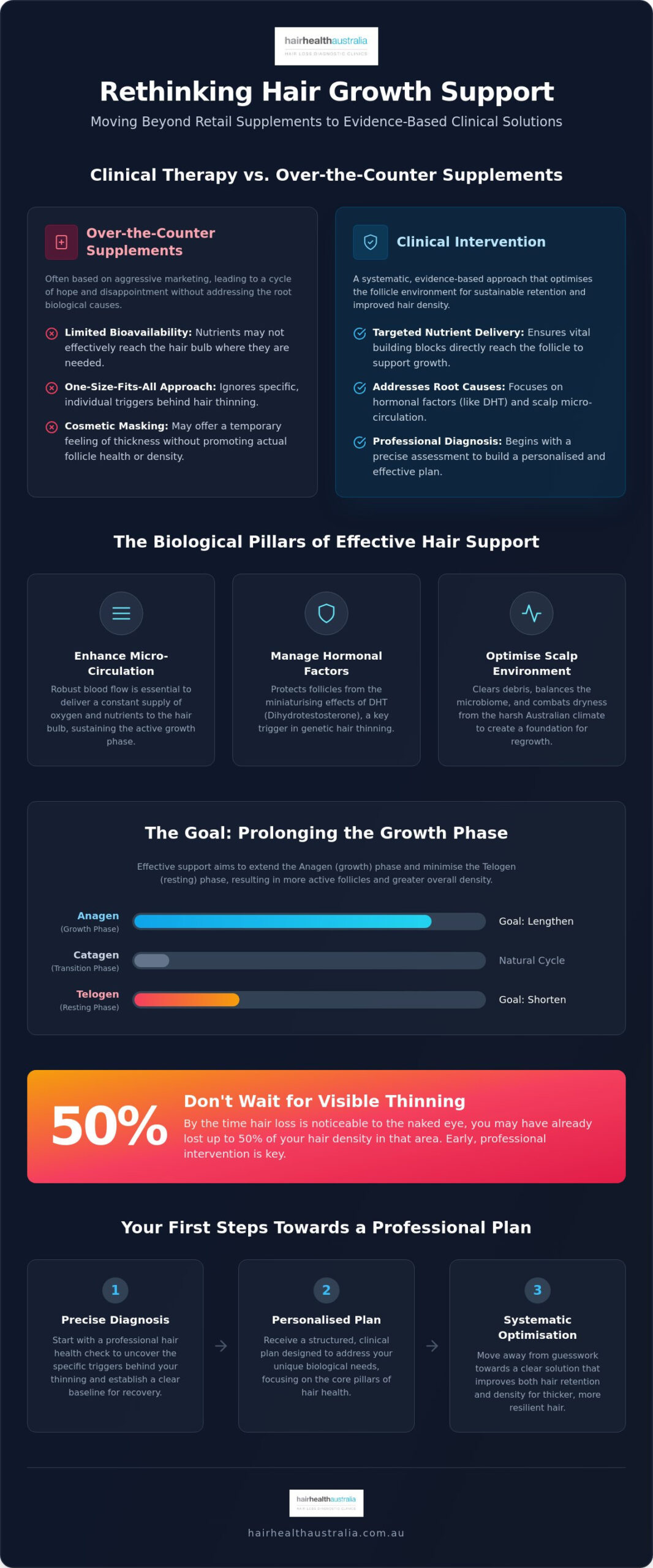
Understanding the hair growth cycle is essential here. Your hair moves through the Anagen (growth), Catagen (transition), and Telogen (resting) phases. Effective support aims to prolong the Anagen phase while minimising the time follicles spend in the Telogen phase. This ensures more hairs are growing at any given time, which naturally leads to a fuller, more resilient appearance.
Who Benefits Most from Professional Support?
Many Australians fall into the “wait and see” trap. They notice a few extra strands in the shower or a slightly wider part and assume it will resolve itself. Unfortunately, by the time thinning is visible to the naked eye, you may have already lost up to 50% of your hair density in that area. Professional support is most beneficial for those noticing early signs of miniaturisation, where hair strands become finer and less pigmented over time.
If your scalp is becoming more visible under bright lights or your ponytail feels thinner, it’s time to move beyond retail supplements. Identifying the specific triggers behind your thinning is the only way to build an effective response. You can begin this process with a professional hair health check to establish a clear baseline for your recovery.
The Biological Pillars of Effective Hair Support
To understand how hair growth support actually functions, we must look beneath the surface at the follicle’s metabolic requirements. The hair follicle is one of the most active structures in the human body. It demands a constant, high-volume supply of oxygen and nutrients to sustain the growth phase. This is why micro-circulation is the first essential pillar of success. Without robust blood flow to the scalp, the vital building blocks of hair remain stranded in the bloodstream rather than reaching the hair bulb where they are needed most.
Hormonal factors also play a decisive role in the thinning process. Dihydrotestosterone, or DHT, is a byproduct of testosterone that can bind to receptors in the scalp follicles. In those with a genetic predisposition, this binding triggers a process that eventually shuts down the follicle’s ability to produce healthy hair. Clinical support must address this hormonal interference to be effective. It is not enough to simply provide nutrients; we must also protect the follicle from the internal stressors that cause it to fail.
Our local environment further complicates this biological balance. The harsh Australian climate, characterised by intense UV radiation and low humidity, can rapidly deplete scalp hydration. A dry, inflamed scalp becomes constricted, which further limits the efficacy of nutrient delivery. Creating a stable, hydrated scalp environment is a fundamental step in any professional restoration programme. It ensures the “soil” is healthy enough to support the “seed.”
Follicle Health: The Engine Room of Growth
In cases of pattern thinning, follicles don’t vanish overnight. Instead, they undergo miniaturisation. Each growth cycle produces a hair that is shorter, finer, and less pigmented than the last. Clinical interventions focus on hair follicle regeneration to interrupt this decline. By reawakening these dormant structures through targeted stimulation, it’s possible to reverse the miniaturisation process. This success is deeply dependent on maintaining optimal scalp health for hair loss prevention, ensuring the follicle’s “engine room” has the right conditions to restart.
Nutrient Synergy: Beyond Biotin
While many over-the-counter products rely solely on Biotin, significant regrowth requires a complex synergy of elements. Amino acids provide the structural foundation for keratin, while Iron and Zinc are critical for cellular repair and protein synthesis. True hair growth support requires these nutrients to be present in the correct ratios and delivered with high bioavailability. If you’re concerned about your current hair density, a professional hair health check can identify exactly which biological pillars need reinforcing in your specific case.
Clinical Therapy vs. Over-the-Counter Supplements
Walk into any Australian chemist and you’ll find shelves lined with “miracle” hair gummies and tablets. While these products are easy to buy, they often lack the potency required for genuine hair growth support. The primary hurdle is bioavailability. When you ingest a supplement, it must survive the acidic environment of the stomach and the metabolic processing of the liver before it ever reaches the tiny capillaries feeding your hair follicles. By the time those nutrients arrive at the scalp, the concentration is often too low to trigger significant change.
Clinical programmes take a different approach by delivering active ingredients directly to the source of the problem. Various Hair loss treatments exist, but their efficacy depends entirely on the underlying cause of the shedding. For genetic thinning, a daily vitamin simply cannot compete with clinical-grade topical therapies and stimulation techniques. These professional methods bypass the digestive “tax,” ensuring the hair bulb receives the exact biological support it needs to stay in the growth phase for longer.
Consider the cost-to-benefit ratio over the long term. You might spend $50 a month on retail vitamins for five years, only to see your hair density continue to decline. That is an investment in disappointment. Professional care may involve a higher initial commitment, but it targets the actual mechanisms of hair loss. Results are measured in visible density and follicle health, rather than just hopeful marketing claims.
When Supplements Are Enough (And When They Aren’t)
Basic nutrient support can be useful for temporary thinning, such as Telogen Effluvium caused by a sudden illness or acute stress. In these cases, the follicle just needs a temporary boost to return to its normal cycle. However, Male and Female Pattern Thinning is a progressive, permanent condition. It is driven by genetics and hormones, not just a vitamin deficiency. If you are dealing with this type of loss, you will likely need to explore the hair regrowth treatment Australia offers through specialised clinics to see real results.
The Role of Professional Diagnostics
Guessing is expensive. Many people waste years switching between different over-the-counter brands without ever knowing why their hair is falling out. Professional diagnostics use microscopic analysis to see what is happening beneath the surface of the scalp. This allows us to identify follicle miniaturisation or scalp inflammation before it becomes irreversible. We recommend you book a Hair Health Check to establish an accurate baseline. Having a clear diagnostic map is the only way to ensure your hair growth support plan is actually working for your specific biology.
Designing Your Personalised Hair Growth Support Routine
Sustainable results require a methodical framework rather than a scattered collection of retail products. A clinical hair growth support routine is not a static list; it is a dynamic process that must evolve alongside your biological progress. To move beyond temporary fixes, you need a strategy that addresses both the internal and external factors affecting your follicles. This structured approach ensures every action you take contributes directly to restoring hair density.
Your professional regrowth journey follows five systematic stages:
- Step 1: Professional Diagnosis. This identifies the specific triggers of your loss, allowing for a targeted rather than a generic approach.
- Step 2: Scalp Optimisation. We focus on clearing debris and balancing the microbiome to create a receptive environment for clinical topicals.
- Step 3: Targeted Stimulation. High-grade stimulants are introduced to re-energise miniaturising follicles and prolong the growth phase.
- Step 4: Systematic Support. Bioavailable nutrients are integrated to provide the essential raw materials for keratin production.
- Step 5: Ongoing Monitoring. Regular clinical reviews ensure the plan is adjusted as your hair health improves and your needs change.
Daily Habits that Support Clinical Results
Gentle cleansing is non-negotiable. Harsh sulphates found in many standard shampoos can strip the scalp of its natural oils, leading to inflammation that hinders growth. In the intense Australian sun, UV protection is equally vital. Just as you protect your skin, thinning areas of the scalp require shade or specialised barriers to prevent oxidative stress from damaging the hair bulb. Understanding how to improve hair density through these daily lifestyle adjustments ensures your clinical treatments aren’t fighting an uphill battle against environmental damage.
Avoiding the ‘Growth Support’ Scams
The hair restoration industry is unfortunately filled with “miracle” cures that lack scientific backing. Be wary of any product that promises total regrowth in weeks or uses “one size fits all” kits. These generic solutions rarely account for the complex biological factors discussed earlier. A straight-talking clinical approach values transparency over hype. It focuses on realistic timelines and evidence-based protocols that have been verified through professional diagnostics. If you are ready to stop the guesswork, you can book a comprehensive Hair Health Check today to build a hair growth support routine that actually works for your biology.
Professional Hair Growth Support at Hair Health Australia
At Hair Health Australia, we’ve refined the process of delivering clinical hair growth support through a range of specialised programmes. Our approach is designed for both men and women who want to address thinning without resorting to invasive measures. We don’t believe in generic, one-size-fits-all solutions. Instead, we focus on evidence-based methods that are tailored to your unique scalp biology. This ensures that every treatment stage is purposeful and grounded in your specific diagnostic data.
Our Sydney clinic provides a supportive, expert-led environment where your concerns are met with medical authority and empathetic understanding. We’re committed to transparency. This means we provide realistic expectations based on your specific diagnostic results rather than hyperbolic marketing promises. You’ll feel like you’re consulting with a trusted specialist who is dedicated to your long-term hair health and confidence. We prioritise honesty in every consultation, ensuring you understand the “why” behind every step of your restoration plan.
Our Non-Surgical Advantage
Many people assume that surgery is the only answer for significant hair loss. However, non-surgical clinical programmes offer a distinct advantage for those wanting to avoid the downtime, high costs, and potential scarring associated with invasive transplant procedures. We focus on restoring density by revitalising your existing follicles and optimising the scalp environment. This approach allows for a gradual, natural-looking improvement that doesn’t require time away from work or social activities.
We use modern diagnostic technology to track your progress at a microscopic level. This ensures we aren’t just guessing but are actively monitoring the restoration of your hair density. By focusing on the health of existing follicles, we help you achieve a more resilient head of hair through systematic, non-invasive care. Our focus is on biological resilience and the long-term longevity of your hair, moving beyond the superficial fixes offered by retail products.
Start Your Journey in Sydney Today
Taking the first step toward addressing hair loss can feel daunting, but you don’t have to navigate it alone. Our specialist team is here to act as your dedicated guide, replacing uncertainty with a clear, actionable path forward. We provide a steady and composed presence throughout your journey, ensuring you feel fully informed at every stage. Whether you’ve just noticed the first signs of thinning or have been struggling with hair loss for years, we offer a professional environment where your results are our primary focus.
Don’t let the fear of permanent loss dictate your future. By choosing a clinically-backed hair growth support programme, you are investing in a proven methodology that values precision and results above all else. Our straight-talking approach builds trust and ensures you are empowered with the knowledge to maintain your hair for years to come. We invite you to book your Hair Health Check at our Sydney clinic today and discover the difference that professional, personalised care can make.
Restore Your Hair Density with Clinical Precision
Achieving sustainable results requires moving beyond retail promises and embracing a systematic approach to follicle health. We’ve examined how genuine hair growth support relies on a synergy of scalp health, hormonal management, and targeted nutrient delivery. By replacing guesswork with evidence-based protocols, you can address the root causes of thinning rather than just masking the symptoms. Professional diagnostics ensure that your recovery plan is as unique as your biology.
Our expert Sydney-based team brings over 15 years of experience to every consultation, providing a steady and knowledgeable guide for your restoration journey. We utilise clinically-backed microscopic diagnostic technology to establish an accurate baseline and monitor your progress with complete transparency. Our specialised non-surgical regrowth programmes are designed to restore density and resilience without the complications of invasive surgery. It’s time to regain control over your hair health with a plan that prioritises science and long-term results.
Book Your Comprehensive Hair Health Check in Sydney today to take the first step toward a fuller, more confident future. We look forward to helping you achieve the hair density you deserve.
Frequently Asked Questions
How long does it take for hair growth support to show results?
Visible results typically manifest within a three to six month window. This timeframe aligns with the natural hair growth cycle, as follicles require several months to transition from the resting phase back into the active growth phase. While initial improvements in scalp health occur sooner, significant increases in hair density take time to become apparent to the naked eye.
Can I use hair growth support products if I have a sensitive scalp?
Yes, clinical-grade hair growth support is specifically formulated to be non-irritating and free from the harsh surfactants often found in retail shampoos. Our programmes prioritise scalp health, utilising gentle yet effective active ingredients that support the follicle without causing inflammation. A professional assessment ensures your regimen is tailored to your specific skin sensitivities.
Is hair growth support effective for men with receding hairlines?
Frontal thinning and receding hairlines can be effectively managed using targeted clinical options. While the hairline is often the most resistant area to treatment, systematic stimulation and hormonal management help stabilise the area and revitalise viable follicles. Early intervention is the most effective way to maintain the frontal boundary and prevent further recession.
Do I need a prescription for professional hair growth support in Australia?
You don’t always require a prescription to access professional hair growth support programmes. While certain pharmaceutical medications are restricted, many of our high-grade topical treatments and clinical stimulation therapies are available through specialised clinics. We focus on a holistic, non-surgical approach that combines multiple modalities to achieve results without the need for traditional pharmacy scripts.
Will my hair fall out again if I stop using growth support?
If you are managing a progressive condition like pattern thinning, stopping treatment will eventually allow the hair to return to its previous state of decline. Clinical management for genetic hair loss is an ongoing process of follicle protection. However, for temporary conditions such as stress-related thinning, you may not need long-term support once the follicles have successfully returned to their normal cycle.
Can stress-related hair loss be fixed with support programmes?
Telogen Effluvium, which is the clinical term for stress-related thinning, responds exceptionally well to structured support. These cases involve a large percentage of follicles entering the resting phase prematurely due to a physiological shock. Professional intervention helps shift these follicles back into the growth phase more efficiently, significantly shortening the overall recovery timeline.
What is the best way to support hair growth after pregnancy?
Postpartum thinning requires a gentle, female-specific approach that focuses on nutrient replenishment and scalp stabilisation. This type of loss is triggered by a rapid shift in hormone levels after birth, which can cause significant shedding. We offer non-invasive clinical options that are safe and effective for restoring hair density and resilience during the recovery period.
How does a ‘Hair Health Check’ differ from a normal hairdresser’s advice?
A Hair Health Check utilises advanced microscopic scanning to analyse the scalp at a diagnostic depth that a standard salon visit cannot provide. While a hairdresser focuses on the aesthetic of the hair shaft, we examine follicle miniaturisation, scalp inflammation, and the health of the hair bulb. This scientific data allows us to identify the specific cause of your loss and build a precise, results-driven plan.