Preparing for Your First Trichologist Appointment: What to Know

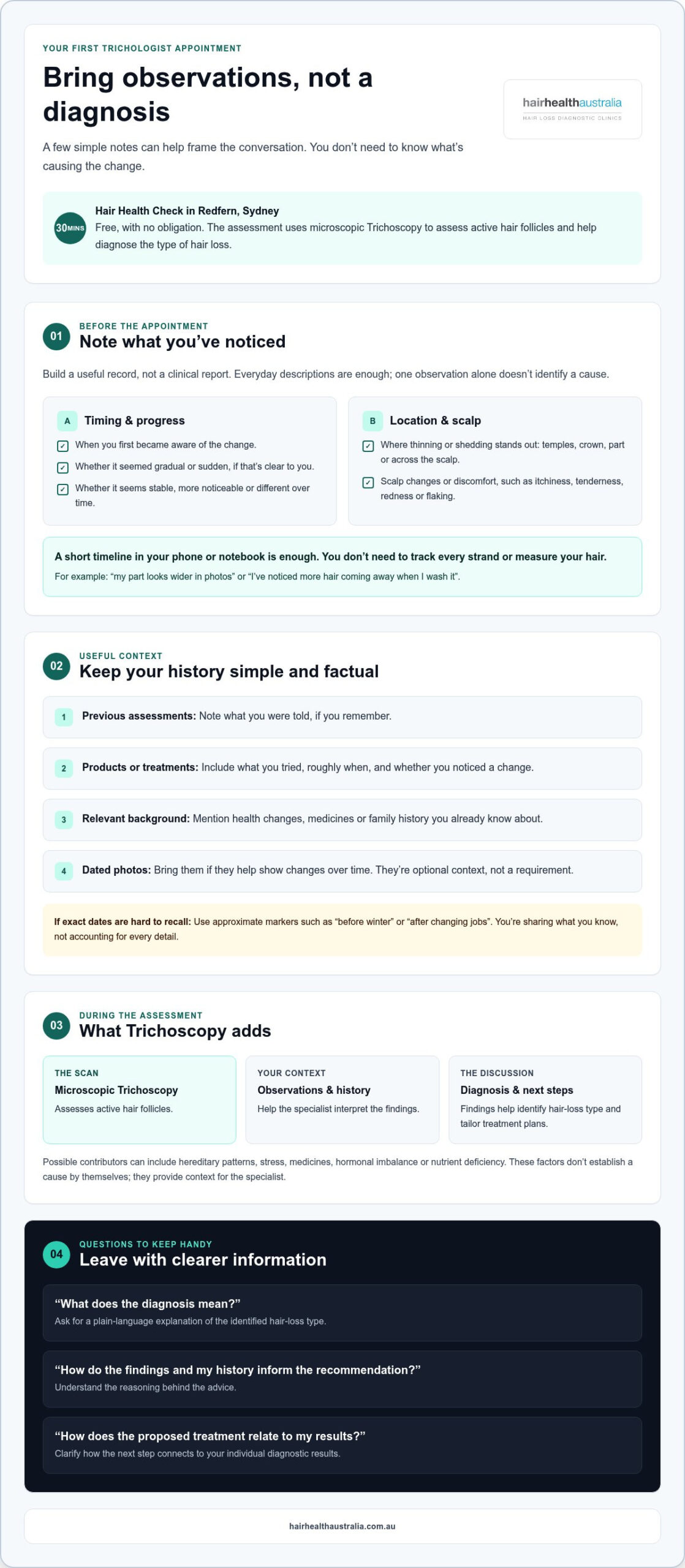
You don’t need to arrive with all the answers, just useful observations. Preparing for your first trichologist appointment can feel daunting when you’re unsure which changes matter or what the assessment involves. You don’t need to diagnose the cause yourself. Notes about when thinning or shedding began, where you’ve noticed it and any changes in your hair or scalp can make the conversation more useful.

A clinical assessment can add detail that memory and a quick glance in the mirror may miss. At Hair Health Australia’s Hair Health Check in Redfern, Sydney, a microscopic Trichoscopy scan assesses active hair follicles and helps diagnose the type of hair loss. The check is free, with no obligation, and takes ONLY 30 MINS. Specialists explain the findings and tailor treatment plans to your individual diagnostic results.

This guide covers what to note before your appointment, what to expect during an assessment and questions that can help you understand your next steps. You’ll be better prepared to discuss your concerns and leave with clearer information about your options.

Key Takeaways

  • When preparing for your first trichologist appointment, note when changes began and what you’ve observed, without trying to diagnose the cause yourself.
  • Microscopic Trichoscopy assesses active hair follicles and helps identify the type of hair loss.
  • Use the assessment to understand the diagnosis, the reasoning behind recommendations and how proposed next steps relate to your results.
  • A simple checklist of your hair-change timeline, relevant history and questions can help you feel organised. Records and product details are useful context, not requirements.
  • Hair Health Australia’s Sydney Hair Health Check is free, with no obligation, and takes ONLY 30 MINS.

Preparing for your first trichologist appointment: start with what you have noticed

Noticing more hair in your brush, a wider-looking part or a change in your hairline can feel unsettling. You don’t need to arrive with a theory about why it’s happening. Start by describing what you’ve observed, when it began and whether it has changed. These details help frame the conversation without turning your notes into a self-diagnosis.

Hair changes can involve shedding, density, the hairline or the condition of your scalp. One observation alone doesn’t identify a cause, and patterns vary between people. If you’re curious about the field, What is Trichology? offers background on its focus on hair and scalp health. For your appointment, everyday descriptions are enough: “my part looks wider in photos” or “I’ve noticed more hair coming away when I wash it”.

What changes should you write down before the appointment?

Jot down a few observations while they’re fresh. You’re building a useful record, not preparing a clinical report. Include what you’ve noticed, even if you’re unsure whether it’s relevant. The assessment can help put those details into context.

  • Timing: Note when you first became aware of the change. Describe it as gradual or sudden if that’s clear to you.
  • Location: Record where thinning or shedding stands out, such as around the temples, crown, part or across the scalp.
  • Scalp observations: Mention visible changes or discomfort, such as itchiness, tenderness, redness or flaking. Describe what you experience rather than trying to label a condition.
  • Progress: Note whether the change seems stable, more noticeable or different in certain areas over time.

A dated record can make a first assessment more focused by showing when changes began and how they developed, rather than relying on memory alone. A short timeline in your phone or notebook is enough. You don’t need to track every strand or measure your hair.

How can you describe your hair-loss history clearly?

When preparing for your first trichologist appointment, keep your history simple and factual. A few dates or brief notes can help organise what you remember, especially if changes have happened over an extended period.

  • List any previous assessments and what you were told, if you remember.
  • Note products or treatments you’ve tried, roughly when you used them and whether you noticed a change.
  • Include relevant health changes, medicines or family history that you already know about.
  • Bring dated photos if they help show changes over time. They’re optional context, not a requirement.

If you can’t recall exact dates, use approximate markers such as “before winter” or “after changing jobs”. The aim is to share what you know, not account for every detail. Your notes give the specialist a clearer starting picture, while the assessment helps interpret the pattern and guide a discussion about next steps.

What happens at a first trichologist appointment and what can it clarify?

A first appointment is an opportunity to move from noticing a change to understanding what type of hair loss may be involved. At Hair Health Australia’s Hair Health Check, microscopic Trichoscopy is used as part of the assessment. This scan assesses active hair follicles and helps diagnose hair-loss type. Your observations and history add context, and the findings inform a discussion about suitable next steps.

What can a microscopic Trichoscopy scan show?

The Trichoscopy scan assesses active hair follicles. It forms part of the Hair Health Check’s full clinical diagnosis of hair-loss type. The scan gives the specialist follicle information to consider alongside what you’ve noticed about density or shedding.

During Hair Health Australia’s Hair Health Check, microscopic Trichoscopy assesses active hair follicles and helps diagnose the type of hair loss.

Thinning or shedding can look similar to you while having different explanations. A scan adds a closer view to the clinical assessment, within its scope of assessing active follicles and helping identify hair-loss type. The findings are used to tailor treatment plans, rather than assuming the same approach suits everyone.

Why does the appointment focus on your individual history?

Scan findings are considered alongside your personal history. Possible contributors to hair changes include hereditary patterns, stress, medicines, hormonal imbalance or nutrient deficiency. These factors don’t establish a cause by themselves, and a timeline or family history can’t prove what is happening. They do give the specialist useful context for interpreting the findings and discussing your situation without relying on a general assumption.

Preparing for your first trichologist appointment can also help you make the most of the explanation. Share relevant details you already know, then ask how they relate to the diagnosed hair-loss type. Specialists explain the diagnosis and educate clients about how recommended treatment works. Treatment plans are tailored to individual diagnostic results.

  • Ask what the diagnosis means: Request a plain-language explanation of the identified hair-loss type.
  • Understand the reasoning: Ask how the scan findings and your history inform the recommendation.
  • Clarify the next step: Make sure you understand how a proposed treatment is intended to work for your individual results.

Clear answers can replace some uncertainty with a more grounded understanding. If you’re looking for a Sydney assessment that uses microscopic Trichoscopy, the Hair Health Check provides a focused way to discuss your findings and individual next steps.

How to assess appointment advice: diagnosis, explanation and next steps

A useful appointment should leave you clearer about what was assessed, what the findings mean and how any recommendation relates to your situation. A product suggestion on its own doesn’t explain the type of hair loss or why an option may suit you. Hair Health Australia’s Hair Health Check uses microscopic Trichoscopy to assess active follicles and support a clinical diagnosis of hair-loss type. The value is in connecting the assessment to an understandable explanation and an individual next step.

Use this simple comparison to organise what you hear during the discussion:

Stage What to understand
Observation What changes you’ve noticed and what the assessment examines.
Diagnosis The hair-loss type identified through the clinical assessment.
Explanation How the findings relate to your individual situation and the reasoning behind the advice.
Proposed next step What treatment or follow-up is recommended, and how it connects to the diagnosis.

What makes an explanation useful and specific?

A clear explanation names the diagnosed hair-loss type and describes the relevant assessment findings in plain language. If a recommendation is made, ask how it follows from those findings rather than accepting a product suggestion without context. You can also ask what the proposed treatment is intended to address, how it relates to your results and what follow-up involves.

You don’t need technical terms to get a clear explanation. Straightforward questions can help you understand the decision-making:

  • What hair-loss type did the assessment identify?
  • Which findings informed that conclusion?
  • How does the recommendation relate to my results?
  • What should I understand about the recommended next steps?

If an answer isn’t clear, ask for it to be explained another way. Understanding the reasoning matters as much as hearing a recommendation.

How should you think about a recommended treatment plan?

A treatment plan should make sense in light of your diagnosis, rather than feel like a one-size-fits-all prescription. Hair Health Australia customises hair regrowth treatment plans for men and women based on diagnostic results, with specialist follow-up. Preparing for your first trichologist appointment includes thinking about what you need to understand before deciding on next steps.

Ask how the proposed plan connects to your assessed hair-loss type, what each recommendation is intended to do and how progress or follow-up will be discussed. Treatment plans are individual, so ask how the recommendation relates to your results. If you’d like to understand how assessment informs tailored recommendations, explore the Hair Health Check.
Preparing for Your First Trichologist Appointment: What to Know

A practical checklist for the day of your first trichologist appointment

Preparing for your first trichologist appointment doesn’t require a folder of paperwork or a perfect account of every hair change. A short, organised summary can help you explain what’s been happening and follow the discussion. Bring what you already have, and treat records and product details as helpful context, not requirements.

Hair Health Australia’s microscopic hair assessment uses Trichoscopy to assess active hair follicles and help diagnose hair-loss type. Use the checklist below to gather information that may put your individual findings in context.

What information is useful to bring along?

Keep your notes brief and easy to refer to. Include details you can readily share instead of spending time trying to reconstruct information you don’t remember.

  • A timeline: When you first noticed a change, whether it seemed gradual or sudden, and what has changed since.
  • Your observations: Where you’ve noticed thinning or shedding, along with any scalp changes or discomfort.
  • Relevant history: Health changes, medicines or family history you already know about and think may be relevant.
  • Previous hair-loss products or treatments: What you tried and any changes you noticed. Product names or packaging details can help if they’re readily available.
  • Existing records: Previous assessment results, health records or dated photos, if they help explain your history. These are optional, not a requirement.

Before you leave, follow any appointment-specific instructions you’ve received. Don’t assume there are standard washing or styling rules. Use the guidance provided for your appointment.

Which questions can help you leave with clarity?

Write down a few questions in advance so you can return to them during the conversation. You can also note the answers in your own words, making it easier to reflect on the information afterwards.

  • What type of hair loss was identified?
  • What does the scan show, and which findings support the explanation?
  • How is a recommended treatment intended to work, and what happens next?

If a treatment is discussed, ask how its suitability relates to your results and what specialist follow-up involves. The aim is to understand the recommendation and the reasoning behind it, not to leave with a one-size-fits-all answer. It’s reasonable to ask for a plain-language explanation or to clarify a point you’re unsure about.

With your notes and questions ready, you can focus on understanding the assessment rather than trying to recall every detail on the spot. Hair Health Australia’s Hair Health Check is free, with no obligation, and takes ONLY 30 MINS.

Your next step in Sydney: Hair Health Australia’s free Hair Health Check

If you’re ready to move from personal observations to a clearer clinical assessment, Hair Health Australia’s Hair Health Check offers a straightforward next step in Sydney. The check is free, with no obligation, and takes ONLY 30 MINS. It’s an opportunity to have your hair assessed and understand what the findings may mean for your individual situation, without needing to arrive with a diagnosis or treatment decision already made.

What is included in the Hair Health Check?

The Hair Health Check includes a microscopic Trichoscopy scan and a full clinical diagnosis of hair-loss type. Trichoscopy assesses active hair follicles and helps identify the type of hair loss. It adds information to the clinical assessment beyond what you may have noticed in the mirror or remember over time.

The scan assesses active hair follicles and helps diagnose hair-loss type. Specialists explain the diagnosis and provide education about the findings. This gives you a clearer basis for discussing what may be appropriate next, with the conversation focused on your results rather than a general recommendation.

The diagnosis clarifies the type of hair loss identified and provides a starting point for considering individual options. Any treatment plan is tailored to your diagnostic results, so recommendations are connected to your assessment rather than assumed in advance.

How can you take the next step in Sydney?

The clinic is located in Redfern, Sydney. If you’ve been preparing for your first trichologist appointment, bring the timeline and questions you’ve gathered to help guide the discussion. You don’t need every detail or record. The aim is to get a clearer understanding of your hair-loss type and the information behind your next steps.

During the check, specialists explain the diagnosis and tailor treatment plans to individual results. Ask how any recommendation relates to the assessment, what it is intended to address and what follow-up support involves. Take the time to understand the explanation before deciding what feels right for you. The check has no obligation, so you can get information without committing to a treatment plan.

Hair Health Australia’s free Hair Health Check uses microscopic Trichoscopy to assess active follicles and help diagnose hair-loss type. It takes ONLY 30 MINS.

Take the next step with a clearer perspective

Preparing for your first trichologist appointment is about giving yourself a better starting point for understanding what’s happening. You don’t need to have every answer before you go. A few notes can give you a clearer basis for asking questions, considering your options and deciding what feels appropriate for you.

If you’re ready to take that step, Hair Health Australia’s Hair Health Check is available in Redfern, Sydney. The free, no-obligation check takes ONLY 30 MINS and uses a microscopic Trichoscopy scan to assess active hair follicles and help diagnose hair-loss type. Specialists explain the findings and tailor treatment plans to individual results, so you can consider your next step with a clearer understanding.

Book your free Hair Health Check or call 1800 908 898 or (02) 93190051 to arrange an assessment in Redfern, Sydney.

Frequently Asked Questions

Is a trichologist appointment worth it if I have only just noticed thinning?

An assessment can be worthwhile even if thinning has only just become noticeable. Preparing for your first trichologist appointment can help you describe the change clearly, while an individual assessment may clarify the hair-loss type instead of leaving you to rely on a guess. Hair Health Australia’s Sydney Hair Health Check uses microscopic Trichoscopy to assess active follicles and provide a full clinical diagnosis. It’s free, with no obligation, and takes ONLY 30 MINS.

What should I bring to my first trichologist appointment?

A short written timeline is a useful starting point. Note when you noticed a change, where it appears and whether it seems different now. You can add relevant health history, medicines, previous hair-loss products or treatments, and any changes you noticed. Existing dated photos or records may help explain your experience, but you don’t need to create a complete file. Follow any appointment-specific instructions you’ve received.

Should I wash my hair before a trichologist appointment?

Follow any appointment-specific instructions you’ve received rather than assuming you need to wash or style your hair a particular way. Preparation advice can differ between clinics, so instructions from another appointment may not apply here. If you haven’t received specific guidance, you can still prepare by noting your hair changes and questions. Hair Health Australia’s check uses microscopic Trichoscopy to assess active hair follicles and help diagnose hair-loss type.

What happens during Hair Health Australia’s Hair Health Check?

The check includes a microscopic Trichoscopy scan and a full clinical diagnosis of hair-loss type. The scan assesses active hair follicles, and specialists explain the findings and how a recommended treatment works. The Hair Health Check is free, with no obligation, and takes ONLY 30 MINS. Hair Health Australia’s clinic is in Redfern, Sydney, making it a local option for an individual assessment.

Is Hair Health Australia’s Hair Health Check free?

Yes. Hair Health Australia’s Hair Health Check is free, with no obligation. It includes a microscopic Trichoscopy scan to assess active hair follicles and a full clinical diagnosis of hair-loss type, and takes ONLY 30 MINS. If treatment is discussed, plans are tailored to individual diagnostic results. The check helps you understand your assessment and doesn’t require you to commit to a treatment plan.

What questions should I ask at my first trichologist appointment?

Ask what hair-loss type the assessment identified, which findings informed that diagnosis and how a recommended treatment is intended to work. You might also ask what specialist follow-up and education are part of your individual plan. Writing questions down beforehand can help you stay focused, and noting the answers in your own words gives you something to reflect on later. Aim to leave understanding the reasoning behind your next steps.
Hair Loss Consultation Near Me: What to Expect from a Clinical Assessment in Sydney

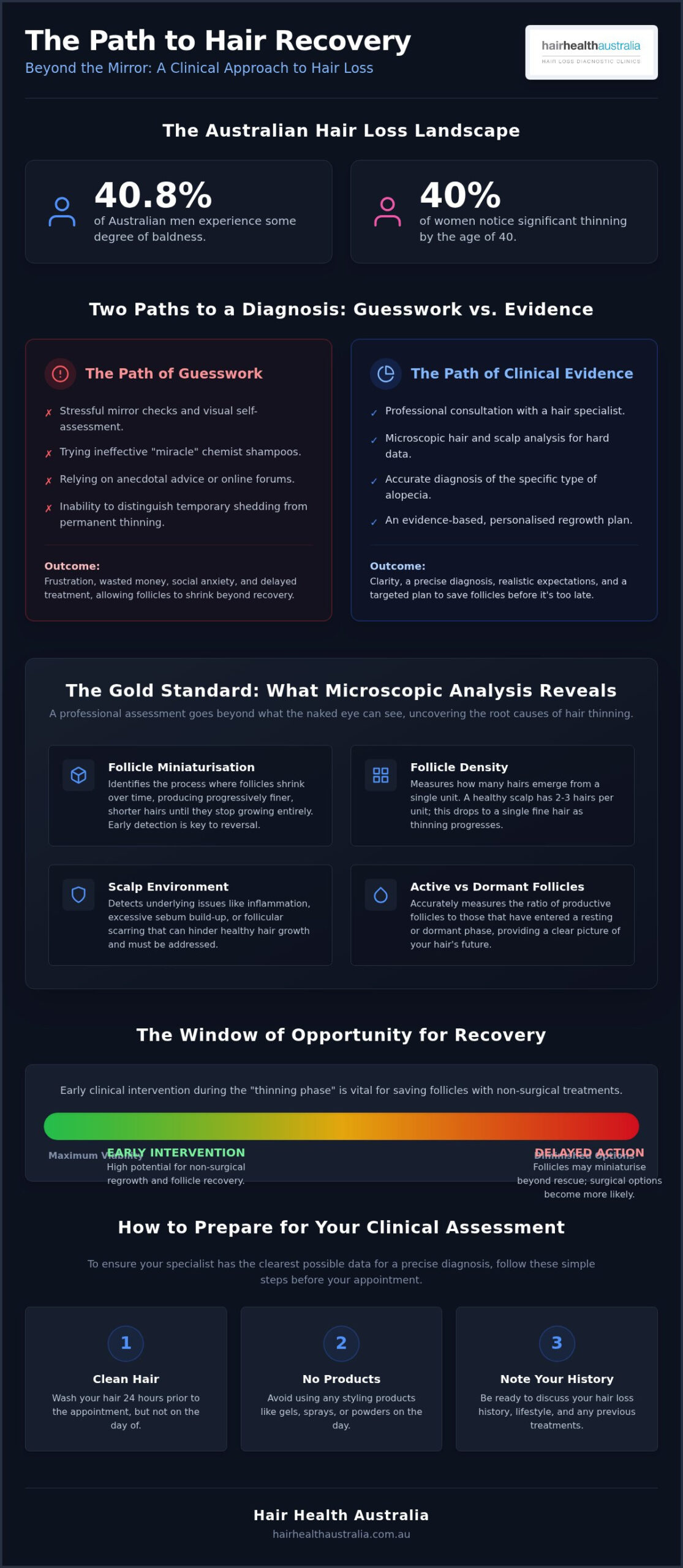
Approximately 40.8% of Australian men experience some degree of baldness, while 40% of women notice significant thinning by the age of 40. If you’ve spent hours searching for a hair loss consultation near me, you likely feel the weight of these statistics alongside the frustration of conflicting online advice. It’s exhausting to waste money on “miracle” chemist shampoos that deliver nothing, especially when social anxiety regarding your thinning hair starts to impact your daily life.

You deserve a path forward rooted in science rather than guesswork. We promise to show you exactly how a professional clinical assessment works and how a precise diagnosis can save your follicles before it’s too late. We’ll explore the role of microscopic hair analysis and explain how a personalised, non-surgical regrowth plan provides the clarity you need to move forward with absolute confidence.

Key Takeaways

  • Identify the critical differences between temporary hair shedding and permanent genetic thinning that a standard mirror check cannot reveal.
  • Understand how a professional hair loss consultation near me utilises microscopic hair analysis to accurately measure active versus dormant follicles.
  • Discover the “window of opportunity” for non-surgical recovery and why early clinical intervention is vital for saving your follicles.
  • Learn exactly how to prepare for your Sydney clinical assessment to ensure your specialist has the data needed for a precise diagnosis.
  • Recognise why a straight-talking, evidence-based approach is essential for establishing realistic expectations and a personalised regrowth plan.

The Importance of a Professional Hair Loss Consultation: Beyond a Visual Check

Looking in the bathroom mirror every morning to check your hairline is a stressful ritual that rarely provides objective answers. While a trusted hairstylist might notice your hair feels thinner, they cannot assess what is happening beneath the scalp’s surface. Hair loss, also known as alopecia, is a complex biological process that requires a scientific lens to understand. Relying on visual guesswork often leads to delayed treatment, allowing follicles to miniaturise beyond the point of rescue. When you book a hair loss consultation near me, you move past anecdotal observations and into the territory of clinical evidence.

A professional assessment is essential for distinguishing between temporary shedding, known as telogen effluvium, and permanent genetic thinning. Telogen effluvium is often triggered by stress or illness and may resolve on its own. In contrast, androgenic alopecia is progressive and requires targeted intervention to halt. Identifying these differences early during the “thinning phase” is the most effective way to maintain your natural hair and avoid invasive surgical procedures in the future.

Why Your GP Might Miss the Finer Details

Most people start their journey at a local medical centre. While general practitioners are excellent for overall health, they often lack the specialised microscopic equipment required for a detailed hair analysis. A standard blood test can rule out iron deficiencies or thyroid issues, but it rarely explains the hormonal sensitivities that drive pattern baldness. Seeking a hair loss consultation near me at a dedicated clinic provides a targeted environment where the focus is solely on follicle health and scalp pathology.

The Clinical Difference: Diagnosis vs. Guesswork

Choosing a professional Hair Health Check replaces uncertainty with a structured roadmap. Clinical diagnostics involve more than just looking at patches of loss; they involve identifying the specific stage of the hair growth cycle your follicles are currently in. This precision allows a specialist to identify rare forms of alopecia that might otherwise go unnoticed. Most importantly, a clinical diagnosis sets realistic expectations. We provide a “straight-talking” assessment of what can be achieved with non-surgical treatments, ensuring you don’t waste time or money on protocols that aren’t suited to your specific condition.

The psychological relief of having a clear plan cannot be overstated. Moving from a state of constant worry to a managed clinical program restores a sense of control. You stop being a passive observer of your thinning hair and become an active participant in your recovery journey.

Advanced Diagnostics: Why Microscopic Hair Analysis is the Gold Standard

Most people think they know their scalp, but the naked eye only tells half the story. When you search for a hair loss consultation near me, you aren’t just looking for a conversation; you’re looking for clinical data. Microscopic hair analysis is the cornerstone of this data-driven approach. It allows us to distinguish between healthy growth and the early signs of miniaturisation. Miniaturisation is the biological process where follicles gradually shrink, producing hairs that are increasingly fine and short until they eventually stop growing altogether. Identifying this process early is the key to successful non-surgical intervention.

Clinical specialists use advanced diagnostic tests for hair loss to determine the exact cause of thinning. This process isn’t just about identifying loss; it’s about assessing the environment in which your hair grows. We look for signs of inflammation, excessive sebum build-up, or follicular scarring that could be hindering your progress. Measuring follicle density is also vital. It tells us how many hairs are emerging from a single follicular unit. In a healthy scalp, you typically see groups of two or three hairs, but as thinning progresses, these units often drop to a single, fine hair. By identifying these issues during your initial hair loss consultation near me, we ensure your recovery plan is built on a healthy foundation.

Visualising Your Hair’s Future

Digital magnification brings your scalp to life on a high-definition screen. You can see your own follicles in real-time, which helps bridge the gap between what you feel and what is actually happening. We also perform a critical check of the “donor area” at the back of the head. Even for those pursuing non-surgical treatments, this area provides a vital baseline for your overall follicle health. Microscopic hair analysis is a non-invasive diagnostic tool that provides immediate, high-resolution insights into scalp pathology.

The Science of Follicle Mapping

We don’t just look; we map. By measuring the ratio of active to dormant follicles, we create a precise baseline for your recovery. This mapping is essential for tailoring a treatment protocol that addresses your specific needs. It allows us to track your progress with mathematical accuracy over months and years. This systematic approach ensures that every step of your journey is backed by evidence rather than guesswork. If you want to see exactly where your hair health stands, you can learn more about our Hair Health Check.

Non-Surgical Recovery vs. Transplants: Finding the Right Path for Your Scalp

Deciding how to address thinning hair often comes down to a choice between clinical management and surgical intervention. When you attend a hair loss consultation near me, the primary goal is to determine if your follicles are still viable for non-invasive recovery. There is a specific “window of opportunity” where clinical programs are most effective. If the hair is merely thinning or the follicle is dormant but alive, non-surgical methods can often revitalise the area. However, if the scalp has become completely smooth or “slick bald,” the follicles may have reached a stage of permanent fibrosis where only a transplant can restore coverage.

The differences in lifestyle impact are significant. Clinical programs allow you to maintain your daily routine without downtime, whereas surgery involves a medical procedure, local anaesthesia, and a recovery period. While a transplant offers a one-time relocation of hair, it does not stop the underlying progression of genetic thinning in the surrounding areas. This is why understanding how dermatologists diagnose hair loss is so important; a proper assessment ensures you aren’t choosing a temporary fix for a progressive condition. Choosing a non-surgical path often represents a more sustainable long-term strategy for those who still have active follicle density.

The Case for Non-Surgical Clinical Programs

Non-invasive treatments focus on the biological environment of the scalp. By blocking Dihydrotestosterone (DHT) naturally and stimulating blood flow to the follicular bulb, these programs aim to reverse the miniaturisation process we discussed earlier. The objective is to keep the hair you have while encouraging dormant follicles to return to the growth phase. This approach is generally more cost-effective over time, as it avoids the high upfront capital investment required for surgical grafts. For a comprehensive look at the latest protocols, refer to our Best Hair Regrowth Treatment Australia 2026 guide.

When is Surgery Actually Necessary?

Surgery is generally reserved for those who have already lost significant hair density where the follicles are no longer present. It is a restorative measure rather than a preventative one. It’s also worth noting that many transplant patients still require non-surgical clinical support to protect their newly grafted hair and prevent further loss of the original hair. If you are weighing up these options, our guide on Hair Replacement vs Surgery provides a detailed breakdown of the long-term commitments involved with each path. Ultimately, your hair loss consultation near me will clarify which stage you are at and which path offers the most realistic chance of success.

Hair Loss Consultation Near Me: What to Expect from a Clinical Assessment in Sydney

Preparing for Your Visit: How to Get the Most from Your Specialist Appointment

A clinical assessment is a collaborative process. While our specialised equipment provides the data, your personal history provides the context. To ensure you get the most out of your hair loss consultation near me, it helps to arrive organised. A clear understanding of your health background allows us to rule out external triggers and focus on the biological root of the issue. We recommend gathering specific details regarding your family history of thinning, your current medication list, and any recent changes to your diet or stress levels. These factors often play a secondary but significant role in how your body responds to treatment.

On the day of your appointment, we ask that you arrive with clean hair that is free from heavy styling products, fibres, or concealers. This is essential because products can coat the hair shaft and scalp, making it difficult for the microscopic lens to capture an accurate reading of your follicle density and scalp health. You don’t need a referral from a GP, but if you have recent blood test results, bringing a copy can be highly beneficial for our specialists.

Your Hair History Checklist

Before you step into the clinic, take a moment to document the timeline of your hair changes. This doesn’t need to be a formal report, but having these details ready ensures nothing is missed during the session:

  • The Timeline: When did you first notice the thinning? Was it a sudden shed or a gradual recession over several years?
  • Lifestyle Stressors: Have you experienced significant illness, surgery, or high-stress events in the last six months?
  • Previous Attempts: List any over-the-counter shampoos, vitamins, or “miracle” cures you’ve tried. Knowing what hasn’t worked is just as important as knowing what might.

Questions for Your Specialist

We encourage a “straight-talking” dialogue. You should leave your session feeling empowered and informed. During your hair loss consultation near me, consider asking the following questions to gain total clarity on your situation:

  • What is the specific, clinical cause of my hair loss?
  • What are the realistic expectations for regrowth or maintenance in my specific case?
  • How will we measure and track our success throughout the programme?

Preparation turns a simple appointment into a comprehensive diagnostic session. By providing us with a complete picture of your hair health journey, you enable us to build a more precise and effective recovery plan. If you are ready to move from uncertainty to action, you can book your Hair Health Check today and begin the process of saving your follicles.

Choosing Hair Health Australia for Your Sydney Hair Restoration Journey

Selecting the right provider for a hair loss consultation near me is a decision that impacts your confidence and your financial investment. At Hair Health Australia, we’ve spent over 15 years specialising exclusively in non-surgical hair loss treatments for men and women. Our Sydney clinic operates on a foundation of clinical precision and “straight-talking” honesty. We believe a consultation should be a diagnostic session rather than a sales pitch. If our microscopic analysis indicates that your follicles are no longer viable for regrowth, we’ll tell you directly. This transparency builds the trust necessary for a successful long-term partnership.

A one-size-fits-all approach rarely succeeds because hair loss is driven by a unique combination of genetics, hormones, and lifestyle factors. We develop personalised regrowth plans that target your specific stage of thinning. By adhering to the latest clinical standards in the Australian market, we ensure our protocols remain at the forefront of non-invasive hair restoration. You aren’t just buying a product; you’re engaging a systematic process designed to preserve and revitalise your natural hair.

Expertise Rooted in Science

Our presence in Sydney since 2009 has allowed us to refine our programs to suit the local community. We understand how the Australian lifestyle, including our harsh climate and outdoor culture, can affect scalp health and treatment adherence. This local expertise is vital for ensuring your plan is practical and effective. If you are still researching your options, our guide on Choosing a Non-Surgical Hair Loss Clinic in Sydney offers a comprehensive checklist to help you make an informed decision.

Your Next Steps to Confidence

The journey doesn’t end when you leave the consultation room. Once we’ve established your clinical roadmap during your hair loss consultation near me, we transition you into a structured regrowth program. Our support system includes regular monitoring sessions where we use follow-up microscopic scans to track your progress. This data-driven approach allows us to adjust your protocol as your hair health improves, ensuring you remain on the most efficient path to recovery. You don’t have to navigate thinning hair alone. Book your professional hair loss consultation at Hair Health Australia today.

Take Control of Your Hair Health Journey

Transitioning from uncertainty to a structured clinical plan is the most significant step you can take for your future confidence. A professional assessment provides a level of precision that visual checks simply cannot match, particularly through the use of high-magnification microscopic analysis. By identifying follicle miniaturisation in its early stages, you can utilise clinically-backed non-surgical methods to protect your hair before permanent loss occurs. This proactive approach is essential for anyone wanting to avoid invasive surgical procedures later in life.

Finding a reputable hair loss consultation near me means choosing a partner dedicated to science-based results rather than marketed cures. Since 2009, our Sydney-owned and operated clinic has focused on delivering personalised microscopic diagnostic scans. This ensures every patient receives a roadmap tailored specifically to their unique scalp pathology and hair growth cycle.

Book your professional Hair Health Check in Sydney today to gain total clarity on your condition. You don’t have to accept thinning as inevitable. With the right expert guidance and a clear clinical path, you can move forward with absolute confidence in your results.

Frequently Asked Questions

Is a hair loss consultation near me covered by Medicare?

Medicare generally does not cover consultations at private hair loss clinics as these services are often categorised as elective or cosmetic. While a visit to a medical dermatologist might attract a rebate if you have a valid GP referral, most specialised clinical assessments are private. It’s best to check with your provider directly when booking to understand their specific billing structure.

How much does a professional hair loss consultation cost in Sydney?

Initial consultation fees in Sydney typically range from a $50 gap fee to $99 depending on the diagnostic technology utilised. Some providers may offer complimentary assessments to determine if you are a suitable candidate for treatment. Because we focus on a detailed clinical approach, we recommend confirming any associated fees before your appointment to ensure total transparency.

Do I need a GP referral to visit a hair loss clinic?

No, you don’t require a GP referral to book a hair loss consultation near me at a private clinical centre. You can book an appointment directly with a specialist to begin your diagnostic process. This direct access allows you to address thinning hair immediately, which is vital for achieving the best possible results from non-surgical treatments.

What is the difference between a trichologist and a dermatologist?

A dermatologist is a medical doctor specialising in conditions of the skin, hair, and nails, often treating medical pathologies. A trichologist is a specialist focused specifically on the biology and health of the hair and scalp. Both professionals provide valuable insights, but a clinical hair specialist often focuses more on non-surgical regrowth protocols and detailed microscopic follicle mapping.

Can a consultation help if I have already lost a lot of hair?

An assessment is highly valuable even if you have experienced significant hair loss. The primary goal is to determine if your follicles are dormant and capable of being revitalised or if they have reached a state of permanent fibrosis. This clinical clarity prevents you from wasting money on treatments that may no longer be viable for your specific condition.

How long does a typical hair loss assessment take?

A comprehensive clinical assessment usually takes between 30 and 45 minutes to complete. This duration ensures there is enough time to review your hair history, perform a high-magnification microscopic scan, and discuss your personalised regrowth options. It’s a methodical process that ensures we build a roadmap based on accurate data rather than guesswork.

Will I get a treatment plan on the same day as my consultation?

Yes, you will typically receive a clear, actionable treatment plan immediately following your diagnostic session. Once the specialist has mapped your follicle density and identified the cause of your thinning, they can outline a specific non-surgical programme. This allows you to move from uncertainty to active recovery on the same day.

Is the microscopic hair analysis painful or invasive?

Microscopic hair analysis is entirely painless and non-invasive. The process involves a specialised digital lens that rests gently on the scalp’s surface to capture high-resolution images of your follicles. There’s no plucking, pulling, or discomfort involved; it’s simply a sophisticated way to visualise your hair’s health in real-time on a digital screen.